Thursday, January 31, 2008

The Globalization of Clinical Trials

Source: Andrew Jack, "New lease on life? The ethics of offshoring clinical trials", The Financial Times, January 28 2008.

Clinical research can be accomplished more quickly in countries with large populations of appropriate subjects, and at lower costs in those countries especially when they have lower costs of personnel and facilities. This article focuses on the risks involved in the change of clinical trials of new pharmaceuticals from Western Europe and the United States to other, less developed regions of the world. It discusses both the risks to the subjects of that research, and to the quality and generalizability of the results.
Clinicaltrials.org, a US website on which all government-funded and many company trials are listed, shows nearly 50,000 under way, of which 10 per cent involve countries outside North America, western Europe and Japan.

The proportion of principal investigators – the lead researchers on a trial – registered with the US Food & Drug Administration (FDA) but based outside the US and western Europe rose from 5 per cent in 1997 to 29 per cent last year. The fastest growth in the past five years has come from India, China, Russia and Argentina.
Comment: I find the volume of clinical trials surprising, but otherwise this article reflects concerns that have been growing over time.

However, I would note that the drugs that are proven efficacious in Europe and the United States are then used all over the world. There is a risk involved for the subjects in clinical trials, and ethically that risk should be shared among all populations that are likely to benefit from the results of the trials. The fact that five percent of the world's population living in the United States are more than than five percent of the subjects of clinical trials might be of concern.

Perhaps an alternative standard for comparison might be the pharmaceutical volume used in different countries; perhaps it would be ethically preferable to draw subjects from countries in proportion to the amounts of drugs that they consume? Expenditures on drugs would not be as good a basis for comparison, unless they could be adjusted for the differences in pharmaceutical prices among countries.
JAD

Wednesday, January 30, 2008

We are going the wrong way on Internet Access!

Steven Levy has a thought provoking article in today's Washington Post (January 30, 2008). It describes an experiment by Time Warner Cable, which sells broadband via its Road Runner service, in Beaumont, Texas. In the experiment, Road Runner will charge Internet users by the number of gigabytes they download.

Levy writes:
There is, however, a net neutrality angle to the Time Warner Cable experiment. As its name implies, this operation's main interest is cable television. An increasingly important component of that business is distributing video on demand. TW's competitors in that arena are Internet companies that intend to do the same thing. The TW plan tilts the field in its own favor. Let's say I want to watch the indie film "Waitress." I may have the choice to order it on my cable box or rent it from iTunes. Each might cost me $3. But if I'm metered, renting it from iTunes might mean that I exceed my monthly limit, perhaps incurring a penalty that's more than renting the movie.

A more profound problem with the metering scheme, however, doesn't involve corporate competition but international competition. In the United States, where the Internet was born, we pay higher prices (seven times what they pay in South Korea) for slower speeds. (Japan's users surf 13 times faster.) Though President Bush promised affordable broadband for all by 2007, tens of millions are still stuck with dial-up.

Fast, cheap, abundant broadband is a fantastic economic accelerator, enabling breakout businesses and kick-starting new industries. Unless we move quickly, these will spring from foreign soil. Instead of testing systems that discourage people from vigorously using our overpriced, underpowered systems, government and industry should be working overtime to figure out how to get faster service for less money and make sure that all users, no matter where they live, have affordable access to the high-speed Net. Maybe then we'll get out of 24th place.
Right on Mr. Levy! Thanks for protecting our interests.

Wynn Complains of Vast Left Wing Conspiracy

The Washington Post tells us today that Al Wynn has filed charges that Donna Edwards, his opponent for the Democratic nomination for the 4th Maryland Congressional District, "has illegally coordinated her campaign efforts with independent organizations that support her -- charges that she immediately rejected as last-minute electioneering by an embattled incumbent."
"There seems to be a vast, dare I say, left-wing conspiracy designed to circumvent campaign finance laws," he said in a conference call with reporters.


The article tells us:
Edwards, who came within three percentage points of defeating the eight-term incumbent in 2006, has the support of progressive organizations that have targeted Wynn because they think he too often votes with Republicans and accepts contributions from corporate interests.

In a statement, Edwards called the complaint "a desperate 11th hour attempt by the Congressman to deflect from the fact that groups representing the core of the Democratic party and the issues it stands for -- worker's rights, affordable housing, protecting women's right to choose, the environment -- have decided that they want to fire him and are supporting me because they know I stand with them and always have."......

Edwards is a member of the board of the League of Conservation Voters, an environmental group that has been sending mail and making calls in support of her. She was also a founding director of They Work For Us, a nonprofit group organized last year to target Democrats whom the group thinks has strayed from the party's core values. They Work For Us recently bought radio ads attacking Wynn......

Leaders of both groups said that Edwards took leaves of absences to run for office and has had no role in shaping their involvement in the race.

"This complaint is a baseless and inaccurate smoke screen to take attention away from Rep. Wynn's record of taking hundreds of thousands of dollars from polluting energy companies and voting for President Bush's energy bill," said Gene Karpinski, president of the League of Conservation Voters.

Steve Rosenthal, president of They Work for Us, said Edwards took a leave from his group Aug. 7 and has had no role since then. He called the complaint "utterly ridiculous."
Comment: Wynn represents one of the most liberal communities in the United States. That community is seeking someone who will provide more leadership in Congress on environmental issues, the protection of democracy in a digital age, and other portions of the liberal agenda. I believe Donna Edwards is that person. I can see why Wynn may feel that all the liberal voters in his liberal district are in a vast conspiracy to defeat him, But that is the way democracy works, JAD

UNESCO and The Universal Declaration of Human Rights

Eleanor Roosevelt with a copy
of the Universal Declaration of
Human Rights


This year the United Nations, and indeed the whole world, are celebrating the 60th anniversary of the Universal Declaration of Human Rights.

The English Bill of Rights was passed in 1689. The French Declaration of the Rights of Man and the Citizen was adopted in 1789. The U.S. Bill of Rights was introduced as ten amendments to the Constitution in 1789 and ratified in 1791. Thus in three countries, political and civil rights were codified by the end of the 18th century. People were seen as having a right to participate in the governance of their nation, and to have natural rights that would be protected against the "divine rights" of kings and the aristocracy.

The social and economic rights of man took longer to recognize. However, with the increasing wealth of Western nations, people began to demand that all people in those nations had the rights to be free from hunger, that they shared with the rich the right to at least a basic education, and to some standard of care during their illness. In the Great Depression, the right to work, to a living wage, and to some form of social security for the young and old became evident, notably to the Government of the United States.

At the end of World War II, the United States was the world's super power militarily, economically, scientifically, culturally, and politically. The U.S. Government, serious in its concern to avoid the mistakes made after World War I, sought to establish with its allies a United Nations that would help to keep the peace. The United Nations would succeed where the League of Nations had failed. As the Bill of Rights was a needed complement to the U.S. Constitution, so the Universal Declaration of Human Rights would be a complement to the Charter of the United Nations.

The existence of the Universal Declaration is due in large part to the determination of non-governmental organizations (along with a number of smaller countries, particularly those from Latin America). A Pan-American conference held in Mexico City in February and March of 1945 consolidated Latin American determination to see human rights included in the UN Charter. Over 1,300 American non-governmental organizations joined together in placing newspaper ads calling for human rights to be an integral part of any future international organization. Individually and collectively, these advocates demanded that the United Nations Charter include a clear and substantive commitment to human rights.

Based on the recommendations of a commission chaired by Eleanor Roosevelt, the UN’s Economic and Social Council established the official UN Commission on Human Rights in June 1946. The Council selected eighteen members to sit on the Human Rights Commission. U.S. Delegate Eleanor Roosevelt was elected Chairperson. Her role was crucial. Not only was she the widow of Franklin Delano Roosevelt, credited with leading the United States out of the Depression and to victory in World War II -- with enormous prestige among the allied nations -- but she had acted often for him due to his disability and in her own right in the defense of human rights. Moreover, she was an exceptionally capable leader in bringing people with divergent views together to agree on that which they could share.

A number of organizations prepared inputs to the process of writing the Declaration. UNESCO, specifically, was asked to examine whether there were in fact universally recognized human rights. Were human rights recognized only in the traditions of Western culture, or were they also recognized in Asian, African, and Middle Eastern cultures. Indeed, there was a great divide among those who felt that there were natural rights established at the creation of man, and those who felt that rights accumulated through a historical process and that the rights of man in the late 1940's differed from those of the past, and from those that would be recognized in the future.

UNESCO created a distinguished committee in 1947 to consider the matter. They in turn invited intellectual leaders from all over the world to provide inputs describing human rights, and indicating the sources of those rights in the traditions of their own cultures. The committee sent forward a report to the United Nations setting forth the grounds for the Declaration, a report which was quite influential in the final creation of the Universal Declaration. Importantly, the committee recognized that people everywhere recognized a right to life and dignity, certain freedoms, and aspirations for rights to at least a minimum standard of life. Even when people could not agree on the philosophical basis from which those rights were derived, they agreed that those rights did exist and should be recognized by nations.

A book was published from the committee's work titled Human Rights: Comments and Interpretations: A Symposium Edited by UNESCO. The book included an introduction by Jacques Maritain, and included contributions by Mahatma Gandhi, Harold Laski, Pierre Teilhard de Chardin, Chung-Shu Lo, Aldous Huxley, and Ralph Gerard. It illustrated the power of UNESCO which could provide a forum for intellectual leaders from different continents and traditions to discuss intellectual issues of global importance, and find ways to reach agreement.

Maritain, who headed the French delegation to the Second General Conference of UNESCO, in his introduction to the book, wrote looking back at his speech to the General Conference:
"How", I asked, "can we imagine an agreement of minds between men who are gathered together precisely in order to accomplish a common intellectual task, men who come from different cultures and civilizations, but are of antagonistic spiritual associations and schools of thought...? Because, as I said at the beginning of my speech, the goal of UNESCO is a practical goal, agreement between minds can be reached spontaneously, not on the basis of common speculative ideas, but on common practical ideas, not on the affirmation of one and the same conception of the world, of man and of knowledge, but on the affirmation of a single body of beliefs for guidance in action. No doubt this is little enough but it is the last resort of intellectual agreement. It is, nevertheless, enough for a great task to be undertaken, and it would do much to crystallize this body of common practical convictions.
Since 1945, there have been significant advances in sciences that shed light on human rights. The social sciences continue to suggest that societies must evolve human rights institutions if they are to be successful in the modern world, and the societies to which most people of the world belong have indeed evolved such institutions. Ed Wilson's description of Sociobiology has lead us to recognize that man has indeed evolved as a social animal, and certain traits needed for people to live in social groups are indeed embodied not only in our culture but in our genetics. We know that we share altruism with other social primates.

As I read Maritain, I wonder whether philosophers of the past, from the traditions of their different (successful) societies, were not seeking to justify positions which had evolved into their cultures and their very genes. Would philosophical arguments long survive that lead to conclusions that were at odds with our cultural institutions or intrinsic beliefs as human beings? We also know that philosophers, when they lack knowledge of the origins of things, can come up with some beautiful but incorrect explanations of their causes.

UNESCO continues to include human rights actions as a central part of its concerns, including through its:

Monday, January 28, 2008

Fionn: In Memorium

"We Didn't Start the Fire"

Billy Joel's song "We Didn't Start the Fire" set to pictures. Turn up volume, sit back and enjoy a review of 50 years of history in less than 3 minutes! Thanks to Billy Joel and some creative student from the University of Chicago. Watch for the subliminals, most of which are uplifting, and be warned there is a short commercial.

CLICK HERE: http://yeli.us/Flash/Fire.html

The Professional Science Masters Degree

The Washington Post today has a good article on the creation of masters' degrees in the Washington DC metropolitan area that train students to work in applied science industries.
The PSM program is designed to provide more advanced training in science or mathematics -- with a dose of business skills -- and entice more students who receive bachelor of science degrees to stay in the field without having to pursue a doctorate.
American University, for example, began a PSM program in 2004 with three branches: biotechnology, applied computing, and environmental science and assessment."

I understand that the National Academy of Sciences is soon to publish a panel report recommending that these programs be used more widely in the United States. I think they are also widely applicable in developing nations.

I myself have a Masters of Science in Electrical Engineering degree, which was seen at the time as preparing me for professional work as an engineer. A doctorate at the time was focused more on research and teaching; a Bachelor of Science in engineering at the time suited one to work in the huge bays of defense contractor engineering staff facilities.

The MSEE was a two year program, following what in my case was a BS in Engineering, not specialized in any specific field. It was, however, a course that involved 140 class hours of study, considerably more than was required in other disciplines, including undergraduate fields such as electrical engineering or mechanical engineering. Thus the MSEE grad had a very strong, albeit basic background (for the time) in mathematics and engineering analysis and synthesis.

Congratulations to the local universities for leading in the development of these degrees, especially in emerging industrial fields, and indeed congratulations to the WP in publicizing them.

I would also point out that I was an adviser for some time to the James Madison University College of Integrated Science and Technology, which sought to offer an undergraduate degree that prepared students in a general way in the sciences and technology, making them scientifically and technologically literate as well as literate and numerate entrants into the workforce. I hope that many of their graduates will find the PSM degrees appropriate ways to continue their education and preparation for leadership positions in science-based industries,

Why We Get Oversimplification During the Campaigns

Source: "The Science of Presidential Complexity" by Shankar Vedantam, The Washington Post, Monday, January 28, 2008.

Excerpts:
In an unusual study analyzing State of the Union addresses like the one President Bush will give tonight, psychologists found a curious pattern in the speeches delivered by 41 U.S. presidents. The pattern explains a lot about why politicians such as Romney and Edwards talk to voters the way they do.

The study found that in the first three years after a new president takes office, his speeches displayed higher levels of complexity compared with addresses in the fourth year in office. In the first three speeches, presidents were more likely to acknowledge other points of view, potential pitfalls and unintended consequences. In the fourth year, however -- as they were about to run for reelection -- the complexity of their speeches plunged.

Not only that, but American presidents who showed a sharper decline in complexity were more likely to be reelected than those who continued to acknowledge that the challenges facing the nation were complex.......

(I)t appears to be the case that the skills required to win power and the skills required to govern are different. In a preliminary analysis of Democratic presidential primary debates in 2004, for example, Conway found that candidates who offered complex arguments were rated less popular in subsequent public opinion polls than those who offered simplistic arguments. Conway emphasized that his study of the debates hadn't yet passed rigorous scientific muster -- but the finding dovetails nicely with work by psychologist Peter Suedfeld at the University of British Columbia, who once found the same pattern among revolutionaries.

Those who changed history -- a group that included leaders from George Washington to Fidel Castro -- invariably had simple ideas as they went about winning power but quickly increased the complexity of their thinking after they obtained power. Revolutionaries who offered complex ideas to begin with or those whose complexity did not quickly increase after wining power usually were failures.

An Interesting Book Review Dealing with the Israeli Palestinian Situation

"Olmert & Israel: The Change" by Amos Elon, The New York Review of Books, Volume 55, Number 2 · February 14, 2008. This is a review of:
Lords of the Land: The War Over Israel's Settlements in the Occupied Territories, 1967–2007
by Idith Zertal and Akiva Eldar, translated from the Hebrew by Vivian Eden
Nation Books, 531 pp., $29.95

Israeli Society at an Impasse
by Sylvain Cypel Walled:
Other Press, 574 pp., $17.95 (paper)
This review expresses, as I read it, some hope that Olmert and Abbas may do better than their predecessors in bringing peace to their region. It also suggests the difficulties experienced by the Palestinians, especially in the Gaza strip. Excerpt from the review:
Before the Annapolis conference, Olmert pledged to freeze new settlement construction. But this promise has been rendered meaningless since, as Haaretz has reported, the Israeli government continues to expand a dozen existing settlements in the West Bank. Another settlement project, "the biggest ever since 1967," at Atarot, between Jerusalem and Ramallah, was announced by the Israeli housing ministry in December. New construction is also taking place at Har Choma, also known as Jebel Abu Neim, a new suburb of greater Jerusalem designed for 15,000 housing units that is located ten minutes from the city but is just outside the 1967 demarcation line; an additional three hundred units are now being added. When I visited the sales office in December, I was told that five-room penthouses will be available for a third of what they cost half a mile down the road in Jerusalem proper.

Elsewhere in the West Bank, Zertal and Eldar describe how the new Jewish neighborhoods are "invading the heart of Hebron," and encircling the main Palestinian towns of Nablus and Ramallah, the present seat of the Palestinian government, creating a human and urban mix so volatile that any attempt to draw a border through it in order to separate the two peoples will entail bitter struggles and agony.

According to Israel's Central Bureau of Statistics, the settlers' community grew by 5.45 percent during the first half of 2007.

The Mortgage Mess

Last night there was a good segment on 60 Minutes, the television news magazine, dealing with the mortgage mess in the United States, which is expanding to other countries. So how did we get into a situation with a trillion dollar loss?

It seems to have been a combination of cheap money on loan and a bubble in housing prices, and I suppose the cheap money helped fuel the housing bubble. However, there were institutional failures that seem fairly obvious in retrospect.

Banks made the housing loans. They offered loans with nothing down, because the bank officers got paid for making loans, and because they could argue that the rising prices would build equity in the homes quickly. They could offer low interest loans for a while (adjustable rate mortgages) because money was cheap at the moment, and because they could argue that the rates could and would be adjusted up in the future, and that the higher equity in the houses would cover the risk of people walking away from the houses later. Perhaps most important, the loan officers could argue that there was no long term risk for the banks because the mortgages were insured and that they were sold to others rather quickly before they could go bad. Thus there was an assured short term return that could be used to pay the money on loan to the bank, restore the bank's investment, pay the investors a profit, and pay the bank staff.

Why the supposedly independent appraisers got sucked into this chain is not clear, except possibly that appraisals are based on current market value, rather than on estimates of the real value of the property or its likely future value. The mortgage insurance companies are apparently in real trouble. Perhaps they too paid their staff on work performed and volume of business rather than on the prudent management of risk!

Apparently the key to all this was the new creation of mortgage-backed securities. The theory here, as I understand it, is similar to that which makes insurance work. While there is a risk in any mortgage that the borrower will not pay, there is in theory much less risk that all the borrowers for a bundle of mortgages assembled from different regions and different kinds of homes will not pay simultaneously. People are willing to pay more for an investment with lower risk, so the firms bundling mortgages into mortgage-backed securities could pay the bank what the mortgage was worth in its portfolio, pay the costs of the transaction, pay handsome salaries to its staff, and still sell the securities to investors.

Of course, the key to all this is that the probabilities of borrowers defaulting on their mortgages should be independent. As we have learned, when a housing bubble bursts and when money becomes more expensive, lots of borrowers default at the same time, nationwide! The risks in the mortgages are not independent.

It was interesting to hear the discussion of the psychology of the borrower. Once, apparently, the idea was that a local bank would loan a person money to buy a house, and the person accepted a personal responsibility to pay back the loan. Collateral was offered in case causes beyond the control of the individual -- illness, loss of a job, etc. -- made it impossible to pay the lender, in which case the collateral would be forfeited. Today, borrowers see the mortgage contract as saying either I make the payments or you take the house. The mortgage holder, not the borrower has the risk that the value of the collateral decreases to the point that it is not worth the payment stream.

That is not to say that people who bought houses cheap during the bubble and lost them when they could not make the payments in their adjustable rate mortgages did not lose in the process. Lenders will make them pay a price in their future borrowing.

Real losers were also the people whose pension plans invested in mortgage-backed securities, indeed those individuals who themselves made such investments, and the citizens in countries whose governments invested in these securities. (Especially those foreign countries that bought over-priced dollars to do so.)

Liberalization of markets, which is often a very good thing, should not be confused with lack of legitimate regulation. We look to the government to keep the system honest, and to keep people from making obscene profits by systematically mis-estimating risks when they work in insurance agencies, banks, securities firms, and brokers. Shame on the government regulators for letting this happen. This was not all the fault of the Bush administration, but the problem festered during its term in office and got worse.

Sunday, January 27, 2008

The Accuracy of Language

I was listening to the radio this afternoon, and I heard a couple of American Muslims arguing against the use of the term "Islamic terrorists". They suggested that "terrorists" or "criminals" were more appropriate.

I must agree that "Islamic terrorist" is an oxymoron, and indeed combines two concepts which are not only apparently but in fact contradictory. Fortunately the Irish terrorism that continued for so much of the last century was not characterized as "Catholic terrorism" and "Protestant terrorism". Indeed, it became important in the latter stages of the peace process to distinguish between "IRA terrorism" and the terrorism of dissident groups who were not or no longer affiliated with the IRA.

On the other hand, I think it is important to distinguish among types of terrorists and among types of terrorist acts for some purposes. I think. for example, it may well be important for intelligence agencies to distinguish among terrorist acts actually carried out by member of an Al Qaeda network, terrorist acts carried out by people inspired by Al Qaeda but not actually members of the terrorist network, and terrorist acts carried out by others with similar aims and beliefs.

There may be an argument for the use of a term like "anti-American terrorists". There are problems with the term. The obvious one is that there are more Americans outside the United States in other American nations than there are in the United States of America. Moreover, as I understand it, the terrorists are not antagonistic to the people of the United States so much as they are to the policies of our government and to the intrusion of our cultural products into their lives and minds. The terrorist acts directed against citizens and residents of the United States are meant to stop or at least discourage our nations actions or the actions of some of our people and institutions.

Adjectives are used to narrow down the class of things referred to by a noun, and good adjectives do so in a way that is useful. The context is all. We would not normally use the adjective "clothed" to delimit the class of terrorists wearing clothing, since pretty much all terrorists are probably dressed. It is not very helpful to use the term "Islamic" to denote terrorists in a region were nearly all people are Muslims.

Which brings me to "profiling". If the idea is to describe someone in terms so specific that they can be identified from a crowd, I think we all do that. I identify myself to people I am meeting in public the first time as a big guy with a white beard -- not because that captures my essence, but because in a public place there are not likely to be many of us big guys with white beards.

What is inappropriate is to use adjectives that apply to a broad category of things and assume that other characteristics cluster -- that "blonds are dumb", that "gringos are cold", or that "Muslims are violent".

So lets stop letting the media get away with dumb terms like "Islamic terrorists". And let us instead try to use language in ways that clarify thinking rather than being lazy and choosing an easy, but cloudy thought. Oxymorons are great when used correctly for effect, but usually the sign of sloppy thinking.

Thursday, January 24, 2008

Edwards Versus Wynn


The Washington Post has an article today on the Democratic primary in Maryland's 4th Congressional District. That primary involves several candidates, but is really between Donna Edwards and Al Wynn.

The WP seems to be leaning over backwards to be fair to both candidates in this story in its Metro section, although it endorsed Donna Edwards in the last primary. (Edwards lost.)

Fortunately both candidates are intelligent and have liberal views that are consistent with those of the majority of the 4th District voters.

The WP writes:

In his 15 years in the House, Wynn's supporters say, he has been a vigorous voice for traditional Democratic causes, particularly raising the minimum wage, union protections for federal workers and proposals to expand health insurance for low-income children, vetoed by President Bush last year.

But Wynn has also shown a willingness to step away from his party on some key issues, particularly, he has said, when driven by his philosophy on small and minority business, leading him to votes that have created an opening for challengers.
The statement raises a question in my mind. The Democrats are very stong on small and minority businesses, so Wynn is claiming that he knows better on these issues than his party, and moreover, that the Republicans also do. I disagree.

I also looked up Wynn's contributers:
I guess I realize that a lot of companies and interest groups support sitting Congressmen, but I really wonder why they feel it important to support Wynn rather than Edwards. There are communications companies that seem to be interested in Wynn's (boneheaded) vote opposing Net Neutrality. Wynn is on the Committee on Energy and Commerce, serving on the Energy and Air Quality subcommittee and chairing the subcommittee on Environment and Hazardous Materials. That explains the supporters from the electrical power industry, and perhaps from the realtors. (Are you satisfied with our energy situation? Do you want someone depending on corporate contributions to be dealing with air quality and environment?) But why is the Human Rights Campaign PAC (focusing on gay and lesbian issues) supporting Wynn in the primary? Edwards is a liberal as Wynn. Why is he getting support from Florida (FPL PAC FLORIDA POWER & LIGHT CO EMPLOYEES POLITICAL ACTION COMMITTEE, FLORIDA SUGAR CANE LEAGUE PAC)? Why is Wal-Mart Stores providing a nice donation in the primary?

I earlier posted that I am supporting Donna Edwards because I think she will be a more active and vital force for our interests in the Congress than Wynn has been. I think I am finding more reasons to support her over Wynn.

The Gaza Ghetto

I am a long-term, strong supporter of the state of Israel. I managed programs of the United States Government supporting Israel for decades, and sought out opportunities to do so.

But is seems a terrible irony that the State of Israel has created a walled ghetto enclosing 1.5 million people in the Gaza strip, and is limiting not only the economic opportunities of the people within that ghetto, but is also restricting their access to medicine, food, and energy. Moreover, its military incursions into Gaza are continuing to kill and injure blameless women and children.

I understand that the Government of Israel is implementing policies that many of its citizens disapprove (as is my own Government). But I wonder how long Israel can continue to implement such policies without becoming a society that its founders would not recognize nor approve.

Wednesday, January 23, 2008

Foreign Policy Teams of the Candidates

The Washington Post published a list of the foreign policy advisers to the leading candidates from president in September of last year. I think experience has shown that a president needs a strong set of advisers on foreign policy these days, given the complexity of the issues and the gravity of presidential decisions on so many matters. Ideally one would want a president who consults widely, and then makes decisions based on his fundamental beliefs which had been formed over decades.

The lists are also interesting in that our most experienced foreign policy leaders are giving public support to these candidates. I would be hesitant to choose a president who is not judged to be worthy of such support by a significant number of foreign policy leaders that I respect.

Three candidates stand out for the depth and quality of their teams of foreign policy advisers: Clinton and Obama among the Democrats, and McCain among the Republicans. Edwards does not seem to have been that successful in enlisting high level foreign policy advisers, nor do Giuliani and Romney (in my opinion). Huckabee and Paul were not deemed worthy of attention by the WP four months ago.

Monday, January 21, 2008

"Where’s the Lab?: American Students Miss Out on Hands-On Science"

This article by Cynthia Washam is provided by the American Chemical Society. The summary is:
Budget constraints, an emphasis on test scores, and incomplete teacher training have combined to minimize student exposure to hands-on laboratory experience, begging the question: How well can students learn science without labs?
Washam points out that while inquiry based learning has been the gold standard of chemistry education (and indeed science education) it is not widely practiced.

If U.S. schools and teachers find it hard to use best practices in chemistry education, think how much harder it must be to do so in developing nations. The microchemistry labs that UNESCO is disseminating worldwide, and virtual labs if good courseware can be developed may help the situation.

Two Major Reports Focusing on Innovation

State of the World 2008: Innovations for a Sustainable Economy
Environmental issues were once regarded as irrelevant to economic activity, but today they are dramatically rewriting the rules for business, investors, and consumers. Around the world, innovative responses to climate change and other environmental problems are affecting more than $100 billion in annual capital flows as pioneering entrepreneurs, organizations, and governments take steps to create the Earth’s first “sustainable” global economy. In State of the World 2008: Innovations for a Sustainable Economy, researchers with the Worldwatch Institute and other leading experts highlight an array of economic innovations that offer new opportunities for long-term prosperity. While the book is for sale in paper format, there are portions added to the descriptive materials on this website.
Global Economic Prospects 2008
Rapid technological progress in developing countries has helped to raise incomes and reduce the share of people living in absolute poverty from 29 percent in 1990 to 18 percent in 2004, says the World Bank's Global Economic Prospects 2008. The report and related materials are available on the web at: http://www.worldbank.org/gep2008
A companion website, providing full details on the macroeconomic forecast included in Chapter 1 of the report is available at: http://www.worldbank.org/globaloutlook

Listen to Barak Obama's Great Speech at King's Church

Sunday, January 20, 2008

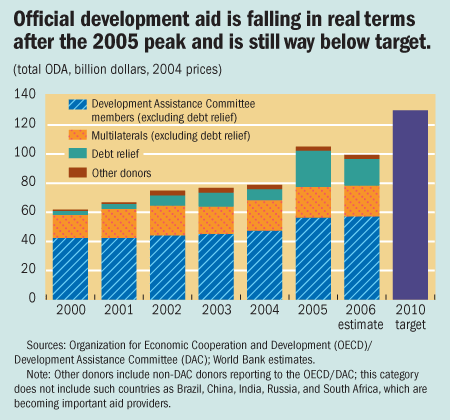
"Changing Aid Landscape"


Finance and Development, December 2007, Volume 44, Number 4.

"Despite donors' commitments to scale up aid in line with the 2002 Monterrey Consensus and the 2005 Gleneagles Declaration, the response has been mixed. Official development assistance (ODA) declined by roughly 5 percent in real terms in 2006—the first drop since 1997—and a slight decline is expected for 2007, according to recent OECD estimates. Moreover, ODA as a percent of gross national income dipped to 0.3 percent in 2006, after inching up to 0.33 percent in 2005, still well short of the UN target of 0.7 percent."

Conditions in Iraq

Source: David Brown and Joshua Partlow, "New Estimate of Violent Deaths Among Iraqis Is Lower," The Washington Post, January 10, 2008.

I quote:
A new survey estimates that 151,000 Iraqis died from violence in the three years following the U.S.-led invasion of the country. Roughly 9 out of 10 of those deaths were a consequence of U.S. military operations, insurgent attacks and sectarian warfare.

The survey, conducted by the Iraqi government and the World Health Organization, also found a 60 percent increase in nonviolent deaths -- from such causes as childhood infections and kidney failure -- during the period. The results, which will be published in the New England Journal of Medicine at the end of the month, are the latest of several widely divergent and controversial estimates of mortality attributed to the Iraq war.
We know that a couple of million Iraqi's have fled to other countries, and another couple of million have fled their homes in Iraq to take refuge in new areas.

We also know that the living is hard for those who remain in the country, with a weak economy, bad services, and frequent fearful times.

A Problem for American Democracy

Source: CHEYENNE WELLS, "Depopulation: The Great Plains drain," The Economist, January 17th 2008. Lead: "How the interior is learning to live with a shrinking population."

The United States Constitution was a compromise among people and states with different interests. A part of the compromise between large and small states was that each state would have two senators, while House of Representatives seats would be allocated by population. Even there, very small states still get a Representative in the House who may have fewer constituents than those of larger states. The presidential vote as a result gives people in small states more influential votes than people in large states.

The map above shows that people are leaving rural areas all across America (and moving to California and other populous states. We know that the Republican party is strong in the states with shrinking populations. The result is, I suppose, that the average Republican is having more influence on Senate and Presidential composition, and the average Democrat less.

It is time to go to a direct election of Presidents!

A WHO Success Story

Source: "Syphilis: Montezuma's revenge," The Economist, January 17th 2008.

I quote:
During the 1950s and 1960s, the World Health Organisation undertook a huge eradication campaign in which more than 300m people in Africa, South America, South East Asia, the South Pacific islands and the Middle East were examined—and tens of millions were treated with penicillin.

Reducing the burden of disease by 95% was good for patients, but not so good for paleopathologists.
Comment: One of my former bosses, Bob DiCaires, was involved in the Yaws campaign in Haiti. He said the campaign appeared magical to the people of that country. People were hidden in their homes when they were affected by the disease, essentially ending their lives. A single shot of penicillin effected a complete cure. After the campaign, the population estimates for the country had to be modified, as a million people (perhaps one-fifth of the total population) emerged from hiding to resume normal lives. JAD

Vatican University Squable About Pope's Position on Science

The Pope has canceled a speech at Sapienza University in Rome after a protest by students and faculty. He did forward the speech which is available online in Italian and in German. The New York Times writes:
The pope’s speech at the university, which was founded by Pope Boniface VIII in 1303 and is now public, was to mark the start of the academic year. But professors and students objected, citing specifically a speech that Benedict gave in 1990, when he was Cardinal Joseph Ratzinger, on Galileo, condemned by the Inquisition in the early 1600s for arguing that the Earth revolved around the Sun.

In that speech, Cardinal Ratzinger, who would become pope in 2005, quoted the Austrian philosopher Paul Feyerabend as saying: “The church at the time was much more faithful to reason than Galileo himself, and also took into consideration the ethical and social consequences of Galileo’s doctrine. Its verdict against Galileo was rational and just.”

In the speech, Cardinal Ratzinger did not argue against the validity of science generally or take the church’s position from Galileo’s time that heliocentrism was heretical. But he asserted, as he has often since elected pope, that science should not close off religion and that science has been used in destructive ways.
Comment: I suspect that Pope Benedict is a far more subtle thinker than the Times quote would suggest, with thoughtful and nuanced positions on the role of science and religion in modern society. I would also suspect that the university community was worried about the influence of the church in what is now a secular university, and not simply angered at an 18 year old speech.

Clearly, in my opinion, universities depend on the exchange of ideas, and Pope Benedict is prototypical of the kind of thinker who ought to be invited to stimulate debate.

I find it surprising that he would feel the need to state that science should not preclude religion, since so few scientists advance the position that it should.

Science indeed has led to technologies that are extremely dangerous, and indeed these weapons have been used in battle to kill and wound people. On the other hand, there have been lots of wars, massacres and indeed genocide justified in the name of religion. Society needs to care to use both science and religion wisely and justly. JAD

Election Results: We Don't Know Anything Yet

Listening to the election results so far on the television media, one might conclude that important decisions have been all be concluded. Of course, the networks are fighting for ratings, and don't want to lead off their programs with an announcement that the results in such and such a state don't mean much. But I think that the results so far don't mean much. Except of course, as they influence the donations to the various candidates, the willingness of people to work for the campaigns, the decisions of those who are soon to vote, and the candidates who are dropping out.

According to the New YoIk Times Election Guide:
  • in the Democratic Convention, 2025 delegate votes are required to win the nomination. Currently, Clinton and Obama are tied with nine committed delegates each, and Edwards trails with four.
  • In the Republican Convention, 1191 delegates are needed to win. Romney now has 27 committed to him, McCain 13 and Huckabee 2.
Even in those states that have completed the first stage of delegate selection process, most has secondary stages to actually designate their delegation rosters.

So what about the popular vote? According to the NYT Election Guide:
  • Clinton and Obama went head to head in three primaries in small states. Obama lead in one, 39% to 29%; Clinton lead in two, 39% to 36% and 51% to 46%.
  • Romney, McCain, Huckabee and Thompson are leading among Republicans. Here is the voter split among the four in states where they competed so far (percentages in same order as names above):
    • Iowa: 25%, 13%, 34% and 13%
    • New Hampshire: 32% 37%, 11%, 1%
    • Michigan: 39%, 30%, 16%, 4%.
    • Nevada: 51%, 13%, 8%, 8%
    • South Carolina: 15%, 33%, 30%, 16%
I guess that the results suggest that the Democratic race is between Clinton and Obama, and the Republican race so far does not include Giuliani as major contender, and perhaps that Thompson is a long shot. I think the results also suggest that nothing much has been decided yet.

Saturday, January 19, 2008

A thought about research on medical economics

Source: "Health-care economics: Comparison shopping," The Economist, January 10th 2008.

I quote:
MOST industries have grasped the idea that new products should be measured against rival offerings. From laptops to double-glazed windows, consumers have ready access to comparative studies from consumer magazines, independent testing bodies and the like.

When it comes to health care, however, comparative-effectiveness studies for new drugs, devices and procedures are rare. Drugs trials often compare new treatments with placebos, not rival pills. Device makers rush to get new gizmos into action before cost-benefit analyses can be done. In America the federal government's health programmes eschew comparative-effectiveness tests as a matter of policy.
Comment: The article goes on to note a few examples of cost-effectiveness studies in health care that have proven useful. Of course, the editorial viewpoint of The Economist supports this kind of work, as I do in principle.

There are, however, ethical problems with comparing the cost effectiveness of alternative medical treatments. How does one deny what is felt to be the best treatment to some patients to evaluate whether there is in fact a difference as compared to the alternative?

In the real world, in developing countries, physicians are often faced with providing advice to patients that identifies various courses of treatment, each with its own cost implications and prognosis. Patients who can not afford the most efficacious treatment often must settle for the best treatment that they can afford.

This situation presents a natural experiment, and it might be very helpful to create a strong medical record system that records diagnoses, treatments and outcomes in such a way that the cost of treatments could be inferred. Data mining might then allow physicians to provide better information to their patients as to the costs and efficacies of alternative treatments for their medical problems.

Indeed, developed nation's support for the such programs where they would be ethical might help the world to avoid more costly but no more efficacious medical interventions.
JAD

War on the U.S.-Mexican Border

I have not noted coverage of this in our local papers in the Washington DC area.

"US ups border gun checks as Mexico drug deaths jump", Reuters, 1/16/08:
U.S. Attorney General Michael Mukasey on Wednesday promised tougher controls on guns flowing illegally over the U.S. border to Mexico, where drug cartels have murdered 115 people already this month.


"Violence Spikes in Mexico" By MARK STEVENSON, Associated Press, 1/18/08:
(F)ighting erupted as federal agents raided a house near the U.S. border Thursday that authorities say sheltered gunmen linked to drug traffickers. Soldiers and police joined skirmishing that became a chaotic three-hour battle. A federal agent and a gunman died and four officers were wounded in the latest outbreak of violence across the border from San Diego. Inside the house, authorities later found six slain kidnap victims......

A day earlier less than two block down the street, police rushed children from a school vulnerable to gunfire from men holed up on the roof and top floors of the besieged safehouse......

Thursday's violence was only the latest in a rash of recent killings.

On Jan. 10, gunmen shot and killed two federal agents and a civilian in the central state of Michoacan.

Two days earlier, two other federal agents were killed and three were injured during a shootout in Reynosa, across the border from McAllen, Texas.

A day before the Reynosa shootout, three suspected criminals were killed and 10 federal agents and soldiers wounded in a shootout in the town of Rio Bravo, across the border from Donna, Texas. Ten people, including three U.S. residents, suspected of having ties to the powerful Gulf cartel were arrested the next day.
"Texas' Rio Grande Valley worries Mexico's drug battles may harm tourism: Border cities worry recent gun battles may harm industry" Dallas News, January 14, 2008:
Deadly gun battles in two Mexican border cities last week left their sister communities in the Rio Grande Valley hoping that the brutal cross-border violence plaguing Nuevo Laredo for years has not spread downstream permanently.

Five people died in fierce firefights between suspected Gulf Cartel gunmen and Mexican troops and federal agents in Rio Bravo and Reynosa.

Those cities sit just across the Rio Grande from lucrative havens for so-called Winter Texans, setting the multibillion dollar drug trade on a collision course with a growing tourism industry.
The Spanish language television is covering these events nationally, but they seem to be getting little attention in the print media of this nation's capital.

Brazil in Scientific American

The current issue of Scientific American (February 2008) has several articles that deal with Brazil. "Building a Future on Science" by Christine Soares includes this statement:
The heart of Nicolelis’s vision is a string of “science cities” built across Brazil’s poorest regions, each centered on a world-class research institute specializing in a different area of science or technology. A web of education and social programs would intimately involve surrounding communities with each institution while improving local infrastructure and quality of life. And the presence of these knowledge-based oases would spark a Silicon Valley–style clustering of commercial scientific enterprise around them, jump-starting regional development.
The article also deals with other emerging national science sysgtems:
In 2006 China declared its plan to construct 30 new science cities and to raise its annual research
spending to more than $100 billion by 2020. At that point, the government expects 60 percent of the country’s economic growth to be based on science and technology. India, where a small number of elite universities have become hubs for technology clusters, as in Bangalore, is also betting on a continued tech boom. Although their approaches differ, what many of these nations
have in common is an overt goal of luring a diaspora of scientists trained in the West to bring their expertise back home.

Friday, January 18, 2008

An American Curse

May you live in Texas,
May you trust a politician,
May the IRS audit your taxes,
May you live near a superfund site,
May you believe a used car salesman,
May your spouse become a Scientologist,
May you always travel by car at rush hour,
May your computer be infected with a virusl
May your children go to an inner city school, and
May you depend on Social Security for your retirement.

About the humanities

Stanley Fish has a series of columns in the New York Times that caught my attention:

Fish, a distinguished academic and academic administrator has been a university humanities professor for more than four decades.

Starting with a report on the state university system of New York, he moves to question of why literature, philosophy and history should be supported in universities. He notes that the state university system in New York does not have a campus in the constellation of global superstar univesities, using Berkeley and Michigan as examples of superstars in that constellation. He recognizes that providing annual revenues, investment, and keeping from excessive interference with the operation would, if sustained for decades, attract the people who could raise one of more of the campus to superstardom. Neither he nor I can guess accurately whether the people of New York nor their elected officials will choose to do what is necessary.

Fish suggests that arguments that the humanities have instrumental value and thus should be supported do not have real merit. He ends the second piece writing:
To the question “of what use are the humanities?”, the only honest answer is none whatsoever. And it is an answer that brings honor to its subject. Justification, after all, confers value on an activity from a perspective outside its performance. An activity that cannot be justified is an activity that refuses to regard itself as instrumental to some larger good. The humanities are their own good. There is nothing more to say, and anything that is said – even when it takes the form of Kronman’s inspiring cadences – diminishes the object of its supposed praise.
In a stovepiped academic system, departments in the humanities are staffed by people who participate in their individual paradigms of scholarly study, gaining the professional gratifications that they have been culturally conditioned to value, and that for Fish is enough.

Of course, he realizes that they are supported by the students who consume their services, by the parents of such students for whatever reasons they need to provide that support, and from the public purse largely for the teaching that they do.

It raises the question in my mind as to why thsse studies have continued, while others have not. Once many theologians argued about how many angels could fit on the head of a pin, and as far as I know theologians no longer find that a worthy pastime. The professors at campuses that were centers of learning in the middle ages no longer study and teach that which their predecessors studied and taught.

I am not sure that lumping literature, history and philosophy together is a good idea for the purposes of this thinking. The scholarly study of history may have more instrumental value than does the scholarly study of literature. Philosophy still has key questions of concern to us as humans that need to be better addressed.

Our culture, through an evolutionary process, has selected certain fields of learning for inclusion in the university, which is after all intended to include more than professional studies. Within each of the stovepiped academic departments, the paradigm evolves to include certain topics and approaches and to delete others. There is an argument that it is worthwhile to continue the development of these academic field paradigms both to keep alive the learning that has gone into them, and to continue the selection process of the important knowledge and understanding from the mass of contemporary materials that is being generated.

There is of course no need for a single reason to keep the humanities going. Each of the reasons adds its bit to the total of support. Not least of the bits added to the total is the willingness of very smart people to invest very heavily in education and then accept relatively small levels of pay to staff the departments of humanities.

I would bet that literature, philosophy and history will continue to be taught in our universities in 100 years, bacause they are central to our culture and our cultural values. I mean culture not in the sense of "high culture" but in the more general sense of the set of institutions, values, and attitudes passed down from one generation to the next that are central to our society. I would also bet that the content of these subjects will be quite different in 100 years than they are now.

Shame on the Polish Government

The Washington Post tells me today that the Polish Government has created a law that "prohibits anyone from asserting that 'the Polish nation' was complicit in crimes or atrocities committed by Nazis or communists." That Government is apparently now considering prosecuting a Princeton professor under that law for his book which treats Polish actions during the Holocaust. Putting people in jail for contributing to the debate on responsibility for crimes against humanity seems a lot less useful than prosecuting those responsible for the crimes themselves!

I hope that UNESCO and other organizations promoting freedom of information will come out against this Polish law.

The Nevada Casino Voting Decision

The papers report that the courts have decided that Democratic caucuses could be held in Nevada casinos, as had been planned to encourage participation by workers in the areas of those casinos. The Teacher's unions had filed suit to prevent the use of those locals. It seems that that union, which has endorsed Clinton, thought the caucuses in the casinos might bring out more Obama supporters than folk who shared the teacher preferences.

Caucuses are supposed to tell us all what the preference of the majority really is. I do not appreciate politicians seeking to undercut participation to favor their own candidates! Shame on the teachers! JAD

"Mature Human Embryos Created From Adult Skin Cells"


Source: Rick Weiss, The Washington Post, January 18, 2008.

I quote:
Scientists at a California company reported yesterday that they had created the first mature cloned human embryos from single skin cells taken from adults, a significant advance toward the goal of growing personalized stem cells for patients suffering from various diseases.
Comment: Is the Bush administration now going to insist that stem cells from embryos produced in this way not be used for research (or therapy)? Do they believe that embryos created from skin cells should not be destroyed if they are not to be used. Do they want us to seek to use them to impregnate women? If not, why not? If so, why?

I think the folk who believe that an embryo of human cells is a human being with rights to life are now going to have to face the conceptual problems of their possition. JAD

Google Announces First Donations to Charity

Source: Sheryl Sandberg, Google Press Release, 1/17/2008.

Google.org has announced five core initiatives beginning it corporate giving program totaling more than $25 million. The five are to help combat climate change, global poverty and emerging threats such as pandemic disease. These initiatives are planned to draw upon Google's strengths in access to information and scalable technology. Google.org plans to use a range of approaches including grants, investments in for-profits and advocacy, and to continue to tap the experience of Google engineers and other team members.

Comment: This seems like a good start. I applaud the idea of starting small, gettin experience, and then scaling up. I also like the idea of building on Google.com's expertise in information collection and mining, and its great techie staff. Congratulations to the team responsible for this initiative! JAD

Read more articles on the donations in:

Wednesday, January 16, 2008

Fight the Maryland Tax on Computer Services

During the November 2007 special session, the Maryland General Assembly enacted legislation to expand the state’s sales tax to computer services. A coalition of business organizations and Maryland companies is working to repeal the computer services sales tax during the 2008 General Assembly Session. I support that effort.

I pay sales taxes on a lot of things, and adding one more won't hurt me that much. But Maryland's firms that buy computer services, and then pass on the cost of those services to their own customers are going to be less competitive, since firms in other states don't pay such a tax. Computer services are crucial not only to computer businesses, but also to biotechnology companies and other high technology companies. Moreover, a lot of out of state firms are not going to comply with the Maryland law, and online ICT services are becoming more and more common.

Learn More:

Take Action

Click here to contact your legislators and urge them to repeal the computer services sales tax.

A Report That Most ICT Projects Fail

Yesterday I heard a senior officer of the World Bank cite a study by a well known international consulting firm that said that 90% of ICT projects in companies fail. That leads me to consider several alternatives;
  1. The consulting firm that is prototypical of the firms that do ICT projects that it says usually fail, failed in this study, and their conclusion is just plain wrong.
  2. The ten percent of successes are so wildly successful that they pay for the 90% of the failures (our officer's suggested interpretation.)
  3. The officers of private companies are fools.
  4. The officers of private companies are not acting as rational "economic men".
  5. The process of setting objectives and evaluating success is dangerously flawed. (Perhaps it is hard to do, takes a lot of time and effort, gives frequent wrong answers, and is dangerous when people accept and act on those wrong answers.
How come if the projects are so unsuccessful, there are so many of them, and more to the point, the information revolution has swept industry with historically very rapid progress and changed the way all industries function in developed nations. I offer:

6. The projects build organizational and social capital, that is very hard to measure, but which accumulates and eventually results in revolutionary changes in organizations, institutions, and sectors.

S&E Indicators 2008


The new edition of the National Science Foundation's flagship publication, Science and Engineering Indicators, has been published.

The New York Times covers the release, writing:
The United States remains the world leader in scientific and technological innovation, but its dominance is threatened by economic development elsewhere, particularly in Asia, the National Science Board said on Tuesday in its biennial report on science and engineering.

The country’s position is especially delicate, the agency said, given its reliance on foreign-born workers to fill technical jobs.

Kweisi Mfume To Endorse Donna Edwards

Former Congressman and longtime health care advocate

to announce

endorsement at local retirement community


TOMORROW, fourth congressional district candidate Donna Edwards will visit with residents at the Woodside Retirement Community along with former Congressman Kweisi Mfume. Mfume was a five-term Democratic Congressman from Maryland, serving from 1987- 1997, and is the former President/CEO of the NAACP. While in Congress, Mfume was a tireless advocate for universally accessible health care.

Cardin on Media Consolidation

Senator Ben Cardin from Maryland wrote me in part:
I support a transparent and informed FCC rulemaking process that takes into account the unique obstacles that minorities and women often encounter in getting their small businesses off the ground.

I am concerned that Chairman Martin's introduction of new media ownership rules at the end of last year rushed what should be a deliberative and democratic rulemaking process . I have major reservations about any agency rulemaking process, whether employed by the FCC or any other agency, which does not provide a reasonable window of time for public comment, response, and review.

I am further concerned that Chairman Martin's rule change, which loosen s restrictions on newspaper-broadcast cross-ownership , would benefit national media conglomerates at the expense of my state's small business owners. This same rule change and several others were rejected by Congress in 2003 for good reason.

Senator Byron Dorgan introduced S. 2332 as bipartisan legislation to address some of these concerns. S. 2332 would require the FCC, before adopting any new broadcast ownership rules, to give 90 days notice for public comment, and to initiate, conduct, and complete a separate rulemaking to promote the broadcast of local programming and content. It also would require the FCC to establish an independent Panel on Women and Minority Ownership of Broadcast Media and to conduct a full and accurate census of the race and gender of broadcast owners.

On December 4, 2007, the Senate Committee on Commerce, Science, and Transportation reported S. 2332 out of committee favorably . Please be assured that I will follow the progress of this bill closely and look forward to giving it my support should it come to the Senate floor for a vote. I will also continue to keep a close eye on any proposed FCC rule changes and weigh in on the rulemaking process as necessary.
Good for you Senator Cardin!

A Thought About e-Development

The World Bank maintains a website on e-Development. The term was promoted within the Bank by Nagy Hanna, who championed information and communications technology for decades. Nagy has described the process by which the Bank's first e-Development project was developed in some detail in two books. Now there are another ten or so e-development projects under consideration by the Bank, in part because Bank clients are calling for those projects and in part because the experience with the first has overcome resistance within the Bank.

e-development has two possible connotations -- the development of the ICT related aspects of society (e.g. bundling e-government, e-civil society, e-business and ICT infrastrcture development) and using ICT as a tool within a holistic approach to social and economic development. How are the two related in practice in Sri Lanka?

It seems to me that both aspects take place. The experience in both Sri Lanka and India shows that the integrated approach to developing ICT infrastructure, human resources, and applications does lead to social and economic development. Certainly the Sri Lanka project by bundling these approaches achieved synergies that contribute to each of the sectoral objective.

It seems to me that e-Development is also an important strategy for more general development. Governments have become more transparent and oriented toward service to the people, and thus governance has improved. In India, the ICT-based private sector has become a motor for development, producing foreign exchange, employment and profits. Civil society organizations have been strengthened. All made possible in part by the increased penetration and quality of the ICT infrastructure.

Indeed, I think riding the wave of the Information Revolution has some significant advantages as an approach to social and economic development. Certainly programs to improve governance, to strengthen innovative sectors of industry, and to strengthen civil society are likely (in our modern world) to increase demand in each sector for ICT infrastructure and applications. But all to often tackling these problems head-on has proven ineffective. Sneaking up on the development objective through overt efforts at technological innovation may work better.

It seems to me that it is important that the Bank staff recognize e-development as an important approach to improving governance, building civil society and strengthening the economy -- the things the people on that staff are really interested in.

"Ex-Officials Benefit From Corporate Cleanup"

Source: Carrie Johnson, The Washington Post, January 15, 2008.

I quote:
Federal prosecutors are steering no-bid contracts to former government officials who earn millions of dollars by monitoring companies accused of cheating investors and other schemes.

A consulting firm led by former U.S. attorney general John D. Ashcroft recently won an assignment, valued at more than $25 million, to ensure that a medical equipment maker stops paying kickbacks to doctors who use its products. Other former government officials with ties to the Bush administration have secured similar deals, which are paid using corporate funds and entail few, if any, checks on spending.

The lucrative arrangements are known as "monitorships," unusual contracts in which an outsider comes into a troubled company with vast power to expose corruption and change business practices. The deals allow scandal-plagued companies to avoid criminal charges -- and they give prosecutors a way to ensure businesses keep their promises and clean up abuses. But legal experts and lawmakers are expressing growing concern about inconsistency and secrecy surrounding the appointments.
Comment: The Bush administration has discovered another way to bypass the checks and balances of our system, this time using the law to make corporations pay for services given not by people the corporations choose, but by people the administration chooses.

I have noted that the informal arrangement by which the U.S. administration in power is allowed to name people to key jobs running United Nations programs or other intergovernmental organizations (of which there are many thousands) also provides a means to appoint loyalists to desirable posts outside of civil service and Congressional oversight.

I bet there are more ways that the administration is putting its supporters in remunerative and influential jobs without oversight.
JAD

"Scientists Take Complaints About Interference to Hill"

Canada Lynx
One of the species
endangered in US
by the Bush admin. rules


Source: Elizabeth Williamson, The Washington Post, January 16, 2008.

I quote:
Two dozen scientists swarmed over Capitol Hill this week mad as vespinae ( hornets) at what they say is Bush administration meddling in environmental science.

Organized by the Union of Concerned Scientists and the Endangered Species Coalition, the rumpled researchers won time in the offices of more than 20 lawmakers. They are protesting what Francesca Grifo, director of the Scientific Integrity Program at the Union of Concerned Scientists in Washington, calls "the systematic dismantling of the Endangered Species Act through the manipulation and suppression of science."
Comment: Certainly now that we have a Democratic Congress, it is time for the Congressional checks to the Republican administration's cavalier approach to environmental laws to be applied, as the Constitution requires. JAD

Two Local Annoying Situations

The Washington Post today informs me that Maryland Governor "Martin O'Malley rejected a proposal yesterday to issue separate driver's licenses to undocumented immigrants and legal residents." He was acceding to the new Real ID law that was in theory promulgated to promote "Homeland Security". Last year there were nearly 43,000 traffic fatalities in the United States. Thus from 2000 through 2007 there were something on the order of a quarter million deaths from traffic accidents in the United States, and 3,000 from international terrorism (if you don't count the number of Americans who died in Iraq and Afghanistan in the wars we have started in the name of anti-terrorism.) We have an estimated 12 to 20 million illegal immigrants in the United States. Do we have more to fear from their driving without passing tests to demonstrate their mastery of local traffic laws and the operation of a motor vehicle, or from terrorists. (Indeed, did the terrorists enter the United States illegally?) And what is the impact of making these illegal immigrants not only break immigration laws but also drive without licenses. It generally is not a good idea to pass laws that huge numbers of people will choose to break. Scofflaws don't make the best neighbors.

I do agree that Maryland law should not be in conflict with federal law. Why not have a certificate of mastery of traffic laws and vehicular operation different from a drivers license. Then pass a law that people could not drive here unless they had a Maryland drivers license, a drivers license from another state, an International Drivers license, or such a certificate. Or indeed, why not simply start issuing international drivers licenses to people who ask and qualify for them without asking about residence?

Incidentally, check out "Once World Leader in Traffic Safety, U.S. Drops to No. 9"

An Idiocy in My County

The Washington Post also tells me:
Juashaunna Kelly, a Theodore Roosevelt High School senior who has the fastest mile and two-mile times of any girls' runner in the District this winter, was disqualified from Saturday's Montgomery Invitational indoor track and field meet after officials said her Muslim clothing violated national competition rules.
Comment: The clothing police are out in force to protect us against head scarfs! Arghh! JAD

Tuesday, January 15, 2008

A Thought on Why the Network of Intergovernmental Organizations Exploded in the Late 20th Century

As the figure shows, there appears to have been an explosive growth of intergovernmental organizations in the last four decades. At the beginning of the 20th century there were very few of these organizations. The reference given above cites 37 in 1908.

There was a wave of globalization that took place from say 1820 until 1914. It was based on improved transportation of goods via railroad and ship, improved communications via telegraph and mail, and the growth of manufacturing. It was also built on a political basis of colonialism, and institutions within the imperial frameworks of the colonial empires. The few intergovernmental organizations included the Universal Postal Union, the Red Cross, and the Pan American Health Organization. The wave broke on the schoals of World War I and the Great Depression.

A new wave of globalization started about 1960 and continues today. It too was based on improved transportation and communications technology and systems, but this time developed in a post-colonial world. The League of Nations, while in many ways a failed experiment, laid the foundations for the more successful United Nations and its related family of organizations. Thus there were by the latter part of the 20th century successful models of intergovernmental organizations.

It occurs to me that a wave of globalization requires many problems to be solved which are beyond the capacities of individual nations working alone. Imperial powers provided a means for coordinating problem solving among colonies and the colonizing power. In recent decades, countries have used the model of intergovernmental organizations such as those of the United Nations systen or the Bretton Woods organizations to approach the emerging problems of globalizing economies and societies.

Monday, January 14, 2008

Ushahidi.com

Ushahidi means witness. This website provides a map of outbreaks of crime or violence in Kenya. It has easy templates for people to report incidents via the Internet, and it now allows instant messaging to be used to report incidents. The incidents are verified, often by inquiries to NGO's known to be working in the geographic area in which the incidents are reported. The verified incidents are mapped using Google mapping software, so that the user can zoom in or out, and can see maps, satellite photos, or both. It has been suggested that this technology, which is deliberately simple, could be a model for similar websites serving other countries with insurrection or communal violence.


"Good Options Can Mask Bad Choices"

Source: Shankar Vedantam, The Washington Post, January 14, 2008.

This is an interesting short article on a bias in decision making. Vedantam writes:
Democrats argue about the relative merits of Barack Obama, Hillary Clinton and John Edwards, but opinion polls suggest that most Democrats think they are choosing among excellent options. Should any of these candidates win in November, your average Democrat will be delighted.

The Republicans present a very different field. John McCain and Rudy Giuliani are viewed with suspicion by social conservatives and Republicans most worried about illegal immigration. Mike Huckabee is viewed with suspicion by the party establishment and by fiscal conservatives. Mitt Romney is viewed with suspicion by, well, depending on which version of Romney you mean, nearly everyone.

Psychological experiments show that people behave and think differently when they are confronted with multiple strong alternatives, compared with when they face a number of poor choices......

(W)hat the research does reveal, paradoxically, is that Democrats might be more willing to accept a poor candidate because they like all their choices. When people are predisposed to feel good about their decisions, the internal warning mechanism that tells them they are making a mistake may not go off. By contrast, Republicans are not predisposed to be satisfied with whomever they choose.
Vedantam suggests that the Republicans choosing carefully from a weak field may produce a better candidate that the Democrats choosing less carefully from a strong field because of this bias in human decision making.

Comment: Perhaps we should consider the election in a different way. After the election, we will have a new president, but also a recession and an economy faced by emergent challenges not only from newly industrializing nations but to our technological leadership. We will still have a war in Iraq and a war in Afghanistan. We will have a weak education system, and a health system that costs an arm and a leg and does not offer adequate protection to our poor. We will face a world that increasingly distrusts our intentions and our wisdom. Moreover, we will still live in a world where not only is global warming threatening our grandchildren, but in which environmental degradation is taking place in many countries, and is increasing due to both population growth and the growing per-capita environmental footprint of those people. And we will face all of that with a budget that has been driven into huge deficits, an aging population many of whom will retire in the not too distant future.

I suggest we choose our new president very carefully, because he or she will not make much difference to a very grave situation unless he or she is very competent indeed, and brings with him or her a very strong team to implement a very good program!
JAD

"Escalating Ice Loss Found in Antarctica"

Source: Marc Kaufman, The Washington Post, January 14, 2008.

The article states that new research indicates that climate change is destabilizing ice sheets in western Antarctica much more than had been thought. It raises the specter that we might see both the Antarctic and Greenland ice melting, leading to sea level rises of meters this century rather than feet as had previously been thought. There was a recent report that scientists looking at the long-distant past climate had found that when the climate warmed as much as is expected in the 21st century, sea level rose some 20 feet.

Sea level rises of that magnitude would be catastrophic for small island nations, Bangladesh, and indeed for low lying coastal areas all over the world. While they would decimate vacation homes on the coasts of the United States, they would be much worse for poor people in many countries who don't have the resources to survive such changes.

As far as I can figure out, scientists have not developed a very good understanding of the climate-ice pack dynamics. Clearly, huge amounts of cold, fresh water entering the oceans would have oceanographic effects that would be unprecedented and thus difficult to predict. The overall interplay of oceans, atmosphere, and ice is not only complex, but apparently non-linear. Predictions based on simulations of such systems for decades are not only very difficult, but are very sensitive to assumptions that are made.

In short, the world is facing threats that could be very grave, with very unsatisfactory scientific information on which to base decisions. We know that mankind is in trouble in this century, but we are not sure how bad that trouble may be. Caution would seem to be the prudent course!

Where Does All the Computer Power Go?

Source: "Computer brings science up a gear," BBC News, January 14, 2008

"One of the largest and most powerful computers in the country has been unveiled in Edinburgh.

"Hector (High End Computing Terascale Resources) is capable of 63 million million calculations a second and is four times faster than its predecessor.

"It represents the equivalent of approximately 12,000 desktop systems.

"The £113m project will run for six years and will enable scientists to develop life-saving drugs and model climate change and epidemic patterns."

USTTI Course Catelog Is Now Out

USTTI provides a great (and affordable) opportunity for people from developing countries to develop knowledge and skills about information and communications technologies through study in the United States.


The United States Telecommunications Training Institute is a non-profit public-private partnership between senior federal officials and leaders of the U.S. information and communication technology (ICT) and broadcast industries. The goal of this collaborative effort is to share the United States' technological and managerial advances with women and men who regulate and maintain the IT and communications infrastructures throughout the developing world.

I was involved in a formal evaluation of USTTI many years ago, and was greatly impressed by its programs, and the positive perception that they had in the minds not only of their sponsors and teachers, but also their graduates.

In 2008, USTTI will offer 83 courses. Each of these courses is described in this 2008 course catalog. The catalog also includes information about how to apply, and funding. Since the courses are offered without tuition to developing country participants, and since in some cases funding for travel and living expenses in the United States is available, the courses are often quite affordable.

A group of Indian Ocean emergency communications students from the U.S. Telecommunications Training Institute (USTTI) during a visit to the Pacific Tsunami Warning Center. They visited the Center other NOAA facilities in the Pacific and Alaska Regions to learn how the United States conducts tsunami preparedness and mitigation. Source: NOAA NWS Focus

Sunday, January 13, 2008

HOW THE MILLENNIUM DEVELOPMENT GOALS ARE UNFAIR TO AFRICA

William Easterly, Working Paper 14, The Brookings Institute, November 2007.
ABSTRACT: "Those involved in the Millennium Development Goal (MDG) campaign routinely state 'Africa will miss all the MDGs.' This paper argues that a series of arbitrary choices made in defi ning “success” or 'failure' as achieving numerical targets for the Millennium Development Goals made attainment of the MDGs less likely in Africa than in other regions even when its progress was in line with historical or contemporary experience of other regions. The statement that 'Africa will miss all the MDGs' thus paints an unfairly bleak portrait of Africa."
Comment: Easterly makes a number of points, including that starting counting of MDG performance in 1990, a decade before they were promulgated, fails to take into account the African problems in that decade, and that it is harder to achieve the goals for Africa since it starts from further back. I know what Easterly means, but I don't know how goals per se can be unfair. What might be unfair is the interpretation of goal accomplishment. Certainly African nations have made significant development gains in the last decade and a half, and should be credited with those successes.

On the other hand, the Millennium Development Goals may be unfair to richer nations, since they do not much challenge those countries. It also seems that countries with abysmal poverty in is aspects of hunger, ignorance, illness and early death should be challenged with ambitious goals to eliminate those problems. JAD

Small is Working: Technology for Poverty Reduction


This is a set of videos on intermediate technology developed by Practical Action-the Intermediate Technology Development Group and UNESCO.

The distribution of Wealth

Warren Buffet and Bill Gates were both estimated to be worth more than $50 billion last year. by Forbes magazine. That is, they each have more than 5 million times the $10,000 net worth shown in the following graph.

SOURCE: Employee Benefit Research Institute and Mathew Greenwald & Associates, 2007 Retirement Confidence Survey | The Washington Post - January 12, 2008.

The Millennium Development Goals Monitor reports
:
The number of people in developing countries living on less than US $1 a day fell to 980 million in 2004; down from 1.25 billion in 1990.

Saturday, January 12, 2008

What has happened to America

I have just started Partners: The United Nations and Youth by Eleanor Roosevelt and Helen Ferris. The book, published in 1950, has an illustration in its first chapter of the 150 thousandth refugee arriving in the United States after World War II. The San Diege Mercury News wrote last month:
The United States in recent years has admitted less than one-third of the number of refugees who arrived each year during the late 1980s and early 1990s.

In the 2007 fiscal year, State Department data shows the United States admitted 48,281 refugees, well below the 70,000-person yearly legal limit. Last year, 1,608 Iraqis were among those refugees admitted to the United States, only 3 percent of total refugee admissions, a Mercury News analysis of State Department data shows.

The Bush administration promises improvement in 2008, but critics say it is betraying the trust of the Iraqi people, including translators and other Iraqis who risked their lives to help U.S. forces in Iraq.

The United States resettled about 34,000 Iraqi refugees after the first Gulf War. This was in my opinion a very small number, given the way the U.S. Government encouraged insurrection in Iraq, especially in Shiite areas, and then left the insurgents to face the Iraqi army without our support. But that was far better than what the Government is doing in this war. There are millions of displaced people, and Syria and Jordan, countries much smaller and poorer than our own which are each struggling to absorb a million displaced Iraqis. Why can't the United States do better?

I was especially struck by Eleanor Roosevelt, at that point the widow of the president, leading the effort to build public support for human rights, generosity towards the people displaced by the war. The book of course recognizes the UN Relief Organization, and the roles of UNICEF and UNESCO in helping the children left alone and destitute by the War. Too bad we don't have similar leadership in helping the children left abandoned in the wakes of war and civil unrest, not only in Iraq and Iran, but in dozens of conflicts in Africa and other parts of the world. Non Governmental Organizations are working hard to meet the needs, but the Republican leadership is too busy building irrational fears of immigrants for their political purposes, and the Democrats are not stepping up to defend one of America's proudest traditions!

Friday, January 11, 2008

Biopharmaceutical Research Infrastructure May Save Billions


Science Daily reports:
Improvements to the technology infrastructure for researching and developing new biopharmaceuticals would be expected to save the industry hundreds of millions of dollars annually, according to a new economic study* sponsored by the National Institute of Standards and Technology (NIST).......

The study focused on expenditures for four major categories of technical infrastructure: bioimaging, biomarkers, bioinformatics, and gene expression, as well as expenditures for infrastructure supporting processing and quality control for commercial manufacturing and activities involved with postmarket surveilliance.

Comment: Note that this infrastructure would include an expensive and powerful ICT component. JAD

A Set of Intergovernmental Organizations Americans Don't Know Well

I came across an interesting article by Krishnan Srinivasan in The UN Chronicle. He talks about the development of:

  • The British Commonwealth, built among the nations formed from the British Empire;
  • Organisation de la Francophonie built among France and its former possessions.
  • Communidade dos Países de Língua Portuguesa (CPLP), the Community of Portuguese- speaking countries.
  • Organización de Estados Iberoamericanos (OEI) para la Educación, la Ciencia y la Cultura (Organization of Iberian-American States for Education, Science and Culture).
These are important international organizations, but the United States stands apart from all of them.

A Thought on K-12 Education

Matt Miller, in the current Atlantic Monthly, modestly proposes: "First, Kill All the School Boards". He quotes Mark Twain:

In the first place God made idiots. This was for practice. Then he made School Boards.
- Following the Equator; Pudd'nhead Wilson's New Calendar
Miller discusses how it may be that the United States spends more on schools than other nations, and only produces middling scores on international comparative tests.

His map tells it all. There are huge areas in which educational spending per student is too low. On the average, local taxes pay 44% of the cost of public schools, states pay 47%, and the federal government 9%. The local school districts can produce a lot of revenue for their schools in high income communities, and some states strongly support education. Strangely, federal support for education matches state funds, so "them that has, gets".

It would seem that there ought to be national standards for facilities and supplies, and a system whereby the affluent subsidize the poor if we are to equalize the educational opportunities.

Perhaps some kind of national scale for teacher pay might be considered, modeled after the civil service. Pay might be based on qualifications, with cost of living adjustments.

If we paid enough to have good teachers everywhere, and if we gave them adequate facilities and supplies, we should see the average educational outcomes approach the best that we have. Miller also suggests that No Child Left Behind testing and standards are a joke, and we need a system in which we can tell whether all of our kids are learning math, science, and English.

A thought about national economic accounts

Freidrick Schneider a couple of years ago estimated the average size of the "shadow economy" to be 38.7% of the official GDP in developing nations, 40.1% in transition countries, and 16.3 in OECD countries. One definition of the shadow economy is the market based production and consumption that is not captured in official GDP figures, but the idea is that these are activities that circumvent government monitoring and control.

We know that some of the growth of GDP in the OECD countries has come from people shifting from home production-consumption to market transactions. If mom cooks a meal at home, her work does not show up in the GDP. If she works in McDonalds, and the family comes in a buys a meal, her work does show up.

We also know the old argument that someone who is sick may go to a hospital, may need extensive medical services, and may consume expensive drugs, all of which show up on the GDP. His well neighbor does none of these things, and puts his money in the matress. The sick one adds to the GDP, the well one does not. GDP is not equal to welbeing!

I note that the United States is known for a relatively large civil society, and presumably has a lot of volunteers who work without pay. We believe a vigorous civil society, with lots of clubs and associations helps build social capital and democratic governance. On the other hand, it would seem not to contribute to the measured economic activity of a country.

Similarly, people doing favors for one another don't show up. I rather like the idea of a culture with a lot of reciprocal favors, but the GDP supposes that one in which the same people buy the same services from each other is stronger.

Federal Spending Bills Contain 2,526 R&D Earmarks, AAAS Analysis Finds

The SSTI Weekly says:
A new AAAS analysis of the disappointing federal budget for 2008 reveals Congress’s obsession with earmarks is back with a vengeance, guaranteeing that competition for the remaining federal funds for R&D will be even more fierce.

While lower than 2006, earmarks consumed $4.5 billion of the federal R&D budget, scattered among 2,526 projects AAAS was able to identify.

Congressional earmarks amounted to $939 million in the omnibus appropriations bill signed last month by President Bush and $3.5 billion in the Department of Defense appropriations bill enacted in November, said Kei Koizumi, head of the AAAS R&D Budget and Policy Program.

"Although earmarked R&D funding declines in 2008 compared to previous years," Koizumi said, "in a tight budget environment, earmarks once again crowd out hoped-for increases in competitively awarded research programs."
Comment: There is a general argument that may have some merit that legislators, with the support of their staffs and inputs from the Executive Branch, and with the direct inputs from their constituents, may be at least as well able to make good decisions on funding priorities as the Executive Branch itself that prepares the budget proposal to the Congress. It is hard to see how the Legislative Branch can compete with the peer review process for research used by the scientific agencies of the Government. So, while I support increases in the research budget in general, Congressional earmarks do not seem to be the best way to achieve such increases.

On the other hand, it is also hard to keep the biggest hogs from the trough, so you might as well fill it with nutritious slop. Maybe it is better that the lawmakers fund research than bridges to nowhere!
JAD

Wednesday, January 09, 2008

Interpreting the Election Results

The media describe the election results as dramatic and predictive. But of course the media want viewers to stay with them. If the voters in future primaries are in fact influenced by the talking heads, then these initial results are important.

I guess that with many states holding their primaries on Super Tuesday next month the campaigns with the most money will have an advantage, So there may be an impact of the first results on the willingness of donors to support the various candidates.

On the other hand, we have only had two out of 50 states go through their primaries. The Conventions, where each party nominates its candidates for president, are attended by delegates from the states, and most delegates are awarded proportionately from the states. The Democrats make proportional representation mandatory, and the Republicans use proportional representation in about half the states.

So basically, Obama and Clinton are about even with a very few delegates selected for the Democrats, with Edwards a little behind.

The New York Times Election Guide is very informative.

Tuesday, January 08, 2008

Congress Cuts Funding for Fusion Power Research


From the American Institute of Physics Bulletin of Science Policy News:
The ITER language in the Explanatory Statement accompanying the FY 2008 Consolidated Appropriations Act was completely unexpected. Appropriators zeroed out the U.S. contribution to ITER for FY 2008, and instructed Department of Energy officials not to shift money from within the Fusion Energy Sciences program to restore this money.
ITER is a joint international research and development project that aims to demonstrate the scientific and technical feasibility of fusion power. The partners in the project - the ITER Parties - are the European Union (represented by EURATOM), Japan, the People´s Republic of China, India, the Republic of Korea, the Russian Federation and the USA. ITER will be constructed in Europe, at Cadarache in the South of France.

Comment: This seems like a very short sighted decision. First, fusion power is a hugely important technology for the future, both in terms of meeting energy needs and in terms of clean energy to prevent excessive global warming. But it is also going to tee off our allies, leaving them to pay our share of an expensive collaborative project. JAD

Monday, January 07, 2008

Legitimate Questions for Candidates

Source: "Science and God in the Election," by Donald Kennedy.
Science 4 January 2008: Vol. 319. no. 5859, p. 12

Donald Kennedy gives the following descriptions of questions that one may legitimately ask of candidates, accepting the separation of church and state, at the interface of science policy and religious belief:
The candidates should be asked hard questions about science policy, including questions about how those positions reflect belief. What is your view about stem cell research, and does it relate to a view of the time at which human life begins? Have you examined the scientific evidence regarding the age of Earth? Can the process of organic evolution lead to the production of new species, and how? Are you able to look at data on past climates in search of inferences about the future of climate change?.....

We need to know the candidates' qualifications for understanding and judging science, and for speaking intelligently about science and technology to the leaders of other nations in planning our collective global future. I don't need them to describe their faith; that's their business and not mine. But I do care about their scientific knowledge and how it will inform their leadership.
The issue contains information on the science, technology and innovation policy statements of the major candidates. Clinton and Obama come out pretty good. McCain not bad. Huckabee worries me.

17 year olds can vote in the February Primary in Maryland!


Maryland Elections Board Restores Party Primary Voting Rights:

The Maryland Democratic Party is announcing a statewide voter registration and education effort focused on 17 year-olds following a policy reversal by the Maryland State Board of Elections. With a new advisory from Attorney General Doug Gansler the board restored the primary election vote to all 17 year-olds who will be 18 years of age by the November 4, 2008 General Election.

Tell Every 17 Year-Old to Register Now:

"You Can Vote in the February 12th Presidential Primary"

You must register in a party by January 22, 2008 in order to participate in the primary process to selects your party's nominee!

A cynical comment

William Tecumseh Sherman, when being considered as a candidate for President, said:
If drafted, I will not run; if nominated, I will not accept; if elected, I will not serve.
Today I think most of the candidates should say:
There is no chance of my being drafted. If nominated, I will not know how to run. If elected, I will not know how to govern.

Computer Tax Will Hurt Maryland

Do you want to tell this guy you are
taxing the service to get him out of
this predicament?


Source: "Computer Tax Will Hurt Md." TOM LOVELAND, The Washington Post, January 7th, 2008.

Loveland writes:
But the future of Maryland's strongest sectors is in jeopardy. In November, the legislature voted to extend the state's 6 percent sales tax to cover computer services. Many of us in Maryland's technology sector were astonished by the move, which will hurt the welfare of industries beyond our sector and will drive some businesses out of state.

This new tax, which takes effect in July, will put many Maryland businesses at a severe disadvantage. Innovative technology fuels business growth and job creation, but it can be expensive and risky. So it's often the last thing a business invests in, using the final dollars of its technology budget, if any remain. But now those final dollars will be diverted to the tax, significantly curbing investment in innovation and dampening job creation. Small businesses -- the least able to sidestep the tax and a key generator of new jobs -- will be particularly affected.
Comment: The obvious answer is for the legislature to repeal this tax, and find the money elsewhere.

There is an old adage, that "any new tax is a bad tax". But a legislature that passes a tax without due consultation with the people who will be affected and with the public -- as apparently this tax was passed -- is increasing the probability that the result will be really bad!
JAD

Sunday, January 06, 2008

Good News on the Flu Front

Source: BBC News, 4 January 2008.

Acambis, has announced a new vaccine which it claims should protect against all strains of influenza A. There is an annual, worldwide epidemic of flu A which makes many millions sick and kills half a million to a million people each year. On the other hand, every once and a while there is a new variety of the virus which bypasses existing immunity, and triggers a pandemic that affects many more people. Pandemics kill many millions of people when they occur, and the Spanish flu during World War I killed many tens of millions of people.

Current flu vaccines work by giving immunity to two proteins called haemagglutinin and neuraminidase, which are found on the surface of flu viruses.

However, these proteins keep mutating which means doctors have to keep making new vaccines to keep up.

The Acambis vaccine homes in on a different protein, called M2, which is found on the surface of all A-strains of flu and does not appear to mutate so readily.

Professor Ian Jones, a University of Reading virologist, said the jab could end the scramble to produce a new winter jab each year.

But he said it would still be some years before it was widely available for patients.

"Larger trials and tests on a wider range of viruses will be needed before the full potential for pandemic protection can be assured," he said.

As the old saying goes, "there are many slips twixt the cup and the lips." Don't count on this vaccine until it is proven and in production. Still, the public health impact of a universal flu vaccine would be huge. This is very good news indeed!


Barack Obama's Victory Speech

It would be nice to have a president again who can give a beautiful and inspiring speech. If you have not heard Obama's Ohio victory speech, you should see and listen to it.

"Net Neutrality Wins Iowa"

Matt Stoller writes in Open Left:
In mid-November, Barack Obama laid down some truly remarkable and transformative proposals for the internet, including a strong embrace of net neutrality. Edwards also put out a series of similar policy ideas embracing openness and net neutrality, chiming in during the very imporant 700 megahertz auction of the public airwaves. Clinton, by contrast, laid out a set of proposals written by telecom lobbyists that did not include net neutrality.......

Interestingly enough, on the right, Mike Huckabee has embraced net neutrality at least in concept, whereas every other Republican has not. First on a conference call with bloggers, and then on a Tech President video, Huckabee analogized the internet to the highway system and decried a two tiered set of controls. It's not a full-throated embrace, but it's pretty close.
Comment: I am not a single issue voter, especially not on the issue of net neutrality, but perhaps this is a bellwether issue. The candidates that are really for a change in the way we do things are also for a net neutrality.

I recently thought of two questions to ask of my local Congressional candidates. They were:
  • What can the Congress do to restore the good name of the United States government in the world at large (given the increasing antipathy in the Islamic world, Latin America and Russia, and the feeling among our best allies that we don't consult and among the poor nations of the world that we don't care)?
  • What can the Congress do to be sure that the United States stays on the leading edge of the economic wave caused by the Information Revolution, while not suffering from a decay in our democracy due to the misuse of the technology?
There are lots of major problems: Iraq, Israel and Palestine, control of nuclear weapons, climate change and environmental degradation more generally, failure to deal with the legitimate needs of the poor (especially access to health care and insurance), signs of an economic recession, an inadequate educational system, massive illegal immigration, and international terrorism.

Still, it we have a strong democracy, a strong economy, and the respect of the other nations of the world, our government should be able to work out the details! JAD

Population Program Affects on National Stability -- A Question

Over the last couple of weeks the television has shown riots in Pakistan after the assassination of Bhutto and in Kenya after the elections. Last night I was Charlie Wilson's War (which is a very good movie) which showed crowds of Afghanis celebrating the speech of Chairman Doc Long's pledge of U.S. support for their anti-Soviet insurgency. In all that footage what seems most evident is the fact that it is young men who are doing the rioting. Indeed, all those young men seem to be poor.

In all these countries the rates of population growth are are very high, and there are lots of young men. Indeed, the ratio of young men to older people is high. We know that effective population policies also involve the education and empowerment of women. And there is a lot of information that slowing the rate of population growth can lead to more investment in the kids who are born, and thus to higher rates of growth of per capita income.

Is it perhaps the case that good population policies produce a generation later more peaceful societies?

"A World Without Islam"

Graham E. Fuller has an article in the current Foreign Policy magazine by this title. He makes that point that ethnic Arabs, Persians, Kurds, Palestinians, Jews, Berbers, Kurds, and other ethnic groups would probably still share the lands they now occupy, and that the institutional legacy of Persian, Byzantine, and other empires would still be found in the region had there not been an Islamic empire. He does not say, but perhaps should say that there would still be a physical geography that makes the Nile critical to Egyptian and the Tigris and Euphrates rivers critical to Iraqi civilizations; there must be huge effects of the Mediterranean and Red Sea geography, and the climatology of the world occupied by Islam. There would be an influence of the physical culture that evolved in the region,

It also occurs to me that Fuller does not reflect on the saving and elaboration of Greco-Roman culture that occurred in the golden age of Islam, that in turn reached and affected cultures in the East and the West.

The golden age of Islam made trade and the flow of ideas possible from Asia to the Atlantic. Would Europe have developed as it did without those flows? Would the European explorers have been financed to develop an alternative path to Asia after the fall of Constantinople had there never been a golden age of Islam? How would the world have developed had those explorers delayed a few decades or centuries in discovering the existence of the Americas, and triggering the Columbian exchange?

I have no answers, but the questions are interesting.

Friday, January 04, 2008

More on my experience with One Laptop per Child

I have been posting on my experience with the One Laptop Per Child XO computer I bought. I ordered it on November 12th, received it on December 20th, and opened and tried to get it to work on December 25th. No luck. I can get it to show an on light, and was able to charge the battery, but the screen stayed dark and there was no sound. Click on the "olpc" label at the end of the posting to see the whole story.

On my second call in which I actually spoke to someone I got an agreement to have someone call me who would be authorized to issue a Return Merchandise Authorization. After two days, I got a call, but unfortunately I missed it. (You have to go to the bathroom once and a while.) The message said that I should call the number I had been calling, and anyone there could issue the RMA.

I called at 9:05 this morning, and discovered that there is now a different phone message, which automates the handling of complaints about computers that don't work. After about ten minutes I got an operator. She took all my information which took about another ten or fifteen minutes. Note, that I had already done this whole business twice before -- name, address, phone number, date of purchase, confirmation number, serial number of the machine, date of delivery, was the box damaged, what was wrong with the computer.

At this point I was wondering if I could simply return the computer and get a refund (I was quite willing to forgo the donation of $200 for a computer for a kid abroad and the shipping cost). I was told that since I had opened the shipping box, I did not qualify for a refund.

However, if I ship the computer to Brightstar, they will look at it, and if they decide it doesn't work, they will repair it under warranty and send it back. Otherwise they will just send it back (and I can use it as a doorstop.) I was warned that if I did not return it in six days, they would not accept the return. I was also told to expect a one month turn around on the review, possible repair, and return of the computer.

More later.

Meanwhile, BBC today reports that Intel is pulling out of the OLPC partnership due to "philosophical differences".

This statistic puts things in perspective!

From the Washington Post this morning:
About 2 million of the 10 million deaths annually in children younger than 5 worldwide are caused by pneumonia, an inflammation of the lungs caused by an infection.

Thursday, January 03, 2008

Congressional Race in MD 4th District

I attended a League of Women Voters meeting at which ten candidates for the Congressional seat all spoke. They were led by Al Wynn the incumbent and Donna Edwards the Democratic runner up in the last primary. Ten people speaking in an hour and a half doesn't leave much time for anyone. Still it was interesting to hear the outsider candidates who get very little attention in any media.

The main point that all the candidates agreed upon is that the United States is going in the wrong direction in far too many ways -- the war, the economy, migration, education, health care, personal liberty. The district includes many minority citizens, and half the candidates were black. There was an agreement that the blacks still are not getting as fair a break as they deserve. The debate was held in a senior citizen community, and there was an agreement that the rights of the senior citizens have to be protected against those who would scam them, as well as from failure of social security and medicare. It was interesting to hear the incumbent who has been in the Congress for 15 years saying that the election was about how best to change the country;s direction.

One very interesting question was what was the gravest threat to U.S. security. The candidates answered from different perspectives, and several seemed to be right. Donna Edwards saw the war in Iraq as worth her minute, and it qualifies as both a high priority short term threat and one that deserves prompt attention from the next Congress. Another candidate suggested that the economy was the problem, and clearly if the country can not maintain a strong economy it will indeed be insecure. George Mitchell said that the education of America's children was the problem, and in the long run a well educated population is surely the country's best security -- and certainly the education system needs to be improved. Someone said that we ourselves are the greatest threat to American security, and that too is probably true.

One-Third of Primate Species in Danger of Extinction


The 25 most endangered primates include 11 from Asia, seven from Africa, four from Madagascar and three from South and Central America. The list includes primates like the Sumatran orangutan of Indonesia and the Cross River gorilla of Cameroon and Nigeria as well as lesser known species such as the Greater bamboo lemur.

Almost a third of all apes, monkeys and other primates are in danger of going extinct because of rampant destruction of their tropical habitat, the commercial sale of bush meat and the trade in illegal wildlife. The remaining members of all of these species together would fit in a single football stadium.

Read the full story by Michael Casey in Sci-Tech Today of October 26, 2007.

Comment: This is simply not acceptable. Good neighbor policies should extend to protection of our nearest neighbor species against extinction. Besides, we have the most to learn about Homo sapiens from these species with which we share so much genetic history. JAD

Wednesday, January 02, 2008

U.S. Position in International Science

China USA UK Germany France Japan EU-25
1993 1.69 34.73 8.89 7.45 5.98 8.49 35.04
1994 1.70 33.66 8.97 7.54 5.99 8.57 35.90
1995 2.05 33.54 8.88 7.62 6.09 8.65 36.21
1996 2.31 32.29 9.02 7.93 6.18 8.94 37.08
1997 2.66 31.94 8.73 8.32 6.31 8.98 37.60
1998 2.90 31.63 9.08 8.82 6.48 9.42 38.82
1999 3.44 31.24 9.08 8.67 6.44 9.52 38.68
2000 3.89 30.93 9.22 8.69 6.31 9.49 38.67
2001 4.30 31.01 8.90 8.68 6.33 9.52 38.77
2002 4.98 30.75 8.60 8.50 6.10 9.43 38.16
2003 5.51 30.68 8.46 8.35 6.10 9.40 38.02
2004 6.52 30.48 8.33 8.14 5.84 8.84 37.59
2005 7.42 29.65 7.88 7.88 5.67 8.21 37.04
2006 8.42 29.50 7.84 7.72 5.56 7.82 37.05
Table: Percentages of world share of publications using
the 'Science Citation Index-Expanded version' at the ISI
Web-of-Knowledge.


This table is from "S&T publication rates: The bigger picture" by Loet Leydesdorff, published in SciDev.Net, 20 December 2007. Leydesdorff cites a more extensive paper he has written with Caroline Wagner: "Is the United States losing ground in science? A global perspective on the world science system."
In terms of citations, the competitive advantage of the American “domestic market” is diminished, while the European Union (EU) is profiting more from the enlargement of the database over time than the US. However, the USA is still outperforming all other countries in terms of highly cited papers and citation/publication ratios, and it is more successful than the EU in coordinating its research efforts in strategic priority areas like nanotechnology.
Comment: Comparing a large nation such as the United States with a much smaller nation such as France or Germany in terms of total output of publications is OK, but can easily be misinterpreted. Per capita publication rates are more likely to show the relative intensity of science.

The table shows not only that China is rapidly gaining scientific stature, at least in terms of indexed scientific papers, but also that the European Union has surpassed the United States in scientific publications for more than a decade. The United States now accounts for less than one-third of the world's scientific publications, down from more than half 50 years ago. That is good, in that other countries are bearing a more equitable part of the responsibility for creating new scientific knowledge.

I suspect that the impact indicators also reflect the common phenomenon of people being more influenced by the papers by compatriots than by those of foreigners. The large scientific community within the United States would then lead to American authors being more read and more attended to than authors from smaller national scientific communities.
JAD

SCIENTISTS, ENGINEERS, AND TRACK-TWO DIPLOMACY


SCIENTISTS, ENGINEERS, AND TRACK-TWO DIPLOMACY

A Half-Century of U.S.-Russian Interacademy Cooperation

Description:
This report is intended to provide a brief historical perspective of the evolution of the interacademy program during the past half-century, recognizing that many legacies of the Soviet era continue to influence government approaches in Moscow and Washington and to shape the attitudes of researchers toward bilateral cooperation in both countries (of special interest is the changing character of the program during the age of perestroika (restructuring) in the late 1980s in the Soviet Union); to describe in some detail the significant interacademy activities from late 1991, when the Soviet Union fragmented, to mid-2003; and to set forth lessons learned about the benefits and limitations of interacademy cooperation and to highlight approaches that have been successful in overcoming difficulties of implementation.
Glenn Schweitzer has written this book for the National Academy of Sciences (2004) based on decades in which he lead the cooperation between the U.S. National Academies and those of the Communist nations. Glenn preceded me as Deputy Director of the Office of Science and Technology of USAID decades ago, and has had a broad and distinguished career in international science and scientific cooperation.

The Globalization Index 2007

For the seventh year, FOREIGN POLICY partners with A.T. Kearney to measure countries on their economic, personal, technological, and political integration.

"The Winners’ Circle: For the fourth time in seven years, Singapore tops the list as the most globalized country in the world. But there was plenty of movement in the rest of the top 20. Many of the countries that previously ranked high fell off because of stiff competition from newcomers to the index. The top new addition was Hong Kong, which debuted in second place and distinguished itself with the highest scores in both the economic and the personal contact dimensions. The Netherlands made its way back into the top three for the first time since 2001, mostly due to the merger of the Royal Dutch Petroleum Company and Britain’s Shell Transport and Trading Company. Worth about $100 billion, the deal helped to increase foreign direct investment outflows for the Netherlands by more than 590 percent over the previous year. Meanwhile, the United States slipped four places in the overall rankings to end up at seventh. Although U.S. trade grew by 12 percent, foreign investment shrank by more than 60 percent, mostly due to the effects of the 2004 American Jobs Creation Act, which granted tax incentives for hiring domestically. Clearly, the forces of globalization can turn on a dime."

Europeans to increase research cooperation with Africa

* "Positive partnership clinched at EU–Africa summit," Katherine Nightingale, SciDev.Net, 14 December 2007.
Science and technology is one of the priority partnerships adopted by Africa and the European Union (EU) as part of a joint action plan at the EU–Africa Summit in Lisbon, Portugal last week (8–9 December).

Eight 'partnerships' — each with priority action points — were adopted, including one on 'Science, Information Society and Space', which aims to build science and technology (S&T) capacity in Africa to reduce poverty and promote social and economic development.
* "Africa and EU deepen S&T relationship," Carol Campbell, SciDev.Net, 11 December 2007.
The European Commission, the governing body of the European Union (EU), has approved a high-level network to promote cooperation in science and technology between African and European scientists on projects of mutual interest and benefit.

The four-year initiative, CAAST-Net — Coordination and Advancement of sub-Saharan Africa-EU Science and Technology Cooperation Network — is supported by the EU's Seventh Framework Programme (FP7).
Comment: The United States should follow suite, not only because international cooperation is one of the best ways to build the scientific capacity that Africa needs to address its urgent development problems, but also because eventually good relations with Africa will pay benefits to American science, international commerce and security. JAD

Tuesday, January 01, 2008

Public Diplomacy

The State Department describes itself as implementing a comprehensive public diplomacy strategy based on three strategic objectives:
  • Offer people throughout the world a positive vision of hope and opportunity that is rooted in America's belief in freedom, justice, opportunity and respect for all;
  • Isolate and marginalize the violent extremists; confront their ideology of tyranny and hate. Undermine their efforts to portray the west as in conflict with Islam by empowering mainstream voices and demonstrating respect for Muslim cultures and contributions; and
  • Foster a sense of common interests and common values between Americans and people of different countries, cultures and faiths throughout the world.
Public Diplomacy has been a part of U.S. foreign policy at least since the time of Woodrow Wilson, and is a much larger part of the foreign policy of many other nations.

Public diplomacy has been the subject of a number of studies in recent years, including:
Our leaders have noticed that large numbers of people in the Muslim world think the United States Government is involved in an anti-Islamic crusade, that many or our European allies think the Government is not addressing their interests; that anit-American attitudes are growing in Russia and Latin America; and (I hope that they recognize) that many of the poor people and poor countries think the U.S. government does not recognize their legitimate needs and aspirations, putting our greed before their survival.

In the minds of many American leaders, public diplomacy is confused with propaganda. On the one hand, efforts in public diplomacy are hindered by rules and regulations that prevent the U.S. government from propagandizing at least its own citizens. On the other hand, it really appears that there has been a history of U.S. public diplomacy in fact being propaganda in the negative sense of "saying one thing while doing another".

If we want the people of the world to think we are fair, generous, responsible, even handed, and worthy of the leadership position among nations that our economic, political and military strength require, then we must actually be those things!

Public diplomacy should be a long term goal. A major element of public diplomacy must be education not only for Americans about other peoples but real education of other peoples so that they have both better lives and a more complex and complete understanding of the nature of the world and the relations among nations.

A major element of public diplomacy should be exchanges, and these exchanges should include not only educational exchanges, but cultural exchanges and scientific exchanges.

Communications have always been an important part of public diplomacy, but with the improving global information infrastructure they are of ever increasing importance. Freedom of the press and of information is an obvious objective and instrument of public diplomacy.

If we see public diplomacy as fundamentally achieving a situation in which countries understand each other, and peoples have a realistic understanding of the economic and political, not to mention physical world in which they live, then public diplomacy should be a shared interest among the nations of the world, or at least among those governments which feel truth is more to their benefit than lies.

For that reason, intergovernmental programs should be seen as critical elements in our public diplomacy strategy. UNESCO especially is a collaborative effort among nations to create peace by building its defenses in the minds of men, focusing strongly on exchanges among nations and among peoples that build mutual understanding. Yet few of the theorists seem to recognize the importance of United Nations and Bretton Woods Institutions as instruments of U.S. public diplomacy.

A Couple of Interesting Publications

1. "THE KNOWLEDGE ECONOMY: IS THE UNITED STATES LOSING ITS COMPETITIVE EDGE? BENCHMARKS OF OUR INNOVATION FUTURE"
Task Force on the Future of American Innovation, February 16, 2005.

2. "Global Tour of Innovation Policy"
Issues in Science and Technology, Fall 2007.

THE RISE OF NETPOLITIK: How the Internet Is Changing International Politics and Diplomacy

"THE RISE OF NETPOLITIK: How the Internet Is Changing International Politics and Diplomacy"
A Report of the Eleventh Annual Aspen Institute Roundtable on Information Technology
by David Bollier, The Aspen Institute, 2002.

"The Aspen Institute Communications and Society Program convened the 2002 Roundtable on Information Technology to address ways to consider the complex issues facing national and international policymakers as we enter into this Era of Complexity. What are the significant factors that determine the evolution, and even the survival, of the layers of networks extant in the world today? What are the best frameworks for understanding the trends, forces, and characteristics of our emerging network society? How do we understand the stories of peoples who are different from us, and how do we tell our own stories, our national grand narratives, or our cultural heritages, so that they will be understood by others?"

Quotation

"It is a profoundly erroneous truism, repeated by all copybooks and by eminent people when they are making speeches, that we should cultivate the habit of thinking of what we are doing. The precise opposite is the case. Civilisation advances by extending the number of important operations which we can perform without thinking about them."
Alfred North Whitehead
Quoted in Advancing Knowledge and the Knowledge Economy
Edited by Brian Kahin and Dominique Foray

Comment: I am not sure what Whitehead meant, but I suppose this is idea underlies a representative form of government. If our representatives are doing their job, we don't need to think nearly as much about what we as a people are doing. It is easier to evaluate whether they are doing a decent job than to figure out how to do that which they should do. JAD

"Advancing Knowledge and the Knowledge Economy"

I just noticed that Brian Kahin and Dominique Foray published this book in the Fall of 2006. I don't know Foray, but I find that Kahin is always worth listening to.

The book is for sale, but the contents and the first chapter can be read on this website.