Monday, September 29, 2008

Half way to through the MDG period


Some 400 million fewer people live in absolute poverty today than in 1990.

At least 90 percent of boys and girls in all but two regions of the world are enrolled in school.

Deaths from measles fell from 750,000 in 2000 to less than 250,000 in 2006, and 80 percent of children in developing countries are now vaccinated against the disease.

Some 1.6 billion more people than in 1990 can now get safe drinking water.

Facing half the world's population who live in poverty, or facing 1.4 billion people who live in extreme poverty, it is important to recognize that we are making progress. Indeed the progress has been quite rapid. Unfortunately we are not progressing nearly fast enough, given the human suffering we are allowing to continue to exist. I predict that the worsening global economic situation will slow progress on the Millennium Development Goals.

Two new reports

Economic Doctrines and Policy Differences describes how three traditional economics doctrines – conservative neo-classical (supply-side), liberal neo-classical (Rubinomics), and neo-Keynesianism – have long dominated economic thinking in Washington, and explains how a new theory and narrative of economic growth – innovation economics – based on an explicit effort to understand and model how technological advances occur, has reformulated the traditional model of economic growth by placing knowledge, technology, entrepreneurship, and innovation at the center of economic growth theory.

The companion report, An Innovation Economics Agenda for the Next Administration, explains an approach designed to ensure robust economic growth and rising standards of living for all Americans by putting innovation at the center of our nation’s economic policies. The report lays out eight concrete policy proposals to drive innovation-led economic growth, including significantly expanding the R&D tax credit, creating a National Innovation Foundation, and implementing an innovation-based national trade policy.

Another Bush Administration Failure

On a day in which the Bush administration was badly embarrassed on the bailout legislation for the financial industry, and had a damning IG report on the Justice Department politicization, here is still a third. Reporting on the successful passage of legislation to improve data on broadband access in the United States, Free Press reports:
"The Bush administration promised universal, affordable broadband access by 2007. Nearly a year past that deadline, we are still a long way from that goal. As high-speed Internet access becomes an economic and social necessity, closing the digital divide must be a national priority.

Watch out for appeals to your unconscious racism in this election

Yesterday I saw an interesting talk by Drew Westen, the author of The Political Brain. If I can do him justice, I came away with an increased appreciation of the fact that we make decisions based on our emotional responses to political parties and candidates as well as (and perhaps more than) our conscious analysis of the risks and benefits they offer the country in the current circumstances.

I was especially impressed by his demonstration that political advertising has an impact on our emotional response due to visual and other cues in addition to the more rational impact made by the explicit verbal content. The people who produce television and radio adds for commercial products are aware of this, and work very hard to make you feel you will be more attractive if you buy their product. The national political campaigns no doubt are trying very hard to employ those people to make their advertisements who will deliver the most votes.

Westen really made an impression on me showing how much some anti-Obama adds triggered unconscious racism. If you don't like the appeal to racism by McCain supporters, be conscious of the subliminal content in those adds, and fight against their attempt to unfairly manipulate your decisions!

This is what Josh Marshall says about the attack add the McCain campaign issued on Obama and education (I won't link the add, since even recognizing its bias it might leave a bad residue as well as a bad taste):
(T)oday McCain comes out with this rancid, race-baiting ad based on another lie. Willie Horton looks mild by comparison. (And remember, President George H.W. Bush never ran the Willie Horton ad himself. It was an outside group. He wasn't willing to degrade himself that far.) .......This is ugly stuff. And this is an ugly person. There's clearly no level of sleaze this guy won't stoop to to win this election.

Think for yourself, don't depend on your "political team" being right

Shankar Vedantam's Department of Human Behavior column in The Washington Post today has another interesting discussion of the way we make political decisions.

Research indicates that while Democrats and Republican activists both tend to see more difference between the Democratic and Republican candidates these days, moderates tend to see less difference. He ascribes this phenomenon in part to the fact that activists are more interested in politics on the average than moderates, and follow the candidates more closely. However, following the research of political scientist Marc J. Hetherington, he suggests that party members are exhibiting behavior analogous to that of sports fans following their teams.
On a variety of unrelated issues -- gun control, the economy, war, same-sex marriage, abortion, the environment, the financial bailout -- the views of Republicans and Democrats have become increasingly monolithic. There is no reason someone who is against abortion should necessarily also be against gun control or for economic deregulation, but that is exactly what tends to happen among committed Republicans. Loyal Democrats have similarly monolithic views on unrelated issues......

Another consequence of intense party identification is that the Democratic and Republican parties have rid themselves of contrarians. Liberal Republicans and, to a lesser extent, conservative Democrats are endangered species.
Vedantum suggests that this is more true of American voters now than was true in the past. Accepting that this polarization has taken place, there is still the question of why now, after more than 200 years of partisan politics in the United States.

Let me advance an uninformed hypothesis. People tend to seek out information that agrees with their preconceptions, and to believe more in data that confirms rather than challenges those preconceptions. Today it is easier to do so, not only by choosing friends as informants, but also by choosing apparently "authoritative" sources of information from the media. Not only are the mass media dividing along partisan lines in the United States, but using the Internet we can seek out copacetic opinions. Indeed, we can watch the speeches of our favorite candidate on the Internet without the "inconvenience" of listening to the other side. So the information we choose leads us to believe more of what the other members of our party believe, if we are members of a party.

One should also "follow the money". The candidates who have the most money and buy the most and best advertising get the most votes and win their elections. Incumbents have an advantage in the elections, and thus attract more money from those seeking to invest wisely in the search for influence. Thus incumbents are almost always reelected. The exception is incumbents in years of voter discontent in vulnerable constituencies; they receive support from their state and national parties. The dominant party in the state is more likely to be effective in exercising that influence. States become more monolithic politically.

Still, I think there is much to be said for the position that the media are not doing their job. They do not ask hard questions of candidates on both sides, and seek to honestly present the positions on both sides while debunking the political hyperbole and falsehoods.

Perhaps the best antidote to falling into the trap is to make a conscious effort to listen to the arguments on both sides. Ask yourself if you really accept each position of your candidate. There is no reason why one can not be a fiscal conservative and a social progressive. Certainly one can be a conservationist and not a conservative! One can feel we should not have entered the war in Iraq, and also feel that we need to get out of that war very carefully due both to the risks involved in destabilizing a large part of the world and to the moral responsibility we owe to the Iraqi people.
Source of table: “The Discounted Voter: Polarization at the Congressional District Level,” Marc J. Hetherington and Bruce I. Oppenheimer

Almost half of Congressional districts had closer than a 40/60 split in 1976, fewer than one-quarter in 2004. Fourteen districts had a 20/80 split or more polarized in 1976, while 40 did in 2004.

Sunday, September 28, 2008

Congo Elephants Even More Endangered Than We Thought

Source: "Elephants in Congo: Big and helpless," The Economist, September 25, 2008.

The forest elephants of central Africa—smaller, with shorter, straighter tusks—may even constitute a distinct species from the African elephants we think of from the savannahs of eastern and southern Africa. The forest elephants are few in number and being poached, in part to supply the demand for ivory from China.
The Congo basin is “haemorrhaging elephants”, says TRAFFIC, which monitors trade in wildlife. The head of the 790,000-hectare (1,952,000-acre) Virunga National Park in eastern Congo, Emmanuel de Merode, reports that 24 elephants have been poached in his park so far this year. The situation is dire: 2,900 elephants roamed Virunga when Congo became independent in 1964, 400 in 2006, and fewer than 200 today. Most have been poached by militias, particularly Hutu rebels from Rwanda who hack off the ivory and sell it to middlemen in Kinshasa, Congo’s capital, who then smuggle it to China.

The criteria for the presidential election

In the election, it is important to forget what we learned in kindergarden. As children we choose our friends for our teams. As adults, that is called cronyism, and is frowned upon. Now the Democratic and Republican candidates all seem to be personally admirable:
  • Obama appears to be a good family man who has worked hard all his life and succeeded admirably,
  • McCain has served his country for decades, often in the most severe conditions, and ascribes to the code of duty, honor, country,
  • Biden too appears to be a good family man who has overcome great hardships and returned to the service of his country.
  • Palin, the mother of five, appears to be committed to her religion, her family, her community and has also succeeded admirably in her life.
The question is not which of these people we most like, but who should we vote for thinking of the needs of the nation. As I have written before, that is a question of which administration would best lead the nation, working most effectively to resolve our current problems and to set the basis for future challenges and opportunities. Of course the character, temperament and ideology of the candidates matter, as do their understanding of the world and ability to master new information and rise to new challenges. I would give more weight to leadership, the ability to mobilize their own party and to collaborate with the other party, and to the demonstrated strengths of the party the candidate represents.

Saturday, September 27, 2008

"China: from ‘emerging contender’ to ‘serious player’ in cross-border student mobility"


This is a good posting on the GlobalHigherEd blog. It points out that China is succeeding in attracting a larger portion of the world's population of people enrolled in higher education outside of their own country. The United States while still attracting more students than any other country has seen a significant decrease in the portion of the world's foreign students under the Bush administration.

Surprise Modeling

Aurelie Thiele in her interesting blog, Thoughts on business, engineering and higher education, posted a comment on the Technology Review "list of ten emerging technologies that its editors believe will be particularly important over the next few years" with the following explanation of Surprise modeling (which appears on that list):
"Surprise modeling", pioneered by Eric Horvitz of Microsoft Research's Adaptive Systems and Interaction group, has led to a traffic-monitoring tool (for the Seattle area) called SmartPhlow, which focuses on alerting users to surprises in traffic patterns rather than the congested points everyone is supposed to know about. Using several years of traffic data, Horvitz and his group estimated traffic conditions, to represent the expectations of knowledgeable drivers, and have then concentrated on predicting the moments when the "data shows a significant deviation from the averaged model". The system, when set to a false-positive rate of 5 percent (which means that the chance of the system predicting a surprise when there's none is 5 percent), "tips drivers off to 50 percent more surprises than they would otherwise know about." While the system is not available for download on the Web by the general public, "more than 5,000 Microsoft employees" are said to have installed it on their smart phones.
Comment: My operations research skills are outdated, and I had not known about this approach. However, it is a great idea. I can think of all sorts of applications. How about putting a surprise monitor into biomedical tracking systems? How about migration data?


The Technology Review list is also interesting. It includes ways to make electronics smaller and more efficient and wireless power, as well as ways to better predict and understand human behavior. I am more doubtful about its prediction of new enzymes to transform lignocellulose into a liquid fuel, since I managed a program with that objective for more than a decade, several decades ago. But the list should combine both importance and feasibility as estimated by experts.
JAD

Congress Steps in to Protect Travel to the Space Station

As I posted recently, the Congress has waived a provision of a previous law which prohibits buying technology from Russia and other countries supporting Iran, in order to allow NASA to purchase voyages on the Soyuz rocket to the space station in the absence of the Space Shuttle.

The Washington Post today reports that:
The Senate, meanwhile, has added language to the NASA Reauthorization Act that would prohibit NASA from taking any steps to make it impossible to resurrect the space shuttle fleet after 2010, when it is scheduled to be grounded.
Comment: Of course, it is prudent to keep the Soyuz option open while the Space Shuttle program is in its current state. It sounds to my inexpert ears, however, like the Senators are trying to open an option for the next president. With a bad economy, it seems likely that Bush's strategy of making big announcements of manned space travel. leaving the heavy lifting of funding the program to his successors is coming home to roost. We may have to fund a more modest, more cost effective program of unmanned scientific space activities. JAD

The Debate Last Night

The British Telegraph reports:
Mr McCain's sometimes patronising attitude cost him support among a panel of 27 undecided voters assembled in the swing state of Nevada by Mr Luntz, a Republican polling guru.

Using hand-held dials, they indicated their reactions throughout the debate. Thirteen had supported Democrat John Kerry four years ago and 12 were for Mr Bush, with two voting for neither. By the end of Friday's debate, 17 said they felt more favourable about Mr Obama and 10 about Mr McCain......

In a so-called "insta-poll" of 524 uncommitted voters for CNN, Mr Obama won the debate by 51 per cent to 38 per cent. CBS conducted a similar survey with a victory for Mr Obama by a 39 to 24 per cent margin, with 36 per cent declaring it a draw.
One's Political Party Counts

Senator McCain has a problem, and Senator Obama did not point it out, perhaps because it is too subtle for a mass audience. Senator McCain's ideology and voting record places him in the center of the Republican Senators, although since he was one of the Keating Five he has tried to make a record against cozy deals with supporters and earmarks and probably alienated colleagues in the Senate. He is considerably to the right of the Democrats, thus to get a program through the Congress he will almost certainly have to craft one that his party will buy into almost without exception. That has also been the situation faced by President George W. Bush. So the McCain economic and foreign policies will probably be very much a continuation of the Bush economic and foreign policies.

I suggest that McCain has voted so consistently in support of Bush policies because that is the way politics works. To get anything done in Washington, one goes along with the wishes of one's party. Since the voters are generally opposed to the Bush administration policies, they will be opposed to the only policies that McCain is likely to be able to enact into law.

What Will Happen in the Economy

I don't know, but I believe the pundits who tell us that even if the effort to define a bailout are successful this weekend, there will be a long hard slog to repair the damage. That sounds to me like a recession and high unemployment, with consequent reduction of the tax base. The theory, as I understand it, is that the government should spend more than its income in recessions to help the economy pull out of its problems, and to spend less than its income in boom times in order to pay off its debts. Unfortunately, I would guess that not only will the national debt increase by about ten percent this year due to the deficit and bailout, but the interest rates the government will have to pay to finance that debt will also go up, so there is going to be a bigger "nut" that the government can not avoid.

If Obama can get the Iraqi's to pay part of the bill, and pull down the forces in Iraq, while increasing taxes on the rich, and given that he has been predicting economic problems due to the lack of regulation and the sub-prime lending crisis, if I am right he should be able to implement the major portions of his proposed policies. He will have to make cuts in discretionary programs and delay parts of his ideal program, but if times are tough you pull in your belt.

McCain's proposals seem less realistic. Entitlements and interest represent the major part of the federal budget, and if McCain plans to protect military expenditures and expenditures on veterans while cutting taxes he is either going to have to decimate discretionary programs or run into a debt crisis, with the consequent further increases in interest expenses.

Polarization in safe states

There is an interesting posting in Andrew Gelman's The Monkey Cage indicating that legislators from Republican "safe states" tend to be more conservative than their constituents, legislators from Democratic "safe states" tend to be more liberal than their constituents, and legislators from "battleground states" tend to share the bimodal distribution of ideology of their constituents more closely. Senators tend to be more homogeneous in their ideology than members of the House of Representatives in the "safe states".

I have heard it commented upon in the past that the increasing number of safe constituencies in the United States has contributed to the increasing polarization of the Congress, and Gelman's data would tend to support that idea.

By the way, the blog is from this quotation:
Democracy is the art of running the circus from the monkey cage.
H.L. Mencken

Friday, September 26, 2008

Science Community Calls for Energy Research

More than 70 business, higher education, and scientific organizations have issued a petition to be delivered to both Presidential campaigns calling on the next President to propose and implement a comprehensive energy research initiative to help lead the country toward long-term energy security.

Speakers at the meeting that was held on the release of the petition included MIT's Susan Hockfield, DuPont's, Uma Chowdhry, Intersil's David Bell and Berkeley Lab's Steven Chu.

Malaria may finally be erradicated


Sources: The Washington Post, BBC News.

The malaria summit this week, held in conjunction with the meeting of the United Nations, attracted the heads of more than a dozen countries. It saw the unveiling of the The Global Malaria Action Plan that calls for expanding access to bed nets and treatment to everyone in need by 2010, with the goal of reducing by 2015 the number of malaria deaths to zero.

Pledges were made totalling some three billion dollars.
The new funding commitments include: $1.6 billion from the Global Fund to Fight AIDS, Tuberculosis and Malaria; $1.1 billion from the World Bank; $168.7 million from the Bill and Melinda Gates Foundation; $2 million from Ted Turner's United Nations Foundation; and $100 million from a coalition of corporations, including $28 million from Houston-based Marathon Oil to extend its malaria-prevention program across Equatorial Guinea.
Global malaria statistics are notoriously incomplete and inaccurate. Still it is estimated that 300 million to 500 million people become sick with the disease each year, and more than a million people die from the disease. The deaths are mostly kids. In hyperendemic areas, people get the disease repeatedly (although they develop some resistance over the course of these repeated infections). The burden of this disease increases poverty, and makes all development efforts harder and less effective.

There was a previous, failed effort to eradicate malaria globally. The earlier success of the Italian government in eradicating malaria in Italy and the success of DDT in controlling vectors led the World Health Organization to declare a Global Malaria Eradication Campaign in 1955. By 1969, however, it was apparent that the effort would not succeed, and efforts were scaled back. Malaria remained a plague of the tropical world. While developed countries succeeded in eliminating transmission within their borders, many poor nations limited themselves to trying to reduce the incidence and mortality due to the disease to more manageable efforts.

Paradoxically, the problem has gotten both more worrisome and more amenable to interventions in recent decades. Insects have become resistant to insecticides in many regions, as the disease agent has become resistant to treatment with a range of drugs. Global climate change carries the threat of conditions becoming more conducive to the vectors of malaria in many places, leading in turn to increased transmission of the disease and introduction of endemic malaria to populations with no resistance to the disease.

On the other hand, programs to distribute insecticide impregnated bed nets have proven effective in recent years as affordable nets have become available, a new drug -- artemisinin -- has proven effective and drug combinations have proven at a mimimum to delay the development of resistance, and there is a new acceptance of appropriate utilization of insecticides in malaria programs. Developing nations' governments are much more capable of managing malaria eradication campaigns than they were a half century ago, and there has been considerable economic progress since the last campaign failed.

As was done with Smallpox, it is conceptually possible to eradicate malaria. There is no known animal reservoir for the disease. We know that if we fail again in the effort, the disease is likely to return to the current or higher levels, and the control of the disease is likely to be even more difficult in the future.

The "war" metaphor is overused, but I suggest it fits, and the world should embark on a war against malaria. The disease has killed too many people, and with this coalition it should be possible to end the threat from this disease for good.

"Anti-poverty summit raises 16 billion dollars: UN chief"

Source: Agence France Press, September 26, 2008.

UN chief Ban Ki-moon said Thursday: "We have full commitment from many countries in pledges to help the world's poor, around the 16 billion dollars mark." The announcement was made at the close of the day-long summit called to review implementation of the Millennium Development Goals (MDGs). The exact total from pledges from world leaders, the private sector and civil society still had be tallied, and it should be noted that in the past not all such pledges had been fulfilled.

Major commitments were announced Thursday in four key areas: malaria control, education, health and food security.

  • Participants committed around three billions dollars for malaria to save more than 4.2 million lives between 2008 and 2015
  • 4.5 billion dollars' worth of new pledges and commitments were made for education which are to get 24 million children into school by 2010, as a milestone toward universal primary education by 2015
  • In the health sector, commitments totaling nearly two billion dollars next year and rising to seven billion by 2015 were made for the MDGs relating to child mortality and maternal health
  • 1.6 billion dollars were pledged to boost food security, including a new initiative to help poor farmers in sub-Saharan Africa and central America gain access to rich markets.
The Washington Post, in its coverage of the story, notes:
Last year, donors spent about $103.7 billion in foreign assistance. Ban has asked states to give an additional $18 billion a year, including more than $6 billion a year for Africa.

U.S. Approves Funding for Soyuz


Source: "Spending Bill Would Resolve a Pressing NASA Concern," JOHN SCHWARTZ, The New York Times, September 25, 2008.

A continuing resolution passed by the Congress on Wednesday will allow NASA "to buy seats on Russia’s Soyuz spacecraft until 2016. Without it, NASA would have been unable to buy passage aboard the Soyuz after the current Congressional permission to do so expires in 2011."
The Soyuz seats are critical to the space program because NASA plans to wind down the space shuttle program in 2010. The next generation of spacecraft will not be ready until 2015, at the earliest, under current plans. In order to continue reaching the International Space Station during the gap between the end of the old program and the beginning of the new, NASA plans to fly with the Russian space program.

A 2000 law — the Iran, North Korea and Syria Nonproliferation Act — prohibits the government from making payments to Russia related to the International Space Station because of Russia’s sale of nuclear materials to Iran. Congress had passed a waiver to the law that allowed NASA to purchase Soyuz seats, but that waiver will expire in 2011. Since Soyuz spacecraft take a full three years to build, NASA needed quick action on a new waiver or risk losing access to the station three years from now when the old waiver expires.
Comment: At least this one crisis has been postponed to be handled later by a new administration. Congratulations to the Congress! JAD

Thursday, September 25, 2008

Political Affiliations of Scientists and Professors

From a 2005 article by Scott Jaschik in Inside Higher Ed:
Several studies this year — some disputed — have suggested a political tilt (toward Democrats) among professors. Now a new study is being released saying that social science professors are overwhelmingly Democratic, that Democratic professors in those disciplines are more homogeneous in their thinking than are Republicans, and that Republican scholars are more likely than Democrats in the field to end up working outside of academe......

The latest study is based on surveys conducted in 2003 of members of various disciplinary associations. On the question of political affiliation, the survey found the following breakdown of Democrats to Republicans:

* Anthropologists and sociologists — 21.1:1
* Political and legal philosophers — 9.1:1
* Historians — 8.5:1
* Political scientists — 5.6:1
* Economists — 2.9:1
A little more searching and I found a posting by Eric Schwitzgebel on The Splintered Mind:
I have looked at the public voting records of professors in several states (California, Florida, North Carolina, Washington State, and soon Minnesota)....Here's what I found.

Among philosophers (375 records total):

Democrat: 87.2%
Republican: 7.7%
Green: 2.7%
Independent: 1.3%
Libertarian: 0.8%
Peace & Freedom: 0.3%

Among political scientists (225 records total:)

Democrat: 82.7%
Republican: 12.4%
Green: 4.0%
Independent: 0.4%
Peace & Freedom: 0.4%

Among a comparison group drawn randomly from all other departments (179 records total):

Democrat: 75.4%
Republican: 22.9%
Independent: 1.1%
Green: 0.6%

By comparison, in California (from which the bulk of the data are drawn), the registration rates (excluding decline to state [19.4%]) are:

Democrat: 54.3%
Republican: 40.3%
Other: 5.3% [source]
Comment: I tend to identify with these highly educated people, but I find it interesting how strongly they lean toward the Democrats. JAD

Science in the United States -- Problems in the House!

Norman R. Augustine has written an editorial for the current issue of Science magazine (Science 19 September 2008: Vol. 321. no. 5896, p. 1605). It paints a dim picture of the situation:
The United States ranks 16th and 20th among nations in college and high-school graduation rates, respectively; 60th in the proportion of college graduates receiving natural science and engineering degrees; and 23rd in the fraction of GDP devoted to publicly funded nondefense research. The number of U.S. citizens receiving Ph.D.s in engineering and the physical sciences has dropped by 22% in a decade. U.S. high-school students rank near the bottom in math and science.
Comment: The situation is perhaps not so bad as these numbers might imply. The United States has been successful in attracting scientists and engineers trained elsewhere. The large number of Americans entering higher education accounts for part of the lower completion rates and part of the lower ration of science and engineering students to all students. Still, these figures are disturbing in themselves and bode ill for the future of the economy. JAD

Augustine also writes:
Of the 535 members of the U.S. Congress, only 8 list themselves as engineers or scientists. Of the 9 senior leaders in China, 8 hold such degrees. How can America's political leaders be expected to make sound policy decisions in a world of increasingly complex science and technology if the most qualified individuals in those fields remain absent from the field of play?
Comment: Given how few scientists and engineers are actually elected to Congress, it is important that the members get good scientific and technological advice. The efforts of the professional societies to place fellows on Congressional staffs are very important. But perhaps it is time to lobby for the reinstitution of an advisory body such as the Office of Technology Assessment that was abolished by a Republican controlled Congress in 1995, or the Office of Science and Technology Policy that provides advice to the President. If the Congress is to provide a check and balance to the Executive Branch, it too needs an advisory body to do so well in areas of science and technology. JAD

The failure of the United States to offer equal educational opportunities to minorities may be part of the reason we will be facing a problem in scientific and technological manpower in the not too distant future, and consequent economic problems.

EIT Launched

Tech Transfer eNews informs me:
The European Union has launched its much-anticipated new high-tech institute, the European Institute of Innovation and Technology (EIT), with a formal opening at the Hungarian Academy of Sciences in Budapest. EU officials envision the institute as the European counterpart of the Massachusetts Institute of Technology, with leading researchers from across the continent collaborating and developing world-leading innovations in a variety of disciplines. At its inaugural meeting, EIT's 18-member governing board unanimously elected an industrial scientist, Martin Schuurmans, former executive VP of Philips Research, as the institute's first leader.

UN High Level Meeting Today on MDGs

Almost 100 world leaders are converging on the United Nations today for a high-level meeting to assess how to translate commitments into effective action to meet the Millennium Development Goals (MDGs).

The gathering at UN Headquarters in New York, convened by Secretary-General Ban Ki-moon and General Assembly President Miguel D’Escoto, seeks to pinpoint gaps and identify steps to take to accelerate progress towards achieving the MDGs.

This is where the high level officials will be discussing poverty.


People like these will probably not survive without more help!

The UK on the MDGs

The Department for International Development (DfID) of the government of the United Kingdom has issued a comment on the progress toward meeting the Millennium Development Goals as the world has reached the half way point between in the 2000-2015 period agreed to by the UN to reduce poverty.

I quote the DfID summary of what more needs to be done::
* 75 million children are still not in school.
* Half of the developing world lack basic sanitation.
* Over half a million women still die each year from treatable and preventable complications of pregnancy and childbirth.
* Over 33 million people are living with HIV.
* More than one million people die of Malaria every year, including one child every 30 seconds.
* 980 million people still live on less than $1 a day.
Comment: The World Bank has recently recognized that the $2 per day poverty line is too low, adjusted it to a still lowly $1.25 per day, and reestimated the number of people living in such extreme poverty at 1.4 billion, that is 1,400,000,000. It is interesting to compare the effort to help these people with the $700 billion now proposed to prevent a recession in the United States. JAD

Wednesday, September 24, 2008

A possible lesson from history.

I have been reading the chapter on the Dreyfus Affair in Barbara Tuchman's The Proud Tower. As a vast oversimplification, the difference was between two camps. One which held that the French Army was sufficiently important that its prestige should be maintained, even at the cost of covering the mistake of senior officers and leaving an innocent man in prison. The other held that justice required freeing the innocent and punishing the guilty, including those guilty of deliberate miscarriage of justice. It occurs to me that were the Army unable to admit its defeats in so minor an affair as the conviction of Dreyfus, it would be unlikely to handle information adequately to conduct a war.

I don't know if Tuchman was deliberately seeking to draw a parallel with modern conditions, but it occurs to me that there are lessons to be learned from the Dreyfus Affair that might bear fruit in Iraq and Afghanistan. We learned in Vietnam not to demonize the military for doing what they were ordered by the elected civilian powers to do. We must not forget that lesson. Indeed, I think we need to redouble our efforts to treat the veterans of Iraq and Afghanistan with respect, assuring that the nation lives up to its debt to them.

On the other hand, human beings being what they are, we can be sure that mistakes have been made and evil acts committed. Given that such acts are inevitable when so many people are placed in such a position, the nation bears a part of their responsibility, and should own up to it. So too, the military should be asked to consider what it has done badly, how the damage may be ameliorated, and how such errors can be better avoided in the future.

Fool me once.........

In the first year of the Bush administration there was a catastrophe. Bush and his appointees told us that there was a huge peril from Iraq, which was developing weapons of mass destruction and linked to Al Qaeda, and that war was necessary to save us from future terrorist attacks. So we went to war, and discovered that there were no WMDs and no links to the terrorists, but thousands have died and a trillion dollars have been lost.

Now in the last year of the Bush administration, there is a financial disaster. Bush and his appointees tell us there is a huge peril in the financial markets, and that a huge payoff is necessary to save us from future financial meltdown. Do we believe them?

Tuesday, September 23, 2008

"McCain, Obama Present Their Wars on Cancer"

Science magazine has a brief news article by Jennifer Couzin on the candidates positions:
McCain's statement highlights legislation he supported in 2001 to improve access to clinical trials and, last year, to fund research on the environmental risk factors of breast cancer, a bill Obama endorsed as well. McCain also referred to his past support for doubling the National Institutes of Health (NIH) budget over 6 years, adding that "as President, [I] will make sure that our researchers have necessary funding to defeat cancer once and for all."

Obama offered a denser, arguably more detailed plan, which included doubling the budget for cancer research in 5 years, mainly through the National Cancer Institute, and boosting from about 4% to 10% the number of adults with cancer participating in clinical trials. He also said he would provide "additional funding for research on rare cancers and those without effective treatment options" and for the study of genetic factors driving cancer and outcomes.
Comment: I don't suppose I would choose a candidate on the basis of his science and technology policy, in the current situation with economic woes and two wars, and indeed it is difficult to see the difference between the two candidates from their position statements. Still, I think they should be stating those policies so that we have something to hold the next president to in terms of science and technology. JAD

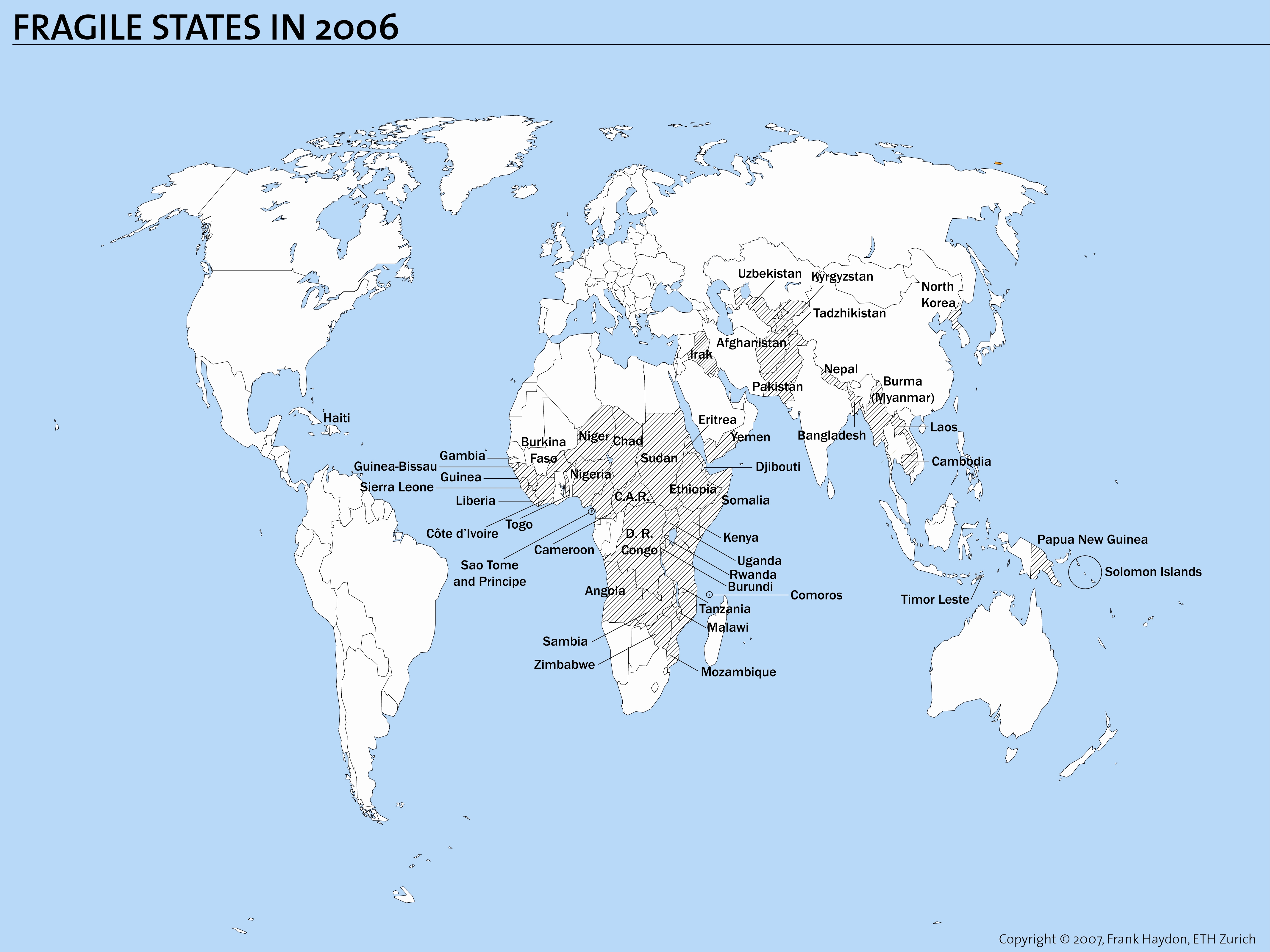
"Fragile States: ‘Toughest Development Challenge of Our Era’"


"One billion people live in countries where the state is breaking down or is overcome by conflict. The countries are often poor or with large pockets of poverty. Their governments are typically unable or unwilling to provide basic services or enough security for people’s lives to improve. These fragile states are the “toughest development challenge of our era,” Bank President Robert B. Zoellick observed recently at the International Institute for Strategic Studies in Geneva. “The diseases, outflows of desperate people, criminality, and terrorism that can spawn in the vacuum of fragile states can quickly become global threats,” Zoellick said." More!

Monday, September 22, 2008

Water may be the real problem

Source: "Water for farming: Running dry," The Economist, September 18th 2008.
"(A)s the world’s population grows and incomes rise, farmers will—if they use today’s methods—need a great deal more water to keep everyone fed: 2,000 more cubic kilometres a year by 2030, according to the International Water Management Institute (IWMI), a research centre, or over a quarter more than they use today. Yet in many farming regions, water is scarce and likely to get scarcer as global warming worsens. The world is facing not so much a food crisis as a water crisis, argues Colin Chartres, IWMI’s director-general."
Comment: As in the case of energy efficiency, there is one strategy that has a couple of benefits. If we were to eat more vegetable protein and less animal protein, we would save a lot of agricultural water, and those of us living in fat societies would also be healthier.

Of course, as water becomes more scarce, farmers will must and will use more water efficient technologies. The Israelis have decades of experience in water saving agriculture, including water harvesting technologies.

Still, given the inertia of political systems, I fear water wars in some areas that are already "tinder boxes" in both senses of the term. JAD

World Malaria Report 2008

"Half of the world's population is at risk of malaria, and an estimated 247 million cases led to nearly 881 000 deaths in 2006. The World malaria report 2008 describes the global distribution of cases and deaths, how WHO-recommended control strategies have been adopted and implemented in endemic countries, sources of funding for malaria control, and recent evidence that prevention and treatment can alleviate the burden of disease."

According to the Economist:
The report comes on the eve of a United Nations malaria summit in New York on September 25th. Governments, philanthropic outfits (notably the Gates foundation), activists and celebrities will launch a new global strategy and collect hefty pledges in its support. Campaigners say that malaria’s moment has finally arrived.

"Science Questions for Would-Be Presidents"


Scientific American provides a brief article in the October 2008 issue on the scientific positions of the two candidates. The editors, who provided the piece, emphasize that the candidates have as others before them, avoided providing details of their science and technology policies leaving it difficult to choose between them. After describing similar positions on energy, stem cells and space, the article states:
Obama, more than McCain, has taken positions on many other science issues. He has promised to double federal funding for basic research. Over what period? And does that figure include his promised energy investment? He has said he would appoint a chief technology officer to protect citizens’ electronic privacy, but could that person really overrule federal agencies with their own prerogatives? How precisely would Obama make good on his vow to reform the troubled copyright and patent system?
Comment: The editors apparently would prefer that the candidates would inform us about their policies. The candidates, I strongly suspect, want to provide only as much information as will maximize the number of votes that information captures for them, avoiding losing any more votes than necessary. Indeed, the situation is probably even more complex. Can they not be thinking about voters in Florida, with the space flight center, when they support manned space flight?

Both candidates are politicians and, in spite of their emphasis on change, each has voted the vast majority of the time with his party. That may tell you more about their likely science and technology approach than their formal statements.
JAD

The Candidates on the Financial Crisis

The candidates are commenting on the current financial crisis and making proposals as to what they would do about it. Of course, even when elected the winning candidate will not be able to act as president until January 20th, 2009.

More to the point, neither one knows much at the moment, compared to the spokespersons for the government. A Candidate has a few hundred policy people that he can draw on. The secretary of the Treasury has thousands. Not only is the Treasury Department there at his disposition, but he can draw on the State Department and its thousands of diplomats for information on foreign governments, the Commerce Department, not to mention the regulatory agencies. The federal government should have many more people, with enormous skills and resources working on the analysis that has lead to nearly a trillion dollars of initiatives. No candidate can match those resources.

It is interesting to hear how they approach the crisis in terms of evaluating their teams and fundamental approaches to governing, but it is not useful in coming to decisions on what the government should in fact do.

Sunday, September 21, 2008

The Web Science Research Initiative

The Web Science Research Initiative (WSRI) is a joint endeavour between the Computer Science and Artificial Intelligence Laboratory (CSAIL) at MIT and the School of Electronics and Computer Science (ECS) at the University of Southampton. The goal of WSRI is to facilitate and produce the fundamental scientific advances necessary to inform the future design and use of the World Wide Web.

The Initiative seeks to bring together academics, scientists, sociologists, entrepreneurs and decision makers from around the world. These people are to create the first multidisciplinary research body to examine the World Wide Web and offer the practical solutions needed to help guide its future use and design.

Tim Berners-Lee, credited with inventing the World Wide Web, director of the World Wide Web Consortium, senior research scientist at MIT and professor at the University of Southampton is one of the four founding directors of the Initiative.

"Africa's Great Green Wall"

Before and after images source: "Africa's Great Green Wall," Celcias

The Community of Sahel-Saharan States (CEN-SAD) has initiated a project to build a Great Green Wall across the continent from Mauritania in West Africa to Djibouti in the East. The project is an attempt to stop growing desertification in the northern regions of the continent. A 5 km wide 7,000 km long green strip of trees is to be planted across the desert from Dakar to Djibouti to constitute a barrier to further progress of desertification.

Read more at Global Envision.


This is an extremely ambitious project, and one that has not yet been completely funded. There is at least one precedent. The Great Hedge of India was installed in the 19th century to help stop smuggling (of drugs). It stretched a distance of 2,300 miles and was guarded by nearly 12,000 men.

Information technology Competitiveness

Will Informatization Recapitulate Mechanization?

Once, not all that long ago, physical strength was important in day to day life. My great-grandfather was remembered in my life as a man who could alone lift a barrel of bear down from a cart. A man who could plow a straight furrow following his animal, or a woman who could weave most dexterously was admired for the physical ability. Then came mechanical power to amplify man's strength and mechanization that was more dexterous than the most rapid manipulator. Those abilities were no longer needed in day to day life.

Indeed, the quickest is now the jet pilot or the racing driver; the strongest is the operator of the biggest earthmoving equipment or locomotive; the most dangerous person in single combat may be the operator of a predator unmanned aircraft. Their mental and physical endowments are quite different than those of the athlete.

We still honor the swiftest runner, the man who can throw a javelin furthest, the man who can lift the heaviest weight in the Olympics. We provide great economic rewards for the best professional players of soccer, football, basketball, and baseball, and the best professional cyclists. We do so, however, because we find the competition entertaining (and we can bet on the results), not because the best performing athlete will be the best warrier or best worker.

Even now, many intellectual abilities are important in everyday life. Yet some which were once important have been devalued by the changes that have occurred in our society. A good memory is less important than it once was, as means of automating recall have become more common. In my youth, the skills of the clerk typist and draftsman, essentially putting information in good order, were highly valued, but today those functions have been largely automated. The librarian, an expert in locating and retrieving knowledge, is a highly trained professional, but kids now Google to locate what they need quickly on the Internet; we are seeking to make those kids information literate in much the same way as professionals who once depended on clerk typists had to learn to use computers to prepare and store their own documents.

More and more information and communications technology is used to allow the average person to do that which only the intellectually gifted or trained person. So too, we will probably reduce the prestige we allocate to those who possess these once important abilities which are now common due to ICT-based intellectual augmentation. Expert systems, artificial intelligence, and other developments can only extend the effect.

We will still value those persons who can use the information and communications machines most effectively. Those who create the most powerful computer systems, the most complex Internet protocols have abilities that are rare and important to our society.

We still find demonstrations of intellectual abilities entertaining, and reward the winners of spelling bees, of school scholastic competitions, of chess, bridge and go tournaments. We even still have quiz shows on television that reward memory abilities.

Perhaps we will reserve our future adulation for the most moral people, for those with the 'greatest temperament", or those with other moral capacities.

Which is the important story today

The one the newspapers covered or the one they did not?

Those Covered:

The story they didn't cover:
I find myself unable to adequately address the failure of the media to put stories in their true perspective.

If the average American really understood that most of these kids die because no one cares enough to save them, would we really act as we do in the world?

For Developing Countries
Source: Christine Park
"Committing to Child Survival: What are the Priorities?"
Global Health Policy, June 08, 2007

STE4D and poverty alleviation


This is a gross oversimplification, but my time working for USAID led to the belief that that agency had two different sets of objectives for foreign assistance. For some countries for which the United States seeks political leverage, the program focuses on financial assistance at high levels according to the interests of the governments in power. For other countries, the humanitarian objectives dominate, the program is more modest and directed at poverty alleviation.

Similarly, my time with the World Bank led me to believe that its loan programs were directed by the borrowing countries to areas that would generate income needed to repay the loans. The resources provided on subsidized bases to the poorer nations were more focused on poverty alleviation.

From the point of view of science, technology and engineering for development (STE4D), it matters quite a bit whether the focus in increasing GDP or poverty alleviation. I do believe that in countries with strong pro-poor policies, increasing GDP per capita is a good way to reduce poverty, and in those countries STE4D can combine direct interventions aimed at poverty alleviation within the propoor policy and measures to improve GDP more generally.

In general, I think, the STE4D efforts to improve GDP will be oriented toward the more productive industries, including extractive industries, often toward exporting industries, and often in urban areas. While they will recognize the needs for more labor intensive approaches than would be used in developed nations, they will often focus on relatively capital intensive enterprises. The politics in the United States of using U.S. taxes to subsidize the transfer of technology to developing nations to support the development of export industries is not very attractive. Investments in science and technology to support human resource development for these industries is more acceptable, and so one does see STE education, educational technology, biomedical research and medical technology included in even the assistance to poor nations.

While I can and have helped develop both kinds of programs, I am much more interested in STE4D applied specifically to poverty alleviation. Generally such programs focus on:
  • agriculture, both to alleviate hunger and to improve the incomes of the agricultural workforce including subsistance farmers;
  • health, to alleviate the illness that is one of the worse burdens of poverty;
  • environment, since the poor are so vulnerable to the worsening of their poverty due to the degradation of their environment;
  • what is termed "Appropriate Technology" being that which is used in the productive activities of the poor, such as technologies for residential housing, cooking, clothing, etc.
There should be, but seems seldom to be, an emphasis on engineering science and technology. A significant impediment for poor people seeking to raise themselves out of poverty is the inadequacy of the infrastructure that serves them. They don't have good roads, and so pay more for the goods they buy and get less for the goods they sell. They don't have access to electricity nor telephone services, nor even broadcast media. Their potable water and sanitation infrastructure is weak, so they spend a lot of time carrying water and get sick more than they should. Their fields are not irrigated, their agricultural water supply uncertain, and thus their agricultural productivity limited.

Indeed, there is also a need for engineering technologies such as development of artisanal foundries, lime kilns, and brick kilns, small scale mining and forestry, etc. I would even suggest that the introduction of information and communications technology for microfinance enterprises is a significant element within an STE4D poverty alleviation strategy.

It is (now) widely recognized that there are areas of tropical agriculture, infectious diseases, tropical fisheries and tropical forestry in which research and development needs to be subsidized internationally in order to meet the needs of poor people in developing nations. The R&D done in rich countries does not adequately meet these needs, and commercial firms don't find sufficient market incentives to develop technologies for people living on less than one or two dollars a day.

It is perhaps less recognized that the needs for technologies specific to poor countries is very broad. For example, these countries need to develop road construction materials that use their own mineral resources and do not have excessive maintenance requirements. Mobile phone technologies may be quite different for the dense populations of frequent phone users in developed nations versus the sparse rural populations of low-frequency phone users of poor countries. A low price computer with software in local languages linked to local legal requirements might be quite different than one designed for sale in the United States or Western Europe. Scrap metal used by foundries differs from country to country, and foundry technology should be optimized for the characteristics of the country. The criteria for an appropriate medical technology -- affordability, need for professional administration, patient requirements to comply with treatment regimens, genetic makeup of the population, likely co-existing diseases, etc. -- make the choice of medical technology country dependent.

As a result of the need to adapt technology to local needs, there must be a considerable STE capacity in country devoted to STE4D for poverty alleviation. The local people would select internationally available technologies, adapt them to local circumstances and develop new technologies for local use.

Unfortunately, support for agricultural research and development oriented toward poverty alleviation and development of Appropriate Technologies has withered, and is likely to suffer still more in the coming economic hard times. There are still a few billion very poor people in the world who will suffer more than necessary in the future for lack of adequate investments in STE4D for poverty alleviation.

Geoff Oldham on the history of S&T4D

Geoff Oldham has a long presentation in a streaming video which, although nominally on the Sussex Manifesto (on science and technology for development -- done in 1970), includes a great deal on attitudes towards the subject over the last forty years, as well as his suggestions on the updates that would be made.

Go to the seminar website, where you can also download the manifesto itself.

Saturday, September 20, 2008

McCain on the economics of health care

From Paul Krugman's Conscience of a Liberal blog (September 19, 2008):
OK, a correspondent directs me to John McCain’s article, Better Health Care at Lower Cost for Every American, in the Sept./Oct. issue of Contingencies, the magazine of the American Academy of Actuaries. You might want to be seated before reading this.

Here’s what McCain has to say about the wonders of market-based health reform: "Opening up the health insurance market to more vigorous nationwide competition, as we have done over the last decade in banking, would provide more choices of innovative products less burdened by the worst excesses of state-based regulation."
Given that failure to regulate the financial services industry has resulted in a cascading crisis that is generally agreed to be the worst since the 1930's, and is leading the Republican administration to socialize major segments of the industry, Senator McCain seems very hard to convince of the dangers of unregulated markets.

Actually, his article is even worse than that quote would suggest. He diagnoses the problem of American health services is that they cost too much. He proposes as the major element of his health policy:
I propose to spread the tax subsidy for health insurance more equitably. I would change it to a refundable credit amounting to $5,000 for all families and $2,500 for individuals purchasing health insurance—regardless of the source of that coverage, regardless of how one purchases it, and regardless of one’s income.
He seems to think that that will allow the tens of millions of people who do now not have health insurance to obtain the insurance. That is doubtful, but if it were to be true it would increase the demand for health services. He has no plan to increase the supply of health services. If you increase demand more than you increase supply of any service, the price charged for that service goes up. That is not a way to reduce the cost of health service.

There are two fundamental facts about health services:
  • people are willing to pay a lot more to treat their illness than they are to prevent an illness that may never eventuate;
  • because of the knowledge differential between doctors and patients, the providers of medical services prescribe them and the patient recipients of the services don't have the knowledge to substitute their own economic choices.
Senator McCain writes:
We can build a health care system that is more responsive to our needs and is delivered to more people at lower cost. The “solution,” my friends, isn’t a one-size-fits-all big-government takeover of health care. It resides where every important social advance has always resided—with the American people themselves, with well informed American families making practical decisions to address their imperatives for better health and more secure prosperity.
Senator McCain apparently assumes that the public will choose the most cost-effective health insurance providers and the insurers will contain the costs of the service providers. Good luck getting an industry that depends for its growth on the growth of health care costs to contain those costs.

Finally, Senator McCain gets to an area of health planning in which I worked for a number of years. He writes:
Genuine and effective health care reform requires accountability from everyone. Drug companies, insurance companies, doctors, hospitals, medical technology producers, the government, and patients must operate in a more transparent environment that reveals what particular elements of health care cost and the outcomes they produce. Protecting the ability of Americans to have access to quality health care through affordable insurance products will involve expanded use of such policy tools as comparative effectiveness research to guide decision-making by medical practitioners; greater transparency and coding of health outcomes; and all-in costs for episodes of treatment so that people can actually make more effective and meaningful decisions about their care.
Far be it from me to argue against accountability, transparency, or learning more about the costs and benefits of alternative health care treatments. On the other hand, medicine is both an art and a science. The efficacy of treatment depends not only on the patient's conditions but also on patient compliance, diagnostic categories are uncertain and often diagnoses are not made at all (most consultations in primary care don't result in a specific diagnosis), and physicians are not machines. Moreover, an error at the laboratory, the doctors office, the surgical suite, the nursing station, the pharmacy, or the follow-up service may result in a failure of the whole chain. The communist nations found how difficult it is to control a system by central government planning to set quotas and quality standards.
Source: Ezra Klein, "Health Care Costs Will Eat Us," The American Prospect.
Source: "The Future of Medicare: Demographics vs the Cost of Health Care"
National Committee to Preserve Social Security and Medicare

LINK News Bulletin: August 2008

Special Issue on Development Assistance

"To coincide with the high level forum on aid effectiveness taking place in Accra in the first week of September, this issue of the LINK News Bulletin presents two opinion pieces on science and technology and development assistance. The first, by LINK co-ordinators Andy Hall and Jeroen Dijkman, reflects on the implication of a global knowledge economy and the way it calls into question the notion of donor and recipient countries. Norman Clark, the author of the second opinion piece, has been working on policy aspects of S&T and development since the early 1970s, and has held positions at SPRU and, most recently, at the African Centre for Technology Studies (ACTS) in Nairobi and the Open University in the UK."

Conference: Science with Africa

This conference, which took place from 3 - 7 March 2008 in Addis Ababa, Ethiopia, aimed to explore how African scientists can increase their collaboration and participation in international science initiatives and research and development projects as well as promote the use of science and technology in the African development process. The Conference outlined specific plans of actions for implementation under each of the Conference themes.

Republicans tend to be more easily startled

Shankar Vedantam, the reporter who covers human behavior for the Washington Post, had an article in yesterday's paper reporting a small study done in Nebraska. He reports
People who startle easily in response to threatening images or loud sounds seem to have a biological predisposition to adopt conservative political positions on many hot-button issues.........The finding suggests that people who are particularly sensitive to signals of visual or auditory threats also tend to adopt a more defensive stance on political issues, such as immigration, gun control, defense spending and patriotism. People who are less sensitive to potential threats, by contrast, seem predisposed to hold more liberal positions on those issues.
Of course, as you would expect, he goes on to report that
researchers stressed that physiology is only one factor in how people form their political views -- and far from the most important factor. Startle responses, moreover, cannot be used to predict the political views of any one individual -- there are many liberals who startle easily and many conservatives who do not. What the study did find is that, across groups of people, there seems to be an association between sensitivity to physical threats and sensitivity to threats affecting social groups and social order.

"For a Global Generation, Public Health Is a Hot Field"

This article by David Brown in the Washington Post (September 19, 2008) reports that enrollment in public health classes is increasing in schools that have long offered them, and
A recent survey by the Association of American Colleges and Universities found that 137 of its 837 members, or 16 percent, now offer majors or minors in public health. (The number offering single courses is unknown.) Nearly two-thirds of the schools in that group require students majoring in the subject to undertake fieldwork or research.
I suggest that the increased emphasis on public health is not only a useful complement to medical and nursing schools that focus primarily on curative medicine, but a rebalancing of a system that has focused too much on cure and not enough on prevention. Moreover, as the article correctly states:
the benefits of studying public health go considerably beyond understanding infectious disease.

The concepts introduced in basic epidemiology courses include causation and correlation, absolute risk and relative risk, biological plausibility and statistical uncertainty. Nearly all health stories in the news -- from the possible hazards of bisphenol A in plastics and the theory that vaccines cause autism, to racial disparities in health care and missteps in the investigation of tainted peppers -- are better understood with grounding in that discipline.

Friday, September 19, 2008

"Knowledge, technological learning and innovation for development"

The Least Developed Countries Report, 2007

UNCTAD produces a report on the least developed nations every year. The Least Developed Countries Report 2007 focuses on knowledge accumulation, technological learning and the ability to innovate as vital processes toward genuine productive capacity development in these countries.
The Report shows that the current pattern of technology flows to LDCs through international trade, foreign direct investment and intellectual property licensing does not contribute to narrowing the knowledge divide. Sustained economic growth and poverty reduction are not likely to take place in countries where viable economic re-specialization would remain impossible in the absence of significant progress in technological learning and innovation capacity-building.

The Report suggests that national governments and development partners could meet this challenge, notably through greater attention to the following four key policy issues:

* How science, technology and innovation policies geared toward technological catch-up can be integrated into the development and poverty reduction strategies of LDCs.

* How stringent intellectual property regimes internationally affect technological development processes in LDCs, and how appropriate policies could improve the learning environment in these countries.

* How the massive loss of skilled human resources through emigration could be prevented.

* How knowledge aid (as part of official development assistance) could be used to support learning and innovation in LDCs.
Note that there is a set of eleven background papers available on the website -- papers that were prepared to support the major document. They include a paper by my friend Sara Farley, "Donor Support to Science, Technology and Innovation for Development; Approaches in the Least Developed Countries".

"LEED & Extreme makeover"

The TECO blog has an interesting posting on a house makeover that produced a very ecofriendly building:
The home maintains a sustainable site by being completely devoid of conventional, water-guzzling turf. Some 85% of the lot is permeable, allowing rainwater to filter into the ground rather than polluting the aquifer as runoff. Energy use is reduced by 37% over conventional new homes with a thermal envelope tightly sealed by spray foam. Cooling efficiency is 45% better than a conventional new home, a major coup in muggy Louisiana. Three separate water-heating systems serve three zones of the house to minimize travel distance for hot water. The house is stocked withENERGY STAR®-rated windows and appliances. The home was panelized ahead of time, using 100% renewable energy.
TECO reports the makeover was done quickly as well.

Blocking Care for Women

Source: HILLARY RODHAM CLINTON and CECILE RICHARDS, The New York Times, September 18, 2008.

LAST month, the Bush administration launched the latest salvo in its eight-year campaign to undermine women’s rights and women’s health by placing ideology ahead of science: a proposed rule from the Department of Health and Human Services that would govern family planning. It would require that any health care entity that receives federal financing — whether it’s a physician in private practice, a hospital or a state government — certify in writing that none of its employees are required to assist in any way with medical services they find objectionable.

Laws that have been on the books for some 30 years already allow doctors to refuse to perform abortions. The new rule would go further, ensuring that all employees and volunteers for health care entities can refuse to aid in providing any treatment they object to, which could include not only abortion and sterilization but also contraception.
There is a very simple thing you can do to help. Take 5 minutes out of your day TODAY and visit the planned parenthood website, and click on the Bush Attacks Women's Health banner on the right side. It links to an already created letter that will be automatically sent to the Dept of Health and Human Services when you enter your name and zip code. These letters need to be submitted by September 25th so PLEASE - ACT NOW.

Science and Technology for America's Progress: Ensuring the Best Presidential Appointments in the New Administration.

The National Academies have issued a new report titled Science and Technology for America's Progress: Ensuring the Best Presidential Appointments in the New Administration. The report, was sent to John McCain and Barack Obama , and is intended to provide guidance for the one elected president in November. The book provides suggestions on filling key science appointments after the election, listing some 80 high-level science and technology appointees who will be crucial in advising the new president on issues that range from energy to health care to economic growth. It also urges members of the scientific community to serve in these positions, and suggests ways to make it more attractive for well-qualified people to do so. Richard Biddell, who was once my boss, was the staff director for the report, working with a distinguished panel.


Read this FREE online!
Full Book | PDF Summary
Authors:
Committee on Science and Technology in the National Interest: Ensuring the Best Presidential Appointments; National Academy of Sciences, National Academy of Engineering, and Institute of Medicine

A Question for the ages.

If Sarah Palin is John McCain's running mate, what kind of mate is Cindy McCain?

Thursday, September 18, 2008

Candidate's Positions on Issues of Science and Technology

Science Debate, an ad hoc group created this year for a failed effort to develop an in person debate between the candidates for president on science and technology, has succeeded in getting each candidate to submit responses to 14 questions. Obama answered first at the end of August, which gave McCain a couple of weeks to adjust his responses to those of his opponent.

I must admit that I find the responses tend to be full of pious hopes and promises, and provide very little that I could use to differentiate the candidates. McCain seems to be running somewhat against the science and technology policy of the Bush administration, but his position on stem cells seems less forthcoming than it might be. McCain frequently refers to his naval career as if it provides a basis of scientific and technological expertise and positive attitudes toward the field; I doubt that naval officers are necessarily paragons of scientific and technological temperament.

Many of the questions deal with policies such as greenhouse gas emission reduction, energy policy, and public health and not with science and technology as I understand the terms.

An article from the Environmental News Service on the Q&As states:
Democratic nominee Senator Barack Obama of Illinois says his administration would put the United States on track to cut carbon emissions 80 percent by the year 2050. "I will restore U.S. leadership in strategies for combating climate change and work closely with the international community," Obama says.

On the other hand, Republican nominee Senator John McCain of Arizona says his administration would aim for a reduction of at least 60 percent below 1990 levels by the year 2050. He does not mention international engagement but promises a $5,000 tax credit to every customer who buys an American zero-emissions car.

"PRESIDENTIAL LEADERSHIP TO ENSURE SCIENCE AND TECHNOLOGY IN THE SERVICE OF NATIONAL NEEDS: A Report to the 2008 Candidates"

"PRESIDENTIAL LEADERSHIP TO ENSURE SCIENCE AND TECHNOLOGY IN THE SERVICE OF NATIONAL NEEDS: A Report to the 2008 Candidates"

This report too recommends a strengthening of the science and technology capacity in the White House in the next administration, and recognizes that the Assistant to the President for Science and Technology is a key post in that effort. The report has some interesting historical notes. The report is the product of a distinguished Study Group on Presidential Science and Technology Personnel and Advisory Assets created by the Center for the Study of the Presidency.

"R&D IN THE FY 2009 BUDGET"


The AAAS provides this website tracking the development of the U.S. federal budget for science and technology for fiscal year 2009.

Quotation

"Now, the value of an idea has nothing whatsoever to do with the sincerity of the man who expresses it. Indeed, the probabilities are that the more insincere the man is, the more purely intellectual will the idea be, as in that case it will not be coloured by either his wants, his desires, or his prejudices.,"
Oscar Wilde, The Picture of Dorian Gray (1891)

"Critical Upgrade: Enhanced Capacity for White House Science and Technology Policymaking: Recommendations for the Next President"

The Woodrow Wilson International Center for Scholars has published a short document calling for the next administration to develop OSTP 2.0, an new and improved Office of Science and Technology Policy in the White House. Its major recommendations are:
  • The President should appoint a nationally respected leader to be Assistant for Science and Technology. This individual should serve at the cabinet level. The appointment should be made early in the new Administrationalong with the appointments of heads of cabinet-level agencies.
  • OSTP must be funded adequately, staffed fully, and integratedclosely with other policy-making bodies withinthe White House.
  • Robust mechanisms to obtain advice must be established and maintained through the President’s Council of Advisors for Science and Technology (PCAST), the President’s Council on Innovation and Competitiveness, the National Science and Technology Council (NSTC), the National Academies, and a proposed new Federal-State Science and Technology Council.

The authors of the report (JENNIFER BOND, MARK SCHAEFER, ROD NICHOLS and DAVID REJESKI) have interviews a large number of people with intimate knowledge and long experience in U.S. science and technology policy, and have produced a thoughtful and useful report. I especially recommend the quotations that are liberally sprinkled through the document.

Read what others have said of the report:

"The presidents' guide to science"

Source: James van der Pool, BBC Horizon, September 16, 2008.

Mr McCain went to naval academy, while Mr Obama graduated in political science before training as a lawyer. Whichever is elected president will face issues which demand scientific and technological understanding.
  • Climate change requires understanding of atmospheric systems and the generation of greenhouse gases. This administration has caused grave problems by failing to understand that the rapid introduction of subsidies for the production of biofuels would result in dramatic increases in food prices.
  • The energy crisis has complex economic causes, requires understanding of the projection of energy demands, requires understanding of the potential for making the economy more energy efficient through technological change, and requires understanding of oil reserves and the environmental implications of their exploitation by alternative means.
  • The biotechnology revolution involves weighing ideological issues against medical risks and scientific potentials. The Bush administration has restricted government funding to only a few lines of stem cells which are aging and losing their utility, while it has been discovered that stem cell research is not only potentially important for development of treatments of degenerative diseases but also may hold the key to cures for cancer.
  • The United States depends for its future economic health on maintaining a rapid rate of technological innovation, and for that purpose depends on maintaining a strong cadre of entrepreneurial scientific and technological manpower.
  • National security also involves complex scientific and technological issues. The Bush administration is currently struggling to understand how much of a threat the processing of nuclear materials poses, whether dual use technologies are efficient for that processing, and how quickly a mid income country could prepare a nuclear weapon. Missile warfare also involves judgments of technical feasibility, and indeed the social scientist views should be brought to the table in discussing the roots of terrorism and the likely success of alternative policies to uproot terrorism.
  • Other challenges are likely to arise during the administration. Think about the anthrax attacks and the follow up investigation, the HIV/AIDS pandemic, the SARS epidemic. The fundamental point is that over a four year period, unforeseen crises are almost certain to arise.

Thus it is important that the president receive good scientific and technological advice, helping him to understand the more abstruse scientific and technological aspects of these and other problems. The advice coming through tne Domestic Policy Council, the Council of Economic Advisors, and the National Security Council should be complemented by advice coming through the Office of Science and Technology Policy, headed by the president's Science Adviser and complementary advisory bodies.

The most important job of the Science Adviser and his office is to manage the interface between the expertise embodied in the scientific and technological community and the presidency, seeking to assure that presidential decisions are adequately informed by scientific and technological knowledge. The Office also serves as an advocate for the scientific and technological subsystems of the federal government, and attempts to achieve some coordination among these subsystems. The Office, and especially the Science Adviser serves also as a spokesperson for the Administration on matters of science and technology policy and to the science and technology policy community, as well as a liaison with the Congress on scientific issues.

The Science Adviser should have not only be prepared by background and experience to fulfill these functions, but have sufficient prestige within the scientific and/or technological community to have face validity in the post. While it may be tempting to select the Adviser for his/her personal expertise in an area of special interest to the president, the person should have wide understanding of science and technology policy, and the ability not only to deal with a wide range of issues, but also to respond to unforeseen crises.

The choice of the Science Adviser is one of the more important ones for an incoming administration, albeit one that has seldom been so recognized. Indeed, the top level of officials in his office are sufficiently important to warrant Congressional approval. We must hope that the candidate elected in November selects a good one.

Beefcake Talking Sense


Source: YouTube

Monitoring and Evaluation: ICT

These are not us chatting!

I was chatting with a graduate student about monitoring and evaluation of efforts to disseminate ICT to developing nations, and it occurred to me to post some of my thoughts on the topic.

Planned Versus Viral Dissemination

The first major distinction I would make is probably between planned and viral processes for the dissemination of technology. It seems often my more bureaucratic friends think about pilot projects which, when tinkered into success, are scaled up. Their planned, deterministic approach might be applied to the introduction of ICTs in the public medical care system, the public school system, or the development of a national system of telecenters in rural areas. It is similar to the approach for innovation in an organization which creates a center for the innovation followed by a process of dissemination to other organizational units.

The viral approach, easy for me as an American to identify with, involves setting up the conditions that encourage people to innovate and creating the institutions needed for them to obtain the resources with which to innovate, and letting inventions diffuse. People observe their neighbors successes and failures, obtain information from all sorts of sources, and adapt the technology as best they can to their own needs and desires. The process is unplanned, teleonomic rather than telologic, but is the preferred approach in our U.S. post-frontier, anti-authoritarian culture.

Both approaches have their place, and indeed they may be complementary. But for the purposes of monitoring and evaluation, the two approaches have differing meanings.

I suggest, however, that projects should always be evaluated, and seldom are so evaluated, in terms of their contribution to the overall development of the ICT infrastructure and the appropriate evolution of the institutions utilizing that infrastructure. Are the projects properly chosen for the state of the infrastructure and institution? Could the project resources have been better used to grow the infrastructure faster or better, to make the institution function better or to achieve institutional improvement more quickly?

Projects Versus Infrastructure and Institution Building

I would also make a distinction between projects and the longer range process of change of the ICT infrastructure and change of the institutions built upon that infrastructure. Projects are best understood within that larger context.


The information revolution has been going on in its pioneer societies for a very long time. Computers were first introduced in World War II, and telephones in the last quarter of the 19th century; the telegraph even earlier. Large organizations in developed nations not only have a long experience of building their ICT infrastructure, they function in ways made possible only by that infrastructure. So too, modern nations have long histories of building national information and communications infrastructures and of elaboration of changes in social and economic institutions to adapt to the challenges and opportunities of their evolving infrastructures.

It is platitudinous to say that most ICT projects fail, but it is also obvious that institutions have changed enormously due to huge investments in ICT and are vastly more efficient and effective as a result of the information technology revolution. I think the answer is that there have been unrecognized positive externalities of these failed projects. And of course that the viral processes that have been going on in parallel with the planned projects have also yielded great benefits.

With the foregoing as preamble, let me suggest that the terms we use to describe "projects" matter. Here are some common ones:
  • A "pilot project" is a project conceived of as developing and testing ICT approaches that, if successful at the pilot stage, would be more widely applied;
  • A "demonstration project" is one conceived of as demonstrating ICT approaches known to work well in one or more situations to people who might adopt them in other situations;
  • A "research and development project" is one that is conceived as seeking to develop new ICT approaches, leaving their diffusion to later efforts;
  • We might also consider a "generational project" as one which develops the next generation of an ICT approach. Thus chip manufactures develop generations of chips, making massive changes in design and manufacturing processes for each generation; Microsoft replaces DOS with Windows, and then Windows with Vista.
On the one hand, it is important in monitoring and evaluation of a project to be specific as to the objectives of that project. On the other hand, it is also important to recognize that a projects effects can be seen and evaluated in the larger context.

I would caution against mis-designation of projects. If indeed an ICT application is at the early stage best characterized as research and development, it is unfair to evaluate it as a pilot or demonstration project. I would also caution against allowing one's preconceptions of the nature of the project from blinding one to the actual results of the project. A pilot project may not be scaled up, but may instead be widely influential in the diffusion of the technology via other means; is it then a failure?

I had difficulties with this kind of error when I was the Work Program Director of the infoDev program. The projects we funded were intended to be innovative projects, introducing a new technology into their countries and often inventing new ICT approaches. A survey I did identified that the project personnel were publishing their findings, were teaching in universities building on their experience, were consulting, and were demonstrating their efforts to many (apparently) influential visitors. ICT officers of donor agencies were gaining experience with ICT applications via exposure to those projects, and were presumably utilizing that experience in other project development. We had no way to measure the impact of those projects on the actual dissemination of ICT in developing nations, but I continue to believe that there was such an impact.

On the other hand, few of the projects reported that their projects had been adopted by a government as pilots and had been scaled up. The program was criticized by its donors for the lack of that kind of impact. I think the issue was in the distance between the preconceptions of donor staff, infoDev staff and project staffs. However, it seems to me that without means of measuring the actual impact of the portfolio, it was unfairly criticized as failing to meet preconceptions of a few donor agency staff members.


Project Portfolios

Portfolios of projects raise their own monitoring and evaluation issues. Often people suggest that each project in a portfolio devote a given percentage of its budget to monitoring and evaluation. This can not be right! Consider the total resource base available for monitoring and evaluation of the portfolio. The field of possible alternatives for the allocation of these resources among the projects of the portfolio is infinite. The probability approaches zero therefore that the optimum allocation is either equal amounts to each project or the proportional allocation according to project budgets. I suggest that a heuristic allocation based on the issues the portfolio managers are most willing and able to address is likely to be better than any nominal allocation. (Incidentally, the limiting resource may not be funding, but rather things like human resources or the time of key decision makers.)

I managed portfolios of projects for many years and I found some useful approaches to be a combination of:
  • Ex anti peer review of project proposals, in a multistep process in which more time and effort are devoted to the proposals most likely to merit funding (with feedback to project proponents);
  • Regular reporting on project progress from all projects (but not so often as to constitute an excessive burden to the project personnel not to overwhelm the staff reviewing the progress reports);
  • Portfolio management staff review and feedback on all project reports;
  • Focus groups of representative project implementers with portfolio management staff for a combination of open discussion and directed discussion of key issues;
  • Ad hoc ex post peer reviews of groups of projects, where the issues to be addressed are identified in advance and the projects are selected as those best suited for the purpose of addressing those issues.
The Problem of Intentionality

As described above, infoDev was an intermediary between large donor agencies and small grant recipients. (Large donors generally don't make small grants, since their management often believe their agencies can not do so efficiently and effectively.) The result was that the program was held by each of its donors responsible for achieving that donor agencies objectives in funding infoDev. The staff of infoDev, which came from a number of backgrounds, had their own intentions for the program. Of course, the grantees all had their own objectives, and most sought only an acceptable overlap with the intentions that they perceived (not always accurately) of infoDev.

This is an example of the general problem that different stakeholders in the application of ICT to development have different intentions. My experience is that often the intentions are not articulated, and perhaps not even fully appreciated by those involved. Successful writers of proposals are expert at hiding their own intentions and explaining how the proposed effort is likely to meet the perceived objectives of the funding agency. In short, efforts to evaluate whether efforts have achieved objectives run into the problem of determining what the objectives were, and whose objectives count for how much.

Even dealing with projects prepared by skilled international bureaucrats in organizations with strong bureaucratic procedures to assure clear statements of objectives, I have found the stated objectives of projects to be hard to understand, and have found different interpretations of those stated objectives by different stakeholders.

An alternative to the effort to evaluate the fulfillment of project objectives is an effort to document project effects, both positive and negative, and to compare those with project costs. The evaluator can then come to his/her own conclusion as to whether the benefits outweigh the costs, recalling that effects that can not be measured or quantified may still exist.

Which brings me to the unintended consequences of projects. I am reminded of the creators of a network of telecenters in villages in India who discovered to their surprise that its most important application in the minds of the villagers appeared to be in simplifying the search for suitable marriage partners for their young people from other, nearby villages. The organizers had assumed that the benefits would come from agriculture, public health and other "serious" applications. How foolish it would be to denigrate the advantages that were recognized by the people themselves. In a similar vein, the telephone companies originally tried to dissuade the household use of telephones, feeling the network should be reserved for "important" uses in business. Consumer demand eventually overcame that foolish bias.

ICT As a Means to an End: The Matrix of Objectives

The Logical Framework is a well known approach to the management of development projects, first developed and disseminated by Leon Rosenberg and my friends Larry Posner and Molly Hageboeck. Using the LogFrame, projects are described in terms of their inputs, outputs, immediate purposes and longer term objectives. It encourages assumptions to be documented, and requires the project personnel to define specific indices and benchmarks against which project performance is to be measured. The approach can be adopted for monitoring and evaluation of projects introducing ICT applications, and indeed has often been so adopted.

Let me suggest, however, that it might be more appropriate to consider ICT applications more specifically using a framework for the sector in which the technology is to be applied. Consider for example, health services. We may consider health services to be divided into several categories according to the institutions which provide them:
  • health education and communications delivered via mass media, in schools, etc.;
  • public health services such as immunizations delivered house to house or otherwise in the community;
  • outpatient medical services delivered via health centers, emergency rooms, physicians offices, etc.;
  • inpatient medical services delivered via hospitals of various kinds.
We can also consider a hierarchy of measures that can be applied to the evaluation of health services, such as:
  • benefit to cost ratio
  • overall cost
  • effectiveness (measured over the population)
  • coverage
  • efficacy (measured in the individuals receiving interventions)
  • quantity of service output
  • quality of service output
  • cost per unit service output
  • financial inputs
  • quantity and quality of human resource inputs
  • quality of the technology (body of techniques utilized)
  • quality and magnitude of the physical plant used to deliver services
  • quality of the management of the service
I consider ICT in this context to include a wide variety of technologies, and indeed it may be that formal review of the possibilities of application of the variety of technologies to the variety of functions of the health service will lead to interesting and useful innovations. Consider:
  • broadcast radio and television, including community radio;
  • recorded media such as cassette recordings, VCR,
  • citizens band, short wave and other point to point to radio
  • mobile and fixed line telephone.
  • call center technologies
  • PDAs and other hand held computers,
  • personal computers
  • computer centers
  • networks, local area networks, wide area networks, Internet
  • imaging technologies and other ICT embedded in diagnostic or other medical devices
Such a broad framework encourages one to consider whether the resources available for introducing and disseminating ICT innovations in the health sector are being used most effectively to improve the health of the target population.

For example, it encourages one to ask:
  • Whether innovations in communications should best be used to influence the general public via broadcast media, or target populations of patients via small group or individual sessions, or health service providers?
  • Whether telemedicine should be introduced focusing on service to the homebound patient, the community health auxiliary, backup of primary care physicians with specialists, etc.?
  • Whether computer support should prioritize applications in service management or in the delivery of care?
Returning to earlier themes, the health system as broadly conceived has obviously been evolving its ICT infrastructure for decades and has been evolving institutional responses to the changing infrastructure over a similar period. I find myself communicating with my HMO via the Internet in ways I could not have imagined thirty or forty years ago. On a visit to my physician, I am greeted by a nurse with a fully automated set of instruments that communicate directly with ah HMO wide network. All the providers in the system face me with computer terminals at their sides, entering and retrieving information from my computerized medical records. I also have had medical imaging via computerized tomography. The examples go on and on of service involving ICT that I could not have imagined in the past.

Thus the introduction of ICT in the health system must necessarily be considered a very long term process which, especially in developing nations, is at least decades from completion. It is important to manage that long term process so as to utilize scarce resources as effectively as possible, ultimately to maximize the improvements in the health of the population being served.

Doing so must necessarily involve projectizing interventions to improve the ICT infrastructure and its applications. Thus there is a need for project monitoring and evaluation, as well as the longer term monitoring and evaluation of the development of the ICT infrastructure and its applications for health services. Indeed, in my HMO I am sure that at any given time there is an ongoing portfolio of ICT related projects being simultaneously implemented.

In the process, the interests of many stakeholders have to be considered. Patients are not an undifferentiated collective these days, but may be organized in community or diagnostic categories. The interests of physicians, nurses, pharmacists, and other professionals in a health service are not identical and may be conflicting. The public has interests both as those paying for the health service system and as the patients of that system, and the guardians of these interests may be different one from the other.

You can find many resources on monitoring and evaluation of ICT projects on the Development Gateway's site, which at the moment is not available to accept new postings.

Wednesday, September 17, 2008

Thinking about politics with your preconceptions

Jonah Lehrer has three related postings over the past three days on his The Frontal Cortex blog discussing recent research results on how people interpret information on political candidates:
The first of these cited a "backfire effect" suggesting that people may be more likely to believe a false report when they are provided information demonstrating that it is false. Lehrer includes this quotation:
In a paper approaching publication, Nyhan, a PhD student at Duke University, and Reifler, at Georgia State University, suggest that Republicans might be especially prone to the backfire effect because conservatives may have more rigid views than liberals: Upon hearing a refutation, con
In the later postings Lehrer demonstrates what I assume is liberal guilt, suggesting that Democrats and Republicans are equally guilty of the backfire effect.

I think the clear point in the research is that we are all using "motivated reasoning" and what we learn is a function of what we believe. One result which I would underline is that in one study Lehrer cites, the ten percent best informed people seemed less subject to hearing only things that reinforce their original positions.

Still, I don't find anything in the latter two postings to refute Nyhan's and Reifler's idea that Republicans may be (even) more subject to backfire effects than Democrats. Of course, that is damning Democrats with the faintest of praise!

It seems to me that it is fairly clear that the best newspapers in the country are in blue counties -- the New York Times, the Washington Post, the Boston Globe, The Miami Herald, the Los Angeles Times, The Chicago Tribune. The big cities are Democratic, and their citizens have more and better news media. Do they learn more about the candidates?

"Your Brain Lies to You"

Image source: "With MRI lie detectors
your brain gives you away
"
Marc Perton, Engadget


My friend Julianne pointed out this article by SAM WANG and SANDRA AAMODT from the New York Times (June 27, 2008). The authors describe the phenomenon of "source amnesia", the process by which through the accessing and restorage of information we eventually forget its original source and simply remember the fact.

You know George Washington was the first president of the United States, but you almost surely don't remember the places where you found that information. Unfortunately, you may also know that he threw a dollar across the Potomac and cut down the cherry tree, even though he never did those things. Since you can't remember where you "learned" about such throws and cuts, it is hard to reevaluate that "knowledge".

How important is this phenomenon? Wang and Aamodt write:
A false statement from a noncredible source that is at first not believed can gain credibility during the months it takes to reprocess memories from short-term hippocampal storage to longer-term cortical storage. As the source is forgotten, the message and its implications gain strength. This could explain why, during the 2004 presidential campaign, it took some weeks for the Swift Boat Veterans for Truth campaign against Senator John Kerry to have an effect on his standing in the polls.

Even if they do not understand the neuroscience behind source amnesia, campaign strategists can exploit it to spread misinformation. They know that if their message is initially memorable, its impression will persist long after it is debunked. In repeating a falsehood, someone may back it up with an opening line like “I think I read somewhere” or even with a reference to a specific source.
This echoes a point I made in a previous posting. The negative advertising being used in the current election campaign, most notably by the McCain campaign, has included statements found to be false. Unfortunately, some of those statements will remain in voters' memories dissociated from their sources, and accepted as truth rather than the falsehoods that they are.

Protect yourself by remembering the candidate responsible for the falsehood. Protect us all by voting against him/her.

Tuesday, September 16, 2008

"This is not a pipe"


I have removed my posting "How we see the world influences how we think of the world" from September 2. Bob Abramms of ODT maps objected to my posting which used copyrighted map images from that site.

I would make the basic point again that images which we take very much for granted can influence the way we think about the world and indeed about very important issues. There are many various projections that allow one to map the spherical surface of the earth on a flat map. The world map that is most familiar to us uses the Mercator projection, which happens to make areas look bigger the farther they are from the equator. As a result, most of us think Europe and the United States are relatively larger than they are in comparison with countries on the equator such as Brazil or the Democratic Republic of the Congo.

I think the point I am making is very similar to that made by René Magritte in the image above: the image of a thing is not the thing itself. I remember reading in the past of the surprise of people in Africa, who on showing photographs to very isolated indigenous people discovered that they could not "read" a photograph. They could not relate the small image on paper to the larger objects in the round that they represented. I also recall an ornithologist mentioning that indigenous people helping him to find birds in the forest thought of those birds in terms of their songs and the way that they fly, and found his use of pictorial images "unintuitive". We are so familiar with photographs, and think so commonly in "photographic images" that we can forget not only that they are not that which they represent, but that others do not so perceive reality. (Moreover, we also fall easy prey to photoshop falsifications posing as photos.)

Indeed, I suspect that this phenomenon is but one aspect of a more fundamental phenomenon. Our culture involves lots of tacit knowledge which we learn without examining the epistemology of that knowledge. Such cultural knowledge influences how we perceive issues, and our thinking about those issues is thus subject to biases of which we are unaware.

We always select what information to present, and the presentation of that information is not value free. Those of us with Western educations may too often assume that our knowledge is more culturally free than it indeed is. But economists draw on images (such as demand and supply curves) that they have been acultured to in order to present their theories. I recall in my early days in a college of engineering finding "engineering drawing" difficult: it was quite difficult to figure out how to represent three dimensional objects in orthogonal sets of two dimensional projections, although we take those two dimensional drawings to be obvious.

Indeed, I suspect that not only are our readings of our perceptions different according to the culture we have learned so unconsciously, but our brains differ from one another according to our cultural development. Musicians who have practiced music since early childhood have more of their brains devoted to music than do those of us not so privileged, and often can perceive the notes of music more accurately than can the rest of us.

I happen to have read of the Daly schools of Celtic Ireland, created by my ancestors, which trained people to remember public events and to report on them in verse. The students were kept in dark rooms for years on end in order to learn to depend on verbal memory rather than on visual memory. I too have that kind of mind, depending on remembering what I hear more than on what I see. That kind of mind is quite difficult for some of my friends to understand.

If you read a false charge, be careful it does not leave a negative residue in your mind

According to About.com, "this is not a photo of the Republican Party's 2008 vice-presidential nominee, Sarah Palin. Someone doctored this image by pasting Governor Palin's head on top of someone else's body." (Emphasis added.)

My friend Julianne sent me a link to "John McCain's ads are LIES. Here's the video proof." The link is to a YouTube video posted by Bravenewpac that presents a number of adds sponsored by the McCain campaign, each with a follow-up indicating that its substance was untrue. The video also cites a number of national publications which identify the negative advertising to which the McCain camp has taken refuge.

I thought I would make the video available here, but decided against doing so. My decision was based in part on Shankar Vedantam's article in yesterday's Washington Post. He makes the point that a false charge can result in a worsening of opinion about the person charged and that the impact is greater among people predisposed to think ill of the subject than among those predisposed to think well of the subject. The research also indicates that a follow-up which exposes the falsehood repairs the damage for those predisposed to think well of the subject; however, a negative residue is left in those predisposed to think ill of the subject even after the exposure of its falsehood.

So I will not post the video, but will post the photo cited by Vedantam of Sarah Palin, with the advisory that it is false!

Quotations

If you know what you know, and you know what you don't know, then that is true knowledge.
Old Chinese proverb.

True knowledge exists in knowing that you know nothing.
Socrates

True wisdom comes to each of us when we realize how little we understand about life, ourselves, and the world around us.
Socrates

Check "How do you know what you know" on Blair Warren's blog.

Monday, September 15, 2008

Today's Washington Post provides the second of two articles by Barton Gellman adapted from Angler: The Cheney Vice Presidency.

The article discusses the process used in March 2004 to decide whether and how to renew the warrantless domestic surveillance program. The program was classified and knowledge of its very existence was limited to a very few people. Lawyers from the Department of Justice, the FBI and the CIA felt it was illegal as it was being implemented, and the Department of Justice refused to clear on the required extension of the program. The Vice President and lawyers from the White House felt the president had the right to implement the program. With the limited information available to him, the president signed the extension.

At that point, according to the article, the Attorney General, the Deputy Attorney General, the Assistant Attorney General, the head of the FBI, the General Council for the FBI and the General Council for the CIA were prepared to resign collectively on the basis that they would not serve in an administration that implemented such a policy in spite of the law and in spite of the advice of the relevant agencies. Only the Nixon "Saturday Night Massacre," in which the Attorney General and Deputy Attorney General resigned, is remotely comparable to the resignation that was to take place.

Again according to the article, President Bush still had no clue that there was such extreme opposition to the program, nor that the discussions had been going on for months. Condolezza Rice, not having been involved in the key meetings, heard through back channels that there was a real problem and took advantage of a brief meeting with him to tell the president that he should talk to the Deputy Attorney General. He did so, catching him on the way out of another meeting. Gellman described the president as "gobsmacked" by the discovery that he faced a revolt within his administration over a decision he had already made.

The president stepped back and the program was revised in ways that satisfied the Department of Justice of its legality.

The Decision Making Process

It is hard to know how the decision making process could go so wrong. Clearly the president should have been informed of the breadth and depth of the opposition to the continuation of the program in its initial form before he signed off on its unmodified continuation.

The original decision making must also have been flawed. Gellman includes in his description of the hospital bed scene the following:
Ashcroft told the president's men he never should have certified the program in the first place [7].

"You drew the circle so tight I couldn't get the advice that I needed," Ashcroft said, according to Comey. He knew things now, the attorney general said, that he should have been told before.
That flaw is perhaps understandable in the aftermath of 9/11, but the system failed to inform the Attorney General in time to act in previous reauthorizations.

The conflict appears to derive fundamentally from the difference of opinion between a faction in the White House headed by the Vice President advocating very great powers for the president in matters related to national security and the position of the lawyers within other agencies who advocated more limited powers more constrained by laws. However, the nature of the controversy does not explain why the president was not fully informed of the position of both sides, and his reversal of his signature clearly indicates that he did not understand its full implications when he originally signed.

Gellman seems to imply that the problem was that the president was detached from the decision making, perhaps due to the pressure of the election campaign. That too fails to stand up to scrutiny. Had the resignations taken place, I suggest that the election would most probably have been lost, and the president surely would not have wanted to lose an election due to public appearances eight months before the election itself. The system should direct the president's attention to the points where it is most needed. The administration should understand the president's priorities well in order to direct his attention to the issues he would wish to study without the need for his personal day to day guidance.

I think there is a good case to believe that the limitations on the information distribution about the program interfered with the decision making process. Some of the people who should have been involved in assuring that the president made is decision on an adequate basis of information were not informed about the surveillance program's existence, and none of the people who did know about it were free to discuss it freely among themselves.

It seems that there was a failure to get the whole range of parties involved in the decision analysis into the same room at the same time with the president to discuss the decision, or alternatively that key parties in that room failed to present their case clearly and make clear how very strongly they felt about the policy alternatives under discussion. Of course, one does not want to allocate more of the president's attention to a matter than is necessary, nor does one want to have meetings so large that discussion can not take place, nor does one want to have too great a social distance between participants given how hard it can be to tell someone several rungs about you that you disagree with their position. Still, for the president not to know that the Attorney General, the Deputy Attorney General and the head of the FBI were about to resign suggests a major failure.

Of course, it is possible that some parties were manipulating the system to assure the decision that they wanted. A charitable interpretation of that possibility is that they felt the surveillance was so important to the security of the country that the process should be biased to assure it continued. It has also been suggested that some in the White House had long believed that the Constitution gives the president powers that have been abridged by custom over history, and it might be that there was an attempt to influence the decision to provide a precedent for the exercise of that power.

Over the history of the United States great thought and effort has been given to perfect the process by which decisions are made by the President in the White House. The Chief of Staff and other officers of the administration are responsible both to understand the lessons that have been learned and to manage the system well. It would seem likely no single element would result in so egregious a failure of the decision making process as Gellman describes. Rather one must assume that several combined in a way that a priori appeared and probably were most unlikely.

One hopes that future administrations will learn from this case, and install still further safeguards on the decision making process.

Sunday, September 14, 2008

Fight for Fuel Efficiency Standards


From the Union of Concerned Scientists:
In response to high gas prices, the Bush administration and its allies are calling for new oil drilling that would take decades and eventually save only pennies-per-gallon.

Meanwhile, Bush’s Department of Transportation is undermining historic new fuel economy standards. They unrealistically assume gas will cost around $2.50 through 2020 and that hybrid vehicles won’t even exist until 2014. Because the agency balances the cost of new fuel economy technology against the gas savings the new technology provides, these outrageous assumptions are being used by the administration to reduce the automakers’ requirement to bring more fuel-efficient options to consumers.

According to the administration’s own analysis, if they simply used a more realistic gas price, the standards would save consumers enough fuel to equal about a dollar per gallon discount at the pump. This would dwarf the minuscule price drop from oil produced through new drilling without the environmental consequences of feeding our addiction to oil.
Click here, and the Union of Concerned Scientists will guide you to effective action.

The Winning Cartoon

With this entry, Jason Bilicki won the annual Union of Concerned Scientists' third annual Scientific Integrity Editorial Cartoon Contest.

You can also order your 2009 Scientific Integrity Cartoon Calendar by clicking here.!

We Better Integrate Minorities


It looks like there is band crossing the southern United States where the population is going to be majority Latino and Black in a few years. The countries involved can stimulate the nation's economic growth if their populations are well educated and have full opportunities to innovate and progress. If they are not given those opportunities, I foresee major political changes coming as they organize to demand their rights.

Population Data: Without Comment


Source: 2008 World Population Data Sheet, Population Reference Bureau
Presentation by Bill Butz, Carl Haub, Richard Skolnik, and Linda Jacobsen

'PLANT SCIENCE: China Plans $3.5 Billion GM Crops Initiative'

Source: Richard Stone, Science, 5 September 2008: Vol. 321. no. 5894, p. 1279.

"Confronted with land degradation, chronic water shortages, and a growing population that already numbers 1.3 billion, China is looking to a transgenic green revolution to secure its food supply. Later this month, the government is expected to roll out a $3.5 billion research and development (R&D) initiative on genetically modified (GM) plants. 'The new initiative will spur commercialization of GM varieties,' says Xue Dayuan, chief scientist on biodiversity at the Nanjing Institute of Environmental Science of the Ministry of Environmental Protection."

"Yes Men: What happens when the president's advisers don't speak up."

Donald Rumsfeld, Dick Cheney, and President Bush
cringe as Bob Woodward holds his finger to the wind.
Illustration by Philip Burke via Vanity Fair


Josiah Bunting III reviews Bob Woodward's A Secret White House History 2006-2008 in the Book World section of today's Washington Post. I want to quote extensively from the review because it makes important points with respect to the use of knowledge in governmental decision making:
(I)t is a study of what happens when men and women, charged with leading the country in wartime or with counseling those who lead, do not tell each other what they really think. White House advisers are faithless to their responsibilities if they withhold their conclusions and convictions from those they serve, or from their colleagues. It is a toxicity that, by Woodward's account, infected the whole grim process......

Here are earnest, ambitious, tired (the pace of work is unremitting and furious) people trying to make sense of the war the country is prosecuting and why their strategy is not working. Many feel constrained from speaking freely by rank and hierarchy. Specialized expertise seems to have trumped the judgment provided by experience and common sense......

Inevitably, many readers will wonder how other presidents would have handled this war; in this, the sixth year of U.S. ground combat in Iraq, accounts of earlier wartime administrations have new resonance. Two spring readily, and uneasily, to my mind. As Doris Kearns Goodwin makes clear in Team of Rivals, Abraham Lincoln presided over a famously contentious wartime cabinet: Outspoken counsel was expected, even demanded. And in his biography of Gen. George C. Marshall, Forrest C. Pogue recounts the advice that Marshall received from Treasury Secretary Henry Morgenthau about how to deal with Franklin Delano Roosevelt. "Stand right up and tell him what you think," Morgenthau said. "There are too few people who do it, and he likes it."
Comment: I think Bunting is right about the importance of those around the president being frank about their positions and indeed arguing them seriously. I also think it is harder to do so than most people might think.

My year in the White House, long ago, was in a much less complex time and role that Woodward described, but I can attest that the pace of work it fantastic and people are tired. When you have a chance to affect U.S. national policy which in turn affects the whole world, you tend to take the extra step; everyone around you does as well, and the the result is a tremendous work ethic.


It is a platitude that it is hard to tell truth to power. You might think that is due to people protecting their careers by avoiding annoying the boss (or the boss' boss' boss). That is true, but there are other problems as well. I think you actually tend to believe the things the "Alpha dog" in the pack believes. It is also hard for a regular person to stand up to the egomaniacs that often inhabit the higher ranges of our government. Then of course, a reasonable person confronting a situation as complex as that in Iraq or Afghanistan should feel uncertainty about his/her conclusions and diffidence in their presentation is a form of communication about that confidence level. JAD

I also note in the article the following:
Woodward states few conclusions directly. He describes the symptoms in detail, but hands off to his readers the burden of diagnosing what went wrong. Moreover, he rarely mentions the heavy costs of misjudgment: Two continents away, 19-year-old Americans were dying while grand strategy was being debated around conference tables in air-conditioned rooms in Washington. (emphasis added)
Comment: How about the tens of thousands of people in Iraq and Afghanistan who have died, the millions who have been forced to leave their homes and take refuge from the violence, the sickness, injuries and suffering of tens of millions of these people? The chauvinism of the author in assuming that only the young American soldiers are worth considering is both breathtaking and all too frequent in American thinking. JAD

Defend Science in the United States

Thousands of scientists have signed the statement on this website, seeking to defend science in the United States from the attacks being made on it by various reactionary forces, including some high in the Bush administration. I encourage you to visit the site and sign the statement.

Thanks to the Readers of this Blog!


Technorati rank for this blog is 519,508.

Last year David Sifry wrote that, as is shown in the graph above, " Technorati is now tracking over 70 million weblogs".

Thus, my readers have put this blog well within the top one percent of all blogs.

Thank you very much!

I hope it has and will continue to provide useful information and insights,

"U.S. Arms Sales Climbing Rapidly"


Source: ERIC LIPTON, The New York Times, September 13, 2008.

"The Bush administration is pushing through a broad array of foreign weapons deals as it seeks to rearm Iraq and Afghanistan, contain North Korea and Iran, and solidify ties with onetime Russian allies.

"From tanks, helicopters and fighter jets to missiles, remotely piloted aircraft and even warships, the Department of Defense has agreed so far this fiscal year to sell or transfer more than $32 billion in weapons and other military equipment to foreign governments, compared with $12 billion in 2005.

"The trend, which started in 2006, is most pronounced in the Middle East, but it reaches into northern Africa, Asia, Latin America, Europe and even Canada, through dozens of deals that senior Bush administration officials say they are confident will both tighten military alliances and combat terrorism."

Comment: I was tempted to be sarcastic, but I don't want to take the chance on being misunderstood. It is a terrible waste to spend huge amounts of money on weapons when the problems of poverty are so severe. The money being spent by poor nations on fighter jets could better be spent on education, public health, and relieving hunger. The Bush administration should be ashamed rather than proud of its success as an arms dealer! JAD

Discrimination against migrant kids hurts them and the discriminating country

This figure from The Economist shows that the performance of immigrant students is predicted by both the country from which they come and the country to which they go. It is based on information from the surveys of the Program for International Student Assessment (PISA) of the Organisation for Economic Co-operation and Development. The article from which it is drawn notes:
At least in theory, the new findings should help counter some of the sillier things that policymakers say about the influence of migrants on a country’s overall attainments. “When we started to do the PISA rankings in 2000, many countries were shocked at how badly they did,” says Mr Schleicher. “And excuses we often heard were: ‘We get too many migrants,’ or, ‘we get the wrong sort of migrants.’”

Although immigrant children typically do worse at school than locals, there is no country-wide effect. The OECD’s analyses show an insignificant correlation between the number of immigrant children a country has and the average pupil’s attainment—and it is countries with more immigrant children that do (slightly) better.
It also notes that immigrants tend to be more motivated to obtain an education than the native kids. The great performance of Chinese immigrants in Australia and New Zealand attests to the good job done by their schools and the potential of the immigrant students. It also suggests that New Zealand and Australia will do well in the globalizing knowledge economy.

Saturday, September 13, 2008

Where Does All the Computer Power Go?

There is a new publication of the National Academies of Science titled "The Potential Impact of High-End Capability Computing on Four Fields of Science and Engineering".
Committee on the Potential Impact of High-End Computing on Illustrative Fields of Science and Engineering, National Research Council, 2008

Description: The study considered, as examples, four fields of science and engineering to determine which of their major challenges are critically dependent on high-end capability computing (HECC):

1. atmospheric science
2. astrophysics
3. chemical separations
4. evolutionary biology

While this study does identify the potential impact of High End Computing Capacity in these four fields, and thus implicitly identifies some potential funding opportunities, that is not the goal, and this study is no substitute for competitive review of specific proposals. Rather, the study is meant to illustrate the sort of examination that any field or federal agency could undertake in order to analyze the HECC infrastructure it needs to support progress toward its research goals, within the context of other means of attacking those goals.
Comment: This book provides another example of the importance of computer facilities that are beyond the budget of poor nations. JAD


Read this FREE online!
Full Book | PDF Summary

" US space woes felt by Europe"

On her last days!
Source: Irene Klotz, BBC News, 12 September 2008

Europe may have to find its own solutions for transporting astronauts and cargo to and from the International Space Station due to short-sighted US policies that now threaten Nasa's ability to maintain a presence on the orbital outpost.

More

Palin, Preventive War versus Preemptive Strike


Charles Gibson asked Candidate Palin in the recent interview whether she agrees with the "Bush Doctrine". When she finally understood he was referring to foreign policy and the decision to attack another country, Sarah Palin answered:
"Charlie, if there is legitimate and enough intelligence that tells us that a strike is imminent against American people, we have every right to defend our country. In fact, the president has the obligation, the duty to defend."
Here is what Wikipedia writes about the difference between a preemptive strike and a preventive war:
Preemptive war (or a preemptive strike) is waged in an attempt to repel or defeat a perceived inevitable offensive or invasion, or to gain a strategic advantage in an impending (allegedly unavoidable) war before that threat materializes. Preemptive war is often confused with the term preventive war. While the latter is generally considered to violate international law, and to fall short of the requirements of a just war, preemptive wars are more often argued to be justified or justifiable.
Richard C. Holbrooke, is cited by the Washington Post identifying the 2002 National Security Strategy of the White House as the critical statement of a Bush doctrine. The strategy document itself articulates the principle as follows:
"The greater the threat, the greater is the risk of inaction -- and the more compelling the case for taking anticipatory action to defend ourselves, even if uncertainty remains as to the time and place of the enemy's attack. To forestall or prevent such hostile acts by our adversaries, the United States will, if necessary, act preemptively."
Comment: The charitable interpretation of Governor Palin's response is that she avoided answering the question Gibson intended her to answer, saying a preemptive strike was justified in some circumstances.

The likely interpretation is that she does not understand how significantly President Bush deviated from American historical and accepted international practice when he promulgated the 2002 National Security Policy. If in fact the McCain-Palin ticket is proposing to change the Bush policy -- rejecting preventive war and returning to a policy of allowing only a preemptive strike and only when intelligence demonstrates an attack in imminent -- that would be a major change from the Bush administration. Since the McCain-Palin ticket is seeking to convince the public that they will change the policies of the Bush administration, Gibson's question would have been a golden opportunity to give an important example of a policy change if indeed there is a change. JAD

Clarity of Objectives

The Washington Post article quotes Bush press secretary Dana Perino:
"the Bush doctrine is commonly used to describe key elements of the president's overall strategy for dealing with threats from terrorists." She laid out three elements:

"The United States makes no distinction between those who commit acts of terror and those who support and harbor terrorists. . . . We will confront grave threats before they fully materialize and will fight the terrorists abroad so we don't have to face them at home. . . . We will counter the hateful ideology of the terrorist by promoting the hopeful alternative of human freedom."
The Washington Post also cites Peter D. Feaver, who worked on the Bush national security strategy as a staff member on the National Security Council, who "said he has counted as many as seven distinct Bush doctrines. They include the president's second-term 'freedom agenda'; the notion that states that harbor terrorists should be treated no differently than terrorists themselves; the willingness to use a "coalition of the willing" if the United Nations does not address threats; and the one Gibson was talking about -- the doctrine of preemptive war."

Comment: If you had any doubt that the military and diplomats of our government have been suffering from "mission creep" they should now be laid to rest. Different people inside and outside the administration, including the current Republican Vice Presidential candidate have different opinions as to what the Bush administration policy is.

One of the attributes of a good leader is letting his subordinates know precisely what the goals are. Experience may lead a good leader to adjust goals, but the adjustment should be explicit, the old goals formally renounced, and the new goals clearly articulated as now operative.

If the government functionaries do not know what they are to accomplish, it should not be surprising if they fail to do well! JAD

Friday, September 12, 2008

The Scientist as Politician

This is a good,, short article by Edyta Zielinska in The Scientist, not only reflection the need for scientists to bring their special knowledge to public fora, but identifying a range of alternatives for doing so, ranging from those taking only a few hours to really serious investments of time and effort.

Avian Flu, a Pandemic & the Role of Journalists

Sylvia Renteria watches a big wave caused by
Hurricane Ike crash into a seawall in Galveston, Texas.
Photo from National Geographic


Nieman Reports has published excerpts from a conference in which public health experts and journalists discussed preparations to cover the news during the next flu pandemic. Since there have been 10 flu pandemics in the last 300 years, we ought to expect that another one will arrive sooner or later. If by some chance it is not a flu pandemic, we must expect some other pandemic of a communicable disease, following. After all, we are still dealing with HIV/AIDS and remember the threat of SARS.

It is a real issue, since the reporters too are likely to be affected by the disaster and the worse the disaster, the greater the need that it be covered, and the less the ability of the journalists to do so. There is also a question of how and how much to prepare for an eventuality that may not materialize.

In the case of the next flu pandemic, it should be realized that some pandemics are much worse than others. Some generate infections more rapidly than others, some infect a larger portion of the population than others, some are more lethal than others, and some target especially important members of society (as HIV/AIDS in some African nations has been more prevalent in the military, teachers and truck drivers). The worst flu epidemic in the last 300 years is estimated to have killed 50 times as many people as the least lethal. How then does a newsroom prepare to meet the emergency?

When a hurricane occurs, and a newspaper is struggling to put out a reduced edition in the most severe of conditions, surrounded by stories that need telling, how do the editors allocate their resources, and how do they set priorities for the content that they publish? Can they prepare for those decisions in advance?

Three new NSF InfoBriefs

Read the titles of these three recent publications of the National Science Foundation:
The growth in R&D expenditures, when adjusted for inflation, was 3.1 percent nationally from 2006 to 2007. After adjusting for inflation, company-funded R&D increased 6.2%, and federally funded R&D in companies increased 7.7% from 2005 to 2006. The third report shows that R&D increased in real terms in firms with more than 5,000 employees, but decreased in firms with 5 to 24 employees and in firms with 500 to 999 employees.

The most fundamental knowledge is likely to come from fundamental research done in academic institutions, and the most innovative technologies from the smaller firms, while the giant firms are likely to be emphasizing marginal improvements in existing technology. I wonder about the Bush administration's willingness to make long term investments in U.S. competitiveness rather than subsidize the interests of their corporate supporters. (Of course, one of the explanations of the change is that the U.S. economy is moving away from the mature manufacturing sectors into higher technology sectors, and thus R&D is a larger part of the total GDP.)

Who is smarter? Who has the better team?

The United States already faces a series of huge challenges. I saw two distinguished economists yesterday saying that the economy is facing its biggest challenges since the Great Depression of the 30's, although they clarified that they did not predict a depression. It looks like we will transfer trillions of dollars of capital to the oil exporting countries in the next decade, and those nations are governed by people with whom we have huge differences. After wasting eight years before doing something about global climate change, we must make a start in the next president's administration. Two wars are continuing, and we must figure out an exit strategy that does not destabilize the Middle East. Most Americans can expect their children to be poorer than they are themselves unless the current trends are reversed. China, India and Russia, with their large populations, are growing rapidly, and are competing for resources and influence in international affairs. I suggest that the world is going soon to face food and water shortages that will require major changes in the way we live. Moreover, as history demonstrates again and again, presidents face challenges in their time in office that no one predicted in advance. Which candidate is smart enough to face the challenges of the office?

Barack Obama after college sought graduate education in Harvard Law School, and was elected to be the president of the Harvard Law Review, essentially the most prestigious student post in the most prestigious law school in the United States. He taught law for 12 years at the University of Chicago Law School. He first came to national attention when he published the first of the two books he wrote.

John McCain graduated from the Naval Academy ranking 890th in a class of 896, in spite of the fact that his grandfather was a four star admiral and his father was on the way to his four star rank in the Navy. (One assumes that faculty at the Academy would if anything favor the son and grandson of such senior officer). The two books to which his name is attached were written by a staffer.

It is pretty clear, if it was not already from watching them perform, which of these two is the smarter.

The team

When I worked in the White House, that agency had about 1,000 employees. The president's team includes not only the White House staff, but cadres of political appointees in every agency of the government. That staff is needed to analyze the issues, impose the president's policies on the executive branch of the government with its millions of employees, and deal with the other branches of government. If the president can not get his program through the Congress, he is sunk, and that alone involves dealing with hundred of legislators and thousands of Congressional staffers.

While the president is important, the intellectual challenges faced by the presidency require the combined smarts, knowledge, skills and understanding of a very large team. The question should be asked as to which party and candidate is prepared to field the stronger team. We would not want a dumb president, but I suggest that the smartest men have not always had the best presidencies (Hoover comes to mind), and the most effective presidencies may have been more marked by the capacity of the executive team than the smarts of the president himself (Reagan comes to mind; Supreme Court Justice Oliver Wendell Holmes famously quipped after meeting Franklin D. Roosevelt: “a second-class intellect but a first-class temperament”).

Barack Obama clearly has the support of the Democratic Party, and can draw on the resources of the party including those who worked in Clinton's successful administration.

McCain is running as a Republican for change. Where then is he going to recruit the team he will need to run the government. Either he will
  • retain and reshuffle the team working for President Bush, or
  • he will recruit from lobbyists and and others who study but don't work in government, or
  • he will have to go to outsider Republicans.
I am pretty sure that I don't like any of those alternatives. Since is campaign staff includes an estimated 135 lobbyists, it seems possible that he would bring us a government of the lobbyists, by the lobbyists and for the lobbyists. On the other hand, how could the people who brought you the Bush administration, which is seen by 80 of our people as unsuccessful, bring a fresh approach and make the needed changes. Or, how could the a team drawn from state and local governments and academia understand the complexities of the federal government well enough to hit the ground running and make the needed changes. (I worked in the Carter White House, and have observed the difficulties of outsiders bringing change, even under the guidance of so smart and well motivated a man as Jimmy Carter.)

The first choice by each candidate for his team, the Vice President, is suggestive. Biden's academic career was not outstanding, but he is a lawyer, and he has decades of experience in the Senate foreign relations and judiciary committees. Sarah Palin, while obviously bright, has only an undergraduate degree, and has admitted lack of knowledge about key policy issues. Biden has great understanding of how to get things done in Washington, Palin is a complete outsider.

A sad lesson

Mark Benjamin, in "Reporting a Scandal When No One Bothers to Listen,' describes his experience reporting for Salon.com the failure of Walter Reed Hospital to deal adequately with the returning soldiers and having no one listen. It was not until several years after he documented the story that articles in the Washington Post, which garnered a Pulitzer Prize, gained broad interest and lead to corrective action.

His story reminds me of one of my own. I worked with a friend to develop a system for scheduling traffic lights in Santiago, Chile. It involved the collection of data and the use of a computer program. We tested the system, and for one glorious day the "green wave" worked on the main street of the nation's capital, and traffic flowed smoothly. We trained the people in government to use the system, then nothing more happened. The synchronization deteriorated, and traffic slowed eventually to its original snail's pace. Turns out that it is not enough simply to make things possible, it is necessary to motivate people to take action.

Unfortunately for the soldiers who suffered, some to the point of committing suicide, it took more than articles in Salon.com to motivate the military, the Bush administration, and the Congress to act! Of course the question is why was the Washington Post successful when Salon.com was not, and why did the print media not pick up on the story when it was broken in the online media.

Thursday, September 11, 2008

Empire of Trust of Conquest: How to Plan and Decide


Source: "The Petraeus Doctrine," by Andrew J. Bacevich, The Atlantic, October 2008.

There is a debate going on in the military as to the likelihood of different kinds of missions in the future and how to best prepare for that future. The author identifies two camps as polar extremes in the debate:
  • One believes that the experience in Iraq and Vietnam required U.S. military capacity to protect civilians and to change entire societies in order to stabilize them, and that the military should prepare for more such missions in the immediate future,
  • The other continues to advance the Powell Doctine which emphasis on overwhelming force, assuming that future American wars would be brief, decisive, and infrequent, fought by a coalition of allies.
The prototypical proponent from the second camp believes:
that an infatuation with stability operations will lead the Army to reinvent itself as “a constabulary,” adept perhaps at nation-building but shorn of adequate capacity for conventional war-fighting.
"The Long War" prospect, calling for an Army configured mostly to wage stability operations, appears to imply political objectives of democratic transformation or imperial domination: thus the Long War implies a vast military enterprise undertaken on a global scale and likely to last decades.

In a world with an increasingly self confident Russia and China, the lack of a military capable of fighting an old-fashioned conventional war has obvious military and diplomatic risks.

Where should we institutionalize nation building capacity?

Hubert Humphrey, in his last days, sought to consolidate the various organizations implementing portions of U.S. foreign assistance into one agency reporting directly to the President. In that long distant time, the U.S. Agency for International Development was involved in nation building, and Humphrey saw the need to integrate all the nation builders into one civilian agency. The intervening years have seen a limitation of our foreign assistance to much more modest objectives, with a corresponding elimination of those from the civilian agencies who thought in terms of the big picture of nation building.

Thus there is a real possibility that the United States will develop a policy in which our military power is focused on the Long War and nation building, and our civilian development assistance community is limited to marginal roles, especially in support of the political objectives of the State Department.

Thomas Madden, in his new book Empires of Trust: How Rome Built--and America Is Building--a New World suggests that the United States is in fact established a an "empire of trust" through the creation of powerful networks of allies, and extending an umbrella of protection based on its own military strength and the strength of its coalition to those imperiled states that sought its aid. The provision of development assistance focusing on nation building by civil authorities when invited by developing nations is consistent with that empire of trust. A nation building military, involved in long term occupation to following invasion and conquest, in order to stabilize a new government allied to the United States is consistent with an empire of conquest.

It is important that military experts put forward the implications of each strategy. In the United States, it is even more important that elected civilian authorities decide on which strategy will actually be used. If we have a military designed and capable of the Long War, it is likely that we will have an administration sooner or later that will use it to try to transform the United States into an empire of conquest.

A comment on the process of analysis

Bacevich notes in his article:
The military remains a hierarchical organization in which orders come from the top down. Yet as the officer corps grapples with its experience in Iraq, fresh ideas are coming from the bottom up. In today’s Army, the most-creative thinkers are not generals but mid-career officers—lieutenant colonels and colonels.
First, I don't see the lieutenant colonels and colonels as "the bottom" but rather a key mid level in the military organization. In my experience, large complex organizations often, indeed almost always, delegate policy analysis to this level. The top administrators are, I suppose, to busy with the running of the organizations, and are necessarily dealing with a broad range of issues and concerns. Indeed, often the best policy analysts are ill suited by temperament for senior administrative posts in large organizations. (In scientific laboratories it is in my experience not uncommon to have a chief scientist and a chief operating officer, working closely together, to obtain complementary skills of administration and investigation.)

The issue in organizational design and managing large organizations is to get both the good administrators and the forward thinkers to do what each does best, and to get the two to listen to each other.

As we face the election in November, it is hard to see which future each candidate would be more likely to foster. I think, however, that Obama is likely to opt for the United States aspiring to be an empire of trust, and McCain is likely to opt for an empire of conquest. McCain has called for the Long War in Iraq and Afghanistan, and Obama knows from his experience in community development how very hard it is going to be to change culture.

A Thought About The Aftermath of Slavery

In my book club yesterday, someone wondered why prejudice against American blacks remains so long after the emancipation of all slaves, and after the even longer time that free blacks have lived in America.

Other ethnic groups were discriminated against, but generally have overcome prejudice more rapidly. I have read that Irish immigrants to the South in the famine years rioted in port cities to get access to the good and safe jobs that were reserved for slaves. People took an economic loss if a slave were killed or crippled, but an Irish immigrant only cost a wage while working, and a low wage at that. Yet we elected Irish Catholics president 48 and 16 years ago.

The word "slave" comes from "Slav", and the Slavs were once enslaved in parts of Europe. The Slavs seem to have overcome any prejudice that might have hung over from their time of slavery. Indeed, from what I read, there seems to be little prejudice against ex slaves or blacks in Islamic culture.

It was suggested that it is race that makes the difference, and majority white populations are prejudiced against the black descendants of former slaves. Thinking of Brazil, Hispanic American countries, and the United States, that seems likely. Still, racial prejudice takes quite different forms in Portuguese, Spanish and Anglo America, and indeed is different in the southern states of the United States than in other states such as Maryland where slavery existed before emancipation.

The likely explanation is that the nature of the prejudice is a function of the cultural matrix in which it is found, and contingent on the history of the abolition of the slave trade, emancipation, desegregation, and subsequent racial relations. That sounds reasonable, but it is simply giving a name to something i don't understand. What are the differences between these cultures and histories that caused racial prejudices to differ and to be expressed in different ways?

Wednesday, September 10, 2008

McCain is the true inheritor of the Bush legacy


Nita Chaudhary of MoveOn.org, in an email today wrote:
Here's the situation: John McCain and Sarah Palin are repeatedly deceiving, manipulating, and flat-out lying. And polls are showing that some of those lies are convincing voters.

Palin says she opposed the "Bridge to Nowhere"—when in fact she fully supported it. McCain says Obama wants sex-ed for kindergartners—when he voted for a bill to protect them from sexual predators.1 And Swift Boat style groups are literally accusing Obama of consorting with terrorists.
Bob Woodward's story of the Bush White House handling of the wars over the past two years is continuing in the Washington Post. It is notable that he has consistently reflected confidence in public that the United States was "winning" or more recently "succeeding" in the wars, while telling his staff that he needed more information to know what was happening and implying that he lacked confidence in the conduct of the war.

McCain too seems to be telling the public what he thinks telling them will do him the most good, rather than trying to tell the truth.

Woodward writes this about his last interview with President Bush:
By his own ambitious goals of 2001, he had fallen short. He had not united the country, but had added to its divisions and had become the most divisive figure in the country. He acknowledged to me that he had failed "to change the tone in Washington." He had not rooted out terror wherever it existed. He had not achieved world peace. He had not attained victory in his two wars. Bush himself has noted this, declaring in a Sept. 15, 2007, speech that success in Iraq "will require U.S. political, economic and security engagement beyond my presidency."
I think it is clear that if the nation elects John McCain president, he will continue this legacy. In fact, given his admitted lack of understanding of economics and that of his running mate, it may well be that his conduct of domestic economic policy will be worse than his conduct of foreign policy.

Judging Scientific Information

Steven Wiley has an article in The Scientist explaining the basis for his advice at a recent conference:
Keep current with experimental technologies, and evaluate papers on a technical basis before trusting their conclusions.
Basically, if you don't trust someones methods, don't trust their observations, and if you don't trust their observations, don't trust their conclusions. Wiley properly recognizes that you have to keep up with changing techniques to properly evaluate the methods.

Wiley uses the example of a series of articles by two scientists, a senior author named Racker and a graduate student who apparently falsified experiments. He writes:
Thankfully, fraud this outlandish is rare in biology. What fascinated me the most about the case, however, was the lack of recognition by Racker (and apparently the paper's reviewers) of the technical implausibility of what the authors were describing. Exciting ideas and Racker's past accomplishments apparently blinded him and many other people in the field. The harm to science was minimal, but the damage to Racker's distinguished career was severe.
Of course, all of us ought to be regularly evaluating the results of new scientific research for which we do not have the scientific training to adequately judge methods. "Information literacy" then involves the set of skills involved in warranting information that we are not professionally competent to warrant.

Wiley was surprised, as he should have been, that a paper with a distinguished senior author in a peer reviewed journal should have proven fraudulent. These are good indicators of confiability. Indeed, scientific knowledge system imposes serious sanctions on a scientists demonstrated to have added his/her name to a fraudulent publication or other professional document.

Belief for a scientist is a relative thing. One believes ones own results only after checking them and replicating them. One believes them more after they have passed peer review, and still more after they have been replicated by others. One greets results from others, if they are important, with skepticism, increasing belief when one has replicated them in one's own lab, and still more when they have been replicated by others, and still more when they have been incorporated in a body of theory. Even results that were as well established as Newton's theory of gravity after a couple of hundred years can be reinterpreted and revised when an Einstein comes along.

Indeed, sometimes old, rejected scientific beliefs are revived. The evidence that the rate of increase in velocity of distant galaxies was not constant lead to a revival of an old and once discredited possibility advanced by Einstein, and the resulting theories of the existence of "dark energy" seem similar to the idea that space was filled with a substance known as ether. Thus scientists are (or at least should be) prepared to increase their belief in things that they once believed to be highly unlikely.

There is a good lesson in the scientific attitude toward belief for the rest of us. If information appears to come from a reliable source and is trusted by others we trust, assume that it is probably true, but recognize it may be untrue. Trust but verify. Be prepared to readjust the confidence you have in your beliefs as new information arrives.

Think of betting on a horse race. What is the probability you would assign to each horse winning? What odds would you take to make a bet on your favorite. How sure are you of your estimates? How big a bet would you be willing to make if you got your odds?

Donna Edwards Voting Record

According to the well known Internet news source Daily Kos, Donna Edwards has the best voting record in the House of Representatives. I am happy to note that she is the Representative from the 4th District in Maryland, where I live.

Tuesday, September 09, 2008

Arabs don't believe Bush, What a surprise

The New York Times has a piece by Michael Slackman that says that Muslims in the Middle East are very likely to believe that 9/11 was part of a program by Israel or the United States to build support for anti-Muslim activity -- a program that led to the invasions of Iraq and Afghanistan.

The first thing to say is that there is a certain credibility to the story. I believe that the Bush administration used charges that Iraq was developing weapons of mass destruction and was meeting with Al Qaeda to justify the invasion of Iraq, at a time that the senior members of the administration should have and probably did know those charges were unsubstantiated and probably false. At the very least the U.S. government refused to accept the declaration of war from the Japanese Ambassador until after the attack on Pearl Harbor, and there is a certain credibility in the story that the Roosevelt administration did not act on prior information because it needed an overt attack to justify entering the war on the side of the allies. The explosion on the Battleship Maine was used as a reason to go to war with Spain and as far as I know it is still not known if it was in any way the result of sabotage. The Bush administration has bugged people illegally (as the Nixon administration did the Democratic National headquarters) and seems to have been bugging the current government of Iraq (our allies) as it did the delegations of our allies to the negotiations on the founding of the United Nations, in all probability lying about all that bugging to cover it up. While I do not think it is credible that the Bush administration nor the Israelis would crash airplanes into the Twin Towers and the Pentagon for propaganda, I can see how others might reasonably give credence to the story.

The story apparently has passed from person to person in the Arab world much like an urban legend. People there, as here, often do not take the time and effort to validate information that they receive, and in this case would have no way to do so. They make judgments on the basis of the trust that they have in the source, the credibility of the story being told (internal consistency and consistency with other information that they have), and the emotional appeal of the story. The story attributing 9/11 to a U.S. and/or Israeli conspiracy has lots of the hallmarks of something that would be widely and rapidly spread by the "urban legend" processes. It is quite memorable, and likely to be told and retold, and was likely to be brought up in conversation often in the aftermath of the shock felt around the world by the images of the falling towers. Moreover, it would appear consistent with the invasion of a people on false charges, the mistreatment and torture of Muslims in Abu Grheib, the ethnic cleansing of Palestinian villages by the Israelis, etc.

Of course, in contrast to the urban legend, in this case the man in the Arab street has to choose between two conflicting stories -- the U.S.-Israel conspiracy story from his friends and acquaintances and the Al Qaeda conspiracy story told by the U.S. government and the government controlled media available in his Arab country. Once Radio Free Europe and other U.S. government media had and deserved the trust of their audience. The Bush administration has both undercut those programs and in its Public Diplomacy initiative has cast doubt on that the purpose is dissemination of information rather than propaganda. Moreover, people tend to find their friends and acquaintances worthy of trust, and in the Arab world have learned to distrucst the official media.

The U.S.-Israel conspiracy story also differs from urban legends in that it may well have been spread deliberately by networks of anti-American and anti-Israeli organizations in a campaign of disinformation. These network sources might have been considered quite credible by the individuals with whom they planted the story and who began the chains of distribution of the story.

I recently read "Witchcraft, Weather and Economic Growth in Renaissance Europe" by Emily Oster. She shows a strong correlation between bad weather in Europe and the burning of witches. More witches were burned when the weather turned bad long enough to reduce crop yields. She infers that the social and economic trauma caused by the crop losses led people to accept stories of malevolent, magical behavior that they would not otherwise accept. There are similar theories that the pandemics of the middle ages spawned superstitious behavior on a very large scale, including pograms against the Jews and other groups chosen as scapegoats.

Thus it seems reasonable to me that the 9/11 story circulated and gained believers in part because of the difficult and worsening economic and social conditions experienced by so many Arabs. It is no wonder that they might seek scapegoats, and indeed powerful outside influences with malevolent intensions.

If this analysis is reasonable, it suggests a multipronged strategy to overcome the myth:
  • First, trust in the communications from the United States must be reestablished, both for that from the Government and from private sector media. Advertising can help, as can sweeping clean the offending adminstration with "new brooms", but much more important is being trustworthy.
  • We may encourage our allied governments in the Middle East to work harder to reestablish trust from their own people both in their official pronouncements and in the state controlled media.
  • It may be helpful to desseminate the counterstory to the myth via networks in the Arab world who are trusted by Arabs and who believe our story, serving as a counterbalance to the disinformation of our adversaries.
  • We can seek to combat the anti-American and anti-Israeli networks spreading disinformation, as the Bush administration and its allies have been doing (including by denying them funds).
  • We can also seek to ameliorate the desperate conditions in which the Arabs too often live, conditions which encourage them to seek scapegoats and to disseminate and believe conspiracy stories.
  • We can, over the very long term, promote the development of new institutions in developing nations that distribute reliable information, including a free press, a publishing industry, free mass media, libraries, etc.
  • We can also promote education which will help wean people from the traditional institutions disseminating superstitions as often as facts, substituting these more modern institutions for the dissemination of high quality information.

Portals for Development Information

Of course every donor agency has its own website with a wealth of information produced by that agency and its clients. The importance of the agency does not unfailingly predict the importance of its website as a source of information. Thus, the UNESCO website ranks higher than the World Bank website according to Google's Page Rank Checker although I think most informed people would think the World Bank and the UNDP were the more significant development agencies. (Alexa ranks the World Bank above UNESCO, and that difference in rankings may also serve as a warning about the use of these tools.)

There are several sites that that provide a wide range of information on development problems, not limited to a single agency. The following are the ones I find useful:
  • The Development Gateway (in which I contribute, with tens of thousands of community members and tens of thousands of online resources)
  • Eldis (The British site, with good summaries and resources you can download.)
  • Dev-Zone (from down under, with a very liberal orientation.)
  • The Development Directory (which is in fact a directory of relevant organizations.)
You might also be interested in The Communications Initiative, a widely used portal filled with information specific to the role of communications in social and economic development programs and projects.

MandE News, also from the United Kingdom, contrary to its name, has lots of online resources relevant to the monitoring and evaluation of social and economic development projects and programs.

Sunday, September 07, 2008

Counterpoint: Two Stories Caught My Eye Todaly

Bob Woodward in the Washington Post:
Throughout much of the past two years, U.S. surveillance of Prime Minister Nouri al-Maliki, his staff and others within the Iraqi government has given the Bush administration a transparent view of the prime minister's actions, according to officials knowledgeable about the intelligence gathering.

"We know everything he says," said one source, who, like the other officials, declined to speak on the record because of the highly sensitive nature of the subject.


From the Economist:
VIEWED from any angle, the revelation that Abin, Brazil’s intelligence agency, recorded a conversation between Gilmar Mendes, president of the Supreme Court, and Demóstenes Torres, a senator, is ugly. Either someone told the agency to bug the highest judge in the land, or the senator’s phone was bugged—or an agent was freelancing. Any of these scenarios would be bad enough. But according to the source who handed the transcript to Veja magazine, the agency has also bugged the offices of the president and his chief of staff, as well as numerous congressmen.

In response to the news, President Luiz Inácio Lula da Silva on September 1st ordered an inquiry and temporarily suspended Paulo Lacerda, the country’s chief spook, and senior officials in his agency. Mr Lacerda denies that his men bugged Mr Mendes. He has Lula’s backing, for the moment. In the meantime, all three branches of government—legislative, executive and judicial—are wondering whether they really were spied on, by whom and for what purpose.
Comment: Right to privacy, where privacy can be expected, should trump the desire for information on others. Getting caught invading someones privacy may, as Bob Woodward implies, by worse than ignorance. JAD

Palin Versus the Wolves

Sarah Palin, soon after assuming the office of Governor of Alaska announced a $150 bounty per wolf killed. According to the Defenders of Wildlife, the Alaska Wildlife Alliance and the Alaska Chapter of the Sierra Club the Governor was overstepping her legal authority in doing so.

When Rep. George Miller, a member of the House Natural Resources Committee, introduced federal legislation last year to end Alaska's policy of allowing people to shoot wolves from airplanes, according to a California paper, Governor Palin objected:
"Congressman Miller doesn't understand rural Alaska (and) doesn't comprehend wildlife management in the North," the Alaska governor said in a statement issued last September.
A letter was signed by many scientists in 2007 beginning with the following paragraph:
As scientists and other wildlife professionals , we urge you to strengthen the application of science-based wildlife management to sound policy decisions, especially for those Alaska programs related to predator control. We are concerned with potential problems of managing and conserving large mammalian carnivores and their ungulate prey resulting from recent approval of predator control programs designed to severely reduce populations of gray wolves, black bears and brown bears. We strongly urge the State of Alaska to gather data necessary to justify, implement, monitor and evaluate these programs so that management practices will ensure sustained populations of both predators and prey.

NASA Chief's E-Mail

An e-mail from NASA Administrator Michael Griffin is quoted in the Washington Post today:
"They will tell us to extend shuttle," he wrote of a new administration. "There is no other politically tenable course. It will appear irrational -- heck, it will be irrational -- to say we've built a space station we cannot use, that we're throwing away a $100 billion investment, when the cost of saving it is merely to continue flying shuttle."
Comment: The article implies that Griffin is angry at the Office of Management and the Office of Science and Technology Policy in the White House because they are not giving NASA an extra billion dollars a year so that he can develop rockets more quickly, and that they are not leaving the U.S. participation in the international space station for some years to the good will of the Russians to transport Americans there with their rockets. On the one hand, the email exposes the sham in the Bush administration's proposal for manned space exploration. The Bush administration has spent many fortunes on unnecessary wars, tax cuts to benefit the rich, an energy policy that is transferring our wealth (what is left of it) to the oil exporting countries, and a failure to regulate financial institutions which has lead to crisis. As a result, we will probably not only have to cut the manned space program, but even the space science program as well as other science and technology programs. The article also suggests that Griffin has been telling the public one thing while believing another. JAD

Friday, September 05, 2008

The mind remembers what the brain decides to store and retrieve

There is an interesting article on the Scientific American website by Robert Stickgold and Jeffrey M. Ellenbogen titled "Sleep on It: How Snoozing Makes You Smarter". As the title indicates, it reviews evidence that sleep has an important role in cognition and memory. I quote an early paragraph that makes a fundamental point:
it helps to review a few memory basics. When we “encode” information in our brain, the newly minted memory is actually just beginning a long journey during which it will be stabilized, enhanced and qualitatively altered, until it bears only faint resemblance to its original form. Over the first few hours, a memory can become more stable, resistant to interference from competing memories. But over longer periods, the brain seems to decide what is important to remember and what is not—and a detailed memory evolves into something more like a story.
Comment: It is important to remember that the mind has an inflated idea of its own accuracy, and that what we remember is at best only a part of what we perceived, and that probably modified; at worst........JAD

"the Future of U.S. Science Policy"

Illustration by Jordan Domont

There is a useful article in The Scientist which recommends that the next Administration restore the office of President's Science Adviser (at a high level in the White House) as a first step in restoring the strength of the science, technology, engineering, mathematics and innovation efforts of the United States. I quote from the section describing the problem:
In late 2001, the George W. Bush Administration stripped the Office of Science and Technology Policy director John Marburger of his official title - "assistant to the president" - and moved the office from its longtime home in the Old Executive Building in the White House complex to a site blocks removed from the Oval Office. It was a short distance, but symbolic, say critics of how the administration has handled science.

On top of frequent news articles quoting accusations of government meddling in science over the past few years, scientists have lamented the plateauing of the National Institutes of Health budget, and the woeful rate of acceptance for NIH grant applications (in 2005, only about 9% of R01 grants were successful).
Comment: The fact that Barack Obama has responded to Science Depbate (see earlier posting) and John McCain has not, suggests a real difference. Moreover, the choice of Sarah Palin for VP worries me about the likelihood of a Republican return to Bush administration science policies. Still, I agree that U.S. policy can be returned to excellence in all its aspects, but that it will take time and effort. JAD

Donors are falling short of the MDG commitments

The United Nations Millennium Development Goals Gap Task Force has issued a report detailing the gap if the MDGs are to be met. The Los Angeles Times article covering the release states:
development aid from the United States, the largest benefactor, fell 10% last year to $21.7 billion. Japan's dropped 30% and the European Union's nearly 6%. The report says the 22 donor countries committed to the plan must increase their development aid by $18 billion a year between now and 2010 to meet targets they accepted three years ago.

This Chart is to Molecular biology as Mendeleev's Table is to Chemistry


According to a new article in Nature Cell Biology, this chart shows all the basic components found in various combinations in the animal cell. It will lead to new approaches in biomedical and other research. Read more!

The McCain Speech Last Night

I don't usually comment on national politics on this blog since I have no special knowledge worth sharing. But I wonder whether others were disturbed by an aspect of Senator McCain's speech as I was.

In his address he told a dramatic story of his captivity as a prisoner of war in Viet Nam. It was truly affecting, and made me feel that I could never really understand the depth of the feelings he must have felt during those years. He went on to say, and I accept, that he came out of that experience with a far deeper patriotism and ambition to serve his country and its people. He then implied that that was the motivation for his seeking the presidency. I can see that his candidacy offers his party and the nation an important alternative -- one that will move the country in directions that he feels are beneficial and important.

On the other hand, I think Senator McCain is a complex person, motivated by private ambition as well as a desire to serve. That is as it should be, but by denying that his run for the presidency is in part to fulfill that personal ambition, I thought he demeaned his valid patriotic response to his terrible ordeal in Viet Nam. Indeed, it seemed to me that he might have allowed his speech writer and handlers to put him in the invidious position of exploiting his real patriotism to move a crowd, in order to satisfy his worldly ambitions.

A Great Proposal for Joint R,D&D on Energy and Environmental Technologies

In June Wang Qishan published an article titled "Strengthening the US-China dialog." I quote from the article:
First, we should build joint laboratories or research and development (R&D) centres for energy and environmental protection technologies and promote the development of platforms for engineering application of technologies, experiment centres for industrial application of technologies, and intermediate experiment centres for technologies. Priority should be given to R&D of technologies on efficient use of fossil fuels, energy conservation, environmental protection and development of renewable energy.
Richard Holbrook, a distinguished diplomat and former U.S. Ambassador to the United Nations, endorsed the proposal for a joint U.S.-Chinese energy research center in the September/October issue of Foreign Affairs. He notes that Wang Qishan is the powerful Vice Premier of China in charge of trade and finance.

Comment: Vice Premier Wang has advanced a great idea -- to create such a joint research, development and demonstration program focusing on energy and environmental technologies. While it is always important to get the details right, it should be quite possible to create such a program that would yield both China and the United States technological benefits that would exceed the costs of the program. The technologies developed would have large external benefits to other nations, both in making cost-effective technologies more available and in reducing the severity of the coming environmental crises.

In addition, such a program would be a great example of "soft diplomacy", helping technological leaders in the United States and China understand each other better, both improving the likelihood of success in future international energy and environmental negotiations and contributing modestly to improving overall relations between the two countries.
JAD

Thursday, September 04, 2008

Maryland Bio 2020 Initiative

The BIO 2020 Initiative is a comprehensive, targeted plan to leverage Maryland’s science and technology assets and nationally acclaimed workforce to attract and grow the bioscience opportunities of tomorrow in Maryland.
Governor Martin O'Malley.
The Maryland Bio 2020 Initiative includes:
  • The creation of the “Maryland Biotechnology Center” – a “one stop shop” to showcase and support biotechnology innovation and entrepreneurship in Maryland, and consolidate various State, academic and private sector ventures. The Center will bring together TEDCO’s tech transfer initiatives, DLLR’s industry regulatory functions and various UMD initiatives. Industry experts at the Center will build or expand the state’s relationship with federal labs, universities, and private sector companies.
  • Expanding and Improving Maryland’s Biotech Investment Tax Credit: Under the proposal, Maryland would double its Biotech Investment Tax Credit in FY 2010 and again by 2013, a move that would leverage almost $50 million in private investment for Maryland biotech companies each year. Currently, Maryland’s $6 million Biotech Investment Tax Credit is an effective and highly successful equity-building program that is usually exhausted within months of fund availability each year.
  • Growing Maryland’s Technology Incubator Network: Under Governor O’Malley’s proposal, Maryland will invest $60 million over the next ten years to leverage $120 million in private and federal investment funds and grow Maryland’s incubator network by 50%. A recent study found that there is a strong demand for additional space. Maryland’s incubators comprise more than 453,061 square feet, create more than 14,000 jobs, and provide $104 million in state and local taxes. Additional funds would help expand existing incubators, build new incubator sites, and provide related programs to help Maryland’s small technology companies take their ideas to market.
  • Continuing to Grow Maryland’s Nation-Leading Stem Cell Research Fund: The Maryland Stem Cell Research Fund was created in 2006 to promote state-funded stem cell research and cures through grants and loans to public and private entities in the State. Under the Governor’s proposal, Maryland will continue to invest in life-saving stem cell research. The Governor is proposing at least $20 million annually dedicated for this purpose. During the first two years of the O’Malley-Brown administration, the State has invested $42 million in stem cell research. To date, over $36 million and 86 research applications have been funded. The Fund is the third largest state funded program in the nation.

Wednesday, September 03, 2008

Maryland is moving up in technology readiness

The Milken Institute has announced that Maryland has climbed into the No. 2 ranking nationwide for technology economy preparedness.
“This is tremendous news for the State of Maryland,” said Governor O’Malley. “With strong partnerships between the public and private sectors, and collaborative research with universities, we have been able to strengthen our position as a national and world leader in the research and development of groundbreaking new science with the potential to reshape the landscape of 21st century medicine. The results of the Milken study are further evidence that Maryland is highly competitive in drawing, retaining, and growing technology-based businesses.”
Check out the Milken report, State Science and Technology Index. For those of you in developing nations, it might be useful in planning partnerships, visits to the United States, and its methods might be adapted to your country.

St. Paul Police Arresting Journalists

Police in St. Paul arrested several journalists yesterday, including Democracy Now! host Amy Goodman and an AP photographer as they were covering protests of the Republican National Convention. And earlier this weekend, police raided a meeting of the video journalists' group I-Witness with firearms drawn to arrest independent media, bloggers and videomakers.

A couple of tidbits on Michelle Obama

From About.com:
After graduating from Harvard Law School, Michelle joined the law firm of Sidley Austin as an associate specializing in marketing and intellectual property. In 1988, a summer intern two years older by the name of Barack Obama came to work at the firm, and Michelle was assigned as his mentor. They married in 1992.......

In 1996, she joined the University of Chicago as associate dean of student services and established the University's first community service program. She was named executive director of community and external affairs and served in that role until her 2005 appointment to her position at the University of Chicago Medical Center.
Comment: So Michelle Obama has a background that would be unique among first ladies in intellectual property law and health law. Presumably Barack Obama also actually worked in intellectual property law, albeit briefly, as her intern. JAD

Obama on Science, Technology, Engineering, Mathematics and Innovation

Barack Obama has provided answers to 14 key questions supplied by Science Debate describing his positions on science, technology, engineering, mathematics, and innovation. I strongly recommend that you read the entire set, but here is an excerpt that summarizes his views:
Ensuring that the U.S. continues to lead the world in science and technology will be a central priority for my administration. Our talent for innovation is still the envy of the world, but we face unprecedented challenges that demand new approaches. For example, the U.S. annually imports $53 billion more in advanced technology products than we export. China is now the world’s number one high technology exporter. This competitive situation may only worsen over time because the number of U.S. students pursuing technical careers is declining. The U.S. ranks 17th among developed nations in the proportion of college students receiving degrees in science or engineering; we were in third place thirty years ago.

My administration will increase funding for basic research in physical and life sciences, mathematics, and engineering at a rate that would double basic research budgets over the next decade. We will increase research grants for early-career researchers to keep young scientists entering these fields. We will increase support for high-risk, high-payoff research portfolios at our science agencies. And we will invest in the breakthrough research we need to meet our energy challenges and to transform our defense programs.

A vigorous research and development program depends on encouraging talented people to enter science, technology, engineering, and mathematics (STEM) and giving them the support they need to reach their potential. My administration will work to guarantee to students access to strong science curriculum at all grade levels so they graduate knowing how science works – using hands-on, IT-enhanced education. As president, I will launch a Service Scholarship program that pays undergraduate or graduate teaching education costs for those who commit to teaching in a high-need school, and I will prioritize math and science teachers. Additionally, my proposal to create Teacher Residency Academies will also add 30,000 new teachers to high-need schools – training thousands of science and math teachers. I will also expand access to higher education, work to draw more of these students into science and engineering, and increase National Science Foundation (NSF) graduate fellowships. My proposals for providing broadband Internet connections for all Americans across the country will help ensure that more students are able to bolster their STEM achievement.

Progress in science and technology must be backed with programs ensuring that U.S. businesses have strong incentives to convert advances quickly into new business opportunities and jobs. To do this, my administration will make the R&D tax credit permanent.
I especially want to quote Obama on safeguards for the role of science in government decision making:
Scientific and technological information is of growing importance to a range of issues. I believe such information must be expert and uncolored by ideology.

I will restore the basic principle that government decisions should be based on the best- available, scientifically-valid evidence and not on the ideological predispositions of agency officials or political appointees. More broadly, I am committed to creating a transparent and connected democracy, using cutting-edge technologies to provide a new level of transparency, accountability, and participation for America’s citizens. Policies must be determined using a process that builds on the long tradition of open debate that has characterized progress in science, including review by individuals who might bring new information or contrasting views. I have already established an impressive team of science advisors, including several Nobel Laureates, who are helping me to shape a robust science agenda for my administration.

In addition I will:

  • Appoint individuals with strong science and technology backgrounds and unquestioned reputations for integrity and objectivity to the growing number of senior management positions where decisions must incorporate science and technology advice. These positions will be filled promptly with ethical, highly qualified individuals on a non-partisan basis;
  • Establish the nation’s first Chief Technology Officer (CTO) to ensure that our government and all its agencies have the right infrastructure, policies and services for the 21st century. The CTO will lead an interagency effort on best-in-class technologies, sharing of best practices, and safeguarding of our networks;
  • Strengthen the role of the President’s Council of Advisors on Science and Technology (PCAST) by appointing experts who are charged to provide independent advice on critical issues of science and technology. The PCAST will once again be advisory to the president; and
  • Restore the science integrity of government and restore transparency of decision- making by issuing an Executive Order establishing clear guidelines for the review and release of government publications, guaranteeing that results are released in a timely manner and not distorted by the ideological biases of political appointees. I will strengthen protection for “whistle blowers” who report abuses of these processes.

Tuesday, September 02, 2008

Sarah Palin on Science

The Wikipedia article on Sarah Palin has information that suggests her attitudes toward science. Sarah Palin has a bachelor degree in communications-journalism, and her only job outside government was apparently that of a television sports reporter. It seems to me that there are three "hot button" issues that set the tone: environment, reproductive biology and stem cell research, and evolution versus creationism.

Environment: "Palin has strongly promoted oil and natural gas resource development in Alaska, including in the Alaskan National Wildlife Refuge (ANWR)....When asked about climate change after becoming Senator McCain's presumptive running mate, she stated that it would 'affect Alaska more than any other state', but she added, 'I'm not one though who would attribute it to being man-made.'......In May 2008, Palin objected to the decision of Dirk Kempthorne, the Republican United States Secretary of the Interior, to list polar bears as an endangered species. The State of Alaska filed a lawsuit to stop the listing amid fears that it would hurt oil and gas development in the bears' habitat off Alaska's northern and northwestern coasts. She said the move to list the bears was premature and was not the appropriate management tool for their welfare." According to Slate, Governor Palin is also in favor of programs that would shoot wolves from aircraft in order to increase the population of moose.

Reproductive biology: She "has described herself as being as 'pro-life as any candidate can be.'" I find this 2006 Q&A from the conservative Eagle Forum Alaska on a blog:

Q: Will you support funding for abstinence-until-marriage education instead of for explicit sex-education programs, school-based clinics, and the distribution of contraceptives in schools?

SP: Yes, the explicit sex-ed programs will not find my support.

According to CBS:
She takes the militant position of opposing allowing women to choose to terminate pregnancies even in cases where they have been raped. She also opposes allowing abortions in cases of incest.......

She opposes embryonic stem-cell research and other scientific initiatives that might give sick people the option of choosing treatments that could cure them or at least allow them to treat their ailments.
Creationism versus Evolution: The Lang Report states:

Republican vice-presidential candidate Sarah Palin wants creationism taught in science classes. In a 2006 gubernatorial debate, the soon-to-be governor of Alaska said of evolution and creation education, "Teach both. You know, don’t be afraid of education. Healthy debate is so important, and it’s so valuable in our schools. I am a proponent of teaching both."

Comment: This appears to be someone who has little understanding of nor respect for science. JAD

The Bush administration 2009 R&D budget

Image source: ASEE Prism

Information Source: "President's FY 2009 Budget Requests 3.4% Increase in R&D Funding," Richard J. Bennof, NSF InfoBrief NSF 08-312, July 2008.

The Bush administration has proposed a total budget authority of $143 billion for federally funded research and development in FY 2009, an increase of 3.4% in current dollars over the preliminary FY 2008 figure. Defense R&D is slated to rise by 3.8% and nondefense R&D by 2.8%. In constant FY 2000 dollars, federally defense R&D is to grow by 1.7% and nondefense R&D by 0.8%.

In real terms, the Bush administration's proposed FY 2009 R&D budget authority total for nondefense R&D is less than it was 5 years ago, in FY 2004. R&D funding for health is proposed to increase by 0.5%; in constant FY 2000 dollars, health R&D budget authority fell for the fifth consecutive year, this time by 1.5%. Proposed natural resources and environment R&D is $2.0 billion in FY 2009, down 1.0% ($21 million) from the FY 2008 level. Agriculture R&D is scheduled to total $1.6 billion in FY 2009, down by 12.7% from the FY 2008 funding level. The increases in nondefense R&D are thus concentrated in Space research and technology, energy R&D, and the basic research funded by the National Science Foundation.

Comment: The priorities seem wrong. We should be increasing nondefense R&D, not military R&D. We should be increasing health, environment and agricultural R%D within the nondefense category, and the money going to space technology and basic research will yield fewer benefits to the public than those in health and agriculture. JAD

Vetting Palin

A Houston newspaper (Chron.Com) has a story on the vetting of Sarah Palin by the McCain campaign staff. It states:
A series of disclosures about Alaska Gov. Sarah Palin, Sen. John McCain's choice as running mate, called into question on Monday how thoroughly McCain had examined her background before putting her on the Republican presidential ticket.

On Monday morning, Palin and her husband, Todd, said their 17-year-old daughter, Bristol, was five months pregnant and intended to marry the father.

Among other news of the day: It was learned that Palin now has a private lawyer in a legislative ethics investigation in Alaska into whether she abused her power in dismissing the state's public safety commissioner; that she was a member for two years in the 1990s of the Alaska Independence Party, which has at times sought a vote on whether the state should secede; and that Todd Palin was arrested 22 years ago on a drunken-driving charge.

Aides to McCain said they had a team on the ground in Alaska, now, to look more thoroughly into Palin's background.
The authors do not seem to be aware of Ms. Palin's association with the Alaska Independence Party. If you doubt that check out the following and its YouTube website for related videos.


Comment: This blog is primarily concerned with knowledge and the role of knowledge in development. It would not have occurred to me, in that respect, that the presidential candidate of a major American party would name a Vice Presidential candidate without a thorough background check. Any candidate should recognize his own mortality, and John McCain would be the oldest man assuming office and thus should be most aware. One should not lightly put a person a heartbeat away from the leadership of the world's most powerful nation.

Senator McCain apparently did not have such a check done for Sarah Palin. Either that or (perhaps more probable) he has chosen a staff incapable of doing such a background check adequately. I guess there is a third possibility that he knew all this information and more and just didn't care. I am not sure which of the three possibilities has the worst implications for his capacity to be president.
JAD

Monday, September 01, 2008

Quoted from Donna Edwards on Labor Day

Donna Edwards, my representative in Congress, sent an email to constituents on Labor Day. I quote:
On this last Labor Day in the presidency of George W. Bush, our nation's workers face the most uncertain times seen in a generation. Two disastrous terms under the policies of this president have eroded precious gains made by prior generations of American workers. With inflation at a 17-year high, stagnant wages, health and pension benefits threatened, and personal incoclome dropping, many workers in our district and across the country are struggling to make ends meet.

And, while the New Direction Congress has made great strides in only two years in providing relief to our nation's workers by passing the first federal minimum wage increase in 10 years and significantly extending unemployment benefits for those seeking work, much more needs to be done.