Friday, October 31, 2008
Devex
Devex is a international development portal providing recruiting and business information services. The website is intended by its creators to help members find jobs, projects, news and professional connections. As this is written the site claims more than 150.000 members drawn from the fields of international development and humanitarian relief.


"This Is Your Brain on War"

Source: Foreign Policy, November/December 2008
A recent report commissioned by the U.S. Defense Intelligence Agency to map the future of cognitive warfare, envisions
improving a soldier’s ability to process information with chemicals that alter brain chemistry or computer hardware that interfaces directly with the brain. “There’s the potential to not only bring someone up to a certain level of function, but actually enhance their function, make them smarter or faster than they would be otherwise,” says Jonathan Moreno, an expert on neuroscience and warfare at the Center for American Progress who worked on the report.Comment: It would be more useful to have ways to improve knowledge workers minds, or to improve the educational system with aids to learning. I suppose those will come long before society is ready for them. JAD
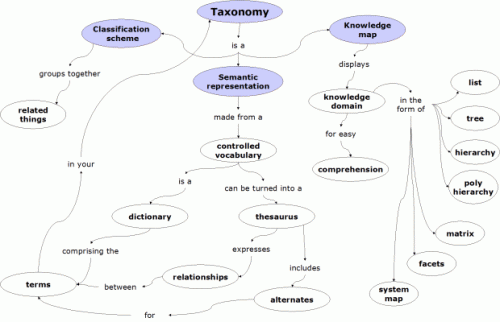
Towards a Taxonomy of Knowledge

"The peculiar character of the problem of a rational economic order is determined precisely by the fact that the knowledge of the circumstances of which we must make use never exists in concentrated or integrated form but solely as the dispersed bits of incomplete and frequently contradictory knowledge which all the separate individuals possess."
F. A. Hayek
Reading the above quotation by Friedrich Hayek it occurs to me that it might be useful to do a posting with suggestions towards a taxonomy of knowledge. Such a taxonomy should be useful in assessing the status of knowledge in a society and thus in identifying particular weaknesses and planning the appropriate means to overcome them.
There are many ways that one can classify knowledge, and they can be used separately or in combination. Note that I am not focusing on classifications of information, such as might be used with modern relational databases, but rather with information that is internalized as skills, knowledge or understanding.
The most common classification of knowledge is by subject, as in the Dewey Decimal System or that of the Library of Congress. Alternative structures, still classifying by subject, are used by encyclopedias, such as the Encyclopedia Britannica.
Knowledge can also be classified by the credibility of its assertions, and there is a great deal of epistemological basis for doing so. In science, for example, more credibility is attached to an observation that has been replicated many times than to one that has been reported by a single laboratory, or to a theory such as the theory of gravity or the theory of evolution that is long established and supported by many observations. The courts accord more authority to a large body of precedent than to a single case. Note that the degree of credibility assigned to an assertion depends on different criteria in different institutions. A scientist may feel that an observation used as forensic evidence has a different level of credibility than does the jury for which it is adduced.
Social/Institutional Embodiment
One can classify knowledge by the way it is embodied. I suggest that the difference between knowledge and information is that someone or something has to “know” it for information to be transformed into knowledge. Knowing involves “remembering/storing” the information and being able to recall or utilize that information. Since the information can not be stored and used without something to do so, one says that the information is embodied when it becomes knowledge. We are most familiar with knowledge of the form of information embodied in people. Increasingly we have information embodied in machinery, such as in robots that are found in many factories or in the control systems for chemical plants. I suggest that more generally, we may consider knowledge to include information embodied in physical plant, thus including that involved in an assembly line, etc. Similarly, information can be embodied in supplies and thus correspond to another type of knowledge. Thus improved seeds embody information developed in the crop improvement research and modern drugs embody information developed through pharmaceutical research and development.
I would also suggest that there is a form of knowledge embodied in institutions. Thus the structure and processes of an organization may not be fully understood by any of its living members, but they represent information that was used to develop an organization that functions effectively. So too, there is information embodied in other institutions. For example, the water temple system in Bali results in the expansion of the rice field system and allocation of water among fields in ways that no one fully understands, but which serves to keep insect populations in check while producing crops of rice.
Thus I suggest the following ways that knowledge is embodied:
- · In people,
- · In plant and machinery
- · In supplies
- · In institutional structure and process
Institutional Processes of Social Construction
I suggest that most knowledge is socially constructed, jointly construed by several or many people rather than held by individual based on direct observation. Social construction takes place within a social context, and one can classify knowledge according to the social contexts in which it is constructed. For example, one could define classes such as the following (from U.S. culture):
- · Scientific knowledge, constructed by a scientific community through a well-known process of theory construction, hypothesis testing, replicated controlled observations, and peer review.
- · Technological knowledge, constructed by technological communities such as engineering, agronomic and biomedical, composed of professionally qualified personnel, or constructed by communities of skilled craftsmen.
- · Judicial knowledge, constructed by trial, based on codified bodies of law and common law, construed by a jury of peers based on presentations by trained and licensed advocates under the supervision of authoritative judges.
- · Legislative knowledge, constructed in legislative bodies through a process of hearings, analysis by full time staff, consultations with constituents and interest groups, and debate in public and in private.
- · Bureaucratic knowledge, constructed within bureaucratic organizations using processes that have been illuminated by decades of studies in management and organizational science.
Culture
The way in which knowledge is socially constructed depends greatly on the culture in which the institutional knowledge system is embedded. Thus judicial knowledge is different in Anglo-Saxon common law systems versus the French Napoleonic legal system or the Arab/Islamic legal system.
We frequently find differentiation between the knowledge of “modern” societies versus traditional knowledge or indigenous knowledge. Local knowledge is used to encompass both the knowledge held by many indigenous communities and many local communities that rely on traditional knowledge sources. So too, in the example above, I have used the term Arab/Islamic as an umbrella term to cover a number of related by differing cultures. Thus the cultural categories lend themselves to hierarchical structures.
Thursday, October 30, 2008
Knowledge for a soft landing?
This blog focuses on knowledge to enhance economic and social development and to reduce poverty, especially in poor nations. But that orientation presupposes that there will be economic progress. For the next few years, I am afraid, there is going to be more economic recession than economic progress. I suspect, therefore, that there will be more need for and interest in knowledge to prevent or reduce economic decline than knowledge for development.
Lets hope that donor agencies and governments, not to mention academia make the switch.
- economists might focus on mining the experience with stimulus packages and the management of recessions,
- management might focus on knowledge and skills to help them deal with falling sales and downsizing,
- social scientists might focus on social policies to help deal with increasing unemployment and decreasing expectations,
- educators might focus on policies to prepare students for niche occupations that survive recession well, and for riding out the hard times,
- ecologists might focus on dealing with marginal lands that are going out of production due to contracting markets for primary products, and on the demands of rural populations that have added recourse to harvesting wild products when facing downturns in employment and markets,
- epidemiologists might focus on the changes in morbidity and mortality that will result from worsening economic conditions and how to ameliorate the problems that will arise.
Lets hope that donor agencies and governments, not to mention academia make the switch.
A concern about the Republican campaign tactics
In the final days of this campaign, John McCain seems to have used innuendo to imply that there is something to hide in Barack Obama's relations with Rashid Khalidi. USNews reports: page assigned to his book:
It also undermines the quality of discussion with respect to the Israeli-Palestinian conflict. If we are to have a knowledge based foreign policy, the quality of the political discussion is extremely important. JAD
Former New York City Mayor Rudy Giuliani, appearing on Fox News' On The Record, said Khalidi "has made very incendiary remarks about Israel. ... He has a connection with the PLO. He worked for...WAFA, he was their spokesman. I believe Khalidi's wife was the translator for that organization, which was affiliated with the PLO. There is no dispute about the fact that he has a very hostile view to the state of Israel."Compare Giuliani's comment with that of Scott Horton in Harpers Magazine responding to similar charges in the conservative magazine The National Review:
This doesn’t sound much like the Rashid Khalidi I know. I’ve followed his career for many years, read his articles and books, listened to his presentations, and engaged him in discussions of politics, the arts, and history. In fact, as McCarthy’s piece ran, I was midway through an advance copy of Khalidi’s new book Sowing Crisis: The Cold War and American Dominance in the Middle East.......Rashid Khalidi is an American academic of extraordinary ability and sharp insights. He is also deeply committed to stemming violence in the Middle East, promoting a culture that embraces human rights as a fundamental notion, and building democratic societies. In a sense, Khalidi’s formula for solving the Middle East crisis has not been radically different from George W. Bush’s: both believe in American values and approaches.Or to this by Juan Cole in his blog, Informed Comment:
The increasingly sleazy John McCain, who once promised to run a clean campaign, has now attacked my friend Rashid Khalidi and attempted to use him against Barack Obama. Khalidi is an American scholar of Palestinian heritage, born in New York and educated at Yale and Oxford, who now teaches at Columbia University. He directed the Middle East Center at the University of Chicago for some time, and he and his family came to know the Obamas at that time. Knowing someone and agreeing with him on everything are not the same thing.Here is Amazon.com's description of Khalidi from the
page assigned to his book:Rashid Khalidi, author of six books about the Middle East—Sowing Crisis, The Iron Cage, Resurrecting Empire, Origins of Arab Nationalism, Under Siege, and the award-winning Palestinian Identity—is the Edward Said Chair in Arab Studies and director of the Middle East Institute at Columbia University. He has written more than eighty articles on Middle Eastern history and politics, including pieces in the New York Times, the Boston Globe, the Los Angeles Times, the Chicago Tribune, and many journals. Professor Khalidi has received fellowships and grants from the John D. and Catherine T. MacArthur Foundation, the Ford Foundation, the Woodrow Wilson International Center for Scholars, the American Research Center in Egypt, and the Rockefeller Foundation; he was also the recipient of a Fulbright research award. Professor Khalidi has been a regular guest on numerous radio and TV shows, including All Things Considered, Talk of the Nation, Morning Edition, NewsHour with Jim Lehrer, and Nightline.Comment: Khalidi certainly seems a serious scholar. I have been reading Juan Cole and I hold his opinions in great respect, as I do the editors of Harpers Magazine. If they can be believed, the Republicans are denigrating the reputation of a scholar in their negative campaigning. This is wrong per se.
It also undermines the quality of discussion with respect to the Israeli-Palestinian conflict. If we are to have a knowledge based foreign policy, the quality of the political discussion is extremely important. JAD
Wednesday, October 29, 2008
Hayek on knowledge

I just read "The Use of Knowledge in Society" by F.A. Hayek (American Economic Review, XXXV, No. 4; September, 1945, pp. 519-30). which I should have read long ago. Here are some quotations from the paper:
"The peculiar character of the problem of a rational economic order is determined precisely by the fact that the knowledge of the circumstances of which we must make use never exists in concentrated or integrated form but solely as the dispersed bits of incomplete and frequently contradictory knowledge which all the separate individuals possess."
"Today it is almost heresy to suggest that scientific knowledge is not the sum of all knowledge. But a little reflection will show that there is beyond question a body of very important but unorganized knowledge which cannot possibly be called scientific in the sense of knowledge of general rules: the knowledge of the particular circumstances of time and place."
"If we can agree that the economic problem of society is mainly one of rapid adaptation to changes in the particular circumstances of time and place, it would seem to follow that the ultimate decisions must be left to the people who are familiar with these circumstances, who know directly of the relevant changes and of the resources immediately available to meet them."
Comments: Fortunately, Hayek focuses on the problem of achieving a good allocation of resources in a complex system where decisions are made with imperfect local knowledge. Unfortunately, he treats knowledge as exogenous, not dealing with the allocation of resources:
- to improve knowledge about resources.
- to improve knowledge of technology to exploit resources
- to improve knowledge of how products can be better distributed to consumers
- to improve knowledge of the institutions of society that influence the production and distribution of goods and services
- etc.
It is interesting to see how much the developments since this was written have outmoded Hayek's concerns. Today of course, Communism has fallen and with it much of the emphasis on central planning. Moreover, a great deal of work is being done to institutionalize systems (especially those utilizing the evolving global information infrastructure) to better exploit local knowledge of time and place. Think of just in time manufacturing and inventory systems. His recommendation that decision making be decentralized to allow the person with the most relevant and accurate knowledge to make the decision is now not only an accepted defense of market economies, but a "common knowledge" among management theorists.
Hayek is reacting to what he feels is an excessive focus on the infrequent decisions such as where to build a factory or what product to produce, at the expense of the large number of smaller decisions. It seems to me that the perception of focus depends on who you talk to. Senior executives and directors of firms and governments, given their limited time and intellectual resources, tend to focus their attention on such decisions. If you talk to the guy on the factory floor, or individual consumers, or the point of sale salesclerk, they focus on quite different decisions, and there are a lot more of them! Economists must simplify models, and in 1945 they had to simplify much more than we do now, since computers have allowed them to model complexity much more successfully. Besides, I suspect that most economists see senior executives and directors as much more of their audience than factory workers, salesclerks or consumers.
Still I strongly recommend that people interested in knowledge for development read this classic article. JAD
The Candidates on Education

The National Education Association has compared the positions of Obama and McCain on Education. The NEA summarizes:
Expand Early Childhood Education
- Obama: Supports
- McCain: Opposes expansion, supports better coordination
Increase Student Aid for College
- Obama: Supports
- McCain: Opposes
Tax Employees' Health Benefits
- Obama: Opposes
- McCain: Supports
Reduce Class Size
- Obama: Supports
- McCain: Opposes
Congressional Earmarks: A Tragedy of the Commons?
John McCain has tried to make a campaign issue of Congressional Earmarks, and Barack Obama has responded that they represent an inefficiency of the legislative process, but are small potatoes relative to the size of our current economic problems. Both Obama and Sarah Palin have been described as seeking earmarks for their constituents in the past.
It seems obvious that if the rules permit earmarks, a legislator should seek to get earmarks passed that benefit his constituents; if he/she does not, all the earmarks will go to the districts of other legislators and his constituents will lose out. It also seems obvious that if the rules permit earmarks to be passed without scrutiny by the legislative body as a whole, a legislator should seek to take advantage of those rules for the benefit of his/her constituency.
The problem is that if all the legislators follow this process, a lot of money will be misallocated to low priority projects, and the country as a whole will lose. Thus if every legislator does that which benefits his constituency under the current rules, then the average constituent will lose. This seems to be typical of a "tragedy of the commons."
We know that the way to avoid such a tragedy is to have institutions that keep people from over-exploiting a resource. Those rules can be formal or informal. The Congress could develop a culture in which legislators thought first of the good of the country and only second of the demands of their constituents, but I don't see that happening, and I am not sure that the cure would not be worse than the disease. Formal rules seem more likely and practical. I like the proposal by Senator Obama to create an open database of proposed earmarks, searchable by the public and the bureaucracy, identifying the sponsoring legislators, and up for a long time before action is taken on the legislation in the Congress.
The problem does not affect only our legislators, and we have all sorts of people and interest groups seeking their own advantage rather than the public good. I am old enough to remember World War II when the crisis brought most people to consider the public interest first or at least with higher priority than we do now, and when "profiteering" was a damning epithet. Perhaps in the current situation, with two wars and the economy in the pits, we could see a little more of that willingness to put first the public interest.

It seems obvious that if the rules permit earmarks, a legislator should seek to get earmarks passed that benefit his constituents; if he/she does not, all the earmarks will go to the districts of other legislators and his constituents will lose out. It also seems obvious that if the rules permit earmarks to be passed without scrutiny by the legislative body as a whole, a legislator should seek to take advantage of those rules for the benefit of his/her constituency.
The problem is that if all the legislators follow this process, a lot of money will be misallocated to low priority projects, and the country as a whole will lose. Thus if every legislator does that which benefits his constituency under the current rules, then the average constituent will lose. This seems to be typical of a "tragedy of the commons."
We know that the way to avoid such a tragedy is to have institutions that keep people from over-exploiting a resource. Those rules can be formal or informal. The Congress could develop a culture in which legislators thought first of the good of the country and only second of the demands of their constituents, but I don't see that happening, and I am not sure that the cure would not be worse than the disease. Formal rules seem more likely and practical. I like the proposal by Senator Obama to create an open database of proposed earmarks, searchable by the public and the bureaucracy, identifying the sponsoring legislators, and up for a long time before action is taken on the legislation in the Congress.
The problem does not affect only our legislators, and we have all sorts of people and interest groups seeking their own advantage rather than the public good. I am old enough to remember World War II when the crisis brought most people to consider the public interest first or at least with higher priority than we do now, and when "profiteering" was a damning epithet. Perhaps in the current situation, with two wars and the economy in the pits, we could see a little more of that willingness to put first the public interest.
Tuesday, October 28, 2008
'Tech giants in human rights deal'
Source: Maggie Shiels, BBC News, 28 October 2008
'Microsoft, Google and Yahoo have signed a global code of conduct promising to offer better protection for online free speech and against official intrusion.......The guidelines seek to limit what data should be shared with authorities, in cases where free speech is an issue.'
'Microsoft, Google and Yahoo have signed a global code of conduct promising to offer better protection for online free speech and against official intrusion.......The guidelines seek to limit what data should be shared with authorities, in cases where free speech is an issue.'
Obama and McCain Campaigns Weigh In on Issues Affecting Women in STEM
Earlier this summer, the Association of Women In Science (AWIS) and the Society of Women Engineers (SWE) submitted a list of questions to both the Obama and McCain campaigns regarding the candidates' positions on issues which affect women in STEM. Read a side-by-side comparison here.
Read the response of
Read the response of
"Microsoft: Let's Get White Spaces Going (PC Magazine)"
Excerpt from Yahoo! version of the story:
Several days after Microsoft chairman Bill Gates jumped into the white spaces debate, the software giant reiterated its commitment to white spaces and called on the Federal Communications Commission to quickly approve rules that would allow for the emerging technology to come to market.Comment: The broadcasters probably don't see any way that opening up the white space can help them, and suspect the rest of the world will find ways to use it that will cause them discomfort. Lets hope, and demand, that the FCC represents the public rather that the broadcasters on this one! JAD
"We're pretty convinced … that there's virtually no risk" to digital TV signals posed by white spaces devices, Craig Mundie, Microsoft's chief research and strategy officer, said during a Monday conference call with reporters.
Utilizing white spaces is "a great opportunity for the U.S. not to just develop the technology but lead in its deployment," something that has not been done with broadband deployment, Mundie said.
Where does all the computer power go: cloud computing
The Economist of October 23, 2008 has a survey focused on cloud computing and the implications of the rise in cloud computing for corporations. I excerpt from some of the articles:
"CORPORATE IT: Where the cloud meets the ground"

"CORPORATE IT: Computers without borders"
Comment: While the global recession may slow the investment needed to make the changes suggested by The Economist, I suspect that a watershed change is coming. Note that more control of cyberspace will be given to the countries that can afford the data centers and the development of the software that the data centers make available.
Developing countries should benefit, and indeed may even have opportunities to to technological leapfrogging, using cloud computing to avoid the need to develop the human resources to maintain intra-corporate information systems.
The cyberspace cloud with autonomous data sensors and input devices, huge and cheap computing capacity, and a universal user population untied from their PCs will result in far more changes that those described above. I am sure that developing nations are not ready for those changes. JAD

"CORPORATE IT: Where the cloud meets the ground"
This is Microsoft’s new data centre in Northlake, a suburb of Chicago, one of the world’s most modern, biggest and most expensive, covering 500,000 square feet (46,000 square metres) and costing $500m. One day it will hold 400,000 servers........."CORPORATE IT: On the periphery"
There are an estimated 7,000 such data centres in America alone, most of them one-off designs that have grown over the years, reflecting the history of both technology and the particular use to which it is being put. It is no surprise that they are egregiously inefficient. On average only 6% of server capacity is used, according to a study by McKinsey, a consultancy, and the Uptime Institute, a think-tank. Nearly 30% are no longer in use at all, but no one has bothered to remove them. Often nobody knows which application is running on which server. A widely used method to find out is: “Let’s pull the plug and see who calls.”
by the end of this year Amazon will have sold nearly 380,000 Kindles, says Mark Mahaney, an analyst with Citigroup, a bank. “Turns out the Kindle is becoming the iPod of the book world,” he recently wrote in a note to clients, in a reference to Apple’s iconic music player.......
it is safe to say that, once the next generation of wireless networks is up and running, hundreds of millions of devices will come, like the Kindle, with built-in radio connectivity (see chart 5). Digital cameras will automatically upload pictures. Smart meters will send readings of how much electricity a house consumes. All kinds of sensors will be able to send messages, even things like dipsticks when tanks of liquid are low.The relationship of these devices to cloud computing may not be obvious. But if huge data centres and applications make up the cloud itself, then all the hardware and software through which it connects and communicates with the real world are its periphery. In IT speak, this is known as the “front end” or “client side”.
As the Kindle and other examples show, this layer does not have much to do with the user interface or client device of old. It will do a lot of computing itself. It will come in all shapes and sizes, depending on what the user wants to do. And it will not just distribute information, as the web does, but collect it as well........
Whatever the buzzword, the principle is much the same. Servers no longer dish up simple hypertext markup language (HTML), the web’s early lingua franca. Increasingly, web pages are bona fide pieces of software that are executed in the browser. Users of Web 2.0 sites who venture into menu items such as “view source” in their browsers can sometimes see thousands of lines of code.
In recent months the browser has become even more of a platform for other programs, akin to an operating system such as Windows. The main driver of this trend is Google, with its huge strength in distribution that can only gain from more and more software being offered as a service. In May 2007 the Silicon Valley firm launched Gears, a program that allows web applications to be used offline, and in September this year it released a new browser called Chrome. Its most important feature is that it can execute several sophisticated web applications at once.

"CORPORATE IT: Computers without borders"
IT industry leaders note that officials from many countries have begun to take an interest in the cloud. Some just want data centres to be built in their country to create jobs; others are concerned about issues of law enforcement and jurisdiction. The danger, they say, is that cloud providers might be obliged to build more data centres than are needed and have to comply with many different regulatory regimes. Some of them have been floating the idea of “free-trade zones” for data centres where common rules would apply.Check out the links provided with the authors acknowledgments and sources.
Comment: While the global recession may slow the investment needed to make the changes suggested by The Economist, I suspect that a watershed change is coming. Note that more control of cyberspace will be given to the countries that can afford the data centers and the development of the software that the data centers make available.
Developing countries should benefit, and indeed may even have opportunities to to technological leapfrogging, using cloud computing to avoid the need to develop the human resources to maintain intra-corporate information systems.
The cyberspace cloud with autonomous data sensors and input devices, huge and cheap computing capacity, and a universal user population untied from their PCs will result in far more changes that those described above. I am sure that developing nations are not ready for those changes. JAD
Quotation
"Notwithstanding the high sounding pronouncements that routinely emanate from the White House and the State Department, the defining characteristic of U.S. foreign policy at its most successful has not been idealism, but pragmatism, frequently laced with pragmatisms first cousin, opportunism."
Andrew Bacevich
The Limits of Power: The End of American Exceptionalism
Andrew Bacevich
The Limits of Power: The End of American Exceptionalism
Are our brains different than those of our ancestors

Mitchell Leslie wrote in Sandford Magazine several years ago:
(W)hat turned humans into a planetary power? Lacking evidence to answer that question, we can only guess at the cause or causes. Among the dozen or so experts focusing on “the leap,” most favor cultural, social or demographic explanations, Klein says. They speculate, for example, that humans suddenly crossed a threshold of creativity after a long, slow buildup in population, or that a radical population boom set off a maelstrom of competition between groups, inspiring rapid innovation.Today's Washington Post, in an article ("Learning About Learning: Brain Research May Produce Results in the Classroom" by Nelson Hernandez0 today notes
A few researchers reject the whole notion of a sudden behavioral revolution, arguing instead for slow cultural evolution. Some of the so-called hallmarks of modernity, they say, showed up tens of thousands of years earlier. Noting that the brain reached its full size at least 130,000 years ago, these anthropologists think humans had all the intellect they needed from then on and that modern advances arose one by one over a vast period of time.
Klein suggests a third possibility—a strictly neurological scenario that has gained few followers in a field of study dominated by cultural explanations, he says. Humanity’s big bang, he speculates, was sparked not by an increase in brain size but by a sudden increase in brain quality. Klein thinks a fortuitous genetic mutation may have somehow reorganized the brain around 45,000 years ago, boosting the capacity to innovate. “It’s possible this change produced the modern ability for spoken language,” he says.
Clearly, speech eases communication. But it also fosters something less obvious and equally important. Spoken language, Klein says, “allows people to conceive and model complex natural and social circumstances entirely within their minds.”
One of the most startling recent revelations in neuroscience has been that the brain's structure is much more flexible (a concept called neuroplasticity) than was previously thought.The brain is the organ of thought. The brain may or may not have changed much genetically over the past 130 thousand years, but the way it is used has changed a lot. Neuroplasticity implies not only that brain will assign portions of itself away from seldom used functions to much used functions, but that practice makes it better at the functions that are practiced.
Take athletics as a metaphor. A professional boxer hits much harder than the average person, not only because he has learned how better to throw a punch, but because he has built the muscle power to do so through his training. So too, competitive runners train to run faster, and competitive weight lifters build their muscles and don't look the rest of us.
The first Homo sapiens 130,000 years ago were hunter gatherers. Think how they used their brains. They lived short lives in small communities, and their lives depended on finding food in the wild and avoiding accidents and predators. As children they must have learned mostly by watching their elders. Vocabularies probably would have been simple, heavily biased towards what one would find where.
How different from modern Homo sapiens in the United States, most of whom live in cities, dealing almost exclusively with the artifacts of modern civilizations, having attended schools and learned from books, subjected to a bombardment of information from radio, television, the Internet and media that are even in elevators and on the sides of buses.
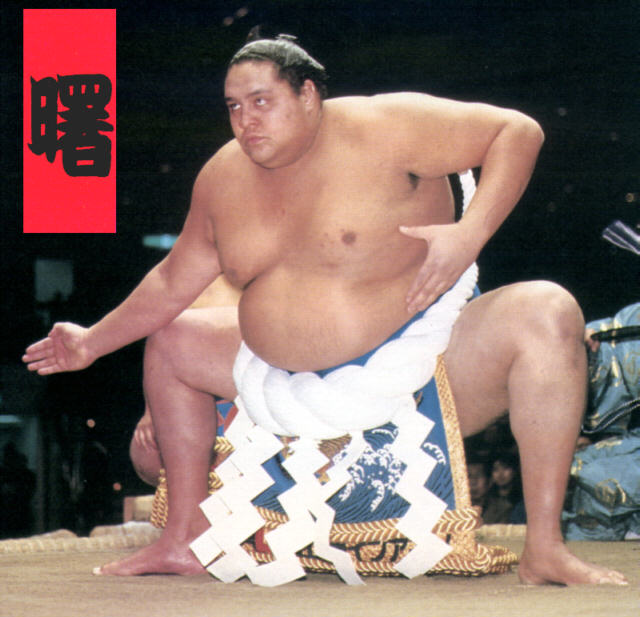
Functionally the brains of the first hunter gatherers micht have been as different from modern humans as are the bodies of Michael Phelps and Akebono, the sumo wrestler.

Republican Senator Mathias Endorses Obama
Source: Editorial, The Washington Post, October 28, 2008.
Charles McC. Mathias Jr., a Republican, represented Maryland in the U.S. House of Representatives from 1961 to 1968 and in the U.S. Senate from 1969 to 1986. He writes:
Charles McC. Mathias Jr., a Republican, represented Maryland in the U.S. House of Representatives from 1961 to 1968 and in the U.S. Senate from 1969 to 1986. He writes:
This decision, and this hard-fought race, have been difficult for me. In 1860, my great-grandfather ran for the Maryland Senate from Frederick on the anti-slavery Republican ticket. At the top of that ticket was Abraham Lincoln. In 1912, my grandfather rallied to Theodore Roosevelt and the Bull Moose. Most of the Mathias family has voted Republican ever since. In 1964, as a Republican member of the U.S. House of Representatives, I astounded many of my friends and supporters by voting for Barry Goldwater, despite disagreeing with many of his views and despite his lack of support in my congressional district. I publicly endorse the Democratic candidate for president with a sense of the historic significance of the choice before us all.
Tony Hillerman is Gone
 The Washington Post published an obituary for Tony Hillerman today. He was an author who brought me and my wife many, many hours of pleasure. We have read all his 18 mystery novels set in the Navajo reservations of the Southwest, going back and rereading them periodically. We have also read others of his 30 books.
He told a good story, producing books full of the flavor of the landscape, and respectful of the Navajo culture and way of life. We already miss the anticipation of a new Hillerman book.
'Microsoft To Offer 'Cloud Computing''
Source: Dina Bass and Brian Womack, Bloomberg News via The Washington Post, October 28, 2008
Microsoft has announced a program called Windows Azure that stores and runs customers' data and programs in the company's computer-server farms. Microsoft didn't disclose a release date or pricing for Azure. Windows Azure will be marketed as making it easier and cheaper for corporate clients to manage their software and information technology systems. 'Amazon and Salesforce.com have already gotten their cloud computing models in operation.
Monday, October 27, 2008
"At the U.N., Many Hope for an Obama Win"
 "A lot of bad feeling" about the past eight years."
William Luers of the United Nations Association
(Neilson Barnard - Getty Images)
Source: Colum Lynch, The Washington Post, October 26, 2008
I quote:
An informal survey of more than two dozen U.N. staff members and foreign delegates showed that the overwhelming majority would prefer that Sen. Barack Obama win the presidency, saying they think that the Democrat would usher in a new agenda of multilateralism after an era marked by Republican disdain for the world body.Comment: My own impression is that the U.S. foreign policy experts that I know, as well as the people from the international community with whom I have worked, as well as my family members who are citizens for foreign countries overwhelmingly support Obama.
Obama supporters hail from Russia, Canada, France, Britain, Germany, the Netherlands, Sierra Leone, South Africa, Indonesia and elsewhere. One American employee here seemed puzzled that he was being asked whether Sen. John McCain (R-Ariz.) was even a consideration. "Obama was and is unstoppable," the official said. "Please, God, let him win," he added.
In part this is a response to his life history and that of his parents, in part it is a response to the wisdom of his foreign policy pronouncements over the past several years, in part it is a response to the negative views of the foreign policy of the Republcan administration over the past eight years (and of the earlier Republican Congressional leaders) and in part it is due to distrust of McCain's views and temperment. Some might suggest that we ignore the views of the international community, but I think they are enough to strongly support Obama's foreign policy credentials. JAD
"Global crisis threatens to undo all UN's work-Ban"
 Source: Patrick Worsnip, Reuters,24 October 2008
"U.N. Secretary-General Ban Ki-moon warned his top lieutenants on Friday that the global financial crisis jeopardized everything the United Nations has done to help the world's poor and hungry.
"''It threatens to undermine all our achievements and all our progress,' Ban told a meeting of U.N. agency chiefs devoted to the crisis. 'Our progress in eradicating poverty and disease. Our efforts to fight climate change and promote development. To ensure that people have enough to eat.'
"At a meeting also attended by the heads of the World Bank and International Monetary Fund, Ban said the credit crunch that has stunned markets worldwide compounded the food crisis, the energy crisis and Africa's development crisis.
"'It could be the final blow that many of the poorest of the world's poor simply cannot survive,' he added, in one of his bleakest assessments of the impact of the financial turmoil."
Musing: The Global Recession and International Migration of Skilled People

People move from one country to another because they perceive the opportunities in the receiving country to be better than those in the country of departure. I don't mean just the economic opportunities, although they are certainly important. But there are social and other opportunities that matter. Certainly, many highly educated people are motivated to utilize their knowledge and skills to help people, especially people of the society from which they come. The opportunities to enjoy close relationships with friends and families also count, and the development of low cost communications networks (especially the Internet) has encouraged emigration by reducing the cost and difficulty of communicating with family at a distance.
I have found it useful sometimes to think of the flow of international migrants in terms of demand pull and supply push. I have posted often in this blog on the importance of creating conditions in the United States that attract people with technological skills and knowledge and with entrepreneurial and innovation skills to maintain the economic growth of the nation; that is I have posted on the need to keep the demand pull factors high here for immigration of appropriate scientific and technological personnel.
I have suggested that often developing nations push their scientifically and technologically trained people to emigrate because they allow conditions to exist that are unattractive to those people -- low salaries, poor working conditions, and often lack of opportunity to utilize their education productively. Surprisingly, developing nations often expend large amounts of resources to train excessive numbers of professionals, at least to train more people than the nation will put to productive work. Not surprisingly, the well trained, underemployed people often leave.
International migration of scientific and technological professionals has both benefits and costs to the home country. The costs may seem obvious, but they are only real if the country is willing and able to utilize the talents of the migrant. I recall a time when Bolivia had a union of unemployed doctors with something like 130 members; it was not surprising that many of its doctors emigrated to the United States. Bolivia was not using their expensive training. On the other hand, the remittances from the expatriate professionals can be quite useful.
I would also note that Israel, recognizing that its scientific and technological community is not capable of maintaining world-class standards in isolation, strongly encourages its scientific and technological professionals to travel and work abroad on a regular basis. The lessons they learn abroad are brought home on their return, keeping the country at the frontier of global science and technology.
The Crisis and its Likely Impact
I think that we are in the early stages of a multiyear global recession, and that the recession will tend to both increase supply push and decrease demand pull for international migration of S&T professionals. Financial downturn in developing nations will probably result in reductions of their attractiveness for S&T professionals: fewer S&T jobs, lower pay, fewer exciting professional opportunities.
I would suppose that the same factors would apply in developed nations, but the situation may be not be so simple. Often, I think, the United States seeks to attract S&T professionals from developing nations to work at lower salaries in fairly routine professional roles. It may recruit foreign medical graduates to provide family medicine in rural areas or foreign S&T graduates to fill teaching positions in community colleges or even at the secondary school level. The cuts in funding for these kinds of jobs may be less than for the more prestigious jobs in high technology industry or research intensive universities.
Of course, the market is segmented, and I assume that the highest prestige organizations will still seek to attract the most gifted scientists, engineers, and other technological professionals from wherever they are found, and will be successful in doing so from developing countries.
The economic crisis may provide opportunities for policy makers in developed and in developing countries to build S&T capabilities for the future. If I am right, generally there will be fewer attractive opportunities for S&T personnel globally. A company, state, province or country that moves counter to the general trend may be able to accumulate a strong S&T capacity during this period and put it to work for the future. Once a community of such people is working productively and producing useful results, its members should be much less likely to leave for future greener pastures.
Musing: The Global Recession Will Be Very Hard on Science for Development

Any reader of this blog will realize that I advocate strongly for science to be applied to the reduction of poverty and more generally to development, especially in poor nations. Science is key to understanding their natural resources and their management, to improving agricultural productivity, to the understanding and combating the diseases of poverty, and (the social sciences) to managing their economic, political and social institutions.
Not only do poor nations have less money to spend on science than do rich countries, they tend to spend a smaller portion of their GDPs on science than do more affluent countries. On the other hands, the scientifically powerful countries of the North don't devote much of their scientific effort to the problems of poor people in poor nations. As a result, there is a major need to develop the scientific capacity of poor nations, in order that they can tackle the problems that are of their own national priority and that are also inadequately supported by the global scientific enterprise. Indeed, science should not be considered only for its instrumental value for the solution of immediate problems, but for the more fundamental value a scientific establishment has for the knowledge systems of the society.
I suggest that the economic crisis will have serious negative impact on the development of the science needed in and for poor nations.
- politicians in most countries find expenditures on science easy targets in times of financial retrenchment. Investments in science are long term, and pay off only slowly, the scientific community has itself little political power, and popular support for science is weak. So poor countries themselves will probably cut funding for science.
- politicians in the North are likely to target international scientific expenditures, foreign aid, and research on problems of less direct impact to their home countries especially as they cut overall support for science.
- Corporations will also probably cut funding for research and development as a short term response to worsening business conditions, and will be especially likely to cut funding for R&D for applications targeted for developing nations, since the market demand for such applications will be seen to be diminishing.
- Funding for foreign travel, graduate education of developing country scientists in the North, for foreign journals, etc. will probably all go down.
Sunday, October 26, 2008
The Wolves of Yellowstone
 Image Source: "First Outing," Todd Fredericksen from a film by Bob Landis, Trailwood Films Wildlife Art Gallery
According to today's Washington Post, 13 years after wolves were reintroduced into Yellowston, the U.S. Fish and Wildlife Service took steps to remove the gray wolf of the northern Rockies from the Endangered Species List. "Environmentalists howled, calling it a last-gasp effort by the Bush administration to delist wolves."
The Post states that
for every 100 wolves at least six months of age, only 74 will live through the year, Bangs says. Of those that will not, 10 will be killed by government agencies because they attacked livestock. Another 10 will be killed illegally. Another three will die accidentally -- struck by a car, for example. And three will die from natural threats, including being killed by other wolves.So how many wolves are there in the Rockies?
Last winter, Bangs says, there were 1,513 wolves in the northern Rockies. But the population has dropped this year, and there will probably be about 1,450 come winter......I have read that there is good evidence that the wolves are a keystone species in the larger Yellowstone ecosystem, and that the predation of moose is resulting in changes in their grazing patterns that in turn is benefiting the plant communities. If they are a keystone species in Yellowstone, then I would guess they could be important in the larger ecosystem of the northern Rockies.
Smith also suspects that there's an element of self-regulation of population. Yellowstone is now dense with wolves -- 171 of them spread among 11 packs. (The larger Yellowstone ecosystem has about 350 wolves.)
"At some point wolves control their own numbers through killing one another," Smith says.
Comment: I can understand why the guys raising cattle and sheep want to eliminate wolf predation on their herds and flocks, but 1,500 is a very small population to maintain a species, and the northern Rockies is a very big space. The larger Yellowstone ecosystem, if it can support only 350 wolves is too small to protect the species.
I think this again is the Bush administration combining pseudo science, an ideological predisposition to distrust environmental regulations, and an unholy desire to pander to their (increasingly narrow) constituency that is pulling a fast one in the administration's dying days. This is worth a stand by all those interested in biodiversity, the protection of world heritage (The United States has had Yellowstone inscribed in the list of World Heritage sites maintained by UNESCO's World Heritage Center), the environment, and wolves specifically.
There must be a way to protect enough wolves to establish a sustainable population. The government could indemnify the owners of any calves or sheep killed by wolves. Laws could be more strongly enforced to prevent poaching. Research, if strongly supported over time, should provide means to keep the wolves within defined ranges and to reduce or prevent their predation on domestic animals. JAD
If we make the mistake of electing the McCain-Palin ticket, the wolves are probably in for a very hard time in the next administration. See my posting "Palin Versus the Wolves".
"Financial Meltdown Worsens Food Crisis: As Global Prices Soar, More People Go Hungry"
Source: Ariana Eunjung Cha and Stephanie McCrummen, The Washington Post, October 26, 2008
Excerpts:
In a time frame of a couple of years, I worry about both the cut back in farmer plantings reducing supply, and the impact of the financial crisis in developing nations reducing the ability to buy food, as well as a cut in donor funding.
Agriculture may be in serious trouble? JAD
Excerpts:
Oxfam, the Britain-based aid group, estimates that economic chaos this year has pulled the incomes of an additional 119 million people below the poverty line. Richer countries from the United States to the Persian Gulf are busy helping themselves and have been slow to lend a hand........Comment: This looks very complicated. In the short term, the price of food has gone down, but so too has the funding available for food aid.
The U.N. Food and Agriculture Organization estimates that 923 million people were seriously undernourished in 2007.......
Commodity prices have plummeted in recent weeks as investors have shown increasing concern about a global recession and a drop in the demand for goods. Wheat futures for December delivery closed at $5.1625 on Friday -- down 62 percent from a record set in February. Corn futures are down 53 percent from their all-time high, and soybean futures are 47 percent lower. Such declines, while initially welcomed by consumers, could eventually increase deflationary pressures -- lower prices could mean less incentive for farmers to cultivate crops. That, in turn, could exacerbate the global food shortage........
In June, governments, donors and agencies gathered in Rome to pledge $12.3 billion to address the world's worst food crisis in a generation. But only $1 billion has been disbursed. An additional $1.3 billion, which had been earmarked by the European Commission for helping African farmers, is tied up in bureaucracy, with some governments now arguing that they can no longer afford to give up that money.
In a time frame of a couple of years, I worry about both the cut back in farmer plantings reducing supply, and the impact of the financial crisis in developing nations reducing the ability to buy food, as well as a cut in donor funding.
Agriculture may be in serious trouble? JAD
The Coming Financial Crisis
Dani Rodrik, a very competent economist, writes in his blog (October 26, 2008):
Paul Krugman frets that we are about to witness the mother of all currency crises in emerging markets, and I am afraid that he is right. As I wrote in my previous post, the financial crisis in the developing world has just started and there are indications that it will get a lot, a lot worse. What is different with this phase of the crisis is that it cannot be addressed by governments in the affected countries issuing their own fiscal guarantees and domestic currency. These countries need external lines of credit, and they need it fast before the scale of the problem becomes truly unmanageable.Comment: These guys should know! Fasten your seat belts, the going is going to get rough! JAD
The solution is clear. The IMF, possibly along with central banks of the G7, has to act as a global lender of last resort to emerging markets.
"Has humanitarianism in its current form become part of the problem, rather than the solution?"
Source: "Human rights and wrongs," by Michael Williams, guardian.co.uk, Sunday October 26
This is a review of Conor Foley's book titled The Thin Blue Line: How Humanitarianism Went to War. It cites some of the dangerous aspects embraced by some of the individuals and organizations currently promoting humanitarian assistance:
Comment: Williams and (apparently) Foley have belled a cat that definitely needed belling. As "the road to hell is paved with good intentions," and as "patriotism is the last refuge of scoundrels," so to I might say that "the road to the imperialistic exercise of power is covered with protestations of humanitarian motives." Few seem willing to come out publicly and challenge claims based on declared humanitarian goals.
The problem is perhaps exacerbated by the reality that many, probably the majority of people who are actually on the ground providing humanitarian assistance are very well and highly motivated, and that they do a lot of good. The lengthening of lifespan in developing nations, the reduction of the threat of famine, and the reduction of the portion of the world's population that live in abject poverty speak for themselves. When good people are exploited for cynical purposes I get angry.
A related problem is that people and organizations with true humanitarian motives can be wrong, especially when they advocate based on ideology rather than knowledge. I have found that to be a problem with new technologies, where "do gooders" with little understanding of the technology have slowed applications due to poorly founded fears triggered by the novelty (e.g. biotechnology for crop improvement, nanotechnology for industrial development). There are also environmentalists who fail to properly recognize the needs for poverty alleviation, and people focusing on economic development who fail to properly recognize the needs for a sustainable environment.
The donor agencies appear to run scared of the NGO's, and I think there are good projects and programs that have been delayed or canceled due to fear of the fuss that would be raised by NGO advocates, where those advocates had largely unjustified fears.
Donor assistance with humanitarian motives is important. The question is how do we protect against errors caused by cynical or well intentioned arguments based on humanitarian ideas and misuse of humanitarian programs themselves. A first step is being aware that such problems can and do occur, and having achieved that recognition to examine claims and programs and act to correct abuses. JAD
From The Urban Dictionary:
This is a review of Conor Foley's book titled The Thin Blue Line: How Humanitarianism Went to War. It cites some of the dangerous aspects embraced by some of the individuals and organizations currently promoting humanitarian assistance:
- exagerating the severity of humanitarian problems to generate political support for their humanitarian relief,
- promoting other values (such as women's rights, literacy for children, and sex education that derive from liberal Western tradition) in programs intended to deal specifically with hunger or disease,
- directing humanitarian assistance where it might produce political advantage rather than where it would be likely to help the most people and/or people most in need.
Comment: Williams and (apparently) Foley have belled a cat that definitely needed belling. As "the road to hell is paved with good intentions," and as "patriotism is the last refuge of scoundrels," so to I might say that "the road to the imperialistic exercise of power is covered with protestations of humanitarian motives." Few seem willing to come out publicly and challenge claims based on declared humanitarian goals.
The problem is perhaps exacerbated by the reality that many, probably the majority of people who are actually on the ground providing humanitarian assistance are very well and highly motivated, and that they do a lot of good. The lengthening of lifespan in developing nations, the reduction of the threat of famine, and the reduction of the portion of the world's population that live in abject poverty speak for themselves. When good people are exploited for cynical purposes I get angry.
A related problem is that people and organizations with true humanitarian motives can be wrong, especially when they advocate based on ideology rather than knowledge. I have found that to be a problem with new technologies, where "do gooders" with little understanding of the technology have slowed applications due to poorly founded fears triggered by the novelty (e.g. biotechnology for crop improvement, nanotechnology for industrial development). There are also environmentalists who fail to properly recognize the needs for poverty alleviation, and people focusing on economic development who fail to properly recognize the needs for a sustainable environment.
The donor agencies appear to run scared of the NGO's, and I think there are good projects and programs that have been delayed or canceled due to fear of the fuss that would be raised by NGO advocates, where those advocates had largely unjustified fears.
Donor assistance with humanitarian motives is important. The question is how do we protect against errors caused by cynical or well intentioned arguments based on humanitarian ideas and misuse of humanitarian programs themselves. A first step is being aware that such problems can and do occur, and having achieved that recognition to examine claims and programs and act to correct abuses. JAD
From The Urban Dictionary:
cheneyisma figure of speech expressing a fantasy, generally used to manipulate(ie. "My belief is we will, in fact, be greeted as liberators." --March 16, 2003, orHe used many forms of cheneyism is his relationships with women, most commonly, "Of course I'll still respect you."
"I think they're in the last throes, if you will, of the insurgency." -- June 20, 2005)
Donna Edwards Endorsements
 Donna Edwards and son Jared.
The Gazette has endorsed Donna Edwards for the 4th Congressional District of Maryland. From the endorsement by the Washington Post:
WHEN VOTERS in Maryland's 4th Congressional District, which stretches from Prince George's County into Montgomery, dislodged Rep. Albert R. Wynn in the Democratic primary this year, they put considerable faith in the potential of an energetic but untested newcomer, Donna F. Edwards. Ms. Edwards, a civic activist, had proved herself to be an effective advocate for causes such as raising the minimum wage and curbing domestic violence. But could she produce results in Washington? Four months into her service, which began when Mr. Wynn resigned and she won a special election, Ms. Edwards has shown that she deserves a full term in Congress.......Comment: Is someone really suggesting at this time we abolish the Federal Reserve? It seems to have responded to the current economic crisis in a way that has kept us out of a new depression, and the Fed is now lead by the foremost expert on economic crises in the United States. JAD
Her opponent, Republican Peter James, is a crusader against deficit spending who endorses such extreme remedies as abolishing the Federal Reserve and who has issued a local currency to underscore his point. The currency hasn't caught on; neither should his candidacy.
Saturday, October 25, 2008
SCIENCE ADVICE: ADVISING THE PRESIDENT ABOUT ADVISORS.
Bob Park wrote yesterday in his blog:
Lets hope Obama is more interested in getting it right than in satisficing his special-interest constituencies, that he wants and seeks out science advice, and that he is successful in finding someone who can manage the advisory process in the White House and front for its science policies and conclusions drawn on scientific evidence. JAD
Science magazine today has a brief assessment of where the candidates stand on ten science policy issues ranging from national security to space. Obviously staff written, it wasn't much help. We need to know to whom the future President will turn for advice on science-related matters. Presidents can call on anyone: FDR relied on Vannevar Bush, Truman on Isadore Rabi, Eisenhower to Killian and Kistiakowski, and Kennedy to Wiesner, none of whom are any longer available. Alas, the stature of the science advisor diminished seriously under Nixon and Reagan. It may have hit bottom in the 2003 state-of-the-union address when Bush announced his hydrogen initiative; it was clear that he had not bothered to check with his science advisor. The job is no longer seen as the "nation's top scientist." Whatever influence the science community has should be used to persuade the next President to select a wise science advisor as quickly as possible and rely on the science advisor's counsel.Comment: If you don't want scientific advice, and don't plan to use it if offered, don't appoint a highly visible, highly respected, active and effective science advisor. If you do, both you and the advisor will be bothered.
Lets hope Obama is more interested in getting it right than in satisficing his special-interest constituencies, that he wants and seeks out science advice, and that he is successful in finding someone who can manage the advisory process in the White House and front for its science policies and conclusions drawn on scientific evidence. JAD
"The Misused Impact Factor"
Kai Simons makes an interesting point in an editorial in Science (10 October 2008).
The problem to which Simons refers is the increasing efforts made by journal editors to increase the estimated impacts of their journals. They do this not merely by choosing the best and most important articles that they can find, but by publishing more survey and other kinds of articles that tend to produce high ratings.
This is an example of a general problem with indicators. They are often imperfect measures of that which is important, and if people seek to maximize the indicator value rather than do what is most important, they can be dangerous.
I recall one of my friends long ago telling me that as an Indian Health Service physician he discovered that their production index gave more points for physician supervised preventive services than for those provided by unsupervised nurses. So he moved the nurses and his desk into a common area and did his paper work while the nurses were providing their services. This now counted as supervision, and his productivity numbers were greatly increased.
The lesson is that one should not confuse what is measured with what is important. This is not a criticism of the people designing indices, but of the bureaucrats who misuse the data they produce.
Each year, Thomson Reuters extracts the references from more than 9000 journals and calculates the impact factor for each journal by taking the number of citations to articles published by the journal in the previous 2 years and dividing this by the number of articles published by the journal during those same years.The data is used widely; researchers and research institutions are judged according not only to the numbers of their publications but also the impact of the journals in which they publish. Money hangs on the judgment, both in terms of salaries for the researcher and endowments for the institutions; so does prestige and promotion.
The problem to which Simons refers is the increasing efforts made by journal editors to increase the estimated impacts of their journals. They do this not merely by choosing the best and most important articles that they can find, but by publishing more survey and other kinds of articles that tend to produce high ratings.
This is an example of a general problem with indicators. They are often imperfect measures of that which is important, and if people seek to maximize the indicator value rather than do what is most important, they can be dangerous.
I recall one of my friends long ago telling me that as an Indian Health Service physician he discovered that their production index gave more points for physician supervised preventive services than for those provided by unsupervised nurses. So he moved the nurses and his desk into a common area and did his paper work while the nurses were providing their services. This now counted as supervision, and his productivity numbers were greatly increased.
The lesson is that one should not confuse what is measured with what is important. This is not a criticism of the people designing indices, but of the bureaucrats who misuse the data they produce.
U.S. Cuban Cooperation in Science
 Source: "Editorial: U.S.-Cuban Scientific Relations," Sergio Jorge Pastrana and Michael T. Clegg, Science 17 October 2008: Vol. 322. no. 5900, p. 345.
The foreign secretaries of the U.S. and Cuban Academies of Science call for increased scientific cooperation in this editorial. They feel the need to suggest areas in which cooperation would be fruitful, but I discovered in 15 years of funding international scientific collaboration projects that the scientists themselves do a great job in figuring out whether a collaborative project will advance their interests. I would prefer an investigator initiated, peer reviewed process for selecting projects.
The more fundamental issue is whether the time is ripe for scientific diplomacy. My guess is that it is now time. The people of Cuba and those of the United States should come together, and the government of Cuba may well be ready for raproachment either now or soon. Scientific diplomacy is a good first step, as is cultural diplomacy more generally.

"U.S. SCIENCE AGENCIES: Media Policies Don't Always Square With Reality"
Source: Eli Kintisch, Science 24 October 2008: Vol. 322. no. 5901, pp. 512 - 513.
"Most U.S. government agencies don't allow their scientists to talk freely with the media, according to a survey by an advocacy organization that has been highly critical of the Bush Administration's track record on scientific integrity. A new report from the Union of Concerned Scientists (UCS) gives some agencies relatively high marks for adopting policies that allow considerable openness but notes that those policies are not always followed. The culture in the majority of the 15 agencies UCS examined "has become [such that] talking with the press has become fraught with risks," says UCS's Francesca Grifo."
Comment: Thanks to Francesca and the UCS! The UCS is not "an advocacy agency" as I usually think of that term, but rather a body that developed from the community of concerned atomic scientists at the end of World War II who wanted to act to prevent nuclear war. In the six decades since it was founded, the UCS has continued to promote the ethical use of science in a variety of areas vital to the public interest. JAD

"Most U.S. government agencies don't allow their scientists to talk freely with the media, according to a survey by an advocacy organization that has been highly critical of the Bush Administration's track record on scientific integrity. A new report from the Union of Concerned Scientists (UCS) gives some agencies relatively high marks for adopting policies that allow considerable openness but notes that those policies are not always followed. The culture in the majority of the 15 agencies UCS examined "has become [such that] talking with the press has become fraught with risks," says UCS's Francesca Grifo."
Comment: Thanks to Francesca and the UCS! The UCS is not "an advocacy agency" as I usually think of that term, but rather a body that developed from the community of concerned atomic scientists at the end of World War II who wanted to act to prevent nuclear war. In the six decades since it was founded, the UCS has continued to promote the ethical use of science in a variety of areas vital to the public interest. JAD
"Making One World of Science"
Source: Mohamed H. A. Hassan, Editorial, Science 24 October 2008: Vol. 322. no. 5901, p. 505.The global scientific community is divided
into three worlds: the North, the surging South, and the stagnant South. The global community now faces the critical challenge of preventing lagging countries from falling even farther behind.Comment: Investment in science in the scientifically stagnent South does not look like a paying proposition for the national governments in those countries, since it is high risk and long term. On the other hand, that investment is not a high priority for donor agencies. Many don't fund science as a priority and are not staffed to do so. The international financial institutions (such as the World Bank or the Inter American Development Bank) do not have many science projects in the scientifically stagnent countries because such projects would be too small to justify their high project development and oversight calls. The effort to create a mechanism funded by the rich countries but under the management of the larger community of nations, under the United Nations system, has failed due to the unwillingness of the major donors to fund such an effort. So the editorial is right on target, but fails to suggest a way to finance the long term capacity building effort that is needed. JAD
The United States continues to dominate global science. In 2007, U.S. scientists published nearly 30% of the articles appearing in international peer-reviewed scientific journals, which is comparable to the percentage a quarter-century ago. But China, responsible for less than 1% of publications in 1983, has recently surpassed the United Kingdom and Japan to become the world's second leading nation in scientific publications. China now accounts for more than 8% of the world's total, whereas India and Brazil produce about 2.5 and 2%, respectively, of the world's scientific articles. All told, scientists in developing countries generate about 20% of the articles published in peer-reviewed international journals.
It is gratifying to see such progress made by the surging South. But we cannot ignore the fact that these advances have been largely limited to just a few countries. The top five performers (China, India, Brazil, Turkey, and Mexico) contribute well over half of the scientific publications from the South. By contrast, sub-Saharan Africa, a region of 48 countries, produces just 1% of the world's scientific publications.
A Republican War on Social Science?


I have been listening to an old talk by Chris Mooney on his book, The Republican War on Science (vua C-SPAN3 History). He makes the points that the Bush administration has two key constituencies -- the Christian Right and Big Business -- and that its political appointees when confronted by a difference between the interests of these constituencies and the advice of their government agency's scientists follow the constituency and overrule the scientists. He notes that think tanks run by these two constituencies have developed their own "sciences" and (in my words) make arguments based on bad science to counter the legitimate science of the government science bodies and organizations such as the National Academies and American Association for the Advancement of Science.
He singles out the administration's actions vis a vis
- reproductive biology (abortion, stem cell research, HIV prevention) and the teaching of evolution in response to the interests of the religious right, and
- regulatory science (environment, climate change, biodiversity, offshore drilling, occupational health) in response to the interests of big business.
- all political appointees tend to respond to their constituencies,
- a tension between politics and science has existed in many administrations, and
- there is no metric for politicization of "scientific" decisions of government
It occurs to me that the problem might be even more acute in terms of the Bush administration's willingness to ignore social science than that relating to natural sciences.
- Does the current economic crisis result from a substitution of a pseudo scientific economic analysis promoted by big (financial) businesses for sound economics? Was the deregulation of the financial industry accepted by mainstream economists for ideological reasons? Were the warnings of mainstream economists about the housing bubble (and the earlier dot.com bubble) not attended to due to ideology?
- Did the willingness of the Bush administration to get into simultaneous wars in Iraq and Afghanistan stem from attending to the pseudo-scientific social science of the neo-cons in response to the neo-con political constituency, rather than listening to the mainstream social scientists in the intelligence community and academia who challenged the assumptions that those country societies were relatively homogeneous, would welcome American intervention, and would quickly adopt democratic processes and rule of lay law if given the opportunity. (The CIA and, in the past, USAID employ many PhD social scientists, and had strong social soundness analysis capabilities.)
Friday, October 24, 2008
New Treaty Aims to Protect Shared Transboundary Aquifers
According to the Environmental News Service, the UN General Assembly on Monday will receive the draft Convention on Transboundary Aquifers. When it comes fully into force, the Convention (or multilateral treaty) will apply to 96 percent of the planet's freshwater resources - those that are to be found in underground aquifers, most of which straddle national boundaries. Underground aquifers contain 100 times the volume of fresh water found on the Earth's surface but they have been neglected under international law despite their environmental, social, economic and strategic importance.
UNESCO has published the first-ever world map of shared aquifers and a monograph assessing those water resources. The publications were timed to coincide with the submission to the General Assembly of the United Nations of the draft Convention on Transboundary Aquifers.
The first thought is that the Convention will apply to those aquifers shared between the United States and Mexico and those shared between the United States and Canada, thereby simplifying cooperation across our boundaries in the management of these important resources. However, the security of the United States might be even more enhanced by the reduction in the probability of conflict between other nations over the management and allocation of waters from their shared aquifers (Israel and Palestine/Jordan/Lebanon, India and Pakistan, India and Bangladesh, etc.). Wars in other regions seem often to drag us into their conflict.

UNESCO has published the first-ever world map of shared aquifers and a monograph assessing those water resources. The publications were timed to coincide with the submission to the General Assembly of the United Nations of the draft Convention on Transboundary Aquifers.
The first thought is that the Convention will apply to those aquifers shared between the United States and Mexico and those shared between the United States and Canada, thereby simplifying cooperation across our boundaries in the management of these important resources. However, the security of the United States might be even more enhanced by the reduction in the probability of conflict between other nations over the management and allocation of waters from their shared aquifers (Israel and Palestine/Jordan/Lebanon, India and Pakistan, India and Bangladesh, etc.). Wars in other regions seem often to drag us into their conflict.

Growing Unequal? Income Distribution and Poverty in OECD Countries
 The gap between rich and poor has grown in more than three-quarters of OECD countries over the past two decades, according to a new OECD report.
OECD’s Growing Unequal? finds that the economic growth of recent decades has benefitted the rich more than the poor. In some countries, such as Canada, Finland, Germany, Italy, Norway and the United States, the gap also increased between the rich and the middle-class.
Countries with a wide distribution of income tend to have more widespread income poverty. Also, social mobility is lower in countries with high inequality, such as Italy, the United Kingdom and the United States, and higher in the Nordic countries where income is distributed more evenly.
Comment: I suspect that the gap will widen still more in the next couple of years, since it seems to me that the economic hard times are going to hit the poor more than the rich, and those unable to protect themselves more than those who have the education, resources, and contacts to ride out the troubles.
Of course, this report of the OECD does not address the poverty gap between rich and poor countries, which is complicated. However, there are many poor countries that have advanced little since 1978, while the richest countries have progressed, with the spread of country GDPs expanding. JAD
Emerging Market Vulnerability
 Source: "West Is in Talks on Credit to Aid Poorer Nations," MARK LANDLER, The New York Times, October 23, 2008.
"The International Monetary Fund, which is in negotiations with several countries to provide emergency loans, is also working to arrange a huge credit line that would allow other countries desperate for foreign capital to borrow dollars, according to several officials.
"The list of countries under threat is growing by the day, and now includes such emerging-market stalwarts as Brazil, South Africa and Turkey. They have become collateral damage in a crisis that began in the American subprime housing market."
Comment: There is an old saying: "When the G7 sneezes, the developing world comes down with pneumonia". Unfortunately, the developed nations seem to have come down with a nasty economic "cold", that is going to last for a while. We are beginning to see the repercussions in the developing world. JAD
Insights(?) from math about the economy
Example 1 from Control Theory

 The top figure is a plot of the Dow Jones Industrial Average for the past two months (from CNN Money). The figure under it shows a "ringing response" of an underdamped system to a step change in its forcing function. If we want the volatility of the stock market to be less in response to a major change in understanding of the market fundamentals, perhaps we need to increase damping in the system. That might involve regulation of trading institutions and reduction of speculation on market prices.
Example 2 from Complexity Theory
The prototypical situation of complexity theory is lots of actors interacting, making independent decisions based on locally available information. The prototypical insight from complexity theory is the existence of "emergent properties" that are visible in the ensemble but not (necessarily) to the individual actors, and certainly not deliberately planned by those actors.
The model might be applied to American society, and the huge level of debt (federal, state, corporate, consumer) might be thought of as an emergent property of their individual decisions. One might look for a state variable, characteristic of the individual actors to help explain the functioning of the complex set of actors. A metaphor might be temperature as a state variable in modeling of climate change, where global warming affects all the cells in the simulation of the global atmospheric system. The willingness to consume in excess of income might be considered such a state variable in a (complexity theory based) simulation of the economy. Many have suggested that there has been a wide spread increase in the willingness of Americans to go into debt, in short greed for immediate consumption and lack of concern for the future.
There should be means to set the temperature of the economy, to reduce the willingness of actors to accumulate debt for immediate consumption. One thinks of schools and churches, the media, and the government. The financial services industry in our capitalist system works on the basis of profit maximization of the individual enterprises, and has invented all sorts of new instruments to maximize those profits. The Great Depression resulted in regulation to assure that banks did not accept too much risk in the effort to maximize profits, but since the Reagan Revolution the U.S. government has been in the power of people who thought that such regulations were excessive; they did not impose limitations on risk on the new financial instruments that were being created, and the financial industry responded by inventing new instruments to avoid existing regulations.
One might infer that we need to get people to return to deferring immediate gratification in favor of investments which would yield long term benefits.
Example 3 from Systems Theory
A key principle of systems theory is the utility of defining a system of entities that interact strongly, separating it from a surround that includes entities that react much less strongly with the elements of the system that those elements do with each other.
The United States went through a long history, developing financial policies on the basis that the American economy would be a system and the economy of the rest of the world its surround. Monitary policy would be under the control of the Federal Reserve System, and fiscal policy would be under the control of the Federal Government.
In the aftermath of World War II and the Great Depression, the community of nations created the Breton Woods institutions (IMF, World Bank, etc.), recognizing that there were interconnections among national economies, in order to regulate the functioning of the international system. Essentially, the Breton Woods institutions managed a global economic system consisting of weakly interacting national systems. In the intervening period, Europe has recognized that the European economies are interacting strongly with each other. The European Union has created and is continuing to evolve institutions to manage the economy of Europe as an single integrated system.
Globalization and the rise of BRICs to comparable status with the G7 have changed the nature of the world. The current crisis seems to suggest that the assumption that national economies can be regarded as independent systems is no longer valid. That in turn would suggest that, as was done in Europe, the nations of the world consider a stronger set of global economic institutions to manage an increasingly interconnected global economy.
The top figure is a plot of the Dow Jones Industrial Average for the past two months (from CNN Money). The figure under it shows a "ringing response" of an underdamped system to a step change in its forcing function. If we want the volatility of the stock market to be less in response to a major change in understanding of the market fundamentals, perhaps we need to increase damping in the system. That might involve regulation of trading institutions and reduction of speculation on market prices.Example 2 from Complexity Theory
The prototypical situation of complexity theory is lots of actors interacting, making independent decisions based on locally available information. The prototypical insight from complexity theory is the existence of "emergent properties" that are visible in the ensemble but not (necessarily) to the individual actors, and certainly not deliberately planned by those actors.
The model might be applied to American society, and the huge level of debt (federal, state, corporate, consumer) might be thought of as an emergent property of their individual decisions. One might look for a state variable, characteristic of the individual actors to help explain the functioning of the complex set of actors. A metaphor might be temperature as a state variable in modeling of climate change, where global warming affects all the cells in the simulation of the global atmospheric system. The willingness to consume in excess of income might be considered such a state variable in a (complexity theory based) simulation of the economy. Many have suggested that there has been a wide spread increase in the willingness of Americans to go into debt, in short greed for immediate consumption and lack of concern for the future.
There should be means to set the temperature of the economy, to reduce the willingness of actors to accumulate debt for immediate consumption. One thinks of schools and churches, the media, and the government. The financial services industry in our capitalist system works on the basis of profit maximization of the individual enterprises, and has invented all sorts of new instruments to maximize those profits. The Great Depression resulted in regulation to assure that banks did not accept too much risk in the effort to maximize profits, but since the Reagan Revolution the U.S. government has been in the power of people who thought that such regulations were excessive; they did not impose limitations on risk on the new financial instruments that were being created, and the financial industry responded by inventing new instruments to avoid existing regulations.
One might infer that we need to get people to return to deferring immediate gratification in favor of investments which would yield long term benefits.
Example 3 from Systems Theory
A key principle of systems theory is the utility of defining a system of entities that interact strongly, separating it from a surround that includes entities that react much less strongly with the elements of the system that those elements do with each other.
The United States went through a long history, developing financial policies on the basis that the American economy would be a system and the economy of the rest of the world its surround. Monitary policy would be under the control of the Federal Reserve System, and fiscal policy would be under the control of the Federal Government.
In the aftermath of World War II and the Great Depression, the community of nations created the Breton Woods institutions (IMF, World Bank, etc.), recognizing that there were interconnections among national economies, in order to regulate the functioning of the international system. Essentially, the Breton Woods institutions managed a global economic system consisting of weakly interacting national systems. In the intervening period, Europe has recognized that the European economies are interacting strongly with each other. The European Union has created and is continuing to evolve institutions to manage the economy of Europe as an single integrated system.
Globalization and the rise of BRICs to comparable status with the G7 have changed the nature of the world. The current crisis seems to suggest that the assumption that national economies can be regarded as independent systems is no longer valid. That in turn would suggest that, as was done in Europe, the nations of the world consider a stronger set of global economic institutions to manage an increasingly interconnected global economy.
Subscribe to:
Posts (Atom)