 The spatial distribution of P. falciparum malaria Pf PR 2–10 predictions stratified by endemicity class. They are categorized as low risk Pf PR 2–10 ≤ 5%, light red; intermediate risk Pf PR 2–10 > 5% to ≥ 40%, medium red; and high risk Pf PR 2–10 > 40%, dark red.
Tuesday, March 31, 2009
The Malaria Atlas Project
The spatial distribution of P. falciparum malaria Pf PR 2–10 predictions stratified by endemicity class. They are categorized as low risk Pf PR 2–10 ≤ 5%, light red; intermediate risk Pf PR 2–10 > 5% to ≥ 40%, medium red; and high risk Pf PR 2–10 > 40%, dark red.


Shared Mobile Phone Network Infrastructures

Source: 'Mobile telecoms: Sharing the load,' The Economist, March 26th 2009.
In developing nations, firms providing mobile phone services often share physical infrastructure, and this article suggests that that may also increasingly take place in developed nations. Moreover, "three big European operators—France Telecom, KPN and Vodafone—have recently decided to outsource the running of their networks in some countries to equipment-makers: Nokia Siemens Networks, Alcatel-Lucent and Ericsson respectively."
Modalities include “site sharing” in which operators use the same antenna masts and equipment cupboards.
However, operators are reluctant to share one thing: the radio gear, known as the “radio access network” (RAN), that communicates with subscribers’ handsets. Telefónica and Vodafone have ruled out such sharing, at least for now. One reason is that firms which have competed for years on the quality of their networks still see the RAN as a source of advantage. Moreover, regulators in many countries do not want operators to get too chummy, because it could limit competition. In some countries RAN sharing is not allowed.Advantages of sharing infrastructure include reductions in capital requirements, reduced operating costs, enabling providers to focus on core competencies, and smaller environmental footprint.
Animal Spirits Led to this and other Economic Crises
 The Economist has another of the good "Economic Focus" columns. This time it focuses on Animal Spirits: How Human Psychology Drives the Economy, and Why It Matters for Global Capitalism by George A. Akerlof and Robert J. Shiller, a Nobel Prize winner and another economist with a very good track record. The book apparently provides a taxonomy of the ways in which people's behavior departs from the rational "economic man" of the models loved by so many economists.
Blogging is an example of an activity which not only has little or no economic return, which one must assume is done by this author and millions of others because we like doing it. People have lots of motivations other than maximizing income or net worth. Of course, as this blog points out from time to time, we also think with our brains as we emote with our brains, and the amazing thing is that we are as rational as we actually are, not that we mis-estimate probabilities and values and assume that trends will continue indefinitely.
The authors apparently worked for six years on this book, and then rushed it into publication because the current bust of the previous boom needed the explanation that they were providing.
There is a very good video of Robert Shiller (who is also the author of Irrational Exuberance and The Subprime Solution: How Today's Global Financial Crisis Happened, and What to Do about It) describing how Animal Spirits helps to explain the sources of the current economic crisis. He also provides opinions on the U.S. Government's efforts to ameliorate the crisis and put us back on an even economic keel.
Democrats Move Forcefully to Protect Wilderness
According to the Washington Post,
Comment: Another reason why I am glad I voted for Obama! Perhaps now he will repair the stupid departure from the World Network of Biosphere Reserves by the Bush administration. JAD
 "Canyons of the Ancients National Monument (CANM) in southwestern Colorado contains a huge number of archaeological sites-- more than 6000 recorded so far, and up to 100 per square mile in some places-- representing Ancestral Puebloan and other Native American cultures. CANM is managed as an integral cultural landscape containing a wealth of historic and environmental resources."
President Obama signed a sweeping land conservation package into law Monday, protecting more than 2 million acres as wilderness and creating a national system to conserve land held by the Bureau of Land Management.Termed "the most significant wilderness effort in at least 15 years", the Obama initiative "would provide the highest level of federal protection to areas such as Oregon's Mount Hood and part of Virginia's Jefferson National Forest, along with sites in California, Colorado, Idaho, Michigan, New Mexico, Utah and West Virginia.......The law also establishes the 26-million-acre National Landscape Conservation System, which aims to protect the most environmentally and historically significant lands controlled by the BLM. The new system, which encompasses 850 sites, including the Canyons of the Ancients National Monument in southwest Colorado, Agua Fria National Monument in Arizona and Nevada's Black Rock Desert National Conservation Area, requires the agency to make conservation a priority when managing these areas."
Comment: Another reason why I am glad I voted for Obama! Perhaps now he will repair the stupid departure from the World Network of Biosphere Reserves by the Bush administration. JAD
"Canyons of the Ancients National Monument (CANM) in southwestern Colorado contains a huge number of archaeological sites-- more than 6000 recorded so far, and up to 100 per square mile in some places-- representing Ancestral Puebloan and other Native American cultures. CANM is managed as an integral cultural landscape containing a wealth of historic and environmental resources."
Monday, March 30, 2009
The Global Voices Book Challenge

April 23rd is a symbolic date for world literature for on this date and in the same year of 1616, Cervantes, Shakespeare and Inca Garcilaso de la Vega all died. The date has been chosen by UNESCO and the United Nations for the annual celebration of World Book and Copyright Day.
The Global Voices Book Challenge is as follows:
- Read a book during the next month from a country whose literature you have never read anything of before.
- Write a blog post about it during the week of April 23.
"World Bank Lowers Remittances Forecast for 2009 as Financial Crisis Deepens"
According to the World Bank:
- Remittances will fall to $290 billion in 2009, from last year's high of $305 billion
- Even with the drop, remittances will outstrip private capital flows and official development aid
- India: $45 billion
- China: $34 billion
- Mexico: $26 billion
- Philippines: $18 billion
- Poland: $11 billion
How Bad Is the Threat of (Pandemic) Flu
Source: "Pandemic Influenza: An Inconvenient Mutation," Scott P. Layne, Arnold Monto and Jeffery K. Taubenberger, Science 20 March 2009: Vol. 323. no. 5921, pp. 1560 - 1561.
 Source of photo: "Antibodies Resurrected from 1918 Flu Pandemic That Killed 50 Million," Posted by Casey Kazan. (Adapted from a Vanderbilt University Medical Center release.) The Daily Galexy, August 18, 2008.
Seasonal influenza affects 10% of the population annually, killing up to one million persons worldwide. Pandemic viruses have even greater potential for mortality.......Comment: The most recent flu pandemics occurred in 1957 and 1968, and the Spanish flu that occurred during World War I killed tens of millions of people. The question, failing to have radically new vaccines, radically improved medicines, radically improved case finding and sentinal warning systems, and radically improved public health measures would seem to be now whether but when the next pandemic will kill millions of people. JAD
About 425 million doses of trivalent influenza vaccine are produced annually, enough to protect less than 7% of the world's population. In the event of a pandemic, well-matched protective vaccines against a novel agent would not be available for at least several months, highlighting the importance of therapeutic options.
By 2009, however, 98% of circulating influenza A/H1N1 strains in North America have become resistant to the frequently prescribed and widely stockpiled neuraminidase inhibitor oseltamivir (Tamiflu), and 98% of A/H3N2 strains are resistant to the adamantanes. The alternative neuraminidase inhibitor zanamivir and the two approved adamantanes--amantadine and rimantadine--are all in short supply, and the adamantanes have substantial side effects. Influenza therapeutic options are clearly unraveling at a time when public health officials are appropriately concerned about pandemic emergence.
Source of photo: "Antibodies Resurrected from 1918 Flu Pandemic That Killed 50 Million," Posted by Casey Kazan. (Adapted from a Vanderbilt University Medical Center release.) The Daily Galexy, August 18, 2008.
The Value of Empirical Knowledge
In a recent editorial in Science, Kurt Gottfried and Harold Varmus offer the hope that the Obama administration will restore the traditional harmonious relationship between science and government in the United States, a relationship that (in my opinion) had become discordant under the Bush administration. They write:
On the other hand, Jefferson, Franklin, Thompson were prototypical men of the enlightenment who had a great deal of accurate empirical knowledge. America's innovators included Eli Whitney, Thomas Edison, and Henry Ford, characterized by empirical rather than scientific knowledge.
Readers of this blog will recognize the high value I place on scientific knowledge, but I also place high value on empirical knowledge. In developing countries we should perhaps place more emphasis on the developing "empirical knowledge societies" in which people are encouraged to distinguish between their empirical knowledge and their unfounded beliefs, and to utilize their analytic abilities accordingly. JAD
The authors of the Declaration of Independence and the Constitution of the United States were children of the Enlightenment. They understood the power that flows from combining human reason with empirical knowledge, and they assumed that the political system they were creating would thrive only in a culture that upheld the values of the Enlightenment. And thrive it did, in large part because our people and government upheld those values throughout most of U.S. history. Recently, however, the precepts of the Enlightenment were ignored and even disdained with respect to the manner in which science was used in the nation's governance. Dogma took precedence over evidence, and opinion over facts.Comment: I really like that paragraph! On the other hand, I note that the authors focus on "empirical knowledge" not "scientific knowledge". Of course the spread of what we would today consider scientific knowledge among even the most knowledgeable Americans was very limited not only at the time of the American Revolution, but until after World War II.
On the other hand, Jefferson, Franklin, Thompson were prototypical men of the enlightenment who had a great deal of accurate empirical knowledge. America's innovators included Eli Whitney, Thomas Edison, and Henry Ford, characterized by empirical rather than scientific knowledge.
Readers of this blog will recognize the high value I place on scientific knowledge, but I also place high value on empirical knowledge. In developing countries we should perhaps place more emphasis on the developing "empirical knowledge societies" in which people are encouraged to distinguish between their empirical knowledge and their unfounded beliefs, and to utilize their analytic abilities accordingly. JAD
Factoid: World Trade
"The volume of trade in merchandise is set to fall by 9% this year, according to the World Trade Organisation. It would be the biggest one-year decline in trade since the second world war. Last year trade volumes grew by a sluggish 2%."
Source: The Economist
Source: The Economist
Freeman Dyson on the Future
I predict that the domestication of biotechnology will dominate our lives during the next fifty years at least as much as the domestication of computers has dominated our lives during the previous fifty years.I came across a talk by Freeman Dyson from several years ago that makes an interesting point:
Freeman Dyson
New York Review of Books, July 19, 2007
I'm not saying the (global) warming doesn't cause problems. Obviously it does. Obviously we should be trying to understand it. I'm saying that the problems are being grossly exaggerated. They take away money and attention from other problems that are much more urgent and more important—poverty, infectious diseases, public education and public health. Not to mention the preservation of living creatures on land and in the oceans.He also told the new holders of graduate degrees:
Your precious PhD or whichever degree you went through long years of hard work to acquire may be worth less than you think. Your specialized training may become obsolete. You may find yourself overqualified for the available jobs. You may be declared redundant. The country and the culture to which you belong may move far away from the mainstream.Comment: This is a nice talk, suggesting that biotechnology will follow the path of information technology, in that it will confound the expectations of its originators and become popularized over the decades to eventually become ubiquitous. That sounds quite possible to me -- unintuitive but possible.
But those misfortunes are also opportunities. It's always open to you to join the heretics and find another way to make a living. With or without a PhD there are big and important problems for you to solve.
He also suggests that in the coming decades the United States will follow Spain, France and England in giving up its status as the world's leading economic power, perhaps being replaced by one of the BRICs. That too sounds likely. JAD

Sunday, March 29, 2009
What U.S. Higher Ed Can Learn From European Reforms
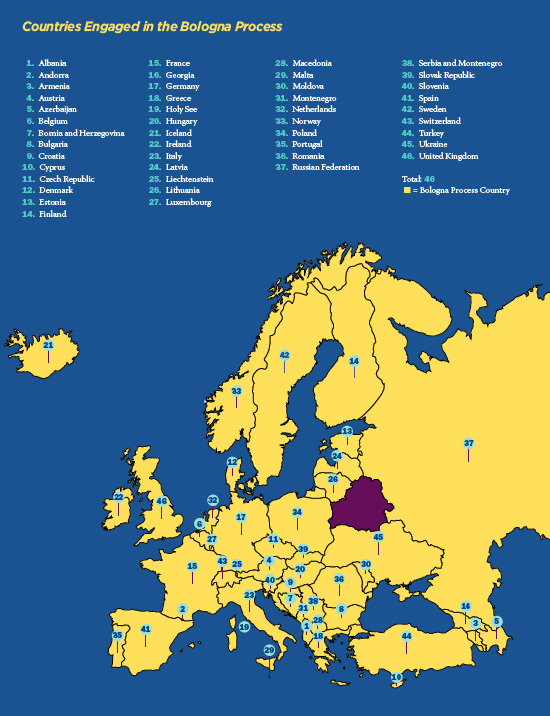 Source of Map: Bologna and Lisbon: Two Processes or One
Per Nyborg, Global Higher Education, February 1, 2008
UNESCO has been negotiating a series of regional conventions on the recognition of credentials from institutions of higher education. The Lisbon Convention, signed in 1997, was for the European region. The European Commission notes:
The Bologna Process aims to create a European Higher Education Area by 2010, in which students can choose from a wide and transparent range of high quality courses and benefit from smooth recognition procedures. The Bologna Declaration (pdf format) of June 1999 has put in motion a series of reforms needed to make European Higher Education more compatible and comparable, more competitive and more attractive for Europeans and for students and scholars from other continents. Reform was needed then and reform is still needed today if Europe is to match the performance of the best performing systems in the world, notably the United States and Asia.In this process, the Europeans have learned quite a bit from the U.S. system of higher education, notably the division of higher education into bachelors, masters and doctoral cycles.
Clifford Adelman has written an interesting long paper titled "What U.S. Higher Education Can Learn from a Decade of European Reconstruction" which seeks both to encourage dialog in the United States about reforms of our higher educational system and to suggest some reforms that might be useful, such as dealing better with part time students and setting up a process to improve harmonization among state higher educational systems.
Click here for an appreciation of the Adelman paper, with a number of comments.
According to Wikipedia:
The Lisbon Strategy, also known as the Lisbon Agenda or Lisbon Process, is an action and development plan for the European Union. Its aim is to make the EU "the most dynamic and competitive knowledge-based economy in the world capable of sustainable economic growth with more and better jobs and greater social cohesion, and respect for the environment by 2010". It was set out by the European Council in Lisbon in March 2000.Thus the Lisbon Process and the Bologna Process are complementary
Comment: The 46 countries participating in the Bologna process span the continent from Russia to Spain. Other countries are copying the efforts of the Europeans. In a global competition for students and for excellence in higher education, it seems obvious that we should watch this process carefully, learn from it, and if possible surpass the Europeans in striving for excellence.
And indeed, the United States should seek to learn from the Lisbon Process in case its lessons will help us improve our innovation system and move more quickly towards a knowledge society. JAD
Saturday, March 28, 2009
The Global Information Technology Report 2008-2009
 "Denmark and Sweden once again lead the rankings of The Global Information Technology Report 2008-2009, released for the eighth consecutive year by the World Economic Forum. The United States follows suit, up one position from last year, thus confirming its pre-eminence in networked readiness in the current times of economic slowdown. Singapore (4), Switzerland (5) and the other Nordic countries together with the Netherlands and Canada complete the top 10.
 "The Report underlines that good education fundamentals and high levels of technological readiness and innovation are essential engines of growth needed to overcome the current economic crisis. Under the theme “Mobility in a Networked World”, this year’s Report places a particular focus on the relationship and interrelations between mobility and ICT."
The Report is produced by the World Economic Forum in cooperation with INSEAD, a business school, and is sponsored by Cisco Systems.Comment: The new edition of the most influential of eReadiness studies. JAD
Friday, March 27, 2009
"On Being a Scientist: Third Edition"
 Committee on Science, Engineering, and Public Policy, National Academy of Sciences, National Academy of Engineering, and Institute of Medicine
National Academy Press, 2009
Description:
The scientific research enterprise is built on a foundation of trust. Scientists trust that the results reported by others are valid. Society trusts that the results of research reflect an honest attempt by scientists to describe the world accurately and without bias. But this trust will endure only if the scientific community devotes itself to exemplifying and transmitting the values associated with ethical scientific conduct.
On Being a Scientist was designed to supplement the informal lessons in ethics provided by research supervisors and mentors. The book describes the ethical foundations of scientific practices and some of the personal and professional issues that researchers encounter in their work. It applies to all forms of research--whether in academic, industrial, or governmental settings-and to all scientific disciplines.
This third edition of On Being a Scientist reflects developments since the publication of the original edition in 1989 and a second edition in 1995. A continuing feature of this edition is the inclusion of a number of hypothetical scenarios offering guidance in thinking about and discussing these scenarios.
On Being a Scientist is aimed primarily at graduate students and beginning researchers, but its lessons apply to all scientists at all stages of their scientific careers.
An Interesting Case Study in Public Health Decision Making
Source: "A Vaccine Debate Once Focused on Sex Shifts as Boys Join the Target Market," Rob Stein, The Washington Post, March 26, 2009.
Gardasil, a vaccine, protects against the human papillomavirus (HPV), the most common sexually transmitted infection. HPV causes genital warts and, in women, can lead to cervical cancer -- a disease that strikes about 10,000 American women a year and kills about 3,700.
Any vaccine carries risks to the vaccinated; even when there are large studies of the safety and efficacy of a new vaccine there is a possibility that problems will arise in mass immunization campaigns that were not seen in the research. The public health decision involves comparing the costs and risks of the immunization to the potential benefits. Those benefits include both the benefits to the immunized person, and the benefits to others.
If you can get enough of the population immunized, even the unvaccinated are protected since epidemics are limited. If you can immunize enough people, as was done for smallpox, the disease may be eliminated entirely.
Think also about flu vaccines, which are given to old and sick people who are likely to suffer worse cases of flu if they are infected. In this case, the vaccine is also given to young, healthy people if they might infect a more vulnerable person if they catch the flu.
The HPV vaccine is different in that the direct benefits to males are different than those for females, and one may assume that the indirect benefits in terms of protecting sexual partners and the public are also different. The indirect benefits are especially hard to estimate.
As always in immunization campaigns, there is the problem of conforming individual decisions to the public good. How do you get mothers of young boys to subject their sons to even the small risk of an immunization, and spend the money for the vaccine, in order to provide protection for a possible wife in the distant future?
I suspect this is an especially important public policy issue because its solution will set a pattern for future immunization policy decisions. The genetics of sex are very obvious, but in the future we are going to know a lot more about the genetic makeup of people and how their genome affects their response to vaccines and vulnerability to communicable diseases. We will have lots of situations in which the same vaccine will have different risks and different benefits for different, identifiable groups of people. Making the right decision on immunization policy for boys for the HPV vaccine may help us to make better decisions in many cases in the future. JAD

Gardasil, a vaccine, protects against the human papillomavirus (HPV), the most common sexually transmitted infection. HPV causes genital warts and, in women, can lead to cervical cancer -- a disease that strikes about 10,000 American women a year and kills about 3,700.
The virus causes at least 250,000 new cases of genital warts and an estimated 7,500 cancers in males each year, causing perhaps about 1,000 deaths. Vaccinating boys and men would also help prevent the spread of the virus to their sexual partners.......Comment: This vaccine presents an interesting problem. It is the first case I can think of in which a vaccine was recognized to have different benefits for males than for females.
After the Food and Drug Administration approved the vaccine in 2006 for girls as young as 9, medical authorities recommended that they receive it at age 11 or 12 to protect them before they start having sex......in December, Merck asked the FDA to approve the vaccine for males ages 9 to 26.......The relatively pricey vaccine costs about $500 for three shots and the associated office visits.
Any vaccine carries risks to the vaccinated; even when there are large studies of the safety and efficacy of a new vaccine there is a possibility that problems will arise in mass immunization campaigns that were not seen in the research. The public health decision involves comparing the costs and risks of the immunization to the potential benefits. Those benefits include both the benefits to the immunized person, and the benefits to others.
If you can get enough of the population immunized, even the unvaccinated are protected since epidemics are limited. If you can immunize enough people, as was done for smallpox, the disease may be eliminated entirely.
Think also about flu vaccines, which are given to old and sick people who are likely to suffer worse cases of flu if they are infected. In this case, the vaccine is also given to young, healthy people if they might infect a more vulnerable person if they catch the flu.
The HPV vaccine is different in that the direct benefits to males are different than those for females, and one may assume that the indirect benefits in terms of protecting sexual partners and the public are also different. The indirect benefits are especially hard to estimate.
As always in immunization campaigns, there is the problem of conforming individual decisions to the public good. How do you get mothers of young boys to subject their sons to even the small risk of an immunization, and spend the money for the vaccine, in order to provide protection for a possible wife in the distant future?
I suspect this is an especially important public policy issue because its solution will set a pattern for future immunization policy decisions. The genetics of sex are very obvious, but in the future we are going to know a lot more about the genetic makeup of people and how their genome affects their response to vaccines and vulnerability to communicable diseases. We will have lots of situations in which the same vaccine will have different risks and different benefits for different, identifiable groups of people. Making the right decision on immunization policy for boys for the HPV vaccine may help us to make better decisions in many cases in the future. JAD
Last Comment on Overthrow
1. American foreign policy is made by imperfect people, at best working from limited rationality on imperfect and incomplete information, and at worst on the basis of ignorance, superstition, or bullheadedness.
2. In the century in which America had the power to overthrow foreign governments, presidents have used that power more than a dozen times to do so. The exercise of superior military force is not an aberration but a common aspect of American foreign policy.
3. When American government leaders decide to overthrow a foreign government they understand the people living under that government only poorly and barely consider the welfare of those people, who after all are likely to be the most affected.
4. Americans who understand and care about the people affected by the regime change don't have the power to make the policy; people who do make the policy tend not to understand or care about the people.
5. The long term effects of overthrowing a foreign government are almost always negative for the United States and for the people of the other nation, in part because the U.S. does not make the investment in development it would seem to owe the people of the foreign nation.
Wednesday, March 25, 2009
Invention, Innovation and Beyond
Invention is the creation of something new to the world. It's earmark is the novelty that is a basis for patent protection. Innovation is the introduction of something new, but not necessarily an invention. Thus a technology imported from abroad can be an innovation for a country that does not already use that technology. We talk about the diffusion of innovations, reflecting the fact that even though an innovation has reached a country, its adoption by new enterprises within the country can still be innovations within the adopting enterprises.
Economic progress is associated with increased productivity, especially the increase in labor productivity, which underlies improvements in per capita income. Labor productivity can be improved by capital accumulation, either in the form of physical capital or human capital. I have noticed however that increases in capital per worker are often associated with innovations.
Capital accumulation is limited, and it has long been observed that the rate of economic growth can be as much as doubled by high rates of innovation. It has seemed to me in fact that a high rate of productive innovation in an economy should lead to more rapid investment, since there are new things in which to invest offering future profits.
In the United States there has been a tendency to promote invention fueled innovation. Perhaps this is not surprising in a country that early in my career funded more than half of global research and development.
Certainly there are advantages in invention led innovation, especially under the monopoly rights granted by intellectual property rights protection. Not only does the inventor have control of the market for a significant period, but also enjoys an early innovator advantage.
With economic development, countries increase the portion of their domestic product devoted to research and development, and the economic growth of European and Asian nations has resulted in an increase in their R&D and a decrease in the relative importance of U.S. R&D. With five percent of the world's population it is more surprising that we still fund one-third of global R&D than that the percentage of R&D funded by the rest of the world is increasing.
I strongly suggest that as a result of this long term trend, the United States should increasingly emphasize the adoption of inventions from abroad within our domestic innovation strategy. We need to continuously scan the globe for inventions that we can impor and we need to provide an environment in which enterprises have the resources they need to adopt foreign innovations and profit from them. Indeed, we need to encourage government and civil society similarly to adopt appropriate foreign innovations as well as to invent new ones.
All this seems to be more or less commonly accepted. What seems not to be recognized it is not doing something new that is important, but doing it well. The innovations must lead to efficient efforts of high quality. If not, in an evolving global knowledge society, others in other nations will appropriate the advantages from the innovation -- they will eat our lunch.
Americans have historically worked long and hard, and have innovated not only in what they produced by in how it was produced, seeking to organize ever better and work ever smarter. The challenge is to continue to do so faced with the challenges of workers from other nations who are increasingly enabled by better systems to put energy to work in innovating well.
We have done well be expanding educational opportunities since the Great Depression, integrating women into the workforce, and reducing the barriers to productivity imposed by racism and prejudice. Still much more needs to be done. It seems especially that the geographic spread of innovation and excellence must increased.
 Source: "Benchmarking Economic Transformation in USA," Panagiotis Tsarchopoulos
Economic progress is associated with increased productivity, especially the increase in labor productivity, which underlies improvements in per capita income. Labor productivity can be improved by capital accumulation, either in the form of physical capital or human capital. I have noticed however that increases in capital per worker are often associated with innovations.
Capital accumulation is limited, and it has long been observed that the rate of economic growth can be as much as doubled by high rates of innovation. It has seemed to me in fact that a high rate of productive innovation in an economy should lead to more rapid investment, since there are new things in which to invest offering future profits.
In the United States there has been a tendency to promote invention fueled innovation. Perhaps this is not surprising in a country that early in my career funded more than half of global research and development.
Certainly there are advantages in invention led innovation, especially under the monopoly rights granted by intellectual property rights protection. Not only does the inventor have control of the market for a significant period, but also enjoys an early innovator advantage.
With economic development, countries increase the portion of their domestic product devoted to research and development, and the economic growth of European and Asian nations has resulted in an increase in their R&D and a decrease in the relative importance of U.S. R&D. With five percent of the world's population it is more surprising that we still fund one-third of global R&D than that the percentage of R&D funded by the rest of the world is increasing.
I strongly suggest that as a result of this long term trend, the United States should increasingly emphasize the adoption of inventions from abroad within our domestic innovation strategy. We need to continuously scan the globe for inventions that we can impor and we need to provide an environment in which enterprises have the resources they need to adopt foreign innovations and profit from them. Indeed, we need to encourage government and civil society similarly to adopt appropriate foreign innovations as well as to invent new ones.
All this seems to be more or less commonly accepted. What seems not to be recognized it is not doing something new that is important, but doing it well. The innovations must lead to efficient efforts of high quality. If not, in an evolving global knowledge society, others in other nations will appropriate the advantages from the innovation -- they will eat our lunch.
Americans have historically worked long and hard, and have innovated not only in what they produced by in how it was produced, seeking to organize ever better and work ever smarter. The challenge is to continue to do so faced with the challenges of workers from other nations who are increasingly enabled by better systems to put energy to work in innovating well.
We have done well be expanding educational opportunities since the Great Depression, integrating women into the workforce, and reducing the barriers to productivity imposed by racism and prejudice. Still much more needs to be done. It seems especially that the geographic spread of innovation and excellence must increased.
Source: "Benchmarking Economic Transformation in USA," Panagiotis TsarchopoulosFive states—Massachusetts, Washington, Maryland, Delaware and New Jersey—are leading the United States’ transformation into a global, entrepreneurial and knowledge- and innovation-based New Economy, according to The 2008 State New Economy Index, released by the Ewing Marion Kauffman Foundation and the Information Technology and Innovation Foundation (ITIF).
TB, Made Worse by HIV, is Still With Us
 According to WHO:
The total number of new tuberculosis (TB) cases remained stable in 2007, and the percentage of the world's population becoming ill with TB has continued the slow decline that was first observed in 2004, according to a new report released by the World Health Organization (WHO) today.However, the 2009 Global TB Control Report also reveals that one out of four TB deaths is HIV related, twice as many as previously recognized. In 2007, there were an estimated 1.37 million new cases of tuberculosis among HIV-infected people and 456,000 deaths. This figure reflects an improvement in the quality of the country data, which are now more representative and available from more countries than in previous years.
U.S. Government Hiring for Foreign Assistance Posts
Source: "Uncle Sam Wants You for Foreign Service," Joe Davidson, The Washington Post, March 25, 2009.
Officials from the U.S. Agency for International Development and the government's Millennium Challenge Corp. were recruiting at a job fair last week at the Ronald Reagan Building, USAID's headquarters. USAID plans to double, to 2,200, its ranks of foreign service officers by 2012; it plans to hire more than 300 people this year.
Officials from the U.S. Agency for International Development and the government's Millennium Challenge Corp. were recruiting at a job fair last week at the Ronald Reagan Building, USAID's headquarters. USAID plans to double, to 2,200, its ranks of foreign service officers by 2012; it plans to hire more than 300 people this year.
Leopard Cub at the National Zoo

 These pictures have nothing to do with the theme of this blog, but I could not resist adding the photos of new-born cubs that are being raised in the Front Royal facility of the National Zoo. Photo: Tracy Woodward, Photo source: The Washington Post.
Tuesday, March 24, 2009
IMPACT on Cyber Security
The International Multilateral Partnership Against Cyber-Threats (IMPACT) in Cyberjaya, Malaysia will host the ITU’s Global Cybersecurity Agenda (GCA), which promotes international cooperation to make cyberspace more secure in an increasingly networked information society. It has just opened.
Natural Disasters
 Source: The Economist
"More than 240,000 people lost their lives to natural and man-made catastrophes last year, according to Swiss Re. The insurance firm puts the total cost of damages at $269 billion, less than a fifth of which was covered by insurance......China’s earthquake in May left almost 88,000 people dead or missing. The worst catastrophe was tropical cyclone Nargis in Myanmar, which claimed 140,000 victims."
Comment: I was surprised by the huge number of deaths from natural disasters, but such numbers should always be understood in context. Disaster mortality fades in importance when seen in light of some 60 million deaths per year globally. Indeed, compare the mortality from infectious diseases in low income with that in high income countries in the graph below and you will see that there are millions of preventable deaths per year from infections.
That is not to say that we should ignore better protection against natural disasters.
Last week I heard that there is a city of more than 600,000 people in Indonesia with hundreds of thousands living in the coastal plain who are at risk of tsunamis which are all but sure to arrive in the next decade or two. The tsunami warning system has been greatly improved since the 2004 disaster, but donor support is beginning to wane. JAD
Comment: I was surprised by the huge number of deaths from natural disasters, but such numbers should always be understood in context. Disaster mortality fades in importance when seen in light of some 60 million deaths per year globally. Indeed, compare the mortality from infectious diseases in low income with that in high income countries in the graph below and you will see that there are millions of preventable deaths per year from infections.
That is not to say that we should ignore better protection against natural disasters.
Last week I heard that there is a city of more than 600,000 people in Indonesia with hundreds of thousands living in the coastal plain who are at risk of tsunamis which are all but sure to arrive in the next decade or two. The tsunami warning system has been greatly improved since the 2004 disaster, but donor support is beginning to wane. JAD

Monday, March 23, 2009
Hunger Map
 Estimated food security conditions, 1st Quarter 2009 (January-March), FEWS Net.
The Famine Early Warning Center predicts high levels of food insecurity in Somalia and parts of the Sahel.
Smart Power
There is an interesting column in the current issue of USAID's Frontlines by Joe Nye. I quote:
President Obama reminded us [Jan. 20] that “our power grows through its prudent use; our security emanates from the justness of our cause, the force of our example, the tempering
qualities of humility and restraint.”
A week ago, in her confirmation hearings to become secretary of state, Hillary Rodham Clinton said: “America cannot solve the most pressing problems on our own, and the world cannot solve them without America.... We must use what has been called ‘smart power,’ the full range of tools at our disposal.”
Smart power is the combination of hard and soft power. Soft power is the ability to get what you want through attraction rather than coercion or payments. Opinion polls show a serious decline in American attractiveness in Europe, Latin America and, most dramatically, the Muslim world.
Thoughts on Reading "Overthrow"
I have been reading Overthrow: America's Century of Regime Change from Hawaii to Iraq by Stephen Kinzer. Kinzer writes and interesting story, and in this book he makes a good case that American governments over a period of more than a century have sought to overthrow foreign governments repeatedly and often successfully. He suggests that the results were often much worse than the instigating government officials perceived as a result of the unwillingness of the government to follow through with nation building support for the long periods such efforts require.
Because he has chosen to deal with many case studies in a short book, each is perhaps too brief to fully deal with the complexity involved.
I lived in Chile in the mid 1960s and am perhaps better able to evaluate Kinzer's treatment of the overthrow of Salvador Allende, that was completed in 1973. Kinzer describes overt and covert measures by the U.S. government to undermine the Allende regime, and rightly points out that some of these measures, such as limiting foreign assistance to Chile, were quite within the rights of the United States. Some of the covert efforts, when they were revealed, were widely condemned in the United States as well as abroad.
In my opinion, Kinzer ascribes too much influence to the American efforts and not enough to the Chilean. By 1967 a lot of people I knew predicted that Allende would win the 1970 election and that the military would overthrow the elected government. The rich and powerful in Chile, who were mostly against the leftest government were quite capable of raising public sentiment against Allende, and when the right wing of the military gained control there was little that the civilians could do to resist a military coup. Kinzer does say that the impact of the American actions may have been to change the timing and form of these coups, and I would accept the possibility/probability that the coup in Chile took place earlier and with a more right wing tinge than might have occurred without the U.S. interventions.
I would suggest that the leftest groups in Chile were more revolution and more subversive than Kinzer seems to indicate. I assume that the Chilians were quite capable of anti-American actions without much support from Russia or China, and that some factions of the Chilian left might well have had revolutionary intent. Chile might well have been on a course toward major troubles no matter what the United States did.
The book is very effective in painting senior officials in the United States foreign policy apparatus as elitists with very little understanding of the common man in foreign societies, and as very easily affected by biased inputs from foreign elites. Secretaries of State seem overly willing to ignore the advice of CIA and State Department staffers who have lived in and studied foreign societies for decades.
Kinzer writes that Jacobo Arbenz Guzman, the president of Guatemala overthrown in 1954 was a nationalist rather than a Communist as perceived by the Dulles family and the Eisenhower administration. I think of "nationalism" as an ideology that seeks to allow nations to be self governing -- to align the boundaries of the state with the distribution of an ethnic group, creating nation-states. Guatemala is a multiethnic society which in the 1950s still had a strong colonial heritage of European and mestizo domination of indiginous peoples. I think of Arbenz as anti-imperialist and socially progressive politician. Still, my experience of Latin American leftists suggests that they are not likely to be willing to subordinate their own interests to those of distant powers.
It seems to me that there is a widely shared "leftest" ideology in Latin America that emphasizes social justice and national independence and opposes foreign multinational enterprises as neo-imperial. In that climate, many actors in many countries may independently choose anti-American positions and act against the rightist powers in their own countries. This did not necessarily imply an effective international Communist conspiracy. It also did not necessarily require U.S. government support of right wing regimes, no matter how coercive or venial.
I hope the government is not making the same error with respect to the Islamic peoples. It seems to me quite possible that there is a wide spread set of cultural attitudes that result in many individuals embarking on anti-American activities, without the need for a central terrorist network to plan and organize the efforts.
It seems to me that the way to deal with wide spread cultural attitudes is through both to recognize the justice in the complaints and reform, as well as to educate people as to the real situation. I hope that American policy makers share that approach.
Because he has chosen to deal with many case studies in a short book, each is perhaps too brief to fully deal with the complexity involved.
I lived in Chile in the mid 1960s and am perhaps better able to evaluate Kinzer's treatment of the overthrow of Salvador Allende, that was completed in 1973. Kinzer describes overt and covert measures by the U.S. government to undermine the Allende regime, and rightly points out that some of these measures, such as limiting foreign assistance to Chile, were quite within the rights of the United States. Some of the covert efforts, when they were revealed, were widely condemned in the United States as well as abroad.
In my opinion, Kinzer ascribes too much influence to the American efforts and not enough to the Chilean. By 1967 a lot of people I knew predicted that Allende would win the 1970 election and that the military would overthrow the elected government. The rich and powerful in Chile, who were mostly against the leftest government were quite capable of raising public sentiment against Allende, and when the right wing of the military gained control there was little that the civilians could do to resist a military coup. Kinzer does say that the impact of the American actions may have been to change the timing and form of these coups, and I would accept the possibility/probability that the coup in Chile took place earlier and with a more right wing tinge than might have occurred without the U.S. interventions.
I would suggest that the leftest groups in Chile were more revolution and more subversive than Kinzer seems to indicate. I assume that the Chilians were quite capable of anti-American actions without much support from Russia or China, and that some factions of the Chilian left might well have had revolutionary intent. Chile might well have been on a course toward major troubles no matter what the United States did.
The book is very effective in painting senior officials in the United States foreign policy apparatus as elitists with very little understanding of the common man in foreign societies, and as very easily affected by biased inputs from foreign elites. Secretaries of State seem overly willing to ignore the advice of CIA and State Department staffers who have lived in and studied foreign societies for decades.
Kinzer writes that Jacobo Arbenz Guzman, the president of Guatemala overthrown in 1954 was a nationalist rather than a Communist as perceived by the Dulles family and the Eisenhower administration. I think of "nationalism" as an ideology that seeks to allow nations to be self governing -- to align the boundaries of the state with the distribution of an ethnic group, creating nation-states. Guatemala is a multiethnic society which in the 1950s still had a strong colonial heritage of European and mestizo domination of indiginous peoples. I think of Arbenz as anti-imperialist and socially progressive politician. Still, my experience of Latin American leftists suggests that they are not likely to be willing to subordinate their own interests to those of distant powers.
It seems to me that there is a widely shared "leftest" ideology in Latin America that emphasizes social justice and national independence and opposes foreign multinational enterprises as neo-imperial. In that climate, many actors in many countries may independently choose anti-American positions and act against the rightist powers in their own countries. This did not necessarily imply an effective international Communist conspiracy. It also did not necessarily require U.S. government support of right wing regimes, no matter how coercive or venial.
I hope the government is not making the same error with respect to the Islamic peoples. It seems to me quite possible that there is a wide spread set of cultural attitudes that result in many individuals embarking on anti-American activities, without the need for a central terrorist network to plan and organize the efforts.
It seems to me that the way to deal with wide spread cultural attitudes is through both to recognize the justice in the complaints and reform, as well as to educate people as to the real situation. I hope that American policy makers share that approach.
An Arab Plan of Action for Science and Technology

The Economic Summit of the Kings, Heads of State and Governments of the Arab League has adopted an Arab Plan of Action for Science and Technology. The plan was adopted at the summit held in Kuwait from 19 to 20 January 2009. UNESCO and the Arab League Educational, Cultural and Scientific Organization (ALECSO) are spearheading efforts to implement the plan.
Under the plan, a network of centres of excellence in the Arab world will be set up. These centres will work together on joint research projects to facilitate cooperation and thereby strengthen scientific ties and mobility within the Arab world. As many Arab scientists are living and working farther afield, the plan includes a collaborative research programme with the diaspora.
An Arab observatory of science and technology will be set up to monitor progress in research and development (R&D) and the application of research results to problem-solving in Arab society. Four priority areas for R&D have been identified: water, food, energy and agriculture.
100 Hours of Astronomy

100 Hours of Astronomy
The 100 Hours of Astronomy Cornerstone Project is a worldwide event consisting of a wide range of public outreach activities, live science center, research observatory webcasts and sidewalk astronomy events.One of the key goals of 100 Hours of Astronomy is to have as many people as possible look through a telescope as Galileo did for the first time 400 years ago. 100 Hours of Astronomy will take place from 2-5 April when the Moon goes from first quarter to gibbous, good phases for early evening observing. Saturn will be the other highlight of early evening observing events.
The 100 Hours of Astronomy Cornerstone Project is a worldwide event consisting of a wide range of public outreach activities, live science center, research observatory webcasts and sidewalk astronomy events.One of the key goals of 100 Hours of Astronomy is to have as many people as possible look through a telescope as Galileo did for the first time 400 years ago. 100 Hours of Astronomy will take place from 2-5 April when the Moon goes from first quarter to gibbous, good phases for early evening observing. Saturn will be the other highlight of early evening observing events.
Warming leads to disease leads to forest loss

Source: "ECOLOGY: Western U.S. Forests Suffer Death by Degrees," Elizabeth Pennisi, Science, 23 January 2009: Vol. 323. no. 5913, p. 447
I quote:
An insidious problem has taken hold in the forests of the American West, quietly thinning their ranks. Mortality rates in seemingly healthy conifer stands have doubled in the past several decades. Often, new trees aren't replacing dying ones, setting the stage for a potentially dramatic change in forest structure, says Phillip J. van Mantgem, a forest ecologist at the U.S. Geological Survey (USGS) in Arcata, California. Warmer temperatures and subsequent water shortfalls are the likely cause of the trees' increased death rate, he and his colleagues report on page 521.
"This is a stunningly important paper," says David Breshears, an ecologist at the University of Arizona, Tucson. For years, he and others have lamented massive diebacks that occur when fungal and insect pests ravage stands of trees. "What's harder to detect," he explains, is any subtle but significant shift in the trees' background death rate. "They have done a very thorough job" of documenting it."
Original Source
Widespread Increase of Tree Mortality Rates in the Western United States"
Phillip J. van Mantgem, Nathan L. Stephenson, John C. Byrne, Lori D. Daniels, Jerry F. Franklin, Peter Z. Fulé, Mark E. Harmon, Andrew J. Larson, Jeremy M. Smith, Alan H. Taylor, and Thomas T. Veblen (23 January 2009)
Science 323 (5913), 521. [DOI: 10.1126/science.1165000]
Abstract:
Persistent changes in tree mortality rates can alter forest structure, composition, and ecosystem services such as carbon sequestration. Our analyses of longitudinal data from unmanaged old forests in the western United States showed that background (noncatastrophic) mortality rates have increased rapidly in recent decades, with doubling periods ranging from 17 to 29 years among regions. Increases were also pervasive across elevations, tree sizes, dominant genera, and past fire histories. Forest density and basal area declined slightly, which suggests that increasing mortality was not caused by endogenous increases in competition. Because mortality increased in small trees, the overall increase in mortality rates cannot be attributed solely to aging of large trees. Regional warming and consequent increases in water deficits are likely contributors to the increases in tree mortality rates.
Sunday, March 22, 2009
"Ratifying the Law of the Sea"
Source: Melissa Bert and Mark Schlakman, The Boston Globe, March 16, 2009.
President Obama has a chance to promote global security and stability by advocating for ratification of the UN Convention on the Law of the Sea.
President Obama has a chance to promote global security and stability by advocating for ratification of the UN Convention on the Law of the Sea.
The United States has 12,500 miles of coastline and 360 major commercial ports. Among the world's largest importers and exporters of goods and services, it has more to gain by ratifying the convention than by avoiding it, especially against the backdrop of global recession.Comment: Sounds reasonable to me! JAD
In the absence of such a legal framework, history is replete with examples of rogue nations unduly restricting maritime access and encroaching upon others' interests, potentially compromising military operations, disrupting commerce, and flouting accountability for environmental degradation.
So far, 156 countries and the European Community have ratified the treaty.......
Support for ratification is bipartisan. Proponents include both former presidents Bush and Clinton; former secretaries of state Condoleezza Rice, Colin Powell, and Madeleine Albright; Secretary of State Hillary Clinton; Admiral Mike Mullen, chairman of the Joint Chiefs of Staff; Admiral Thad Allen, commandant of the Coast Guard; major environmental groups and many others.
Saturday, March 21, 2009
Holder on Science Decision Making
I found the following report of an exchange in the confirmation hearing of the new White House Science Advisor:
In the search for knowledge, one might well choose to accept as probably true the most likely alternatine.
If you are making decisions that involve the interpretation of scientific data, one probably should "bet" based on the costs and benefits of the alternative interpretations as well as their likelihood. JAD
Rockefeller then asked how divergent views should be resolved inComment: What an unfortunate quote!
areas such as climate change. Holdren's reply indicates how he will
approach such issues, as well as his position on climate change:
". . . there is always, has always been, always will be diversity of
opinion among scientists about any complicated issue. Scientists are
as diverse a group as any other you will find, and people come to
different conclusions about how to interpret the same data. This is
routine.
"My position would be that in matters of public policy, policymakers
should bet with the odds. You look at the range of scientific
opinion. You look at the center of gravity of that scientific
opinion. You look at what the bodies that have accumulated the most
expert knowledge and brought it to bear on the question have to say.
And while you can never conclude that any particular interpretation
in science is final. All science is contingent. It could change
with new information, new data, new observations, new analysis. But
if you're making policy, it is wise, in my judgment, to go with the
opinion of the bulk of the part of the scientific community that has
studied that particular question.
In the search for knowledge, one might well choose to accept as probably true the most likely alternatine.
If you are making decisions that involve the interpretation of scientific data, one probably should "bet" based on the costs and benefits of the alternative interpretations as well as their likelihood. JAD
Transition in Research Intensity
 I wanted to share this great graph prepared by Carl Dahlman for a paper he delivered at the Joint OECD-World Bank Conference on Innovation and Sustainable Growth in a Globalised World. (He and Carlos Braga presented their papers again last week in a session at the World Bank that I was able to attend.)
The size of the circles on the graph are the total R&D expenditures for the countries. The graph compares R&D indicators for emerging S&T powers (Brazil, India, China, and South Korea) with advanced developed nations (France, Germany, Japan, United Kingdom and United States).
The obvious conclusions are:
- That there is a transition from lower to higher investments in R&D with social and economic development;
- China, because of its large population, has become the third largest funder of R&D in the world (after the United States and Japan) even with relatively low per capita expenditures on R&D and per capita R&D personnel.
I recommend the seminar!
THE ROLE OF INNOVATION POLICIES IN THE CURRENT FINANCIAL CRISIS
This is a brief summary of an informal consultation held at the OECD.
"Confronting the financial crisis : Its impact on the ICT industry"
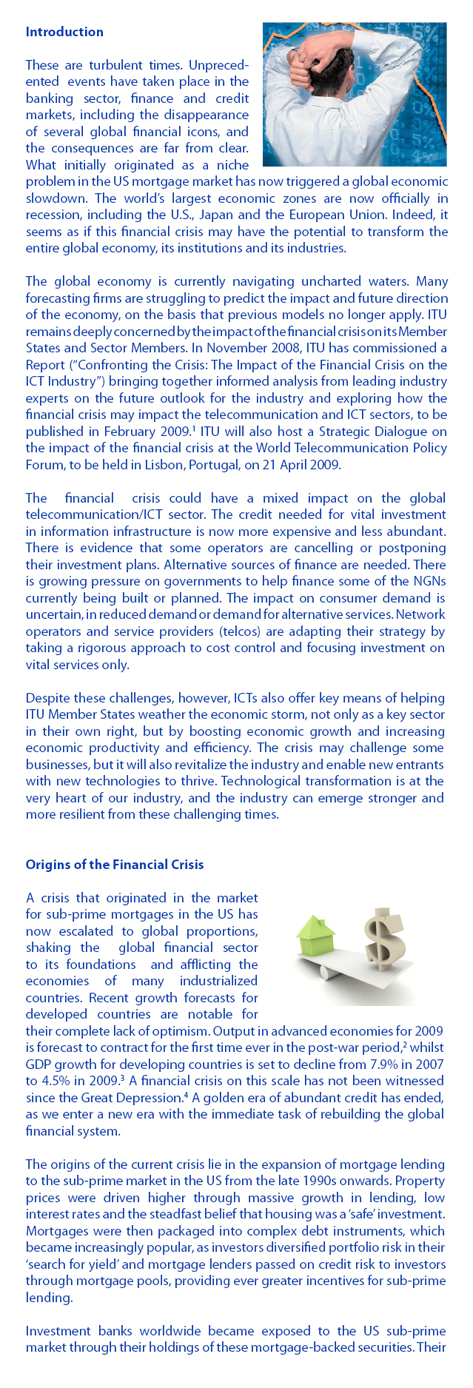 This report was prepared by the International Telecommunications Union in preparation for the World Telecommunication Policy Forum. The theme of the Forum is "the theme Confronting the Crisis". The Forum will be held in Lisbon from 21-24 April.
AfriGadget
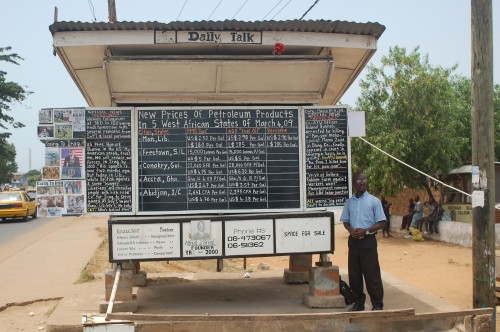 Erik Hersman posted a story on AfriGadget (March 13) about Alfred Sirleaf, "an analog blogger". Sirleaf "runs the 'Daily News', a news hut by the side of a major road in the middle of Monrovia.......He uses his cell phone as the major point of connection between him and the 10,000 (he says) that read his blackboard daily."
AfriGadget is a website dedicated to showcasing African ingenuity. A team of bloggers and readers contribute their pictures, videos and stories from around the continent. The stories of innovation are inspiring. It is a testament to Africans bending the little they have to their will, using creativity to overcome life’s challenges.
This is a great website!
'Disappearing Birds'
 Source: The Washington Post
"Habitat loss has sent many bird species into decline across the United States."
State of the Birds Report
Comment: I don't really know what this graph means. There are good trends -- wetlands and all birds in the last decade. There are trends of concern in grasslands and arid lands. However, we need to balance the needs for agricultural production with the concern to maintain a healthy environment. Converting some grasslands and arid lands to agriculture would be expected to reduce the populations of birds living in natural grasslands and arid lands. The question is whether the decrease in bird populations is excessive.
Probably the recovery in the past decade is testimony to better pesticide application policies. Don't get too comfortable with that. As global population increases by another three billion, and as people eat more meat, there will be social and economic pressures to increase agricultural production and the birds may suffer! JAD
Probably the recovery in the past decade is testimony to better pesticide application policies. Don't get too comfortable with that. As global population increases by another three billion, and as people eat more meat, there will be social and economic pressures to increase agricultural production and the birds may suffer! JAD
Wednesday, March 18, 2009
A David Dickson Editorial Worth Quoting
"Anyone seeking to tackle the problems facing the developing world must remember two simple facts of life. First, none of these problems — from food shortages and the spread of disease, to achieving sustainable economic growth — can be addressed without the use of science and technology.
"Second, harnessing science for development depends on the skills of a country's people. And that in turn requires a robust and effective higher education system — the only mechanism that can produce and sustain these skills."
An interesting idea: put new grads to work on research
There is an interesting proposal today from Sam Wang and Sandra Aamodt via the New York Times. They propose that rather than funding traditional research grants competitions with the large science component ($21.5 Billion for Federal R&D) of the government stimulus package. They propose
I would suppose that the way to do this would be to create a grant program to fund university and other organization proposals for small research programs. The proposals would have to justify the relevance and importance of the research, would have to demonstrate that young people could be recruited to do the research, and that there would be suitable guidance to guarantee quality of the experience and results. JAD
using some of the windfall to provide an opportunity for fresh college graduates to pursue two years of research in the nation’s service while the job market is bottoming out. Call it “Research for America.” Our proposal would put young Americans to work and support science — without setting off a later bust cycle in research support, as previous funding booms have done.Comment: This sounds like a good idea to me, for at least a part of the funding. It would probably generate new employment; more grants via the standard grants programs might not do that. The young researchers, with proper guidance, could produce useful results. Some of them would go on to other jobs with a better understanding of research and the value of scientific evidence; some would go back to get doctorates and become professional researchers.
I would suppose that the way to do this would be to create a grant program to fund university and other organization proposals for small research programs. The proposals would have to justify the relevance and importance of the research, would have to demonstrate that young people could be recruited to do the research, and that there would be suitable guidance to guarantee quality of the experience and results. JAD
OECD Observer: Hot issues: Financial crisis
 "The financial crisis and economic downturn are likely to put upward pressure on government debt. The trouble is, according to OECD in Figures 2008, public debt (general government debt, which includes central and local government) had already risen quite sharply in the OECD as a whole since 1987, from 59% of GDP to 75% in 2007. Two decades ago, Belgium had the highest public debt, but today that position is filled by Japan, whose debt rose from below 60% to 170% of GDP. Italy’s debt has also shot above 100% of GDP in the past 20 years."
Check out this great OECD website on the financial crisis!
Science & Innovation Policy: Aid for higher education
This is a new dossier from SciDev.Net, providing news, features, opinion, policy briefs, book reviews, practical guides, links, etc. "Donors are increasingly recognising that they have a key role to play in strengthening higher education in developing countries. But how should aid be delivered? And which areas need most support?"
"Higher Education to 2030 (Vol. 1): Demography"
 Japan and Korea have already started to see their enrolments in tertiary education decline, but other countries like Turkey and Mexico can still expect a boom. What might be the future impact of demographic changes on tertiary education systems and institutions? How can and do countries address these changes? What opportunities and challenges do they bring? Drawing on trend data and projections, this book takes an in-depth look at these important questions from both a qualitative and quantitative standpoint.
OECD, 2008.
The Executive Summary, contents, and three chapters are available online.
This is a publication of the OECD Center for Educational Research and Innovation (CERI). CERI’s work covers learning at every age, from birth to old age. It goes beyond the formal education system. We have a particular concern with emerging trends and issues, futures thinking in schools and universities. We often have a longer timeframe than most work, typically aiming to set an agenda for the next 5-10 years orlonger.
Tuesday, March 17, 2009
Can A Company Patent the Medical Application of Decision Support Systems?
Science magazine had a story in the February 27, 2009 issue about a dispute relating to the HIV Drug Resistance Data Base.
At the center of the dispute are U.S. patents owned by Advanced Biological Laboratories (ABL) S.A. in Luxembourg that involve computer methods to guide treatment of patients with HIV infection and other diseases. In early 2007, ABL notified Stanford that its popular Internet-accessible HIV Drug Resistance Database (HIVdb) possibly infringed two of the company's patents.
This seems to be one of the patents.
And this seems to be another.
The patents linked above were awarded for the application of expert systems to HIV diagnosis, which seems an obvious application of an approach that had been around for decades.
What is meant be reduction to practice in this kind of an application? I would think it would take more than a mock-up, but a system that could really provide useful information. Was such a system ever provided to the examiner?
Some 50 years ago I worked on the demonstration device for a patent application for an automatic price reader for grocery stores. The machine would not have withstood the rigors of real clerks in real stores, but it did recognize the prices in sample price tags. It really demonstrated that such a device could be built. For an expert system, the demonstration that a useful device could be built would be quite hard.
Am I missing something?
In any case, it certainly seems that someone should help to defend a medically useful website such as the HIV Data Base, and make the firms claiming patent infringement prove their claim!
And this seems to be another.
I thought patents were to be awarded to inventions based that were innovative, non-obvious, and reduced to practice. I checked on the Wayback Machine, and the HIV Drug Resistance Data Base was online a couple of years before the patents seem to have been submitted.
The patents linked above were awarded for the application of expert systems to HIV diagnosis, which seems an obvious application of an approach that had been around for decades.
What is meant be reduction to practice in this kind of an application? I would think it would take more than a mock-up, but a system that could really provide useful information. Was such a system ever provided to the examiner?
Some 50 years ago I worked on the demonstration device for a patent application for an automatic price reader for grocery stores. The machine would not have withstood the rigors of real clerks in real stores, but it did recognize the prices in sample price tags. It really demonstrated that such a device could be built. For an expert system, the demonstration that a useful device could be built would be quite hard.
Am I missing something?
In any case, it certainly seems that someone should help to defend a medically useful website such as the HIV Data Base, and make the firms claiming patent infringement prove their claim!
'Comparison Shopping for Medicine'
Subtitle: "Obama's Stimulus Package Funds Research on Cutting Costs"
By Ceci Connolly, The Washington Post, March 17, 2009.

By Ceci Connolly, The Washington Post, March 17, 2009.
President Obama has dedicated $1.1 billion in the economic stimulus package for federal agencies to oversee studies on the merits of competing medical treatments.Comment: The Europeans have better health status indicators and lower medical costs than we do in America. You certainly would not want to go to their system. Of course, their system allocates their health resources more on the basis on need less on ability to pay. In terms of the thrust of this blog, I don't know which would be worse:
The approach, known as comparative effectiveness research, is aimed at finding the best treatments at the best prices. Proponents say reducing ineffective or unproven care is one way to rein in health costs, which consume nearly 18 percent of the gross domestic product, straining family budgets, company profits and the federal government.
Skeptics, however, say Obama's decision to invest heavily in such research will lead to European-style rationing in which patients are denied lifesaving therapies to save money.
- limiting the development of the efficacy and efficiency of alternative remedies, or
- failing to use such information as it becomes available.
Scientific Research on Alternative Medicine
The Washington Post has an article today describing a move to eliminate the National Center for Complementary and Alternative Medicine (NCCAM) at the National Institutes of Health. NCCAM's budget this year is about $122 million; the National Cancer Institute's Office of Cancer Complementary and Alternative Medicine also has a budget of $122 million. The total NIH alternative medicine portfolio is about $300 million a year. The total NIH budget is about $29 billion.
I am no expert, but I tend to trust the NIH. A lot of medicine has roots in traditional therapy (aspirin is based on willow bark therapy, something like on-third of drugs have natural product bases). It may well be that some traditional therapies hold promise for treatments that have not been added to our current medical practice.
It may be even more important to demonstrate danger or lack of efficacy in alternative medical practices. Negative results add to our knowledge. More than that, there is a huge market for these alternative medical treatments, and those that can be demonstrated dangerous or ineffective can through such demonstrations be more effectively removed from use.

I am no expert, but I tend to trust the NIH. A lot of medicine has roots in traditional therapy (aspirin is based on willow bark therapy, something like on-third of drugs have natural product bases). It may well be that some traditional therapies hold promise for treatments that have not been added to our current medical practice.
It may be even more important to demonstrate danger or lack of efficacy in alternative medical practices. Negative results add to our knowledge. More than that, there is a huge market for these alternative medical treatments, and those that can be demonstrated dangerous or ineffective can through such demonstrations be more effectively removed from use.
Anthony O'Daly
On St. Patrick's Day I thought I would share this piece with you. The music is from Reincarnations by Samuel Barber sung by the Taipei Chamber Singers. It is a setting of the following poem:
Anthony O'DalyStephens, in turn wrote the poem as a "reincarnation" of the lament in Irish by my several times great grandfather, Anthony (Blind) Raftery (Antoine Ó Raifteiri also Antoine Ó Reachtabhra, 1784-1835). The original was written for Anthony O'Daly, a young Irishman hanged by the British as a rebel in 1820. Raftery is supposed to have witnessed the hanging.
Anthony!
Since your limbs were laid out
the stars do not shine!
The fish leap not out
in the waves!
On our meadows the dew
does not fall in the morn,
for O Daly is dead!
Not a flow'r can be born!
Not a word can be said!
Not a tree have a leaf!
On our meadows the dew
does not fall in the morn,
for O Daly is dead!
Anthony!
After you
there is nothing to do!
There is nothing but grief!
by James Stephens (1882-1950)
from Reincarnations, published 1918
Raftery was never published in his lifetime but the poems were stored in memory and in the Gaelic Renaissance were collected and published. Douglas Hyde, later president of Ireland, published Abhráin Atá Leagtha Ar an Reachtúire, Or, Songs Ascribed to Raftery in 1903. The book which is in both Irish and English has been made available on the Internet by Google Books. The Irish version of the poem, Anthony O'Daly, is on page 128 for those who might be interested.
John Anthony Daly
A Bit of Yeats on St. Patrick's Day
Easter, 1916
I have met them at close of day
Coming with vivid faces
From counter or desk among grey
Eighteenth-century houses.
I have passed with a nod of the head
Or polite meaningless words,
Or have lingered awhile and said
Polite meaningless words,
And thought before I had done
Of a mocking tale or a gibe
To please a companion
Around the fire at the club,
Being certain that they and I
But lived where motley is worn:
All changed, changed utterly:
A terrible beauty is born.
That woman's days were spent
In ignorant good will,
Her nights in argument
Until her voice grew shrill.
What voice more sweet than hers
When young and beautiful,
She rode to harriers?
This man had kept a school
And rode our winged horse.
This other his helper and friend
Was coming into his force;
He might have won fame in the end,
So sensitive his nature seemed,
So daring and sweet his thought.
This other man I had dreamed
A drunken, vain-glorious lout.
He had done most bitter wrong
To some who are near my heart,
Yet I number him in the song;
He, too, has resigned his part
In the casual comedy;
He, too, has been changed in his turn,
Transformed utterly:
A terrible beauty is born.
Hearts with one purpose alone
Through summer and winter seem
Enchanted to a stone
To trouble the living stream.
The horse that comes from the road.
The rider, the birds that range
From cloud to tumbling cloud,
Minute by minute change;
A shadow of cloud on the stream
Changes minute by minute;
A horse-hoof slides on the brim,
And a horse plashes within it
Where long-legged moor-hens dive,
And hens to moor-cocks call.
Minute by minute they live:
The stone's in the midst of all.
Too long a sacrifice
Can make a stone of the heart.
O when may it suffice?
That is heaven's part, our part
To murmur name upon name,
As a mother names her child
When sleep at last has come
On limbs that had run wild.
What is it but nightfall?
No, no, not night but death;
Was it needless death after all?
For England may keep faith
For all that is done and said.
We know their dream; enough
To know they dreamed and are dead.
And what if excess of love
Bewildered them till they died?
I write it out in a verse --
MacDonagh and MacBride
And Connolly and Pearse
Now and in time to be,
Wherever green is worn,
Are changed, changed utterly:
A terrible beauty is born.
-- William Butler Yeats
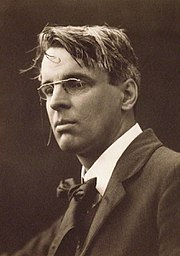
Comment: The great Irish poet wrote this after the Easter uprising in which Irish insurgents sought to revolt against England's colonial rule. As I understand it, Yeats was converted to a more militant nationalism after the execution of the leaders of the rebellion. The final lines of the poem ring down until today:
I have met them at close of day
Coming with vivid faces
From counter or desk among grey
Eighteenth-century houses.
I have passed with a nod of the head
Or polite meaningless words,
Or have lingered awhile and said
Polite meaningless words,
And thought before I had done
Of a mocking tale or a gibe
To please a companion
Around the fire at the club,
Being certain that they and I
But lived where motley is worn:
All changed, changed utterly:
A terrible beauty is born.
That woman's days were spent
In ignorant good will,
Her nights in argument
Until her voice grew shrill.
What voice more sweet than hers
When young and beautiful,
She rode to harriers?
This man had kept a school
And rode our winged horse.
This other his helper and friend
Was coming into his force;
He might have won fame in the end,
So sensitive his nature seemed,
So daring and sweet his thought.
This other man I had dreamed
A drunken, vain-glorious lout.
He had done most bitter wrong
To some who are near my heart,
Yet I number him in the song;
He, too, has resigned his part
In the casual comedy;
He, too, has been changed in his turn,
Transformed utterly:
A terrible beauty is born.
Hearts with one purpose alone
Through summer and winter seem
Enchanted to a stone
To trouble the living stream.
The horse that comes from the road.
The rider, the birds that range
From cloud to tumbling cloud,
Minute by minute change;
A shadow of cloud on the stream
Changes minute by minute;
A horse-hoof slides on the brim,
And a horse plashes within it
Where long-legged moor-hens dive,
And hens to moor-cocks call.
Minute by minute they live:
The stone's in the midst of all.
Too long a sacrifice
Can make a stone of the heart.
O when may it suffice?
That is heaven's part, our part
To murmur name upon name,
As a mother names her child
When sleep at last has come
On limbs that had run wild.
What is it but nightfall?
No, no, not night but death;
Was it needless death after all?
For England may keep faith
For all that is done and said.
We know their dream; enough
To know they dreamed and are dead.
And what if excess of love
Bewildered them till they died?
I write it out in a verse --
MacDonagh and MacBride
And Connolly and Pearse
Now and in time to be,
Wherever green is worn,
Are changed, changed utterly:
A terrible beauty is born.
-- William Butler Yeats
Comment: The great Irish poet wrote this after the Easter uprising in which Irish insurgents sought to revolt against England's colonial rule. As I understand it, Yeats was converted to a more militant nationalism after the execution of the leaders of the rebellion. The final lines of the poem ring down until today:
I write it out in a verse --Of course, it was not only Yeats, but most in Ireland who were moved by the events of Easter 1916, and those events led directly to the creation of the Republic of Ireland. JAD
MacDonagh and MacBride
And Connolly and Pearse
Now and in time to be,
Wherever green is worn,
Are changed, changed utterly:
A terrible beauty is born.
Monday, March 16, 2009
"Crisis 'will cost Africa $49bn'"
Source: BBC News, 16 March 2009.
"The financial crisis and global recession will see African economies lose up to to $49bn by the end of this year, research by ActionAid suggests.
"About $27bn of this was a fall in aid, export earnings and income from richer recession-hit nations said the charity.
"The lost income is equivalent to a 10% pay cut for the continent, it added."
Comment: BBC is reporting that while the economic crisis is going to produce unemployment, losses of homes, and general belt tightening in Europe and the United States, it is going to kill people in Africa.
The ActionAid story is just one more piece of evidence as to the seriousness of the current crisis in developing nations. JAD
"The financial crisis and global recession will see African economies lose up to to $49bn by the end of this year, research by ActionAid suggests.
"About $27bn of this was a fall in aid, export earnings and income from richer recession-hit nations said the charity.
"The lost income is equivalent to a 10% pay cut for the continent, it added."
Comment: BBC is reporting that while the economic crisis is going to produce unemployment, losses of homes, and general belt tightening in Europe and the United States, it is going to kill people in Africa.
The ActionAid story is just one more piece of evidence as to the seriousness of the current crisis in developing nations. JAD
Sunday, March 15, 2009
Where Does All the Computing Power Go: Simulating Crowd Behavior
 An army of orcs from the “Lord of the Rings” trilogy
Source: "Crowd modeling: Model behavior," The Economist, March 5th 2009
The battle scenes in the Lord of the Rings were so good in part because the computer-generated imagery included as many as half a million virtual actors in a single shot, each not only pictorially right, but also because each one
was modelled as a software “agent” with its own desires, needs and goals, and the ability to perceive the environment and respond to the immediate surroundings in a believable way.Now that technology is being used in a range of applications, from helping architects to design safer buildings (by realistically simulating occupant behavior when faced by an emergency), to planning train stations, to simulating crowd behavior when someone is injured.


Saturday, March 14, 2009
FY 2008 Data Show Downward Trend in Federal R&D Funding

I quote from a new NSF infoBrief:
The most recent data from the National Science Foundation (NSF) show a $3.5 billion decline—from $116.7 billion in FY 2007 to $113.2 billion in FY 2008—in federal funds obligated for research and development and R&D plant (facilities and fixed equipment). Adjusted for inflation, the data reflect a 4.8% decrease in R&D and R&D plant obligations. The expected FY 2008 total is 7.3% lower, in constant dollars, than that recorded in FY 2005. In contrast, during the 4 preceding years (FY 2001–05) total obligations rose 22.2% in real terms (table 1).Comment: Given the current economic crisis, the funding may get lower still in the next few years. JAD
"When Science Is a Siren Song"
Source: David A. Shaywitz, The Washington Post, March 14, 2009.
Shaywitz points out that not only are a lot of published scientific studies wrong but scientists are as human as the rest of us, often driven by less than a sublime search for truth. He writes:
Comment: Right on!!! JAD
Shaywitz points out that not only are a lot of published scientific studies wrong but scientists are as human as the rest of us, often driven by less than a sublime search for truth. He writes:
Does all this mean the system is broken? Surprisingly, no. Ultimately, science tends to be self-correcting, and flawed ideas are eventually recognized and disregarded. There really does seem to be a marketplace of ideas, and many good ideas eventually gain traction and persist, while many attractive but incorrect hypotheses eventually fall under the weight of compelling evidence. The system is far from perfect -- especially with regard to the exploitation of the most junior (and most vulnerable) researchers, who support much of this ecosystem -- but like capitalism, it may represent the best available option.His point is that it would be as dangerous for the Obama administration to put too much faith in the advice of individual scientists as it was for the Bush administration to ignore the advice of the scientific community that conflicted with its ideological positions.
Comment: Right on!!! JAD
We need a new law!
.jpg)
.jpg&imgrefurl=http://www.firstpeople.us/pictures/wolves/1024x768/JLM-wolves-1024x768.html&usg=__IcbjOFBo_394OF6xOnNENjGUHvE=&h=768&w=1024&sz=116&hl=en&start=3&sig2=KvTaTTDLby_dTgAgwU-qiQ&um=1&tbnid=8vG8vv30-HFKyM:&tbnh=113&tbnw=150&prev=/images%3Fq%3Dwolves%26hl%3Den%26rlz%3D1C1GGLS_enUS350US351%26sa%3DX%26um%3D1&ei=TPjqSoXNCoOOlQfd94WABQ)
Source: "Salazar's Wolf Decision Upsets Administration Allies," Juliet Eilperin, The Washington Post, March 14, 2009.
According to the referenced article, based on the analysis of scientists in the Fish and Wildlife Service wolves are to be removed from endangered species protection and subjected to regulated hunting in Idaho and Montana "because the states have pledged to maintain at least 500 and 400 wolves, respectively, in the short term, and the animals will be able to migrate and interbreed with thousands of gray wolves in Canada." It is estimated that there are now 1650 wolves living free in the Rockies.
While it seems unintuitive that 400 wolves in an area as large as Montana are enough to maintain a viable population of the species, I defer to the scientists. Moreover, I am glad to read that the Secretary of the Interior is seeking to follow the law and the factual findings of government scientists.
The experience in Yellowstone has indicated that wolves are a keystone species, and that the return of wolves to the park has resulted in changes in the populations of many other species of both animals and plants. I would very much doubt that 1650 wolves are enough to maintain the Rocky Mountain ecology in anything like its pre-Columbian richness. We need a law that protects ecosystems by maintaining adequate populations of their keystone species, not simply a law that protects the most endangered individual species.
In the case of wolves, there are very many Americans who love these animals and who want to know that they exist in significant numbers in the wild. I, like many others, would love some day to see a wild wolf in the Rockies. There should be a law that supports our interest. Clearly wolves will kill some livestock if they roam free in the wild, and clearly there should be some recompense for the owners of those animals that are killed while in leased grazing areas. A law that protects keystone species in adequate numbers should also protect the people who live in affected areas from losses due to the action of the protected animals.
According to the referenced article, based on the analysis of scientists in the Fish and Wildlife Service wolves are to be removed from endangered species protection and subjected to regulated hunting in Idaho and Montana "because the states have pledged to maintain at least 500 and 400 wolves, respectively, in the short term, and the animals will be able to migrate and interbreed with thousands of gray wolves in Canada." It is estimated that there are now 1650 wolves living free in the Rockies.
While it seems unintuitive that 400 wolves in an area as large as Montana are enough to maintain a viable population of the species, I defer to the scientists. Moreover, I am glad to read that the Secretary of the Interior is seeking to follow the law and the factual findings of government scientists.
The experience in Yellowstone has indicated that wolves are a keystone species, and that the return of wolves to the park has resulted in changes in the populations of many other species of both animals and plants. I would very much doubt that 1650 wolves are enough to maintain the Rocky Mountain ecology in anything like its pre-Columbian richness. We need a law that protects ecosystems by maintaining adequate populations of their keystone species, not simply a law that protects the most endangered individual species.
In the case of wolves, there are very many Americans who love these animals and who want to know that they exist in significant numbers in the wild. I, like many others, would love some day to see a wild wolf in the Rockies. There should be a law that supports our interest. Clearly wolves will kill some livestock if they roam free in the wild, and clearly there should be some recompense for the owners of those animals that are killed while in leased grazing areas. A law that protects keystone species in adequate numbers should also protect the people who live in affected areas from losses due to the action of the protected animals.
Subscribe to:
Posts (Atom)