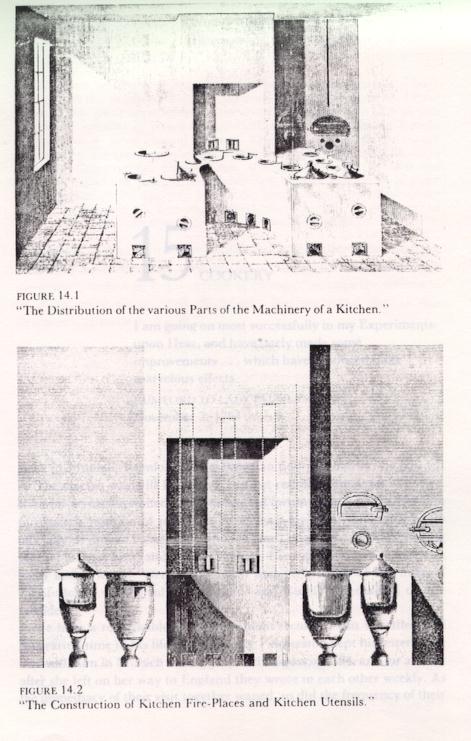
 Image source: The Bavarian kitchen
I was thinking about stoves.
It was Benjamin Thompson, Count Rumford, who got me to thinking about them. He is a fascinating character. A spy for the British, who went on to be knighted in England, lead the Bavarian army, introduce the potato to Bavaria, and marry the widow of Lavoisier, he was an important scientist. He was the man who successfully challenged the idea of a caloric fluid, clarifying that heat was a manifestation of the motion of particles within a material. He was also an inventor, having introduced the Rumford fireplace, wax candles, drip coffee makers, double boilers, and pressure cookers. He also apparently created enclosed stoves, including the first iron ranges.
Here is a description of Rumsford's stove:
From the point of view of cooking history, the most important of Rumford’s invention was the kitchen range, which he proposed as the remedy for the waste of fuel and singeing of chefs that resulted from cooking on blazing open hearths. A typical Rumford arrangement consisted of a brick range, enclosing and separating a series of fires, above each of which a pot or stew-pan fitted into a circular, iron-rimmed opening. The heat of each fire could be separately regulated by varying the draught through its ash-pit door and the smoke was carried away by flues leading through the brickwork to the main chimney. Any temporarily unwanted fire was capped with an earthen-ware cover and its draught almost cut off. In this way it could be kept alive, but burning hardly any fuel. The entire arrangement concentrated heat where it was needed, reduced fuel waste and made the chef’s work more bearable. simple as it seems, this invention, together with the baking oven, was mainly responsible for modern methods of cooking and baking.
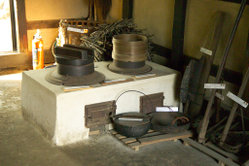 This brief history of stoves suggests that the first European stove that completely enclosed the fire, thereby achieving greater energy efficiency as well as a less smoky kitchen, was introduced in 1735. However, such stoves were invented and introduced much earlier in Asia. (see the "raised kamado" stove from Japan on the left).
Still in many countries many people do not enclose fires to cook efficiently, and
 the appropriate technology movement has innovated with stoves much like those used in the past in Asia, Europe and America. Note, for example, the Justa stove introduced into Guatemala. (right)
No comments:
Post a Comment