Citing the new incidence estimate of HIV infections (ranging between 55,000 and 58,500), the article states:
"Over 95 percent of people living with HIV are not transmitting to someone else in a given year," said David R. Holtgrave, an expert on AIDS prevention at the Bloomberg School of Public Health at Johns Hopkins University. "What that says is the transmission rate has been kept very low by prevention efforts."The CDC reports:
At the end of 2003, an estimated 1,039,000 to 1,185,000 persons in the United States were living with HIV/AIDS, with 24%-27% undiagnosed and unaware of their HIVThese figures, with the new estimates of incidence, suggest that are about five new infections per 100 people with HIV per year. We know that there is a period of eight to eleven years on the average between infection with HIV and the appearance of symptoms. It seems that the average age of infection is about 30, and there was a recent story that life expectancy for an HIV infected person is about 70 years. Thus the average person has about 40 years after infection in which to transmit the infection to others.
Combining these figures, as a rough estimate, it appears that on the average an infected person will infect two others in their lifetime. This is the picture of an epidemic out of control! It fools us for two reasons:
- We are used to communicable diseases that are short lived, with rapid transmission, and so incidence that rises very rapidly; the HIV/AIDS epidemic has people living with the infection and infecting others slowly over a long period, and thus prevalence rises slowly.
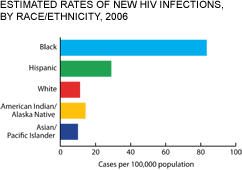
- The contagion is not evenly distributed over the whole population, but is concentrated in certain subpopulations. As we know, the epidemic is much worse among gay men and blacks than among women and whites.
The article also remarks:
Statistics compiled by the Kaiser Family Foundation show that 4 percent of the $23 billion the U.S. government is spending this year on all HIV-AIDS activities (including research, medical care and overseas programs) goes toward prevention.Thus the prevention expenditures are about one billion dollars per year. Compare that with the $57 billion that the government has spent to guard against bioterrorism since 2001(on the basis of one attack that killed 5 and made 17 others sick).
According to a paper published last year in the American Journal of Preventive Medicine, in inflation-adjusted dollars, the CDC's budget for AIDS prevention in 2006 was only 5 percent higher than it was in 1990.
If the Congress and the next administration don't spend more on AIDS prevention, we will see a continuing, growing problem. The prevention expenditures should be allocated where they will prevent the most disease, and not limited by false morality of our politicians.
Check out the:
No comments:
Post a Comment