Showing posts with label Human Rights. Show all posts

Sunday, September 06, 2015

On reading Eric Foner's "Short History of Reconstruction"

the slave went free, stood for a brief moment in the sun; then moved back again toward slavery. W. E. B. Dubois
I just finished reading A Short History of Reconstruction, Updated Edition by Eric Foner. Foner is arguably the most important historian focusing on 19th century America. His book, Reconstruction: America's Unfinished Revolution, 1863-1877, won the Bancroft, Parkman, and Los Angeles Times Book prizes. It is still in print, and remains perhaps the most important book on the period. His more recent book, The Fiery Trial: Abraham Lincoln and American Slavery, won the 2011 Pulitzer Prize in History, the Bancroft Prize, and the Lincoln Prize. He has served as president of the Organization of American Historians, the American Historical Association, and the Society of American Historians.

The Business of the USA in the 19th Century

Thomas Jefferson saw the destiny of the United States of America to be that of empire, spanning from the Atlantic to the Pacific. It would be a republic, dedicated to the proposition that all men were created equal, endowed by their Creator with certain inalienable rights. Jefferson thought it would take 100 generations to populate that shining empire. Inventions such as the steamboat, the railroad, and the telegraph -- together with mass immigration from Europe -- made it possible to do so in a century. I see the completion of Jefferson's dream as the business of America in the 19th century.

The Louisiana Purchase, the war with Mexico, and expeditions to the Northwest had added the land Jefferson envisioned to the USA by the mid 19th century. The nation was attracting immigrants in huge numbers. It had started as an exporter of agricultural commodities, but was developing industry to become a world leader in manufacturing in the 19th century . The USA was increasingly not only technologically competitive with Europe but a leader in innovation. The nations business in the 19th century would include developing industrial technology and industry to match a world class infrastructure.

It would also be to settle the land that it claimed, and to build cities that would come to house an increasing portion of its population.

Foner focuses on the period 1863 to 1877 in this history, but I think the Civil War and dozen years after its conclusion is best understood in terms of the overall empire building of the United States, especially that of the 19th century.

What Did The Civil War Settle?

Before the war, people used the phrase "the United States are"; after the war, they use the phrase "the United States is". The war established that, as the Articles of Confederation and Perpetual Union stated, the union is perpetual. Sovereignty is in the United States of America, not in the several states of which it is composed. While some governmental tasks are reserved for the states, and indeed for local government, the federal government is paramount. During the Civil War, the central government of the Union grew greatly, assuming stature and power never before needed. The secessionist states, defeated soundly in battle, were thus proven to have no right to secede. The question remained, how would the institutions of government be remade following the war so as to best accomplish the nation's business.

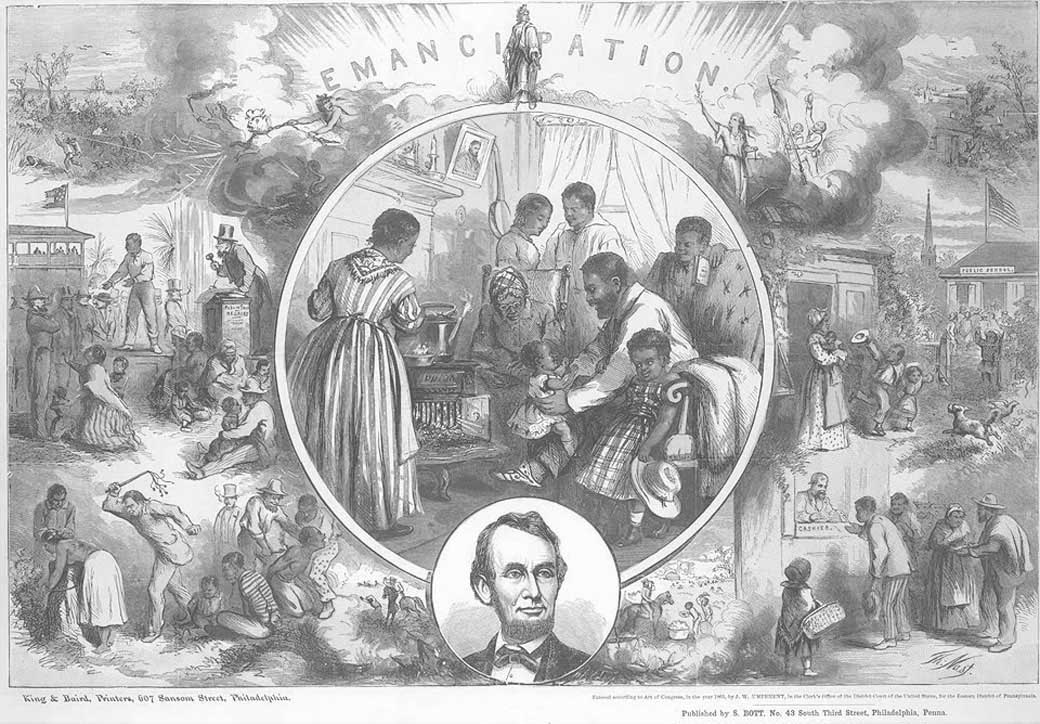
President Lincoln clearly stated at the beginning of the Civil War that the purpose of the North was to preserve the Union. The USA stood as a beacon among nations, but it was not yet clear that "any nation so conceived and so dedicated, can long endure." Yet Lincoln realized during the war that emancipating the slaves in the states in rebellion would be necessary to winning the war. Doing so would greatly reduce the economic capacity of the Confederacy, would prevent European imperial powers from aiding the Confederates, and would add many tens of thousands of black troops to the Union forces. When four million slaves were emancipated by proclamation, the Civil War became about slavery for the North as well as the South. The 13th amendment to the Constitution eliminating slavery from the USA would necessarily follow Union victory.

After the War

Source

Foner makes it abundantly clear that after the war there was no consensus as to what was to be done, many parties competing for power, influence and resources, and a great deal of corruption and people seeking to get a piece of the pie for themselves. This seems to have been true in the north and the south.

Carpetbaggers from the north initially flocked to the south, some in search of opportunities to do good and others in search of opportunities to make money. Scalawags -- southerners who had supported the Union during the war -- were suddenly favored by the new northern masters after having had a bad time during the Confederacy.

It seems to me that the two major concerns in the South were to develop institutions appropriate to the newly freed slaves and to develop new institutions for agriculture -- the ownership of land and the supply of labor to work the land. Perhaps not surprisingly, those who held the land before the Civil War wound up owning the land after 1877 -- at least the large plantations growing cotton and other field crops.

The north had many concerns: reintegrating the rebel states into the Union, facilitating the adjustment of the emancipated slaves and giving them citizenship rights, building infrastructure, settling the west, continuing to build industry, drawing immigrants, developing the institutions of government and more. For a few years after the war, Radical Republicans in the Congress emphasized Reconstruction in the south. However, speculation in railroad stock resulted in an unsustainable financial bubble, and when it burst the economy entered the Panic of 1973. That in turn brought farmers and workers of  the north into open conflict with the north's investors and merchants. Northern attention turned away from helping former slaves and reforming the governance of the southern states. (This inability to stick with a program of cultural change for the decades needed to complete its work seems familiar today.)

Soon after the end of the Civil War, the freedmen were reunited with families and enabled to go to the churches of their choice; these changes were to remain after the collapse of radical Reconstruction. Freedmen were also allowed to form community associations, and would continue to do so, although white violence (unchecked by federal troops) would eventually reduce this right in practice. Confiscated and abandoned lands initially were taken by the federal government, and freedmen families were allowed to homestead on these lands; later however, when the north lost interest in Reconstruction, the homesteads were revoked and the lands redistributed to white owners. Also, initially freedmen were enfranchised, many voted, and some were elected to public office; after northern interest petered out, a campaign of violence essentially removed the franchise from the southern blacks, and few were able to remain in office.

The Reconstruction resulted initially in more vigorous government in the southern states, providing schools, prisons and other governmental services. These were in turn paid for by taxes on property, that is land. The white population found itself paying more to government run by carpetbaggers and scalawags to pay for services that often went to blacks. Not surprisingly, this state of affairs consolidated white southern opposition to the Reconstruction as it was being carried out.

While blacks were originally thought likely to participate in a free labor market for agricultural jobs, ultimately plantation agriculture was run on a sharecropping basis, much to the advantage of the white land owners and to the disadvantage of the black sharecroppers. Bad crops and/or low prices spelled trouble for the small farmers in the South. There was even a wide spread system in which blacks were arrested and convicted on minor charges, and then rented out to white plantation owners or business owners as "chain gangs" of unpaid workers -- the money paid going to the local government (or to graft).

While the north's economy grew during the latter part of the 19th century, the south's economy was more stagnant and the economic gap between the two grew. The south, firmly in the political grip of the white affluent class, became more and more conservative. It could be depended upon to support the Democratic party, and to support conservative causes.

Source
The Legacy

The failure of reconstruction left the nation with a new legacy of racism in which the freedmen were blamed for the failure of Reconstruction, and blacks were left in the minds of many as an inferior race. Racism of course had always been common in both north and south.

Southerners were able to construct a version of the Civil War and Reconstruction that survived for decades, and in my opinion did harm to the nation. The film, The Birth of a Nation, which showed the Ku Klux Klan riding to rescue fair white maidens from evil black men, was premiered in the White House and went on to great audience success in the early 20th century. For generations the south lagged economically, yet played a major role in support of conservative ideology in national politics.

The nation might have learned how very hard cultural change can be, and how very long it takes. The nation might also have learned that the road to chaos is often paved with initial good intentions. Such knowledge might have been very helpful in the aftermath of later wars. Unfortunately, the lesson seemed not to have been learned.

Reading the Book

This is a beautifully written book, a pleasure to read. Some of the latter chapters read like essays by a gifted essayist. Rather than include extensive footnotes, author Foner provides extensive suggestions for further reading for each chapter of the book.

Were the author not so credible a historian, it would be tempting to reject his arguments as inadequately supported. As it is, someone seeking more detail should read his long book on the Reconstruction in its latest edition; that book has the detail. while this book is primarily a summary of the authors analysis and conclusions.

This is a wonderful book

Tuesday, July 07, 2015

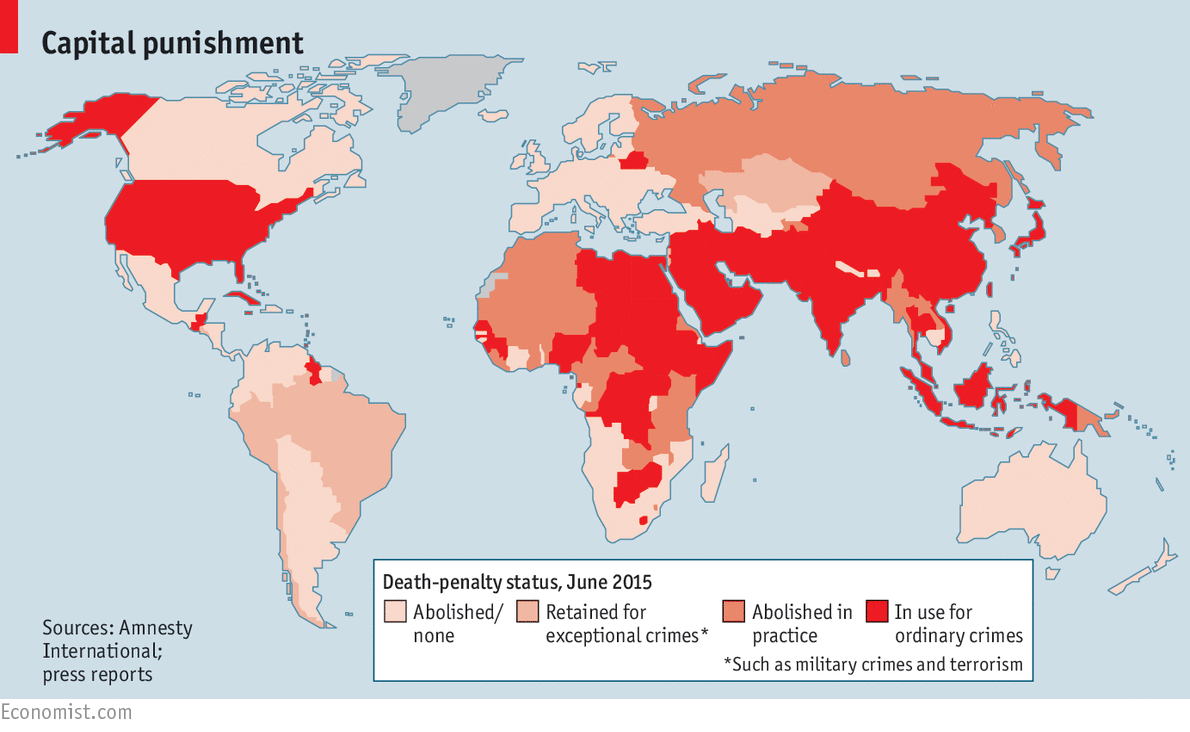
Perhaps it is time to get rid of the death sentence in the USA


Source: The Economist
I quote from an article in The Economist:
The Western world’s chief executioner, America, is putting fewer people to death, too. Last year it executed 35; even if every execution scheduled for this year were to be carried out, which is unlikely, the total would be no more than 33. Of the 31 states that still have the death penalty, half have executed no one since 2010. In May Nebraska passed a law repealing it, the 19th state to do so—and the first conservative one for many years. 
In 1994 80% of Americans said they endorsed the death penalty in principle. The Pew Research Centre reckons that fewer than 60% do so today—and notes that young Americans are less keen than their elders. Blacks are solidly against, as are a small majority of Hispanics. Even the Supreme Court’s recent pro-death-penalty ruling gave comfort to abolitionists by providing a chance to rehearse their case. The death penalty, argued one of the four dissenting judges, Stephen Breyer, is “highly likely” to violate the constitution. Evidence suggested that innocent people, he wrote, had been executed. People on death row had frequently been exonerated. The system was blighted by racial discrimination. Delays between sentencing and executions may violate the eighth amendment, which bars cruel and unusual punishment. And he noted that it is not proven, anyway, to deter crime.
I am no expert, but as I understand the evidence the death sentence costs a lot of money, and there is no convincing evidence that it deters capital crimes.  Lets get rid of this punishment which looks to me to be an abuse of human rights.

Friday, May 08, 2015

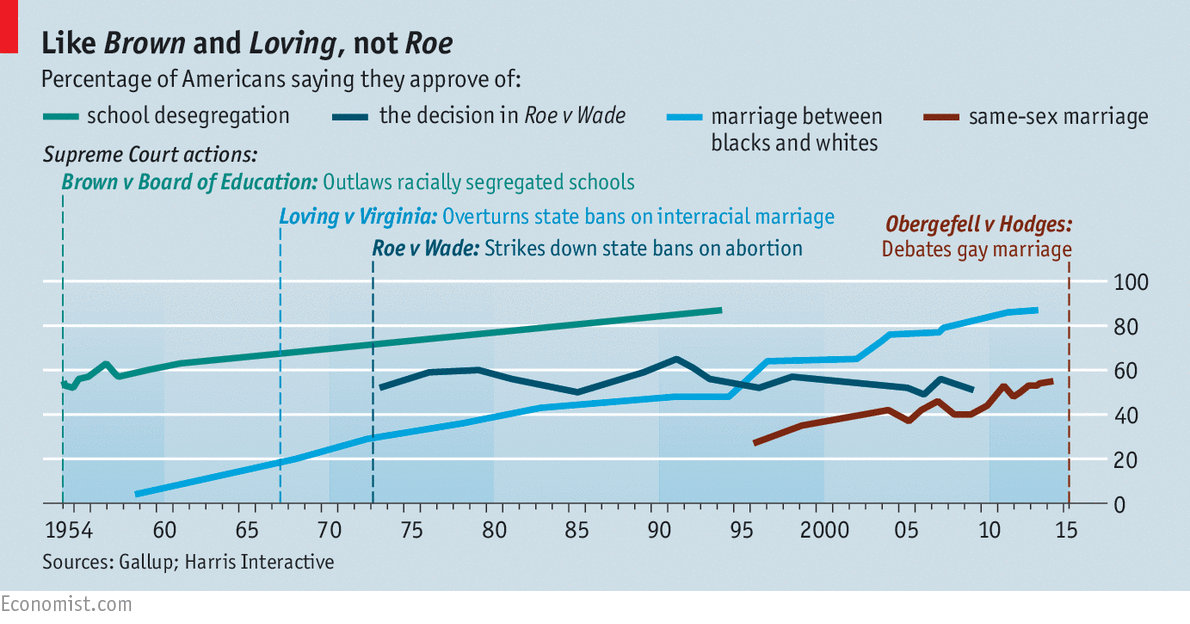
The Rate of Change of Public Opinion on Selected Human Rights Issues


Source: The Economist
The graph shows that there were similar rates of change in American public opinion on school desegregation, marriage between blacks and whites, and same-sex marriage, but the public opinion relative to abortion has remained fairly constant at 50 to 60 percent favorable for decades.

I don't know if my opinion means much, but it seems to me that we have separation of church and state. If a religious institution wants to define marriage in its own way, it is free to do so. Civil law marriage seems to me to be about a single act defining a number of conditions simultaneously, some of which could be done by individual legal instruments (wills, powers of attorney, designation of heirs, etc.) and some of which require "marriage" (inheritance under social security, parental rights, etc.) I am with the majority of Americans favoring same-sex marriage, although perhaps it is time to reconsider some of our public policies. Thus I think a same-sex couple raising children is more similar in terms of social security to a male-female couple raising children than it would be to a male-female couple with two earners and no children.

Monday, May 04, 2015

Thinking About Immigration Policy


Source: Pew Research Center


What are the concerns that should guide the reform of immigration policy:

  • Legal Rights: The law should not be changed to deprive citizens of legal rights which they already possess.
  • Human Rights: There are human rights that would seem to overlap, but not be exactly equivalent to legal rights. Thus a child brought illegally to the USA, who is educated here (with the full formal and informal indoctrination towards being an American) might have a human right to citizenship but not a legal right.
  • Responsibilities incurred by the government: U.S. military incursions into foreign countries seem always to recruit nationals of those countries to serve the USA; if there are sanctions and retaliations against such people, then perhaps the country has a responsibility to grant them residence or citizenship. How about the people in Mexico and Central America who are threatened by a culture of violence that has developed as a result of U.S. drug and gun policies? Does the USA have responsibilities to protect them? Even to the point of granting U.S. residence or citizenship?
  • National Interests: There are many jobs that can not be filled in the USA due to lack of people living here with the right skills or abilities; it is in the national interest to allow immigration of people who can fill those jobs. So too, it is in the national interest to allow immigration of people who can create good new jobs, such as those who could create new businesses or those who could advance useful technologies.
  • Humanitarian concerns: It is generally conceded that countries should grant amnesty to refugees who are fleeing persecution. So too, there is an argument to grant immigration rights to others, such as those seeking medical attention that is available here but not in their home countries.
Generally, do we not believe that rights trump interests? 

Wednesday, April 29, 2015

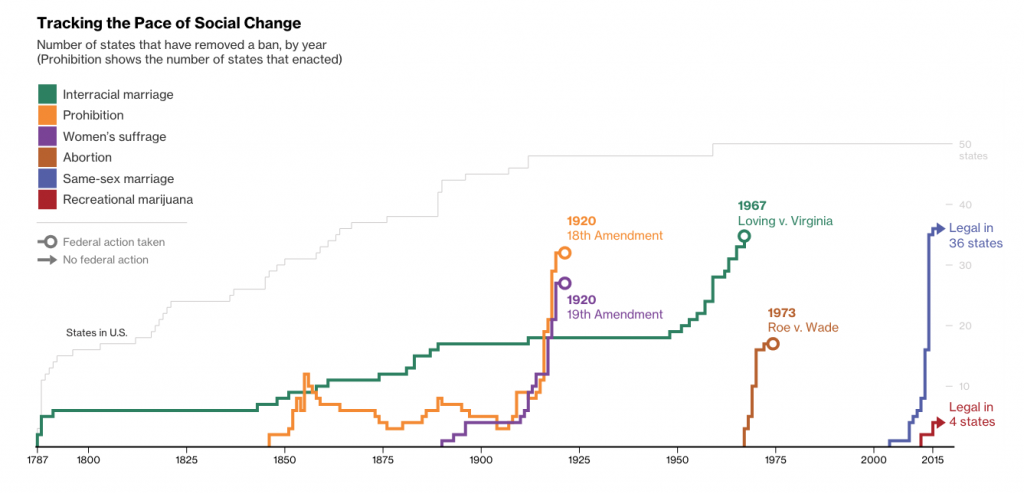
“This is how fast America changes its mind”


Chris Blattman shared this graph that he picked up from Bloomberg

Tuesday, February 10, 2015

UNESCO – Leading the world’s fight against racism for 70 years


The first article of the Universal Declaration of Human Rights affirms that “all human beings are born free and equal in dignity and rights.” Since its creation 70 years ago, UNESCO has tirelessly worked to defend and promote this fundamental idea. - See more at: http://en.unesco.org/70years/leading_fight_against_racism#sthash.otDkesz5.dpuf

Indeed, when the committee appointed by the United Nations, headed by Eleanor Roosevelt, was beginning it work to create the declaration, is asked UNESCO to look into whether there were indeed universally recognized human rights. The results of that investigation are available free online.

UNESCO was created to build the defenses of peace in the minds of men. It seems obvious now that those defenses have to include defenses against racism, since all too often men have mentally constructed racial differences and then used them as a rationale to break the peace. Perhaps that lesson, though less widely shared in 1945, was all the more vivid in the minds of those creating UNESCO in the wake of World War II and the Holocaust!

Thursday, January 15, 2015

Thanks to UNESCO for the information and for trying to protect journalists


The #CharlieHebdo attack highlights the urgency of to defending freedom of expression, and particularly, #pressfreedom today. Globally, 9 of 10 crimes against #socialmediaproducers & journalists go unpunished. What if your opinions on Facebook got you arrested?

Saturday, November 22, 2014

Silent Cal said it well!

If all men are created equal, that is final. If they are endowed with inalienable rights, that is final. If governments derive their just powers from the consent of the governed, that is final. No advance, no progress can be made beyond these propositions. If anyone wishes to deny their truth or their soundness, the only direction in which he can proceed historically is not forward, but backward toward the time when there was no equality, no rights of the individual, no rule of the people. Those who wish to proceed in that direction can not lay claim to progress. They are reactionary. Their ideas are not more modern, but more ancient, than those of the Revolutionary fathers.
Calvin Coolidge
Speech in Philadelphia on July 5, 1926, to mark the 150th Anniversary of the Declaration of Independence

Wednesday, July 16, 2014

The USA has ratified only 5 of 18 UN Human Rights Treaties


They are:

  • The International Convention on the Elimination of All Forms of Racial Discrimination
  • The International Convention on Civil and Political Rights
  • The Convention Against Torture and Other Cruel, Inhuman or Degrading Treatment or Punishment
  • The Optional Protocol to the Convention on the Rights of the Child on the Involvement of Children in Armed Conflict
  • The Optional Protocol to the Convention on the Rights of the Child on the Sale of Children, Child Prostitution and Child Pornography.
The United States is a signatory to four other treaties, Including the Convention on the Rights of the Child, which it has not ratified.

Check out the UN Office of the High Commission on Human Rights website with a great interactive graphic on these treaties and their ratification.

Friday, May 16, 2014

A thought as we celebrate the 60th anniversary of Rowe vs. Wade


60 years ago the Supreme Court in Rowe vs. Wade struck down school segregation. Clearly the decision made a big difference in American culture, and equally clearly not all American children have equal educational opportunities.

Here are some reasons for our communities to provide more and better educational opportunities to all their children.

Education is a human right: It has been recognized as such around the world. It is not just a right for white kids with middle class and upper class parents. You don't deny rights to people for any reason.

If you are denying educational rights because you are a racist, you don't understand the demographics: The big problem with education today is that kids with low income parents, living in low income neighborhoods are too often going to second rate K-12 schools and don't live in an environment that encourages them to seek educational goals. If you deny kids who don't do well on tests the right to continuing education, you are denying Americans of all races. Higher education institutions are increasingly encouraged to give opportunities to students who have made the most of the opportunities that they already enjoyed, rather than on the sole basis of educational attainment.

The folk in the drivers seat will need today's kids to fund their retirement: Many, perhaps most voters today will still be alive when the white workforce is numerically smaller than it is today, and Hispanics, blacks, native Americans and Asians will be the majority of workers. Moreover, a significant number of the workers of that future will be children from low income backgrounds, even if they are white. Those workers will face competition in a still more globalized economy from increasingly well educated workers abroad. If the voters of today want their social security and Medicare to be solid, and their pensions to be adequate, they better see that the U.S. workforce in their retirement is well educated.

The United States can continue as a global power only if its economy grows in pace with those of its major competitors: If it can continue to hold that position, it will be to the benefit of all Americans. But to do so, in a global economy that increasingly values knowledge and innovation, we can not afford to have a workforce in which many workers have only a second class educations. Indeed, the nation will need to be sure that every person with the potential for intellectual excellence achieves that potential.

And it is wrong to deny any kid the opportunity to achieve as much as she or he can achieve intellectually.

Source
White students, while still a majority in the nation’s public school classrooms, have shrunk in number. From 1990 to 2010, the number of white students decreased by 2.1 million. Meanwhile, the number of black, Hispanic and Asian students in those schools has increased by 8.9 million. White students in 2012 made up 51% of public school students, down from 68% in 1990.

Saturday, May 03, 2014

Human Rights Should Be Central to the Development Agenda


William Easterly has recently called for human rights to be placed at the center of the development agenda. This important statement is not a new one.

The United Nations created its Human Rights Council in 2006, upgrading the importance of human rights in its structure to the same level as the Security Council and the Social and Economic Council. Jimmy Carter, when he was president, put human rights at the center of U.S. foreign policy and development policy.


One of the first acts of the United Nations was to issue the Universal Declaration of Human Rights. Eleanor Roosevelt, the widow of one of our greatest presidents and the most famous women in the world at the time, headed the committee that drafted that Declaration. And one of the first things that the committee did was to ask UNESCO to determine if there was indeed a set of rights so widely shared that they could be seen as universal.

UNESCO asked leading intellectuals from many countries to address that question. The response was that, while different religions and different philosophical traditions explained human rights in different ways, there was a core of rights that were widely acknowledged.

Thomas Jefferson described those rights as well as anyone in the Declaration of Independence:
We hold these truths to be self-evident, that all men are created equal, that they are endowed by their Creator with certain unalienable Rights, that among these are Life, Liberty and the pursuit of Happiness.--That to secure these rights, Governments are instituted among Men, deriving their just powers from the consent of the governed.
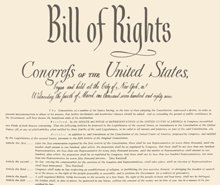
The first thing that the United States Congress did after it was created was to amend the Constitution, adding the Bill of Rights to implement those declared rights in law. So too, the United Nations has sought to create a network of international treaties (termed "Conventions") by which countries commit themselves to creating the legal framework to assure the rights set forth in the Universal Declaration.

Many Americans may be surprised that while our government has participated in the negotiation of these Conventions, it has failed to ratify such important ones as those on the rights of the child and on the rights of woman.


Saturday, April 19, 2014

A thought about women's wage gap


Source
There is an interesting article by the National Women's Law center. It reflects some of the data which shows gender discrimination against women, and that black women face even more discrimination in the workplace than to white women.

A lot of that discrimination seems likely to be unconscious in today's organizations. The people making the discriminatory decisions probably would not only deny bias, but be unaware of the bias. There is some reduction that organizations can make in reducing such bias. Objective tests might be used in hiring and promotion; resumes might be blinded -- the names and other indicators of gender removed. Managers might receive sensitivity training, and might be disciplined if the data suggest that the are discriminating. However, I would expect progress to be slow.

I suspect that couples make decisions that one person will sacrifice income to do more unpaid work, while the other person will do less unpaid work to maximize monetary income. Thus one may stay at home with pre-school children while the other works and advances his/her career and pay level; one may be responsible to leave work and take care of family or home emergencies while the other stays at work. Often these decisions act to the detriment of the woman's monetary income and favor that of a man's. (If the woman's pay rate is lower than that of the man, as seems common, then it makes economic sense to forego the woman's pay rather than the man's.)  Increasing wages equity for women might lead to these family decisions more often favoring a woman's monetary income.

I note the following however:
  • A study by labor economists Francine Blau and Lawrence Kahn found that when you look at the combined effects of occupation, industry, work experience, union status, race and educational attainment, 41 percent of the wage gap remains unexplained.
  • Occupational segregation – the fact that women and men are concentrated in different occupations – contributes to the wage gap. 
Note that 59 percent of the variance in the Blau and Kahn study is due to the named factors. Thus having women work in higher paid occupations, in industries with higher pay profiles, with more work experience, more often as union members, and with more education will be likely to help increase their monetary income. Those are long term goals, involving working with young women and girls to prepare them for more remunerative careers, as well as opening opportunities for women with the required qualifications.

Thursday, March 27, 2014

Tribute to Jimmy Carter -- Energy and Human Rights


Two of the major initiatives of Jimmy Carter's presidency focused on Human Rights and Energy. He was right both times, but the nation was too short sighted to recognize his wisdom and follow through on his initiatives;

Energy

We should have emphasized energy conservation, a win-win proposition. We should now be world leaders in renewable energy technology. I am glad that we have developed fracking technology and are beginning to exploit oil and gas reserves that were not previously available, and I wish that the western Europeans were also exploiting their oil and gas reserves available through fracking. And I wish we had continued a vigorous program of research and development to develop safe nuclear reactors. I think the long run focus of the world might require fusion energy, and I hope that that technology is high on the list of priorities -- it will be a big step, but it may be a necessary one.

If we and western Europe were more energy self sufficient, think of how the foreign policy problems with Russia, the Gulf States, and Venezuela would be simplified. Think how much better our economies and lives would be.

Human Rights

I realize that American attitudes towards human rights are not universally shared, but we have some fundamental values in the area. At the least we can speak out for human rights, and we can work at home to guarantee human rights for all Americans.

Carter maintained that human rights should be important in U.S. foreign policy decision making. I worked in the first year of his administration to try to define American policy to promote health and fight hunger as part of our foreign policy -- and I am proud of having had that opportunity.

He maintained that undemocratic, coercive governments should be challenged on human rights grounds, even if they were otherwise important to the United States. American policy has been less likely to support dictators, oligarchs and kings since, and that is to the good.

Carter is not putting his efforts to the rights of girls and women. He points to the abortions of female fetuses, to the killing of female infants. These are scandalous per se, but are also likely to cause serious social problems in societies with few females.

He points to the sex industry and the involuntary servitude imposed on female sex workers worldwide, including in the United States.

We also know that in many countries, half of the human resources are essentially discarded. This is wrong per se, but all the people suffer from homes that function less well than they might, as does the economy and political institutions.

Jimmy Carter is acknowledged as having achieved greatness as a former president, but I think his stature as a president will improve as historians of the future put his accomplishments into the proper perspective.

Monday, January 13, 2014

Things you must know about the world in three maps.


There is a great new site from The Washington Post with 40 maps, some of which are animated. Here are a couple that I found especially relevant:

Where the world's people live, by economic status
Those dots represent people: the brighter the dot, the more people. The color shows their country's average income level: blue is richest and yellow is poorest.
How countries compare on economic inequality
 Yes, the United States has worse income inequality than Nigeria. That's according to a metric called the Palma Ratio that measures economic inequality. Read more here about how the metric works and the fascinating results of using it to compare the world's countries.

 Where the world's 30 million slaves live
 This is not some soft, liberal, by-modern-standards definition of slavery. This is slavery. There are 30 million people living today as forced laborers, forced prostitutes, child soldiers, child brides in forced marriages or other forms of property. There are 60,000 right here in the United States – yes, really. This map shows the proportion of each country that is enslaved.

Friday, December 06, 2013


Wednesday, December 04, 2013

President Obama made an important speech today!


I quote from President Obama's speech today:
I believe this is the defining challenge of our time:  Making sure our economy works for every working American.  It’s why I ran for President.  It was at the center of last year’s campaign.  It drives everything I do in this office.  And I know I’ve raised this issue before, and some will ask why I raise the issue again right now.  I do it because the outcomes of the debates we’re having right now -- whether it’s health care, or the budget, or reforming our housing and financial systems -- all these things will have real, practical implications for every American.  And I am convinced that the decisions we make on these issues over the next few years will determine whether or not our children will grow up in an America where opportunity is real.

Now, the premise that we’re all created equal is the opening line in the American story.  And while we don’t promise equal outcomes, we have strived to deliver equal opportunity -- the idea that success doesn’t depend on being born into wealth or privilege, it depends on effort and merit.  And with every chapter we’ve added to that story, we’ve worked hard to put those words into practice.  

It was Abraham Lincoln, a self-described “poor man’s son,” who started a system of land grant colleges all over this country so that any poor man’s son could go learn something new.

When farms gave way to factories, a rich man’s son named Teddy Roosevelt fought for an eight-hour workday, protections for workers, and busted monopolies that kept prices high and wages low.

When millions lived in poverty, FDR fought for Social Security, and insurance for the unemployed, and a minimum wage.

When millions died without health insurance, LBJ fought for Medicare and Medicaid.

Together, we forged a New Deal, declared a War on Poverty in a great society.  We built a ladder of opportunity to climb, and stretched out a safety net beneath so that if we fell, it wouldn’t be too far, and we could bounce back.  And as a result, America built the largest middle class the world has ever known.  And for the three decades after World War II, it was the engine of our prosperity. 
Now, we can’t look at the past through rose-colored glasses.  The economy didn’t always work for everyone.  Racial discrimination locked millions out of poverty -- or out of opportunity.  Women were too often confined to a handful of often poorly paid professions.  And it was only through painstaking struggle that more women, and minorities, and Americans with disabilities began to win the right to more fairly and fully participate in the economy.   
 Perhaps that right to an equal opportunity should have been enshrined visibly in the Declaration of Rights. Certainly some of the reforms of our country of which we are justly proud are those which ended slavery, offered civil rights to racial minorities, and started to even the playing field for women and the disabled.

Sunday, December 01, 2013


Saturday, November 23, 2013

Striving for Human Rights is What America is All About.

The United States is a democratic Republic with a government invented to allow many minorities to protect their interests against the domination of the majority. Some would say that form is the basis of the success of its government. I wonder. Great American leaders have always understood that the purpose of the government was to secure the human rights of its citizens; many of the citizens have dedicated themselves to those human rights.

The Virginia Declaration of Human Rights was adopted by the Virginia Constitutional Convention on June 12, 1776. Its first three sections read:
That all men are by nature equally free and independent and have certain inherent rights, of which, when they enter into a state of society, they cannot, by any compact, deprive or divest their posterity; namely, the enjoyment of life and liberty, with the means of acquiring and possessing property, and pursuing and obtaining happiness and safety. 
That all power is vested in, and consequently derived from, the people; that magistrates are their trustees and servants and at all times amenable to them. 
That government is, or ought to be, instituted for the common benefit, protection, and security of the people, nation, or community; of all the various modes and forms of government, that is best which is capable of producing the greatest degree of happiness and safety and is most effectually secured against the danger of maladministration. And that, when any government shall be found inadequate or contrary to these purposes, a majority of the community has an indubitable, inalienable, and indefeasible right to reform, alter, or abolish it, in such manner as shall be judged most conducive to the public weal.
This Declaration  was drawn upon by Thomas Jefferson for the opening paragraphs of the Declaration of Independence. It influenced the other colonies and became the basis of the Bill of Rights.

Recall these words from the Declaration of Independence:
We hold these truths to be self-evident, that all men are created equal, that they are endowed by their Creator with certain unalienable Rights, that among these are Life, Liberty and the pursuit of Happiness.--That to secure these rights, Governments are instituted among Men, deriving their just powers from the consent of the governed, --That whenever any Form of Government becomes destructive of these ends, it is the Right of the People to alter or to abolish it, and to institute new Government, laying its foundation on such principles and organizing its powers in such form, as to them shall seem most likely to effect their Safety and Happiness.
Note in both cases:
  • Rights are fundamental;
  • The power of government is rooted in the will of the governed;
  • The key function of government is to help the governed to obtain and protect their rights; and
  • Government can and should be altered (or abolished) to better serve the rights of the governed.
The Articles of Confederation and Perpetual Union (enacted in 1777 and in force from 1781) basically established linkages among the states that had declared independence from Britain, Its statement of purpose:
The said States hereby severally enter into a firm league of friendship with each other, for their common defense, the security of their liberties, and their mutual and general welfare, binding themselves to assist each other, against all force offered to, or attacks made upon them, or any of them, on account of religion, sovereignty, trade, or any other pretense whatever.
One can read a concern for human rights and related function of government in this purpose, but it is a relatively weak statement of that concern. However, under these Articles the Continental Congress passed the Northwest Ordinance of 1787 establishing the rules for governance of the Northwest Territory (which would eventually yield 6 states).  That Ordinance included a bill of rights protecting religious freedom, the right to a writ of habeas corpus, the benefit of trial by jury, and other individual rights. In addition the ordinance encouraged education and forbade slavery.

The Preamble to the Constitution gives its purpose as follows:
We the People of the United States, in Order to form a more perfect Union, establish Justice, insure domestic Tranquility, provide for the common defence, promote the general Welfare, and secure the Blessings of Liberty to ourselves and our Posterity, do ordain and establish this Constitution for the United States of America.
The union to which it refers is, of course, that established by the Declaration of Independence and the Articles of Confederation. Moreover, the government established by the ratification of the Constitution was to "establish justice", "promote the general welfare" and "secure the blessings of liberty".


One might have assumed that the promotion and protection of human rights of the citizens was included, but in the ratification process states demanded a Bill of Rights.
On September 25, 1789, the First Congress of the United States therefore proposed to the state legislatures 12 amendments to the Constitution that met arguments most frequently advanced against it. The first two proposed amendments, which concerned the number of constituents for each Representative and the compensation of Congressmen, were not ratified. Articles 3 to 12, however, ratified by three-fourths of the state legislatures, constitute the first 10 amendments of the Constitution, known as the Bill of Rights.
In 1863, in the midst of the Civil War, President Lincoln gave his Gettysburg Address, which has become for many of us a key document in understanding the purpose of the U.S. Government: Recall especially:
Fourscore and seven years ago our fathers brought forth on this continent a new nation, conceived in liberty and dedicated to the proposition that all men are created equal. Now we are engaged in a great civil war, testing whether that nation or any nation so conceived and so dedicated can long endure...... 
(W)e here highly resolve that these dead shall not have died in vain, that this nation under God shall have a new birth of freedom, and that government of the people, by the people, for the people shall not perish from the earth.
In January 1941, as the nation prepared for entry into World War II, in his State of the Union Address, President Roosevelt said:
The basic things expected by our people of their political and economic systems are simple. They are:
  • Equality of opportunity for youth and for others.
  • Jobs for those who can work.
  • Security for those who need it.
  • The ending of special privilege for the few.
  • The preservation of civil liberties for all.
  • The enjoyment -- The enjoyment of the fruits of scientific progress in a wider and constantly rising standard of living. 
These are the simple, the basic things that must never be lost sight of in the turmoil and unbelievable complexity of our modern world. The inner and abiding strength of our economic and political systems is dependent upon the degree to which they fulfill these expectations. 
Many subjects connected with our social economy call for immediate improvement. As examples:
  • We should bring more citizens under the coverage of old-age pensions and unemployment insurance.
  • We should widen the opportunities for adequate medical care.
  • We should plan a better system by which persons deserving or needing gainful employment may obtain it.........
In the future days, which we seek to make secure, we look forward to a world founded upon four essential human freedoms.
  • The first is freedom of speech and expression -- everywhere in the world.
  • The second is freedom of every person to worship God in his own way -- everywhere in the world.
  • The third is freedom from want, which, translated into world terms, means economic understandings which will secure to every nation a healthy peacetime life for its inhabitants -- everywhere in the world.
  • The fourth is freedom from fear, which, translated into world terms, means a world-wide reduction of armaments to such a point and in such a thorough fashion that no nation will be in a position to commit an act of physical aggression against any neighbor -- anywhere in the world.
I suggest that "rights" are unconditional in the sense that a persons right may not be ethically taken away by another person nor an institution. It may be inconvenient to pay that children may exercise their right to education, but their right trumps our convenience.

On the other hand rights are conditional. One does not have a right to what is impossible, but newly possible states create new rights. If it is possible to protect a child's right to life by immunization against common childhood diseases, then the child has the right to those immunizations. Yet in the 18th century when vaccines did not exist, no such right existed.

I believe that it was the U.S. historical dedication to human rights that led to the creation of the Universal Declaration of Human Rights by the United Nations. The fact that Eleanor Roosevelt was unanimously elected as the first chair of the UN Commission on Human Rights and that she chaired the committee that drafted the Universal Declaration supports that belief.

Prior to the drafting of the Universal Declaration, UNESCO was asked to inquire of intellectual leaders from different cultures as to whether there were indeed rights so widely shared among cultures as to be seen as universal. The result was published.  The fundamental conclusion was that while different cultures disagreed as to the source of those rights, there was a shared idea that many rights indeed exist in common across societies.

One such right is the right of children to education. That right is acknowledged within many societies. On the other hand, in some countries not all children are thought to share equally in the right to schooling -- many more girls are excluded than boys. Obviously, in rich countries young people go to school longer than in poor countries -- the right depends on what a country can afford. Yet the global Education for All movement indicates that almost all governments have over the past quarter century done a great deal to more fully realize the rights of their children to education.

However, in some sense, rights are defined culturally; We now recognize rights that our forefathers denied to many.  When the Constitution was ratified, slavery was legal in the United States. Then and long after, citizens of the United States felt quite justified in taking land from Indians and indeed moving Indians across the continent to reservations where Indians were deprived of many rights, including often the right to life. It was only in the 20th century that woman were allowed the right to vote.  Now the country is deeply divided as to whether gay and lesbian couples have the right to marry and as to whether women have the right to chose whether or not to terminate pregnancy.

Even where we generally agree on rights, the government is sometimes far from guaranteeing them. Racism continues to exist in this country, effectively denying some people rights enjoyed by the majority. Indeed, many Americans feel that the government should not extend its reach to add to the rights of its citizens as it becomes more possible to do so. In a country in which more and more wealth is monopolized by a smaller and smaller portion of the population, the lack of empathy of that oligarchy of wealth leaves children hungry and schools weak.

I think the arrow of history is clear. As the country becomes richer and as technology improves, more and better rights become possible. This government was created of the people and by the people to extend more rights to all the people. It is up to us, the people, to fight to see that the nation will continue to pursue the ideals of its founders.

Monday, November 18, 2013

150 Years Ago Tomorrow, Lincoln Delivered the Gettysburg Address


The Civil War was started by those who were willing to destroy the United States in order to maintain the institution of slavery. In 1863, President Lincoln spoke for those who would preserve a nation conceived in liberty, having emancipated the slaves in the states in revolution against that nation, and soon to succeed in changing the Constitution to abolish slavery forever in all of the nation.

The Clansman was published in 1905 romanticizing the Ku Klux Klan, immediately made into a play, and in 1915 made into the movie, The Birth of a Nation. These led to a founding of the second Ku Klux Klan which reached a peak of power in the late 1920s.  Woodrow Wilson, a racist who segregated federal government facilities, took office as President of the United States in 1913.

In 1963, during the Centennial of the Civil War, the civil rights struggle was most acute in Birmingham Alabama. Police Chief Bull Conners was leading police violence against peaceful demonstrators and Governor George Wallace sent state troopers not to support civil rights but to help Connors forces of repression. Little girls were killed when a church was bombed, and little boys were shot dead. It was the year of Martin Luther King's I Have a Dream Speech and of the assassination of John Fitzgerald Kennedy.

It seems that the arrow of history is toward liberty and justice. American enemies of civil rights for minorities are less malevolent than they were 150, 100 or 50 years ago. On the other hand, where today are the charismatic progressives to match Lincoln, Kennedy and King?