Showing posts with label foreign policy. Show all posts

Thursday, August 20, 2015

Base Historical Stories on Evidence, not current Ideology


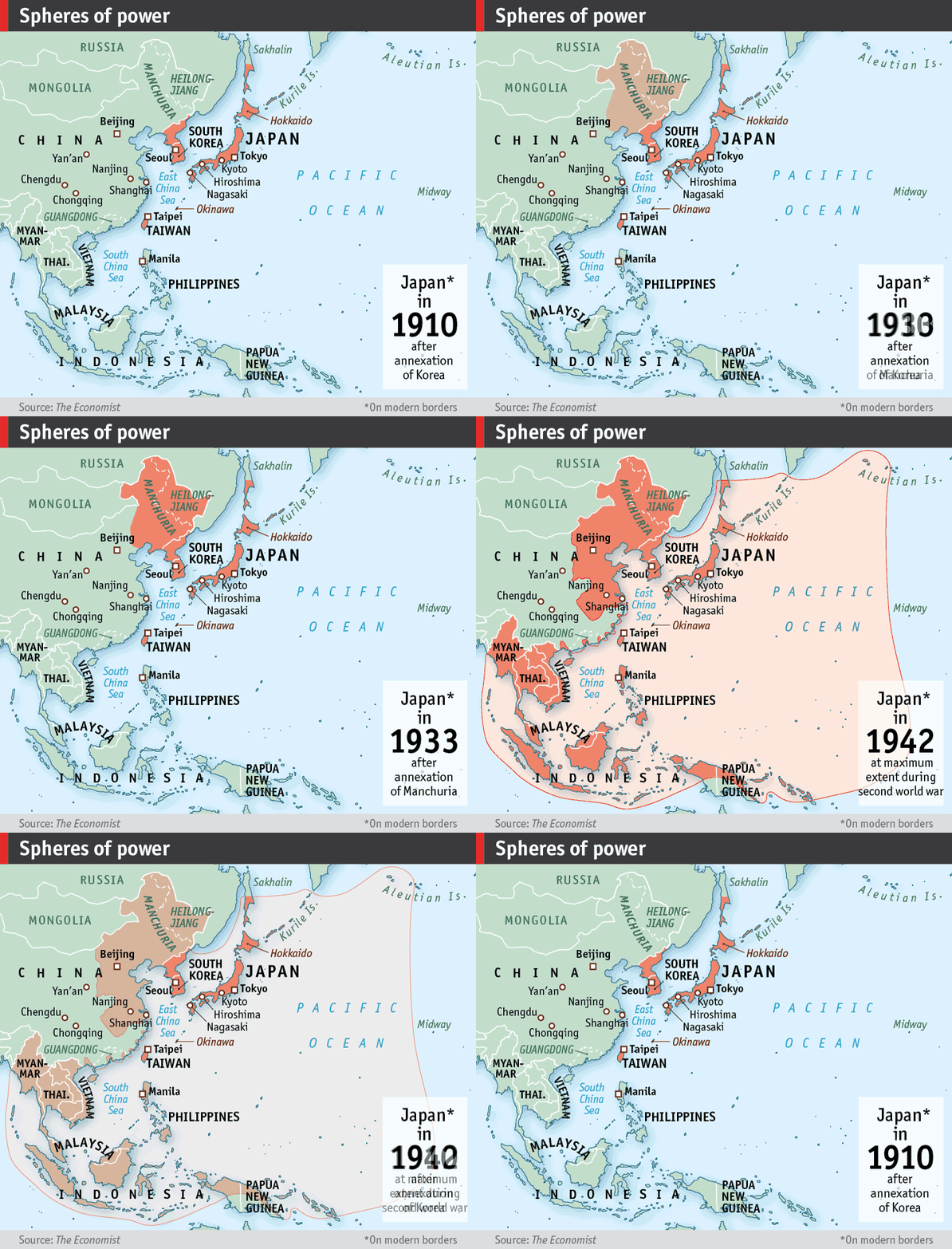
The Economist published an essay this week titled "The Unquiet Past". It suggests that Shinzo Abe, Japan's Prime Minister, is seeking to change the perception of electorate of the World War II history of their country. Speaking of the "Greater Asia Co-Prosperity Sphere" concept advanced by his country in World War II:
Mr Abe believes that Japan’s pursuit of fukoku kyohei was essentially right then and still is today, and that its resumption is the key to making Japan what some would call a “normal” nation again. It is what Mr Abe chooses to call “the post-war” which is the shameful historical exception, with its reliance on American tutelage and a constitution that clips Japan’s wings abroad.
The article begins describing the Yasukuni Shrine that commemorates 2,466,532 Japanese who died in wars following the Meiji Restoration. They are termed imperial protectors, their names inscribed in the "Book of Souls".
But in 1978 the priests of Yasukuni surreptitiously enshrined 14 political and military leaders, including General Hideki Tojo, the wartime prime minister, who had been found guilty by the Tokyo War Crimes Trial of planning or prosecuting the military aggression of the 1930s and 1940s. All 14 had either been executed by Japan’s new American overlords or died in prison.
Emperors Hirohito and Akihito thereafter stopped attending ceremonies at the shrine as did other national leaders. Shinzo Abe, however, does attend the festivals there honoring the Japanese leaders executed for war crimes as well as other persons more appropriate for his salute.

The article also notes that it was Chiang Kai-shek, and his Kuomintang (KMT) that led the Chinese resistance to the Japanese invasion of China, while the Communists were less involved in that resistance, secure in their redoubts in the interior. After the Communist victory over the KMT, the official history of the war tended to ignore the sacrifices of Chiang and the KMT. Now, however, people in regions of China that bore the heavy brunt of the Japanese attack and that tied up Japan's military (so that it could not be used in other theaters) are beginning to claim credit for their regions' sacrifices and successes.

Of course, the revision of official history is not new. Recently in the news some have sought to remind the German speaking people of the debt that they owe to other Europeans for the Holocaust and German/Austrian aggression in two World Wars. In the United States, as Confederate flags continue to be flown in the South, many seek to remind those venerating the Stars and Bars that the Confederacy was founded on the principal that African-Americans were inferior to European Americans and that it sought to make the institution of chattel slavery permanent in the Confederacy; indeed, hundreds of thousands of lives were lost in a war in which those who fought under the Stars and Bars were doing so to keep other people enslaved.

History Should Be Based on Evidence, Not Emotion

Of course, Historians have changed the dominant interpretation of past epochs. However, professional historians are continuing to mine original sources, publishing their findings in peer reviewed journals and well sourced books. The body of evidence -- including factual evidence -- on many historical epochs continues to increase in volume and improve in quality.

I expect that historians will have increasing difficulty challenging existing paradigms without adducing new and important evidence to support novel assertions.

When politicians and government officials offer new views of history, they should be tested against the prevailing historical ideas and especially against the evidence. Substitution of ideology for knowledge is not a good way to make successful policies.

Of course, policy makers views should be based more widely on knowledge. It appears that both the Japanese and Chinese governments have gotten their economics wrong in the recent past. Economists too are building impressive edifices of factual evidence, and are increasingly defending their ideas with such evidence.

One hopes the two governments are drawing on expert sociological knowledge, the Chinese to project the implications of the one child policy that their country followed, and the Japanese to project the implications of an aging population increasingly supported by a smaller workforce. Again, sociologists are strengthening their field by gathering and organizing factual evidence, and supporting theses with evidence.

When I think of the region of the world from Syria to Pakistan, I can only wonder at its complexity and at the willingness of Americans to intervene in the region with very little understanding of the history, culture or religion of the region. The willingness to intervene seems to continue as does much of the ignorance. Of course, there are many in America who have lifetimes of experience in these countries, having immigrated from them; unfortunately, those sometimes most willing to speak from such knowledge to power only do so to advance their own interests. 

Friday, August 07, 2015

Disinterested, evidence based policy decisions and emotional needs for action


I find myself worrying about the chasm between the way policy should be made and the bases of policy support by the public.

An example in the Bush administration's war decisions. 9/11 was a shock widely shared by the American public. The public after 9/11 would support almost any action to get back at the terrorists who planned the action. The Bush administration, as far as we can tell, made the right decision that Al Qaeda was responsible, and supported those in revolt against the Taliban in Afghanistan on the basis that the Taliban was sheltering Al Qaeda leadership. With the Taliban overthrown, the Al Qaeda leadership was in danger from American retaliation in the east of Afghanistan.

At that point, the Bush administration appears to have misused its intelligence assets and used spurious analysis to argue that Iraqi political leaders had also supported Al Qaeda, were implicated in the 9/11 attack on the World Trade Center, and had stock piles of weapons of mass destruction; all of these charges eventually proved false. However, the public and the Congress, still emotionally driven by anger after the 9/11 attacks, approved of a war on Iraq to be conducted in parallel with the action in Afghanistan, Osama Bin Laden got away in Afghanistan, the U.S. quickly conquered the Iraqi army and eliminated Baath party members from the Iraqi government and military, and then chose to embark on long and costly military efforts in Afghanistan and Iraq.

More American lives were lost in the Iraq and Afghanistan war efforts than were lost in the Twin Towers, thousands more Americans were wounded and/or disabled, and huge numbers spent years of their lives in the war zones away from families and friends. The casualties among Iraqis and Afghans dwarf the America casualties. The cost of the wars have still to be fully counted, but appear to be more than a trillion dollars. Perhaps most important, a large region of the world -- never too stable to begin with -- is now far less stable than it might have been.

My guess is that the Bush administration did not do due diligence in thinking through the causes of 9/11, nor the alternatives available to it, nor the effects of the actions it chose. However, those actions were easy to sell to the American public at the time that they were taken because the public was acting on the basis of emotion and not reason.

Policy should, I believe, be based on a reasoned judgement as to what is best for the nation. Emotional response to current events on the part of the policy makers tends to get in the way of good policy decision making. The public is more prone to emotional response to riveting events, especially those driven home by vivid media coverage, but public intellectuals should strive to keep a dispassionate, evidence based assessment of the situation before the public. Walter Cronkite, the most trusted newsman in America in his time, did yeoman work of that kind anchoring the news around Viet Nam and the Kennedy Assassination.

Good policy making involves drawing on people who have knowledge about the issues and peoples to be affected, and in situations such as planning wars in Iraq and Afghanistan requires reaching out to people outside of the normal framework; there were people in the USA, and indeed in government, who had expert knowledge about these countries, but they were not in the cabinet or the cadre of political appointees in the State Department, Defense Department, nor the Treasury Department. Good policy making would seem to require the president and his key advisers to be able to rise above their emotional responses to immediate events in order to look carefully at evidence and dispassionately consider alternative scenarios and their probabilities. It requires being able to consult with leaders of allies and consider carefully the views of leaders of other countries.

Tuesday, April 21, 2015

Children are still migrating alone from Central America to the USA


An article in The Economist points out that children are still migrating to the USA from Central America, and doing so without adult family members to help. The numbers are down from 2014, but are still quite high.

The article goes on to state that the migration is not primarily to reunite the kids with family members in the USA but for them to escape the violence and poverty of their native lands.

The governments of Mexico, Guatemala, Honduras and El Salvador are working to improve conditions, but appear to need a lot of help to achieve their objectives. That is where Joe Biden's plan to provide $1 billion in aid next year comes in. Lets hope that Congress appropriates the money. It would be an important step in improving U.S. immigration policy.

Indeed, there used to be a Good Neighbor Policy and an Alliance for Progress. It is time for the United States government to return to a policy of offering a friendly hand to our neighbors to the south. If your neighbors house is on fire, and he asks for the use of your hose, you don't rent to him!

Sunday, April 05, 2015

Nice to See Former Republics of the USSR Doing WellS


Source: The Economist
I spent a little time in Kazakhstan a few years ago and was very positively impressed by how thoughtfully the people I met were going about using their new found oil wealth.

Thursday, March 19, 2015

U.S. Economic Support to Israel


The U.S. Congressional Research Service last year published "U.S. Foreign Aid to Israel". I quote from the summary:
Israel is the largest cumulative recipient of U.S. foreign assistance since World War II. To date, the United States has provided Israel $121 billion (current, or non-inflation-adjusted, dollars) in bilateral assistance. Almost all U.S. bilateral aid to Israel is in the form of military assistance, although in the past Israel also received significant economic assistance. Strong congressional support for Israel has resulted in Israel receiving benefits not available to any other countries; for example, Israel can use some U.S. military assistance both for research and development in the United States and for military purchases from Israeli manufacturers. In addition, U.S. assistance earmarked for Israel is generally delivered in the first 30 days of the fiscal year, while most other recipients normally receive aid in installments, and Israel (as is also the case with Egypt) is permitted to use cash flow financing for its U.S. arms purchases. In addition to receiving U.S. State Department-administered foreign assistance, Israel also receives funds from annual defense appropriations bills for rocket and missile defense programs. Israel pursues some of those programs jointly with the United States. 
In 2007, the Bush Administration and the Israeli government agreed to a 10-year, $30 billion military aid package for the period from FY2009 to FY2018. During his March 2013 visit to Israel, President Obama pledged that the United States would continue to provide Israel with multi-year commitments of military aid subject to the approval of Congress. 
The FY2014 Consolidated Appropriations Act (P.L. 113-76) provides the President’s full $3.1 billion request in FMF for Israel. In addition, it provides another $504 million in funding for research, development, and production of Israel’s Iron Dome anti-rocket system ($235 million) and of the joint U.S.-Israel missile defense systems David’s Sling ($149.7 million), the Arrow improvement program (or Arrow II, $44.3 million), and Arrow III ($74.7 million). 
For FY2015, the Administration is requesting $3.1 billion in FMF to Israel and $10 million in Migration and Refugee Assistance. The Missile Defense Agency’s FY2015 request for joint U.S.-Israeli programs is $96.8 million. The Administration also is requesting $175.9 million for Iron Dome. 
The sum of the foreign aid contributions since the creation of Israel in the 1940s underestimates the real value of that assistance. For example, if the United States had provided $3 billion per year for 40 years the total would be $120 billion. If instead, the United States had invested $3 billion per year for 40 years obtaining 5% growth on total investment per year, the net value at the end of that period would be just under $294 billion.

According to the CIA's World Factbook:
  • The population of Israel is 7,821,850
  • The GDP of Israel is $272.7 billion (2013 est.)
  • The per capita GDP of Israel is $36,200 (2013 est.)
The average Israeli family has 3.72 members. Thus the per family GDP is $134,664. This is not the same as the per family income, but the point is made that Israel is not a poor country, and on average its families are not poor. The proposed U.S. aid to Israel for 2015 would not greatly increase the income of its people.

It should be noted that the United States provides aid to other countries in support of Israel. Thus is has provided large amounts of aid to Egypt as part of the deal leading to a peace treaty between Israel and Egypt. So too, it has provided aid to Jordan at a level that is justified by the importance of peaceful relations between Jordan and Israel.

Since 1992, the U.S. has offered Israel an additional $2 billion annually in loan guarantees. Congressional researchers have disclosed that between 1974 and 1989, $16.4 billion in U.S. military loans were converted to grants and that this was the understanding from the beginning. Indeed, all past U.S. loans to Israel have eventually been forgiven by Congress, which has undoubtedly helped Israel's often-touted claim that they have never defaulted on a U.S. government loan. U.S. policy since 1984 has been that economic assistance to Israel must equal or exceed Israel's annual debt repayment to the United States....... 
In addition, there is the more than $1.5 billion in private U.S. funds that go to Israel annually in the form of $1 billion in private tax-deductible donations and $500 million in Israeli bonds. The ability of Americans to make what amounts to tax-deductible contributions to a foreign government, made possible through a number of Jewish charities, does not exist with any other country. Nor do these figures include short- and long-term commercial loans from U.S. banks, which have been as high as $1 billion annually in recent years.
Note that the fact that $1 billion in so-called private donations to Israeli causes means that there is significant tax financing of aid to Israel from the United States. Thus the U.S. government is foregoing tax income that it would otherwise receive by allowing the donors to deduct the donations to Israeli causes from their income.

The United States also has free trade agreements (FTAs) with Israel and Jordan. The FTA with Israel was created in 1985, the first such agreement made by the United States. That agreement
continues to serve as the foundation for expanding trade and investment between the United States and Israel by reducing barriers and promoting regulatory transparency.....(There is also a U.S.-Israel) Agreement Concerning Certain Aspects of Trade in Agricultural Products (ATAP), which provided for duty-free or other preferential treatment of certain agricultural products. 
This agreement has also meant billions of dollars in benefits to the Israeli economy.

There has been an income tax treaty between Israel and the United States since 1975. Here are online copies of the relevant documents. According to the U.S. Internal Revenue Service:
Under these treaties, residents (not necessarily citizens) of foreign countries are taxed at a reduced rate, or are exempt from U.S. taxes on certain items of income they receive from sources within the United States. These reduced rates and exemptions vary among countries and specific items of income. Under these same treaties, residents or citizens of the United States are taxed at a reduced rate, or are exempt from foreign taxes, on certain items of income they receive from sources within foreign countries. Most income tax treaties contain what is known as a "saving clause" which prevents a citizen or resident of the United States from using the provisions of a tax treaty in order to avoid taxation of U.S. source income.
It is perhaps time to reconsider U.S. foreign aid to Israel. It is less important than it once was to Israel, given Israel's current GDP, and is perhaps not needed given the relatively high per family GDP.  Moreover, there remain other economic advantages that Israel has with respect to U.S. markets and support that are expensive to maintain and of value to Israel.

Tuesday, February 10, 2015

What Should President Obama Decide About Ukraine?


There is an interesting article in Foreign Policy magazine titled "Why Arming Kiev Is a Really, Really Bad Idea" by Harvard International Relations Professor Stephen Walt. It suggests that there are two different kinds of aggression in foreign policy:
Sometimes states act aggressively because their leaders are greedy, seeking some sort of personal glory, or ideologically driven to expand, and are not reacting to perceived threats from others. The classic example, of course, is Adolf Hitler and Nazi Germany, and in such cases accommodation won’t work. Here the “deterrence model” applies: the only thing to do is issue warnings and credible threats so that the potential aggressor is deterred from pursuing its irrevocably revisionist aims. 
By contrast, the “spiral model” applies when a state’s seemingly aggressive policy is motivated primarily by fear or insecurity. Making threats and trying to deter or coerce them will only reinforce their fears and make them even more aggressive, in effect triggering an action-reaction spiral of growing hostility.
So which of the models is more applicable to Putin's Russia? (Of course, Putin's Russian support for aggression in Ukraine may be based on a mixture of both Hitlarian aggressiveness and fear and insecurity; they may also be -- perhaps partly -- motivated by other factors, say Putin's concern for his domestic base which can be manipulated by nationalism and fear of the West.)

Walt suggests that the spiral model is more applicable to the Ukraine situation, and that were the U.S. to supply arms to the Ukrainian military it might fuel Russian fears and lead to still more aggressive behavior. I posted some time ago on why Russia might fear NATO expansion into Ukraine.

Ukraine's Interests

I recently read a history of Ukraine and posted some thoughts (see Ukraine: the Borderland). As we think about U.S. and E.U. policy with respect to the current Ukrainian crisis, it is well to think about the country itself and its leadership. Is the leadership strong enough and "worthy enough" to invest in? Certainly the government has been changed by popular demand a couple of time in the couple of decades since independence, and there has been a great deal of government corruption in that time.

Here is a result from a 2014 pre-election poll of Ukrainians:
A majority of Ukrainians are satisfied with Poroshenko’s handling of relations between Ukraine and the EU (52%) and media rights and freedoms (51%); however, few expressed satisfaction with his handling of a number of key issues, such as the conflict in the East (15%), corruption (11%), inflation (6%) and job creation (6%). These perceptions are reflected in the widely held belief that the overall situation in the country has gotten worse in the past six months. Outside Donbas, 69 percent believe that that the overall situation is somewhat or definitely worse, while 15 percent believe the situation is better and 9 percent believe the situation has not changed in the past six months. In Donetsk, 94 percent believe the situation is definitely or somewhat worse. These numbers are largely driven by a perceived decline in economic conditions (55%) or political stability (36%). Over the same period, a number of Ukrainians see improvement concerning the unity of citizens (45%), respect for citizens’ rights by authorities (31%) and maintenance of law and order (25%).

Source: BBC News
Ukraine, as it was created in the breakup of the USSR was ethnically diverse. As the maps above indicate, many of the people living in the east of Ukraine have Russian ethnic roots, and their political preferences are different than those in the rest of the country. I also recently posted on the difference between a civic state and a national state. As Putin's Russia absorbed Crimea and is supporting separatist movements of native Russian speakers in eastern Ukraine, it may be that nationalism is also involved in the crisis -- a subgroup of people believing themselves to be ethnic Russians having been placed in Ukraine by a historical accident seeking to live in a more Russian state.

I am glad that others more knowledgeable than I will have to make the decisions on U.S. policy. I hope they understand the situation, that they get advice from a variety of informed sources, and that they do the right thing. It seems to me that it will be hard to find the right policiy balancing the interests of the various Ukrainians, the Russians, the western Europeans and the Americans.

Wednesday, November 19, 2014

Did Multiethnic Empires Expire in the 20th Century?


Two maps with related quotations would seem to answer that question. Source.

China
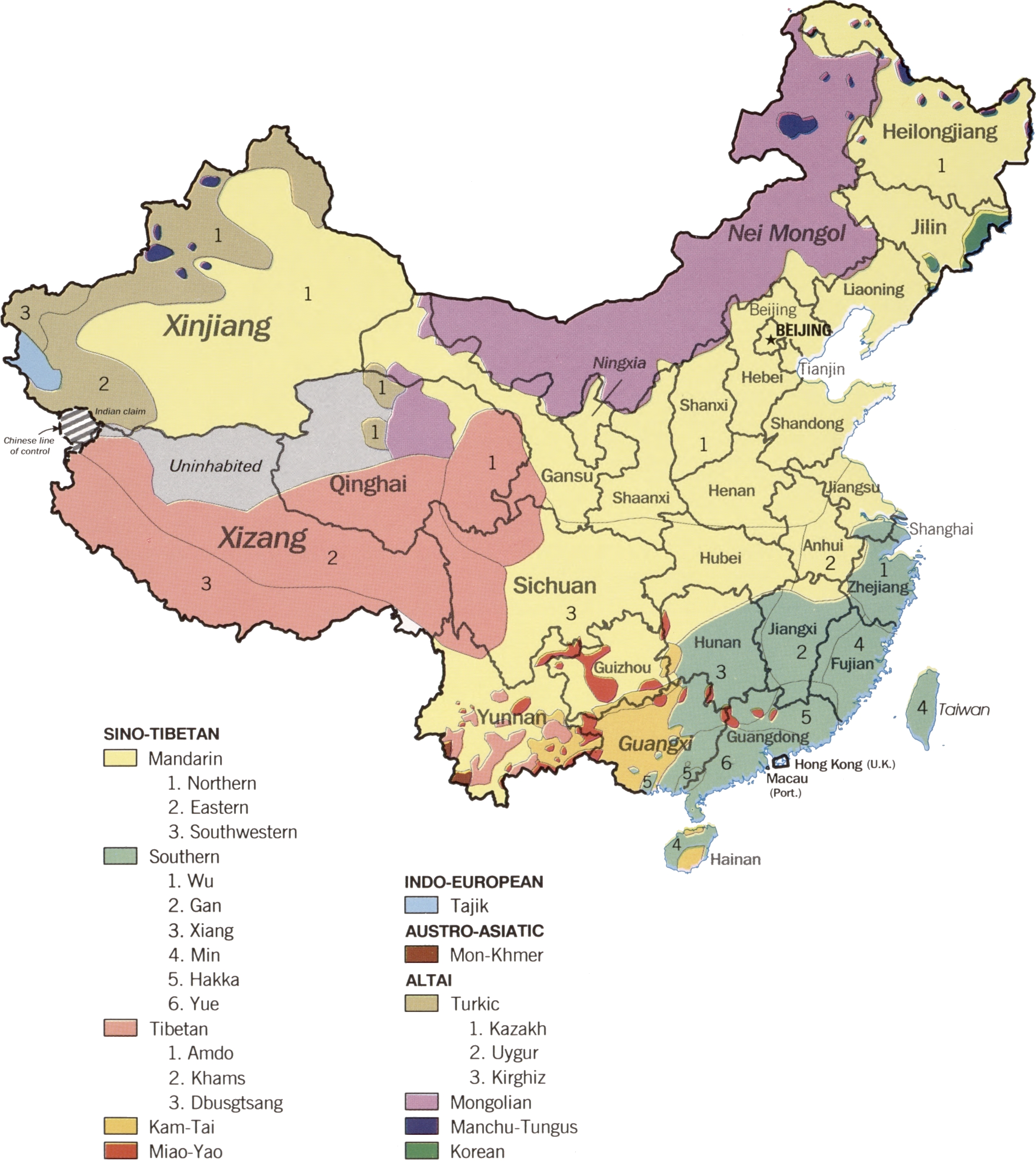
China's languages
Most people know that Mandarin Chinese — the official dialect used and promoted by the Chinese government and taught in most Western Chinese courses — is just one of many, and that a variety of other dialects (Cantonese, Shanghainese, Taiwanese, etc.) have millions of speakers as well. The above map illustrates the geographic distribution of the various dialects on mainland China and Taiwan. But perhaps less well known is exactly how different the dialects can be. They use the same character set, and most use Mandarin in writing, but the spoken dialects are often mutually unintelligible. As University of Wisconsin linguist Zhang Hongming once told the New York Times, "The degree of difference among dialects is much higher than the degree of difference among European languages."

India's languages
Just as many of China's most populous cities (Shanghai, Guangzhou, Shenzhen, Hong Kong) are located in regions where dialects other than Mandarin prevail, many of India's biggest cities (Mumbai, Bangalore, Kolkata) are in states where Hindi does not dominate. This map is a bit outdated — Andhra Pradesh was split up this year, with the city of Hyderabad going to the new state of Telangana — but it's a good indication of the levels of linguistic diversity in the country, which speaks about 780 languages total, and has lost 220 in the past fifty years.
As we have seen ethnic separatist movement recently -- Scotland, Wales, Catalonia, Kurds, ISIL, Libya, Sri Lanka, and Ukraine come to mind -- one wonders if we will see further separation in the two most populous countries of the world. 

Tuesday, November 18, 2014

Why the Pacific Counts in One Graphic


I quote from the article in The Economist:
Since the 1970s trade across the Pacific has far outrun the Atlantic sort. China, for instance, has taken its hunger for high-protein food and raw materials to Latin America and become the biggest trading partner of distant Chile. By one estimate, in 2010 it promised more loans to Latin America than the World Bank, the Inter-American Development Bank and the United States Export-Import Bank combined.

Friday, September 26, 2014

US in a converging world, Hans Rosling on CNN (Fareed Zakaria GPS)


This is several years old, but it is not outdated. The rate of economic growth of the USA and other members of the rich nation's club is limited, while less developed areas with the right conditions and policies can catch up. As Rosling shows in the video, in 1954 the United States (having emerged from World War II almost alone in the industrialized world with its industrial infrastructure intact, and indeed enhanced) had much higher per capita income than any other country. Given the large population of the USA, its GDP was huge as compared with other countries. Note too that this was a time when the European imperial powers were decolonizing. American leaders today grew up in a world in which the U.S. economy was dominant. That is no longer true today, and is likely to be even less true in the future. I think we need to face life in a world in which the European Union and China are comparable economic powers, and then India and other countries will join the club.

Tuesday, September 16, 2014

Thursday, September 04, 2014

Why the Russian Federation Might Feel Threatened


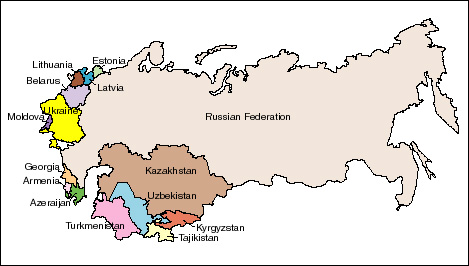
Countries in the Former Soviet Union (before Russian takeover of the Crimea)
Source

Countries of the Warsaw Pact (Satellites of the USSR) before it broke up
Source

I needed to remind myself of the geography of the Cold War. Recall that while Albania and Yugoslavia were Communist, they were not members of the Warsaw Pact. They and the Warsaw Pact nations formed a wide band separating western Europe from the USSR. Since Russia fought Germany in World War I, and the Russian dominated USSR fought Germany in World War II, Russia it thought to have long term concern for its safety from war with western European nations.

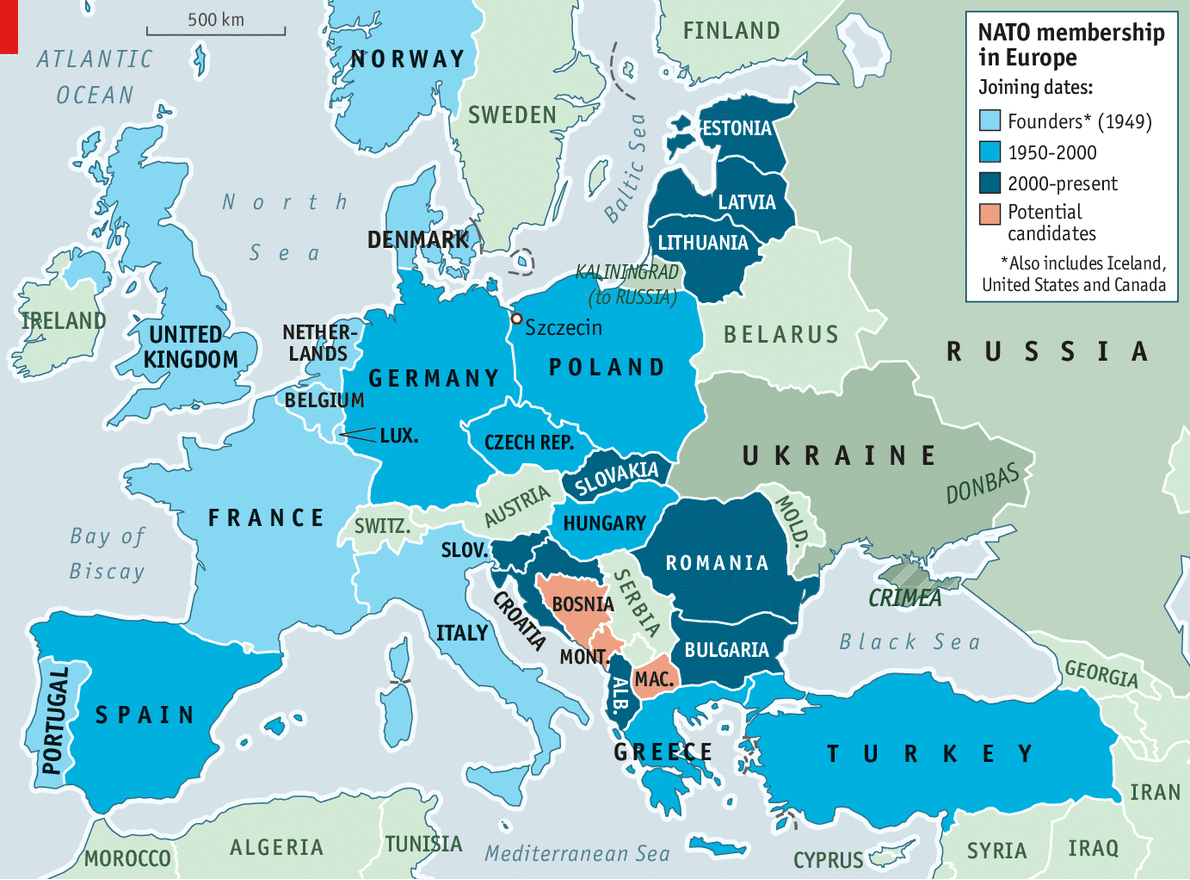
With the end of the Cold War and the breakup of the Soviet Union and the Warsaw Pact, the North Atlantic Treaty Organization expanded to include many of the Baltic countries that had separated from the Soviet Union and many of the former Warsaw Pact countries as shown in the next map. Finland, Moldova, Ukraine and Belarus are the remaining non-NATO countries separating the Russian Federation from the NATO countries in western Europe. If Ukraine were to join NATO there would be nothing that the Russian Federation might see as a buffer between it and NATO.

Source: The Economist
Now look at the more general map of Europe and Asia (still showing Crimea as part of Ukraine) :

Source
Note that Georgia, Armenia and Azerbaijan (formerly parts of the USSR) separate the Russian Federation from Turkey and western Iran. Kazakhstan, Turkmenistan, Uzbekistan, Tajikistan and Kyrgyzstan separate the Russian Federation from eastern Iran and Afghanistan. Recall that there was a war between the Russian Federation and Georgia in the last decade. Armenia and Azerbaijan also have been in conflict for many years. Azerbaijan is a majority Muslim country, as are the "stans" of central Asia. Recalling the long history of warfare between ethnic Russians and Muslims, the Russians might be concerned with threats of infiltration of Islamic militants from its southern borders.

Of course, Russia and Japan fought several times in the 20th century, and the Soviet Union and Communist China were on the brink of war at one point. Thus the Russian Federation, thinking in historical terms, might be concerned about its eastern borders.

And of course, the Cold War rivalry with the United States can not be far from the minds of Russian leaders, even if we see the Cold War as having ended 25 years ago.


Monday, September 01, 2014

Research on forecasting.


Tetlock also found that specialists are not significantly more reliable than non-specialists in guessing what is going to happen in the region they study. Knowing a little might make someone a more reliable forecaster, but Tetlock found that knowing a lot can actually make a person less reliable. “We reach the point of diminishing marginal predictive returns for knowledge disconcertingly quickly,” he reports. “In this age of academic hyperspecialization, there is no reason for supposing that contributors to top journals—distinguished political scientists, area study specialists, economists, and so on—are any better than journalists or attentive readers of the New York Times in ‘reading’ emerging situations.” And the more famous the forecaster the more overblown the forecasts. “Experts in demand,” Tetlock says, “were more overconfident than their colleagues who eked out existences far from the limelight.”
The quotation is from a review of Philip Tetlock's book,  Expert Political Judgment: How Good Is It? How Can We Know?, from the New Yorker magazine.

Some years ago I compared the forecasts of GDP made by World Bank economists with simple linear extrapolations of GDP. On average, the linear extrapolations were slightly more accurate. Now economists realize that there is a great deal of inertia in national economic systems, so they tend to be relatively conservative in forecasting deviations from the trend. My data seemed to show that when they did forecast a significant change from the trend, they tended to overestimate the actual deviation. I have known and worked with several World Bank economists, and I have the greatest respect for their competence. I think my findings were consistent with Tetlock's view that experts are frequently not as good at forecasts as we might expect from their frequent appearances in televised news programs.

Another quote from the New Yorker:
Low scorers look like hedgehogs: thinkers who “know one big thing,” aggressively extend the explanatory reach of that one big thing into new domains, display bristly impatience with those who “do not get it,” and express considerable confidence that they are already pretty proficient forecasters, at least in the long term. High scorers look like foxes: thinkers who know many small things (tricks of their trade), are skeptical of grand schemes, see explanation and prediction not as deductive exercises but rather as exercises in flexible “ad hocery” that require stitching together diverse sources of information, and are rather diffident about their own forecasting prowess.
Foreign affairs are complicated. There seem to be high probabilities of making mistakes in predictions on what is going to happen in Ukraine, Syria, Iraq and other hot spots. Perhaps it is best to make small decisions and not work from a grand plan (one big thing) in foreign policy. Certainly it seems wise to look for the "black swan", the event or piece of information that doesn't fit with forecasts and assumptions.
Tetlock also has an unscientific point to make, which is that “we as a society would be better off if participants in policy debates stated their beliefs in testable forms”—that is, as probabilities—“monitored their forecasting performance, and honored their reputational bets.” He thinks that we’re suffering from our primitive attraction to deterministic, overconfident hedgehogs.
I wonder whether Tetlock is a hedgehog or a fox? How good is his intuition as to what would improve our society? 

Saturday, August 30, 2014

A question for media talking heads and politicians


What is wrong with this syllogism:
  • Anything I don't like in the international situation is a problem
  • All problems can be solved.
  • America can solve problems.
------------
Therefore:
  • America should fix any international situation I don't like.

Friday, August 22, 2014

Did the Cold War have Roots in World War I?


Americans tend to think about the Cold War as lasting from about 1947 to 1991. We see it as a contest pitting the USA and NATO allies representing democracy and capitalism versus the Communist USSR, Warsaw Pact countries, and -- after 1950 -- China.

It was a "cold" war since the major powers never declared war against each other, and it did not erupt in a feared World War III. We think of the USSR and China being allied with the USA and the British and French empires in World War II against the Axis forces, and thus we see the Cold War as starting with the breakdown of that alliance. If you think about it, though the dates assigned to the cold war are arbitrary and indeed the designation of a title to a period in which a complex set of forces resulted in events all over the world for more than a generation is itself arbitrary.

I wonder if the Communist leaders shared that understanding of the origins of the antipathy between the USA and the USSR and Communist China. Perhaps they trace the conflict back to the first world war, and actions of the United States under the Woodrow Wilson administration at the end of the war.

The U.S. Intervention in Russia

I draw from an article in Wikipedia on the west's involvement in northern Russia. The Bolsheviks came to power in Russia in October 1917 and established the Russian Soviet Federative Socialist Republic. Five months later, they signed the Treaty of Brest-Litovsk with Germany, which among other things formally ended the war on the Eastern Front.


In response to Bolshevik actions, the British and French governments decided that a military intervention was needed in north Russia, with three objectives:
  • prevent the Allied war materiel stockpiles in Arkhangelsk from falling into German or Bolshevik hands,
  • mount an offensive to rescue the Czechoslovak Legion, which was stranded along the Trans-Siberian Railroad and
  • resurrect the Eastern Front by defeating the Bolshevik army with the assistance of the Czechoslovak Legion and an expanded anti-communist force drawn from the local citizenry.
In July 1918, against the advice of the U.S. War Department, President Woodrow Wilson agreed to a limited participation in the Campaign by a contingent of United_States_Army soldiers. Apparently some 8,000 American troops took part in the campaign that lasted from late 1918. Those troops became involved in support of White Russians fighting the Bolsheviks. The last significant battle fought by the Americans before their departure took place from March 31 through April 4, 1919.

The American Expeditionary Force Siberia (AEF Siberia) was a United States Army force that was involved in the Russian Civil War in Vladivostok, in the far eastern part of Russia, during the end of World War I after the October Revolution, from 1918 to 1920. The AEF Siberia eventually totaled 7,950 officers and enlisted men.

An article from Critical Inquiry states:
It may also be argued that this incursion into the fledgling Soviet Union (then called the Russian Soviet Federative Socialist Republic) by Allied forces set the stage for later Soviet fear of attack from the West. Certainly the intervention of foreign troops and their action against the new communist regime was a useful propaganda tool. It could be used to justify fear of capitalist states, the later creation of the eastern European Soviet bloc (as a buffer against invasion), and even the extermination of Soviet soldiers who came into contact with non-Soviet governments and military agencies.
In a recent talk on American History TV, Graydon Tunstall said that in one of his speeches, Stalin had dated the start of the cold war to American troops landing in Archangel and Vladivostok (about 18 minutes into the video).

Shandong, China

Source

Shandong is a historically, culturally and economically important province in the northern coastal area of China. Quoting from Wikipedia:
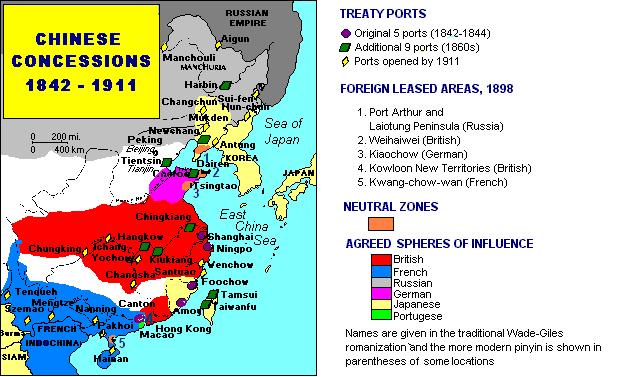
During the nineteenth century, China became increasingly exposed to Western influence, and Shandong, a coastal province, was especially affected. Qingdao was leased to Germany in 1897 and Weihai to Britain in 1898. The rest of Shandong was generally considered to be part of the German sphere of influence.
And from a different Wikipedia entry:
During the First World War, China supported the Allies on condition that Germany's concessions on the Shandong peninsula would be returned to China. However in 1915 China agreed to Japan's Twenty-One Demands which acknowledged Japanese control of former German holdings. Britain and France promised Japan it could keep these holdings. In late 1918 China reaffirmed the transfer to Germany and accepted payments from Japan. Article 156 (of the Treaty of Versailles) in 1919 officially transferred the concessions in Shandong to Japan rather than returning sovereign authority to China. 
Despite its formal agreement to Japan's terms (in 1915 and 1918), China at Paris in 1919 now denounced the transfer of German holdings, and won the strong support of President Wilson. The Chinese ambassador to France, Wellington Koo, stated that China could never relinquish Shandong, which was the birthplace of Confucius, the central Chinese philosopher, as much as Christians could not concede Jerusalem. He demanded the promised return of sovereignty over Shandong, to no avail. Japan was adamant and prevailed. Chinese popular outrage over this provision led to demonstrations and a cultural movement known as the May Fourth Movement and influenced Wellington Koo not to sign the treaty.
China's refusal to sign the Versailles Treaty necessitated a separate treaty with Germany in 1921. The Shandong dispute was mediated by the United States in 1922 during the Washington Naval Conference. In a victory for China, the sovereignty of Shandong was returned to China. However Japan maintained its economic dominance of the railway and the province as a whole.
In its article on the May 4th movement, Wikepedia states:
Many in the Chinese intellectual community believed that the United States had done little to convince the imperialist powers (especially Britain, France, and Japan) to adhere to the Fourteen Points, and observed that the United States itself had declined to join the League of Nations; as a result they turned away from the Western liberal democratic model. Marxism began to take hold in Chinese intellectual thought, particularly among those already on the Left. It was during this time that communism was studied seriously by some Chinese intellectuals such as Chen Duxiu and Li Dazhao. 
Some historians have speculated that Chinese history might have taken a different course at this time had the United States taken a stronger position on Woodrow Wilson's Fourteen Points and self-determination. The United States was not a major imperialist power and was in a relatively strong position to take an anti-imperialist stance; however, it did not do so. As a result, China turned its attention to utilizing other political tools that could potentially resolve many of the nation's issues. These tools subsumed the concepts of Marxism and Leninism.
Also from the Wikipedia article on the May 4th movement is this quote from Mao Zedong:
The May 4th Movement twenty years ago marked a new stage in China's bourgeois-democratic revolution against imperialism and feudalism. The cultural reform movement which grew out of the May 4th Movement was only one of the manifestations of this revolution. With the growth and development of new social forces in that period, a powerful camp made its appearance in the bourgeois-democratic revolution, a camp consisting of the working class, the student masses and the new national bourgeoisie. Around the time of the May 4th Movement, hundreds of thousands of students courageously took their place in the van. In these respects the May 4th Movement went a step beyond the Revolution of 1911.
And from a review of  Bruce A. Elleman's book Wilson and China: A Revised History of the Shandong Question.
Wilson helped China regain political control of Shandong in 1922, but since the transfer was from Japan and not Germany, the Chinese saw it as a betrayal. Had China signed the Treaty of Versailles, the transfer of the Shandong from Japan to China would have been swifter (p. 130). China, it seems, should have counted its blessings--under the 1898 treaty with Germany there was no legal obligation for Shandong to be returned to China until 1997 (p. 28). Looking for a scapegoat for its mismanaged diplomacy, Beijing blamed Wilson. On July 28, 1919, the Beijing Daily News published an open letter to the U.S. Senate, recommending that it reject the Versailles Treaty. The letter blamed Wilson for allowing imperialists to continue their exploitation of China (p. 128). This letter, argues Elleman, contributed to the Shandong myth, its perception that Wilson had betrayed China, and it helped convince the U.S. Senate to reject America's joining the League of Nations. Perhaps Wilson's ultimate failure was his lack of success in setting the record straight about the Shandong question. 
An important consequence of the Shandong myth is that it "opened the door to Bolshevik propaganda and influence" in China (p. 135), providing the Chinese Communist movement with an issue (pp. 2, 107, 130, 135-154). The 1919 May Fourth Movement, largely a reaction to the Shandong question, turned many Chinese intellectuals away from the West. Wilson was seen as being hypocritical when he spoke in favor of national self-determination. The Soviet Union was able to exploit what happened and thus exert an ideological influence over its neighbor next door. Indeed, the same year that the Treaty of Versailles was signed, the Comintern sent its first operative to China. The Chinese people, believing they were betrayed at Versailles by the United States and its European allies, looked to Soviet Russia for an alternative political model. Elleman writes, "To a large degree the Chinese rejected the American model because they truly believed that Wilson had betrayed China's national interests; by contrast, the Chinese believed that Soviet Russia would treat China fairly" (p. 136). The question as to "who lost China" that certain political conservatives in the United States were asking during the 1950s might have an answer in the Shandong myth (pp. 2, 4, 180-181). According to Elleman," After World War II, the long-term impact of the Shandong question can be seen in the origins of the cold war in Asia" (p. 179).
Final Comment

Woodrow Wilson was a neophyte to foreign affairs when he took office as president of the United States in 1913. Indeed, the United States was only then on the brink of assuming a major role in global affairs, and I doubt that there was a great deal of expertise in the State Department or the Departments of the Army and Navy. Perhaps the U.S. diplomacy at the time lacked a long term perspective that it might later gain.

Wilson's 14 points, represented a transformation of World War I from one of imperial competition for territory to one with a moral justification. People all over the world saw that statement as a guarantee of U.S. support for self-determination. We have to remember, however that Wilson was a racist; his support for self determination did not extend to nations he thought to be unready to rule themselves. Moreover, the British and French allies were not about to sign away their African and East Asian holdings as part of the Treaty of Versailles.

Not surprisingly, American boots on the ground in Russia in support of White Russian armies rankled the USSR leadership for many decades. Apparently, the Shandong problem and the myth of American involvement triggered similar feelings among China's Communist leadership.

Russian distrust of Germany as well as the ideology of a global spread of Communism would have tended to lead to serious differences with democratic and capitalistic societies after World War II. So too, I suppose, would the Chinese anger at European takeover of much of China for centuries before World War II. Still, one wonders it Wilson's government acted differently, would the Cold War have evolved differently. Counter-factual supposition is always dangerous.

The U.S. actions at the end of World War I left bad feelings toward this country among communist leaders. The USSR takeover of a swath of countries that became the Warsaw Pact nations and its support of Communist movements in other, Western European countries was clearly going to create a counter reaction in the United States and other countries with democratic governments. Moreover, it seems to me that the anti-Communist feeling was very strong among a large portion U.S. leadership and the U.S. public, that our British and French allies shared that, and that our alliance with Nationalist China put the U.S. at odds with Chinese communists. The Cold War might well have started even had U.S. foreign policy in from 1914 to 1925 been sufficiently prescient to try to avoid antagonizing the Bolsheviks and the Chinese left.

Sunday, August 17, 2014

We are the Global One Percent


Generic Lorenz Curve
The Lorenz Curve is a simple way to show the way income (or wealth) is distributed in a population. The Gini Coefficient, derived from the Lorenz Curve, is the most widely used single figure denoting income (or wealth) distribution.
The Gini coefficient can then be thought of as the ratio of the area that lies between the line of equality and the Lorenz curve (marked A in the diagram) over the total area under the line of equality (marked A and B in the diagram); i.e., G = A / (A + B).
Thus the Gini coefficient in theory varies from zero to one. the larger the value, the more unequal the distribution over the population.

Here is how the Gini Coefficient has evolved in the United States since World War II:

Source

As you can see, the distribution of income became more and more equal after the war, but reversed course and began a long process of becoming less equal from about 1975. As the One Percent appropriated more and more of the income in the United States to themselves, we have seen a rise of Occupy Wall Street and the Tea Party.

I suspect that Americans are upset that most Americans are not doing better economically as time goes on, and that their hopes for the next generation will not be fulfilled. On the other hand, there is some anger at the very rich who seem to be using their political and economic power to bias the playing field to further enrich themselves.

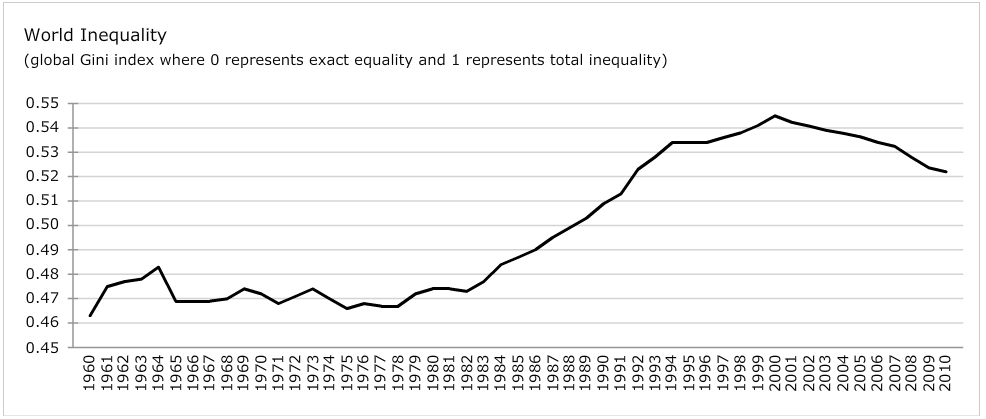
Now consider the evolution of the Gini coefficient for the world's entire population:
Source
Global income distribution was relatively stable from 1960 to  1980, with greater inequality than now exists in the United States. It then rose until the beginning of this century, when it began to drop. Still, the current Global Gini coefficient of 0.52 is significantly higher than the U.S. Gini coefficient.

I suspect the wide spread envy and anger of the One Percent in the United States is mirrored by wide spread feelings for the affluent in the United States in the rest of the world.

GDP per capita World Map
Source

Wednesday, August 06, 2014

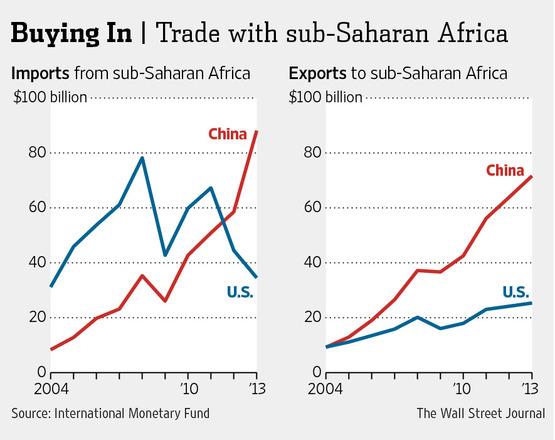
Woops, there goes another trading partner?

Thanks to Helmut Reisen for sharing this information.

Wednesday, July 23, 2014

A thought about ideology and thinking


I came across an interesting article seeking to explain why the discussion of Israel and Palestine is so polarized in the United States. For the purposes of this blog I want to quote one portion:
A wealth of experimental evidence demonstrates that political life makes everyone think worse. People tend to seek out information that proves their ideology to be Good and True, their enemies to be Bad and Wrong. 
For instance, one famous study showed two groups of people identical write-ups of fake studies about the death penalty. People who believed the death penalty deterred crime uncritically accepted the research coming to that conclusion, but tried their best to poke holes in the study shttp://arstechnica.com/science/2014/07/men-would-rather-give-themselves-electric-shocks-than-sit-quietly/howing no deterrent effect. The reverse was true for those who didn't believe in death penalty deterrence. The point is that people weren't neutrally evaluating arguments. They're simply reasoning to the conclusion they want.
Ideology seems to me to be a useful tool to avoid thinking. Thinking is hard, and most people don't like to do much of it. A lot of the time it is easier to draw on an ideological position than to think through a problem from the start and come to a new position.

For most of us, what we think about Israel and Palestine is not very consequential. We will not take steps to intercede to make the situation better, even if we could think of the right steps to take; indeed, American intercession in foreign problems often  seems to make those problems worse. Most of us will not choose who to vote for on the basis of positions on Israel or Palestine, or indeed on foreign policy. So taking the easy way out and avoiding thinking is in fact easy.

The problem of course is that sometimes one adopts an incorrect ideological position on an issue when one's position does count. That is clearly a problem for people in policy making positions.

And sometimes too many of us accept ideological positions ultimately empowering the wrong people in policy making positions.

Tuesday, July 22, 2014

Thoughts on beginning The Sleepwalkers


I am enjoying reading The Sleepwalkers: How Europe Went to War in 1914 by Christopher Clark, a book highly recommended by a couple of friends. The book focuses on how an assassination in 1914 resulted in the first world war. I am about half way through the book -- the portion in which Clark describes how governments came to operate by 1914.

Background

It occurs to me that the background to this book, which the author probably assumes the reader will already know, is that the first wave of globalization had been going on for some three-quarters of a century.

That globalization had been made possible by advances in technology, including railroads, steamships and the telegraph. So too, the industrial revolution had resulted in a great increase in the capacity to produce some goods (tied to the development of larger markets by the development of transportation infrastructure), and an increased demand of raw materials for the production of those goods (that could not be brought to the manufacturing hub by that transportation infrastructure).

This globalization was accompanied by the the growth of empires, especially colonial empires. Thus a number of countries tried to create international trading systems via conquest of less developed areas, turning those conquered areas into colonies. The imperial country did so utilizing its advantage in guns and steel (see Guns, Germs, and Steel: The Fates of Human Societies by Jared Diamond). The industrial revolution allowed production of large amounts of cloth and clothing and other manufactured goods in the home country which could be exported to its colonies, which in turn provided food and raw material to the home country.


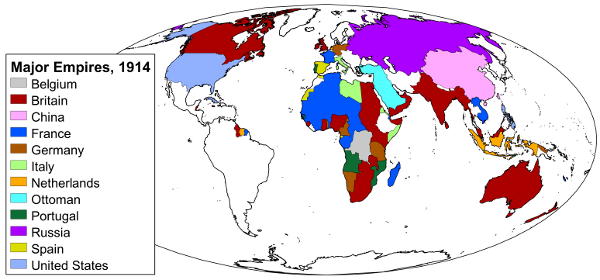
Colonialism in 1914. This map shows the world's major empires on the eve of World War I. The focus of European colonialism has shifted to the Eastern Hemisphere, and neo-European United States has become a colonial power in its own right, seizing some of declining Spain's possessions. After the war, much of the Ottoman Empire's territory was divided up among Britain and France, while Germany lost its overseas possessions to the victorious nations. China's power was severely weakened by the ongoing fall of the Qing Dynasty. 

based on a map by Wikimedia/Andrei nacu

This Led to Complexity

The book suggests the complexity of foreign policy. Japan and Russia were competing in the east, seeking to acquire territory from China. Russia and Britain were competing in central Asia. Russia sought to acquire rights to control passage from the Black Sea to the Mediterranean from the Ottomans. France was willing to allow Italy to acquire Libya from the Ottomans in return for Italian support for France's acquisition of Morocco, and was willing to give Germany assurances of protection of its businesses in Morocco and land in sub-Saharan Africa for the same purpose. Russian concerns in east and central Asia limited its ability to oppose Germany. The duality between Austria and Hungary was complicated in itself, and the Austro-Hungarian empire faced the Ottoman Empire in the Balkans, and Russia in the east. Britain was competing not only with Russia as described above, but with Germany and France in Africa. I could go on, but you see that these expansionist empires were rubbing up against each other all over the globe. An action in support of one country in one region  of the world could have ramifications in other regions, and eventually with other countries.

Clearly if all the other empires ganged up against any one of them, that empire would be in trouble. Consequently, empires tended to form alliances. Only an alliance of empires might resist another alliance of different countries. The alliances varied over time, but the major ones in the early 20th century were the Triple Alliance (among Germany, Austria-Hungary and Italy) and a network of alliances among Britain, France and Russia. France and Britain would be successful in removing Italy from its alliances with Germany and Austria-Hungary in World War I.

Political Institutions

The political institutions were different in different empires. However, many were monarchies in which the monarchs shared power with an aristocratic elite. A revolution in China replaced its monarchy with a republican government in 1912. The Austro-Hungarian, German, Ottoman and Russian monarchies fell during or as a result of World War I. (It is tempting to believe that they were the most fragile.)
  • Monarchs sometimes acted as if they actually believed that they enjoyed divine right to rule. 
  • Cabinets often were divided into feuding factions. Usually they were insulated from public opinion and pressure.
  • Diplomats were often in opposition to their foreign ministers and prime ministers, and sometimes ambassadors would make foreign policy themselves.
  • The military and the foreign policy establishments were often competing for influence and resources.
  • Governments sometimes paid for press support, both within their own countries and other countries.
Policies shifted due to changes in staff, and ministers could change often, but also due to changes in the power and influence among different factions in government. When monarchs were interested in foreign policy and especially when they had  strong support in the cabinet or bureaucracy, they could strongly influence policy; if the monarch then had changeable opinions or easily diverted attention, policies could change rapidly.

In these conditions it became very hard for governments to understand and predict the responses of other governments. Not only were governments opaque and their policies subject to change, but diplomatic reports could be biased. Deception was used by governments to disguise their purposes from other governments. Sometimes the foreign press was used as a divining rod to guess at the positions of foreign governments.

Author Clark's narrative leads one to be grateful that heads of government are now elected; monarchs could by totally incompetent and dangerous, but to be elected a politician has to have some competence and should be less likely to be dangerous. So too, Clark's narrative makes one glad that government policy is more open to meritocratic selection rather than restricted to aristocrats, and that bureaucracies are more professional.

Still, my experience in government suggests that many of Clark's insights about government before World War I remain remarkably relevant to current governments.

Deeper Processes

I wonder whether the 20th century was experiencing an institutional change in response to a technological change. The new technologies of the 19th and 20th century made global commerce more and more possible. If institutions could be built to support that commerce, the magic of comparative advantage would increase the benefits available to producers and consumers.

Colonialism came to be replaced by global markets. (Communism, with its central planning, was an option that many believed appropriate, but which failed in practice.) The European and other common markets have come to the fore, allowing free exchanges over large geographic areas.

Similarly, monarchies came to be replaced by more democratic political institutions -- which were more able to provide good governance. Colonial empires have disappeared, while large nation-states (China, India, the USA, Indonesia, Brazil) have survived -- perhaps due to their geographic compactness and/or their efforts to bring a national consciousness to their multi-ethnic populations. Some institutions such as the United Nations, the IMF and the World Bank (and at least 1000 other intergovernmental organizations) have been created to provide governance functions beyond those of the nation state. 

Perhaps the specific events that historians so like to recount are less influential than the "economic imperative" that makes it profitable to improve economic institutions to better utilize technological advances, and that require improved political institutions to govern the economic institutions, finance the public investments needed to utilize the new technologies, and better distribute the gains. Of course, the fact that the 20th century saw a huge increase in schooling made possible by the more efficient production and distribution of goods and services also played its role in cultural development, providing support for the new technologies and political and economic institutions.

Monday, July 07, 2014

A thought about foreign policy


I heard Andrew Card use an interesting metaphor yesterday. George H.W. Bush was Vice President (1/81 to 1/89) when Gorbachev introduced perestroika and glasnost and president (1/89 to 1/93) when the Soviet Union fell and Communism effective ended in the West.

Card said that Bush 41 believed that things were headed in the right direction in the Soviet Union when he assumed the presidency, and that if he put in his oar he might steer them in the wrong direction. However, he used his team of very experienced foreign policy advisers to scan for shoals which might be dangerous for the process of change in the Soviet Union and Russia; in the event of such peril, he Bush might then try to steer the course in a safer direction.

President Bush 43 (1/2001 to 1/2009) led as the United States invaded Afghanistan and Iraq, leading to more than a decade of war. Rather than the restraint in the use of American military power shown by his father, George W. Bush sought  "shock and awe" to foreign policy. His was a very costly policy.

The world is a very complicated place. I have come to believe that American officials are often surprised by events in other countries. Indeed, as leaders in various countries and factions respond to each other, they often seem to seek out and implement initiatives just because they will  be unexpected by others, and thus have a potential advantage.

A policy like that attributed to Bush 41 -- of watching events unfold, looking for potential problems, and making relatively modest, cost-effective interventions to avoid the shoals -- seems quite reasonable in terms of the unpredictability of world events.

So too does a major investment in understanding foreign cultures, foreign countries and foreign leaders. That investment should start in our schools and universities, involve our politicians and news media, include our foreign policy and intelligence institutions, and even our citizens in general.


Monday, May 05, 2014

Thoughts on reading Russian in Search of Itself.


I just finished reading Russia in Search of Itself by James H. Billington. Published in 2004, the book summarizes the outpouring of ideas from Russians about the nature of the Russian Federation and the Russian people after the break up of the USSR in 1991.

I posted some thoughts on the book last week.

The book strikes me as a genre of its own, seeking to categorize contemporary writings on the nature of a political system and of a society. Billington, who is a distinguished scholar of Russian history, has read a great deal of the relevant material published during the dozen years he covers, and has had the opportunity to discuss issues with both young people and older Russians whose thinking has already influenced many of their countrymen. Still, I found the work unsatisfying.

It occurs to me that were someone to summarize views on U.S. governance and U.S. society from libertarians, tea party members, moderate Republicans, moderate Democrats, Progressives, KKK members. black nationalists, leaders of La Raza and militia leaders you would be more confused than enlightened. Add to those readings the ideas of leaders of various religions (Roman Catholics, Born-Again Protestants, Mormons, Buddhists, Black Muslims, Snake Handling Protestant Ministers, those who believe the end of the world is at hand, Jews, Sunni Muslims, Shiite Muslims, Baha'i, athaists, agnostics, etc.) and the situation would not be clarified. Then consider the views of CEOs of large and small businesses in various industries, union leaders, directors of charitable foundations, leaders of the environmental movement, PETA, university presidents, and others, the result would be a cacophony. One might conclude that in the United States there was a wide diversity of opinion on the identity of the country and the identity of the American people, but little more.

I infer that Billington may feel that if and when Russians decide on their identity as a people, that will lead them to a decision on the identity of the state. Somehow by acknowledging the crimes committed by past rulers on their own people, building upon the Orthodox church that has been central to Russian life for 1000 years, integrating that with the strength of family and local community that characterized the majority of Russians, building on the Silver Age of Russian culture early in the 20th century, and selectively adopting innovations from western culture such as more democratic processes and more efficient economic institutions, by integrating them all, they will build a state. That state will evolve a new path with respect to dealing with its own citizens and with both the west and Asia.

It seems to me that the policies of this country come out of processes of government, politics and the media that form public opinion, rather than respond to it. Moreover, I think that views of the nature of the country and its society can change dramatically in only a few years. Thus I wonder if the author's quest to understand the process by which Russians are seeking to build new identities will really lead to an understanding of the way the Russian Federation will interact with the world. Perhaps, as has happened in the Tsarist empire and the Soviet empire, autocratic leaders will take dramatic actions, and foreign powers will act on Russia, and the identity of the state and of the people at that time will adjust to what it must.

When Billington wrote this book, Russia was just turning the corner economically from an economic crisis to what would become a decade of rapid economic growth. Would he have predicted that the economic picture would be much less attractive in 2014 than it was in 2004? Would he have predicted that President Putin in a new term of office would be leading a government that acts as it is acting now?

We have just seen a revision of estimates of the gross domestic product of countries, which has raised India to third in the world (following the USA and China) and demoted Russia to sixth (following Japan and Germany). So too, we are seeing Russia having fought a war in 2008 which formalized the speparation of South Ossetia and Abkhazia from Georgia, and having this year taken Crimea from Ukraine, is currently implicated in the crisis in eastern and southern Ukraine. How will Russia respond. I don't begin to guess.

I do guess that I understand a little more about post Soviet Russian society than I would have had I not read this book. That is not a little thing.