Showing posts with label Technology. Show all posts

Friday, September 11, 2015

The Degree of Politicization of Views on Scientific Issues


There is an interesting (long) report from the Pew Research Center on this topic. For example:
71% of Democrats and independents who lean to the Democratic Party say the Earth
is warming due to human activity, compared with 27% among their Republican counterparts (a difference of 44 percentage points). This report shows that these differences hold even when taking into account the differing characteristics of Democrats and Republicans, such as their different age and racial profiles. 
Democrats and leaning Democrats also are more likely to favor policies to mitigate greenhouse gas emissions and promote alternative energy sources. Republicans and independents who lean to the GOP are more likely favor some key energy development policies such as offshore oil drilling, fracking and construction of nuclear power plants. In a December 2014 Pew Research survey, fully 75% of Democrats and leaning Democrats said the United States should prioritize alternative energy sources, such as wind and solar power, over expansion of oil, coal and gas production. By contrast, only 43% of Republicans and leaning Republicans expressed support for prioritizing alternative energy production over traditional energy development. 
Here is another finding from the report:
Fully 83% of Democrats and leaning Democrats say government investment in basic scientific research pays off in the long run, and just 12% say such investments are not worth it. A considerably smaller majority of the GOP and independents who lean to the GOP see benefits from government funding of basic science; 62% say government investments pay off in the long run, but 33% say such investments are not worth it.
 I don't think this is a good thing -- that people divide about issues of scientific consensus as they divide by party affiliation, but I don't have anything useful to suggest about it (other perhaps that it is not a good idea to have GOP control of the Congress because that then puts control of government expenditures on science and technology in the hands of the party that campaigns frequently against the scientific consensus). 

Wednesday, September 09, 2015

Tech Immigrants: A Map of Silicon Valley's Imported Talent


Silicon Valley imports its brains. Where do they come from?
Source: Bloomberg Business
Before the Congress does anything about immigration, it better be sure not to hinder the flow of brains to Silicon Valley and other tech centers vital to the U.S. economy.

Tuesday, August 18, 2015

Friday, April 10, 2015

American Should Know More About the History of Science and Technology


Last night the book club to which I belong discussed Sea of Glory: America's Voyage of Discovery, The U.S. Exploring Expedition, 1838-1842 by Nathaniel Philbrick. (I previously posted my thoughts on this book.)

A key point made in the book is that the Exploring Expedition (Ex. Ex.) marked an important point in the emergence of science and technology in the United States. As a direct result of the Ex. Ex., the Smithsonian Institution was instituted to do science and to house scientific collections. Such collections are critical to the development of descriptive sciences such as ethnology, zoology and botany.

Moreover, the the United States Botanical Garden, the United States Hydrographic Office and the Naval Observatory were all created as as a result of the Ex. Ex. For the Ex. Ex. the Congress accepted its role in funding scientific work, and it continued increasingly to so ever since. Philbrick states that while there had been men who did science in the United States before the Ex. Ex., it was only after the Exploring Expedition that it became possible for young men to plan a career as paid scientists.

So What?

Why is the Ex. Ex. not widely known by the American public, and why is it not taught in the schools? The question was asked in several forms by members of our club last night, but I think not fully answered.

The North American colonies of the European imperial powers were quite provincial. Some science was done, and some technology was advanced, but the English colonies were kept dependent on England. Since the Revolutionary War and independence, the United States has grown into the world leader in science and technology. For a while after World War II, at least half of the papers published in scientific and technological journals were produced by U.S. authors. The Ex. Ex. marked an important benchmark in the growth of American science and technology/

Source
The American System of Manufacturing gave the United States a competitive advantage in international commerce, as well as in the manufacture of products for domestic markets. It was developed first in the government armories, starting in the 1820s -- about the same time that the idea for the Ex. Ex. was gaining steam.

Americans went to sea in significant numbers in the 19th century; the U.S. whaling industry was the largest in the world at the time, but there was also a China trade, and extensive coastal trade, and extensive river traffic. As Sea of Glory illuminates, the government assisted in the growth of this industry by charting the areas frequented by the ships. I suppose that the building of iron-clad ships in the Civil War also advanced ship building technology via government support.

Starting very early, the government created West Point to train military engineers. The Naval Academy was established in 1845. In 1862 the federal government passed the Morrill Act which made grants to federal land to create a national system of land grant colleges which were to advance -- among other things --agriculture, mechanical arts and military tactics. In 1887, the Hatch Act led to the creation of agricultural research stations in the land grant colleges and thus to agricultural extension services. This system was instrumental in making U.S. agriculture efficient and a major motor for national growth.

I could go on to identify government roles in the inventions of the telegraph, the electrical light and the supporting electrical infrastructure, automobiles, airplanes, radio, computers, the Internet etc.

One of the members pointed out during the meeting that Michael Faraday discovered electromagnetic induction in England while the Ex. Ex. was conducting its explorations. The great American scientist, Joseph Henry, independently discovered electromagnetic induction at about the same time; Henry of course soon after became the first Secretary of the Smithsonian. Henry will be remembered as long as inductance is measured in a unit called the Henry in his honor. Similarly, some decades later, James Clark Maxwell (from the United Kingdom) clarified the relation between electricity and magnetism, and will be remembered as long as that relationship is described by Maxwell's equations. During our club meeting it was suggested that 1000 years from now, Henry and Maxwell may well be remembered, while people will not be sure exactly who Abraham Lincoln was or what he did.

Why is it that American schools don't teach about the U.S. Exploring Expedition as part of the general curriculum? Indeed, American schools don't teach the history of science and technology. A part of the answer may be a long tradition of anti-intellectualism in American life.

More Generally

Perhaps secondary school children should be prepared to pass the following essay exam to graduate:

  1. For most of the human race's time on earth, most people spent a large part of their time getting food, and since in spite of that hunger was common, famine not exceptional. What is the historical sequence of events that explains how it is that a few percent of Americans are able to produce enough food for the whole country, that there is enough food that no one need go hungry, and that famine is unknown in the USA?
  2. For most of that time, average life expectancy was much lower than it is today and the population was much smaller. Over history, many diseases have emerged into the human population. What is the historical sequence of events that explains how it is that life expectancy at birth in the United States is now so much longer than it was in the past?
  3. For most of that time, people didn't have many possessions; indeed, for a great deal of the race's time on earth people had so few possessions that they could carry them all with them. What is the historical sequence of events that explains how Americans have so many possessions -- homes, cars, clothing, and many other things?
  4. The human race today has more knowledge than ever before, indeed, by orders of magnitude more than it had even 500 or 1000 years in the past. Moreover, while mastery of that body of knowledge is widely distributed in a huge population, the average teenager in the USA has more access to knowledge through his/her smart phone than did the greatest monarch a century ago through his government. What is the historical sequence of events by which this situation came tp pass?
  5. People today are more able to do what they want than ever before -- on the average they can live more comfortably, move faster and over longer distances (and indeed leave the earth), communicate more quickly and easily over longer distances, overcome disabilities to a greater degree, and entertain themselves with a greater variety of alternatives of better quality. What were the historical sequences of events that so empowered people of today, as compared with those of the past?


Wednesday, February 25, 2015

A Major Technological Shift in Transportation


An article in The Economist predicts that hybrid cars are going to increase market share worldwide as are all electric cars at the expense of all fossil fuel cars. Electric motors for automobiles will replace internal combustion engines (I guess) as battery technology improves and as fossil fuels become harder to obtain and thus more expensive. The Economist seems to think it will take a long time for the shift to be completed.

Tuesday, February 10, 2015

Carl Djerassi, the chemist behind the Pill, died on January 30th, aged 91


Here is the obituary from The Economist for a truly distinguished man.

I met Dr. Djerassi first when he was the Chair of the National Research Council's Board on Science and Technology for International Development (BOSTID), and I began a two decade association with BOSTID as the manager of the grants from USAID that provided a major part of its funding.

Carl Djerassi was I suppose best described as a polymath. His career as a chemist was distinguished: he synthesized the chemical that made the first birth control pill possible.
He developed synthetic juvenile hormone in insects, preventing them becoming adults, for non-toxic control of mosquitoes and fleas, developed corticosteroids for inflammation—steroids had been a passion since the 1940s—and devised a way of detecting opiates in urine, used by the army in Vietnam.
He was a professor of chemistry at Stanford University for many years. As an entrepreneur and expert in research management, he ran two research companies while on the Stanford Faculty. He owned a California winery that produced fine wines. He was an art collector. Later he wrote novels and plays.

I knew him as a man who cared about the poor in poor counties and was willing to devote time and effort to advising the government on how to use science and technology to better the lot of these people; he did so without pay.

I remember others associated with BOSTID, including George Bugliarello, Roger Revelle, Frederick Seitz, E.O. Wilson, Hugh Popenoe, John Gibbons, Joshua Lederberg and Frederick Robbins. Offhand I can think of two Nobel Prizes and two Pulitzer Prizes among these eight people. For those who have thought that leaders in fields of science and technology live in "ivory towers", knowing any one of these men would be a revelation. Each was brilliant in his own field of specialization, each had many skills, and each cared enough about the poor and needy to devote time and effort to their aid. 

Wednesday, January 07, 2015

Experts too have difficulty predicting the future


Thanks to Gyan Parida, who collected these bits of wisdom from the past that had been previously posted on FB by Adam Roberts:
"There is no reason why anyone would want a computer in their home."— Ken Olsen, Founder Digital Equipment Corp.,1977 
"I think there is a world market for maybe five computers."— Thomas Watson, Chairman IBM, 1943 
"Automobiles are just a fad. They can never replace horses."— Chief of the Michigan Savings Bank advised the lawyer of Henry Ford, 1902 
"It is impossible to come up with a 32 bit operating system. We will never make a 32 bit operating system."— Bill Gates 
"Radio has no future. Heavier-than-air flying machines are impossible. X-rays will prove to be a hoax" — William Thomson, Lord Kelvin, British scientist, 1899 
"Nuclear energy will never be obtainable"— Albert Einstein
"A rocket will never be able to leave the Earth’s atmosphere."— New York Times, 1936 
"There will never be a bigger plane built."— A Boeing engineer, after the first flight of the 247, a twin engine plane that holds ten people 
"Travelling through rail will never be possible."— Dionysius Lardner 
"Fooling around with alternating current is just a waste of time. Nobody will use it, ever." — Thomas Edison 
"Remote shopping, while entirely feasible, will flop"— TIME magazine, 1968 
"I predict the internet will soon go spectacularly supernova and in 1996 catastrophically collapse."— Robert Metcalfe, inventor of Ethernet,1995 
"There’s no chance that the iPhone is going to get any significant market share. No Chance."— Steve Ballmer, 2007 
"There is practically no chance communications space satellites will be used to provide better telephone, telegraph, television, or radio service inside the United States."— T. Craven, FCC commissioner, 1961 
"While theoretically and technically television may be feasible, commercially and financially it is an impossibility."— Lee DeForest 
"I have traveled the length and breadth of this country and talked with the best people, and I can assure you that data processing is a fad that won't last out the year."— The editor in charge of business books for Prentice Hall, 1957.

Friday, January 02, 2015

A thought about foreign aid


Development occurs when there is a widespread movement of people doing things better. They better protect their health, living longer, healthier lives as a result. They better produce goods and services, seeing the GDP per capita increase as a result.

How do people come to do things better? Well they do them smarter, and they do them with better technology. Farmers plant better cultivars, they are smarter about the use of agricultural chemicals, they use better equipment. Factory workers similarly are better organized, they are better equipped, and they work smarter to produce better products more efficiently. I could go on to talk about lumberjacks, bankers, teachers, health workers, etc. but you get the picture.

As economists have pointed out, doing things better on a society wide basis involves investment -- usually improving technology involves investing in new plant and equipment. Some of that investment is in better infrastructure (and better infrastructure technology) -- roads, ports, railroads, airports, electric power infrastructure, water and sanitation infrastructure, dams, canals. It also requires investment in people, especially their education and training and their health physical well being.

This seems so obvious, the question arises, why has development been so difficult. One reason seems to be rapacious people in power who use their power to acquire all the loose resources in their societies, exporting the capital and living high; there is nothing left for investment by the majority, and little reason for the majority to do things better since they will not benefit from doing so.

Another reason is conflict. Wars destroy the very resources that are needed for development, diverting those who could do things better for society into destructive activities.

Disorganization, as typified by failed states, is still another reason that people don't do better.

A number of people are suggesting that foreign aid has failed because it has too often been directed toward places where these things get in the way of progress. The focus on the technical problems combined with acceptance of corruption, emphasis on countries in conflict and emergency aid had resulted in ineffective aid.

I think there is merit to the criticism, but perhaps it fails to recognize that there have been big victories from the technical approach. The green revolution that has seen food production keep up with population growth, the spread of contraceptive technologies that have allowed population growth rates to be reduced, and the improvement in life expectancy globally are examples.

Saturday, December 27, 2014

Monday, December 15, 2014

Perhaps a new technological revolution in the biological technologies.


Journey of Homo innovaticus since the dawn of agriculture 
highlighting recent advances in technology and bioscience.
Source
This graph, shows both the rate of world population growth and the rate of invention in biotechnologies. The left hand portion shows the prehistoric domestication of key species in thousands of years BC and AD.

It was drawn from a post by Timothy Taylor in his blog, Conversable Economist. It originated in an article by William Hoffman in Global Policy. I quote the complete abstract of that article:
Arising from its roots in the US, biotechnology today is a global enterprise. Cutting-edge tools are transforming traditional models of drug discovery and development and diagnostic testing. They are enabling the potential for large scale production of renewable fuels, biodegradable materials, safer industrial chemicals and food crops grown under harsh conditions. The practice of technological innovation in the industrial era – the systematic application of ideas, inventions and technology to markets, trade and social systems – is now being joined with the code of life through rapid DNA sequencing and synthesis technologies. The pace of bioscience innovation is also influenced by geographic concentration of research, entrepreneurship and investment (clusters). Policy makers are just beginning to consider and debate the implications of the new biological technologies: the promises they hold for global public health, natural resource conservation, and economic growth, and the risks they pose from their power and accessibility around the world.
Of course, the potential in this technology will not be easily achieved. We know that people are frightened by many of these technologies, and that there will be a huge job of educating the public as to where the real risks are and which perceived risks are simply due to misperception.

Some of the benefits of this innovation will be available to all without adaptation, such as vaccines for globally endemic diseases. Others, such as improved crop varieties will need local capacity to adopt to local needs; these will often require development in poor countries, which have less developed scientific and technological capacity. Some of these technologies potentially beneficial for developing nations will have to be invented in those countries, and for that purpose the capacity will have to be greatly strengthened.

Tuesday, November 18, 2014

"Rich countries are deluged with data; developing ones are suffering from drought"


I quote from an article in The Economist:
AFRICA is the continent of missing data. Fewer than half of births are recorded; some countries have not taken a census in several decades. On maps only big cities and main streets are identified; the rest looks as empty as the Sahara. Lack of data afflicts other developing regions, too. The self-built slums that ring many Latin American cities are poorly mapped, and even estimates of their population are vague. Afghanistan is still using census figures from 1979—and that count was cut short after census-takers were killed by mujahideen.
And:
Poor data afflict even the highest-profile international development effort: the Millennium Development Goals (MDGs). The targets, which include ending extreme poverty, cutting infant mortality and getting all children into primary school, were set by UN members in 2000, to be achieved by 2015. But, according to a report by an independent UN advisory group published on November 6th, as the deadline approaches, the figures used to track progress are shaky. The availability of data on 55 core indicators for 157 countries has never exceeded 70%, it found (see chart).
Fortunately, there are now efforts to improve the situation (cited in the article):
A volunteer effort called Humanitarian OpenStreetMap Team (HOT) improves maps with information from locals and hosts “mapathons” to identify objects shown in satellite images. Spurred by pleas from those fighting Ebola, the group has intensified its efforts in Monrovia since August; most of the city’s roads and many buildings have now been filled in (see maps). Identifying individual buildings is essential, since in dense slums without formal roads they are the landmarks by which outbreaks can be tracked and assistance targeted. 
On November 7th a group of charities including MSF, Red Cross and HOT unveiled MissingMaps.org, a joint initiative to produce free, detailed maps of cities across the developing world—before humanitarian crises erupt, not during them. The co-ordinated effort is needed, says Ivan Gayton of MSF: aid workers will not use a map with too little detail, and are unlikely, without a reason, to put work into improving a map they do not use. The hope is that the backing of large charities means the locals they work with will help. 
In Kenya and Namibia mobile-phone operators have made call-data records available to researchers, who have used them to combat malaria. By comparing users’ movements with data on outbreaks, epidemiologists are better able to predict where the disease might spread. mTrac, a Ugandan programme that replaces paper reports from health workers with texts sent from their mobile phones, has made data on medical cases and supplies more complete and timely. The share of facilities that have run out of malaria treatments has fallen from 80% to 15% since it was introduced. 
Private-sector data are also being used to spot trends before official sources become aware of them. Premise, a startup in Silicon Valley that compiles economics data in emerging markets, has found that as the number of cases of Ebola rose in Liberia, the price of staple foods soared: a health crisis risked becoming a hunger crisis. In recent weeks, as the number of new cases fell, prices did, too. The authorities already knew that travel restrictions and closed borders would push up food prices; they now have a way to measure and track price shifts as they happen.
It seems to me that drones (remotely operated aerial vehicles), computers with geographic information system software, GPS technology, and cell phones represent a real technological solution to the need for better maps. Some donor (USAID) should leap on this and help to create better maps, that could be shared by the Internet and smart phones, for developing countries. 

Saturday, October 25, 2014

John Quincy Adams: from his first message to Congress in 1825


Upon this first occasion of addressing the legislature of the Union, with which I have been honored, in presenting to their view the execution so far as it has been effected of the measures sanctioned by them for promoting the internal improvement of our country, I can not close the communication without recommending to their calm and persevering consideration the general principle in a more enlarged extent. The great object of the institution of civil government is the improvement of the condition of those who are parties to the social compact, and no government, in what ever form constituted, can accomplish the lawful ends of its institution but in proportion as it improves the condition of those over whom it is established. Roads and canals, by multiplying and facilitating the communications and intercourse between distant regions and multitudes of men, are among the most important means of improvement. But moral, political, intellectual improvement are duties assigned by the Author of Our Existence to social no less than to individual man.

For the fulfillment of those duties governments are invested with power, and to the attainment of the end—the progressive improvement of the condition of the governed—the exercise of delegated powers is a duty as sacred and indispensable as the usurpation of powers not granted is criminal and odious.

Among the first, perhaps the very first, instrument for the improvement of the condition of men is knowledge, and to the acquisition of much of the knowledge adapted to the wants, the comforts, and enjoyments of human life public institutions and seminaries of learning are essential. So convinced of this was the first of my predecessors in this office, now first in the memory, as, living, he was first in the hearts, of our countrymen, that once and again in his addresses to the Congresses with whom he cooperated in the public service he earnestly recommended the establishment of seminaries of learning, to prepare for all the emergencies of peace and war—a national university and a military academy. With respect to the latter, had he lived to the present day, in turning his eyes to the institution at West Point he would have enjoyed the gratification of his most earnest wishes; but in surveying the city which has been honored with his name he would have seen the spot of earth which he had destined and bequeathed to the use and benefit of his country as the site for a university still bare and barren.

In assuming her station among the civilized nations of the earth it would seem that our country had contracted the engagement to contribute her share of mind, of labor, and of expense to the improvement of those parts of knowledge which lie beyond the reach of individual acquisition, and particularly to geographical and astronomical science. Looking back to the history only of the half century since the declaration of our independence, and observing the generous emulation with which the governments of France, Great Britain, and Russia have devoted the genius, the intelligence, the treasures of their respective nations to the common improvement of the species in these branches of science, is it not incumbent upon us to inquire whether we are not bound by obligations of a high and honorable character to contribute our portion of energy and exertion to the common stock? The voyages of discovery prosecuted in the course of that time at the expense of those nations have not only redounded to their glory, but to the improvement of human knowledge.

We have been partakers of that improvement and owe for it a sacred debt, not only of gratitude, but of equal or proportional exertion in the same common cause. Of the cost of these undertakings, if the mere expenditures of outfit, equipment, and completion of the expeditions were to be considered the only charges, it would be unworthy of a great and generous nation to take a second thought. One hundred expeditions of circumnavigation like those of Cook and La Prouse would not burden the exchequer of the nation fitting them out so much as the ways and means of defraying a single campaign in war. but if we take into account the lives of those benefactors of man-kind of which their services in the cause of their species were the purchase, how shall the cost of those heroic enterprises be estimated, and what compensation can be made to them or to their countries for them? Is it not by bearing them in affectionate remembrance? Is it not still more by imitating their example—by enabling country-men of our own to pursue the same career and to hazard their lives in the same cause?

In inviting the attention of Congress to the subject of internal improvements upon a view thus enlarged it is not my desire to recommend the equipment of an expedition for circumnavigating the globe for purposes of scientific research and inquiry. We have objects of useful investigation nearer home, and to which our cares may be more beneficially applied. The interior of our own territories has yet been very imperfectly explored. our coasts along many degrees of latitude upon the shores of the Pacific Ocean, though much frequented by our spirited commercial navigators, have been barely visited by our public ships. The River of the West, first fully discovered and navigated by a countryman of our own, still bears the name of the ship in which he ascended its waters, and claims the protection of our armed national flag at its mouth. With the establishment of a military post there or at some other point of that coast, recommended by my predecessor and already matured in the deliberations of the last Congress, I would suggest the expediency of connecting the equipment of a public ship for the exploration of the whole north-west coast of this continent.

The establishment of an uniform standard of weights and measures was one of the specific objects contemplated in the formation of our Constitution, and to fix that standard was on of the powers delegated by express terms in that instrument to Congress. The governments of Great Britain and France have scarcely ceased to be occupied with inquiries and speculations on the same subject since the existence of our Constitution, and with them it has expanded into profound, laborious, and expensive researches into the figure of the earth and the comparative length of the pendulum vibrating seconds in various latitudes from the equator to the pole. These researches have resulted in the composition and publication of several works highly interesting to the cause of science. The experiments are yet in the process of performance. Some of them have recently been made on our own shores, within the walls of one of our own colleges, and partly by one of our own fellow citizens. It would be honorable to our country if the sequel of the same experiments should be countenanced by the patronage of our government, as they have hitherto been by those of France and Britain.

Connected with the establishment of an university, or separate from it, might be undertaken the erection of an astronomical observatory, with provision for the support of an astronomer, to be in constant attendance of observation upon the phenomena of the heavens, and for the periodical publication of his observances. it is with no feeling of pride as an American that the remark may be made that on the comparatively small territorial surface of Europe there are existing upward of 130 of these lighthouses of the skies, while throughout the whole American hemisphere there is not one. If we reflect a moment upon the discoveries which in the last four centuries have been made in the physical constitution of the universe by the means of these buildings and of observers stationed in them, shall we doubt of their usefulness to every nation? And while scarcely a year passes over our heads without bringing some new astronomical discovery to light, which we must fain receive at second hand from Europe, are we not cutting ourselves off from the means of returning light for light while we have neither observatory nor observer upon our half of the globe and the earth revolves in perpetual darkness to our unsearching eyes?.......

The laws relating to the administration of the Patent Office are deserving of much consideration and perhaps susceptible of some improvement. The grant of power to regulate the action of Congress upon this subject has specified both the end to be obtained and the means by which it is to be effected, "to promote the progress of science and useful arts by securing for limited times to authors and inventors the exclusive right to their respective writings and discoveries". If an honest pride might be indulged in the reflection that on the records of that office are already found inventions the usefulness of which has scarcely been transcended in the annals of human ingenuity, would not its exultation be allayed by the inquiry whether the laws have effectively insured to the inventors the reward destined to them by the Constitution—even a limited term of exclusive right to their discoveries?.........

The Constitution under which you are assembled is a charter of limited powers. After full and solemn deliberation upon all or any of the objects which, urged by an irresistible sense of my own duty, I have recommended to your attention should you come to the conclusion that, however desirable in themselves, the enactment of laws for effecting them would transcend the powers committed to you by that venerable instrument which we are all bound to support, let no consideration induce you to assume the exercise of powers not granted to you by the people.

But if the power to exercise exclusive legislation in all cases what so ever over the District of Columbia; if the power to lay and collect taxes, duties, imposts, and excises, to pay the debts and provide for the common defense and general welfare of the United States; if the power to regulate commerce with foreign nations and among the several States and with the Indian tribes, to fix the standard of weights and measures, to establish post offices and post roads, to declare war, to raise and support armies, to provide and maintain a navy, to dispose of and make all needful rules and regulations respecting the territory or other property belonging to the United States, and to make all laws which shall be necessary and proper for carrying these powers into execution—if these powers and others enumerated in the Constitution may be effectually brought into action by laws promoting the improvement of agriculture, commerce, and manufactures, the cultivation and encouragement of the mechanic and of the elegant arts, the advancement of literature, and the progress of the sciences, ornamental and profound, to refrain from exercising them for the benefit of the people themselves would be to hide in the earth the talent committed to our charge—would be treachery to the most sacred of trusts.
Source

Tuesday, October 07, 2014

101st birthday of the automobile assembly line


Henry Ford introduced the Model T in 1908 but continued to improve the production process, creating the Highland Park Ford Plant to automate the assembly of the cars on a single moving production line. The line went into operation on October 7, 1913 -- the birth of the automobile production line. The price of the Model T was reduced to $550, making an automobile of adequate quality affordable for a large market. Ford also paid the factory workers enough that they could themselves buy Ford cars. Read more......

Congratulate an electronics or electrical engineer on her/his day!


Nikola Tesla, Alexander Graham Bell and Thomas Edison were among the members of the Institute of Electrical and Electronics Engineers (IEEE) . Today is the anniversary of the "1884 meeting in Philadelphia when members of the American Institute of Electrical Engineers, one of IEEE’s predecessor societies, gathered for the first time to share technical ideas." So October 7th is also the day the 430,000 members of the IEEE celebrate IEEE Day.

Who says your destiny is not written in the stars? (Some will understand.) Everyone, have a good day.


Friday, October 03, 2014

Innovation in Obama's Speech on the Economy


President Obama yesterday made a major address on the economy. Here is a video excerpt:


Here are some selected portions of the address:
(T)he day I took office, I said we would rebuild our economy on a new foundation for growth and prosperity. And with dedicated, persistent effort, we have been laying the cornerstones of this new foundation every day since. 
The first cornerstone is new investments in the energy and technologies that make America a magnet for good, middle-class jobs........ 
American manufacturing has added more than 700,000 new jobs. It's growing almost twice as fast as the rest of the economy........That's progress we can be proud of. But we also know that many of these manufacturing jobs have changed. You're not just punching in and pounding rivets anymore; you're coding computers, and guiding robots, and mastering 3D printing. These jobs require some higher education or technical training. That's why the second cornerstone of this new foundation is preparing our children and our workers to fill the jobs of the future...... 
Of course, even if you have the right education, for decades, one thing that made it harder for families to make ends meet and businesses to grow was the high cost of health care. And so the third cornerstone had to be health care reform....... 
Finally, we put in place financial reform to protect consumers and prevent a crisis on Wall Street from hammering Main Street ever again. 
And this:
If we want to make and sell the best products, we have to invest in the best ideas, just like you do at Northwestern. Your nanotechnology institute doesn't just conduct groundbreaking research; that research has spun off 20 startups and more than 1,800 products, and that means jobs. Here's another example. Over a decade ago, America led the international effort to sequence the human genome, and one study found that every dollar we invested returned $140 to our economy. I don't have an MBA, but that's a pretty serious return on investment. Today, though, the world's largest genomics center is in China. That doesn't mean America is slipping. That means America isn't investing. We can't let other countries discover the products and businesses that will shape the century. Let's invest more in the kind of basic research that led to Google and GPS, and make our economy stronger.
I think the key to economic progress is to learn to do things better in the future than we are doing them now. Clearly a large part of that effort has to be based on improving technology. The president has stressed the need to improve energy technology, and implied the need to innovate in health, education and manufacturing technology. We will also have to invent new technology to solve problems we are not adequately addressing now.

Technology is not used simply because it is invented and/or available. As the president indicates, people apply the technology, and they must have the education (and health and incentives) to do so. It also takes finance to invest in the application of the technology. As the president implies, you will not have the capacity to finance technology unless the financial industry as a whole is on a firm basis.

The president does not address the fact that you have to organize to do things better, and I would suggest that you have to better organize for that purpose. Economists have long described the process of creative destruction, in which the business community is reconstructed again and again to apply new ways of doing things to improve production and thus people's lives. I suggest that the same is true in fields of health care, education, and public infrastructure -- which we do not necessarily perceive as part of businesses.

It goes without saying that a gridlocked Congress, inhabited by many entrenched politicians who deny and denigrate science and technology is no help in achieving the technological revolution we need.


Sunday, September 07, 2014

Most Read of My Technology Posts


I just looked at the posts in this blog that I have tagged "technology" and I find some of them have had many page views. Here are those with more than 100 page views:

The 27 posts taged "technology with more than 100 page views are listed. The four most viewed are designated With This Tag.

A Thought About Technology Innovation


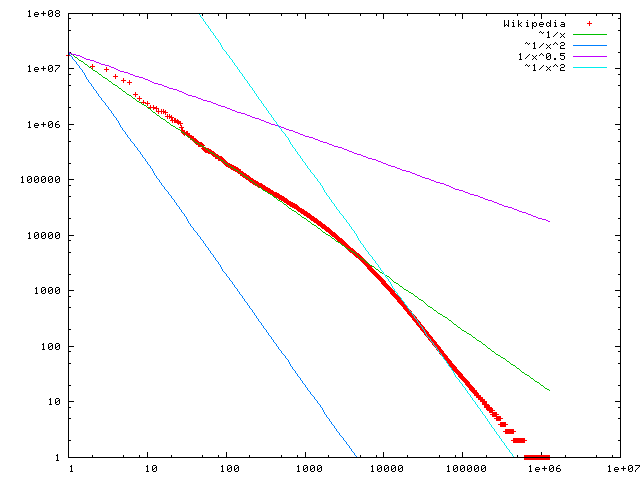
Frequency of English Words in Wikipedia Entries (in 2006)
"Wikipedia-n-zipf" by Victor Grishchenko - Victor Grishchenko [1]. Licensed under GNU Lesser General Public License via Wikimedia Commons - http://commons.wikimedia.org/wiki/File:Wikipedia-n-zipf.png#mediaviewer/File:Wikipedia-n-zipf.png
A plot of word frequency in Wikipedia (November 27, 2006). The plot is in log-log coordinates. x  is rank of a word in the frequency table; y  is the total number of the word’s occurrences. Most popular words are "the", "of" and "and", as expected. Zipf's law corresponds to the upper linear portion of the curve, roughly following the green (1/x)  line.
When you are writing, most thoughts will be expressed with common words. Sometimes you will use less common words, but words that are in your working vocabulary. Sometimes you will use words you have read and understood but not used before -- words you then need to express a thought precisely. Sometimes you will go to a thesaurus or ask a friend for a word that you need and can not find without help.

People have analysed large bodies of text, as was done in the graph above. If words are ranked according to the frequency that they are used and ordered by that rank, then the graph of frequency shows the expected pattern. More than that, there is a highly regular graph and the distribution follows a power law, called Zipf's law.

A conceptual model for the process is that at each point you draw a word from your vocabulary; you select the word that expresses the concept needed. Some concepts occur frequently in your writing, some occasionally and some rarely. The probability that you will draw a specific concept and word is proportional to how often you use that concept and word. Sometimes you will reach out to add a word to your written vocabulary to express a concept new to your writing or to better express a concept you have tried to express before. You do so a set of possible words adjacent to your working vocabulary. (I am here drawing on an idea from the evolutionary biologist, Stuart Kauffman, who has discussed the concept of "the adjacent possible") Having used a new word, you are more likely to use it in the future, and the more frequently you use it, the more frequently you will use it afterwards.

Technological Innovation

It has been suggested that something similar happens in technology choice. There are some tools and techniques that are used widely in a society, in part because they work to achieve widely shared objectives or solve widely shared problems. Sometimes someone will reach out to use an unusual tool or technique. More occasionally someone will innovate, transferring a kind of tool or technique used elsewhere -- from one class of the adjacent possible technologies. On other occasions someone will combine ideas that exist in the environment to create a new tool or technique. Such invention can also be regarded as derived from a class of adjacent possible technologies.

I had the distinct privilege of working one summer (when I was right out of school) with Mark Kac, a very distinguished mathematician. He is famous for the following quote:
There are two kinds of geniuses: the ‘ordinary’ and the ‘magicians.’ an ordinary genius is a fellow whom you and I would be just as good as, if we were only many times better. there is no mystery as to how his mind works. Once we understand what they ’ve done, we feel certain that we, too, could have done it. it is different with the magicians... Feynman is a magician of the highest caliber.
Perhaps we can think of innovations as characterized by the degree of originality needed by a person to make them. Many innovations would be available to most of us. Some would be available to many of us.

I think of Thomas Edison inventing the light bulb. It was not a new thought that running enough current through a filament would generate light. The problem was to find a way to create that light without destroying the filament in the process. In retrospect it seems fairly obvious that the filament would not burn up if there was no oxygen to support the combustion, so putting the filament in a bulb with no oxygen seems an "adjacent possibility". Edison then had his assistants try many possible filaments. (Edison allegedly said, "I have not failed 1,000 times. I have successfully discovered 1,000 ways to NOT make a light bulb.") That suggests that, at least in the invention of the light bulb, Edison was a genius of the first Kac kind. His innovation in that case was in the selection of a possibility that would be sufficiently close to be available to many, once we had seen what Edison had done.


Then there are the magicians of technological innovation. Nicola Tesla might have been one.


Tesla's invention of alternating current motors and the alternating current electrical system (which beat out Edison's direct current system) seem to me inexplicable. Even having taught electrical machinery at Berkeley I found it hard to visualize the fields involved -- and have no idea how he invented a technology for their use.

I like Brian Arthur's book on the nature of technology. I think it too suggests that technology is a growing body of knowledge, and that technological innovation is usefully regarded as drawing from fields of adjacent possibilities.

A Mathematical Model

This post was based on a recent paper in Nature which provides a model for novelties and innovations. While it does not address technological innovation specifically, its use of Zipf's Law, Heap's Law, and the Polya urn model seem potentially useful if applied to quantitative understanding of the introduction and spread of new technologies. (One thing that the model does not seem to deal with is the replacement of a technology by a newer and better one.)

Justice Often Requires Technological Knowledge


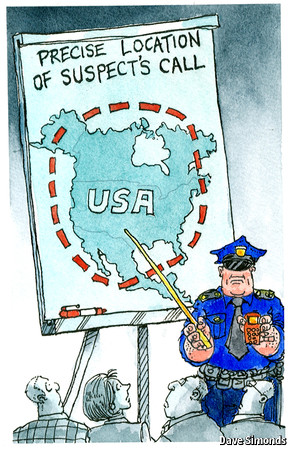
There is an interesting article in The Economist focusing on a case in which a woman was convicted of a serious crime on the basis of completely erroneous interpretation of data on her location at the time of the crime. The data came from triangulation of her cell phone. She was told that her location could be exactly pinpointed at the time of the crime based on the three towers that were receiving signals from her cell phone at that moment.
But the high-tech evidence against her was bunk. Routinely collected tower data can place a mobile phone in a broad area, but it cannot “pinpoint” it. That would require a special three-tower “triangulation”, which cannot reveal past locations........ 
Mobile-phone-tower location data is widely used in court, says Steven Jansen of the Association of Prosecuting Attorneys in Washington, DC. Last year America’s courts and law-enforcement agencies served 37,839 subpoenas, court orders, and search warrants for location data just to one phone company, AT&T......... 
Most police officers and lawyers have “no clue” how phone networks function, says Ryan Bialas, a North Dakota public defender. Cop shows like “CSI” give juries the idea that scientific evidence is almost infallible. But tower data is far less accurate than prosecutors sometimes claim..... 
(The tower cited in the case) could have handled calls from as far as 20 miles (32km) away, according to a deposition prepared by Cherry Biometrics. Which tower a phone connects with depends on such factors as how thick the nearby foliage and walls are, the size of nearby cars and bodies of water, and how well the handset is working. None of this information is usually recorded.
Thus, the fact that three towers are receiving data from a cell phone does not mean that those three towers are the closest to that cell phone, nor that the strength of the signal at each of those towers is directly proportional to its distance to the phone.

It seems to me that prosecutors' offices, public defenders' offices, and the courts need scientific and technological advisory committees. Those committees might provide advice on such matters as to what cell phone triangulation data actually means. Similarly, such a committee might help interpret the meaning of DNA analysis results, fingerprint analysis results, voice analysis, etc.  Indeed, the Department of Justice might regularly ask the National Academies of Science and Engineering for reports on such matters.

In my county, which is a world center for DNA analysis, it has sometimes taken a year or more for the police to obtain a DNA analysis related to a criminal investigation. A scientific advisory panel could perhaps have suggested means by which such analysis could be made much faster, and thus more useful. My county also has many residents who are university scientists, National Institutes of Health (NIH) scientists, and National Institute of Standards and Technology (NIST) scientists. Not only is it richly endowed with scientific and technological expertise, but I think the scientific and technological community would be happy to provide expert advice without cost to the government.

Police officers, defendants in court cases, and juries can not be expected to understand scientific and technical evidence if it is not presented well by the lawyers (in advocating their cases) and without proper guidance from judges. The lawyers and judges thus need themselves to understand, and need access to experts for guidance.

Thursday, September 04, 2014

Unmanned Aerial Vehicles -- a technology soon to reach developing nations


I have long felt that unmanned areal vehicles would offer may opportunities for cost-effective applications in poor countries. These would range from remote sensing, to communications, to delivery of material in difficult circumstances. While the term "drones" seems to be associated in the minds of many with military uses, and even the delivery of weapons, there are many uses for the large and high performance vehicles developed by the military. There are also many more civilian vehicles, such as these available by mail order from Amazon.com.

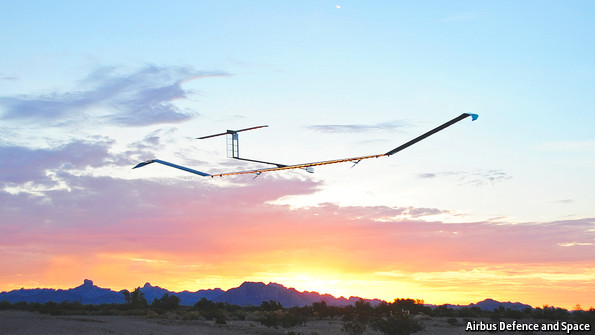
The Economist has an article about still another variety of such vehicles, high-altitude pseudo-satellites (HAPS):
Zephyr.....is.......an unmanned, ultralight, solar-powered, propeller-driven aircraft. But it is designed, just as some satellites are, to hover indefinitely over the same part of the world. With a 23-metre wingspan and a weight of only 50kg, it is fragile and must remain above the ravages of the weather and the jet stream both by day and by night. It therefore flies at an altitude of around 21km (70,000 feet) during daylight hours, and then glides slowly down to around 15km when the sun is unavailable to keep it aloft. 
Its solar cells, which are mounted on its wings, produce 1kW for every 1kg of panel. That power is fed into lithium-sulphur rechargeable batteries which can store 350 watt-hours per kilogram. (For comparison, the lithium-polymer batteries in iPhones store around 200 watt-hours per kilogram.)
The article also states:
Hovering drones could act as relays for telephone calls and internet traffic in places that do not have good enough infrastructure on the ground. And there is never a shortage of customers who would like to snoop on various parts of the Earth’s surface, whether for commercial or military reasons.......

Airbus is not alone in the HAPS game. Google and Facebook are involved as well.........Paul Brooks, spokesman for Airbus’s HAPS programme, says he does not see these firms as competitors, but rather as collaborators in proving the idea of endurance flight and promoting the changes in regulations needed to permit its safe use. 

Thursday, August 28, 2014

"whenever you do a thing, act as if all the world were watching"


Very interesting statistic from an article in the Wall Street Journal:
(I)n Rialto, Calif., where an entire police force is wearing so-called body-mounted cameras, no bigger than pagers, that record everything that transpires between officers and citizens. In the first year after the cameras' introduction, the use of force by officers declined 60%, and citizen complaints against police fell 88%. 
It isn't known how many police departments are making regular use of cameras, though it is being considered as a way of perhaps altering the course of events in places such as Ferguson, Mo., where an officer shot and killed an unarmed black teenager. 
What happens when police wear cameras isn't simply that tamper-proof recording devices provide an objective record of an encounter—though some of the reduction in complaints is apparently because of citizens declining to contest video evidence of their behavior—but a modification of the psychology of everyone involved. 
The effect of third-party observers on behavior has long been known: Thomas Jefferson once advised that "whenever you do a thing, act as if all the world were watching." Psychologists have confirmed this intuition, showing that something as primitive as a poster with a pair of glaring eyes can make test subjects behave better, and even reduce theft in an area.
This technology seems to be used in some Maryland police departments.