Once about Knowledge and knowledge systems, especially knowledge applied to economic development, but since I retired branching into politics, music and whatever catches my attention.
Did you know that states, with their constitutional powers, can allocate their electoral votes in presidential elections as their legislatures choose. Most have all the electors vote for the candidate who gets the most votes in their state.
But that is not required. In Maine and Nebraska, two electoral votes go to the candidate who gets most votes in the whole state, and one electoral vote goes to the candidate who gets most votes in each Congressional district. Thus in these states electoral votes are often split.
Now we know that in red states, most of the voters are rural or small town residents and the Republican majority takes all. In blue states, most voters live in big cities, and the Democratic majority takes all.
What would happen in a close election if Republicans controlling the state government of a slightly red state were to switch to the Maine/Nebraska like system? Well Republicans would likely pick up some electoral votes -- those from the rural districts in the state.
Might they really do that? Might that work? Read this!
An article in The Economist points out that we have had two of the most unproductive Congresses in recent history. Certainly the pubic seems to be fed up with gridlock and want a more productive legislature. Optimists believe that the results of the election will lead to more compromise and more legislation passed into law. "Fool me once, shame on you; fool me twice, shame on me."
The federal election is reported to have cost nearly $4 billion, but apparently that does not include the so called "black money" that is not accounted. (Apparently, non-profit organizations of some kind are now funding adds and other election related expenses, and while they are theoretically required to report these to the Bureau of Internal Revenue, they are not doing so -- the so called black money.) I have heard it estimated that black money may have added $2 billion to the campaign chests.
Only 36.6 percent of the electorate turned out to vote, and there are many Americans who could register to vote who do not do so. The article says:
For reasons that include the sorting of the electorate into like-minded folks, redistricting and the cultural divide between cities and prairies, only 5% of the House’s 435 districts were truly competitive on November 4th. There were 69 congressional districts where the candidate faced no opponent. This means that the main threat to the jobs of congressmen comes from primary elections, in which fewer than 20% of the electorate vote, about the same proportion who describe themselves as holding consistently conservative or consistently liberal views. Few congressmen lost to primary challengers in 2014, but results like the defeat of Eric Cantor, the House Majority Leader, in Virginia’s seventh district remind them that such voters are not wild about anything that smells of compromise with the other side. These voters have the first veto.
Thus a small minority of adult Americans actually elect the members of the House of Representatives. The voters who actually matter are probably not representative of the public at large. I would bet that they are often poorly informed on the issues, depending frequently on sources of education that pander to audiences with narrow ideological spectrums of views (e.g. Fox News and MSNBC). The Congress had an 11% approval rating, but 96.4 of the candidates running for reelection were in fact reelected.
Getting a bill safely through the House, something that has become harder since Republicans adopted the idea that bills should have the support of a majority of their caucus to pass, is straightforward compared with getting one through the Senate, thanks to the filibuster rule. Since a filibuster requires a bill to gain a 60-vote majority, a group of 41 senators can halt almost any piece of legislation. Even the smallest state has two senators, so those 41 sometimes represent a small chunk of the electorate: Larry Sabato of the University of Virginia has worked out that states that are home to just 11% of Americans can elect the senators needed to block legislation. This potent weapon gives the minority party in the Senate the second veto........
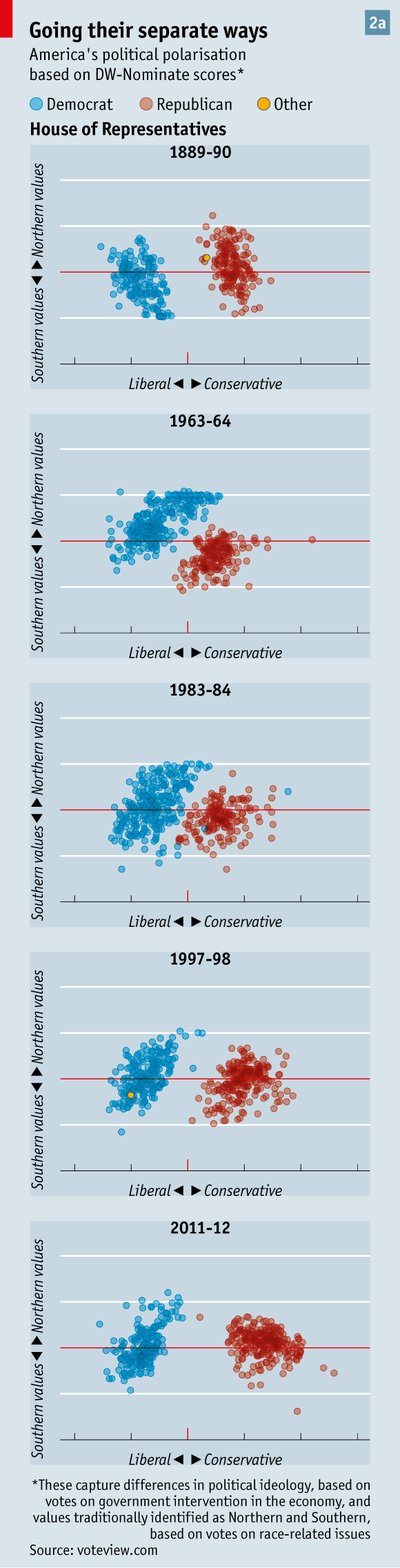
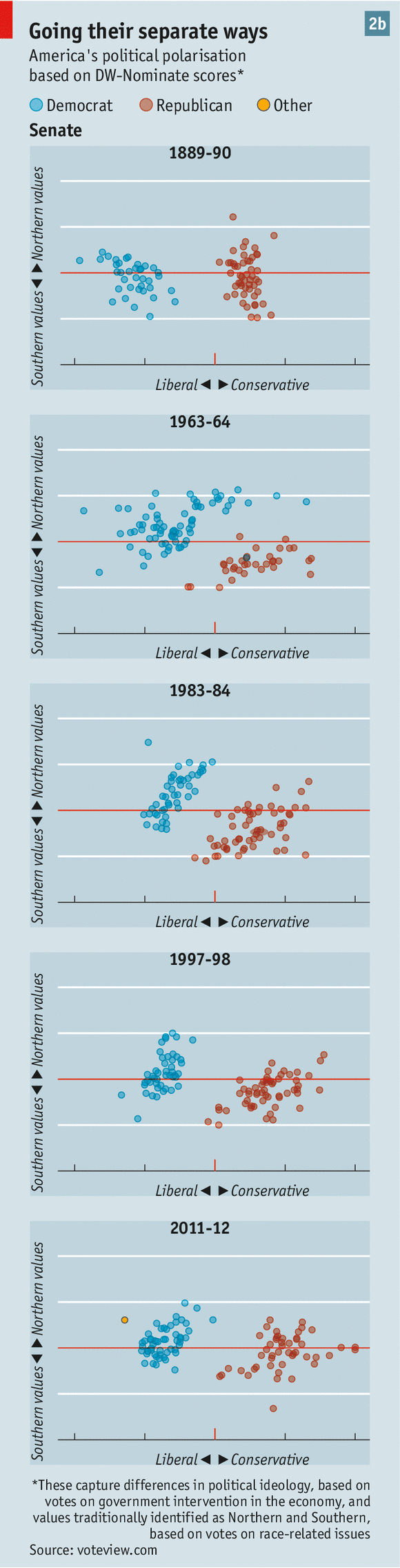
Congressional Republicans and Democrats have withdrawn from each other, to the point where there is now hardly any common ground between them (see chart 2).
Voting patterns in Congress suggest that the parties are even further apart now than they were in the mid-1990s, when Republicans tried to impeach Bill Clinton, or the middle of the past decade, when Democrats denounced George W. Bush as a warmonger.
While the cost of this election was higher than ever, this election saw a reduction of the number of donors. The Stayers apparently contributed nearly $74 million during this election cycle; Micheal Bloomberg more than $20 million; with many others contributing one to several million dollars each.
I find it embarrassing that democracy seems to be working so poorly in the USA. This country fought in a couple of world wars with a stated objective of making the world safe for democracy. We spent a decade, trillions of dollars and thousands of American lives supposedly in an effort to spread democratic institutions to Iraq and Afghanistan. American exceptionalism has been proclaimed for many decades. In our greatest speech, President Lincoln said about the Civil War, our bloodiest,
that we here highly resolve these dead shall not have died in vain; that the nation, shall have a new birth of freedom, and that government of the people, by the people, for the people, shall not perish from the earth.
He was a realist and a practical politician, but how would he feel a century and a half later about the state of our government? How much are the people of other nations laughing at our pretensions of a government of the people, by the people, and for the people?
I quote from a recent communication from the Slaughter & Rees Report giving advice to the newly elected members of Congress:
Understand that what unifies American voters of all parties and persuasions is economic anxiety—about themselves today and about their children tomorrow. Exit polls on Tuesday made this soberingly clear. Only one percent of voters described the U.S. economy today as “excellent.” Almost 70 percent described it as “not so good” or “poor.” Only 29 percent said their family’s financial situation had improved in the past two years. Nearly 80 percent said they were “somewhat worried” or “very worried” about the direction of the economy. These numbers accord with a slew of recent polls. Two months ago in their joint survey, The Wall Street Journal and NBC asked Americans, “Do you feel confident or not confident that life for our children’s generation will be better than it has been for us?” An all-time record 76 percent do not feel confident about their children’s prospects.
What drives this pervasive anxiety is not jobs per se. Last Friday’s Employment Situation report indicated that unemployment in October fell to 5.8 percent. Allowing for measurement error in this statistic, it means the U.S. labor market is quite close to full employment. No, what drives anxiety is the stagnant earnings of so many jobs. Since 2000, only workers with a doctorate or a professional post-graduate degree—just 4.0 percent of workers in 2013—have enjoyed increases in their average inflation-adjusted money incomes. Median household income in America in 2013 was $493 less than inflation-adjusted U.S. median household income in 1989.
Perhaps some of the malaise of the American people has been caused by the tsunami of attack adds and negative opinion on so called cable news, but I accept that the economic gains in the recovery from the Great Recession have been largely appropriated by the wealthy. They have seen huge increases in income while the poor are still poor and the middle class is hardly progressing.
For the wealthy, the increase in wealth is more important than income. The Dow Jones Industrial Average hit a low of 6,443.27 in March 2009, and is 17573.93 now. Thus someone who had a billion dollars in these stocks in 2009 has nearly three billion dollars today; if he just held the stocks, there was no taxable income associated with the increase.
The housing boom was in part due to providing home loans to people who were too poor to qualify for loans in the past. The risk of these loans was passed on through new financial instruments, often going into the investment portfolios intended to support retirement. The result of the increased demand for modestly priced homes was a real estate bubble. When that market crashed, a lot of people had their loans foreclosed, and lost their savings; others still are under water, owing more on their mortgage than their homes are worth. The impact of the disappearance of savings was like a negative income.
Serious economists suggest that those who fear that their children will not be better off than they are will often be right. The one-percent are more likely to protect what they have than to grow the economy for others; they seem likely to use their economic power to obtain political power and use that to appropriate still more of the income and wealth of the country.
We have two years to get ready for the next election, and try to put in people who will do a better job than those elected last week.
I think there was always an understanding that one could not lie about someone thereby damaging him or her, and that the government could impose penalties (observing due process) on one who broke the laws against libel or slander. Holmes appears to have loved discussion of ideas and to have recognized that ideas would be clarified and improved in the give and take of open discussion. In the context of World War I, the Congress limited freedom of speech in legislation primarily focused on stopping espionage. Holmes began with the belief that it was permissible for the government to limit speech opposed to the war effort, but came to feel that the Supreme Court should be explicit in indicating the standard to be used in deciding which speech could be limited and which must be free.
In reading the book, it occurs to me that in 1919 few would have had a good idea on how to qualify risk. Thus, one might have tried to estimate the risk of someone's speech leading to injuries or death. In today's language, one might look at the expected number of disability adjusted life years (DALYs) lost due to an utterance. That value could be quite large if for example someone revealed to the enemy the plan of attack of a new offensive on the western front. I read today that doctors in Kenya are spreading the rumor that immunization is being done with an additive to the vaccine that sterilizes the recipient; that is a speech that is likely to have a significant impact measured in DALYs. On the other hand, a person with little influence railing against a well accepted government policy might have cause negligible risk by that speech.
Of course, balancing the cost one might also consider the potential benefits of the act of speech. Holmes famously wrote that there was not right to yell fire in a crowded theater. Of course, there is no such right if there is no fire, but every right if there is a fire and alerting the audience will save lives. What if someone makes some observations which lead him/her to think that there is a probability of a serious fire in the theater, but does not lead to certainty; assume further that an immediate warning would be effective in avoiding injury and death, but waiting to be sure would lose the opportunity to do good. One could in theory again calculate the likely benefit of yelling "fire". Would that justify the yell if it proved later that there had not been a fire?
A Higher Level Risk-Benefit Analysis
What would be the cost in DALYs of each of the various standards that the Supreme Court might set for the nation as the standard became accepted and used nationwide? What would be the cost in enforcement in accordance with that standard. These would seem to be relevant for the justices to consider in setting such a standard.
On the other hand, what would be the larger cost to the nation in the limitation on free speech -- which is after all a basic freedom on which the nation was founded. How much would the public debate be affected, and the process of public policy determination hurt?
It is less than a week after the election, and this election seems to have occasioned a flood of negative advertising. Was any of this false advertising? A lot? A little? Should there be some limitation on politicians making false or misleading statements in an election campaign? Should there be a limitation on others making such statements verbally or in the media during a campaign? I don't know, but I wonder whether the judicial process has access to adequate analytic expertise to properly analyse the issue.
I just watched a public affairs program from the International Foundation for Electoral Systems in which Americans experienced in the Federal Election Commission explained to an audience from other countries how the 2014 federal election was financed. It brought home how bad our system looks to others, and how hollow are the claims of our democracy.
There is no public funding for candidates for Senator or House of Representatives in the federal system. The law provides for funding of candidates in presidential elections, but the funding limits are so low that Republican and Democratic candidates choose to raise their own money.
As I understood it, in the federal system there are three kinds of campaign financing:
That raised by the candidates themselves, which must be reported to the Federal Election Commission and the donors disclosed. Adds paid for from these funds are the ones that include the statement that the candidate has approved the message.
That raised by the so-called Super PACs, in which the donors are also disclosed by less frequently. Apparently Super PAC donors often delay their contributions until so late in the campaign that they are only identified in the public records after the election is all over. Adds paid for by the Super PACs are identified by the organization (most voters of course never figure out who really funded them).
That raised by non-profit organizations supposedly organized for other than political purposes, that still raise money and advertise in elections. The only disclosure from these is to the IRS (our tax agency). Apparently the law says that these organizations should be regulated, but they are not regulated; the suit requiring the government agency to carry out the law is still working its way through the courts.
The discussion took place on the day before the voting. At that time it was estimated that $4 billion had been spent on the federal election, but that did not include such things as efforts to get out the vote (some of which are done by employees of rich donors rather than political parties). Increasingly, according to the speakers, more of the money is coming from wealthy donors, with individuals sometimes spending more than $100 million on a single election (yes. in a country of more than 300 million people, 2 1/2% of the total cost of the election may have been spent by a single person). Small donors are contributing less, in part because they feel that their contributions don't count when compared to those of the rich.
The most spending this year appears to have taken place in North Carolina, where at least $112 million was spent on the federal election. This is far from the largest of our 50 states, and the impact of the outside spending to influence the election must be considered to be huge.
The Federal Election Commission is composed of three Democrats and three Republicans by law. All are to be nominated by the president and confirmed by the Senate. In practice, the president actually nominates the Commissioners from his party, but simply rubber stamps the nominees from the other party that have been identified by the leadership of that party in the Senate. Unfortunately, the system is broken in the gridlocked Congress, and only two new Commissioners have been confirmed in the last 6 years; the rest were confirmed during the Bush administration and continue to serve.
The result of the system has been a flood of negative advertising. All the negative adds probably angers the voting public about the government. It is likely to explain the negative views of the political parties, and may be related to the very low turnout of voters -- who can't choose between two candidates both of whom seem bad.
The current emphasis on freedom of speech in election campaigns results in a situation in which there is no control to assure the truthfulness of campaign advertising. There seems to be no check on the false claims made by anonymous adds against candidates.
All of this in a country that was supposed to have fought two world wars to make the world safe for democracy, that fought two long wars in this short century to bring democracy to Iraq and Afghanistan. I suspect the foreign audience thought we were not living up to our out principles.
The Republicans have 244 and the Democrats 182 seats, before a few undecided races are completed.
Voter turnout was 36.6 of registered voters (lots of Americans don't even bother to register to vote). This is the worst turnout since the 1940s when the country was at war and lot of the population was abroad or had moved away from home for war work.
Apparently, approval of the Congress was 11%. Most Americans apparently don't know the name of their Congress person when asked. Still most are reelected in every election -- perhaps in part because most Congressional districts have safe majorities for one or the other party.
A higher portion of Republican voters turned out in this election than Democratic voters.
Check out this video on who voted. More than half of the voters viewed the Democratic Party unfavorably and more than half of the voters viewed the Republican Party unfavorably.
The Purple Districts on the Census District Map were those found to be competitive in a recent study. Source.
I quote from an article in the Washington Post last year focusing on the 2012 election:
In 2012, Congressional approval averaged 15 percent, the lowest in nearly four decades of Gallup polling. And yet, 90 percent of House Members and 91 percent of Senators who sought re-election won last November.
The seeming paradox between the low regard with which people hold Congress and the high rate of re-election of incumbents is explained well by new data released by Gallup on Thursday that points to a simple reality: People hate Congress but (generally) like their Member of Congress.
Gallup found that 46 percent of respondents said they approved of "the way the representative from your congressional district is handling his or her job" while 41 percent disapproved. That's in spite of the fact that overall Congressional approval was at just 16 percent in the same survey and hasn't been higher than 24 percent since the start of 2011.
Even more fascinating, Gallup asked a different set of respondents if they could name their Congressman and his/her party and then followed up with a question on whether they approved of the person.
Roughly one in three people (35 percent) could name their Member of Congress -- that was surprisingly high, at least to us -- and, of that group, 62 percent approve of how their Member of Congress is going about their job while 32 percent disapprove. "Americans who say they can name their congressional representative skew older, more highly educated and somewhat Republican," writes Gallup's Elizabeth Mendes.
The 2014 election, a mid term election, had a smaller turnout than that of 2012. Proportionately fewer women, young people and minorities turned out to vote.
So why are members of Congress almost always reelected, even though people don't like the job that the Congress as a whole is doing?
People not only don't know what their Congressman is doing, they don't know who he/she is.
Is it that incumbents have more name recognition and can more easily raise funds (because they are more likely to be elected than their opponents and will have more seniority if elected and thus more power)? Probably that helps.
There are very few competitive districts. People tend to live in places occupied by others with the same political affiliation, and where they are not doing so, the states often create safe districts. So people vote their party and the representative of that party in their safe district for that party is usually the incumbent.
And I suspect that the recent Supreme Court Citizens United decision which allows corporations to fund campaigns across the country has aided the Republican Congressional candidates in this election. I understand the $4 billion was spent on the campaigns!
In my previous post I showed that Hispanic American voting participation is low. Surprise, surprise, Hispanic Americans are concentrated in in states that border Mexico as well as Florida.
More than four-in-ten (44%) Hispanics in Texas are eligible to vote, ranking Texas 17th nationwide in the share of the Hispanic population that is eligible to vote. By contrast, more than three-quarters (78%) of the state’s white population is eligible to vote.
Perhaps we need another Voting Rights Act to enfranchise Hispanic Americans.
I am not sure that the decrease in white voter turnout would have made MLK very happy. Black voter turnout in the two Obama elections might not define a long term trend.
What does seem clear is that Hispanic and Asian American voter turnout is far too low for us to take satisfaction that voter rights are being respected.
Based on education data from the U.S. Census Bureau’s’ American Community Survey, 24/7 Wall St. identified the U.S. states with the largest and smallest percentages of residents 25 or older with a college degree or more.
The difference in median income between those with only a high school diploma and a college degree is dramatic. Differences in poverty rates related to education are just as dramatic. For U.S. adults with at least bachelor’s degrees, the percentage living in poverty in 2011 was just 4.4%. For adults with only a high school diploma, 14.2% were living below the poverty line.
The effect of wage gap by education becomes clear when comparing the states by graduation rate. Of the 10 states with the largest percentage of college-educated residents, eight are in the top 10 for median income. Among the worst-educated states, eight are among the 10 with the lowest median income.
There is an interesting article by Bruce Bartlett, a former senior economist at the White House, US Congress and Treasury. He points out that, although in the presidential election campaign both candidates ran promising to restore economic growth, the president actually has limited power to do so.
The Constitution places the main responsibility for the federal budget in the Congress. The executive branch prepares a budget proposal, but the Congress makes the actual decisions on appropriations. The president's power over the budget proposal is itself limited. He depends on a few thousand political appointees, largely drawn from his party leadership, to lead the huge government bureaucracy in preparing that budget, but there are limits both to any one man's ability to master the details of the budget and to oversee his political appointees and through them the departments of government.
Moreover, financial policy is largely under the authority of an independent Federal Reserve system. Moreover, the judicial branch can in some situations intervene, as when the Supreme Court decides that presidential action is unconstitutional.
The article perhaps underestimates the influence of the president. The president has "the bully pulpit" and can inform the public and go to the public for support of his policies. As mentioned above, he does lead a cadre of thousands of political appointees who have been selected to share his views, especially his views on economic and foreign policy. Moreover, the bureaucracy in my experience is filled with professionals who generally seek to implement the people's will as expressed through their choice of their elected officials. The president is also the leader of his party, and in the coming Congress President Obama's party will have a majority in the Senate and a large minority in the House of Representatives.
I suppose that President Obama will have significant influence in his effort to avoid the fiscal cliff, and in the development of policies intended to continue recovery from the Great Recession in the very short term and to reduce the federal deficit in the next 10 or 15 years.
I think he may have still greater influence in the longer term strategies
to assure institutions and policies conducive to the creation of new enterprises in the United States
to develop the basis in scientific knowledge needed to underlie new technology, and indeed in assuring technological leadership by the agencies of the federal government
to educate our citizens, both to provide a 21st century workforce and an informed electorate
to help assure the continued development of a strong national infrastructure and
to provide the security needed for these developments in a nation at peace.
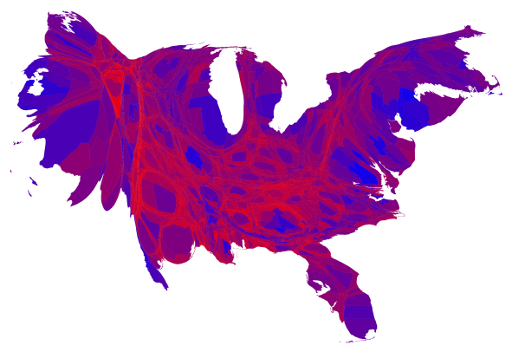
Mark Newman of the Department of Physics and the Center for the Study of Complex Systems at the University of Michigan has produced a great set of maps showing how Americans voted in the presidential election this year.
The map shown above shows results by county. The area allocated to each county is not its land area but rather its population. Dr. Newman has kept the overall shape of the country in this projection more or less comparable to the projections we are used to seeing.
He has used red, blue, and shades of purple in between to indicate percentages of votes for Republicans and Democrats.
When the United States government was created, there were slaves in every state. The nation was rural. Suffrage was restricted to white, male property holders, almost all of whom were Protestants. If those conditions still existed, Mitt Romney would have been elected on Tuesday. As it was, the big cities, women, blacks, Latinos, Jews, Catholics and gays all gave their majorities to Obama. So did young voters. That was why Obama won the popular vote. The white males voted in their majority for Romney.
The changes in the electorate seem to favor the Democrats in future elections, in that the "minorities" are growing as a percentage of the total population, and urbanization continues. Unless the Republicans manage to attract voters from these groups in the future, the Democrats will be increasingly successful in elections.
The U.S. President is chosen by the electoral college, not the popular vote. The system was the result of a compromise between the large and small states in the Constitutional Convention. Thus each state has as many votes in the electoral college as it has members of Congress (i.e. two senators and as many members of the House of Representatives as its population justifies). Four presidents have been elected by the electoral college even though they lost in the popular vote. All but two states have enacted laws specifying that their electoral votes be cast in a block.
Over the history of the United States, granting statehood has been an intensely political process. Before the Civil War, the compromise was to admit free and slave states in equal number -- a compromise made to protect the institution of slavery. During the Civil War the Republican dominated Congress admitted two free states. In the later 19th century, when the Republicans enjoyed the electoral spoils of the Civil War, a number of western states were admitted to the Union, all of which were and are rural with relatively small populations. Currently this fact seems to suggest that Republicans can more easily win the election while losing the popular vote, as did George Bush in 2000.
Before the passage of the Civil Rights Act in the 1960s, the South was solidly Democratic. At the time the Republican party had a conservative wing and a more centrist wing. The Democratic party had a northern liberal wing and a southern conservative wing. With the Nixon Southern strategy, the South became a Republican stronghold, joining a swath of mid western rural states. Those are the red states in the above map. The northeastern and western states are the Democratic stronghold. In the current election there were only a few swing states which were thought to be available to each party (in the middle in the following table).
(The Congress is different. Senators are elected from their states as a whole, but Representatives are elected from their specific electoral districts; there has been a great deal of gerrymandering, so that many congressional districts are safe for one or the other party. This, combined with the advantage enjoyed by incumbents, helps explain why the House of Representatives can have an elected majority belonging to one party while the president elected at the same time belongs to the other party.)
The Obama campaign developed, organized and analysed information with exceptional skill in this election. It did so to raise huge amounts of money, to get out the electorate, and to target its efforts to key swing states.
Money
The presidential election of 2012 was the most expensive ever. Total spending in the 2012 election has been estimated at nearly $6 billion. The New York Timesestimate of the money raised through September by the presidential candidates, the national party committees and the primary “super PACs” whose sole purpose is to support a candidate was: $934.0 million for Obama and $881.8 million for Romney. Other funding surely was raised and spent by super PACs and issue oriented non-profits.
I think of the Republicans as the party of the more affluent, Democrats as the less affluent. In this election, Obama campaigned on a promise to raise tax rates for high income people, Romney to lower their taxes. Moreover, a Supreme Court decision had declared that corporations had the right to fund political campaigns, and one expects that they would have supported the Republican Romney who ran on his business background and skills. Consequently I thought a year ago that it was likely that the Republicans would raise more money for this presidential election that would the Democrats,
While the Republican party has often outspent the Democratic party in national elections, the Democrats have outspent the Republicans in the last three presidential elections. It seems that the Obama campaign pioneered in 2008 and further developed in 2012 "big data" techniques that were exceptionally successful in identifying potential donors, and exceptionally successful in targeting advertisements and donation requests, as well as online procedures that facilitated small donations. Of course, phone banks were still used as were fund raising events, but the fund raisers were provided with more and better information on who to approach and how to do so. (Read more.)
Getting out the vote
The 2008 election was held when President Bush was unpopular, the United States was entering the Great Recession, and we were involved in two unpopular wars. In 2012, President Obama was relatively unpopular because of the continuing recession and the continuing high levels of unemployment. President Obama won the 2008 election by a much greater margin over Senator McCain than he did the 2012 election over Mitt Romney. Much of the difference must be attributed to the changed conditions that were more favorable for the Democrats in 2008. Some must be attributed to the success of the Romney campaign in making the case for Romney, energizing its base, and getting out the Republican voters.
Still, it seems to be agreed that the Democrats did an exceptional job of getting out the likely Obama voters. This seems to be true in spite of reports of Republican efforts in a number of states to make voting more difficult. The success of the Obama campaign has been attributed in part to developing strong local campaign presence, but also to the big data approach which was effective in helping to identify potential campaign workers, and in identifying the likely Obama voters, not to mention developing effective advertisements to encourage people to vote.
It seems clear that the Obama campaign very early on recognized that most states were going to be safely in the Republican or the Democratic camp, and that there would be nine swing states whose electoral votes would determine who won the election. Both campaigns in fact concentrated on these states, but Obama won most of them, notably Florida with 29 electoral college votes, Ohio with 18, and Virginia with 13. Since Romney would have won the election had he obtained 65 more electoral college votes, the 60 votes from these three states alone were almost conclusive. However, Obama also took Pennsylvania, Wisconsin, Iowa, Colorado and Nevada.
Again, the Obama campaign used big data effectively. It had polling data on something like 28,000 potential voters in Ohio alone. It also effectively built local capacity in these states, mobilized its bases there, increased registration, drew in workers from other states, and got out the likely Obama voters.
The techie staff on the Obama 2012 campaign drew on the experience of the 2008 campaign, but was several times larger. No doubt drawing on the advances in management of big data that have occurred in the last four years, it managed to create an integrated information system for the nationwide party use. Using that data it helped the campaign raise more money than the opponents, get out more voters for Obama, and more effectively target swing states.
Nate Silver and the 538 Blog
Nate Silver apparently first came to the attention of a large part of the public by using statistics on professional baseball. He came to my attention by producing very accurate odds for the 2008 national election, especially calling the presidential race very accurately. He triumphed in this election, calling the presidential odds state by state very accurately, predicting the popular vote and the electoral college outcome, and doing exceptionally well in predicting the Senate and House of Representatives outcomes. He tracked the changing odds for months on his 538 blog on the New York Times website.
Silver takes advantage of the large number of surveys done by others, adding their published data to his own model. He weights the data from the various surveys, giving more weight to those with methods he approves of, and more to those that have been successful in predictions in the past. He claims, and I believe, that this weighted combination of many surveys is likely to be more accurate than single surveys.
The 538 blog showed Obama consistently ahead in the popular and electoral votes from June on, and also as the favorite to be elected. He gave increasingly good odds on Obama winning from mid October. During most of this time, the television news broadcasts were saying that the race was very close. By Monday, Silver was citing 10 to 1 odds on an Obama victory. He of course was dead on right. (Might the networks have been trying to maintain interest in their election night broadcasts or their nightly news, or did they simply not have the same quality of analysis that Silver used?)
Conservative pundits and Fox News were predicting a Romney win, and some a Romney landslide. They were very wrong! (Read this, this and this.) It is believed that people like to vote for a winner, and that a general consensus that one candidate will win increases the margin of that candidate's victory. So it is possible that these pundits were deliberately giving false statements. It is also possible that they believed their own biased surveys and that they believed each other. Whatever the reason for their errors, the conservative pundits were frequently very insulting in their public statements about Nate Silver. However, Silver triumphed in the accuracy of his final predictions, giving some credibility to the accuracy of his tracking over the last five months.
Thus the big data team in the Obama campaign triumphed in the support that they provided to the successful campaign. Remember that never has an incumbent president been reelected with so high an unemployment rate and an economy in such perilous condition since Franklin Roosevelt's time -- the election was not an easy win. So too has Nate Silver's serious analysis based on data from many surveys succeeded in providing the public with accurate odds on the results of the election.
The Maryland legislature changed the boundaries of the state's congressional districts after the 2010 census. The 6th Congressional District which had been a Republican stronghold was changed, removing rural areas in the northeast of the state and extending it into the Washington suburbs. The new shape of the district is shown in the map above.
Roscoe Bartlett, a Tea Party Republican and 10 term Congressman is now running against John Delaney to represent the district. Delaney, a successful businessman, is a moderate Democrat who appears well suited to represent the people of the district and work with the state delegation in Congress.
The more I read about Bartlett, the more unhappy I am that he represents me in Congress. I have been posting on the things I find. Please check these out:
John Delaney won the election and will represent Maryland's 6th Congressional District in the next Congress, More....
The Washington Post reports that the Congressional redistricting done this year has been approved by a large majority. Thus the Maryland 6th Congressional District should remain as shown at least until 2022. Here is the count as of this morning (November 7, 2012):
America has around 197,000 medium-sized firms, defined as those with annual revenues between $10m and $1 billion, according to data from the National Centre for the Middle Market at Ohio State University. Together, they employ over 40m people in the country and account for around one-third of private-sector GDP (equivalent to the economies of India and Russia combined).
Some 82% of medium-sized firms survived the dark years of 2007-10, compared with 57% of small firms. And although the survival rate among the 2,100 big firms (with revenue over $1 billion) was 97%, these giants shed 3.7m jobs during those years. Mid-sized companies, by contrast, added 2.2m jobs. This trend has continued as the economy has struggled back to its feet. In 2010-11, medium-sized firms increased employment by 3.8%, compared with growth of 2.5% by small firms and 0.8% by big business.
You would never suspect that there is a network of medium size enterprises listening to our politicians, much less that they are the job creators.
I got to think of that on watching the Foreign Policy Debate last night. Barack Obama and Mitt Romney see the world differently. A part of the difference comes from their differences in experience.
Obama famously is the son of a Kenyan exchange student who lived in Indonesia during his childhood. He is also the son of a woman who made a career in development assistance, raised largely by a grandfather who served in World War II and a grandmother who worked in a plant building bombers during the war. Obama grew up in Hawaii, America's most ethnically diverse state, and is supposed to have associated with foreign students during his college years. He served on the Senate Foreign Relations Committee and Homeland Security Committee for four years and of course has been president for four years.
Romney famously is the son of a U.S. auto executive, governor and presidential candidate who was born in Mexico of American parents. George Romney lived in a Mormon colony in Mexico from birth in 1907 to the return of his parents to the United States in 1912. Mitt Romney was a Mormon missionary in France for two and a half years and has had a number of increasingly senior positions in his church. He was a businessman managing investments abroad. He spent three years managing the planning for the Winter Olympic Games of 2002. He served one term as Governor of Massachusetts.
As U.S. Senator on the Foreign Relations Committee and as the President of the United States Obama had a superb position to learn about U.S. foreign policy. If it takes seven years to develop expertise, Obama must have done so by now.
The view of the world of a missionary and religious leader is presumably quite different than that of someone making national policy. So too is the view of a businessman looking for investment opportunities or consulting with international firms. So too is the view of a sporting event organizer. Governors have some limited responsibilities for international policy relating to the foreign interests of constituents. Thus Romney had a different and more limited exposure to international affairs.
Senators and especially presidents have unequaled opportunities to meet and get to know foreign governmental leaders. So too, they have unequaled opportunities to meet and learn from U.S. foreign policy experts.
I suspect that Barack Obama understands the world in a very different way than does Mitt Romney because they are very different people, formed by very different life experiences and very different associations over their lifetimes.
A great deal of knowledge of foreign policy is tacit rather than explicit. As such it is very difficult for voters to identify and study. While a debate will indicate something about a candidates command of facts, it will do little to convey his understanding of situations, causes and their effects. That tacit knowledge and understanding is developed over time and with experience -- it can not be picked up from books.
Theodore Roosevelt was the leader of the progressive faction of the Republican party in 1910. He got the problem! The U.S. economy has returned to levels of inequality not experienced since his day. The impact will be felt in lack of economic growth and lack of opportunity for most American kids. Mitt Romney is the presidential candidate of the Republican party. He doesn't get the problem!
This is what Republican progressives believed in 1910: "The essence of any struggle for healthy liberty has always been, and must always be, to take from some one man or class of men the right to enjoy power, or wealth, or position, or immunity, which has not been earned by service to his or their fellows..........At many stages in the advance of humanity, this conflict between the men who possess more than they have earned and the men who have earned more than they possess is the central condition of progress. In our day it appears as the struggle of freemen to gain and hold the right of self-government as against the special interests, who twist the methods of free government into machinery for defeating the popular will. At every stage, and under all circumstances, the essence of the struggle is to equalize opportunity, destroy privilege, and give to the life and citizenship of every individual the highest possible value both to himself and to the commonwealth." Theodore Roosevelt
Today we find: "Including capital gains, the share of national income going to the richest 1% of Americans has doubled since 1980, from 10% to 20%, roughly where it was a century ago. Even more striking, the share going to the top 0.01%—some 16,000 families with an average income of $24m—has quadrupled, from just over 1% to almost 5%. That is a bigger slice of the national pie than the top 0.01% received 100 years ago." The Economist
What does this imply: "Two Spanish economists, Gustavo Marrer0 and Juan Gabriel Rodríguez, built an index of economic opportunity for individual American states. They found that states’ GDP growth was inversely correlated with their inequality of opportunity, but not with overall inequality. In a forthcoming World Bank working paper, Ezequiel Molina, Jaime Saavedra and Ambar Narayan find that countries with lower educational equality, as measured by the Human Opportunity Index, grow more slowly.
"This line of research is in its early stages, but a second strand of evidence, which examines the link between inequality and social mobility, is more developed. There are now plenty of studies which use the inter-generational elasticity of income to measure social mobility in different countries. Miles Corak, a Canadian economist, first plotted the results of these studies on a single graph. It is known as the “Great Gatsby Curve” (see chart 4), and suggests that countries with higher Gini coefficients tend to have lower inter-generational social mobility." The Economist
QUESTIONER: When you said that we already have a leader who divides us with the bitter politics of envy, I’m curious about the word envy. Did you suggest that anyone who questions the policies and practices of Wall Street and financial institutions, anyone who has questions about the distribution of wealth and power in this country, is envious? Is it about jealousy, or fairness? ROMNEY: You know, I think it’s about envy. I think it’s about class warfare. When you have a president encouraging the idea of dividing America based on 99 percent versus one percent, and those people who have been most successful will be in the one percent, you have opened up a wave of approach in this country which is entirely inconsistent with the concept of one nation under God. The American people, I believe in the final analysis, will reject it. QUESTIONER: Are there no fair questions about the distribution of wealth without it being seen as envy, though? ROMNEY: I think it’s fine to talk about those things in quiet rooms and discussions about tax policy and the like. But the President has made it part of his campaign rally. Everywhere he goes we hear him talking about millionaires and billionaires and executives and Wall Street. It’s a very envy-oriented, attack-oriented approach and I think it will fail