Thursday, August 11, 2011

Comments on the book, 1912: Wilson, Roosevelt, Taft and Debs--The Election that Changed the Country

My book club met last night to discuss 1912: Wilson, Roosevelt, Taft and Debs--The Election that Changed the Country by James Chase. The election was quite unusual in that Woodrow Wilson (the Democrat( was elected with under 42 percent of the vote, Theodore Roosevelt running for a third party (the Progressive, or the Bull Moose) was second in popular vote with 27 percent, William Howard Taft (the Republican) received 23 percent, and Eugene Debs (the Socialist) received an unprecedented and unmatched 6 percent.

Progressivism may have reached a high mark in this election with Roosevelt running formally as a progressive, Wilson including many progressive elements in his campaign, and Debs if anything to the left of the progressives. I guess that this represented a spirit at large in the country in which many people would have been concerned with the desperate working conditions suffered by many people and the recurrent serious recessions. This was a peak in power of the trusts which monopolized many industries, and indeed of the power of big finance in New York that could form trusts which demolished competition. Indeed, all the candidates seemed to offer platforms that emphasized the need for government to regulate the trusts.

The book focused not on the problems faced by the country so much as the process of politics during the election. (Only Roosevelt and Debs come off in the book as primarily concerned with the welfare of the nation.) Wilson is described as portraying himself as far less conservative than he really was, while allying himself with William Jennings Brian -- who held quite different political positions -- the kingmaker who turned the Democratice convention to Wilson's favor. In the time when primary voting was something of a straw poll not binding on delegations, Taft sewed up the party machines and the Republican nomination; it seems likely that the bosses were more concerned with their own power and the welfare of their financial backers than with ideology or the welfare of the public. Indeed, I inferred from the book that Roosevelt may have been largely motivated by his own pride and his desire for the limelight.

Looking back after nearly a century, it is clear that the world was about to enter World War I, that the United States would play a key role in that war and in the peace negotiations. Chace suggests that had Roosevelt been elected rather than Wilson the outcomes of the war and peace negotiations would have been much different, the evolution of Europe different after the war, and even that World War II might have been averted. Yet, the book suggests that there was very little attention to foreign policy during the campaign, with an emphasis on domestic policy. Politicians seemed unable to foresee the key problems of even the near future.

The book's title describes the election as changing the country. While Chace is not very positive about Wilson, he accomplished a number of things such as the creation of the Federal Reserve system and the Federal Trade Commission to regulate the trusts. His administration introduced the income tax and began military preparations in advance of entering World War I, and of course entered the war. I was impressed by how much more prepared the United States was for the war as a result of things put in place by the Wilson administration.

Yet the eight year Democratic administration, which followed many Republican administrations, was followed by three more successive Republican administrations. The election marked a local high point of socialism and the progressive movement. Certainly there has been long term trends in United States history eliminating slavery, reducing racism against African Americans and Indians, and improving the welfare of industrial workers, and enfranchising women. Yet many of the improvements came during and after the Depression.

The question came up as to the modern counterpart of the progressive movement of 1912. That movement was responsive to the impact of the industrial revolution, to the huge and misused power of the trusts, and to the horrendous problems of workers and the poor, and today/s society is quite different than that of 1912. However, it was suggested that the increased concentration of income and wealth in a small economic elite and the worsening economic conditions and social conditions experienced by most Americans have led to a modern progressive movement, albeit one with much less widespread support than that of the progressivism of 1912.

We also discussed the concept of "national interest". Why, for example, was it in the national interest for the United States to enter the war on the part of the Allies in World War I? Of course, one aspect of the answer is that the pro-war factions succeeded in convincing a majority of the public that the war was in the national interest. On the other hand, the Zimmerman telegram which offered German support to Mexico were Mexico to declare war on and invade the United States (as unrealistic as that proposal seems) clearly implied a national interest to not be invaded. We went on to question to what degree the national interest was in fact threatened in other more recent military interventions.

I note that after World War II, genocide came to be seen in international law and by many Americans as a situation which also demanded military intervention by those nations strong enough to protect those threatened by extermination. The failure to have intervened in Rwanda rankles.

In general, the book seemed easy to read, well written, and interesting, describing a period about which many of us knew less than we wanted to know. While the author might have been well advised to explicitly acknowledge the limitations of his ambition in this short book, it was probably a wise decision to focus on the political machinations of the election in a short book rather than trying to tackle a more holistic discussion of the period (which would have necessarily involved a much longer and probably a much more difficult and confusing book).

Wednesday, August 10, 2011

The Decline of the Non-Professional Middle Class

I quote from "Can the Middle Class be Saved" by Don Peck, The Atlantic, September 2011: 

Since 1993, more than half of the nation’s income growth has been captured by the top 1 percent of earners, and the gains have grown larger over time: from 2002 to 2007, out of every three dollars of national income growth, the top 1 percent of earners captured two. Nearly 2 million people started college in 2002—1,630 of them at Harvard—but among them only Mark Zuckerberg is worth more than $10 billion today; the rise of the super-elite is not a product of educational differences. In part, it is a natural outcome of widening markets and technological revolution, which are creating much bigger winners much faster than ever before—a result that’s not even close to being fully played out, and one reinforced strongly by the political influence that great wealth brings.
Recently, as technology has improved and emerging-market countries have sent more people to college, economic pressures have been moving up the educational ladder in the United States. “It’s useful to make a distinction between college and post-college,” Autor told me. “Among people with professional and even doctoral [degrees], in general the job market has been very good for a very long time, including recently. The group of highly educated individuals who have not done so well recently would be people who have a four-year college degree but nothing beyond that. Opportunities have been less good, wage growth has been less good, the recession has been more damaging. They’ve been displaced from mid-managerial or organizational positions where they don’t have extremely specialized, hard-to-find skills.”
The article is interesting. According to Peck,  the bottom 70 percent have been suffering over decades, especially during the Great Recession, while the top one percent have been doing very well indeed, thank you. Those of us with advanced degrees, clustered in places like Washington, New York and Silicon Valley have been doing well, while much of the rest of the country has not. Large numbers of men, those with high school educations, have stayed in declining fields such as manufacturing and are suffering economically, while women, increasingly college educated, have taken new jobs in service industries such as health and educational services, and are gaining economically. The results seem to be hard on many American families.

The decline of the economic situation and expectations of the lower middle class is also associated with a decline in the participation in civic life of its members. (This echos the theme of Putnam's Bowling Alone: The Collapse and Revival of American Community.


Peck also writes:
As the journalist Bill Bishop showed in his 2008 book, The Big Sort, American communities have become ever more finely sorted by affluence and educational attainment over the past 30 years, and this sorting has in turn reinforced the divergence in the personal habits and lifestyle of Americans who lack a college degree from those of Americans who have one. In highly educated communities, families are largely intact, educational ideals strong, and good role models abundant. None of those things is a given anymore in communities where college-degree attainment is low. The natural leaders of such communities—the meritocratic winners who do well in school, go off to selective colleges, and get their degrees—generally leave them for good in their early 20s.

I think it may be very bad for our society if it continues to become more stratified, with the extremely wealthy consuming more and more (and more conspicuously), a growing professional class, more than comfortable in wealth and income, and a large and growing lower class deprived of hope for a better life for their children.

Perhaps one of the problems is that we have been investing in the wrong kind of innovation. Perhaps we could reorient our research and development to provide more and better jobs for the people who would once have been in the middle class, who are now in a decline into the lower class, but who could again be in the middle class. Such R&D might be less remunerative for the very rich and the professional class, but might lead to a better society.

So too, I think we need to revamp our educational system, focusing more on lifelong learning. Certainly our colleges and universities should continue to be supported and certainly we should continue to maintain and build a strongly educated professional class, but we should also provide many more opportunities for people who don't go to college or university to invest in the skills, knowledge and understanding that they will need to work more productively (and especially to change into the new jobs from a more socially responsible innovation policy).

Both of these changes would seem to require cross-the-board cultural changes. We have as a society to become more concerned with the equity of opportunity in our society. We should be less concerned with increasing the affluence of the already affluent, and more concerned with the advancement of the rest of society. We will have to rethink attitudes toward vocational education, continuing education and on the job training. (The Republican objection to programs to retrain workers who lose their jobs due to competition from emerging nations and the resulting change in trade patterns is a prototypical example of the attitudes we need to change.)

A thought about innovation and development

I quote again from "Can the Middle Class be Saved" by Don Peck, The Atlantic, September 2011: 
In 2010, the McKinsey Global Institute released a report detailing just how mighty America’s multinational companies are—and how essential they have become to the U.S. economy. Multinationals headquartered in the U.S. employed 19 percent of all private-sector workers in 2007, earned 25 percent of gross private-sector profits, and paid out 25 percent of all private-sector wages. They also accounted for nearly three-quarters of the nation’s private-sector R&D spending. Since 1990, they’ve been responsible for 31 percent of the growth in real GDP. 
Yet for all their outsize presence, multinationals have been puny as engines of job creation. Over the past 20 years, they have accounted for 41 percent of all gains in U.S. labor productivity—but just 11 percent of private-sector job gains. And in the latter half of that period, the picture grew uglier: according to the economist Martin Sullivan, from 1999 through 2008, U.S. multinationals actually shrank their domestic workforce by about 1.9 million people, while increasing foreign employment by about 2.4 million.
He goes on to say that the United States has a shorter period than in the past to gain competitive advantage from the innovations that come from our heavy investment in R&D:
Knowledge, R&D, and business know-how depreciate more quickly now than they did even 15 years ago, because global communication is faster, connections are more seamless, and human capital is more broadly diffused than in the past...... 
America has huge advantages as an innovator. Places like Silicon Valley, North Carolina’s Research Triangle, and the Massachusetts high-tech corridor are difficult to replicate, and the United States has many of them...... 
But we need to better harness those advantages to speed the pace of innovation, in part by putting a much higher national priority on investment—rather than consumption—in the coming years. That means, among other things, substantially raising and broadening both national and private investment in basic scientific progress and in later-stage R&D—through a combination of more federal investment in scientific research, perhaps bigger tax breaks for private R&D spending, and a much lower corporate tax rate (and a simpler corporate tax code) overall.
This is counter-intuitive, that as we have more difficulty in appropriating financial (and employment) benefits of our innovation, we should invest more in innovation. Yet I see no alternative if the United States is to continue or return to high levels of economic growth in an increasingly globalized economy with increasingly competent competitor nations.

Various kinds of learning


As I have posted many times, people think with their brains, not with their minds. That is, while in one's mind one thinks logically, in practice there are all sorts of illogical aspects of any man's thinking. Indeed, I sometimes think that the mind sees it function as imputing rationality to the product of its brains thinking. There is a lot of research which suggests that different parts of the brain work in different "circuits" to produce different ideas and conclusions. Moreover, although the brain can use formal syllogisms to reach logical conclusions and can use mathematical techniques to perform complex calculations, it may also be influenced by emotions or by essentialism (as per the previous posting) to produce less than consistent results. That leads me to thinking a little about how we learn.

First, lets think about explicit knowledge. I know it is about a mile from the house in which I now live to the house in which I once lived. I know that because I have often walked between the two, I know how long it takes to do so, and I know how fast I walk. I also know because I have driven the distance and checked on the odometer of my car. Thus I have learned this piece of explicit information by direct experience, and indeed by use of an (unconventional) measuring instrument. Some science educators feel this discovery method of learning it best. I suspect that there is an advantage in having kids get some discovery experience as they study science, in part to obtain some implicit knowledge and skills relating to discovery (see later discussion).

Discovery is time consuming. I can learn the distance to another location more quickly be asking someone. Indeed, we learn a lot by others telling us. Indeed, I found living in societies in which there is much less printed information, people spend a lot of time talking about where things are to be found. Here we might ask for such information on a need to know basis, but in the past I would have looked up an address in a phone book. Today, I would use the Internet, as the Internet has become a memory aid or extension. Similarly, I recall that in Egypt, college students (at least a few decades ago) did not have much access to books, so they learned by listening to lectures from their professors and taking copious notes which they would later study. American college students at the same time learned much more from the expensive books that they were forced to buy.

There are things that you can not learn by direct experience. Those of you who follow this blog (or who click on the "book review" tag) will see that I read a fair amount of history. Clearly one can not observe the past directly, but books are a good way to learn facts about history, as well as to obtain an understanding of historical processes, and to learn to attach meaning to the historical facts one reads about. So too, however, are videos and other "hotter" media when they present historical information.

Implicit knowledge is sometimes the knowledge that you don't know you know. More accurately, it is knowledge that you have but have not articulated and made explicit. Generally, it is learned through a process of apprenticeship, observation and experience. It may be the knowledge of how to farm that a kid learns from watching and helping his parents on their farm, or that which a craftsman has learned in a formal apprenticeship, or even that which a scientist has learned from working under the guidance and supervision of an experienced scientist. Recall how many Nobel Prize laureates were trained in the labs of earlier Nobel Prize laureates; apparently the understanding of how to select important and tractable research problems and bring the research to fruition is tacit knowledge, obtained by contact with those who already possess it.

Skills I think of as acquired through drill and practice. Yet athletes often have quite explicit knowledge about their skills. Think of golfers who watch videos of their swings and work with coaches who provide explicit advice on how to improve the swing and thus to improve scoring. These professional athletes and their coaches can see much more than you or me even in real time, and many times more than the casual observer when using technology to improve their perception of the skill. Indeed, I suspect that they can identify exercises to strengthen muscles involved in a good swing and others to assure flexibility where that is needed.

If indeed we think with our brains, with all their evolved mechanisms and networks and their complex chemistry, tied to the rest of the body's nerves and chemistry, then we must amplify our concept of learning to consider how the body and brain can be modified (and developed) to produce (on the average, or in critical opportunities) better results of thinking. I suspect that in part we can learn in this way through the arts and humanities, as we come to emulate people (fictitious or real) who think in ways that we perceive as effective. So too, growing up in a nurturing environment with role models who think well, we might learn to emulate their thinking.

We are also social animals, who think collectively. Consider a game between two teams of five year old soccer players; both teams tend to clump around the ball with everyone trying to do the same thing. Compare that with world class adult soccer players who distribute themselves across the field, each playing his/her own roll, with a constantly changing pattern of players over the field as players respond to challenges and take advantage of opportunities while carrying out specific responsibilities. Of course, the adult players have developed their own individual skills, but they have also studied the came, played with and against increasingly better players over a period of years, and received expert coaching, all of which contributed to their learning to play effectively within a team. Considering World Cup teams, while all of the players will have achieved high levels of skills as individual and team players, a team will also participate in joint practice and will get better as the players get more and more experience playing together in the same team.

However, as is very clear, at this level teams get still better by replacing good players with still better players, replacing good coaches with still better coaches. A group of people can improve its performance not only by the individuals learning to perform better as individuals and as a group, but also by adding members with abilities needed by the group, and dropping members whose performance is less than optimal.

Increasingly we use information and communications technology (ICT) with which to amplify our thinking. Learning then has an aspect of improving the technology amplifying our thinking and improving our interface and use of technological aids to thinking. Indeed, as we increase our skill in utilizing ICT, we increase our ability to amplify our thinking by means of ICT. Information and communication technologies amplify human cognitive abilities in a way strictly analogous to the way in which mechanical power and machinery amplify human mechanical abilities. Telephone allows us to communicate at a distance, the cloud allows us to store and recall information with alacrity (and indeed to obtain information stored by others), and the computer allows us to calculate with alacrity.

As suggested above, ICT allows us even to improve our physical skills by improving our ability to observe and analyze our current skill levels and performance, ICT allows us more access to literature (remember e-books), drama, and other sources by which we can improve our emotional learning and the integration of our intellectual and emotional learning.

ICT also allows new modalities of group thinking as well as improvement in the speed and quality of group thinking. Consider the use of communications by teams in such organizations as the Secret Service when it protects the president; consider the use of groupware allowing a team to collaborate in an analysis and its communication.

On both an individual level and a group level, investing in ICT infrastructure, developing ICT skills, and building software and data capacity can therefore be conceptualized as a kind of learning; one can consider trade offs between such investments and investments in human capital through education and team building.

If one considers thinking in this broad framework, I suspect that one will develop new ideas about the role and process of schooling, of non-formal education, and of lifelong learning.

Tuesday, August 09, 2011

U.S. Organization Shares UNESCO Literacy Award for 2011


The US-based Room to Read shared the Confucius Prize for Literacy for its program promoting gender equality and literacy through local language publishing. Operating in nine countries – Bangladesh, Cambodia, India, Laos, Nepal, South Africa, Sri Lanka, Viet Nam and Zambia – the program has assisted communities in developing culturally relevant reading materials in local and minority languages.

The Economist Schumpeter column this week is based on The Innovator's DNA: Mastering the Five Skills of Disruptive Innovators  by Dyer, Gregersen and Christensen.
Mr Christensen and his colleagues list five habits of mind that characterise disruptive innovators: associating, questioning, observing, networking and experimenting. Innovators excel at connecting seemingly unconnected things. Marc Benioff got the idea for Salesforce.com by looking at enterprise software through the prism of online businesses such as Amazon and eBay. Why were software companies flogging cumbersome products in the form of CD-ROMs rather than as flexible services over the internet? Salesforce.com is now worth $19 billion.
While the emphasis here seems to be on business innovation, I suspect that the analysis would also apply to social innovation.

Indeed, thinking broadly and unconventionally, questioning assumptions, observing carefully, networking effectively and broadly, and experimenting (accepting failure as useful but limiting the costs of failures) seem to be good practices for people generally.

The impressive growth of developing nations

Source: The Economist
The combined output of the developing economies accounted for 38% of world GDP (at market exchange rates) in 2010, twice its share in 1990 (see upper chart). On reasonable assumptions, it could exceed the developed world’s within seven years. If GDP is instead measured at purchasing-power parity, which takes account of the fact that lower prices in poorer countries boost real spending power, emerging economies overtook the developed world in 2008 and are likely to reach 54% of world GDP this year. Even more impressive, they accounted for three-quarters of global real GDP growth over the past decade.

The developing economies have been increasingly important in the global economy. They have been relatively untouched by the recent economic problems caused by the European debt crisis. On the other hand, their growth has been largely fueled by exports, with difficulties in developing their internal markets, so that one may not count on the developing nations getting the rich countries out of a major recession.

John Boehner Says He Got 98% Of What He Wanted

Dow Jones Industrial Average, Last Five Days

This is clearly the stock market response to the legislation that Boehner worked so hard to get. I hope he is happy with his accomplishmnet.

Monday, August 08, 2011

The Republicans have been delaying consideration of free trade agreements

I quote from the Farm Press:
Senate Majority Leader Reid (D-Nev.) and Minority Leader McConnell (R-Ky.) have announced that when Congress returns from the August recess, they have agreed to consider free trade agreements (FTA) with Korea, Colombia and Panama and the Trade Adjustment Assistance (TAA) program.
I hope that the free trade agreements will be approved. I also hope that the trade adjustment assistance program will be continued.

One of the grave errors of the global depression that started with the stock market crash of 1929 was the wave of protectionism that reduced international trade. It is well known that all economies can take advantage of their comparative advantages and prosper through international trade. Of course, protective tariffs can reduce the advantages of such trade.

It is also the case that comparative advantages can change relatively rapidly, certainly as compared with the working lifetime of the average worker. One of the reasons that innovation is so important for the American economy is to develop new areas of comparative advantage that we can exploit.

Ultimately, the economy has to be flexible in order to move out of areas in which the advantage has declined and move into areas in which it has been created, and to do so rapidly. The workforce has to be able to move from the downsizing industries to growing industries. Retraining, such as that provided under the TAA program is one way to help them do that. (Note, too, that people may also have to move to another place to work in a new industry, and those people who can't sell their homes and especially those who owe more on their homes than they have equity in the homes can not move easily.)

The Republicans have been refusing to approve the free trade agreements, which they like, due to their being linked to the TAA program. This is simply wrong headed!

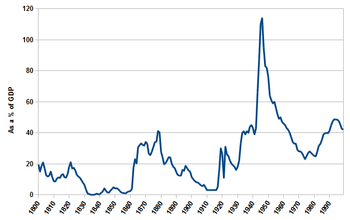
Policy Based on Data: Evolution of the debt to GDP ratio

Ratio of Federal Debt to GDP, United States
Source: Wikipedia

Look at the history of the ratio of federal debt to gross domestic product as it evolved over time. The debt increased rapidly during the Civil War, the First World War, the Second World War, and less rapidly during the current wars in Iraq and Afghanistan. In the post war periods of the first three wars mentioned, the ratio was reduced. While the ratio is high by historical precedents, it is not unprecedented.

Note that the United States did not beat the depression until World War II, when there was a huge stimulus effect of the spending on the war.

Ratio of Federal Debt to GDP, United States
Source: Wolfram Alpha
The second graph shows the same data for just the more recent decades. Note that the debt to GDP ratio increased during the Reagan and Bush 1 administrations and during the Bush 2 administration, being cut during the Carter and Clinton administrations, but growing again due to the stimulus packages in the last few years.
U.S. Federal Debt
Source: Wolfram Alpha
U.S. GDP
Source: Wolfram Alpha


While surely the United States should work to bring down the ratio over the coming decades, it does not seem to be at crisis level now. As the graphs above show, bringing down the ratio historically depended on the growth of the economy. While the federal debt has grown over the years, there were long periods where the economy grew faster than the debt, making that debt more manageable. 

Sunday, August 07, 2011

More on the debt limit debacle

The New York Times writes:
The day after Standard & Poor’s took the unprecedented step of stripping the United States government of its top credit rating, the ratings agency offered a full-throated defense of its decision, calling the bitter stand-off between President Obama and Congress over raising the debt ceiling a “debacle.” It warned that further downgrades may lie ahead.

In an unusual Saturday conference call with reporters, senior S.& P. officials insisted the ratings firm hadn’t overstepped its bounds by focusing on the political paralysis in Washington as much as fiscal policy in determining the new rating. “The debacle over the debt ceiling continued until almost the midnight hour,” said John B. Chambers, chairman of S.& P.’s sovereign ratings committee.
I am tempted to call for a plague on both their parties, since the Democrats and Republicans could not reach a compromise good for the nation, and squabbled for an unconscionable time before reaching the lame compromise that they eventually settled for.

On second thought, the Republicans were holding out against a more reasonable position held by President Obama, for a balanced approach to quickly achieve more progress on debt reduction. Failing to compromise away from a reasonable approach toward a less reasonable approach is not as reprehensible as failing to compromise by holding out for a worse alternative.

On third thought, there is blame enough for both parties, since many politicians were almost surely seeking the alternative that each thought best for his/her own political future and for the future of his/her own party rather than seeking the alternative that was best for the country.

Paul Bloom: The origins of pleasure


"Why do we like an original painting better than a forgery? Psychologist Paul Bloom argues that human beings are essentialists -- that our beliefs about the history of an object change how we experience it, not simply as an illusion, but as a deep feature of what pleasure (and pain) is."

The point of this talk is that we really perceive external stimulus based on what we believe to be its essential nature. It is not just that snobbish people pretend to like a wine better if they believe it expensive than cheap, but they actually do experience the taste differently according to the perceived origin, as confirmed by brain scans. We think with our brains, and not just our minds!


Too bad our politicians have so poorly learned the main lesson of the Civil War

We are commemorating the 150th anniversary of the Civil War this year. That war has been called the greatest lesson in American history of the cost of failing to find a political compromise. Among its costs were 620,000 military deaths out of a total population of 30 million. The war was due to a failure of political leaders to find a compromise, although in retrospect many compromises would have been better for all parties than was the war itself. The failure to compromise was probably due to a failure of those American politicians to accurately forecast the effects of their actions.

As I look at the failure of our politicians to find compromises that would clearly be better than their results over the past year, I recognize that they have failed to learn this important lesson from the Civil War. While they might still fail to accurately foresee the results of their actions (being unthoughtful, uninformed, and arrogant) they might still have sought to avoid such an obvious failure of out past.

It is especially sad that large numbers of our citizens, especially a large portion of Republicans, believe that members of Congress should not seek compromise, willingly subjecting the nation to unneeded hardship rather than sacrificing "principle" as they see it.

Jummy Carter was right too~


If you look at the history of oil price increases (noting the logarithmic scale of the graph y axis), you will be reminded of the price shocks during 1973 (before Jimmy Carter was elected president) and 1979 (while he was in office). They had a devastating impact on the U.S. economy, which was ameliorated by the decreases in oil prices during the Reagan administration and the high rates of inflation.

Look at this graph for the past five years in more detail:


It is a little noted fact that the oil price shock of 2007-2008 was a contributing factor, perhaps a trigger, to the economic crisis that became acute in 2008 (check this Brookings study). Also, notice that the price of oil has returned almost to the 2008 peak level, and that the run up in 2010 may well be related to the economic slowdown of 2011.

Jimmy Carter told us in the 1970s that we had to decrease our reliance on oil, especially imported foreign oil, and proposed a massive effort to develop alternative energy technologies. We should have listened and persevered in following those policies. Not only would we have more and better alternatives to oil technology now, we would have more oil!

Other presidents since Reagan have been right about our need to reduce our dependence on oil (with possible exceptions of the Bush Republican presidents whose family wealth depended on their oil businesses). Still, this is another area in which Obama has been right!

Rant: The Republicans have gotten us into a fine mess!

I quote from Saturday's Washington Post:
Standard & Poor’s announced Friday night that it has downgraded the U.S. credit rating for the first time, dealing a symbolic blow to the world’s economic superpower in what was a sharply worded critique of the American political system.

Lowering the nation’s rating to one notch below AAA, the credit rating company said “political brinkmanship” in the debate over the debt had made the U.S. government’s ability to manage its finances “less stable, less effective and less predictable.” It said the bipartisan agreement reached this week to find at least $2.1 trillion in budget savings “fell short” of what was necessary to tame the nation’s debt over time and predicted that leaders would not be likely to achieve more savings in the future.
Seemingly, the Republicans, especially those of the Tea Party persuasion, do not think that their actions in the Congress have repercussions. It turns out that President Obama was right and that it would have been better to increase the taxes on the very rich to levels typical of past periods of economic progress in order to get greater reductions in the debt. The Republican refusal to compromise on a comprehensive debt reduction policy has cost us the loss of the AAA credit rating. That may cost us a lot more, notably by making a stall of the U.S. economic recovery more likely.

Republicans should also take note of the fact that economies of European nations, Asian nations and the United States are connected. Those of Europe and Japan are also on shaky grounds, especially due to the debt problems of Greece, Ireland, Spain and Italy. Economic downturns in some of these countries will decrease their imports and thus the exports of other nations, decreasing demand for their products, leading to unemployment, and so it goes.....

U.S. Unemployment Rate
Source: The Washington Post

This is only one case where the Obama administration has gotten it right, and the Republicans got it wrong forcing economy damaging compromises.

It is clearly the case that the George W. Bush eight years of bad policies got us into problems that will take more than a few years to repair, even with good policies. That administration got us into two wars that drag on and on, resulting in huge financial costs as well as costs in human lives. The Bush administration also as a result of tax cuts and spending increases created the debt crisis.

  • The Obama administration was correct in perceiving that its first priority was to stimulate the economy, and that required further deficit spending. Incidentally, the need for deficit funding to stimulate the economy when there is a recession (or worse a depression) is why a balanced budget amendment to the constitution is a bad idea, not to mention the need for deficit funding in other situations, such as when the United States is forced to fight "a good war" such as that of World War II.
  • The Obama administration was right in trying to end the "temporary" Bush administration tax breaks for the very rich, but also right in compromising with the Republicans in agreeing to a temporary extension of those breaks last year as the price of a compromise needed to further stimulate the economy.
  • The Obama administration is correct in perceiving that we need to wind down the wars in Iraq and Afghanistan, reducing the drains on our economy and on our military readiness to deal with other, more serious security threats that might arise.
  • The Obama administration was correct in its attempt to reform our health care law, importantly to reduce the rate of increase of costs for medicare and medicaid, but also to extend health insurance to more of the American public.
  • Incidentally, the Obama administration has also been right in reversing the Bush administration policies on stem cell research and on the military "don't ask, don't tell" policy. It has done a real service in strengthening the scientific leadership in the government, and putting scientific accuracy above political expediency (again reversing the Bush administration policy in areas such as the scientific basis of climate change policies and other environmental policies).

Saturday, August 06, 2011

Global Map of Scientific Collaborations

From a huge database of scientific papers published between 2005 and 2009, Oliver Beauchesne drew links connecting the cities in which collaborating authors worked.  The brightness of the lines on the map depends on the number of collaborations between a pair of cities and the distance between them. The map shows Europe to be the hub of multi-city scientific collaboration - and also reveals some rising scientific centres, such as São Paulo in Brazil.


Making the links less bright where the distance between cities is greater may reduce the brightness showing collaborations among cities in the United States as compared to Europe, and may decrease the apparent importance of collaborations across oceans. Still the presentation is interesting. I recommend you go to the interactive site.

Gallup poll on global wellbeing

According to the poll:
Majorities of residents in 19 countries -- mostly in Europe and the Americas -- rated their lives well enough to be classified this way. Denmark, along with Sweden (69%) and Canada (69%), led the list, which is largely dominated by more developed and wealthier nations, as expected given the links between wellbeing and GDP. The U.S. falls somewhat near the middle of the pack, with 59% of Americans thriving.
Our politicians would have us believe that the United States is delivering more to its citizens than other nations. Tell that to the Scandinavians or the Canadians, who have better health care systems and a better social safety net. It has been suggested that the United States has more difficulties than Sweden or Denmark because we are a more diverse population: tell that to the Canadians! 

Different population problems

The issue of Science magazine dated July 29. 2011 has a long special section devoted to demographics and the understanding of world population. The graph above is from that section. I think the lesson is clear. Sub-Saharan Africa has a number of nations with very high population growth (and of course the correlated low levels of education, especially for women, short life expectancy, and high levels of poverty). These countries seem likely to need to work to reduce the rates of population growth. At the other extreme one finds Russia, with a need to deal with high death rates and low birth rates. Different countries have different population situations, and I suspect that their cultures will adapt toward population policies more responsive to the problems that their societies face.

Thinking about polling for White House policy

I was just listening to a panel of presidential pollsters. The panel was composed of the people who do political polling for the White House. I would note that there are a lot of other polls and pollsters that influence White House policy, such as those conducted by the Bureau of the Census, the Department of Commerce or the Department of Health and Human Services. I suspect that these latter polls are much more accurate and much more likely to lead toward policies that truly benefit the American public.

The political pollsters seemed only interested in what would get the president reelected (or the party he represents reelected in a second presidential term). If one is interested in that topic, one would poll the people likely to vote. If one were interested in learning the best policies for the White House to pursue for the benefit of the people, one would presumably sample the opinion of the wisest, most publicly spirited people in the nation, and one would presumably find ways of pulling out what they find most important to say rather than the questions that the pollsters or the White House thinks are most important.

The discussion was interesting in the fine points that were raised as to how questions should be phrased or what is of real importance (e.g. depth of feeling rather than opinion).

Quotation: Rajiv Shah on Development

The Administrator of the U.S. Agency for International Development (USAID) has written an editorial published in Science magazine. I quote:

THERE ARE MANY WAYS TO DESCRIBE THE GOAL OF INTERNATIONAL DEVELOPMENT, BUT ONE IS TO think of it as changing a situation in which billions of people have access to the benefits of  science and technology while billions do not. Throughout history, some of the greatest successes in development have come from extending the reach of scientific and technological breakthroughs to those who lacked access. We must continue to harness the ingenuity of the world’s top researchers and scientific leaders to achieve development goals.
I think that an important aspect of development is to increase the numbers of people in the world who benefit from modern medicine, highly productive agriculture, access to information through modern media, housing built to modern technical standards, ability to get around provided by modern transportation technology, etc.

On the other hand, I think are important aspects of development that not specifically related to science and technology such as living in a society that respects human rights, having the ability to express oneself and to have influence on one's government, and enjoying the heritage of one's artistic culture.

Friday, August 05, 2011

China seems to be deeply involved in hacking, perhaps to the level of cyber war

"Enter the Cyber Dragon" by Michael Joseph Gross, published in the September 2011 issue of Vanity Fair, tells a story of years of hacking from China that has penetrated U.S. and foreign government computers, the computers of defense contractors, and many large and important firms. The article convinces me that combating such cyber crime should be a major role for government, and that the United States and NATO nations must do a lot more to prepare for cyber attacks and indeed to prepare for cyberspace to be a field of combat in future wars.

(Thanks to Julianne for alerting me to this article.)

Thursday, August 04, 2011

Who Are The Tea Party Supporters


CBS News and the New York Times surveyed 1,580 adults, including 881 self-identified Tea Party supporters, to get a snapshot of the Tea Party movement. The Tea Party supporters were most white, southern, and over 45 years of age. More than a third were college graduates. As you would expect, most saw themselves as conservatives.
They also have a higher-than-average household income, with 56 percent making more than $50,000 per year.
This last point merits some thought. People older than 45 should be at their peak earning power, and white college graduates of that age should be fairly well paid. Moreover, this is household income, which would often include two earners. According to Wikipedia, $50,000 per year would be in the middle quintile of American family incomes.

Thus these Tea Party members are pushing their representatives to cut their social security and medicare benefits rather than increase taxes for people who are much, much richer than they are themselves. It is hard to see why they are supporting the legislators who are so likely to hurt their interests.

Of the 1%, by the 1%, for the 1%

There is an article in Vanity Fair by Nobel Economics Prize laureate Joseph Stiglitz that all Americans should read. I quote:
The upper 1 percent of Americans are now taking in nearly a quarter of the nation’s income every year. In terms of wealth rather than income, the top 1 percent control 40 percent. Their lot in life has improved considerably. Twenty-five years ago, the corresponding figures were 12 percent and 33 percent...........While the top 1 percent have seen their incomes rise 18 percent over the past decade, those in the middle have actually seen their incomes fall. For men with only high-school degrees, the decline has been precipitous—12 percent in the last quarter-century alone. All the growth in recent decades—and more—has gone to those at the top. In terms of income equality, America lags behind any country in the old, ossified Europe that President George W. Bush used to deride.
 And:
The more divided a society becomes in terms of wealth, the more reluctant the wealthy become to spend money on common needs. The rich don’t need to rely on government for parks or education or medical care or personal security—they can buy all these things for themselves. In the process, they become more distant from ordinary people, losing whatever empathy they may once have had. They also worry about strong government—one that could use its powers to adjust the balance, take some of their wealth, and invest it for the common good. The top 1 percent may complain about the kind of government we have in America, but in truth they like it just fine: too gridlocked to re-distribute, too divided to do anything but lower taxes.
From what little I know of history, it seems to me that such inequality and the disregard of the rich and powerful for the poor and middle class leads to very bad results. It is one of the differences between colonial Latin America and colonial North America that led to the greater economic growth and I believe more just societies in Canada and the United States as compared with those of Latin America today. It is one of the things that led to a history of war and revolt in Europe's past.

And it is getting worse, as the rich grab more power, to increase their domination of the economy still more! We the people have the potential political power to take back the political processes in this country and restore opportunity to the society, but I don't see it happening. We seem willing to make the plutocrats a gift of still more money and power!

The Bamboo Horse


The Boo Bamboo Bicycle

Wednesday, August 03, 2011

Milestone

I have just contributed my 20,000th post to Zunia, the development portal. I have been adding posts to Zunia for a decade. Zunia is a service provided by the Development Gateway Foundation.

I hope that you will consider using Zunia. I find it most useful as a source of awareness of what is happening in developing nations. You can focus on a specific sector and/or join groups with specific interests. There are more than 50,000 members and you can search for members by interests and geographic location. You can also search the archives of some 100,000 contributions that have been made, using either tags or a search engine. All and all, a useful site for those interested in international development.

Technologies that will change our lives

A recent article cites ten trends that Cisco' Chief Futurist and Chief Technologies believes will change our lives. Among them are:

  1. The Internet of Things:  "the number of Internet-connected things will reach 50 billion by 2020"
  2. Zettaflood: This year  we are creating 1.2 zettabytes of digital content, with one zettabyte equal to 1,024 exabytes.
  3. The Cloud will engulf us: "By 2020, one-third of all data will live in or pass through the cloud, Cisco predicts. Global cloud services revenue will jump 20 percent per year, and IT spending on innovation and cloud computing could top $1 trillion by 2014."
  4. The Interplanetary Network: "Over the next 10 years, Evans expects the speed to his home to increase by 3 million times."
  5. "Virtual humans, both physical (robots) and online avatars will be added to the workforce."
This postulates a world I can barely imagine. On the other hand, the Internet is a world I could barely imagine a few decades ago!

Ajiro - Naturally grown urban personal mobility


This person-powered vehicle is actually built on a bamboo frame that is formed by letting the bamboo grow in a jig that requires it to take the shape shown! It was a finalist for the Australian Design Award -- James Dyson Award. How cool is that!

Rubin on the Economy

Robert Rubin, the Secretary of the Treasury in the Clinton administration, was on the Charlie Rose show yesterday. He suggested that he would prefer to defer efforts to reduce the federal debt for a couple of years, feeling that stimulus was still needed to strengthen the economy and drive down unemployment.

He makes the very good point that we must focus as a nation on our long term economic growth, and that government production of public goods such as education, fundamental science, and infrastructure are critical to that growth. He also stressed, as would I, that government has a critical role in providing a social safety net for its citizens. (Incidentally, I would also stress that government plays a key role in counter-cyclical activity which helps to retain and rebuild the productive economy in periods of recession.)

Rubin further suggests that our government leaders should figure out how much money the government needs to carry out these roles in society, and then it should set revenues from taxes accordingly. If the government needs one-quarter of GDP to fulfill its obligations, then it makes no sense to try to collect one-fifth of GDP in taxes and borrow the rest as a long term plan. Makes sense to me.

Incidentally, he reads the experience of the Clinton administration and his term leading the Treasury department as strongly supporting the position that control of the government debt, especially holding the debt to GDP ratio at a suitably low level, is critical for business, consumer and investor confidence in the economy and thus an important factor in the promotion of economic growth. Thus he is strongly in favor of efforts to reduce the debt to GDP ratio over the next ten to twelve years, putting a strong plan in place now, but also beginning that period with another dose of stimulus to get the economy moving.

Seems reasonable to me!

Thinking about the distribution of income and foreign policy

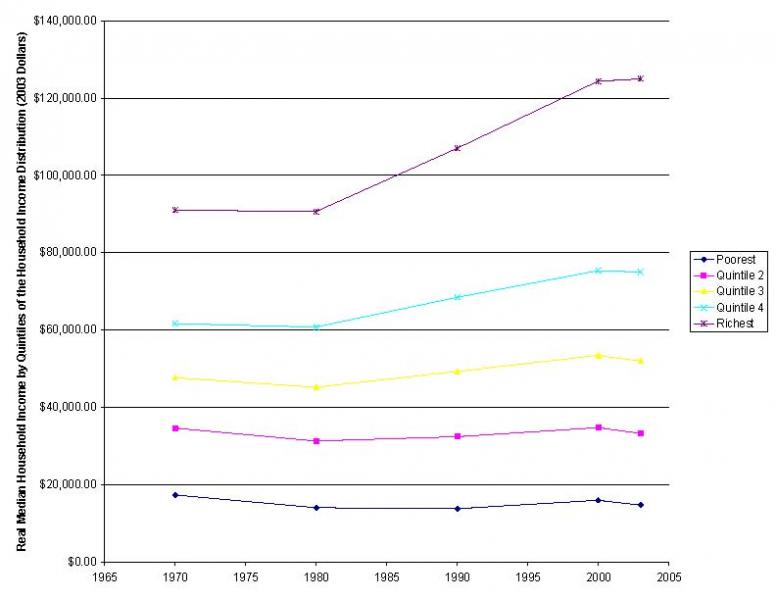
Real Median Household Income by 
Quintiles of the Household Income Distribution
Source: Russell Sage Foundation
Growth of average per capita income seems actually harmful when it occurs in the pattern shown above, where the poor don't benefit at all, and indeed even get poorer for long periods of time, while the rich get much richer. Societies with gross inequalities in income have all sorts of problems that those with more equitable distributions don't suffer from.

On the other hand, economic growth that "lifts all ships" at least equally, and preferably that promotes convergence in incomes seems to me to be very desirable. Why would one begrudge the wealthy even more wealth if the poor are living better lives and the income inequality is not worsening? That would be the growth with pro-poor policies that is the goal of international development programs.

Economic Production, Equity and Power

The soft power of the United States in international relations depends on GDP, and I believe on the equity of distribution of income. If the United States is seen as a country giving opportunity to all, fostering a better life for rich and poor alike, it is more likely to win friends and allies abroad.

Of course, the hard power of the United States also depends on our productive capacity. In World Wars I and II, the ability of the United States to produce the goods needed by our allies was critical to victory. In more recent wars, the quantity and quality of weapons produced by the United States was of great advantage. Note, however, that that hard power has not been sufficient to win the hearts and minds of many of the people of Viet Nam nor Afghanistan.

So where does the security of the United States reside? Surely in both soft power and hard power, and I wonder whether the expenditures on the wars in Iraq and Afghanistan have indeed increased our security. Surely not only have many more innocent people been killed in those wars than Americans would have been killed by terrorists had we not invaded those countries, and indeed more Americans may well have been killed in those wars than would have died from terrorist attacks had we not gone to war.

Tuesday, August 02, 2011

Rant! Who were the winners and losers in the debt limit debate?

The big winners were the rich who will again be able to avoid paying their fair share of the costs of government.

The most immediate losers have been the people who have their retirement savings invested in the stock market, which tanked today after big losses last week. Losers will also be the American public who will have to pay more for the money our government borrows, first because the debate weakened confidence in the full faith and credit of the United States Government, and because it drew attention to the public debt without doing much to slow its growth, and ultimately because the new law will result in increases of the public debt that will be faster and greater than necessary.

The new law, in my opinion, will not provide the flexibility that the government needs to stimulate the economy, practically guaranteeing a second dip recession. Thus the tax income to the government will go down while entitlements will go up. Then the law does not increase Government revenues nor does it go very far to reduce the deficit, so the debt will go up due to this factor also. Since the economy will not be simulated, there will be more people out of work, and they will be big losers. So too will be the businesses that see their profits go down due to the recession, and the owners and stockholders in those businesses.

Of course those who depend on the government safety net will also be losers as the Republicans have succeeded in their demands to cut entitlements.

When the United States sneezes, poor countries come down with pneumonia. The U.S. recession will trigger cuts in demand for imports from poor countries, cuts in foreign direct investment in those countries, and cuts in foreign assistance. Some of the poorest people in the world, people trying to get by on less than a dollar a day, will suffer from this law. The U.S. also uses its soft power to achieve many foreign policy objectives, including the promotion of democracy abroad and the promotion of peace. This law will weaken that soft power, and we will all be losers from that effect.

The talking heads on television have been concerned with the winners and losers among politicians. Those people are all affluent, and even those who lose future elections will be in no financial need. I can't spare any concern for them.

Monday, August 01, 2011

This is very surprising, but also reassureing

Source: The Economist
The population of Indonesia is 246 million, so the graph above suggests that the middle class (defined as $3,000 annual household income) is some three-fifths of the total. I studied Indonesia in the early 1970s when the population was much smaller and the economy much poorer. In spite of all sorts of problems in the interim, Indonesia has had considerable economic success. The Economist attributes that success primarily to the development of natural resources for export markets. I can only hope that Indonesia takes advantage of the large middle class to develop its political and economic systems and to improve the quality of life for all.

East Africa's Hunger and Famine

Source: The Economist
I quote from The Economist:
FOR the first time since the 1980s, the UN has declared a famine in Africa. An exceptionally severe drought is the main cause. More than 10m people are directly affected. The epicentre is in Somalia and Ethiopia—as aid agencies have made abundantly clear in their funding appeals—but the situation in neighbouring Eritrea is almost as desperate and politically much more complicated.
The map doesn't show hunger in South Sudan nor Uganda, but it must be feared that such hunger exists and should be dealt with. This should be a priority, even as development funding is likely to be cut back in the austerity budgets of the OECD nations.

Some thoughts about classes of knowledge

One of the definitions of technology is the organized body of knowledge underlying the ways we make things and do practical, productive things. Whether or not you like that definition, I want to think about that body of useful knowledge.

Source
There is also a body of fundamental knowledge about nature, man and society, prototypically scientific knowledge. We normally think of pure science as not useful, not technological. However, I would suggest that the two bodies of knowledge are not mutually exclusive. For example, human anatomy is both fundamental knowledge and, when in the hands of a surgeon, knowledge applied in making effective medical interventions. Human anatomy, although applied by artists and sculptors to make their products more lifelike, could not be applied widely and effectively for surgery until there were developments of anesthesia and antisepsis.

I think this situation in which knowledge exists which can not be applied applied without the development of complementary knowledge may be fairly common. Think for example of the development of electricity, where people had to discover how to generate electricity relatively efficiently from mechanical energy produced by steam engines, how to transmit it relatively efficiently, and how to transform electrical energy into something really useful (electric light) before commercial electrical systems became feasible. So too, they had to learn how to transform electrical energy efficiently back into mechanical energy before it could be applied to locomotion (trolleys, electric locomotives) or to power machines (made possible by knowledge accumulated in the industrial revolution).

Incidentally, there are many situations where technological knowledge exists and is used without much understanding of the fundamental phenomena that underlie its utility. Acupuncture works, but with due apologies to its practitioners, I doubt that we understand why. Great swords were made for centuries, by sword makers who understood very little metallurgy. Gothic cathedrals were built in the middle ages by masons who had very little understanding of the physics of mechanical forces.

There is considerable interest now in translational knowledge, that which must exist or be developed before fundamental knowledge can be applied in the form of practical technological knowledge. We know that stem cells have the potential to be used therapeutically in applications such as spinal cord repair, but we don’t have the knowledge of how to actually to do that. I suppose that, in the campaign to eradicate smallpox, while the vaccine was available for a long time, translational knowledge had to be developed as how to apply the vaccine efficiently, how to deliver it in usable form in the difficult conditions of poor tropical countries, and especially how to run an eradication campaign effectively in difficult conditions.

Potentially useful knowledge that can not be used, may well be lost. Think of Mendel’s knowledge of genetics that could not be used well until the evolutionary synthesis, which lay buried in old journals until it was rediscovered many decades later. Think of the knowledge that Babbage and Lady Lovelace created that was buried until the development of electronic computers made it viable for productive purposes. Penicillin was discovered decades before Fleming rediscovered it, but could not be utilized until experts in commercial fermentation discovered a commercially feasible way to produce the antibiotic.

Sometimes the limitations on the utility of potentially practical knowledge are social and/economic. World War II provided the conditions that made it necessary and possible to develop penicillin, radar, computers and other technological knowledge. Gutenberg found conditions suitable for the development and dissemination of printing technology; earlier printing was developed for the production of amulets containing verses from the Koran, but the conditions for the further development and dissemination of the technology did not exist and the knowledge was lost.
Source: Martin Roell

We know that there is an important difference between technological innovation and technological invention. The first is economically important, and usually the result of first utilization of an existing technology in a new situation; technological innovation involves more fundamental novelty such as that needed to justify a patent granting monopolistic use of the knowledge. The point I would make is that the productive application of existing knowledge in a new situation in a developing nation may be limited not only by the lack of a supporting social and/or economic matrix, but also be the lack of the requisite complementary knowledge in the community of interest. Indeed, once useful knowledge that existed in the past in now rich countries, that has been lost, might still be used productively in poor countries were the propitious social and economic conditions now exist.

The development of the appropriate knowledge systems, and the dissemination of the appropriate complementary and fundamental knowledge for the application of innovative technological knowledge in poor nations may be more difficult and more important than is generally recognized in the development community.