There is a nice interactive chart from Pew Research Center showing the portion of U.S. adults who have various personal ICT devices.
Monday, May 12, 2014
The Penetration of ICT Devices in the U.S. Population
There is a nice interactive chart from Pew Research Center showing the portion of U.S. adults who have various personal ICT devices.
Labels:
ICT
Sunday, May 11, 2014
On the promise of genetic engineering to improve rice varieties.
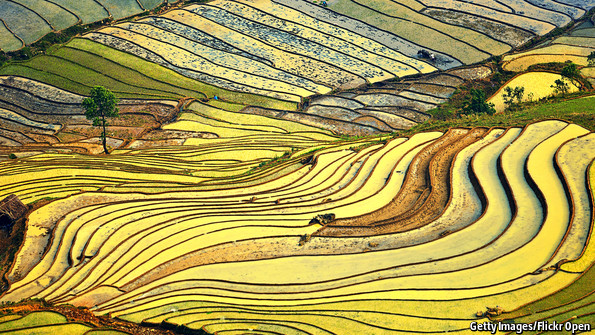
Five years after the first field trials, 5m farmers across the world are planting more than a dozen varieties of rice with flood-resistant genes, collectively called “Sub 1”. They are proliferating even faster than new rice varieties during the heady early days of the first green revolution in the 1960s.
The Economist
The current issue of The Economist has a very good article on the use of genetic engineering in the effort to meet the growing demand for food. Here are some quotes from the article:
- As a rule of thumb, if the world’s population grows by 1 billion, an extra 100m tonnes of rice is required to feed them. Given current world-population forecasts, total rice consumption, now under 450m tonnes, is likely to grow to 500m tonnes a year by 2020 and to 555m by 2035—an increase of 1.2-1.5% a year. That would be manageable if rice yields were also growing at that rate. But they are not. They are rising at barely half that pace.
- Now the gains seem to have levelled off. Plant breeders fear that, with current technology, ten tonnes a hectare for rice in intensive-farming systems may be the limit, though it is not clear why. What is clear is that, out in the fields, output per hectare is stalling, and in some places falling.
- Without new seeds, yields will decline further. Global warming will tend to push harvests down: higher night-time temperatures are associated with lower yields. The richest rice-growing areas in the world are the deltas of Asia’s great rivers, such as the Mekong, Brahmaputra and Irawaddy; they are vulnerable to rising sea levels and increased salinity, which kills rice. The plant uses two to three times as much water as other cereals ........but water is scarce everywhere.
- (To meet the demand for more rice) researchers will tailor seeds (utilizing genetic engineering) for particular environments (dry, flooded, salty and so on). And they are also trying to boost the nutritional quality of rice, not just the number of calories.
- Drought- and flood-tolerant seeds could double yields from these areas (where rain fed rice is grown). That would boost harvests from 110m tonnes to 220m, and push global output to 550m tonnes—enough to meet expected demand in 2035. In short, all the extra rice could come from rain-fed areas alone.
- The original green revolution transformed Asia from a continent stalked by hunger into one that could think and plan beyond the next harvest. It helped lay the foundation for the continent’s economic miracle and made possible Asia’s demographic transition from high fertility and high mortality to smaller, richer families. The second green revolution will not do that. But it should complete the first one, mainly by bringing benefits to the poorest, who missed out first time round. It will help mechanise and move more people off farms and into more productive labour. And it should prevent Asia slipping back under the shadow of hunger and all the political and social disruptions that such misery causes. Few other things can promise as much.
Labels:
Hunger,
science,
Science Policy
I too believe GM foods are safe
I quote from an article in The Economist:
Repeated studies have found no threat to human health from GM ingredients, which are found in up to four-fifths of processed food in American shops; nor have any ill effects appeared during the 20 years in which Americans have been eating the stuff.I am allergic to peas, lentils and faba beans. These are all foods that are widely considered to be safe. In fact a lot of people are allergic to one or another of these foods. Favism, a specific form of allergy to faba beans, can be quite serious. Symptoms include dizziness, headache, vomiting, fever, jaundice, eosinophilia, and often diarrhea.
Large numbers of people are allergic to one food or another, and each year millions of Americans have allergic reactions to foods. Eight foods account for 90% of allergies: Peaanuts. Tree nuts, Milk, Eggs, Wheat, Soy, Fish and Shellfish. 150 to 200 people die per year in the United States from allergic reactions, most as a result of peanut allergy.
A food that had been genetically modified to produce a protein with this kind of allergenic action would not be approved, and if somehow it slipped through the rigorous testing and review process it would no doubt be quickly removed from use when allergic reactions first appeared.
Remember, all the domesticated food we eat differs from its wild ancestors because of generations of selection. For the vast majority of vegetables, varieties have been crossed again and again, sometimes with wild related species. In each cross, there will be half of the genes from one ancestor and half from the other -- thousands of genes entering into the genome of the new variety as compared with either of its parent varieties.
Of course, our ancestors who domesticated and improved the crops tried to avoid varieties that made people sick, but they did not understand genetics until the last century, and did not have the technology to be selective in their plant breeding.
In modern genetic engineering of plants, typically breeders will isolate a single gene that produces a desired property in a crop, and will introduce that gene into a widely used variety. If it works as planned, the resultant cultivar is then carefully tested and subjected to regulatory review.
The reason that breeders are increasingly using this technique is that it is so much faster than making wholesale genetic changes by cross breeding, and then doing generation after generation of breeding to weed out the undesired traits that arrive in the plants with the desired new trait.
Labels:
science,
Science Policy
Bad news on communicable diseases.
The current issue of The Economist has news on two communicable diseases this week.
Polio
Pakistan so far this year reported 59 cases of polio versus 6 in the same period last year. The government has made a major effort to immunize children in the district most at risk this year. Worldwide, WHO reported 74 cases so far this year, in eight countries.
Chikungunya fever
This disease, which is spread by Aedes Aegypti mosquitoes and is common in Africa and Asia, has now come to the Caribbean and the Texas-Mexico border. It is similar to dengue fever, which is also spread by the same mosquito -- perhaps even more painful and longer lasting, but less lethal.
There was once an Aedes Aegypti eradication program in the Americas, and the mosquito was eliminated from 18 countries but not from the United States and several other countries. The regional program was ended at the suggestion of David Sencer, the Director of the U.S. Center for Disease Control. The mosquito then spread back through the Americans re-populating most of the countries from which it had been eradicated.
Labels:
Health
A thought about expertise and government in modern society
The scientific and technological revolutions of the past couple of centuries has made expertise more and more useful and necessary.
There is an average of 87,000 airplane flights per day in the USA. A third of these are airline flights, most of huge planes with many passengers. Yet there are few crashes and very few deaths per mile traveled. In part this is due to the huge effort made over decades to make the aircraft themselves safe. In part it is due to the air traffic control system with its radars, computers, and highly skilled people. The safety is the result of expertise of the designers, builders and operators of the planes and air traffic control system.
The electrical grid of the USA and the generating capacity based on fossil fuel, hydro and nuclear as well as renewable generation plants obviously has required expertise of the highest order.
Walmart with more than 11000 stores and 2 million employees obviously requires expertise in marketing, logistics, purchasing, and other management functions. So too all the successful large multinational corporations require expertise in their management.
The modern U.S. military in battle involves coordination among ground, air and naval forces. Vehicles all carry computers, and there is a complex system providing remote sensing data on the battlefield. Weaponry is highly complex. Again, experts have been involved in creating and operating the systems involved as well as in there various components.
Today your doctor is obviously a certified expert. He/she is supported by an amazing array of complex imaging equipment and radiologists to interpret the images. So too, the doctor is supported by a complex laboratory capable of rapid analysis of many different kinds of samples. The doctor has at his/her disposal thousands of pharmaceuticals of demonstrated effectiveness and safety. There are surgical suits with complex equipment and highly trained experts working as teams to provide curative interventions. Again, the health care system is a highly complex one, built on an amazing variety of expert services, including expert management of hospitals, medical schools, etc.
I could go on and write about many other systems today that demand expertise -- the management of financial institutions, telecommunications, weather forecasting, scientific research, farming, mining, forestry, higher education, and on and on. Modern society differs radically from that of the founding fathers, or indeed that of Abraham Lincoln in that its technological systems are far more elaborate and far more dependent on expertise. This is true too of its institutions, such as its financial markets or police and courts.
The people in government (legislators, executive branch policy officials) who make the laws governing all these (and other) expert systems are not experts in the technology that they oversee. Indeed, they are politicians. Their own field has areas of expertise as politicians -- fund raising, polling, public speaking, managing campaigns. They also have expertise in the art of legislation and the management of bureaucratic organization. Without these forms of expertise they can not obtain and hold office, nor fulfill the duties of the offices they hold.
People are limited. Why would one expect someone who is a good enough politicians to get elected to Congress, and a good enough legislator to exercise influence in the Congress, also to be expert on foreign policy, or medicine, or telecommunications, or ........
Another difference of today's society from that of the founding fathers is geographic scale. Of course in 1775 there was trade between the British colonies and Great Britain, but nothing like the global trade of today. Finance flows globally today, as does communications. We have satellite remote sensing that provides data to our computers that synthesize global images of the environment. There is medical tourism, movies and television programs that go international, airlines fly around the world...... The technological systems are not only vastly more complex and demanding of expertise, but also more global. Yet the governance not only fails to have the expertise in the technology, but it is limited by the geographical imagination of people 200 years ago.
Labels:
government,
Technology
Friday, May 09, 2014
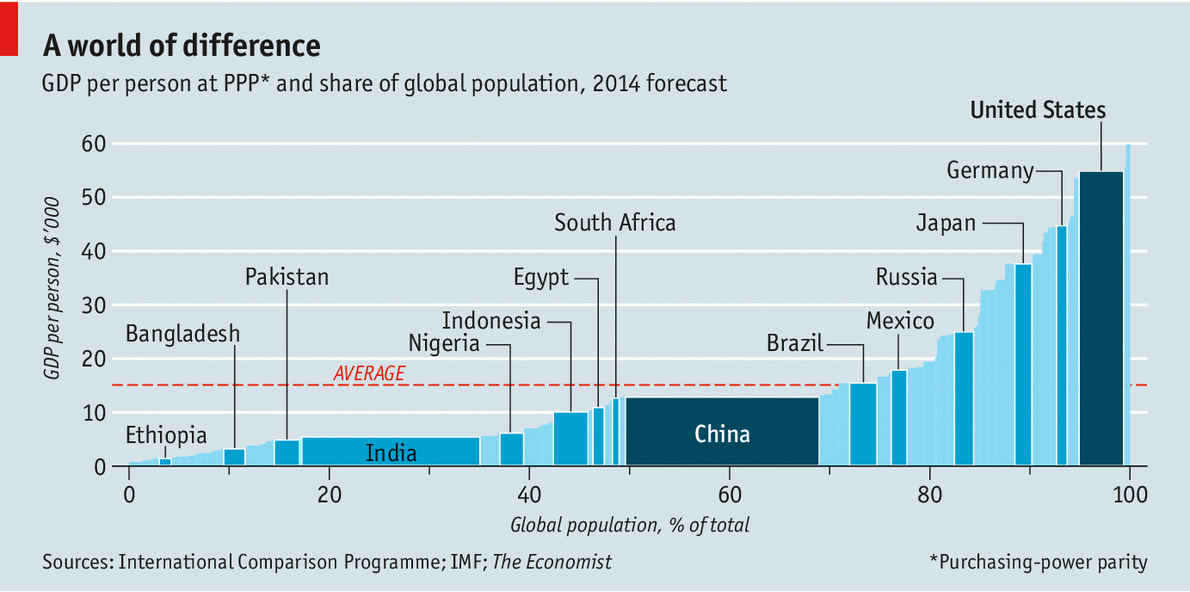
Interesting graphic on production of goods and services by country.
| Source: The Economist |
As it is easy to see, the countries are ordered on the graph by increasing per capita GDP. These estimates made by a World Bank project indicated that the United States produces more goods and services than any other country, followed by China, India, Japan, Germany and Russia in that order. Thus India with a fairly low GDP per capita but a very large population is estimated to produce more than Russia with a much higher GDP per capita but a middle size population.
I suspect that the Russian forecast may be reduced as a result of the sanctions and capital flight in recent weeks.
Labels:
Economics
Wednesday, May 07, 2014
Did you know about the Information Revolution in the first half of the 19th century?
| Relating to the second half of the talk, on industrialization -- the sewing machine |
There is an interesting video of a talk by Merritt Row Smith on the Industrial Revolution in America. I want to focus on only the first part in which he spoke of the Information Revolution that took place here between the mid 1820s and the 1840s. He identified three major innovations that took place in that time frame:
- First was a reorganization of the postal service'
- Second was the introduction of rotary presses powered by steam engines that could print up to 500 pages a minute on both sides, at a much lower cost than the earlier hand operated printers; and
- Third there was the telegraph.
I recall that the United States at the time was a protestant country, and assume that many people who had learned to read to be able to read the bible, were also ready to read other things. I also assume that one of the key results was that newspapers were more widely available and affordable. I recall reading that newspapers were exchanged by post, and the news from a paper in one town might be soon printed by a paper in another town that had received the first town's paper.
Smith points out that this was a period in which large numbers of pamphlets were published and distributed, Thus the abolitionist groups published pamphlets and distributed them not only in the north, but also into the south. The success of those efforts led to other groups to print temperance and women's suffrage pamphlets. Thus ideas for reform circulated more widely than they might have earlier in our history.
The first telegraphy line in the USA was financed by the U.S. government, and ran from Baltimore to Washington, D.C. (I wonder if the purpose was to speed news between the Congress and the port of Baltimore, which was a major port in the USA at the time, with trade with the north and south as well as with Europe. A race was run when the line was completed, with a horse and rider and a train competing with the telegraph to get a message (on the nomination of Polk for President) from Baltimore to Washington. Of course, the telegraphy won handily, and there was little more difficulty in finding private finance to string telegraph lines across the country.
The first half of the 19th century also saw the development of water transportation in the United States, including the Erie Canal and other canals. The road system was extended and improved, And, of course, with the introduction of the railroads, the improved transportation system would have greatly facilitated the functions of the postal service, and presumably the shipment of paper stock and published materials.
The world changed. More information moved across the land, and moved faster and more efficiently than ever before.
A thought on decision making
Gary Becker, the Nobel Prize winning economist died recently. In a tribute in the magazine Business Insider, this remark of his was quoted:
Behavior is driven by a much richer set of values and preferences. The analysis assumes that individuals maximize welfare as they conceive it, whether they be selfish, altruistic, loyal, spiteful, or masochistic. Their behavior is forward-looking, and it is also consistent over time. In particular, they try as best they can to anticipate the uncertain consequences of their actions.I like the recognition that people make decisions not only on the basis of selfishness and economic gain. I like even more the recognition by Daniel Kahneman, another Nobel Prize winner, that people make choices by different psychological processes at different times.
One possibility is that people seek to make decisions that satisfy a number of different conditions simultaneously. In general there will be many alternatives that will simultaneously satisfy a number of different conditions. Operations researchers sometimes will choose one objective to maximize subject to satisfying the others; I suspect most of us in everyday life are happy to find a solution that is "good enough" when compared to a subset of the most important conditions that occur to us as we make the decision.
I like the use of the term "forward-looking" since it recognizes as a fact that most of us are not very good at forecasting or prediction.
I also like the recognition that people try to "anticipate the uncertain consequences of their actions". I would note that there are a couple of different ways. For example, you might seek to anticipate the possibility that your car will break down if you take a long trip. It is more difficult to guess what the cost of such a breakdown might be.
Think about people betting at a (U.S.) race track. In a single race there will be people making pari mutual bets on all the horses. Consider for a second only bets to win. One way to understand the situation is to assume that each punter estimates the probability of each horse winning and the probable pay off if the horse wins; the punter may bet the horse with the best expected return, or may choose not to bet. Of course, the people placing bets at a race track have different amounts of information and different expertise in making bets, but even racing experts with comparable information will come out with different expected results for the horses in a specific race. As they say, that is what makes a horse race.
What that analysis doesn't include is that people like watching horses race, and most people get more enjoyment if they have a bet on the race. So there is an entertainment value in participating quite separate from the expected winnings from a bet. So too, if one is at the races with friends, there is a value in the joint activity of betting the race.
In these circumstances, few if any of us will quantify probabilities and expected returns (or costs). For some, the circumstances will be pathological.
I have tended to think that simulation models exploring the effects of different assumptions of the determinants of human behavior and of their frequency would be a good way to understand "financial" decision making.
Labels:
decision making
Monday, May 05, 2014
Thoughts on reading Russian in Search of Itself.
I just finished reading Russia in Search of Itself by James H. Billington. Published in 2004, the book summarizes the outpouring of ideas from Russians about the nature of the Russian Federation and the Russian people after the break up of the USSR in 1991.
I posted some thoughts on the book last week.
The book strikes me as a genre of its own, seeking to categorize contemporary writings on the nature of a political system and of a society. Billington, who is a distinguished scholar of Russian history, has read a great deal of the relevant material published during the dozen years he covers, and has had the opportunity to discuss issues with both young people and older Russians whose thinking has already influenced many of their countrymen. Still, I found the work unsatisfying.
It occurs to me that were someone to summarize views on U.S. governance and U.S. society from libertarians, tea party members, moderate Republicans, moderate Democrats, Progressives, KKK members. black nationalists, leaders of La Raza and militia leaders you would be more confused than enlightened. Add to those readings the ideas of leaders of various religions (Roman Catholics, Born-Again Protestants, Mormons, Buddhists, Black Muslims, Snake Handling Protestant Ministers, those who believe the end of the world is at hand, Jews, Sunni Muslims, Shiite Muslims, Baha'i, athaists, agnostics, etc.) and the situation would not be clarified. Then consider the views of CEOs of large and small businesses in various industries, union leaders, directors of charitable foundations, leaders of the environmental movement, PETA, university presidents, and others, the result would be a cacophony. One might conclude that in the United States there was a wide diversity of opinion on the identity of the country and the identity of the American people, but little more.
I infer that Billington may feel that if and when Russians decide on their identity as a people, that will lead them to a decision on the identity of the state. Somehow by acknowledging the crimes committed by past rulers on their own people, building upon the Orthodox church that has been central to Russian life for 1000 years, integrating that with the strength of family and local community that characterized the majority of Russians, building on the Silver Age of Russian culture early in the 20th century, and selectively adopting innovations from western culture such as more democratic processes and more efficient economic institutions, by integrating them all, they will build a state. That state will evolve a new path with respect to dealing with its own citizens and with both the west and Asia.
It seems to me that the policies of this country come out of processes of government, politics and the media that form public opinion, rather than respond to it. Moreover, I think that views of the nature of the country and its society can change dramatically in only a few years. Thus I wonder if the author's quest to understand the process by which Russians are seeking to build new identities will really lead to an understanding of the way the Russian Federation will interact with the world. Perhaps, as has happened in the Tsarist empire and the Soviet empire, autocratic leaders will take dramatic actions, and foreign powers will act on Russia, and the identity of the state and of the people at that time will adjust to what it must.
When Billington wrote this book, Russia was just turning the corner economically from an economic crisis to what would become a decade of rapid economic growth. Would he have predicted that the economic picture would be much less attractive in 2014 than it was in 2004? Would he have predicted that President Putin in a new term of office would be leading a government that acts as it is acting now?
We have just seen a revision of estimates of the gross domestic product of countries, which has raised India to third in the world (following the USA and China) and demoted Russia to sixth (following Japan and Germany). So too, we are seeing Russia having fought a war in 2008 which formalized the speparation of South Ossetia and Abkhazia from Georgia, and having this year taken Crimea from Ukraine, is currently implicated in the crisis in eastern and southern Ukraine. How will Russia respond. I don't begin to guess.
I do guess that I understand a little more about post Soviet Russian society than I would have had I not read this book. That is not a little thing.
Labels:
foreign policy
Saturday, May 03, 2014
UNESCO is most importantly an idea.
UNESCO is, in terms of its charter, tiny. The decentralized agency of the United Nations system responsible for education, science, culture and communication has a budget less than that of my local school district and has come down in size over the last couple of years from under 2,000 people. Yet
- it is to promote education at all levels globally;
- it is the lead agency in the UN system for earth and water sciences, as well the study of biodiversity, and the basic sciences;
- it has programs in social science and ethics, not to mention sports.
- it promotes museums, seeks to reduce the international trade in stolen cultural artifacts, and to encourage the protection of tangible and intangible cultural heritage;
- it manages its flagship program certifying cites as worthy of World Heritage status;
- it encourages theater, literature, and music;
- it seeks to promote freedom of expression and protect journalists; and
- it seeks to promote the dissemination and utilization of communications media, including the Internet.
The United States is part of the reason that the resources are so small compared with the breadth of UNESCO's mission. When the Organization was conceived by the allied ministers of education during World War II, they hoped for an organization that might finance the rebuilding of the educational infrastructure of Europe after the war. The United States, which alone was left with its industrial might untouched by the war, preferred to control aid to Europe directly using the Marshall Plan and through the Bank for Reconstruction and Development (which became the core of the World Bank family of organizations, and the model for other multinational development banks). Then, the United States (and the United Kingdom) withdrew from UNESCO in 1984 taking its contributions with it, and did not rejoin the Organization until 2003. Then, in 2011 the USA (then responsible for 22 percent of the UNESCO regular budget) stopped funding UNESCO entirely; it has at this date neither resigned from the organization nor resumed funding for it.
The Constitution of UNESCO states in its preamble, "(t)hat since wars begin in the minds of men, it is in the minds of men that the defences of peace must be constructed." It goes on to state:
That a peace based exclusively upon the political and economic arrangements of governments would not be a peace which could secure the unanimous, lasting and sincere support of the peoples of the world, and that the peace must therefore be founded, if it is not to fail, upon the intellectual and moral solidarity of mankind.
For these reasons, the States Parties to this Constitution, believing in full and equal opportunities for education for all, in the unrestricted pursuit of objective truth, and in the free exchange of ideas and knowledge, are agreed and determined to develop and to increase the means of communication between their peoples and to employ these means for the purposes of mutual understanding and a truer and more perfect knowledge of each other’s lives;
In consequence whereof they do hereby create the United Nations Educational, Scientific and Cultural Organization for the purpose of advancing, through the educational and scientific and cultural relations of the peoples of the world, the objectives of international peace and of the common welfare of mankind for which the United Nations Organization was established and which its Charter proclaims.The importance of UNESCO lies not so much in the actions of a couple of thousand people working in its offices as in the large number of people and organizations that have joined around it in support of that mission.
Perhaps its role in the Education for All movement can illustrate the point. UNESCO sponsored meetings some 25 and 15 years ago in which the participants put forward the idea of a global effort to assure education for all. With encouragement of UNESCO, an educational objective was included by the United Nations in the Millennium Development Goals. However, it was governments and non-governmental organizations that would carry out the work of building schools, training teachers, developing curricula, providing teaching materials, and financing a huge expansion of educational services in developing countries. Teachers by the millions carried out the real work of teaching hundreds of millions of kids.
UNESCO helped countries to establish educational statistics systems that would allow progress to be measured and compared with benchmarks and other countries. It convened meetings of educators and ministers of education to discuss progress, and it published the Education for All Global Monitoring Reports. In short, UNESCO used its convening power to mobilize a global mass movement, which will eventually have an impact on the minds of men globally.
UNESCO helped catalyze the creation of the European Center for Nuclear Research (better known as CERN) decades ago. It had become apparent that experiments in particle physics were going to be expense, and would become still more expensive as time progressed and higher and higher energies were required. European scientists were aware that their countries could not participate in that research unless they jointly financed the facilities. Indeed today, CERN experiments have become so expensive that the United States and Japan join in their finance with European nations. CERN has made important contributions to science, most recently providing the evidence confirming the existence of the Higgs boson, and thus completing the model of basic particles. Perhaps more familiar, Tim Berners-Lee created the software underlying the World Wide Web; he and CERN put that in public domain, hugely increasing the sharing of information worldwide on the Internet.
So too, there are many declarations and conventions developed under the convening power of UNESCO. They express a consensus among nations about key international issues. Each convention imposes treaty obligations on its ratifying nations, and many UNESCO conventions have so long a history and so many signatories that they now constitute international law.
Governments, associations (many of them representing millions of people), non-governmental organizations and even business enterprises have affiliated with UNESCO and/or partnered with it in support of the Organization's mission. So too UNESCO has established huge networks of world heritage sites, bioreserves, geoparks, and wetlands that implement parts of UNESCO's program (on their own dime). Not only are large numbers of people involved in managing these sites, but many millions visit them each year.
There are a number of UNESCO centers, partially or fully supported by donors, but accepted by UNESCO as relevant to its mission. So too there is a large network of affiliated schools and a network of university UNESCO Chairs and specialized university networks; these are supported by others but inscribed by UNESCO as implementing portion's of UNESCO's mission after scrutiny of their charters.
UNESCO is unique among UN agencies in that it has National Commissions in its member states. The National Commissions not only include thousand of members worldwide, but also link the Organization with the communities of educators, scientists, cultural leaders, and leaders in communication in their countries. There are also thousands of clubs that have been created worldwide to support UNESCO and its mission.
Thus UNESCO has a huge influence worldwide, not by the direct services provided by its staff from their offices, but by the much, much larger community of people who believe in its mission and act to build the defenses of peace in the minds of men everywhere.
States have been at war, one with another for thousands of years. Our earliest records from Egypt, Greece, the bible, China and India tell of war and conflict. How long will it take to build the defenses of peace in the minds of men? I suppose centuries, but UNESCO has made a start.
Labels:
UNESCO
Today is Press Freedom Day
“A free press is the unsleeping guardian of every other right that free men prize; it is the most dangerous foe of tyranny. … Under dictatorship the press is bound to languish, and the loudspeaker and the film to become more important. But where free institutions are indigenous to the soil and men have the habit of liberty, the press will continue to be the Fourth Estate, the vigilant guardian of the rights of the ordinary citizen.”
Winston Churchill
From an Algerian former colleague, let me share:
"The basis of our governments being the opinion of the people, the very first object should be to keep that right; and were it left to me to decide whether we should have a government without newspapers or newspapers without a government, I should not hesitate a moment to prefer the latter. But I should mean that every man should receive those papers and be capable of reading them."
Thomas Jefferson
Labels:
Freedom,
freedom press,
quotation
Human Rights Should Be Central to the Development Agenda
William Easterly has recently called for human rights to be placed at the center of the development agenda. This important statement is not a new one.
The United Nations created its Human Rights Council in 2006, upgrading the importance of human rights in its structure to the same level as the Security Council and the Social and Economic Council. Jimmy Carter, when he was president, put human rights at the center of U.S. foreign policy and development policy.
One of the first acts of the United Nations was to issue the Universal Declaration of Human Rights. Eleanor Roosevelt, the widow of one of our greatest presidents and the most famous women in the world at the time, headed the committee that drafted that Declaration. And one of the first things that the committee did was to ask UNESCO to determine if there was indeed a set of rights so widely shared that they could be seen as universal.
UNESCO asked leading intellectuals from many countries to address that question. The response was that, while different religions and different philosophical traditions explained human rights in different ways, there was a core of rights that were widely acknowledged.
Thomas Jefferson described those rights as well as anyone in the Declaration of Independence:
We hold these truths to be self-evident, that all men are created equal, that they are endowed by their Creator with certain unalienable Rights, that among these are Life, Liberty and the pursuit of Happiness.--That to secure these rights, Governments are instituted among Men, deriving their just powers from the consent of the governed.The first thing that the United States Congress did after it was created was to amend the Constitution, adding the Bill of Rights to implement those declared rights in law. So too, the United Nations has sought to create a network of international treaties (termed "Conventions") by which countries commit themselves to creating the legal framework to assure the rights set forth in the Universal Declaration.
Many Americans may be surprised that while our government has participated in the negotiation of these Conventions, it has failed to ratify such important ones as those on the rights of the child and on the rights of woman.
Labels:
Human Rights,
UN,
UNESCO
Friday, May 02, 2014
A Thought About the Russian Economy
The data suggest that the GDPs of Italy, Canada and (what is now) the Russian Federation grew at roughly comparable rates from similar starting points in 1960 until the break up of the Soviet Union. In the following decade, the GDP of the Russian Federation declined. It has grown rapidly since 1999, and essentially caught up with Canada by the beginning of the Great Recession.
I quote from the CIA World Factbook:
Economic reforms in the 1990s privatized most industry, with notable exceptions in the energy and defense-related sectors. The protection of property rights is still weak and the private sector remains subject to heavy state interference. Russia is one of the world's leading producers of oil and natural gas and is also a top exporter of metals such as steel and primary aluminum. Russia's manufacturing sector is generally uncompetitive on world markets and is geared toward domestic consumption. Russia's reliance on commodity exports makes it vulnerable to boom and bust cycles that follow the volatile swings in global prices. The economy, which had averaged 7% growth during 1998-2008 as oil prices rose rapidly, was one of the hardest hit by the 2008-09 global economic crisis as oil prices plummeted and the foreign credits that Russian banks and firms relied on dried up. Slowly declining oil prices over the past few years and difficulty attracting foreign direct investment have contributed to a noticeable slowdown in GDP growth rates. In late 2013, the Russian Economic Development Ministry reduced its growth forecast through 2030 to an average of only 2.5% per year, down from its previous forecast of 4.0 to 4.2%. In 2014, following Russia's military intervention in Ukraine, prospects for economic growth declined further, with expections that GDP growth could drop as low as zero.I suppose there are a couple of obvious points here:
- Economically, the Russian Federation is comparable in size to Italy, rather than to the European Union or the United States, and its economy is based on primary products rather than manufactured products or high technology.
- The high growth rate experienced for a decade may have helped the Russian people feel better about their country (and its government), but President Putin is today facing a long period of little economic growth.
Labels:
Economics
Thursday, May 01, 2014
Thoughts: History, Russia, the USA and the Search for Identity
In March, the members of the history book club to which I belong discussed the practice and uses of history based on a number of short books. I would make a few points related to that discussion:
- Historians gather data on the past from contemporaneous records, newspaper accounts of the time, memoirs, biographies, letters, and other sources.
- They validate the data gathered cross referencing information and using peer review to look for false data, erroneous interpretations, and other problems with the facts at their disposition.
- They create narratives, selecting from many events and much data to tell the story leading up to an important event or situation.
- Those narratives are in turn subjected to peer review, the unsatisfactory ones discarded by the professional community.
- From time to time historians create new narratives reinterpreting the history leading up to an event or situation, subjecting those narratives also to detailed scrutiny by the professional community.
- Sometimes alternative narratives coexist as comparably credible to historians for the time historical situation.
The Search for Identity
I have been reading Russia in Search of Itself by James Billington. As I described in a recent post, Russia has undergone huge changes since World War II. (Of course, it had previously gone through other major changes from the westernization of the 18th century, to the overthrow of the Tzars and introduction of Communism, not to mention a series of major wars fought largely on its own territory.)
Billington addresses the various schools of thought that have arisen seeking to define a new understanding of Russia's society and the country's role in the world after the fall of the Soviet Union. What was once an understanding of the Communist center of an atheistic Soviet empire is being transformed into an understanding of a more democratic, predominantly-Russian-Orthodox, smaller country with a market economy.
Perhaps the United States has undergone comparably major transformations in self understanding during its history. What was once a small poor country, fighting against greater powers for survival, became in the 19th century a continental empire, convinced of its manifest destiny to span the continent from Atlantic to Pacific, ready to challenge Great Britain for the northwest and to fight Mexico for the southwest of what is now the United States. The isolationist nation that elected Woodrow Wilson to "keep us out of the European war", became the arsenal of democracy in World War II, and emerged from that war as the nuclear armed, global super power. Now the USA too is stretching to experience itself as one player in a globalized economic system, with its global economic power challenged by both the European Union and China. The experience in Vietnam, Iraq and Afghanistan are leading to a reexamination of its use of military power (as has the spread of weapons of mass destruction to a number of other countries).
Billington suggests (and I agree) that the understanding of a country's history influences the ideas of its intellectuals and thus eventually of its citizens of the nature of that country -- its identity. I would guess that the perception of that identity emerges from discussions among friends and colleagues, from the stories told by the media, from the analyses offered by intellectuals, from the works produced by writers and artists, from the teaching provided by schools and universities, and importantly from the debates and platforms put forth in the political process. History is used, and misused, in all of those venues in deriving the new understanding of the identity of the country.
Note too that the people are working out their own personal identities. I am an Irish-American, but there is no doubt in my mind that I am an ethnic American of Irish ancestry. I recall, however, that men who had fought for the Union sought to invade Canada and hold it hostage for Irish freedom from English domination -- the Irish identity of those 19th century Irish Americans was of a different order than that of the Irish American of today. America prides itself as a "melting pot" in which people from many ethnic backgrounds have "American" as their first identity, and the hyphenated term as secondary.
Tens of millions of ethnic Russians, who had been even privileged in the Soviet Union, found themselves as members of ethnic minorities in newly independent states in the 1990s. So to, ethnic Ukrainians and members of other ethnic groups found themselves as minorities in the new Russian Federation. Muslims in Russia found themselves suddenly in a society much more committed to the Russian Orthodox Church. How were former citizens of the Soviet Union to re-conceptualize their identities in their new situations? Perhaps we are seeing a portion of that process going on this year in Crimea and Ukraine.
History and the Re-conceived Role of Russia in the World
Historians are pretty good at telling the story of the past in a credible way. Moreover, historians agree that the past holds parallels to current situations, and properly understood history can provide useful in the consideration of alternative policies, strategies and tactics for a country.
However, historians also agree that their field does not provide a sure guide to current action. Prognostication is not an art that historians should practice. While there are means to challenge data gathered by a historian about the past, or to challenge the narrative that he/she weaves about the past, the only way to verify prognostications or narratives about the future is to wait to see if they come true.
Moreover, history is often misused. Myths about the past, often with little or no basis in fact, are sometimes substituted for historical knowledge. People sometimes use the most available memories of the past for guidance, rather than more relevant historical parallels to current problems. Indeed, people sometimes deliberately lie about the past as part of propaganda to bring others to acquiesce to proposed policies. (Of course, the myths sometimes are beneficial, sometimes neutral, but sometimes dangerous, and unfortunately the value sometimes only becomes obvious when it is too late.)
Billington, describing various positions advanced by factions in Russia's search for its identity, gives examples that can scarcely be believed. I suggest that some are so strange that one does not wonder if they were true, but whether they could have been advanced and accepted by anyone. For example, he describes a theory proposed by Lev Gunilev. Gunilev apparently suggests that the decisive factor in history is the energy supplied by and dissipated by ethnic groups, that the relevant energies occur only in the northern hemisphere, that they correspond to thermodynamic processes occurring in nature, and that they are related to cosmic processes. From this basis he Gunilev apparently derives a view that Russia has a role to fulfill leading a Eurasian alliance. Wow!
Before too easy a condemnation of Russians for believing myths about their country, I recall that Americans do so as well. Millions of Americans regularly described the United States as "one nation, with liberty and justice for all", while there were wide spread infringements on liberty and justice was clearly not available for all. Thus too, the idea of "American exceptionalism" has played a role in American foreign policy since the founding of the country, even as America has in the past acquired territory by war, fomented regime change in foreign countries, and supported autocratic governments even as those governments infringed on the human rights of their citizens. And indeed, the myth may have been important and useful, even as the government failed to live up to its ideal.
Are There Useful Historical Precedents for Russian to Consider?
I wonder whether there are historical parallels that might be useful to the Russians as they contemplate their national identity and the role of Russia in regional and world affairs after the fall of the Soviet empire? Consider:
Are There Useful Historical Precedents for Russian to Consider?
I wonder whether there are historical parallels that might be useful to the Russians as they contemplate their national identity and the role of Russia in regional and world affairs after the fall of the Soviet empire? Consider:
- Great Britain after the loss of its colonies in India and Africa, and the independence of Canada, Australia and New Zealand.
- France after the loss of its colonies in Indochina and Africa.
- Austria after the fall of the Austro-Hungarian empire as a result of World War I.
- Turkey after the fall of the Ottoman empire.
- Portugal after the independence of Brazil and the loss of its African colonies.
- Spain after the independence of its American colonies and the loss of the Philippines.
In each of these cases, a multinational empire broke up, leaving the central nation as a smaller, more modern country. The problem of course is that none of the analogies is very close. The Russian Federation is still very large geographically, with a large population; it is still militarily powerful on a global scale. And Russia faces a world that it more integrated by transportation and communications systems, with huge trading blocks, and a global trading network.
I leave the work of identifying similarities and difference between these historical experiences and that of today's Russia to others. So too, I leave to others the exploration of the lessons that the Russians might take to heart, and the precedents that they might better avoid, and those which might be put aside as of little relevance.
Labels:
book review,
History
Wednesday, April 30, 2014
Subscribe to:
Posts (Atom)