Wednesday, December 30, 2015

William Butter Yeats was influenced by a poem by Blind Raftery to buy and restore Thoor Ballylee


Antoine Ó Raifteirí (perhaps better known as Blind Raftery) is an ancestor of mine, and a rather famous poet (1779–1835). He was blind as a result of having smallpox as a child. Consequently he did not write his poems or songs but committed them to memory. Moreover, he composed in Irish and there was no interest in publishing the work of an Irish minstral in Irish during his lifetime. Fortunately, others did capture his songs and poems on paper (at least some times) and some survived in the memories of other for decades. during the revival of Irish culture that took place a century after he lived, Douglas Hyde (Songs Ascribed to Raftery), Lady Gregory (Lady Gregory: Selected Writings)  and William Butler Yeats hunted through the west of Ireland, discovering Raftery's songs and poems.
Thoor Ballylee

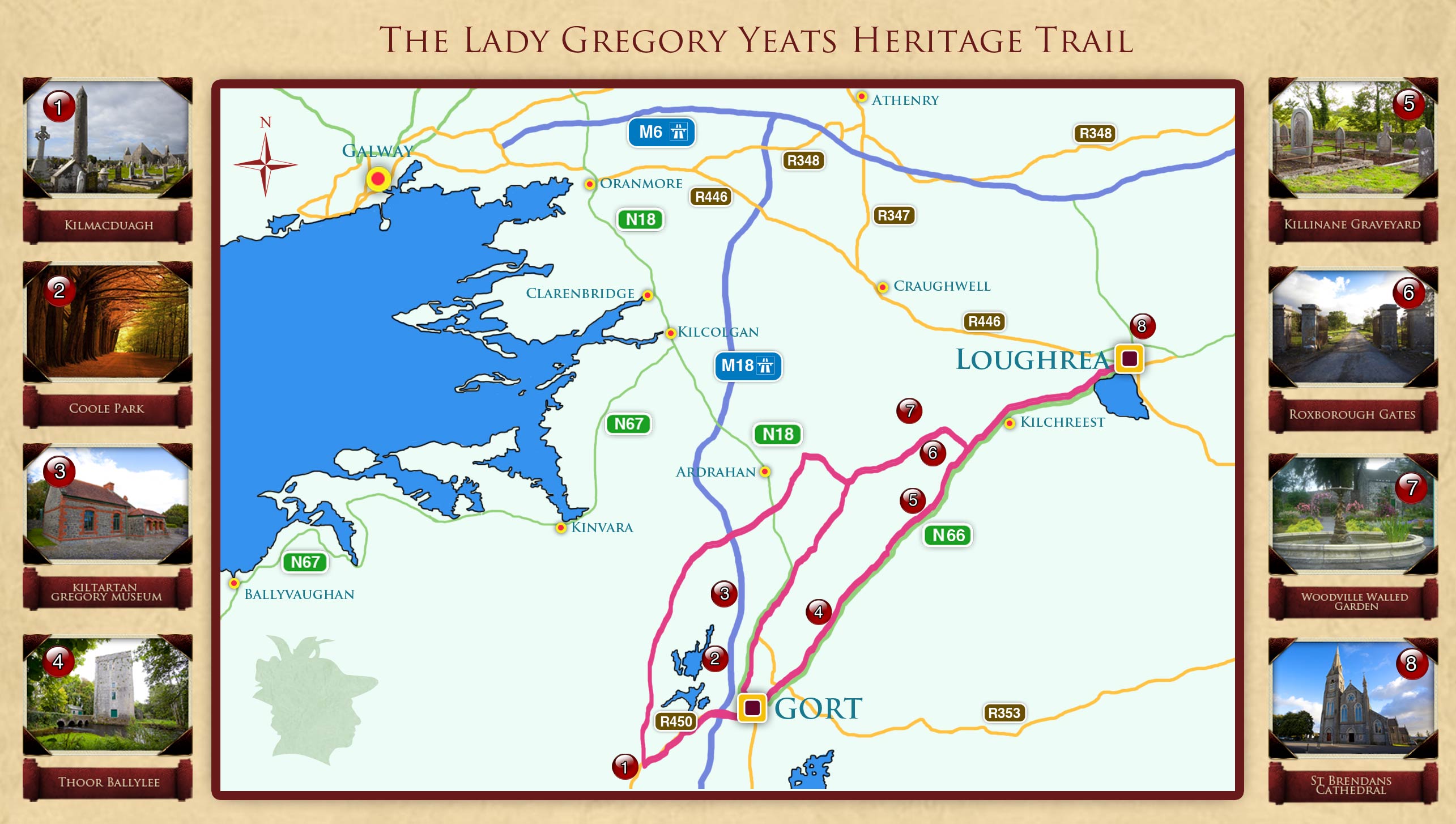
While Yeats is probably the more famous in the USA today, having won the Nobel Prize for Literature, Douglas Hyde was the first President of the Irish Free State. Lady Gregory was I suppose much more famous in her time than she is now, having published a number of books bringing the history of the Irish people to the attention of the Irish themselves. Yeats and Lady Gregory formed a long lasting literary partnership and friendship. Indeed, he bought a property, Thoor Ballylee (#4 on the map), just northeast of the town of Gort.  Lady Gregory's home Coole Park is even closer to Gort, on the lake and just north west of Gort (#2 on the map) -- one could walk between the two. Clearly, proximity to his friend and colleague was important in the choice of location for Yeats' home in his later years  Yet Lady Gregory had established Coole Park as a center for the intellectual elite and that too might have been important.

Lady Augusta Gregory

Under Gregory’s watchful eye Coole House had become a centre for literary and political gatherings, welcoming a great number of notable figures of the day, including William Butler Yeats, his brother the painter Jack Yeats, George Bernard Shaw, John Millington Synge, George Russell (A.E.), and the first President of Ireland, Douglas Hyde. Together with Edward Martyn, who lived down the road at Tulira Castle, Yeats and Gregory founded the Irish Literary Theatre, soon to become the Abbey Theatre. Yeats described the tower and surrounding landscape in his book The Celtic Twilight (1893), which featured local stories about the area and a poem by Antoine O Raifteiri (known to Yeats as Raftery, the poem translated by Lady Gregory) concerning his love for a local beauty named Mary Hynes.
Source: The Lady Gregory Yeats Heritage Trail

Phoroggaph of William Butler Yeats
 by Alice Broughton. Platinum print.
It also seems that the link of Blind Raftery, Mary Hynes and Thoor Ballylee may have been important in Yeats' choice of a home he would buy: from 1921 to 1929, Yeats with his family spent many summers there.

In his poem Coole Park And Ballylee, 1931 he wrote:
Under my window-ledge the waters race,
Otters below and moor-hens on the top,
Run for a mile undimmed in Heaven's face
Then darkening through 'dark' Raftery's 'cellar' drop,
Run underground, rise in a rocky place
In Coole demesne, and there to finish up
Spread to a lake and drop into a hole.
What's water but the generated soul? 
And in The Winding Stair. Yeats wrote:
I am content to live it all again And yet again, if it be life to pitch Into the frog-spawn of a blind man's ditch, A blind man battering blind men; Or into that most fecund ditch of all, The folly that man does Or must suffer, if he woos A proud woman not kindred of his soul.
Raftery's Mary Hynes 
James Stephens published a book of his versions of some of Raftery's poems in the 1920s.  (Reincarnations by James Stephens (1882–1950).  His text for three poems that combine into the choral piece by Samuel Barber, Reincarnations.
Mary Hynes 
She is the sky of the sun,
   She is the dart
      Of love,
She is the love of my heart,
She is a rune,
      She is above
The women of the race of Eve
As the sun is above the moon. 
Lovely and airy the view from the hill
   That looks down Ballylea;
But no good sight is good until
   By great good luck you see
The Blossom of the Branches walking towards you
   Airily.
Anthony O’Daly
Since your limbs were laid out
   The stars do not shine,
The fish leap not out
   In the waves.
On our meadows the dew
   Does not fall in the morn,
For O’Daly is dead:
   Not a flower can be born,
Not a word can be said,
   Not a tree have a leaf;
Anthony, after you
   There is nothing to do,
There is nothing but grief.
And:
The Coolin 

Come with me, under my coat,
   And we will drink our fill
Of the milk of the white goat,
   Or wine if it be thy will;
   And we will talk until
Talk is a trouble, too,
   Out on the side of the hill,
And nothing is left to do,
   But an eye to look into an eye
And a hand in a hand to slip,
   And a sigh to answer a sigh,
And a lip to find out a lip:
   What if the night be black
And the air on the mountain chill,
   Where the goat lies down in her track
   And all but the fern is still!
   Stay with me, under my coat,
And we will drink our fill
   Of the milk of the white goat
Out on the side of the hill.
And here is Reincarnations (Samuel Barber) sung by the Cardinal Singers


T
The interest of so many distinguished Irish intellectuals has generated modern events:
A drawing believed to be of Raftery 

An annual festival, Féile Raiftéirí, is held in Loughrea, Co. Galway each year on the last weekend in March. Raftery spent most of his later years in townlands close to the town. The festival features a contemporary Irish language poet and promotes the native arts of Ireland. The festival ends with a visit to Raiftéirí grave in neighbouring Craughwell.
Ó Raifteirí died at the house of Diarmuid Cloonan of Killeeneen, near Craughwell, County Galway, and was buried in nearby Killeeneen Cemetery. In 1900, Lady Gregory, Edward Martyn, and W.B. Yeats erected a memorial stone over his grave, bearing the inscription "RAFTERY". A statue of him stands in the village green, Craughwell, opposite Cawley's pub. (Source)
Kiltmagh granate memorial
Kiltimagh (where Raftery was born) town square features a granite memorial in honour of Anthony Raftery erected in 1985, in that same year Kiltimagh twinned with Craughwell, the final resting place of the blind Gaelic poet. (Source)

Friday, December 18, 2015

Sunday, December 13, 2015

A Group of Scientists sign declaration that animals share the same awareness with humans


I quote from the source atricle:
Recently an international group of prominent scientists have signed The Cambridge Declaration on Consciousness. This declaration proclaims their support for the idea that animals are conscious and aware to the degree that humans are. The list of animals includes all mammals, birds, and even the octopus. 
The group consisted of cognitive scientists, neuropharmacologists, neurophysiologists, neuroanatomists, and computational neuroscientists. They were all attending the Francis Crick Memorial Conference on Consciousness in Human and Non-Human Animals. The declaration was signed in the presence of Stephen Hawking, and included such signatories as Christof Koch, David Edelman, Edward Boyden, Philip Low, Irene Pepperberg, and many others.
Scientists have been imposing more and stronger rules on themselves for decades as to how animals must be treated in scientific research. There are different rules for primates, farm animals, laboratory animals, and wild animals.

Once the strength of many drugs actually compounded in local pharmacies were measured in "cat units". A cat unit was the volume of a tincture just sufficient to kill an adult cat. That meant that the local drug store owner that was labeling a new batch of the medicine had to test it on cats until he found the does that just killed a cat and a lower dosage (which of course made the cat quite sick) did not kill it.  The local pharmacist had a back room with a lot of cats in cages -- there were few stray cats on the streets.

Why cats you might ask. The answer is apparently that "killing dogs got people upset".

There were actually thousands of scientific papers written using "cat units" to describe the act of natural products such as digitalis on animals and humans.

This clearly is leading to a further advance.

A major problem in running an international research program is in assuring the ethical treatment of animals involved in the research. One issue is that different countries have different laws. Another is that the Western sensibility about animal suffering -- which is evolving as it has done for decades and indeed centuries -- is not exactly equivalent to that in other cultures.

I know. as I dealt with the ethics of treatment of animals in international scientific research as an important part of my job from 1981 to 1997.

Saturday, November 28, 2015

Apparently most people don't understand compound interest


'Percentage of people who understand the concept of compound interest in various countries, with the differences in understanding by gender determined by how dark the circle is. Notably, majority Muslim countries like Saudi Arabia and Yemen have some of the lowest rates of understanding, presumably because Sharia Law prohibits the charging of interest." The Stuyvesant Square Consultancy

Friday, November 27, 2015

Wednesday, November 25, 2015

D.C. court considers how to screen out ‘bad science’ in local trials


There is an interesting article in today's Washington Post titled "D.C. court considers how to screen out ‘bad science’ in local trials".Having managed "peer reviews" of science project proposals for nearly two decades, I have come to the conclusion that this is not an easy thing to do, and even if you have been doing it for some time, you may still get it wrong from time to time;

Fortunately, DC has access to the National Acamey of Science, NIH, NSF. and other organizations with lots of experience doing this, and can delegate the work.

One thing I found useful was developing a data base on how often each expert agreed with other experts. I discovered when I first tried this that expert judgments in that field, which we often taken as 100 percent correct, actually agreed on the final recommendation no more that 90 percent of the time.

In one situation in which the same group of "experts" repeatedly judged similar objects, one of the "expert's" reviews was negatively correlated with all the others. 

Tuesday, November 24, 2015

Monday, November 23, 2015

Friday, November 20, 2015

Tuesday, November 17, 2015

The Power of Behaving as if you Don't Know!


The Washington Post on Sunday ran a review of the book Nonsense: The Power of Not Knowing  by Jamie Holmes.

Let me first quote from the Amazon,com description of the book:
Managing ambiguity—in our jobs, our relationships, and daily lives—is quickly becoming an essential skill. Yet most of us don’t know where to begin.

As Jamie Holmes shows in Nonsense, being confused is unpleasant, so we tend to shutter our minds as we grasp for meaning and stability, especially in stressful circumstances. We’re hard-wired to resolve contradictions quickly and extinguish anomalies. This can be useful, of course. When a tiger is chasing you, you can’t be indecisive. But as Nonsense reveals, our need for closure has its own dangers. It makes us stick to our first answer, which is not always the best, and it makes us search for meaning in the wrong places. When we latch onto fast and easy truths, we lose a vital opportunity to learn something new, solve a hard problem, or see the world from another perspective.

In other words, confusion—that uncomfortable mental place—has a hidden upside. We just need to know how to use it. This lively and original book points the way. 
Over the last few years, new insights from social psychology and cognitive science have deepened our understanding of the role of ambiguity in our lives and Holmes brings this research together for the first time, showing how we can use uncertainty to our advantage. Filled with illuminating stories—from spy games and doomsday cults to Absolut Vodka’s ad campaign and the creation of Mad Libs—Nonsense promises to transform the way we conduct business, educate our children, and make decisions.

In an increasingly unpredictable, complex world, it turns out that what matters most isn’t IQ, willpower, or confidence in what we know. It’s how we deal with what we don’t understand.
Now from the review:
Rationality, mind you, is more than pure logic. It employs a heavy dose of meta-cognition: thinking about how your mind works and the errors it tends to make. It’s more psychology than mathematics and thus helps solve interpersonal disputes (what assumptions am I making about this guy?) as astutely as it does scientific conundrums (what other explanations fit these findings?). One key element of rationality is knowing how much you don’t know and how much more you ought to know before drawing a conclusion. A new book focuses on those gaps in our knowledge and the power therein....... 
The first type of lesson addresses when to induce uncertainty. For instance, ambiguity is good when seeking creative insight. One method for straying into the wild is what the researcher Tony McCaffrey calls the “generic parts technique.” Looking at a set of ingredients, we tend to fixate on their intended function: A candle is for creating light. Instead, list all components with no assumptions about their purpose, and you might find, say, that the string in a candle can tie two objects together. This technique is how Alexander Graham Bell came to see the telegraph as a tool that could transmit voices. 
You might also encourage uncertainty after getting feedback — win or lose. Failure typically does that for us, as it upsets our expectations of what works. But sometimes we don’t win for the reasons we think, so if you want to extend the streak, a debriefing is de rigueur. Query what you think you know. Holmes illustrates this principle with a Ducati motorcycle racing team that rested on its laurels and tumbled off the podium, so to speak. Pixar, on the other hand, makes a habit of deconstructing even its blockbusters.
Thinking back on my own experience, here are some examples:

  • We worked for a year or more in a pattern recognition project trying to properly classify patterns in data based on a human-classified sample of the patternsprovided to us. We could not get better than 90 percent. It occurred to me facing that failure that we had assumed that the sample of patterns provided to us was correctly classified. We went back and checked, and it turned out the the people who did the original classifications only agreed with each other bout 90 percent of the time. The insight that people make mistakes served me well in several future pattern recognition studies, as well as in the analysis of peer review results.
In a number of examples, studying the assumptions made by others, I wondered.

  •  In one case, towards the end of a scheduled presentation, I (a lowly graduate student) dared to ask a visiting lecturer at my university to explain the assumption he had started out with because it did not seem to hold up. He looked at it for a time and then got very angry at me. Seemed he didn't think it could be right after reconsidering it, and that the argument that followed therefore could not be defended -- why had I let he go on wasting the time of his distinguished audience? 
  • In another case, looking at a failed attempt to prove that a proposed solution mechanism to a class of numerical problems was algorithmic (e.g. guaranteed to succeed), I noticed that one feature of the method had not been incorporated in the attempted solution. Again. questioning the author, we agreed that it might be useful to incorporate the feature. I went home and after several days was able to show that the procedure was indeed guaranteed to succeed. I went back to the seminar and presented my logic. Some weeks later, the original presenter published a better proof than mine in a peer reviewed journal.
  • In a third case, one day at lunch a friend and colleague showed me that he had developed a computer program to determine the properties of a reverse osmosis screen from some of the characteristics of its manufacture, and that the program went on to predict the costs of using the screen in a practical water purification scheme. I asked him why he had not gone further and embedded the program in a larger program to optimize costs over the set of characteristics that he was using. A few minutes and some notes on the back of an envelop, he went off happy to revise his program. Five publications followed in quick succession, one in the journal Desalinization. My friend extended friendship beyond courtesy to include me as coauthor in all five, although he had done 99.9% of the work.
I could go on, but I suspect that Nonsense is an important book. Often it is useful to create what my friend Julianne calls "a hard problem" -- one which is poorly defined -- from a more straight forward problem in order to rethink framing and assumptions, thus leading to a better solution to the real underlying problem/

Monday, November 16, 2015

Saturday, November 14, 2015

#jesuisparis


Friday, November 13, 2015

So true


Your opinion is certainly no better than your data, and if you are not a good, careful analyst, probably not as good as your date. Politicians and voters take not!

Monday, November 09, 2015

Diplomats Earn Their Pay Serving the People of their Countries


Next time someone complains that government employees don't earn their pay,  think of these videos.

Sunday, November 08, 2015

Advanced S&T Projects from USAID


Some years ago I wrote an article for the USAID Impact Blog, (Unfortunately, the article was labeled "50th Anniversary: The Program of Scientific and Technological Cooperation" and published on its 30th anniversary.) Still, I think the piece is still useful as a history of a U.S. initiative in science and technology. You will find it here: https://blog.usaid.gov/2011/01/50th-anniversary-the-program-of-scientific-and-technological-cooperation/

In 2007, an article was published in IIP Digital about the Middle East Regional Cooperation Program. That program was also managed by my office, and the article draws heavily on the information and comments provided by David O'Brien, who now manages MERC.  You will find the article here: http://iipdigital.usembassy.gov/st/english/article/2007/10/20071018111900lcnirellep0.2568476.html#axzz3qvJlop9i

Sammy El-Shall discusses nanotechnology, and specifically a nanotechnology project in which his is involved under the MERC program in a transcript published on the State Department website. You will find it here: http://m.state.gov/md212167.htm

Saturday, November 07, 2015

Thursday, November 05, 2015

Dublin You Are


The Dublin You Are project came about in a collaborative manner between a number of Dublin-based artists, Dublin2020 and the people of Dublin. The video is based around the words of poet Stephen James Smith, which capture the good and the bad of Dublin, the successes and the failures, the community and the divide – in essence, it reflects much of the ideas that came from the conversations and workshops Dublin2020 had with people all over Dublin over the past year. The team has created a visual representation of what Dublin is today, a fair portrayal of city’s grim and glory, where the visuals complement the written narrative. #DublinYouAre #Dublin2020 About Dublin2020 Dublin is in competition to become European Capital of Culture in 2020. Dublin2020 is Dublin’s campaign to make sure our city wins. If we win, we have a chance to make real change for our city and its people. We can’t do this alone, to make sure Dublin moves forward to the next round in the competition, we need to spread the word, get involved and join in the conversation. If you are part of Dublin you are part of Dublin2020. DublinYouAre is presented by Dublin2020 in association with: Stephen James Smith: http://stephenjamessmith.com/ Wissame Cherfi: www.wissamecherfi.com Aoife Dooley: http://www.aoifedooleydesign.com/ Aidan Kelly: www.aidan-kelly.com Derek Kennedy: http://www.dublindaily.ie/ Music by Kim V Porcelli: kimvporcelli.bandcamp.com

Stories for those who don't want Hispanic immigrants


Colombia

I was one of three World Health Organization staffers assigned to a research project in Colombia. Several Colombians were also assigned to the project, all with strong professional qualifications. Our closest Colombian colleague was a physician who spoke fluent English as well as Spanish, and had a post doctoral degree from the Johns Hopkins University school of public health; he was assigned to our project by an internationally respected Colombian university.

He and his wife, a nurse. were suffering a real tragedy in the illness of their son. The child was in the hospital every month it seemed, and required a lot of attention, If his parents were not both trained medical practitioners I don't know how they could have managed. But our colleague never complained, never failed to show up on time and work a full day, and was a always a professional participant in every activity. (The boy died at age 5, about a year after the events described in the following paragraphs.

The project offices were provided by a Colombian university on campus. At the time I am writing about, the students were on strike, holding open air meetings on campus. The campus was surrounded not by police, but by tough mountain troops brought in by the federal government. They were heavily armed.

On the morning in question, three of us were in the project offices: another WHO project member and I and the Colombian colleague described above. I as the senior of the three decided that we were not safe, and should lock up and leave. As we did so we had to walk past a mob of hundreds of demonstrating students to reach the end of the campus and a line of troops (who were apparently there to keep the student demonstration contained with the campus).

A large number of the students rushed our small party. Our Colombian physician, without hesitation, put himself between the mob of students and we WHO staffers, protecting us with his body and with his voice, explaining we were an international research team affiliated with WHO and should not be harmed. We got out safely!

Were we in danger. A couple of things suggest we might have been. The International Edition of the Herald Tribune the next day published a story that we had been beaten up by the mob. That next day, the situation exploded. 14 people were killed on campus, one a few yards from our (then empty) offices. An estimated 25,000 people were arrested that day, a number far exceeding the jail capacity in our city; prisoners were placed under guard in the sports stadium.

Were we saved by our Colombian colleague? I don't know, but I think the important thing is that this man with all his responsibility did not think twice before getting in the way of what he believed to be serious danger in order to protect two foreign colleagues that he had know for less than a year.

Dominican Republic


I had the great good fortune to work for some time with a Public Health physician in the DR; he had spent time in jail under sentence of death. As he explained to me, in medical school he and some fellow student were talking in their dormitory rooms about Rafael Trujilo. Trujillo was dictator of the Dominican Republic for more than three decades. The students agreed among themselves that the only way his rule was likely to end was assassination. Trujillo had a very effective secret police, and discovered "the plot", had the students arrested and condemned to death.

There was a worldwide outcry at the injustice and letters poured in from around the world written by health workers, scientists and human rights advocates. Eventually the sentences were reduced. After Trujillo's death, the students were released, and my colleague returned to medical school, became a physician, went on to specialize in public health, and was teaching health administration and health planning in the medical school in Santo Domingo, the capitol. He too spoke fluent English as well as Spanish (and for all I know, other languages).

I worked with him for a year to do an assessment of the health conditions, health services and health resources in his country. He led a Dominican team, and I brought in experts to provide assistance in areas where such assistance appeared to be needed. On the basis of this assessment, the USAID mission in the Dominican Republic developed, in conjunction with Dominican authorities, a health sector loan; it focused on developing an rural health system aimed at reducing infant and child mortality. The assessment had recognized that the rural families faced very high child mortality, that there were few resources to pay for medical services in the rural area, but that by focusing on appropriate public health interventions, a lot could be done at low cost. Importantly, the assessment recognized that in the 19th century had successfully provided services in the rural areas with army medics rather than doctors -- thus there was a proven domestic model for such a service.  My colleague also held a number of meetings with groups in the DR who had opposed such delegated medical services for the poor in the past, explaining that the new system would not only meet their objections, while saving lives, but would in some cases serve their economic interests better than the existing do nothing process. They achieved adequate Dominican support to make the new rural health system feasible.

Amazingly, just before the loan came through, my colleague was appointed Minister of Health of the Dominican Republic. He not only had an idea of what he wanted to do, but had a plan for how to do it, and new money to implement the plan. He even had a small team who understood what had to be done and how to do is, for he took key members of his assessment teams to the Ministry with him,

Something over five years later he showed up in my office in Washington unannounced. He had made the trip to the USA specifically to tell me what he had been able to do as Minister to implement the plans. In those five years, infant and child mortality in the rural areas of the Dominican Republic had been cut in half. Thousands of lives had been saved, This had been accomplished by an efficient service based on delegated functions to health promoters and auxiliary health service providers. I can only imagine the obstacles he must have overcome to make that rural health service a reality.

How many of us can ever claim such a success, yet this man did so after being condemned to death and held in jail in the country he eventually served so well.

Panama

Hugo Spadafora was a Panamanian doctor and public health official. My office carried out a health sector assessment in Panama, and he was the man chosen to lead the Panamanian team; a long time friend and close colleague led the U.S. funded team of consultants. I was kept abreast of the work of the joint team, and got to visit Panama and meet Dr. Spadafora.

Thus was the Panama ruled by Omar Torrijos, the dictator from 1968 to 1981 (to be replaced by Manuel Noriega, dictator from 1983 to 1989). According to Wikipedia:
Originally a critic of the military regime headed by Omar Torrijos, he (Spadaforo) served as its Vice-Minister of Health. 
Spadafaro was completely dedicated to the welfare of the people and this was risky in Panama. Indeed,:
Concerned about the increased Soviet and Cuban influence in the Sandinista regime of Nicaragua and the delay of free elections, Spadafora joined the Sandino Revolutionary Front (FRS) alongside Edén Pastora ("Comandante Zero"), hero of the August 1978 seizure of Somoza's palace. 
Wikipedia states:
Torrijos died in a plane accident on July 31, 1981. Colonel Roberto Díaz Herrera, a former associate of Noriega, claimed that the actual cause for the accident was a bomb and that Noriega was behind the incident.
Wikipedia goes on to report:
About this time (1984), Hugo Spadafora, a vocal critic of Noriega who had been living abroad, accused Noriega of having connections to drug trafficking and announced his intent to return to Panama to oppose him. He was seized from a bus by a death squad at the Costa Rican border. Later, his decapitated body was found, showing signs of extreme torture, wrapped in a United States Postal Service mailing bag. His family and other groups called for an investigation into his murder, but Noriega stonewalled any attempts at an investigation. Noriega was in Paris at the time of the murder, which was alleged by some to have been at the direction of his Chiriquí Province commander, Luis Córdoba. A conversation captured on wiretap between Noriega (in Paris) and Córdoba included the exchange: 
Córdoba: "We have the rabid dog."
Noriega: "And what does one do with a dog that has rabies?"
President Barletta was visiting New York City at the time. A reporter asked him about the Spadafora matter, and he promised an investigation. Upon his return to Panama, he was summoned to FDP headquarters and told to resign. He was replaced by First Vice President Eric Arturo Delvalle. As a friend and former student of George Shultz, Barletta had been considered "sacrosanct" by the United States, and his dismissal signaled a marked downturn in the relations between the U.S. and Noriega. Herrera, a former member of Noriega's inner circle, told Panama's main opposition newspaper, La Prensa, that Noriega was behind Spadafora's murder, and many other killings and disappearances as well. This resulted in an immediate outcry from the public.
How Proud We Should Have Been Had These Men Chosen to Immigrate to the USA!

These three men were highly cultured, highly educated, who had achieved positions of trust and responsibility in their own countries. One put his safety on the line to assure mine, one served in prison under a death sentence imposed by its dictator, and one was actually tortured and beheaded. All were devoted public health physicians, who took risks of contracting serious diseases every day for years. All faced unsympathetic governments to help their people, All had taken the trouble to learn English as a second language. I would have been proud to sponsor any of these three for citizenship if asked. Each would raise the quality of our people by joining us.

Tuesday, November 03, 2015

Sunday, November 01, 2015

The World GDP Density Map


Thanks to William Easterly