Saturday, September 09, 2006

The Bolton Nomination

Last year John Bolton failed to obtain the support of Senator Voinovich or any Democrat on the Senate Committee considering his nomination as U.S. Ambassador to the United Nations. Bush temporarily installed Bolton as U.N. ambassador on Aug. 1 of last year while Congress was in recess. That appointment is to expire in January. He re-nominated Bolton again this year, and hearings were again held on the nomination.

Comment: Bolton is, to put it mildly, an undiplomatic diplomat. He dislikes the United Nations. His term to date has, as far as I can see, been marked by counter-productive pugnacity which has antagonized other diplomats, without gaining any advantage for the United States. While sometimes it is necessary to antagonize representatives of other countries in the course of representing ours, to do so needlessly is simply foolish. Sometimes diplomacy depends on the good will of the diplomats!

Read the negative review Bolton's performance recently published by representatives of the United Nations Association of the United States.

Thursday, according to ABC News, the Senate Committee pulled the scheduled vote. "Senate Foreign Relations Committee Chairman Richard Lugar, R-Ind., gave no reason for the delay and did not say when the vote would be held."

Senator Lincoln Chafee sent a letter to Secretary Rice (Posted by Steve Clemons on TPM Cafe) on Thursday which concluded:
It is my hope that answers will be forthcoming about our policy toward the Israeli-Palestinian conflict, and the Committee can reconvene to debate Ambassador Bolton's confirmation.

Yesterday Clemons reported:
Several well-placed sources close to the Bolton nomination process have reported to me that the Bolton confirmation process is now dead.

The Senate Foreign Relations Committee is "highly unlikely" to reconsider Bolton's confirmation again as things now stand.

Lets hope Clemons is right.

Comment: The Bush Administration has the right to nominate (and renominate) Bolton to the post, and apparently agrees with his views and likes the job he has done so far. But the Constitution provides a check, requiring Senate confirmation. Given the opposition of the Democrats to Bolton's policies and behavior, unless the Administration can bring moderate Republicans to vote for Bolton, he will not be confirmed. It now appears that Senator Chaffee, a Republican widely recognized for his good judgement and knowledge of foreign policy, has stood up to the Administration and said no!

Friday, September 08, 2006

The role of universities in knowledge production

Read the SciDev.Net Policy Brief by Judith Sutz)

Summary: "To increase their contribution to development through the production and distribution of knowledge, universities in developing countries need to transform themselves into 'developmental universities'. But to achieve this, other participants, such as industry and government, must be also be prepared to take on new responsibilities. No ready-made model exists to guide these changes; they will require both creativity and the willingness to engage in thoughtful dialogue, both within and outside universities."

"Doha: the low hanging fruit: A successful outcome to the WTO trade talks is still possible."

Read the full article by Angel GurrĂ­a (Secretary-General of the OECD) in The OECD Observer.
: Published: August 2006

"I am in contact with leaders and officials both from the world’s most developed nations and from developing countries. When the Doha Development Round talks collapsed in July, I was struck by the gap between what officials say when they meet at the OECD in Paris and how they define their positions in the WTO talks in Geneva.

"The Doha Development Agenda is an opportunity to re-balance trade rules in favour of developing countries while boosting the world economy. The Doha talks reportedly collapsed largely because of disagreements over agriculture, but clearly that is not the whole story. Indeed, some rich countries were not ready to accept larger tariff cuts or bigger reductions in trade-distorting domestic subsidies for farm products. Emerging market countries, meanwhile, offered what some saw as only modest improvements in market access for goods and services."

Thursday, September 07, 2006

"Senators Denounce Scientist's Stem Cell Claims: Confusion Over Harm to Embryos In Study at Issue"

Read the description of the event by Rick Weiss in The Washington Post of September 7, 2006.

Senators Arlen Specter (R-Pa.) and Tom Harkin (D-Iowa), respectively Chairman and Ranking Minority Member of the Senate Appropriations Committee's Labor, Health & Human Services, and Education Appropriations Subcommittee, are described as having "lashed out" yesterday at Robert Lanza of Advanced Cell Technology (ACT) in Worcester, Mass during a Subcommittee hearing. Their complaint was that "the scientist and his company have harmed the struggling field by overstating their results." The two senators are said to "strongly support human embryonic stem cell research."

BusinessWire.com reports:
Robert Lanza, M.D., Advanced Cell Technology's Vice President of Medical and Stem Cell Development, testified today before the Senate Labor, Health & Human Services and Education Appropriations Subcommittee. Dr. Lanza's testimony focused on support for wider availability of human embryonic stem cells for basic medical research. Dr. Lanza is the principle author of a paper published online (ahead of print) on August 23 in the peer-reviewed journal Nature, which described a technique for developing human embryonic stem cells with a single-cell biopsy technique called Preimplantation Genetic Diagnosis (PGD). This technique is not harmful to embryos.

The letter to Nature cited in the dispute is by Lanza and four other authors. It states in part:
The derivation of human embryonic stem (hES) cells currently requires the destruction of ex utero embryos. A previous study in mice indicates that it might be possible to generate embryonic stem (ES) cells using a single-cell biopsy similar to that used in preimplantation genetic diagnosis (PGD), which does not interfere with the embryo's developmental potential. By growing the single blastomere overnight, the resulting cells could be used for both genetic testing and stem cell derivation without affecting the clinical outcome of the procedure. Here we report a series of ten separate experiments demonstrating that hES cells can be derived from single blastomeres.

Apparently wide interest was stimulated in and by the media in the possibility of generating embryonic stem cell lines without destroying embryos. To do so would reduce some, but not all, of the religiously based objections many people (including President Bush) have to embryonic stem cell research. The reported research, however, resulted in the destruction of the donated embrios it used. Certainly the research done to date does not justify Business Wire's claim that "this technique is not harmful to embryos."

Lanza seems not to have made excessive claims about the work, and is quoted as stating:
"Our paper is 100 percent correct!"

Weiss, in the article cited above reports:
(A) plainly incorrect announcement (was) sent to science reporters by the journal Nature itself.

"By plucking single cells from human embryos, Robert Lanza and his colleagues have been able to generate new lines of cultured human embryonic stem (ES) cells while leaving the embryos intact," the release said.

That erroneous description -- written not by scientists at Nature but by the journal's lay staff -- was corrected after news stories were published.

Nature later apologized to reporters, blaming the mistake on "internal communication problems."

Comment: I believe that it would better to utilize the many embryos that are currently being destroyed (as no longer needed for implantation as part of reproductive medicine) to derive stem cell lines for research, and eventually (one hopes) for other clinical applicationss. The value of deriving stem cell lines from blastomeres without destroying the embryo is primarily in the eyes of a religious minority. However, were
* embryonic stem cell lines to be successfully derived from cells extracted from embryos,
* the embryos later successful implanted, and
* the resulting pregnancies to yield healthy babies,
then many who do not do so now would approve government funding of embryonic stem cell research. I would welcome their added support.

If Nature's staff made an error in the news release based upon a letter (which was correct in every way), then those staff members deserve blame. So too do the scientists in charge at Nature for not supervising the lay staff more effectively to prevent such mis-statements. So too do the reporters and editors who published the incorrect information from the news release without further verification. While there is plenty of blame to go around, none would seem to attach to Dr. Lanza and his associates for the misunderstanding.

I find it interesting that Senators should use an appropriations hearing to discuss this paper, and inappropriate that they should "lash out" at a distinguished scientist and entrepreneur for a failure that was not his. A little more decorum, please!

Again, I am reminded that the knowledge systems and processes in the media and the U.S. legislative bodies are much different than those of the scientific community and its journals. The scientific knowledge processes are better at getting at the truth of the issue. But, as this case illustrates, the communication among these knowledge systems is fraught with peril.

Wednesday, September 06, 2006

Intellectual Property Rights Harmonization

Does anyone think this phrase has become current in WTO/WIPO North-South fora in part because technologically innovative firms and nations feel it is more decorous and euphoneous than an alternative, blunt statement of their position, such as:
Give us lots more money right away!

Its good to be tall!

"In Congress, a Whole Lot of Half-Truths", By Richard Morin, The Washington Post, September 6, 2006.

"Researchers have known for decades that taller people earn more and have better jobs. Some researchers said it was because tall people had more self-esteem. Others said taller individuals physically and psychologically dominated their shorter colleagues. Still others said it was height discrimination.

Two economists have a simpler explanation: 'Taller people earn more because they are smarter,' claim Anne Case and Christina Paxson of Princeton University. 'As early as age 3 -- before schooling has had a chance to play a role -- and throughout childhood, taller children perform significantly better on cognitive tests.'"

I used to be over 6' 2" when I was a young man, but I have measurably shrunk over the decades. I wonder if that is why I don't feel so smart any more.

Who would have thunk it -- psychologists think school makes you smarter!

In Congress, a Whole Lot of Half-Truths:

"'The Effect of Education on Cognitive Ability' by Torberg Falch and Sofia Sandgren, working paper published by the economics department at the Norwegian University of Science and Technology. Two economists find that every year of formal education raises a student's IQ an average of about 3 points, regardless of family income or parents' educational levels, raising new doubts that genetics alone determines intelligence."

Scientists versus politicians

Two stories in today's Washington Post caught my eye for the contrast that they present in the ways politicians and scientists handle information and political disagreement.

In Congress, a Whole Lot of Half-Truths By Richard Morin.
Gary Mucciaroni of Temple University and Paul J. Quirk of the University of British Columbia sought to see how truthful America's lawmakers were in debating three major bills: welfare overhaul in 1995-1996, the fate of the estate tax in 1999-2000 and telecommunication deregulation in 1996......

In all, they examined the accuracy of 18 claims in 43 separate House and Senate debates.......

Researchers judged the claims made in only 11 of the 43 debates to have been largely substantiated by the facts. An additional 16 were deemed to be "unsubstantiated"-- a polite way of saying they were misleading, mostly false or flatly wrong -- while 16 were an artful mix of fact and fiction, they report in their new book, "Deliberative Choices: Debating Public Policy in Congress.".....

They stopped short of asserting that members of the House and Senate lied to advance their positions. "We don't pretend to know whether they are lying, are ignorant, or misperceive the facts and informed opinion on an issue," Mucciaroni said. "Instead of using 'flatly lying,' we prefer 'flatly incorrect' or 'flatly inaccurate.' "

In Iran, Searching for Common Ground By David Ignatius
Shahriar Khateri, as a boy of 14,...enlisted in the Iranian militia known as the basij and was exposed to chemical weapons attacks by Iraqi forces three times. He escaped serious injury, but after he graduated from medical school, he took a passionate interest in other Iranians who hadn't been so fortunate. Working with Mostafa Ghanei and other Iranian doctors, he supervised a systematic study of the roughly 34,000 Iranians who had been injured by mustard gas. His office here is lined with gut-wrenching pictures of Iranians who were gassed by Saddam Hussein's troops.

Here's where the Iranian-American link to weapons of mass destruction gets interesting. Khateri found a surprise ally in an American researcher named David Haines, who had been studying the effects of Iraqi chemical weapons ever since he served as an Army officer in the 1991 Persian Gulf War. By 2000 Haines was traveling to conferences in Iran and preparing joint research projects with Iranian scientists. He won a $300,000 grant from the National Institutes of Health to bring a young Iranian scientist named Ali Reza Hosseini Khalili to his lab at the University of Connecticut. (When I first reported on Haines's efforts in a June column, gremlins in the U.S. government were blocking Khalili's visa; happily, the visa problems were resolved the day the column appeared.)

This month Haines will present a paper on his joint efforts with Khateri's Iranian researchers to the U.S. Army's chemical defense research facility at the Aberdeen Proving Ground in Maryland. The working title: "Chemical-Agent-Exposed Iranian Populations: A Tool for Understanding Disease." The subtitle pretty much sums up the rationale for these Iranian-American exchanges: A tool for understanding . In the escalating crisis between the two countries, we are either going to do more talking or we may end up fighting.

Conclusion: Politicians don't tell the truth, even on the floor of the Congress, when debating with opposition politicians. Scientists work together, even when their countries haven't had diplomatic relations for decades, trying to get at the facts.

Conclusion 2: Exposing visa tactics of the U.S. government is conducive to open and useful exchanges among scientists, and we ought to continue doing it.

Comment: I don't think politicians become scientists, and I fear that when (on rare occasions) scientists become politicians they behave more like lifelong pols.

Two Reports on Computer and Internet Use by U.S. Students

"Computer and Internet Use by Students in 2003", U.S. National Center for Education Statistics, September 2006. Description:
"This report examines the use of computers and the Internet by American children enrolled in nursery school and students in kindergarten through grade 12. The report examines the overall rate of use (that is, the percentage of individuals in the population who are users), the ways in which students use the technologies, where the use occurs (home, school, and other locations), and the relationships of these aspects of computer and Internet use to demographic and socioeconomic characteristics such as students' age and race/ethnicity and their parents' education and family income. This report confirms that patterns of computer and Internet use seen in previous research are observed in more recent data. One of the more important findings presented in the report is that schools appear to help narrow the disparities between different types of students in terms of computer use. Differences in the rates of computer use are smaller at school than they are at home when considering such characteristics as race/ethnicity, family income, and parental education."

Internet Access in U.S. Public Schools and Classrooms: 1994-2003, U.S. National Center for Education Statistics, February 2005. Description:
"This report presents 10 years of data from 1994 to 2003 on Internet access in U.S. public schools by school characteristics. It provides trend analysis on the percent of public schools and instructional rooms with Internet access and on the ratio of students to instructional computers with Internet access. The report contains data on the types of Internet connections, support of computer hardware/software and websites, technologies and procedures used to prevent student access to inappropriate material on the Internet, and the availability of hand-held and laptop computers to students or teachers. It also provides information on school websites, the availability of computers with Internet access outside of regular school hours, and teacher professional development on how to integrate the use of the Internet into the curriculum."

I am quite impressed at how fully computers and the Internet have penetrated U.S. schools, but somewhat surprised that the digital divide is still so evident in the homes of minority children.

Sustainable telecenters

Mrs. Maniko reads her email at
a telecenter in Mali
Photo: Serge Daniel, copyright: UNESCO


Thomas Bekkers has contributed this highlight to the Development Gateway Information and Communication Technology for Development Community portal.

"Every ICT4D actor knows reducing the digital divide is primarily a question of physical access to a computer necessarily connected to the Internet. We are not speaking here of infrastructure and bandwidth problems but only basic prime level connection. According to the Panos Institute: “More than two-thirds of the world’s population still don’t have access to computers, the internet and other sophisticated new communication technologies”. Solving this problem can be done by implementing community based access points, also known as telecenters, particularly well adapted to the context of southern developing countries. As a matter of fact, we all feel concerned by innovative ways to implement successful telecenters. Sustainability of such telecenters is an important problem to deal with. Sharing related knowledge and experiences could have a direct impact on reducing the digital divide. This highlight is focusing on existing resources that could help developing relevant models regarding telecenters."

UNESCO provides the International Community Telecenter Resource Site. The site is addressed to community telecenter developers, practitioners, and researchers. It contains an annotated and classified inventory of resources on local information and informatics initiatives such as community multimedia and multipurpose telecentres. There are four major sections in this site:
* Projects and Initiatives
* Research
* Resource Organizations and
* Telecentre Technology

Each section covers an aspect of the process of engendering and appropriating ICTs for community development around the world.

I have also been collecting materials related to the evaluation of telecenters on the Development Gateway's Monitoring and Evaluation of ICT Projects topic page. There are currently 43 resources on the topic.

Tuesday, September 05, 2006

Khatami Arrives As U.S. Weighs Sanctions on Iran

Khatami Arrives As U.S. Weighs Sanctions on Iran:

"'We're going to maintain a policy of no contact between the two governments, but at the same time, that doesn't mean that Americans outside government shouldn't be talking to Iranians. Americans should take every opportunity to address the concerns we have over terrorism and nuclear issues with Iranians who visit our country,' (Undersecretary of State R. Nicholas) Burns said."

Tickets for Khatami's talk at the Washington Cathedral do indeed seem to be in short supply, as one of my friend's was turned down on his request.

New African Union Science Summit discussion group & news focus

Image from SciDev.Net

In January 2007, the African Union will hold its 8th annual summit, focusing on science, technology and innovation and organised with support from NEPAD.

This autumn, a number of meetings will take place to prepare and discuss proposals including a model law to regulate biotechnology across the continent, the role of the African diaspora and a new financing facility to support African research.

SciDev.Net has developed a new website on which it has grouped its coverage of these issues, key documents relating to the summit, links, and an invitation to join our related discussion group.

SciDev.Net's special AU Summit site will bring together coverage in the run up to the summit, which will look at the role of science, technology and innovation in the continent's development. The site will feature relevant news, key documents and links.

What is the right vehicle to promote science in Africa? Do scientists feel their needs are being addressed? Do African politicians understand the role that science and technology plays in development? What are Africa's research priorities?

Join SciDev.Net's discussion group to debate the topics that the summit will discuss and highlight any that have been missed.

To join the group visit:

http://www.scidev.net/ausummit07/discussion

Onesmo ole-MoiYoi, director of research and partnerships at the International Center of Insect Physiology and Ecology (ICIPE) in Nairobi, Kenya opens the discussion by highlighting why efforts to use science to drive Africa's development have failed. "Africa’s development problems have potential generic solutions," he writes.

SciDev.Net is the world’s leading electronic source of free news, views and analysis about science and technology in the developing world. Through support from international aid agencies, all SciDev.Net content and services are free of charge.

Monday, September 04, 2006

Negative Findings on UNESCO Science Programs

An evaluation committee reviewing UNESCO's natural and social science programs has produced an interim report (for UNESCO's Executive Board) which appears quite negative. Check out the main elements of the committee's report on our UNESCO in the Spotlight blog.

This is a test uploading from Flickr.


Lizzie at work
Originally uploaded by Tim in Mexico.
In a health center in Patzun, Guatemala, a woman in traditonal dress and a foreign worker use the computer.


I was interested in finding an illustration for posting on the UNESCO in the Spotlight blogs (Education and Culture, and Science and Communications) on the UNESCO program, "ICTs for Intercultural Dialogue: Developing communication capacities of indigenous peoples" (ICT4ID).

This is the result. As it can see, it worked. I wound up cutting from the draft of this blog, and pasting into the two UNESCO in the Spotlight blogs.

Sunday, September 03, 2006

Deep Causality

I am interested in ideas of deep causes that underlie day to day history. I just posted on The Long Summer: How Climate Changed History which suggests that climate and geographical changes were important driving functions in history. Guns, Germs, and Steel: The Fates of Human Societies had similar analysis which implicated environmental factors in partial causality historical models.

I know that people have used single-factor, deterministic models of history with poor effects, but still I think it useful to look at deeper factors, recognizing that they interact in a complex causality.

Two such factors were brought to my attention this week. Both elicited the "why didn't I think of that response".
* An article in the Economist pointed out that globalization underlies a force that makes returns on capital greater in developed nations as compared to returns on labor. As investment can move more freely from rich countries where it has been relatively abundant to poor countries where it has been relatively scarce, the return on capital in rich countries tends to increase. As it moves toward the higher rates of return in poor nations, the balance between labor and capital changes in the rich countries, and returns tend to increase.

* A new book, The J Curve: A New Way to Understand Why Nations Rise and Fall, suggests that democracy and openness in a society enhance stability only in the later stages of their development. Coercive governments can be quite stable, and often become less stable as they open up.


I knew lots of instances where these rules seem to hold, but had not inferred the rules themselves. They may not be laws, but they are worth thinking about.

BBC NEWS | Science/Nature | Top scientist's fears for climate

BBC NEWS | Science/Nature | "Top scientist's fears for climate":

"In his first broadcast interview as president of the American Association for the Advancement of Science, John Holdren told the BBC that the climate was changing much faster than predicted.

'We are not talking anymore about what climate models say might happen in the future.

'We are experiencing dangerous human disruption of the global climate and we're going to experience more,' Professor Holdren said.

He emphasised the seriousness of the melting Greenland ice cap, saying that without drastic action the world would experience more heatwaves, wild fires and floods.

He added that if the current pace of change continued, a catastrophic sea level rise of 4m (13ft) this century was within the realm of possibility; much higher than previous forecasts."

I have been reading "The Long Summer: How Climate Changed Civilization" by Brian M. Fagan. I had not really realized how dramatic climate changes have been in the last 15,000 years. They were enough to melt huge ice sheets, and when the melt water broke through to flow to the oceans, it was enough to shut off the Atlantic circulation, not to mention the geography of continents. Century and millenial climate changes had dramatic effects on plant, animal and human populations.

On the one hand, the book has made me more worried about the impacts of global warming in the 21st century. On the other hand, it has somewhat reduced my concerns for the loss of biodiversity, since species have advanced and retreated to sanctuaries in the past. Still, species are disappearing at a rate never before seen because we are not only changing the climate, but destroying habitat in many other ways.

Would Al Gore accept a position as environmental czar in a Democratic administration in 2009? It gives me some hope!

Wednesday, August 30, 2006

R&D -- the 100 Biggest Spending Firms

Read "R&D 100" by Ron Hira and Harry Goldstein in the IEEE Spectrum Online.

"The 100 companies, taken as a whole, increased their R&D spending by a healthy 7.6 percent in 2004, to US $254 billion. The pharmaceuticals and biotechnology sector actually cut back by 1.1 percent, to $51.7 billion [see box, "Sector Trends"], mirroring a sales drop of 1.6 percent.......Pharmaceuticals and biotechnology ranks as the second most research-intensive industry, just behind software and services........The five years of R&D Top 100 data from the fiscal years 2000 to 2004 show that the top 100 leaders increased their R&D spending by 21 percent—from $210 billion in 2000 to $254 billion in 2004. R&D intensity in 2004 decreased slightly for the group as a whole, from 6.4 percent to 6.1 percent, as sales jumped by 12.3 percent. But that rosy picture certainly doesn't hold for every industry. Each sector has a different story to tell."

BBC NEWS | Business | Google makes novels free to print

BBC NEWS | Business | Google makes novels free to print:

"Search engine Google plans to offer consumers the chance to download and print classic novels free of charge."

SPACE SCIENCE: NASA Chief Blasts Science Advisers, Widening Split With Researchers -- Lawler 313 (5790): 1032a -- Science

SPACE SCIENCE: NASA Chief Blasts Science Advisers, Widening Split With Researchers -- Lawler 313 (5790): 1032a -- Science: (subscription required).

"'The scientific community … expects to have far too large a role in prescribing what work NASA should do,' (NASA Administrator Michael) Griffin wrote council members in a blistering 21 August message. 'By 'effectiveness,' what the scientific community really means is 'the extent to which we are able to get NASA to do what we want to do.''

"The outside engineers, scientists, and educators on the council traditionally offer advice on the agency's policies, budget, and projects. Placed in limbo for nearly a year after Griffin took over as NASA chief in spring 2005, NAC was reorganized this spring under the leadership of geologist Harrison Schmitt, a former U.S. senator and Apollo astronaut who is very enthusiastic about President George W. Bush's plans to send humans back to the moon and to Mars. Schmitt replaced Charles Kennel, director of the Scripps Institution of Oceanography in San Diego, California, who resigned last week from his post as chair of the council's science committee. Two other NAC members--former NASA space science chief Wesley Huntress and Provost Eugene Levy of Rice University in Houston, Texas--resigned last week in response to a direct request from Griffin that they step down.

"Schmitt and members of that committee have clashed repeatedly in recent months over the role of science at the space agency. In a pointed 24 July memo to science committee members, Schmitt complained that they lacked 'willingness to provide the best advice possible to Mike,' refused to back Griffin's decision to cut research funds for astrobiology or recommend an alternative cut, and resisted considering the science component of future human missions to the moon. 'Some members of the committee,' he concluded, 'are not willing to offer positive assistance to Mike.'"

I don't know the details of this public controversy. We had such high hopes for Griffin when he was appointed, and I suppose there is always a tension between the engineers and astronauts (who may tend to be interested in space technology per se) and the scientists (who may tend to want to use space platforms to gain scientific knowledge.) But the politics of NASA make me suspicious. The Bush Administration gets a lot of negative publicity due to the environmental community's reaction to new NASA science results, and a safe technology development program (which will have to be paid for mostly by future administrations)doesn't pose much threat.

Tuesday, August 29, 2006

Higher Education in Africa

This is something of a follow-up to my posting last month about Higher Education in Developing Countries.

There are a number of interesting sources of information on this topic. UNESCO has a website with links to reports including:
* Inventory of major projects in /on higher education and research in Africa by the Africa Scientific Committee of the UNESCO Forum on Higher Education, Research and Knowledge.

* International Bibliographic Database on Higher Education (HEDBIB).

* Arusha Convention on the recognition of qualifications in higher education in Africa.

* "Guide to Teaching and Learning in Higher Education"

* "Recent developments and future prospects of higher education in sub-Saharan Africa in the 21st century" (published for the Meeting of Higher Education Partners (World Conference on Higher Education +5, Paris, 2003).

* "The African university at the threshold of the new millennium: potential, process, performance and prospects."

* Regional Convention on the Recognition of Studies, Certificates, Diplomas, Degrees and other Academic Qualifications in Higher Education in the African States.

* "Recent Developments and Future Prospects of Higher Education in sub-Saharan Africa in the 21st Century (published for the Meeting of Higher Education Partners" (World Conference on Higher Education +5, Paris, 2003)

* "The African University at the Threshold of the New Millennium: Potential, Process, Performance and Prospects."

Note also this UNESCO publication: "Diversification of Higher Education and the Changing Role of Knowledge and Research: Papers produced for the UNESCO Forum Regional Scientific Committee For Europe and North America."

Here are some reports from the World Bank that are relevant to universities in Africa:
* "Constructing Knowledge Societies: New Challenges for Tertiary Education"

* "A chance to learn: knowledge and finance for education in Sub-Saharan Africa"

* "Improving Tertiary Education in Sub-Saharan Africa: Things that Work" (Report of the Africa Regional Training Conference on Tertiary Education" held in Accra, Ghana on September 22-25, 2003.)

* "Higher Education and Economic Development in Africa"
Or, more generally, the website of the World Bank's Africa Region Human Development Working Paper Series.

Also check out:
* The Association of African Universities.

* International Association of Universities (IAU)

* IAU/UNESCO Information Center

Check out also my social bookmarking, especially the things that are tagged both Africa and Higher.Ed.

UNU/UNESCO International Conference on "Globalization: Challenges and Opportunities for Science and Technology"

This UNU/UNESCO International Conference was held 23 & 24 August 2006 in Yokohama, Japan. It was intended to provide "a forum for discussing how we can better harness scientific and technological progress to promote social and economic progress, and to foster knowledge creation/diffusion for the benefit of all." Day One consisted of a public symposium in which experts discussed how globalization is changing science and technology, and vice-versa, and the opportunities that these changes offer. On day Two a workshop allowed parallel working group discussions on the various aspects in which science and technology link with, and contribute to, peace and sustainable development.

A video portal has been provided for the meeting, and streaming videos will soon be available.

An interesting Conceptual Framework

Peter Jones in an email suggested I link to his website on the
Hodges' Health Career - Care Domains - Model [h2cm]

He wrote me, and it seems true, that the model can help identify and map ideas, issues, problems and solutions. The model takes a situated and multi-contextual view across four knowledge domains:
* Interpersonal;
* Sociological;
* Sciences;
* Political.

EU Council of Ministers Reaches Compromise to Allow Stem Cell Research

The European Union has stimulated collaborative research and development efforts across and beyond it territory through a series of "Framework Programs". The remaining obstacles in the way of the Seventh Framework Programme (FP7) were swept aside on 24 July 2006 when ministers representing the EU member nations found agreement on funding for stem cell research and nuclear research.

"As expected, it was stem cell research that kept ministers in the Competitiveness Council until well past the foreseen finishing time. In spite of the fact that stem cell research makes up just a fraction of research receiving EU funding (0.4 per cent of the funding for health research in FP6, according to EU Science and Research Commissioner Janez Potocnik), using stem cells for science, and in particular embryonic stem cells, is a sensitive issue in some countries."

Agreement was possible thanks to a compromise text that makes "it clear that activities leading to the destruction of human embryos will not receive funding, while leaving open the possibility of restricted research involving embryonic stem cells. The text reads:
"The European Commission will continue with the current practice and will not submit to the Regulatory Committee proposals for projects which include research activities intended to destroy human embryos, including for the procurement of stem cells. The exclusion of funding of this step of research will not prevent Community funding of subsequent steps involving human embryonic stem cells."
"As in FP6, certain areas will not receive any EU funding: human cloning for reproductive purposes, research intended to modify the genetic heritage of human beings which could make such changes heritable, and research intended to create human embryos solely for the purpose of research or the purpose of stem cell procurement.

"Each project proposal will also be subject to a strict ethical review, and the rules of each country involved in a project will always be respected."

The Seventh Euratom (European Atomic Energy Community) Framework Program had also appeared to be a sticking point but a compromise was found for that program.

The budget for FP7 will be €55.6 billion.

Knowledge Management for Development (KM4D Journal)

The KM4D Journal provides information on knowledge management in the context of international development. Issues of the Journal regularly include case studies as well as articles, interviews, and reviews. It is a free online journal, produced by the KM4Dev-community. It us scheduled to appear three times a year: in May, September and December. It uses a "peer support process" rather than a traditional review process. Submitted articles will generally be reviewed by one expert. This expert will usually be a member of the Editorial Board but, in addition, other experts can be request to review a paper on a one-off basis.

9th session of the UN Commission on Science and Technology for Devopment

UNCTAD/UNCSTD/9th session:

The Commission on Science and Technology for Development has completed its nineth session. The substantive theme for the inter-sessional period 2005-2006 was “Bridging the Technology Gap between and within Nations”. The specific emphasis was on multi-stakeholder partnerships not only to bridge the technology gap, but also to prevent it from growing wider.

To contribute to a further understanding of the issues, and to assist the UNCSTD in its deliberations at its ninth session, the UNCTAD Secretariat convened a panel meeting in Rabat, Morocco, from 10 to 12 November 2005. The findings and recommendations that have emerged from this panel were considered by the Commission at its ninth session.

The ninth session examined the extent of the technology gap between and within nations, drew on policy lessons from countries that have successfully moved up the technological ladder and elaborated policy frameworks for developing countries to build up technological capabilities.

Monday, August 28, 2006

UNCTAD: Science, Technology and Innovation Policy Review

Science and Technology Policy Reviews (STIPs) are carried out by UNCTAD and several other organizations (e.g. the IDRC, the OECD, the World Bank, and the U.S. National Academy of Sciences).

The main purpose of the UNCTAD STIPs is to enable participating countries to undertake country reviews and analysis of national science, technology and innovation policies with a view to identifying policies and practices favouring technological capacity-building and strengthening technological capabilities, innovation and competitiveness and integrating them in the overall development policy. The STIP Reviews involve a Strengths, Weaknesses, Opportunities and Threats (SWOT) analysis aimed at:
1. Providing policy support to Governments in the designs of their science, technology and innovation (STI) systems;

2. Improving linkages in the industrial sector between SMEs, large firms, science and technology institutions, and business associations;

3. Enhancing national dialogue in the area of science, technology and innovation, and contributing to industrial upgrading;

4. Identifying measures to encourage transfer of technology;

5. Identifying and evaluating new and emerging S&T sectors.
Three reviews have been carried out so far, for Colombia, Jamaica, and Iran.

Click here to download a 67 page Word document: "Science, Technology and Innovation Policy Review: The Islamic Republic of Iran".

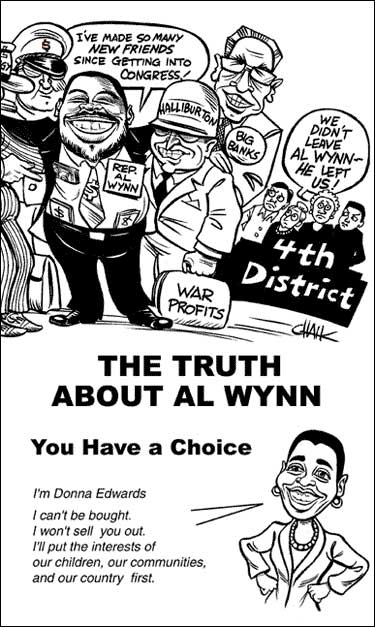
Donna Edwards Releases Political Cartoon

From the local Congressional primary campaign in my district. Wynn's vote against Network Neutrality comes to mind!

Sunday, August 27, 2006

Newsvine - Sudan Accuses Pulitzer Winner of Spying

Newsvine - Sudan Accuses Pulitzer Winner of Spying:

"A Pulitzer Prize-winning foreign correspondent for the Chicago Tribune was charged in a Sudanese court Saturday with espionage and other crimes.

"Paul Salopek, 44, was charged in a 40-minute hearing with espionage, passing information illegally and writing 'false news,' the Tribune reported on its Web site. His driver and interpreter, both Chadian nationals, faced the same charges."

Given the outrages committed by the Sudanese government, the arrest of three people doesn't seem to stack up much, except that these are people who might spread the word to the rest of the world. We need a free press especially where freedom is most theatened.

Saturday, August 26, 2006

Global Economic Integration: What's New and What's Not?


Ben S. Bernanke at the Federal Reserve Bank of Kansas City's Thirtieth Annual Economic Symposium, Jackson Hole, Wyoming, August 25, 2006.

After a summary of the major trends in gobalization over several centuries, Bernanke said:
"Perhaps the clearest conclusion is that new technologies that reduce the costs of transportation and communication have been a major factor supporting global economic integration. Of course, technological advance is itself affected by the economic incentives for inventive activity; these incentives increase with the size of the market, creating something of a virtuous circle. For example, in the nineteenth century, the high potential return to improving communications between Europe and the United States prompted intensive work to better understand electricity and to improve telegraph technology--efforts that together helped make the trans-Atlantic cable possible.

"A second conclusion from history is that national policy choices may be critical determinants of the extent of international economic integration. Britain's embrace of free trade and free capital flows helped to catalyze international integration in the nineteenth century. Fifteenth-century China provides an opposing example. In the early decades of that century, the Chinese sailed great fleets to the ports of Asia and East Africa, including ships much larger than those that the Europeans were to use later in the voyages of discovery. These expeditions apparently had only limited economic impact, however. Ultimately, internal political struggles led to a curtailment of further Chinese exploration (Findlay, 1992). Evidently, in this case, different choices by political leaders might have led to very different historical outcomes.

"A third observation is that social dislocation, and consequently often social resistance, may result when economies become more open. An important source of dislocation is that--as the principle of comparative advantage suggests--the expansion of trade opportunities tends to change the mix of goods that each country produces and the relative returns to capital and labor. The resulting shifts in the structure of production impose costs on workers and business owners in some industries and thus create a constituency that opposes the process of economic integration. More broadly, increased economic interdependence may also engender opposition by stimulating social or cultural change, or by being perceived as benefiting some groups much more than others.
Barnanke went on to suggest that the same patterns persist today, emphasizing the role of information and communications technologies. He then examines:
What, then, is new about the current episode? Each observer will have his or her own perspective, but, to me, four differences between the current wave" of global economic integration and past episodes seem most important. First, the scale and pace of the current episode is unprecedented. For example, in recent years, global merchandise exports have been above 20 percent of world gross domestic product, compared with about 8 percent in 1913 and less than 15 percent as recently as 1990; and international financial flows have expanded even more quickly.......

"Second, the traditional distinction between the core and the periphery is becoming increasingly less relevant, as the mature industrial economies and the emerging-market economies become more integrated and interdependent. Notably, the nineteenth-century pattern, in which the core exported manufactures to the periphery in exchange for commodities, no longer holds, as an increasing share of world manufacturing capacity is now found in emerging markets......

"Third, production processes are becoming geographically fragmented to an unprecedented degree. Rather than producing goods in a single process in a single location, firms are increasingly breaking the production process into discrete steps and performing each step in whatever location allows them to minimize costs.......

"The final item on my list of what is new about the current episode is that international capital markets have become substantially more mature. Although the net capital flows of a century ago, measured relative to global output, are comparable to those of the present, gross flows today are much larger. Moreover, capital flows now take many more forms than in the past."
He concludes:
"By almost any economically relevant metric, distances have shrunk considerably in recent decades. As a consequence, economically speaking, Wausau and Wuhan are today closer and more interdependent than ever before. Economic and technological changes are likely to shrink effective distances still further in coming years, creating the potential for continued improvements in productivity and living standards and for a reduction in global poverty.

"Further progress in global economic integration should not be taken for granted, however. Geopolitical concerns, including international tensions and the risks of terrorism, already constrain the pace of worldwide economic integration and may do so even more in the future. And, as in the past, the social and political opposition to openness can be strong. Although this opposition has many sources, I have suggested that much of it arises because changes in the patterns of production are likely to threaten the livelihoods of some workers and the profits of some firms, even when these changes lead to greater productivity and output overall. The natural reaction of those so affected is to resist change, for example, by seeking the passage of protectionist measures. The challenge for policymakers is to ensure that the benefits of global economic integration are sufficiently widely shared--for example, by helping displaced workers get the necessary training to take advantage of new opportunities--that a consensus for welfare-enhancing change can be obtained. Building such a consensus may be far from easy, at both the national and the global levels. However, the effort is well worth making, as the potential benefits of increased global economic integration are large indeed."

Read coverage of the speach by Nell Henderson "Fed Chief Backs Global-Wealth Sharing: Bernanke Says Policies, Technology Can Help Reduce Poverty Rate," The Washington Post, August 26, 2006.

The International Conference on Harmonisation

ICH

The International Conference on Harmonisation of Technical Requirements for Registration of Pharmaceuticals for Human Use (ICH) is a unique project that brings together the regulatory authorities of Europe, Japan and the United States and experts from the pharmaceutical industry in the three regions to discuss scientific and technical aspects of product registration.

The purpose is to make recommendations on ways to achieve greater harmonisation in the interpretation and application of technical guidelines and requirements for product registration in order to reduce or obviate the need to duplicate the testing carried out during the research and development of new medicines.

Social News Websites

There are a number of Community-Edited News websites on the Internet now. These include:
* Netscape

* Newsvine

* Digg and

* Reddit

They can be seen as examples of what has been termed "crowdsourcing" ("The Rise of Crowdsourcing," Jeff HowePage, Wired, Issue 14.06, June 2006). That is, their content is contributed by a large cadre of people from the cybersphere, rather than by paid reporters and editors. These sites also involve their readers editorially, since they vote on the interest of each posting, and postings are displayed with measures of their popularity. Postings include not only news from the established media, but items found trolling the blogosphere.

Until recently, these social news sites were wholely dependent on volunteers, but that is now changing.

Jason Calacanis, who started the Silicon Alley Reporter magazine and blog publisher Weblogs Inc. (later sold to AOL), is now general manager of Netscape.com. Calacanis's Netscape is now paying bookmarkers with strong track records on other sites to come to work for at Netscape (the old home page for the old browser that’s trying on a new life as a group-edited news site.) This not surprisingly has turned out to be a controverial move among many (except of course for the dozen or so receiving $1000 per month for the services they were previously providing for free).

Read more about Social News:
* "An Eye for Cool, and Cash," Sara Kehaulani Goo, The Washington Post, August 26, 2006

* "Should Community-Edited News Sites Pay Top Editors?," Mark Glaser, Mediashift, July 25, 2006.

InnoCentive

InnoCentive:

InnoCentive is a web-based community matching scientists to relevant R&D challenges posed by companies from around the globe. It provides an online forum enabling companies to crowdsource scientific innovation through financial incentives.

According to Wired magasine,
"Pharmaceutical maker Eli Lilly funded InnoCentive’s launch in 2001 as a way to connect with brainpower outside the company – people who could help develop drugs and speed them to market. From the outset, InnoCentive threw open the doors to other firms eager to access the network’s trove of ad hoc experts. Companies like Boeing, DuPont, and Procter & Gamble now post their most ornery scientific problems on InnoCentive’s Web site; anyone on InnoCentive’s network can take a shot at cracking them.

The companies – or seekers, in InnoCentive parlance – pay solvers anywhere from $10,000 to $100,000 per solution. (They also pay InnoCentive a fee to participate.)"


This organization provides laboratory chemical and microbiological scientists anywhere in the world to utilize their expertise and earn significant cash payments for their successes.

Friday, August 25, 2006

How Discoveries Are Made

The Washington Post today, in its article about the change in Pluto's classification states:
The controversy over how to define Pluto began when scientists realized it is much smaller than it was thought to be when it was discovered in 1930. Early data indicating that it was large enough to disturb the orbits of Neptune and Uranus turned out to be observational errors.
I had thought for decades that the discovery of Pluto was a triumph of scientific accuracy, but apparently it was as accidental as Columbus' discovery of America. It thus falls in the same category as Fleming's discovery of penicillin -- which (if I recall correctly, and the information that I had was right in the first place) was actually a rediscovery of something found earlier but not exploited, and was due to his observing places free of bacterial growth on a dirty Petri dish, and looking for the cause of the anomaly.

I guess these examples simply show the importance of observation in science.

Two seemingly opposing proverbs which come to mind:
* Don't just sit there, do something!
* Don't just do something, think!

Thursday, August 24, 2006

Evolution Major Vanishes From Approved Federal List - New York Times

Evolution Major Vanishes From Approved Federal List - New York Times:

"Evolutionary biology has vanished from the list of acceptable fields of study for recipients of a federal education grant for low-income college students.

"The omission is inadvertent, said Katherine McLane, a spokeswoman for the Department of Education, which administers the grants. 'There is no explanation for it being left off the list,' Ms. McLane said. 'It has always been an eligible major.'

"Another spokeswoman, Samara Yudof, said evolutionary biology would be restored to the list, but as of last night it was still missing."

Quotation: Joseph Priestly

"We were united by a commonlove of science, which we thought sufficient to bring together people of all distinctions, Christians, Jews, Mohametans, and Heathens, Monarchists and Republicans."
Joseph Priestly, Experiments on the Generation of Air from Water
Quoted in The Lunar Men by Jenny Uglow

Priestly apparently did not know the current Republican administration!

Worldmapper

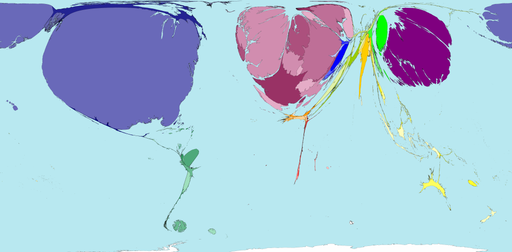
"Two thirds of the territories in the world have experienced a growth in their wealth from 1975 to 2002. The biggest absolute wealth increase has been in China. Eastern Asia has experienced the largest proportional increases in wealth, averaging a growth in Gross Domestic Product (GDP) of 8% a year." Worldmapper has produced a map, based on the familiar projection, which morphs the sizes of countries according to the growth of their wealth between 1975 and 2002.

It is just one of a number of maps of the distribution of world wealth provided by Worldmapper. Thus the section of the website on wealth includes maps of:
* Research and Development Expenditure
* Research and Development Employees
* Patents Granted
* Royalty Fees
There is also a section of maps on education. A section of maps on communication is under development, due later in 2006.

The section titled "manufacturers" includes maps of:
* Electronics Exports
* Electronics Imports
* Computers Exports
* Computers Imports
Worldmapper is a product of the Social and Spatial Inequalities Research Group of the Geography department of the University of Sheffield.

Examples


Here are two of their great maps, illustrating the degree to which a few rich countries dominate the control of patent rights. Of course, they do so by reason of their heavy expenditures on research and development, which are justified by the income generated by their industrial innovation. If knowledge is the new generator of competitive advantage, these countries have a comparative advantage in knowledge generation.
Territory size shows the proportion all patents worldwide that were granted there.
© Copyright 2006 SASI Group (University of Sheffield) and Mark Newman (University of Michigan)

Territory size shows the proportion of worldwide earnings (in purchasing power parity) from royalties and license fees that are earned there.
© Copyright 2006 SASI Group (University of Sheffield) and Mark Newman (University of Michigan)

Wednesday, August 23, 2006

UNCSTD Centers of Excellence

StDEv--Science, Technology and Innovation Policy Review:

"UNCTAD in collaboration with the United Nations Commission on Science and Technology for Development (CSTD), launched in 2005, a project connecting centres of excellence in developing countries. The project is designed to select existing outstanding centres of excellence in developing countries and use them as regional hubs of learning that can pool resources with one another and conduct joint research in areas of importance to developing countries.

Initially, the Network will consist of 10 existing scientific institutions which are willing and able to make their facilities available to scientists and engineers from other developing countries, especially from Africa. Each of these institutions will provide training for scientists and engineers in selected subject areas."

allAfrica.com: Africa: Online Portal Aims to Reverse Brain Drain

allAfrica.com: Africa: Online Portal Aims to Reverse Brain Drain:

"A London-based company has launched an online service to address the impact of the continuing and devastating drain of professional talent from Africa.

Interims for Development launched ReConnect Africa, a unique online publication which would offer a one-stop shop for those who recruit and manage talent in Africa and provides jobs, information and advice for job seekers and entrepreneurs around the world looking at career and business opportunities in Africa."

Monday, August 21, 2006

Amazon.com | Click to download | Economist.com

Amazon.com | Click to download | Economist.com:

"In America online sales were up by 25% in 2005 over the previous year, reckons Forrester, a research company. Travel is now by far the biggest category, worth some $63 billion last year, followed by computer equipment and software ($14 billion), cars ($13 billion), clothing ($11 billion) and home furnishings ($8 billion)."

Cheating Is an Awful Thing for Other People to Do

Cheating Is an Awful Thing for Other People to Do:

"Most people report telling lies on a fairly regular basis and being largely untroubled by them. When pressed, people say their lies are innocuous.

Nor can the world be divided cleanly into cheaters and honest people: A variety of ingenious experiments show that large majorities of people can be induced to do the wrong thing, depending on the circumstances.

Among the most potent motivators to cheat is the sense that one has lost the limelight, is falling behind and will be judged harshly. People are also more likely to cheat if they think other people are cheating."

Can information be owned?

This is a real question, and if there are lawyers or others out there who know the answer, please post a comment or suggest some readings.

It seems to me that under U.S. law, no one owns information.

You can own a book. Some books are worth tens and even hundreds of thousands of dollars to collectors, and they are legally protected n the same way as any valuable physical property. However, the owner of the book does not own the information contained in that physical object.

Copyright explicitly protects the expression or organization of information, not the information expressed or organised. Indeed, if I understand copyright law correctly, a copyright grants the holder the monopoly right to exploit the expression or organization, rather than ownership of the information per se.

Patents and similar instruments, similarly grant the right to exclude others from exploitation of inventions for limited periods of time, but do so on the condition that the information per se is made available to the public. Indeed, the purpose of establishing patent rights under law is to trade the monopolistic exploitation rights for publication of the information, in order that others might take the ideas from the patent and extend and expand them.

Trade secrets are protected from being stolen, but I don’t think the protection extends to ownership of the information per se. Thus if you hold the recipe for a wonderful food product as a trade secret, you are protected against a competitor surreptitionsly buying the recipe from one of your employees and using it in his own product. However, you are not protected from that competitor creating his own recipe for a food indistinguishable from yours and marketing that food. Trade secrecy limits the ways of acquiring information, but not the fundamental right to generate or otherwise legally acquire the information held as trade secret.

Similarly, contract law allows non-disclosure contracts and clauses in which one party to the contract agrees (in return for some benefit) not to disclose certain information. But I would assume that such contracts do not establish any ownership rights to the information involved. Rather they simply formalize the renunciation of the rights of one of the parties to the contract to disseminate that information.

The U.S. government has the right to classify information for national security reasons. This seems again to be a right of government to restrict some people from disseminating that information, and indeed it seems limited to people working directly or indirectly for the government, who in general will have surrendered any right to disseminate such information when granted a clearance.

Anti-spying laws would seem also to limit the ways in which people can acquire information, not imply ownership of that information.

As I understand it, some governments have “state secrets acts” which prohibit any citizen or resident of their country from disclosing information designated as a state secret. But again, this seems a lesser right than would be implied by government ownership of that information. I think it is being debated now whether the U.S. government has the right to exclude the publication of classified information by the media, or whether is should be given such a right; the case of the Pentagon Papers would seem to indicate that the government does not have such a right.

The First Amendment to the U.S. constitution prohibits the government from impinging on the freedom of speech for any and all U.S. citizens. This would seem to allow a citizen the right to communicate any information he/she chooses to the world (unless he/she has contractually accepted a limitation on that free speech). I think this implies that the government can not own a piece of information in the sense of owning a piece of land. It can not exclude others from the right to use or communicate that information.

Certainly one often pays to obtain information. One buys a newspaper or a consultation with a physician, but I think the payment in these cases is made for a good or a service, and the information content comes free in the bundle.

So is it really true that there is no right to own information? If so, is that just U.S. law, or is that common among nations?

The Categories We Use Influence the Way we Think and Act

A Riff Occasioned by Ian Hacking’s Piece in the London Review of Books. ("Making Up People," Vol. 28 No. 16 dated 17 August 2006. Subscription required to read online.)

We categorize things. Our language is constructed to do so. If we have a noun, then we have a category of things to which that noun refers, as the word “chair” refers to the things we categorize as chairs. If we have a verb, then we have a category of actions to which that verb refers, as the verb “to run” refers to the actions we categorize as running. So too, if we have an adjective, then we have a category of things to which that adjective refers, as the adjective “white” refers to the things we categorize as being white.

Our language differentiates the noun categories from the adjective categories. The state of being a chair seems more intrinsic and permanent than that of being white.

I have only studied a few languages, but it seems to me that the link between a word and a class to which that word refers must be universal. I would therefore suppose it is hard wired into our brains.

Hacking in his essay is “interested in classifications of people, in how they affect the people classified, and how the affects on the people in turn change the classifications.” He seems especially interested in biological or medical classifications of people.

He points out that classifications change. Thus “autism” and “multiple personality disorder” are both medical terms of classification that emerged in the latter part of the 20th century. He makes the fascinating observation that there were probably always children we would now call autistic children, but that many psychiatrists believe that there were not people who had what we would now call multiple personality disorder before the psychiatric diagnostic category was created.

He uses also a more popular example. In my younger days, among some people, it was popular to refer to people as “hip” or “square”. Indeed, some people thought of themselves as hip, and acted according to that self-image. I think that very few people think in those terms any more, and I think some aspects of “hip” behavior have pretty much died out.

Some categories carry more information than others. Thus "Downs syndrome" tells one quite a bit about a person with that genetic abnormality, while "African American" tells one much less of medical importance about a person so classified.

For the last couple of hundred years the way people think about categories has changed in the West. (Remember that Bo Derek was a 10!) We count people according to these classifications, and the gathering and analysis of statistics has become a huge undertaking. We define categories of people quantitatively. Thus there are World Health Organization defined borders between the categories of “those of normal weight”, “those who are overweight” and “those who are obese”. We correlate, and find that those who are obese are more likely to have certain health problems than those who are of normal weight.

Hacking points out that, for those of us who have absorbed Western culture, this numerical way of thinking is so ingrained that we tend to assume everyone thinks in this way. This may not be so, and indeed probably is not so.

My first reaction is to wonder how we could ever count the number of people who don’t think quantitatively about people, how we could ever measure the degree of quantification in peoples thinking about people, much less correlate this thinking with any other attributes. See how pervasive quantification is in my thinking!

When we have a category of people, it seems natural (in our Western way of thinking) to wonder about causality. What causes autistic children to be the way they are? What causes people with split personalities to be that way? What causes people to be obese? If we can find a biological reason, or better yet a genetic reason, it affects the way we think about the people involved. I wonder if we would have less homophobia if we knew for sure that homosexuality was caused by hormones during gestation, or was inherent in some people’s genomes?

I suspect that some causal thinking is also hard wired in our brains. Understanding that people who eat a certain kind of plant get sick helps one to avoid eating that plant, and would have had sufficient evolutionary advantage to be selected for. In the past, people often attributed causes to spirits and otherworldly causes. For us Westerners, we seek scientific explanations, and as any reader of this blog would guess, I see that as an advantage.

Knowledge of the categories to which we belong also often affects the way we think about ourselves, and thus the way we act. I am diabetic. Once I was diagnosed, and understood that I have a metabolic disorder that affects the way my cells absorb glucose, I defined myself to include that diagnosis. Similarly, finding that relatives shared certain health problems changed my ideas about myself. Once I thought of myself as a diabetic, I changed my eating and exercise habits, lost weight, began consulting more regularly with my physician, and began a course of prescribed medication.

Hacking also mentions the institutionalization of categories. He notes that autism was once defined as a “medical problem” and thus in the field of competence of medical institutions, but is perhaps being reclassified as a “disability” and thus in the field of competence of other groups that deal with rehabilitation and education for living with disabilities. I think we are now institutionalizing “childhood obesity” as a condition to be dealt with by school systems and families – and the approach is to seek to normalize the child’s weight.

Such “normalization”, or bringing back toward a more typical (“average” or “modish”) value, is also discussed by Hacking. Note that such normalization is probably a good thing for conditions that are correlated with dysfunction, e.g. obesity. It is sometimes applied to conditions for which such correlations are not clear, e.g. being in the WHO category “overweight”. Indeed, it is sometimes applied in ways that seem counterproductive, e.g. ghetto children “normalizing” their scholastically high-performing peers toward the lower scholastic performance that is the ghetto norm.

Finally, Hacking points out that once we have a category applied to people, they can and do form groups and act collectively according to that categorization. Thus there are organizations of people interested in diabetes, and the people in that group lobby collectively (and thereby effectively) for things like stem cell research and fair treatment of diabetics by employers.

Hacking does not extend the discussion into politics or international affairs, but it seems to me that we should do so. It is important, for example, as we think about Iraq to recognize that people there are classified by themselves and by others as Sunni, Shiite, or Kurd. We must also realize that they classify themselves in other ways which we understand even less well, including tribally and factionally. Without understanding the classifications on which people base their actions, it is hard to see how we can predict those actions.

Perhaps the first lesson of international diplomacy and international development is humility, including the recognition of how little we know about others, the categories they use, and the way they think. The natural corollary is that we must give priority to learning about others if we are to interact with them intelligently.

My wife points out that Hacking is a philosopher with an extremely valuable talent and skill – to point out things that are obvious once demonstrated, but which few if any others have previously appreciated. Moreover, as he teaches us about thinking, we can perhaps draw some lessons and learn to think better.

Sunday, August 20, 2006

"Brazil's Road to Energy Independence"

"Brazil's Road to Energy Independence: Alternative-Fuel Strategy, Rooted in Ethanol From Sugar Cane, Seen as Model"
Monte Reel
The Washington Post
Sunday, August 20, 2006.

Gas stations in Brasil offer ethanol, gasoline or premium gasoline. But "the gasoline varieties are blends that contain at least 20 percent ethanol. The pure ethanol is usually significantly cheaper -- 53 cents per liter (about $2 per gallon), compared with about 99 cents per liter for gasoline ($3.74 per gallon) in Sao Paulo this past week." Ethanol has about 70 percent of the fuel efficiency of gasoline, but is the better buy at current prices. Ethanol has replaced about 40 percent of the country's gasoline consumption.

The Center for Sugarcane Technology in Sao Paulo state has worked for decades to improve efficiency in ethanol production with efforts ranging "from the genetic structure of sugar cane varieties to the industrial components of extraction. By the time oil prices began to rise steadily in the early years of this decade, ethanol producers had reduced production costs of a liter of ethanol from about 60 cents to about 20 cents."

"The ethanol extracted from corn yields only about 15 to 25 percent more fuel than the fossil fuels that were used to produce it. In Brazil, according to industry studies, the sugar-based ethanol yields about 830 percent more."

In 2003 Volkswagen introduced the first flex-fuel vehicle to the Brazilian market, and other companies -- including General Motors and Ford -- have followed suit. "Several major automakers predict that such vehicles will represent 100 percent of their production by the end of the year, eliminating gas-only models."

Many Brazilian and U.S. experts "agree that the future of ethanol resides neither in sugar nor corn, but in cellulosic ethanol, a biofuel that theoretically could be extracted from almost anything from switch grass to scrap paper. The United States is leading research into developing cellulosic technology, and the Energy Department this month announced it was dedicating $250 million for two new research centers dedicated to the cause."

I recall not too many years ago people making fun of Brazil for its emphasis on ethanol, and questioning the potential of ethanol production,but for many years I have felt that research and development of biomass coversion programs was a hight priority.

U.S. Rice Found Contaminated by GM Variety

Read the full article by Rick Weiss in The Washington Post of August 19, 2006.

U.S. commercial supplies of long-grain rice were apparently inadvertently contaminated with a genetically engineered variety not approved for human consumption. The variety, produced by Bayer CropScience and known as LLRICE 601, is endowed with bacterial DNA that makes rice plants resistant to a weedkiller made by Aventis. The company reported that it had discovered "trace amounts" during testing of commercial supplies. "Bayer had not finished the process of getting LLRICE 601 approved for marketing before dropping the project years ago. But the company did complete the process for two other varieties of rice with the same gene. And although neither of those were marketed, he said, their approval offers reassurance that 601 is probably safe, too."

I am glad that I just posted "Lets Keep Risks in Perspective". The health risk of trace amounts of a probably safe gene found while testing stored rice, and immediately reported, are probably vanishingly small. There is. however, a financial risk to Bayer, U.S. rice farmers, food exporters, and consumers in developing nations if there is an overblown response to this discovery. The might even be a health risk people in need of food aid are denied food because it might be "contaminated" with trace amounts of a GM variety.

Saturday, August 19, 2006

Why I am Supporting Donna Edwards

In my Congressional District (Maryland's 4th District) two liberal Democrats are competing for the nomination for Congress. I am supporting Donna Edwards against Al Wynn.

Art Brodsky has a good recent piece on Edwards in TPM Cafe. Edwards has endorsements from the National Organization of Women, the Sierra Club, the League of Conservation Voters, and the Progressive Democrats of America (PDA), not to mention Danny Glover and Gloria Steinem.

Al Wynn, while voting with the Democrats on the large majority of bills, but has had a few notable defections. He voted with the Republicans to offer tax breaks and incentives oil and gas companies last year, to ammend the Constitution to ban flag burning, and on the Terry Schiavo case. On all of these I agree with the Democratic majority. While he now opposes the war in Iraq, his vote supported it initially. He also voted in favor of Dick Cheney's failed energy policy. His supporters acted badly at a recent campaign event.

What really got my vote, however, is the issue of net neutrality. Donna Edwards says:
I support legislation that guarantees "Internet Freedom" – known as network neutrality. This is being referred to as the “First Amendment” of the Internet and ensures equal access for all to access the Internet. However, this freedom is now in jeopardy.

There should be no corporate or governmental gatekeepers for the online medium. Consumers should be able to readily visit the website of their choice. Websites, such as those from local businesses, should not have to pay a tax to large cable or phone companies in order to ensure they receive reasonable service. There shouldn't be toll lanes for online communications that would impose additional charges for different levels of access. Such open access is the foundation of the Internet's success and its usefulness as a tool for public information.
Al Wynn's website seems to be silent on his position on the issue. But Al Brodsky tells us:
Congressman Al Wynn (DINO-MD) has a prime congressional seat on the subcommittee that oversees policy for telecommunications and the Internet. It's a shame he's using it to sell out his constituents in favor of the big telecom companies.
And that is the issue that tips the balance!

Friday, August 18, 2006

Lets Keep Risks in Perspective

Jon Stewart last night did a riff on the Daily Show on how the arrest of a suspect in a ten year old murder case had supplanted the Israeli invasion of Lebanon in the news media, as Lebanon earlier had pushed the war in Iraq into the background. The audience of the mass media, and the media itself seem to have trouble keeping perspective on the relative importance of different stories. Unfortunately, that is not just a joking matter.

Nearly 3,000 people were killed on 9/11 (2001). Foreign Policy magazine this month has an article ("9/11 + 5," not yet available on the web) that reports a very low level of fatalities in North America from terror attacks between 1998 and 2005 outside of 9/11. (It reports that the number of such deaths have increased markedly in the Middle East and Asia.)

Iraq Body Count reports today that between 40,340 and 44,871 civilians have been reported killed by military intervention in Iraq. This would seem a very conservative estimate of the true cost of the war in terms of illness, disability, and death. (I know, there is no evidence that Iraq was implicated in 9/11, but I doubt that the Administration could have gotten the authorization for the war without 9/11.) I posted earlier about the huge economic cost of the war in the United States.

The most recent complete and authoritative mortality figures for the United States are for 2003. In that year, 2,448,288 deaths occurred in the United States. The five leading causes of death were:
* Diseases of heart (heart disease) - 685,089

* Malignant neoplasms (cancer) - 556,902

* Cerebrovascular diseases (stroke) - 157,689

* Chronic lower respiratory diseases - 126,382

* Accidents (unintentional injuries) - 109,277
Basically, there have been 150 times as many deaths from accidents in the United States in the last five years from accidents as from terrorist attacks, even counting the 9/11 deaths. Can anyone believe that we have struck the right balance in the relative responses to the large and well known threats from our common health problems versus to the threat of terrorism? Of course we are spending time and effort to improve health, and of course we should take steps to combat terrorism, but really!

There are well known reasons why we make mistakes in estimating risks. We think the more memorable risks are greater. We over-estimate the importance of risks that are new, compared to risks that are familiar. We over-estimate risks that we don't understand. And we over-estimate risks that inspire terror. Thus the public probably has excessive fears of nuclear power and genetically modified crops, which are relatively new technologies that are poorly understood, with a few memorable stories of risky events.

I would suggest too, that risk mongers who encourage the public toward specific fears also have an impact.

The role of the media and of political leaders should be first to base their decision making on accurate risk measurements and second to help the public put relative risks into perspective. Responses made by a great power, such as the United States, should be measured and proportionate to the problem they seek to address.

"The FBI's Upgrade That Wasn't: $170 Million Bought an Unusable Computer System"

Read the full article by Dan Eggen and Griff Witte in today's Washington Post (August 18, 2006).

This article shows how hard it can be to develop a major governmental software application, and how expensive a failure can be. The Virtual Case File (VCF) system was planned by the U.S. Federal Bureau of Investigation to replace its paper system for case management. The old system reflected 1920's technology. Initiated before 9/11, the project priority increased greatly after the terrorist attack, as did its budget.

According to the article, "the collapse of the attempt to remake the FBI's filing system stemmed from failures of almost every kind, including poor conception and muddled execution of the steps needed to make the system work, according to outside reviews and interviews with people involved in the project......the FBI made a fateful choice: It wanted SAIC to build the new software system from scratch rather than modifying commercially available, off-the-shelf software......By early 2004......thousands of new PCs and an integrated hardware network were well on the way to being delivered and installed. But, as the researchers soon learned, the heart of the makeover, VCF, remained badly off track......the FBI planned to launch the new software all at once, with minimal testing beforehand. Doing so.....could cause 'mission-disruptive failures' if the software did not work, because the FBI had no backup plan.....'If the new system didn't work, it would have just put the FBI out of business.'" The decision was made in early 2005 to abandon the VCF project. "Last year, FBI officials announced a replacement for VCF, named Sentinel, that is projected to cost $425 million and will not be fully operational until 2009."

The authors imply that the FBI staff did not include sufficient expertise to manage an ICT project of this kind and magnitude, but that the major contractor was also at fault. External evaluations of the project done by a contractor (for US&2million) and the National Research Council illuminated the problems with the project, and helped senior FBI management with the termination decision. But without sufficient in-house knowledge, major software development projects, on which organizations bet their survival (or ours) are very dangerous!

Tuesday, August 15, 2006

Face value | From online to helpline | Economist.com

Face value | From online to helpline | Economist.com (Subscription required.)

The African Management Services Company (AMSCO), based in Johannesburg is the brainchild of the International Finance Corporatio, the UN Development Programme, and the African Development Bank. Its mission is to help small African firms become competitive. According to this article
AMSCO typically hires one or two specialist managers to work at the client company, usually for three years. Around 225 managers from all over the world—including Africa—are now working with 120 clients in 21 African countries.

Nations Cut Renewable Energy R&D in the Face of Energy Shortage and Global Warming

Read the full editorial by Martin Rees in last week's Science. (subscription required.)

"The urgent challenge is to meet global demand [scheduled to rise by more than 50% in the next 25 years, according to the International Energy Agency (IEA)] while reducing the impact of greenhouse gas emissions on climate change.

"A paper published last October concluded that public-sector R&D investment in energy in most industrialized countries has fallen sharply in real terms, from peak levels in the early 1980s, with some stabilization in the 1990s. That analysis demonstrated that the 11 IEA countries accounting for most of the world's energy R&D had all decreased expenditures as a proportion of gross domestic product between 1975 and 2003. Investments in major energy R&D program areas dropped by 53% between 1990 and 2003. Fossil fuels and nuclear power accounted for more than 90% of the aggregate decline, but there was also an overall drop of 5% for R&D on renewable technologies."

Back to the People -- Kennedy 313 (5788): 733 -- Science

Back to the People -- Kennedy 313 (5788): 733 -- Science: (A subscription is necessary for online access to this editorial in the current Science magazine.

"President Bush's recent veto of HR 810, the measure in the U.S. Congress that would have expanded federal funding for stem cell research, has focused attention on what is happening in this and other issues in science policy. The Senate vote was 63 to 37 in favor: a strong vote, but neither it nor the House could gather enough votes for the supermajority required to override the veto. That left federal funds available for research on only the few cell lines derived before 9 August 2001 and revealed a seismic shift in the relationship between the president and the people's representatives in Congress."

Kennedy goes on to link the veto to the Bush Administration's recalcitrant attitude on global warming and the control of greenhouse gas emisions.

He points out that uniquely, as a result of the failures in scientific leadership of the Administration in these two fields, state and city governments are stepping up to fill the gap. I am happy to report that Maryland, my state, is one of five in which the state government is funding stem cell research.