Showing posts with label . Development. Show all posts

Sunday, November 08, 2015

Advanced S&T Projects from USAID


Some years ago I wrote an article for the USAID Impact Blog, (Unfortunately, the article was labeled "50th Anniversary: The Program of Scientific and Technological Cooperation" and published on its 30th anniversary.) Still, I think the piece is still useful as a history of a U.S. initiative in science and technology. You will find it here: https://blog.usaid.gov/2011/01/50th-anniversary-the-program-of-scientific-and-technological-cooperation/

In 2007, an article was published in IIP Digital about the Middle East Regional Cooperation Program. That program was also managed by my office, and the article draws heavily on the information and comments provided by David O'Brien, who now manages MERC.  You will find the article here: http://iipdigital.usembassy.gov/st/english/article/2007/10/20071018111900lcnirellep0.2568476.html#axzz3qvJlop9i

Sammy El-Shall discusses nanotechnology, and specifically a nanotechnology project in which his is involved under the MERC program in a transcript published on the State Department website. You will find it here: http://m.state.gov/md212167.htm

Friday, September 04, 2015

Friday, August 28, 2015

Our Kids -- Thoughts About Robert Putnam's Book


I just read Our Kids: The American Dream in Crisis by Robert Putnam. Robert Putnam is a very distinguished public intellectual. In this book he shows a great deal of evidence that the college graduates in America are bringing up their children to be as well educated and well off as they are themselves. While once people with a high school education or less were giving their kids better opportunities that they themselves had, this is no longer true. The increasing disparity between the kids of the college educated and the kids of the high school educated is of great concern to Putnam. The book convinces me that it should also be of concern to any American with an ounce of moral character.

The book includes a chapter on Port Clinton where Putnam graduated from high school in the 1950s. It then has chapters on families, parenting, schooling and community; each of these chapters focuses on a specific place: Bend (Oregon), Atlanta, Orange County (California), and Philadelphia. A final substantive chapter is titled "What is to be Done".

Chapters tend to have narrative sections based on extensive interviews that were carried out as part of the research. The authors interview young people and their parents, where one set of parents in each location had college educations and the other set had high school or less. Interviews include African Americans and Hispanic Americans as well as whites. The chapters also have analytic sections, drawing on a wealth of statistical data.

The American Dream

The myth of America, "the American Dream", is that America is the land of opportunity. We think that any American can become president because Andrew Jackson and Abraham Lincoln rose from poverty to do so, because Jack Kennedy did so even though he was Roman Catholic, because Barack Obama did so even though his father was a black Kenyan. Similarly, we think that any child can grow up in America to be rich -- look at Andrew Carnegie, Thomas Edison, Henry Ford and Bill Gates, all of whom were rich beyond most dreams of avarice and far, far richer than their parents.

Putnam points out that in fact the Adams, Harrison, Roosevelt, Kennedy and Bush families demonstrate that someone from the family of a president is far more likely to be president than someone who grew up in a powerless family. Similarly, the child of a family of great wealth is far more likely in America to grow up to have great wealth than is the child born in poverty. Indeed, relative mobility in America has been much like that in other developed countries.

What has been true through much of history is that the rapid development of America has meant that most American parents could reasonably expect their children to be better educated, more affluent, healthier, longer lived, and more influential than the parents were themselves. A rising tide lifts all boats!

The Dream Is Gone

The book advances the thesis that the children of upper class kids in America (typically defined in the book as the children of parents with college degrees) are now likely to do better than their parents; however, the children of lower class parents (typically defined as having high school education or less) are likely to be stuck in the same situation or worse than their parents. Putnam advances evidence to show that upper class parents use different parenting approaches than do lower class parents, that upper class parents tend to stay together to raise their kids while lower class fathers are more often not involved, that upper class families live in safer neighborhoods than do lower class families, all of which help make upper class kids more able to reach the upper classes themselves.

In discussing K-12 schools, Putnam indicates that input indicators such as per child funding and class size do not differ between schools in educated neighborhoods and those in uneducated neighborhoods; the very different outcomes from schools drawing from families with well educated parents versus those with poorly educated parents is the culture of the students themselves. Neighborhoods are increasingly segregated by class, and kids in I-23 usually go to neighborhood schools. The upper class kids are more motivated to learn and more docile in the classroom. Thus it is culture that counts. Moreover, classes full of upper class kids tend to be easier to teach and more rewarding to teachers than classes full of lower class kids. Since schools get equal financial inputs, schools in upper class neighborhoods tend to be more successful in teaching the kids that they receive. Indeed, teachers prefer to deal with docile, motivated upper class kids, and so the schools in richer neighborhoods are likely to recruit better, more experienced teachers.

The book also suggests that upper class neighborhoods are better places to raise kids in the sense that they are less violent and less troubled by drugs. Children growing up in neighborhoods ruled by street gangs are subject to more stress, and that stress has serious negative consequences.

This situation is relatively new. Neighborhoods today are far more segregated by the income and education of their residents than they were in the past. Due to the shipment of jobs overseas and the loss of income from unionized factory work people with little education who once would have had factory jobs with union wages and protection, now no longer do. Thus those without college educations tend to be poor and trapped in their situations. The kids who don't go beyond high school tend to have children earlier, have less stable marital relationships, more money troubles, and indeed more children than do college graduates of the same age.

The increasing separation of affluent from poor neighborhoods means that poor whites, poor blacks, and poor Hispanics are the members of the lower class. Putnam suggests that racism is no longer the problem as much as it once was, and today there are well educated blacks and Hispanics who raise their kids much as do well educated whites, and whose kids have about the same chance of themselves becoming well educated, parents in stable marriages as do the children of well educated whites.

Source
I would note however that poverty is twice as prevalent among Hispanic/Latino populations and more than twice as common among African American and Indian populations than among white populations. Perhaps we need to focus more on the black, Indian and Hispanic populations' kids than Putnam would suggest.

The Internet

The book tends to pay little attention to the Internet and the social networking that it enables. I am in an unusual situation in that my parents were both immigrants to the USA and none of my maternal nor paternal cousins lives in this country. (My inlaws do live here, and I am in touch with them via the Internet.) I am in touch with cousins in England, Ireland, Scotland, Australia and Sweden via the Internet; for example, a cousin's widow and I were able to participate early this year in a project of a young cousin who is in college in Scotland via the Internet.

Similarly, I am fairly active on the Internet with my local community. For example, I used the Internet to keep up with the plans to change use of two local schools last spring, went to a community meeting about those plans that I learned about via the Internet, and sent email messages to my county council members requesting their help on the matter -- emails that were answered.

I belong to a local book club which meets once a month. While only a dozen or so member of the club show up at the monthly meetings, I send information about the books we read to about 100 via email each month, and correspond with several each month via the club listserve. There is a club blog where I post summaries of the club discussions, and those are being downloaded a couple of hundred times per month.

Thus, it is my experience that Internet mediated social networking has implications for the problems that Robert Putnam has identified.

I Focus on Culture and Cultural Change

I note that Asian Americans seem to still live the American dream. I also note that the well educated American family is different culturally than the families of Americans where the parents never went as beyond high school. I suggest that there are two subcultures, rather distinct, within the larger U.S. culture -- a culture of the upper middle class and a culture of the lower class. Both subcultures have the same federal government institutions, both have access to pretty much the same media, but in other ways the two subcultures have institutions that function in quite different ways.

Perhaps, then we should look at the cultural difference between suburban America and slum America. If the solution to the crisis in the American dream is too change the culture of the lower classes in the country, it will be hard and a long process. Cultural change is not easy to accomplish.

Putnam suggests that the change in these subcultures in American have occurred over time. When he graduated from high school in 1959 in the small town of Port Clinton, Ohio, neighborhoods were not nearly so segregated as they are today. The United States then had the strongest economy in the world and globalization had not begun the process of shifting manufacturing jobs out of the USA. Kids whose parents were college professors and kids whose parents were high-school-grad factory workers might well live close to one another, attend the same schools and belong to the same teams and clubs. This was before illegal drug use was common and drug dealers were common sights in poor neighborhoods. The research cited in the book focuses on the last 35 years, and suggests that the negative trends in the subculture of the poor were working during much or most of that period. Now families are less stable, gangs are more common, drugs are more available and more widely used, fathers are more often in jail in the lower class neighborhoods. The neighborhoods in which the college grads live have been much less damaged.

Economics
Source: Wikipedia "Income inequality in the United States"
The top graph shows that we are in a new "Guilded Age": the portion of national income obtained by the very rich has reached levels now that are comparable to those reached before the Great Depression or the end of the Guilded Age. That portion had gone steadily downward from the stock market crash in 1929 until the mid 1970s, but rose again in the period covered by Robert Putnam's analysis.

The lower graph showed that the top fifth of Americans by income did significantly better economically after 1979 than did the the lower four quintiles. Wikipedia reports:
The income growth of the average American family closely matched that of economic productivity until some time in the 1970s. While it began to stagnate, productivity has continued to climb. According to the 2014 Global Wage Report by the International Labor Organization, the widening disparity between wages and productivity is evidence that there has been a significant shift of GDP share going from labor to capital, and this trend is playing a significant role in growing inequality.
I suggest that the high and increasing return to higher education is strongly related to the growth of income of the fifth quintile of income, and the low rate of economic progress of the working class is due to the low growth of incomes in the three lower quintiles.

The Prescription

Putnam offers a number of suggestions that might improve life chances for poor kids. Some of these seem past due for implementation in the USA. For example, we have far too many men in jail, facing long sentences for relatively minor crimes; sentences should be shorter and greater efforts should be made to reintegrate the sentenced people into their homes and communities after they serve their sentences. Similarly, many countries (and virtually all developed countries) offer more generous leave for new parents than does the United States; improving leave policies for new parents seems a useful approach to improving parenting. Offering long term contraception for at risk teens in order to prevent kids too young to provide child care and in need of time to develop their own economic potential from having babies as teenagers.

However, I doubt that Putnam's approach will work very well. It fails to deal with the underlying economic issues that created the underclass culture. My reading of history also suggests that it takes a major disruption to break the political power of the very rich, and today the very rich Americans are richer than ever, have more political power than usual, and don't seem disposed to do much for the underclass.

The book does not talk much about individual talent and potential. I suspect that in each socio-economic class there are kids born more and less gifted. However, the talents of the poor are not being adequately recognized and developed in the subculture of poverty. How much does the nation lose if a Lincoln or Jackson fails to develop because he comes from poorly educated parents and grows up in a bad neighborhood, attending schools that teach badly? A new Henry Ford or Thomas Edison? What if we miss the next Martin Luther King or Cesar Chavez? I think it important not only that kids be given a fighting chance to do better than their parents, but that the nation be given a fighting chance to develop the best minds and characters in each generation, no matter how poor the parents of those kids.

Final Comments

I recommend this book highly. Robert Putnam seems to have described a serious social problem in the United States, one that has not had nearly enough attention.

I guess I am a policy wonk, and I found the sections of the chapters presenting statistical evidence from national studies to be very good -- detailed information, well sources, presented succinctly.

I also found the ethnographic material helpful. I am a 1955 high school graduate with three university degrees, so I found the material about Putnam's school companions and the recently college educated folk to be relatively familiar (although those discussions provided me some fresh insights to the families of my more affluent nieces and nephews). However, I found the materials on the high school educated moms and dads and their kids very helpful in trying to understand the problems that they face and how they try to deal with those problems.

Tuesday, August 11, 2015

Institutional Change and the Reconstruction


I have been reading A Short History of Reconstruction by Eric Foner, and have posted this and this as I read.

The Civil War was very destructive, especially to the southern United States. The war decided that the United States was one nation -- indivisible. It resulted in abolition of slavery in the states in revolt during the war, and abolition of slavery for the entire nation through the 13th amendment to the Constitution immediately after the war. Thus a major focus of the Reconstruction was the reconstruction of political institutions after the war, reconstruction of economic institutions, especially those disrupted by the abolition of slavery, and reconstruction of the institutions of citizenship for to deal with the large number of former slaves who had been freed.
  • Political Institutions: the discussion focuses on who should vote. Should former slaves have the vote? How about Rebel leaders? When should voting rights be restored to the former Confederate states? How would it be decided if the voting had been fair and whether to seat those elected/
  • Economic Institutions: The key issue was how to institutionalize the work of the former slaves. If plantation agriculture was to continue, how would one institutionalize the interface that connected labor to the plantations? How many small farms for black families would be established and how would the relevant economic institutions be organized.
  • Citizenship Institutions: How would citizenship related institutions be restructured to allow former slaves to have citizenship rights and responsibilities? 
The choice of political institutions was influenced of course by the racism common in the southern and northern states. but also be the desire of the Republicans dominating the federal government to institutionalize a system that would keep their party in power.

The freed slaves seemed to have wanted their own small farms that would have focused on subsistence production for the family plus some product for the market; this of course was a radical change from the plantation system of the deep south, a change that the blacks and their allies turned out not to have the power to obtain. Still it was a model that had been used by Sherman during the war (40 acres and a mule) and was a model used in the Homestead Act for the settlement of lands newly taken by the USA.

Since the plantation system survived, how would plantations recruit labor? Various options were tried. The principle one used for many years turned out to be sharecropping. Tenant farming (by black families of land owned by whites also emerged in the post-war south. However, there was also a mechanism used in which blacks were convicted of minor crimes, and then their labor sold to plantations in "work gangs" by officials of the government. The normal hiring institutions that had been assumed to be the outcome by northerners seem to have been little used.

Blacks were given citizenship as a birthright, and had rights to freedom, marriage, to testify in courts, to make contracts, and to own property, etc. It turned out that eventually the right to vote by blacks and to hold political office were initally denied in the south (and sometimes in the north), and were among the most controversial issues of the post-war period.

Beyond the Institutions Described Above

Today we understand that a culture includes many institutions, that the institutions influence one another, and some of the institutions that are less discussed in the book may have been quite important in the Reconstruction period.

Southern Black Culture

Blacks, whose marriages had not been respected in slavery, were very concerned with marriage institutions; as they had often been torn away from children in slavery, in freedom that wanted to institutionalize their rights to bring up their children. 

Former slaves quickly institutionalized their own churches and their own religious institutions, albeit ones that seem to us now to have been modeled after white churches and institutions with which they had been familiar.

Blacks had learned the value of education, and wanted schools. Barred from integrated schools, they quickly created black educational institutions. I assume that the first historically black colleges and universities came to be in this period, as well as adult literacy classes and schools for black children.

So too, blacks quickly developed communal organizations such as clubs, civic action groups, etc.. Recalling that Alexis De Tocqueville was struck by the number and importance of communal organizations in America, it is perhaps not surprising that many of the black institutions seem to have been strongly influenced in form and function by those in white communities.

White Southern Culture

I am no expert, but white southerners seemed more likely (than were blacks) to keep somewhat modified institutions that already existed, perhaps because they had more political and economic power with which to defend those institutions. One obvious exception is the KKK, which was developed to use force to reject black demands for improved status. As stated above, white plantation owners and managers ultimately substituted sharecropping, tenant farming, and use of prisoners for slave labor. thereby achieving high levels of production and export. (Eventually, mechanization would reduce labor needs for cotton farming and other forms of extensive agriculture.)

Northern Institutions

I recall that new institutions were being created in the north as well in the post war period. The transcontinental railroad and telegraph, supported in part by the national government through land grants are an obvious example. In education, the federal government again used land grants to establish a national system of land grant colleges. In the area of science and technology, a national system of agricultural field stations was created, linked to the land grant colleges and universities; the National Academy of Sciences was created.

Of course, the federal government innovated greatly during the Civil War. The military size was increased hugely. Institutions were created to support the soldiers, and in the aftermath of the war a system of National cemeteries was created.

A national currency replaced the many bank issued currencies, and a system of national banks was created. Federal bonds were issued to obtain money, and for the first time some were issued in small denominations for less than wealthy buyers. Wikipedia states:
Republicans enacted their legislation. At the same time they passed new taxes to pay for part of the war, and issued large amounts of bonds to pay for the most of the rest. (The remainder can be charged to inflation.) They wrote an elaborate program of economic modernization that had the dual purpose of winning the war and permanently transforming the economy. The key policy-maker in Congress was Thaddeus Stevens, as chairman of the Ways and Means Committee. He took charge of major legislation that funded the war effort and revolutionized the nation's economic policies regarding tariffs, bonds, income and excise taxes, national banks, suppression of money issued by state banks, greenback currency, and western railroad land grants.
And:
The industrial advantages of the North over the South helped secure a Northern victory in the American Civil War (1861–1865). The Northern victory sealed the destiny of the nation and its economic system. The slave-labor system was abolished; the world price of cotton plunged, making the large southern cotton plantations much less profitable. Northern industry, which had expanded rapidly before and during the war, surged ahead. Industrialists came to dominate many aspects of the nation's life, including social and political affairs.
Temporary measures of the federal government suggested that it might be able to more fully impose federal rules on states in the future. These included the Freedmens Bureau, and the creation of 5 military districts covering most of the Confederate states and installing governors of these districts appointed by the federal government.

This is only a partial listing of institutional changes that might be considered part of the post Civil War Reconstruction.

Wednesday, July 29, 2015

About What Followed the Civil War: 1862 to 1877


I am beginning to read A Short History of Reconstruction, Updated Edition by Eric Foner, published this year. Foner's 1988 book, Reconstruction: America's Unfinished Revolution, 1863-1877, won the Bancroft, Parkman, and Los Angeles Times Book prizes; this shorter book has been updated to include some of the more recent scholarship. Foner's The Fiery Trial: Abraham Lincoln and American Slavery was published in 2011; it won the 2011 Pulitzer Prize for History, the Bancroft Prize, and the Lincoln Prize. Professor Foner has served as president of the Organization of American Historians, the American Historical Association, and the Society of American Historians. 
The Civil War resulted in two major changes in American institutions:
  • Slavery was abolished and all slaves were emancipated. Thus the plantation system of agriculture, as it had depended on slave labor, was also forced to end or to find new institutional mechanisms for the supply of labor.
  • Disunion was no longer an institutional option, as it had seemed to many Americans since the creation of the nation; thus the United States of America was thereafter a singular noun, rather than the plural noun it had been in the past. The federal government emerged from the Civil War transformed into a much more forceful institution, capable of raising armies numbering millions of men, with a much increased budget. New initiatives included creating a national currency, supporting the development of a trans-continental railroad and telegraph, instituting a national system of land grant colleges with its national system of agricultural research stations and extension services, and creating the Homestead Act by which the federal government used its ownership of land to foster settlement of the west and its economic development.
Perhaps even more serious, it changed America. Hundreds of thousands of young men had died in the war, and huge numbers of civilians had died as well. Much of the country, especially in the South, had been decimated and left in ruins; however, northern manufacturing industries sometimes had been quite successful during the war. Millions of former slaves were now freed, seeking to find new ways of living, or even surviving. Cotton, the nation's main export before the war, had not been exported (even to the northern mills) in large quantities during the war, and the nation had to deal with new international competition in the cotton market.

The term Reconstruction Era, in the context of the history of the United States, has two senses: the first covers the complete history of the entire country from 1865 to 1877 following the Civil War; the second sense focuses on the transformation of the Southern United States from 1863 to 1877, as directed by Congress, with the reconstruction of state and society.
It seems to me that it may be useful to use different words to differentiate between the two concepts.
  • One concept is Governmental Reconstruction Programs. We have now a body of  experience now with post conquest efforts: Afghanistan and Iraq, South Korea, Germany and Japan, World War I, the Spanish American War. The 13th, 14th and 15 amendments and the Congressionally mandated reconstruction programs were of significant albeit limited size.
  • The other concept is more general social and economic development, which is brings in northern and western development as linked to the development of the south in a now single nation (albeit one with great internal divisions). Again, half a century of development theory may be useful here.

Friday, July 17, 2015

Income inequality has declined, as top incomes have increased


Thanks to William Easterly for posting this

Friday, July 03, 2015

Some Interesting Maps


Which Exports Make the Country Most Money

Most and Least Ethnically Diverse Countries


Access to Sanitation


Source of these maps: "32 Maps That Will Teach You Something New About the World"

Tuesday, June 09, 2015

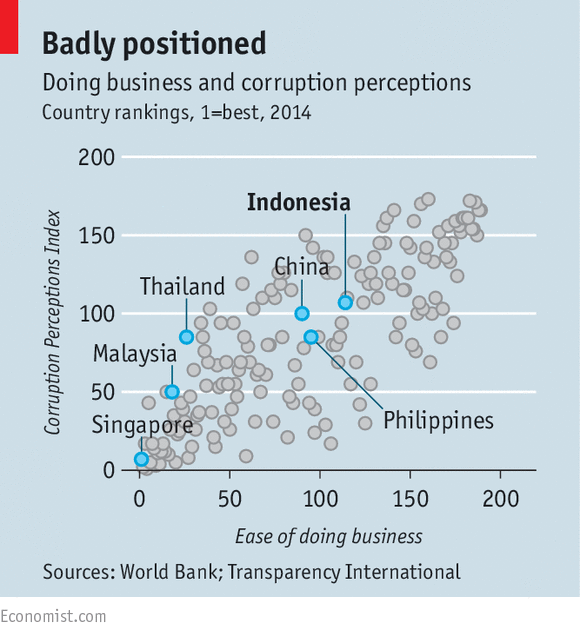
Correlation Between Corruption and Ease of Doing Business


Source: The Economist
I am posting this not because of the data highlighted by the original authors on Asian countries, but rather on the strong correlation shown between the perception of corruption and the ease of doing business. Correlation is not causality, and I assume that there is some deeper cultural cause of both corruption and difficulty of doing business in a country,

It would be interesting to do a Gapminder on this and see how the position of countries changes on these two dimensions in recent history, and relate that change to economic development.