Tuesday, February 02, 2010


Saturday, November 07, 2009
More on Net Neutrality
Net Neutrality Required to Spur InnovationThe Internet's amazing success has been based on its openness, ubiquity and nondiscrimination. The fact that no one ever had to ask permission from the network to innovate has led to one of the greatest periods of economic growth in history. So, when the global communications network grows by leaps and bounds and spurs tremendous innovation, why change its traditional rules?
Nicholas Economides, Financial TimesNet Neutrality Red Herrings, and How to Combat ThemThere will be a tremendous astroturfing campaign against both the current Net Neutrality legislation in Congress and the comment period of the FCC's Net Neutrality rulemaking process. There are a couple of things the Netroots community needs to do in response.
Daily KosEU Ready to Guarantee Internet Access and NeutralityA compromise between European Union negotiators and 27 member states has cleared the way to approve telecom reforms that include Internet access protection. The EU's Viviane Reding said the telecom bill will protect consumer rights and guarantee Net Neutrality. In particular, the U.K.'s "three strikes" rule would be blocked in the EU.
Tuesday, October 20, 2009
"Big names support net neutrality "
Comment: Lets hope the Congress acts to assure net neutrality for us and not depend on the good will of the industry! JAD
Saturday, August 02, 2008
Big Win for Net Neutrality!
Friday, July 11, 2008
Net Neutrality One, Comcast zero
I quote:
When Comcast admitted last fall that it was blocking — or slowing down, as the company preferred to call it — certain file transfers by customers, a lot of people complained that the company was unfairly discriminating against heavy Internet users.
Now it seems that the Federal Communications Commission is poised to agree.
The Associated Press reported late Thursday that the F.C.C.’s chairman, Kevin J. Martin, has concluded that Comcast improperly blocked some file transfers. Mr. Martin told the A.P. he would recommend that the commission punish Comcast, and order it to stop the blocking, tell the commission how and how often it blocked file transfers and disclose to consumers its future plans for managing its network. (UPDATE: At a news conference Friday, Mr. Martin said he would seek no fine, but only a change in Comcast’s practices.)
Monday, April 21, 2008
McCain Beholding to Telecom Industry?
By MICHAEL LUO and SARAH WHEATON, The New York Times, April 21, 2008.
Senator McCain has released a list of the "bundlers" who have brought in at least $100,000 each in donations to his campaign. The New York Times analysis includes the following text:
the potential for conflicts of interest are obvious. Several of Mr. McCain’s top fund-raisers, for example, lobby for the telecommunications industry, which regularly does business before the Senate Commerce Committee, where Mr. McCain is a senior member and once served as chairman.Comment: If you believe Berman, I have some great investment ideas for you. How about the investing in the Capital Building? Woops, Berman beat me to it! JAD
Kirk Blalock, of the lobbying firm Fierce, Isakowitz & Blalock, leads Mr. McCain’s young professional group and has raised over $250,000 for him; his clients include Sprint Nextel and Viacom.
Kyle McSlarrow, chief of the National Cable and Telecommunications Association, the lobbying arm for the cable industry, has raised over $100,000 for Mr. McCain. He and others in the cable industry recently butted heads with Mr. McCain over a proposal that would allow customers to pick and choose which channels they received.
In an interview Sunday, Wayne Berman, who is deputy finance chairman of the McCain campaign and a veteran lobbyist whose clients include Verizon and Verizon Wireless, dismissed the notion that some lobbyists might be raising money for Mr. McCain to curry influence.
" Action urged to keep net neutral"

BBC News provides a report from the recent Stanford University hearing on Net Neutrality.
Tough action is required by US regulators to protect the principles that have made the net so successful, a leading digital rights lawyer has said.A streaming video of Lessig's testimony is available on his blog.
Professor Lawrence Lessig was speaking at a public meeting to debate the tactics some net firms use to manage data traffic at busy times.
He said the Federal Communications Committee (FCC) should act to keep all net traffic flowing equally.
Friday, April 18, 2008
"The Raging Grannies Greet the F.C.C."
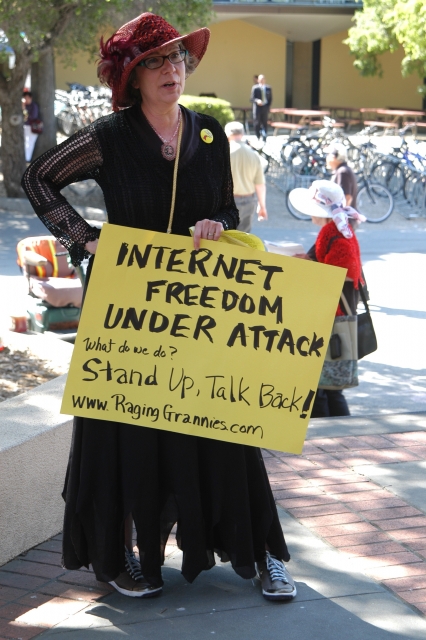
Source: John Markoff, The New York Times, April 17, 2008.
Excerpt:
The complaint that Mr. Topolski posted on the Internet ultimately led to two public hearings held by the agency focusing on the issue of network neutrality. The first was held in February at the Harvard Law School in Cambridge, Mass. The second focused on engineering management of the Internet and new and innovative digital applications.Comment: Hats off to the raging grannies! Net Neutrality is an important principle that we have to support and protect! JAD
At Stanford a parade of witnesses challenged the efforts of the giant Internet service providers to control and, in some cases, block the data traffic that flows over their networks.
The panel was enlivened by an activist group called the “Raging Grannies,” who stood outside before the hearing began and sang songs condemning Comcast’s pricing and other practices.
Tuesday, February 26, 2008
"FCC Head Says Action Possible on Web Limits"
Excerpt:
The chairman of the Federal Communications Commission yesterday sharply questioned Internet service providers who control consumers' Web access over their networks, and suggested the agency could intervene against the practice.Comment: Good for Martin and Markey! I hope they continue to view net neutrality as a consumer right, and act to protect those rights.
Kevin J. Martin made his remarks at an unusual off-site hearing to address complaints that cable provider Comcast restricts the flow of content -- such as video and music clips -- through file-sharing service BitTorrent. Rep. Edward J. Markey (D-Mass.), chairman of the House Energy and Commerce subcommittee on telecommunications and the Internet and a proponent of so-called net neutrality rules barring online traffic controls, offered opening remarks. "While carriers will assert the need to manage networks in their current state of evolution, we need to remember that Internet freedoms are most properly thought of as consumer-centric," he said.
Net neutrality is also important to maintain an open environment that allows innovation, while this technology is new and growing, Doing so is important to our economy, and to our political and cultural systems.
I can imagine situations in which a provider might reasonably have to deviate from net neutrality (e.g. an earthquake knocks out some of the cables, and some management needs to be done to assure service to critical customers such as government and hospitals until the system can be repaired; a terrorist is surrounded in a building and the government asks that he be denied Internet access until apprehended). But I would hope that the FCC would police this authority carefully to assure that service providers not abuse it. JAD
Thursday, February 14, 2008
Wednesday, January 30, 2008
We are going the wrong way on Internet Access!
Levy writes:
There is, however, a net neutrality angle to the Time Warner Cable experiment. As its name implies, this operation's main interest is cable television. An increasingly important component of that business is distributing video on demand. TW's competitors in that arena are Internet companies that intend to do the same thing. The TW plan tilts the field in its own favor. Let's say I want to watch the indie film "Waitress." I may have the choice to order it on my cable box or rent it from iTunes. Each might cost me $3. But if I'm metered, renting it from iTunes might mean that I exceed my monthly limit, perhaps incurring a penalty that's more than renting the movie.Right on Mr. Levy! Thanks for protecting our interests.
A more profound problem with the metering scheme, however, doesn't involve corporate competition but international competition. In the United States, where the Internet was born, we pay higher prices (seven times what they pay in South Korea) for slower speeds. (Japan's users surf 13 times faster.) Though President Bush promised affordable broadband for all by 2007, tens of millions are still stuck with dial-up.
Fast, cheap, abundant broadband is a fantastic economic accelerator, enabling breakout businesses and kick-starting new industries. Unless we move quickly, these will spring from foreign soil. Instead of testing systems that discourage people from vigorously using our overpriced, underpowered systems, government and industry should be working overtime to figure out how to get faster service for less money and make sure that all users, no matter where they live, have affordable access to the high-speed Net. Maybe then we'll get out of 24th place.
Sunday, January 06, 2008
"Net Neutrality Wins Iowa"
In mid-November, Barack Obama laid down some truly remarkable and transformative proposals for the internet, including a strong embrace of net neutrality. Edwards also put out a series of similar policy ideas embracing openness and net neutrality, chiming in during the very imporant 700 megahertz auction of the public airwaves. Clinton, by contrast, laid out a set of proposals written by telecom lobbyists that did not include net neutrality.......Comment: I am not a single issue voter, especially not on the issue of net neutrality, but perhaps this is a bellwether issue. The candidates that are really for a change in the way we do things are also for a net neutrality.
Interestingly enough, on the right, Mike Huckabee has embraced net neutrality at least in concept, whereas every other Republican has not. First on a conference call with bloggers, and then on a Tech President video, Huckabee analogized the internet to the highway system and decried a two tiered set of controls. It's not a full-throated embrace, but it's pretty close.
I recently thought of two questions to ask of my local Congressional candidates. They were:
- What can the Congress do to restore the good name of the United States government in the world at large (given the increasing antipathy in the Islamic world, Latin America and Russia, and the feeling among our best allies that we don't consult and among the poor nations of the world that we don't care)?
- What can the Congress do to be sure that the United States stays on the leading edge of the economic wave caused by the Information Revolution, while not suffering from a decay in our democracy due to the misuse of the technology?
Still, it we have a strong democracy, a strong economy, and the respect of the other nations of the world, our government should be able to work out the details! JAD
Wednesday, August 29, 2007
Differences in Internet Access Bandwidth Among Nations
 Japan's Warp-Speed Ride to Internet Future by Blaine Harden, The Washington Post, August 29, 2007.
Excerpts:

DSL in Japan is often five to 10 times as fast as what is widely offered by U.S. cable providers, generally viewed as the fastest American carriers. (Cable has not been much of a player in Japan.)
Perhaps more important, competition in Japan gave a kick in the pants to Nippon Telegraph and Telephone Corp. (NTT), once a government-controlled enterprise and still Japan's largest phone company. With the help of government subsidies and tax breaks, NTT launched a nationwide build-out of fiber-optic lines to homes, making the lower-capacity copper wires obsolete......
Japan's leap forward, as the United States has lost ground among major industrialized countries in providing high-speed broadband connections, has frustrated many American high-tech innovators.
"The experience of the last seven years shows that sometimes you need a strong federal regulatory framework to ensure that competition happens in a way that is constructive," said Vinton G. Cerf, a vice president at Google.
Japan's lead in speed is worrisome because it will shift Internet innovation away from the United States, warns Cerf, who is widely credited with helping to invent some of the Internet's basic architecture. "Once you have very high speeds, I guarantee that people will figure out things to do with it that they haven't done before," he said.
As a champion of Japanese-style competition through regulation, Cerf supports "net neutrality" legislation now pending in Congress. It would mandate that phone and cable companies treat all online traffic equally, without imposing higher tolls for certain content.
The proposed laws would probably save billions for companies such as Google and Yahoo, but consumer advocates say they would also save money for most home Internet users.
U.S. phone and cable companies, which control about 98 percent of the country's broadband market, strongly oppose the proposed laws, saying they would discourage the huge investments needed to upgrade broadband speed.
Yet the story of how Japan outclassed the United States in the provision of better, cheaper Internet service suggests that forceful government regulation can pay substantial dividends.
The opening of Japan's copper phone lines to DSL competition launched a "virtuous cycle" of ever-increasing speed, said Cisco's Pepper. The cycle began shortly after Japanese politicians -- fretting about an Internet system that in 2000 was slower and more expensive than what existed in the United States -- decided to "unbundle" copper lines.
Wednesday, August 15, 2007
Trade group: More government action needed on e-health - washingtonpost.com
"U.S. lawmakers should avoid passing net neutrality laws as a way to help electronic-health initiatives move forward, an Internet provider trade group said Tuesday.
E-health and telemedicine applications will need to have priority routing over broadband networks in order to function properly, said David McClure, president and CEO of the U.S. Internet Industry Association (USIIA), which represents broadband providers and other Internet-based companies. Any legislation that would prohibit providers from prioritizing network traffic would be detrimental to e-health initiatives, he said.....
Consumer advocacy groups such as Public Knowledge and Free Press have pushed the U.S. Congress to pass net neutrality rules in recent years. Net neutrality rules would prohibit broadband providers from blocking or slowing Web content from competitors. Net neutrality advocates say large broadband providers shouldn't be able to give priority to an e-health application from a partner company and not give the same bandwidth to a competing e-health application.
Art Brodsky, spokesman for Public Knowledge, called USIIA's concerns 'nonsense.'
'What net neutrality strives to prohibit is favoritism,' Brodsky said in an e-mail. 'We don't want Kaiser (to pick one at random) to be the exclusive health-care provider of AT&T, so that customers of Aetna can't get the same monitoring services and the same emergency priority.'"
Comment: It should be possible to create regulations if desired that would privilege classes of use (e.g. health information, emergency reporting). I bet however that the industry will complain as soon as someone seeks to do to that it imposes too great a burden on the firms providing the pipes. JADTuesday, January 16, 2007
American Prospect Online - High Definition
"As Congress begins its new session, there has been a flurry of activity on Capitol Hill to protect the open nature of the internet. On Tuesday, Senators Byron Dorgan and Olympia Snowe re-introduced a bill from last session that bans internet providers from charging certain sites for faster access -- or blocking other sites entirely. The same day, Representative Edward Markey was elected chairman of the House subcommittee that oversees the internet and vowed to hold hearings on the subject, known as net neutrality."
Comment: I hope my Congressman, Al Wynn, will get on board and support net neutrality this time! JAD