Showing posts with label Africa. Show all posts

Monday, February 22, 2016

Excellent summary of investment in renewable power generation across Africa

Thanks to Rachel Strohm

bit.ly/1V3wcxl

Saturday, May 30, 2015

The Scramble for Africa


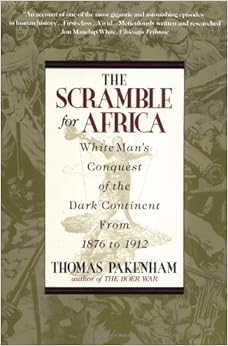
I just finished reading The Scramble for Africa: White Man's Conquest of the Dark Continent from 1876 to 1912 by Thomas Pakenham. (Read my posts of January 14th, February 11th, and May 24th.) This is a long book, but a very good one that told me a lot about African history that I should already have known.

The Scramble Was Recent (in Historical Terms)

There were no colonies of the European imperial powers in Africa in 1876 except on the edges of the continent (although the Ottoman empire had a significant holding in North Africa). As the maps in my February 11th post show, by the beginning of World War I, with the exception of Ethiopia and Liberia, all of Africa was under the control of these European empires. As a result of World War I, the victors took some of the colonies from the losers, notably the British and French took over the German colonies. Thus the colonization of Africa came after the European empires took Asian territories (e.g. British India, Dutch Indonesia, French Indo-China). Great Britain and France made short work to gobble up a huge area of the African continent. Maps lead us to underestimate how large that territory really is, given that lands at the Equator are foreshortened compared to those at European latitudes.

The Scramble Was Brutal

The European powers had modern weapons and powered, metal boats. During this period they built railroads in parts of Africa and telegraph lines. They used their technological superiority to conquer African tribes that sought to resist being incorporated in empires or sought to rebel against their imperial masters.

African nations were tribal, poorly armed as compared with European technology, and with poor infrastructure. Tribes often had long-standing enemies among neighboring tribes. Thus, African troops were armed to do most of the fighting under European officers as the European empires conquered territories. The book even describes the sometimes use of cannibal troops as part of imperial military units -- cannibals who butchered the enemies that they killed, smoked their body parts and thus solved the logistic problem of providing protein to troops in protein poor environments.

In theory, the colonization of Africa was carried out in part to abolish the Muslim trade that captured African natives and sold them in the Middle East and Asia; however, in practice the Christian, European. colonial administrators and colonists were often racists. The book shows how frequently Africans were forced to work without pay by racist government and corporate bosses. Africans during the scramble might be forced to live where their labor was needed, they might be beaten as part of the "supervision of their labor"; in the Congo Africans were mutilated, and crimes -- including murder -- were committed against them by whites who were not punished.

A slogan of "Commerce, Christianity, and Civilization" was used to justify the colonization to Europen publics, and indeed Protestant and Catholic missionaries vied to convert Africans. However, the Christianity was often sectarian and has left an ugly divide in Africa. (See my reviews of The Tenth Parallel: Dispatches from the Fault Line between Christianity and Islam by Eliza Griswold of June 8, 2012 and June 15, 2012.) As far as I can see, there was very little "civilization" that went with colonization, and few Africans were educated to European standards. When Africa was decolonized after World War II, few of the newly empowered African leaders were prepared to run modern nation states.

The European powers were interested in commerce, but mostly to appropriate all the profits from African commerce into their European capitals. Belgian King Leopold seems to have been the embodiment of greed, but businessmen exploiting African resources for their own enrichment lobbied their governments to assure that their greed could continue to work at length. While there were European advocates for the use of African wealth to benefit African peoples, their European governments seems not to attend to those voices during the Scramble.

The Colonization of Africa Was Not the Same for All Imperial Powers

The Portuguese (coastal) colonies predated the Scramble (to the time of the slave trade to Brazil, and are not covered in the book. The German colonization was later than the British and French (and ended as a result of the German loss in World War I). King Leopold's forces colonized the Congo as part of a private land grab, and were not transferred to the Belgian state until 1908. Italian colonization was less successful than British and French efforts, as well as later. The Boer settlers in southern Africa were not British, although the region that the inhabited eventually became part of South Africa, and thus a portion of the British empire. The French colonies tended to be located in the north west of Africa, and included lands of the Sahara Desert and its fringes -- lands that were less productive than the colonies of other countries. Britain appears to have been the most successful in establishing colonies and influence, eventually holding a string of land from the Cape of Good Hope to the Egyptian Mediterranean. And of course, the Ottoman empire lost its African territories to others during the Scramble and its immediate aftermath.

The Book is Very Good on the Complexity of Governance

Author Thomas Pakenham (8th Earl of Longford) is very good on the complexity of governance. Perhaps his aristocratic position provided him with the necessary understanding. In any case, in his hands, the cabinet members of imperial governments differ among themselves on what should be done, and sometimes one will act without the approval or even the knowledge of the others. Governments change, with the new sweeping out the old government's policies. Governments in London or Paris are trying not only to make decisions for African colonies in terms of the impact of those decisions on other African colonies, but also on other regions of the world and on the relationship with other imperial powers. African colonial administrators take actions not approved by their imperial masters, and indeed sometimes in opposition to those governments. the politics are of concern, newspapers count, as do advocacy groups. Business executives bring pressures to bear on governments, sometimes using the press; sometimes the businesses themselves take actions in Africa that affect imperial policies. Decisions are made (in European capitals or by newly assigned colonial administrators) with only poor understanding of the local conditions in Africa, and one assumes often with the most partial exploration of alternative options. Africans are not consulted at all. The financial problems of the day, the competing demands for troops, and changing world markets all come into play. Governance is hard! Africans pay for the errors made.

The Book Helps One Understand World War I

France and Britain negotiated the Entente Cordiale as part of a deal allocating colonies in Africa; since the French also had an Alliance with Russia there also came to be an Anglo-Russian Entente; thus the three key allies of World War I were obligated to support each other in part do to their scramble for African colonies. The German Kaiser was not pleased, but it too was scrambling for African colonies and had thus competed with Great Britain.

Germany was allied with Austria. Belgium, with its dismal colonial record in the Congo, may not have been as innocent as the British and French claimed at the outbreak of the war. (Britain went to war after Germany invaded Belgium on its way to France.) The replacement of the Ottoman Empire by Britain, France and Italy in Egypt, Sudan and Tunisia was at least a signal to Balkan nationalists that they might rise against the Ottomans, and it was the assassination of Arch Duke Ferdinand by Serbian nationalists that triggered the start of World War I.

Austria declared war on Serbia, the Russians came to the aid of Serbia, and the Germans to the aid of Austria; France was obligated to support Russia, and Germany sought to invade France by marching through Belgium; Great Britain joined with France and Russia against Germany and Austria; Italy joined the the war against Austria, and the Ottoman Empire found itself fighting against Russia, Great Britain and France; Italy joined the allies and went to war against Austria When the dust cleared, the Austrian and Ottoman Empires were gone, Yugoslavia (the nation of the Southern Slaves) was created, Germany had lost its colonies, etc. The War was crucial to the development of world in the 20th century, but it can not fully be understood if one does not recognize some of its roots in the scramble for Africa.

Final Comment

This 670 page book took me a while to read, as I was also obligated to read other history books for the book club to which I belong; however, it was well worth the effort. I think Africa is finally developing rapidly economically, and it is wracked by civil war and insurgencies. Thus we should understand the historical roots of its current situation, and this book seems a very worthwhile means of gaining that understanding.


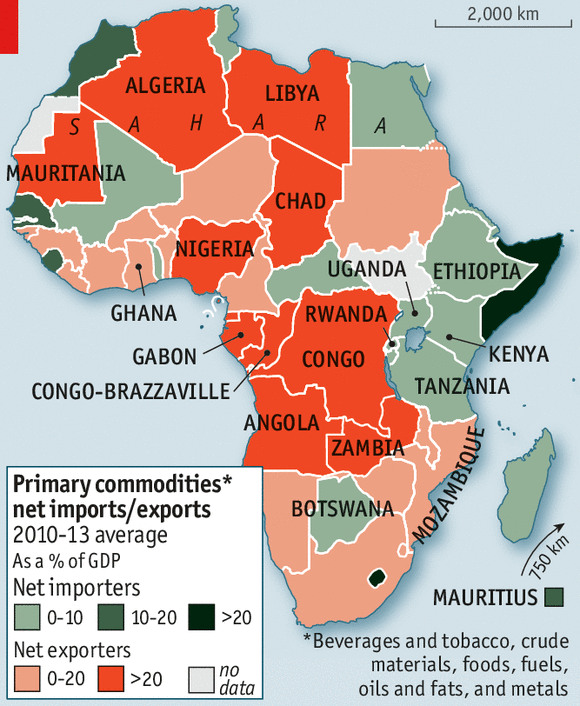
The graph is from the current edition of The Economist. I quote:
Africa’s economy is growing steadily. Last year average growth was 3.9% and it is set to accelerate this year, according to a report by the African Development Bank. Foreign direct investment (FDI) is helping to spur growth. It is expected to reach $55 billion in 2015, 20% higher than in 2010. Inflows of capital are increasingly focused on less resource-rich countries, as investors target the continent’s booming middle classes. The amount of investment into technology, retail and business services increased by 17 percentage points between 2007 and 2013. 

Wednesday, May 06, 2015

The Good News About Africa


Thanks to William Easterly for this graph!

Tuesday, March 03, 2015

Railroads in Africa


There is an interesting article in The Economist on the boom in railroads in Africa. The map shown above, from that article, suggests that the network in East Africa is growing nicely and will provide some real benefits to the region; railroads are really low cost means of transportation, and will mean better costs from imports and lower shipping costs for many exports from the region. I recall being told in Uganda a decade ago or so that most of the railroads in that country were no longer running. Lets hope that the new arrangements work better than did those left from colonial days.

Wednesday, February 11, 2015

The Scramble for Africa and the Modern Consequences in Five Maps


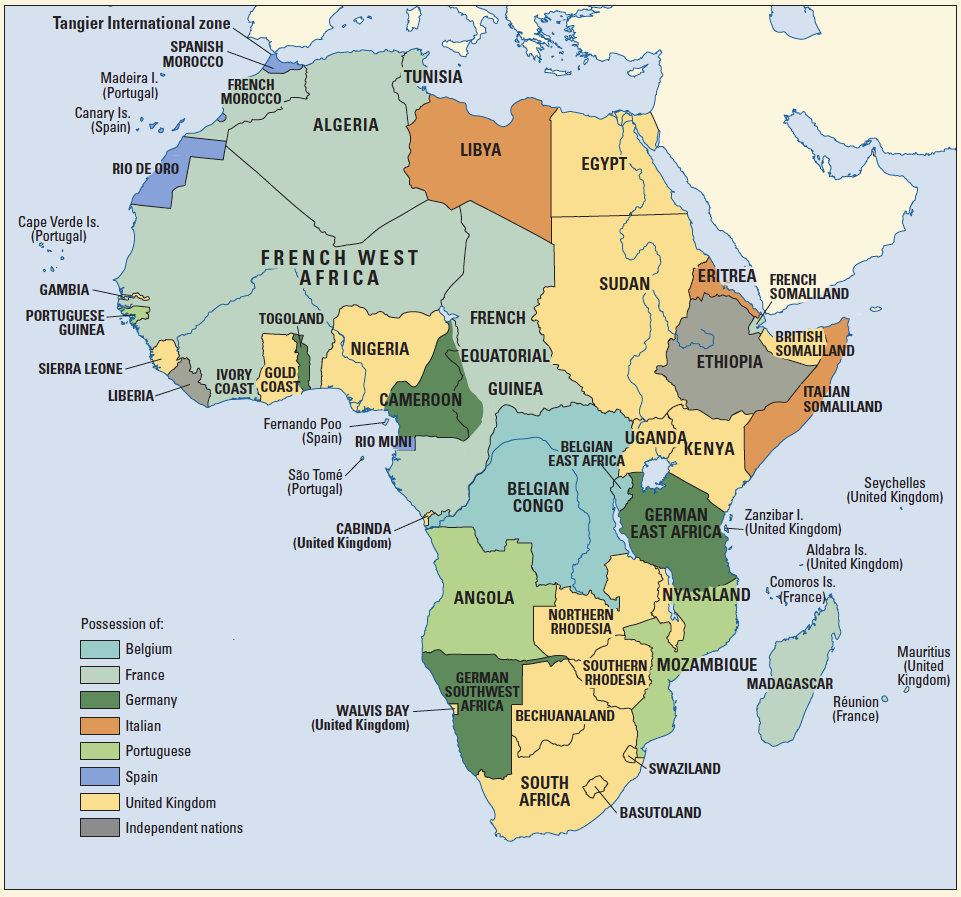
I have been reading The Scramble for Africa: White Man's Conquest of the Dark Continent from 1876 to 1912 by Thomas Pakenham. (See my previous post.) I am struck by how recent it was that the imperial powers divided Africa among themselves -- basically a 40 year period (ending with the transfer of the German colonies to the victors of World War I). The following maps show a great deal about the process in which the imperial powers moved out from their footholds on the coast of Sub-Saharan Africa to control the interior, and as the European imperial powers took over control of North Africa from the dying Ottoman Empire.

Africa Before the Scramble, 1876
Source
As late as 1876, European empires controlled limited areas on the coast of Africa. The Ottoman empire still held nominal sovereignty over a large area of north Africa and the Nile River valley and the related areas of Egypt and the Sudan. Muslim traders and slavers controlled an area in the east, notably the areas shown as controlled by the Sultanate of Zanzibar (see my related post).

By 1912, European empires controlled almost all of Africa, with Germany holding large areas in east Africa and south west Africa, areas it was to lose as a result of World War I. Madagascar, although not so shown on the map, was French at this point.

Colonial Africa 1912
Source
Colonial Africa 1920 - 39
Source

By 1920 France (blue) now has a huge holding in north-west Africa and Madagascar. Britain (red and pink) controls a band from the southern tip of Africa up through east Africa to and including Egypt with holdings in the west including Nigeria, the Gold Coast and Sierra Leone. Portugal (dark green) holds Angola and Mozambique, but much expanded inland from the territory it controlled in 1876. Italy (light green) holds Somaliland, Eritria and Lybia. Spain (yellow) holds small colonies close to Spain itself. Only Liberia (ruled by repatriated blacks from America) and Ethiopia (the areas in grey) remain independent of European imperial control.

Modern Political Map of Africa
Source: WorldAtlas.com
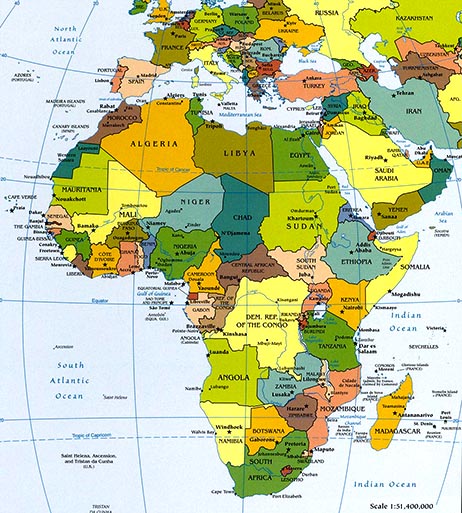
After World War II there was a wave of decolonization leading to independence for the African nations. However, many of the boundaries created by the European empires remained as boundaries of modern African states.

Source: The Long-Run Effects of the Scramble for Africa

Since the European imperial powers didn't consider the tribal origins of the people living in the areas that they grabbed in the scramble for Africa, today many ethnic homelands are divided by national borders left over from the days of imperial colonization.

Wednesday, January 14, 2015

The Scramble for Africa


I am about half way through reading The Scramble for Africa: White Man's Conquest of the Dark Continent from 1876 to 1912 by Thomas Pakenham. I am finding it really useful. It fills a gaping hole in my knowledge of Africa and also a hole in my recent readings on World War I.

We tend to think of North Africa as part of the Mediterranean lands. With the construction of the Suez Canal, making access to the rich colonies of the European imperial powers easier, Egypt became an important strategic area for those powers. England and France used their growing economic power to bring Egypt under their influence.

While Europeans had sailed around the coast of Africa for centuries, and established coastal trading posts and posts to supply ships sailing around the continent, most of the center of Africa remained unknown to Europe and thus uncolonized. In the late 19th century, however, the interest in Africa was raised by European explorers and missionaries, and by the anti-slavery movement. 

I recently read The Sultan's Shadow: One Family's Rule at the Crossroads of East and West by Christiane Bird. (See the relevant post in this blog.) It deals primarily with the Arab control of part of East Africa before and during the early years of the scramble. I am also familiar with King Leopold's Ghost: A Story of Greed, Terror, and Heroism in Colonial Africa by Adam Hochschild. I have also worked for a few months in Egypt and in Uganda, and visited Morocco, Senegal and Ghana. I have also read a little about the countries that were formed from former British colonies of Africa (in conjunction with consulting work for the Carnegie Corporation of New York). However, I did not know much if anything about the 19th century scramble for Africa.

Europeans began to be interested the three “Cs” of African colonialism—the civilizing mission, commerce, and Christianity-- as they learned more about the continent, the dreadful toll that slavery was taking of African peoples, and the potential riches in the interior of Africa that could be acquired. Suddenly, the European colonial powers divided the continent among themselves. Author Pakenham describes the antecedents of the scramble and the process itself. He puts the European interests in perspective of their global concerns as well as domestic politics. He also tells some great stories!

Tuesday, January 13, 2015

How big is Africa


Source

If you normally view the world in maps using the normal projections you probably think of Africa as smaller than it really is, and countries far from the equator as larger than they really are. This figure which compares several countries with Africa according to their actual surface area might help.

A Hopeful View of the African Economy


I quote at length from an article in The Economist:
Over the past decade Africa was among the world’s fastest-growing continents—its average annual rate was more than 5%—buoyed in part by improved governance and economic reforms. Commodity prices were also high. In previous cycles African economies have crashed when the prices of minerals, oil and other commodities have fallen....... 
Since last year the price of oil has fallen by half and many metals such as copper and iron ore have also dropped sharply........ 
In some economies large drops in commodity prices have led to currency falls. At least ten African currencies dropped by more than 10% in 2014. But there have been few catastrophic depreciations. This suggests that investors do not see lower commodity prices as a kiss of death....... 
One reason currencies have been robust may be because economic growth is starting to come from other places. Manufacturing output in the continent is expanding as quickly as the rest of the economy. Growth is even faster in services, which expanded at an average rate of 2.6% per person across Africa between 1996 and 2011. Tourism, in particular, has boomed: the number of foreign visitors doubled and receipts tripled between 2000 and 2012....... 
What explains Africa’s increasing economic diversification? A big pickup in investment helps. That has arisen partly because governments have worked hard to make life better for investors. The World Bank’s annual “Doing Business” report revealed that in 2013/14 sub-Saharan Africa did more to improve regulation than any other region...... 
Better fiscal policy also plays an important role. Commodity markets are volatile; government spending smooths out the booms and busts...... 
(T)here is reason to think the “resource curse” is losing its power. Despite turmoil in commodity markets, Africa is still one of the world’s fastest-growing regions. With better education systems, investment in infrastructure and sensible regulatory reforms, the continent could completely break the spell that has held it back so often in the past.
I can't vouch for the accuracy of the forecasts made in this article; indeed, forecasting is notoriously difficult. Still, it is more optimistic than I would have expected. Africa has long suffered from a lack of economic development, and as a consequence too many Africans have lived for too long in extreme poverty. Let us hope that Africa will continue to progress economically, and that the benefits of that progress will be widely shared, reducing the worst aspects of poverty on the continent! 

Thursday, October 09, 2014

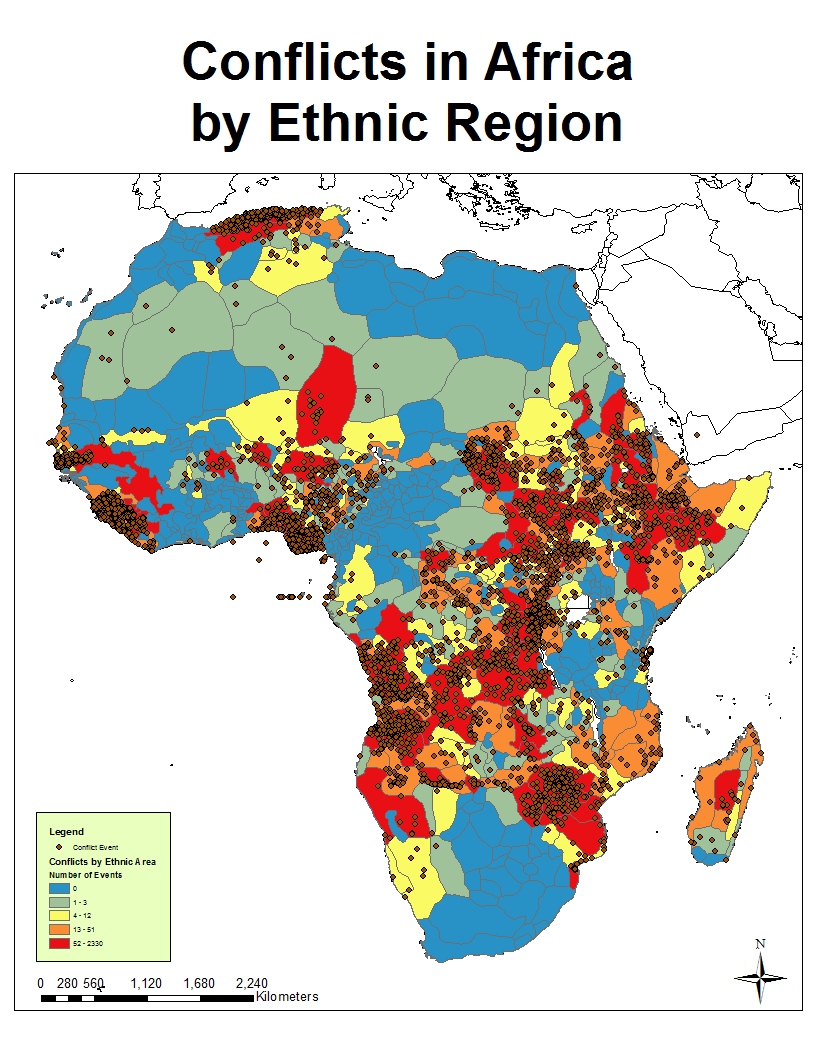
Ethnic Africa Continues Plagued by Conflict


Thanks to Eric R. Kuhne for pointing out the conflicts in Africa mapped atop George Murdock’s map of ethnicities.

Friday, August 15, 2014

From the Our World In Data website


Here are two images relating to Africa:


The Our World in Data effort is seeking funding. Seems a worthy effort to support.

Saturday, August 09, 2014

This is great to see!


The Economist reports that there is
a blossoming of scientific research in Africa. Health care and agriculture are the priorities. Across the continent, programmes are under way to develop seed varieties to withstand Africa’s changing weather. In Uganda, where bananas are a staple, scientists are using genetic modification to boost disease resistance. New strains of cotton and rice are being developed, too.
Health and agriculture seem to be the first priorities for sub-Saharan Africa. Perhaps North Africa might focus more on the industrial research and development. 

Monday, May 26, 2014

Portent of Africa's Future.


Check out the original article from which this map is taken,

Monday, December 02, 2013

"African poverty is falling…much faster than you think"


Good news from a couple of economists.

GDP per capita in Sub-Saharan Africa dropped significantly from the mid 1970s to the mid 1990s, and extreme poverty was much higher at the end of that period than at its beginning. That was the bad old news.

Now analysis indicates that per capita GDP has increased rapidly and consistently for more than a decade, and extreme poverty has dropped accordingly.

Check out the source for more detail on the effect of mineral wealth and access to the coast.

Tuesday, March 05, 2013

GDP Growth and Population by Country in Africa


Source: The Economist
There is a band that goes diagonally across southern Africa where GDP is growing nicely. It is geographically large with a large population.

Monday, December 17, 2012

Maybe the Brain Drain is slowing?

According to the World Bank, "70% of African Diasporan MBAs will return to work in Africa post-graduation."

Monday, December 03, 2012

African's Cities May Be Bigger Than You Think


Source: The Economist
"Booming cities will be good for Africa’s construction sector. Ambitious new city projects like EkoAtlantic in Lagos and Tatu City in Nairobi will be welcomed by a middle class tired of traffic jams, power cuts and insecurity. Such projects are likely to make money, but they will contribute little to giving the poor a sense of ownership of their cities. It is unclear how jobs will be created in cities that have little industry. Innovative services on African mobile phones will win praise in Silicon Valley in 2013, but software can do only so much. Look down the list of growing cities and a host of little-known places like Huambo, Mbuji-Mayi and Mbeya will be expected to serve populations the size of Milan’s—with little infrastructure.

"The standard view of cities as generators of wealth, diversity and ideas will be challenged in Africa. The exclusion of the poor will be magnified by a lack of public space and by rising living costs. To become liveable, cities will have to improve public transport. Many are trying, but safety will be a challenge: murder, and violent carjackings and robberies, will rise in many cities in 2013, sometimes with police involvement."

Did you know that:
  • The population of Khartoum is more than twice that of Amsterdam;
  • The population of Luanda is more that four times the population of Geneva and its surrounding area.

Wednesday, October 24, 2012

The image says it all!


Source: The Economist