
Showing posts with label politics. Show all posts
Showing posts with label politics. Show all posts
Saturday, February 20, 2016


Tuesday, November 03, 2015

Tuesday, October 27, 2015
On Lamar Smith, Chair person of the House Science Committee
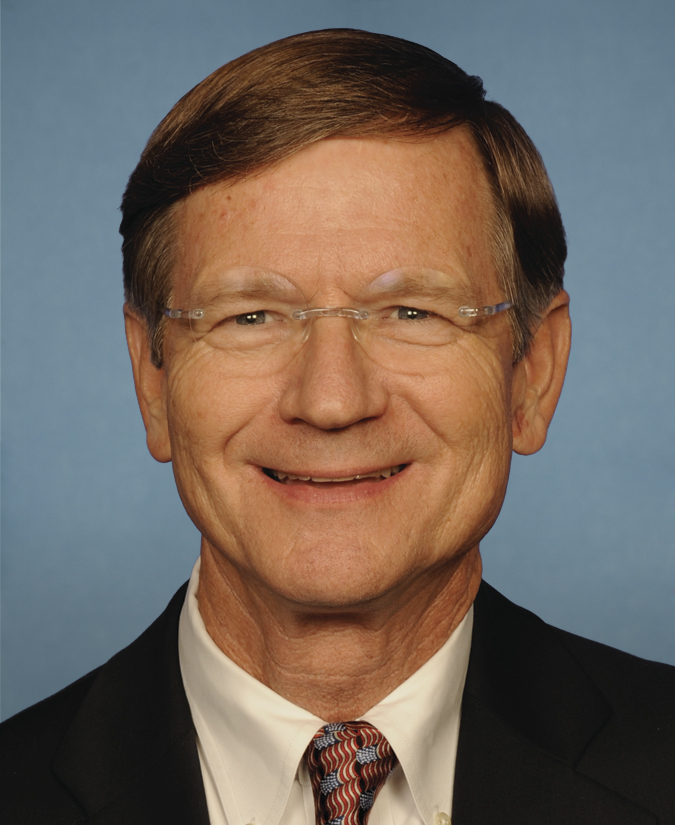 |
| Rep. Lamar Smith Chair of the House Science Committee |
 |
| Alfred E, Newman Mad Magazine |
You should read "The House science committee is worse than the Benghazi committee". The article says that the NSF budget is some $7 billion per year. and that Chairman Smith has asked for complete information on 20 NSF grants with a total value of $26 million; the projects date back to 2005. If my arithmetic is right, the total budget for NSF in a decade (2005 to 2014) would be $70 billion, and the $26 million of projects that interest Rep. Lamar Smith would represent 0.0037 percent of the NSF budget over the period. The article reports:
Four times this past summer, in a spare room on the top floor of the headquarters of the National Science Foundation (NSF) outside of Washington, D.C., two congressional staffers spent hours poring over material relating to 20 research projects that NSF has funded over the past decade. Each folder contained confidential information that included the initial application, reviewer comments on its merit, correspondence between program officers and principal investigators, and any other information that had helped NSF decide to fund the project.The article also states:
This year, Smith was one of the committee chairs granted sweeping new subpoena powers by his fellow House Republicans, what one staffer called "exporting the Issa model." No longer is the chair required to consult with the ranking member before launching investigations or issuing subpoenas.......No chair has taken to his new role with as much enthusiasm as Smith.The article also cites a letter from the ranking member on the Science Committee, including the following:
In the past two years and ten months that you have presided as Chairman of the Committee on Science, Space, and Technology you have issued more subpoenas (six) than were issued in the prior 54 year history of the Committee.
Rep. Smith apparently was not on the Science Committee before being appointed to be its chair. He is a member of the Tea Party Caucus.
Smith is skeptical of global warming. Under his leadership, the House Science committee has held hearings that feature the views of skeptics, subpoenaed the records and communications of scientists who published papers that Smith disapproved of, and attempted to cut NASA's earth sciences budget.And:
Smith has consistently supported restrictions on abortion. In 2009, Smith voted to prohibit federally funded abortions. In 2006, Smith voted for the Abortion Pain Bill, which would “ensure that women seeking an abortion are fully informed regarding the pain experienced by their unborn child”, and the Child Interstate Abortion Notification Act, which would “prohibit taking minors across State lines in circumvention of laws requiring the involvement of parents in abortion decisions”.He graduated from T.M.I.: The Episcopal School of Texas (1965), Yale University (1969), and Southern Methodist University Law School (1975). He is a a Christian Scientist. In 1992, he married Elizabeth Lynn Schaefer, a Christian Science practitioner and teacher, as was his first wife, Jane Shoultz, before her death in 1991.
I don't see anything in that background that prepares him to lead legislation on science.
Friday, September 11, 2015
The Degree of Politicization of Views on Scientific Issues
There is an interesting (long) report from the Pew Research Center on this topic. For example:
71% of Democrats and independents who lean to the Democratic Party say the Earth
is warming due to human activity, compared with 27% among their Republican counterparts (a difference of 44 percentage points). This report shows that these differences hold even when taking into account the differing characteristics of Democrats and Republicans, such as their different age and racial profiles.
Democrats and leaning Democrats also are more likely to favor policies to mitigate greenhouse gas emissions and promote alternative energy sources. Republicans and independents who lean to the GOP are more likely favor some key energy development policies such as offshore oil drilling, fracking and construction of nuclear power plants. In a December 2014 Pew Research survey, fully 75% of Democrats and leaning Democrats said the United States should prioritize alternative energy sources, such as wind and solar power, over expansion of oil, coal and gas production. By contrast, only 43% of Republicans and leaning Republicans expressed support for prioritizing alternative energy production over traditional energy development.Here is another finding from the report:
Fully 83% of Democrats and leaning Democrats say government investment in basic scientific research pays off in the long run, and just 12% say such investments are not worth it. A considerably smaller majority of the GOP and independents who lean to the GOP see benefits from government funding of basic science; 62% say government investments pay off in the long run, but 33% say such investments are not worth it.I don't think this is a good thing -- that people divide about issues of scientific consensus as they divide by party affiliation, but I don't have anything useful to suggest about it (other perhaps that it is not a good idea to have GOP control of the Congress because that then puts control of government expenditures on science and technology in the hands of the party that campaigns frequently against the scientific consensus).
Sunday, September 06, 2015
On reading Eric Foner's "Short History of Reconstruction"
the slave went free, stood for a brief moment in the sun; then moved back again toward slavery. W. E. B. Dubois

The Business of the USA in the 19th Century
Thomas Jefferson saw the destiny of the United States of America to be that of empire, spanning from the Atlantic to the Pacific. It would be a republic, dedicated to the proposition that all men were created equal, endowed by their Creator with certain inalienable rights. Jefferson thought it would take 100 generations to populate that shining empire. Inventions such as the steamboat, the railroad, and the telegraph -- together with mass immigration from Europe -- made it possible to do so in a century. I see the completion of Jefferson's dream as the business of America in the 19th century.
The Louisiana Purchase, the war with Mexico, and expeditions to the Northwest had added the land Jefferson envisioned to the USA by the mid 19th century. The nation was attracting immigrants in huge numbers. It had started as an exporter of agricultural commodities, but was developing industry to become a world leader in manufacturing in the 19th century . The USA was increasingly not only technologically competitive with Europe but a leader in innovation. The nations business in the 19th century would include developing industrial technology and industry to match a world class infrastructure.
It would also be to settle the land that it claimed, and to build cities that would come to house an increasing portion of its population.
Foner focuses on the period 1863 to 1877 in this history, but I think the Civil War and dozen years after its conclusion is best understood in terms of the overall empire building of the United States, especially that of the 19th century.
What Did The Civil War Settle?
Before the war, people used the phrase "the United States are"; after the war, they use the phrase "the United States is". The war established that, as the Articles of Confederation and Perpetual Union stated, the union is perpetual. Sovereignty is in the United States of America, not in the several states of which it is composed. While some governmental tasks are reserved for the states, and indeed for local government, the federal government is paramount. During the Civil War, the central government of the Union grew greatly, assuming stature and power never before needed. The secessionist states, defeated soundly in battle, were thus proven to have no right to secede. The question remained, how would the institutions of government be remade following the war so as to best accomplish the nation's business.
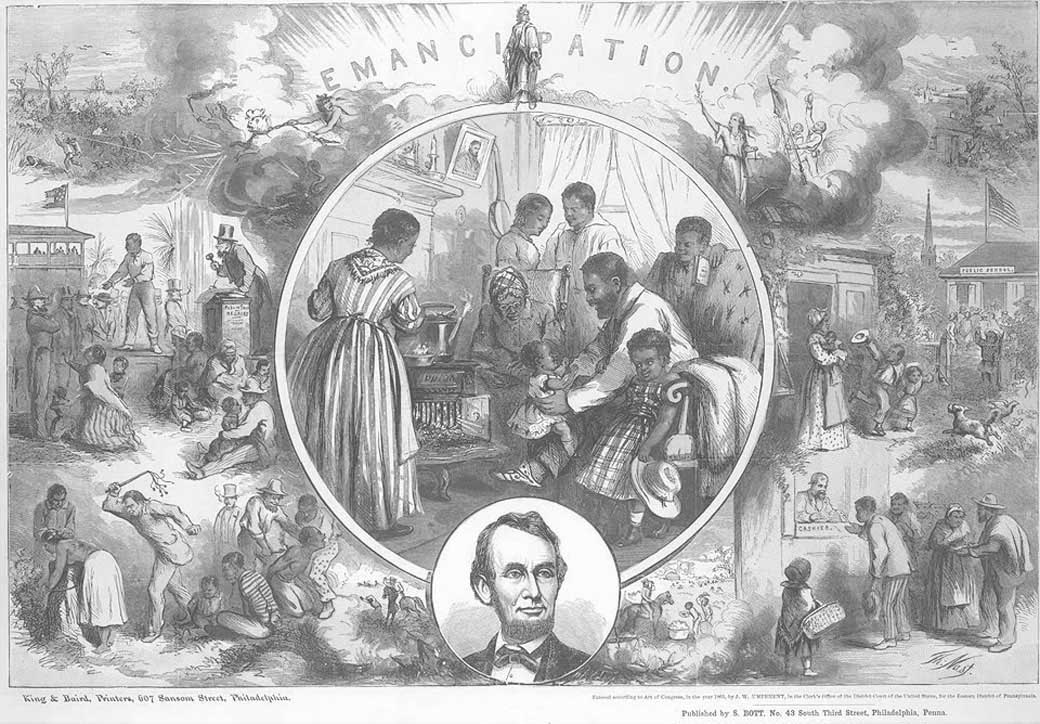
President Lincoln clearly stated at the beginning of the Civil War that the purpose of the North was to preserve the Union. The USA stood as a beacon among nations, but it was not yet clear that "any nation so conceived and so dedicated, can long endure." Yet Lincoln realized during the war that emancipating the slaves in the states in rebellion would be necessary to winning the war. Doing so would greatly reduce the economic capacity of the Confederacy, would prevent European imperial powers from aiding the Confederates, and would add many tens of thousands of black troops to the Union forces. When four million slaves were emancipated by proclamation, the Civil War became about slavery for the North as well as the South. The 13th amendment to the Constitution eliminating slavery from the USA would necessarily follow Union victory.
After the War
 |
| Source |
Foner makes it abundantly clear that after the war there was no consensus as to what was to be done, many parties competing for power, influence and resources, and a great deal of corruption and people seeking to get a piece of the pie for themselves. This seems to have been true in the north and the south.
Carpetbaggers from the north initially flocked to the south, some in search of opportunities to do good and others in search of opportunities to make money. Scalawags -- southerners who had supported the Union during the war -- were suddenly favored by the new northern masters after having had a bad time during the Confederacy.
It seems to me that the two major concerns in the South were to develop institutions appropriate to the newly freed slaves and to develop new institutions for agriculture -- the ownership of land and the supply of labor to work the land. Perhaps not surprisingly, those who held the land before the Civil War wound up owning the land after 1877 -- at least the large plantations growing cotton and other field crops.
The north had many concerns: reintegrating the rebel states into the Union, facilitating the adjustment of the emancipated slaves and giving them citizenship rights, building infrastructure, settling the west, continuing to build industry, drawing immigrants, developing the institutions of government and more. For a few years after the war, Radical Republicans in the Congress emphasized Reconstruction in the south. However, speculation in railroad stock resulted in an unsustainable financial bubble, and when it burst the economy entered the Panic of 1973. That in turn brought farmers and workers of the north into open conflict with the north's investors and merchants. Northern attention turned away from helping former slaves and reforming the governance of the southern states. (This inability to stick with a program of cultural change for the decades needed to complete its work seems familiar today.)
Soon after the end of the Civil War, the freedmen were reunited with families and enabled to go to the churches of their choice; these changes were to remain after the collapse of radical Reconstruction. Freedmen were also allowed to form community associations, and would continue to do so, although white violence (unchecked by federal troops) would eventually reduce this right in practice. Confiscated and abandoned lands initially were taken by the federal government, and freedmen families were allowed to homestead on these lands; later however, when the north lost interest in Reconstruction, the homesteads were revoked and the lands redistributed to white owners. Also, initially freedmen were enfranchised, many voted, and some were elected to public office; after northern interest petered out, a campaign of violence essentially removed the franchise from the southern blacks, and few were able to remain in office.
The Reconstruction resulted initially in more vigorous government in the southern states, providing schools, prisons and other governmental services. These were in turn paid for by taxes on property, that is land. The white population found itself paying more to government run by carpetbaggers and scalawags to pay for services that often went to blacks. Not surprisingly, this state of affairs consolidated white southern opposition to the Reconstruction as it was being carried out.
While blacks were originally thought likely to participate in a free labor market for agricultural jobs, ultimately plantation agriculture was run on a sharecropping basis, much to the advantage of the white land owners and to the disadvantage of the black sharecroppers. Bad crops and/or low prices spelled trouble for the small farmers in the South. There was even a wide spread system in which blacks were arrested and convicted on minor charges, and then rented out to white plantation owners or business owners as "chain gangs" of unpaid workers -- the money paid going to the local government (or to graft).
While the north's economy grew during the latter part of the 19th century, the south's economy was more stagnant and the economic gap between the two grew. The south, firmly in the political grip of the white affluent class, became more and more conservative. It could be depended upon to support the Democratic party, and to support conservative causes.
 |
| Source |
The failure of reconstruction left the nation with a new legacy of racism in which the freedmen were blamed for the failure of Reconstruction, and blacks were left in the minds of many as an inferior race. Racism of course had always been common in both north and south.
Southerners were able to construct a version of the Civil War and Reconstruction that survived for decades, and in my opinion did harm to the nation. The film, The Birth of a Nation, which showed the Ku Klux Klan riding to rescue fair white maidens from evil black men, was premiered in the White House and went on to great audience success in the early 20th century. For generations the south lagged economically, yet played a major role in support of conservative ideology in national politics.
The nation might have learned how very hard cultural change can be, and how very long it takes. The nation might also have learned that the road to chaos is often paved with initial good intentions. Such knowledge might have been very helpful in the aftermath of later wars. Unfortunately, the lesson seemed not to have been learned.
Reading the Book
This is a beautifully written book, a pleasure to read. Some of the latter chapters read like essays by a gifted essayist. Rather than include extensive footnotes, author Foner provides extensive suggestions for further reading for each chapter of the book.
Were the author not so credible a historian, it would be tempting to reject his arguments as inadequately supported. As it is, someone seeking more detail should read his long book on the Reconstruction in its latest edition; that book has the detail. while this book is primarily a summary of the authors analysis and conclusions.
This is a wonderful book
Friday, August 28, 2015
Remember the Know Nothing Party? Looks like they are back.
Would you say that you trust, don’t trust, or are unsure about scientists as a source of information about [vaccines/climate change]?
Trust in Scientists by Issue and State

Chris Mooney, in a new article, provides the graphs above noting?
As you can see, while traditional Republicans and Tea Party supporters in these locations trust scientists considerably more on vaccines than they do on climate change, they also trust them on both issues considerably less than Democrats do.
“The vaccine results were something new, and what was unexpected there was that they followed a very similar pattern to climate change,” says Hamilton. He acknowledges that conducting the survey in two U.S. states is not the same as conducting a nationally representative survey. But he adds that finding a similar result in two quite different parts of the U.S. represents “a fairly broad replication.”This is quite worrying to me. It is a study done in only two states, but it suggests that only half of Tea Party supporters trust scientists on the findings relating to climate change, and only a small fraction trust scientists on vaccines. Tea Party voters tend to have significant weight in selection of Representatives to Congress from "safe" Republican districts. Thus there is a wing of the members of the lower Chamber of the Congress that don't trust the consensus of scientists on two important issues (and perhaps more issues that were not subjects of this study). Moreover, the Democrats tend to trust scientific consensus more than Republicans, but Republicans are in the majority in both chambers of the Congress.
Sunday, August 23, 2015

Friday, August 07, 2015
Those who don't know history may repeat it
In the presidential election of 1912, progressive Republican incumbent William Howard Taft sought reelection. Former progressive Republican president Teddy Roosevelt, dissatisfied with Taft's performance, ran for the Bull Moose Party. The split between the Republicans allowed Woodrow Wilson, who also ran as a progressive, to win the presidency for the Democrats.
In his second term. Wilson reluctantly led the country into World War I, but at the end of that war led in the creation of the League of Nations, an international organization conceptualized to help prevent world war. War had become too terrible to countenance.
Republicans controlled the White House from 1923 to 1933, the Senate from 1919 to 1931 and the House of Representatives from 1917 to 1933. Conservatives in the Congress voted against the Treaty of Versailles (which formally ended World War I) and voted against the United States joining the League of Nations.
What Difference Did it Make?
Understanding what would have been had history been different is always dangerous. The State Department writes:
Most historians hold that the League operated much less effectively without U.S. participation than it would have otherwise. However, even while rejecting membership, the Republican Presidents of the period, and their foreign policy architects, agreed with many of its goals. To the extent that Congress allowed, the Harding, Coolidge, and Hoover administrations associated the United States with League efforts on several issues. Constant suspicion in Congress, however, that steady U.S. cooperation with the League would lead to de facto membership prevented a close relationship between Washington and Geneva. Additionally, growing disillusionment with the Treaty of Versailles diminished support for the League in the United States and the international community. Wilson’s insistence that the Covenant be linked to the Treaty was a blunder; over time, the Treaty was discredited as unenforceable, short-sighted, or too extreme in its provisions, and the League’s failure either to enforce or revise it only reinforced U.S. congressional opposition to working with the League under any circumstances.The isolationism that dominated legislative thinking for much of the time between the wars seems now to have failed to recognize the international role that would be thrust upon the United States and to have contributed to the buildup towards World War II.
It is very important for members of Congress to recognize that they may be wrong in their beliefs and to grant respect to the executive branch views. This is perhaps especially important during the long election season, now at least two years, in which politicians are prone to make statements for political benefit that might not be in the country's best interest.
Monday, July 27, 2015
Sad News About Workers
 |
| Source: The Economist |
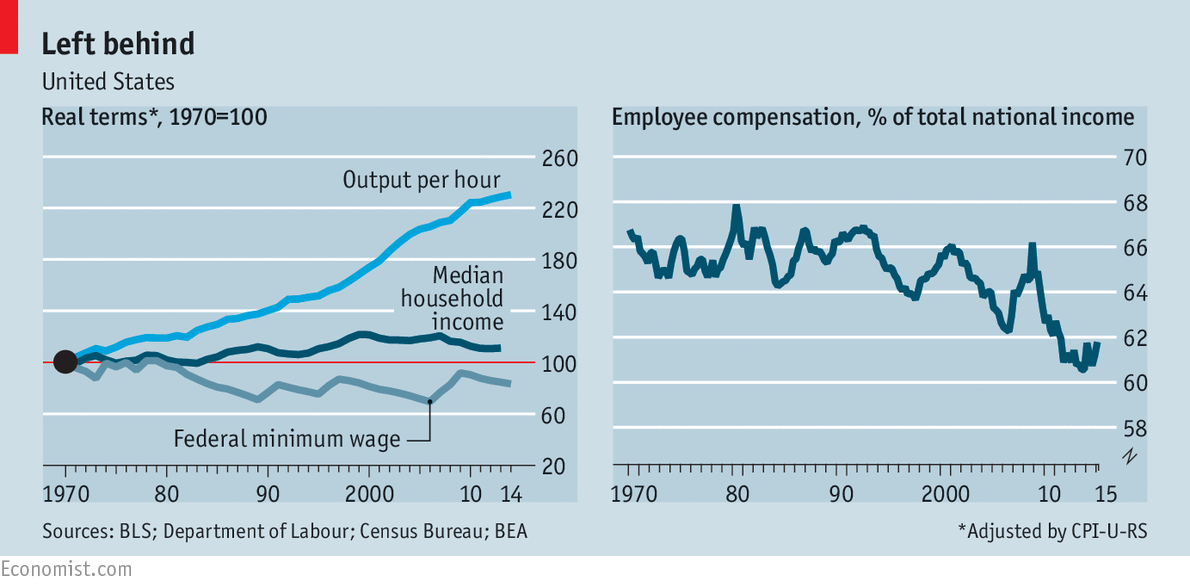
- Left hand graph: Output per hour has increased nicely in the USA since 1970, but median household income has scarcely increase, and is lower now than in 2000; thus half of American households are not benefiting significantly from the improvement in productivity of our workers. The Federal Minimum Wage is lower now in real terms than it was in 1970; increases have never brought it back to the same buying power it had then.
- Right hand graph: Employee compensation bounced around but stayed at about the same portion of total national income from 1970 to the mid 10=990s. However, it is significantly lower now than it was in 1970. Three periods, each several years long, saw a significant decline in the portion of the national income going to workers, the steepest being the most recent.
Bush senior was president from 1989 to 1992; Clinton was president from 1993 to 2000; Bush junior was president from 2001 to 2008; Obama has been president since 2009 but Republicans have had control of the House of Representatives since 2011.
Wednesday, July 01, 2015
Good News from the SCOTUS
 |
| America's Most Gerrymandered Districts |
Gerrymandering is at least partly to blame for the lopsided Republican representation in the House. According to an analysis I did last year, the Democrats are under-represented by about 18 seats in the House, relative to their vote share in the 2012 election. The way Republicans pulled that off was to draw some really, really funky-looking Congressional districts.

The Supreme Court has now ruled on a case, deciding that a state can substitute a redistricting commission for a legislative body in redistricting, This would seem to be a major step in a process that would allow the people to take back the decisions on redistricting, and allow the more representative House of Representatives that the Founding Fathers intended when the Constitution was written and ratified.
That might also make the Congress work a lot better for the American people. Fewer "safe" Congressional districts, in which only the primary really determines who will be elected means fewer districts in which candidates seek only to please the small number of voters who turn out for the primaries -- who tend to be on the extreme wing of their parties.
Friday, June 26, 2015
A Modest Proposal

Following the example set by Jonathan Swift, I wish to make a modest proposal. Substitute a Shoot Out for the Republican Presidential Primaries. Given that Republican candidates must favor open carry, must seek NRA endorsement, and are apparently very concerned with illegal voting in elections, this seems a natural.
Founding Fathers Alexander Hamilton and Aaron Burr showed the way; Andy Jackson would have approved. Shoot Outs would be a series of duels using OK Coral Rules: 8 duels the first round, 4 the second round a month or two later, and 2 in the third round after another couple of months. The survivors would be the Presidential and Vice Presidential candidates, with the less seriously wounded Republican heading the ticket.
The number of candidates should be increased from the current 13 to 16 (Fox News -- that clearly would be the choice to televise the Shoot Out -- could select the three additions). In the first round of duels, 8 candidates would be eliminated. (I am sure many foreign leaders would volunteer to provide the Coups de Grace for the losers.) The 4 survivors of the second round would compete in the third round.
Some advantages of this process are clear:
- The winners would walk the walk, not just talk the talk;
- Democrats would like the process;
- This would be quick and entertaining, rather than the current interminable mind-deadening process used today;
- It would be much less expensive;
- There would be fewer Republican candidates in future presidential elections.
Use the Comments to add advantages or to suggest improvements on this modest proposal.

Wednesday, April 22, 2015
Study: Polarization in Congress is worsening… and it stifles innovation

Check out this study from the Santa Fe Institute, the home of the experts on the study of complexity.
Tuesday, March 03, 2015
If the Congress Doesn't Legislate, the President Can't Veto

The Economist shows us that the number of bills passed by the Congress has decreased over the last half century, but the last Congress set a record. Obama is setting a record low rate of vetoing, but then he has very few bills passed by Congress that to veto.
Wednesday, February 18, 2015
The Easiest and Hardest Places to Live in the USA
 |
| Source: The New York Times |
(The map is based on) six data points for each county in the United States: education (percentage of residents with at least a bachelor’s degree), median household income, unemployment rate, disability rate, life expectancy and obesity. We then averaged each county’s relative rank in these categories to create an overall ranking........
The 10 lowest counties in the country, by this ranking, include a cluster of six in the Appalachian Mountains of eastern Kentucky (Breathitt, Clay, Jackson, Lee, Leslie and Magoffin), along with four others in various parts of the rural South: Humphreys County, Miss.; East Carroll Parish, La.; Jefferson County, Ga.; and Lee County, Ark........
Six of the top 10 counties in the United States are in the suburbs of Washington (especially on the Virginia side of the Potomac River), but the top ranking of all goes to Los Alamos County, N.M., home of Los Alamos National Laboratory, which does much of the scientific work underpinning the U.S. nuclear arsenal. The lab directly employs one out of every five county residents and has a budget of $2.1 billion; only a fraction of that is spent within the county, but that’s still an enormous economic engine for a county of just 18,000 people.
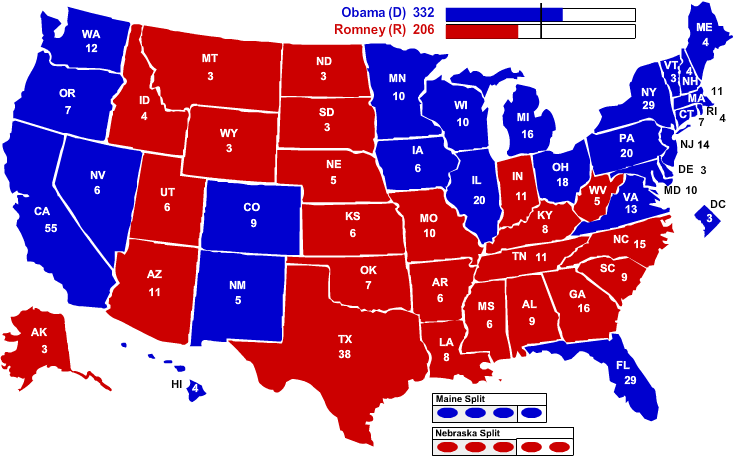
Here are some specific comparisons: Only 7.4 percent of Clay County residents have at least a bachelor’s degree, while 63.2 percent do in Los Alamos. The median household income in Los Alamos County is $106,426, almost five times what the median Clay County household earns. In Clay County, 12.7 percent of residents are unemployed, and 11.7 percent are on disability; the corresponding figures in Los Alamos County are 3.5 percent and 0.3 percent. Los Alamos County’s obesity rate is 22.8 percent, while Clay County’s is 45.5 percent. And Los Alamos County residents live 11 years longer, on average — 82.4 years vs. 71.4 years in Clay County.The poorest parts of the country are the old south and Appalachia. The California coast and the eastern seaboard do well. I note that there is a big blue area (doing quite well) in the northern mid-west, what I think of as the agricultural heartland of the country. The orange areas included in that blue are likely to have large Indian reservation populations. The counties there are big, suggesting that when they became states they were sparsely populated, and I suspect they still have relatively few members of the House of Representatives per Senator. These would be Republican heartland (see map below), benefiting from strong government support for agricultural interests.
I am not sure that the poor counties of the south are natural political allies for the better off counties of the Dakotas, Nebraska, Montana and Wyoming.
2012 Presidential Election Results
Thursday, January 22, 2015
Did You Know This About the U.S. Congress?

The U.S. Constitution was a compromise. Originally the members of the House of Representatives were to be popularly elected, while the members of the Senate were to be appointed by state governments. Later senators came to be elected by the citizens of their states. State governments have considerable leeway in the way that they define the districts from which individual representatives are elected.
gerrymander: to manipulate the boundaries of (an electoral constituency) so as to favor one party or class.How does this work out in practice. I draw from this article from The Nation:
In 2014, Republicans received about 52 percent of votes cast for the House of Representatives. However, they now hold about 57 percent of the seats in the House. Why do they hold a greater portion of seats than the portion of votes that they received? Because in districts in which Democrats won, they tended to win big and in districts in where Republicans won, they tended to gain narrow victories. Why? I suggest that Republican state legislatures were by and large more successful in gerrymandering their states so that Democrats were packed in highly Democratic districts.
"In 2012, Republicans won a lopsided majority of seats despite securing only 48 percent of the vote." Same reason.
A further reason for the imbalance: In the most recent election, 96 percent of running incumbents won reelection. Once a party gains a significantly large majority in the House of Representatives, since the incumbents tend to be reelected (and since they tend not to retire at any reasonable age), that party tends to stay in the majority.
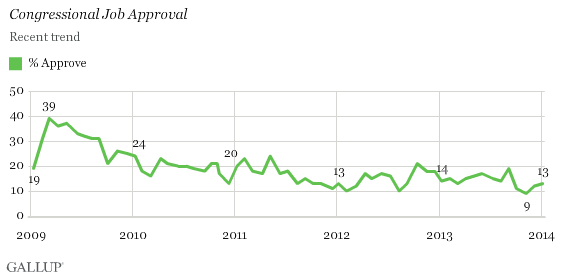
Remember that the Congress, with its Republican majority in the House of Representatives, enjoyed a 9 percent approval rating in November 2014, when the Republicans increased their majority.
 |
| Source |
An Example of Reform
California, in 2008, passed a plebiscite, the Voters FIRST Act. I quote from Wikipedia:
It removed from the California Legislature the responsibility for drawing the state's congressional districts, and gave the responsibility instead to a 14 member Citizens Commission. It also required that the districts drawn up (1) comply with the federal Voting Rights Act; (2) make districts contiguous; (3) respect, to the extent possible, the integrity of cities, counties, neighborhoods and "communities of interest"; and (4) to the extent possible, make districts compact. Several of these terms are not defined in law......
The California Citizens Redistricting Commission certified final district maps on August 15, 2011, and they took effect with the 2012 election. The new districts are described as more "purple" than "red" or "blue" - that is, more mixed in electoral composition compared to the mostly "safe" districts of the previous decade, where incumbents were almost guaranteed re-election. An interactive map comparing the old districts with the new ones is available via the Los Angeles Times.
Sunday, January 18, 2015
Community Concern for a Proposal of the Montgomery County Public Schools
I attended a community meeting last week in which several hundred residents of my community came together to discuss proposals from the Montgomery County Public Schools (MCPS) to:
- Move the MCPS School Bus Depot to the site currently occupied by the Blair Ewing Center for Alternative Education Programs, and
- Move the Blair Ewing Center to the English Manor School location (currently leased to the Children's Learning Center which closes in June 2015).
The community meeting suggested alternative measures:
- That a larger, commercially zoned site be found for the MCPS School Bus Depot -- one with less congested road access.
- That the Blair Ewing Center remain in its current location on Avery Rd.
- That 150 students from the Lucy V. Barnsley Elementary School be moved to a reopened English Manor Elementary School.
Here is a map showing some relevant school locations.
The members of the community offered reasons that I found convincing that their alternative was superior to that of the MCPS.
Better for the Students
The Blair Ewing Center is currently operating successfully for its population of those middle school and high school students who require alternative education. Its physical structure allows the middle school students to be separated from the older high school students, and it has a number of rooms designed for enrichment programs. Moving the students to the smaller and older facility with fewer specialized facilities -- a facility that was designed for primary school students -- would not serve the older students well; there would be less separation of the middle school students from the older high school students.
The Barnsley School is now serving both magnet students and students from the local community; it has more than twice the student population for which it was designed. Moving half the students to a reopened English Manor school would be better for both the remainning Barnsley and the new English Manor students.
Moving the School Bus Depot to Avery Road Is a Bad Idea
Currently 400 school buses are based at the current depot in Crabb's Branch Way (see map). That facility will be closed. 700 cars owned by drivers and employees of the depot are parked at the Crabb's Branch daily. Even demolishing the Blair Ewing Center and using the existing park paid for by the City of Rockville as a parking lot, the Avery Rd. site (see map) is not large enough to house the School Bus Depot.
The MCPS proposal would add significantly to congestion on Route 28, which is already one of the most congested roads in the county. 400 school buses would leave from and return to Avery Rd. during morning rush hour, and the same 400 school buses would leave from and returning to Avery Rd. during the afternoon; 700 cars would arrive at Avery Rd. in the morning hour and leave in the evening rush hour
Parking 1100 vehicles at the Avery Rd. site on a daily basis, as well as the other operations of a School Bus Depot would appear likely to pollute Rock Creek, which is quite nearby. Millions of dollars have been spent to assure the creek water is clean. The creek (and its related walking trail and park) runs all the way into Washington DC. At least an environmental impact study would appear to be required before such an action were taken. It was suggested that the Maryland-National Capital Park and Planning Commission be involved in any decision involving a potential threat to the Rock Creek environment.
The Local Community Has Not Been Adequately Involved in the Decision Process
The families of the students of the Blair Ewing Center are deeply concerned with the welfare of the children who would be moved under the MCPS proposal.
The MCPS proposal would greatly increase vehicle traffic into the English Manor neighborhood. It also raises safety concerns for the residents of the neighborhood.
The community proposal to reduce crowding at Barnsley Elementary School and reopen English Manor Elementary school would be beneficial to the students of both schools and their families, as well as to many residents of the neighborhoods surrounding those schools.
A large number of Montgomery Country residents would be negatively affected by an increase in congestion on Route 28, and a large number of residents would be affected by any deterioration of the Rock Creek environment.
Property values would be affected, perhaps quite negatively in some cases, with implications for the property taxes raised by the county. The economic impact on county residents of the MCPS proposals should at least be considered.
Property values would be affected, perhaps quite negatively in some cases, with implications for the property taxes raised by the county. The economic impact on county residents of the MCPS proposals should at least be considered.
The Aspen Hill Civic Association representatives were informed of the MCPS plan three days before the Board of Education held its hearing to consider that plan; residents along Avery Rd. and in other concerned areas learned of the plan only much later than that meeting and than the vote of the Board approving the plan. Thus county residents have had inadequate opportunity to properly evaluate the plans, much less to respond to the Board of Education and the County Council.
The Board of Directors of the Aspen Hill Civic Association voted unanimously against the MCPS plan, and a large majority of the members of the Association expressed opposition in a poll that was taken. Other local Civic Associations are only now taking up the issue.
For more information I suggest you check out:
- SaveBlairEwing.Org (formerly SaveEnglishManor.Org)
- NextDoor.Com (for local news about your local community)
- The Aspen Hill Civic Association material on the MCPS Proposal to Relocate the County AEP Programs to English Manor
Monday, January 05, 2015
Long and Reasonably Steady Progress Since the Recession of 2008
 |
| Source: The Economist |
Sunday, November 23, 2014
Red and Blue Cities and Institutions

Thanks to my friend Guy for showing me this data. I know with which cities and institutions I identify.
Tuesday, November 11, 2014
About the Federal election of 2014

The federal election is reported to have cost nearly $4 billion, but apparently that does not include the so called "black money" that is not accounted. (Apparently, non-profit organizations of some kind are now funding adds and other election related expenses, and while they are theoretically required to report these to the Bureau of Internal Revenue, they are not doing so -- the so called black money.) I have heard it estimated that black money may have added $2 billion to the campaign chests.
Only 36.6 percent of the electorate turned out to vote, and there are many Americans who could register to vote who do not do so. The article says:
For reasons that include the sorting of the electorate into like-minded folks, redistricting and the cultural divide between cities and prairies, only 5% of the House’s 435 districts were truly competitive on November 4th. There were 69 congressional districts where the candidate faced no opponent. This means that the main threat to the jobs of congressmen comes from primary elections, in which fewer than 20% of the electorate vote, about the same proportion who describe themselves as holding consistently conservative or consistently liberal views. Few congressmen lost to primary challengers in 2014, but results like the defeat of Eric Cantor, the House Majority Leader, in Virginia’s seventh district remind them that such voters are not wild about anything that smells of compromise with the other side. These voters have the first veto.
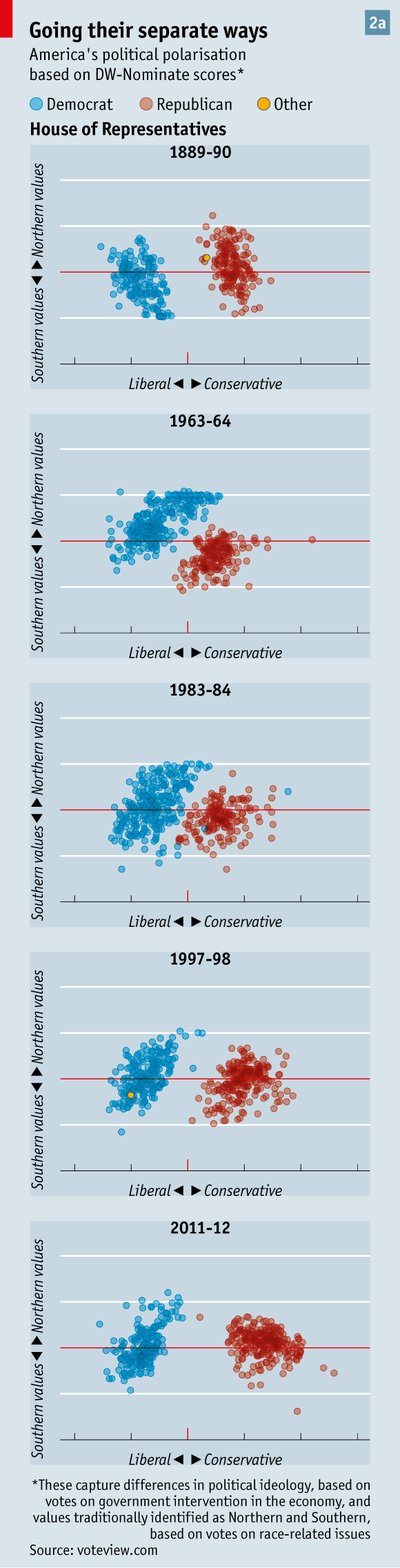
Getting a bill safely through the House, something that has become harder since Republicans adopted the idea that bills should have the support of a majority of their caucus to pass, is straightforward compared with getting one through the Senate, thanks to the filibuster rule. Since a filibuster requires a bill to gain a 60-vote majority, a group of 41 senators can halt almost any piece of legislation. Even the smallest state has two senators, so those 41 sometimes represent a small chunk of the electorate: Larry Sabato of the University of Virginia has worked out that states that are home to just 11% of Americans can elect the senators needed to block legislation. This potent weapon gives the minority party in the Senate the second veto........
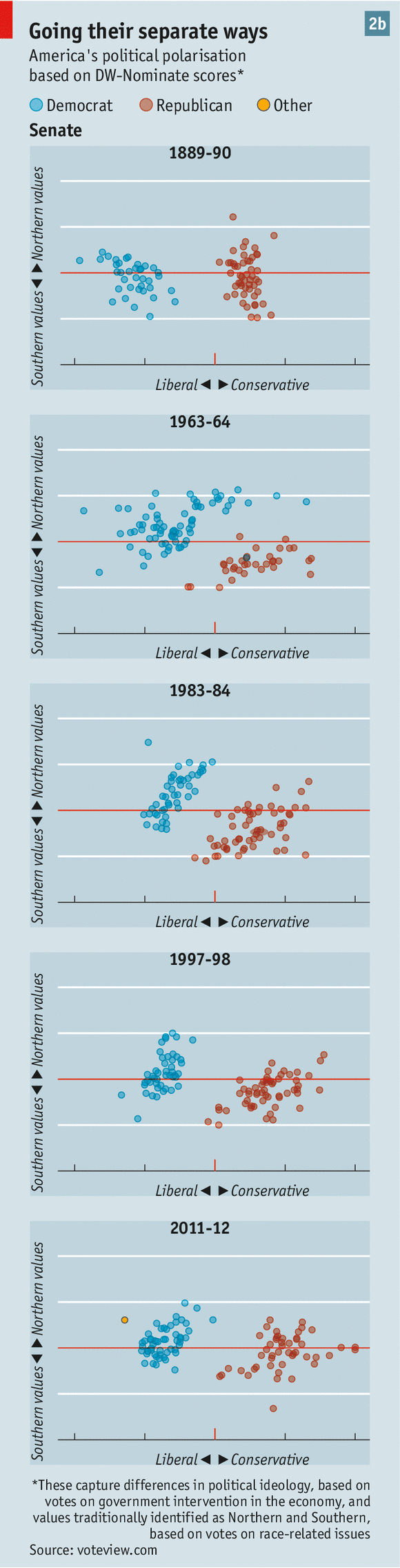
Congressional Republicans and Democrats have withdrawn from each other, to the point where there is now hardly any common ground between them (see chart 2).
Voting patterns in Congress suggest that the parties are even further apart now than they were in the mid-1990s, when Republicans tried to impeach Bill Clinton, or the middle of the past decade, when Democrats denounced George W. Bush as a warmonger.
I find it embarrassing that democracy seems to be working so poorly in the USA. This country fought in a couple of world wars with a stated objective of making the world safe for democracy. We spent a decade, trillions of dollars and thousands of American lives supposedly in an effort to spread democratic institutions to Iraq and Afghanistan. American exceptionalism has been proclaimed for many decades. In our greatest speech, President Lincoln said about the Civil War, our bloodiest,
that we here highly resolve these dead shall not have died in vain; that the nation, shall have a new birth of freedom, and that government of the people, by the people, for the people, shall not perish from the earth.He was a realist and a practical politician, but how would he feel a century and a half later about the state of our government? How much are the people of other nations laughing at our pretensions of a government of the people, by the people, and for the people?
Monday, November 10, 2014
A thought on government and the economy
Understand that what unifies American voters of all parties and persuasions is economic anxiety—about themselves today and about their children tomorrow. Exit polls on Tuesday made this soberingly clear. Only one percent of voters described the U.S. economy today as “excellent.” Almost 70 percent described it as “not so good” or “poor.” Only 29 percent said their family’s financial situation had improved in the past two years. Nearly 80 percent said they were “somewhat worried” or “very worried” about the direction of the economy. These numbers accord with a slew of recent polls. Two months ago in their joint survey, The Wall Street Journal and NBC asked Americans, “Do you feel confident or not confident that life for our children’s generation will be better than it has been for us?” An all-time record 76 percent do not feel confident about their children’s prospects.
What drives this pervasive anxiety is not jobs per se. Last Friday’s Employment Situation report indicated that unemployment in October fell to 5.8 percent. Allowing for measurement error in this statistic, it means the U.S. labor market is quite close to full employment. No, what drives anxiety is the stagnant earnings of so many jobs. Since 2000, only workers with a doctorate or a professional post-graduate degree—just 4.0 percent of workers in 2013—have enjoyed increases in their average inflation-adjusted money incomes. Median household income in America in 2013 was $493 less than inflation-adjusted U.S. median household income in 1989.Perhaps some of the malaise of the American people has been caused by the tsunami of attack adds and negative opinion on so called cable news, but I accept that the economic gains in the recovery from the Great Recession have been largely appropriated by the wealthy. They have seen huge increases in income while the poor are still poor and the middle class is hardly progressing.
For the wealthy, the increase in wealth is more important than income. The Dow Jones Industrial Average hit a low of 6,443.27 in March 2009, and is 17573.93 now. Thus someone who had a billion dollars in these stocks in 2009 has nearly three billion dollars today; if he just held the stocks, there was no taxable income associated with the increase.
The housing boom was in part due to providing home loans to people who were too poor to qualify for loans in the past. The risk of these loans was passed on through new financial instruments, often going into the investment portfolios intended to support retirement. The result of the increased demand for modestly priced homes was a real estate bubble. When that market crashed, a lot of people had their loans foreclosed, and lost their savings; others still are under water, owing more on their mortgage than their homes are worth. The impact of the disappearance of savings was like a negative income.
Serious economists suggest that those who fear that their children will not be better off than they are will often be right. The one-percent are more likely to protect what they have than to grow the economy for others; they seem likely to use their economic power to obtain political power and use that to appropriate still more of the income and wealth of the country.
We have two years to get ready for the next election, and try to put in people who will do a better job than those elected last week.
Subscribe to:
Posts (Atom)