Showing posts with label book review. Show all posts

Saturday, September 19, 2015

On Reading "Black Elk Speaks"


I am reading Black Elk Speaks by John G. Neihardt. Nicholas Black Elk was born in 1863. We are told in this book that he met with John Neihardt on several consecutive days in 1930 and told him the story of his early life. Also present (at Neihardt's request) were several of Black Elk's friends, older than he, who could fill in details of events that occurred when Black Elk was a young child (and would not have seen everything nor fully understood the happenings). Black Elk, an Oglala Sioux, spoke no English; John Neihardt did not speak the Sioux language. Ben Black Elk, Nicholas Black Elk's son was brought in to translate. Neihardt also brought his two daughters to the meetings, one of whom was a trained stenographer who took down what Ben translated. Normally she did so in shorthand, but particularly important statements she wrote down in longhand.

Before he began to explain his life, Black Elk held a ceremony in which he gave Neihardt and his daughters Oglala names, effectively adopting them into his family. (This apparently was required as he was to share details of visions that he had never shared before.) After the telling was completed, a bull was killed and eaten in the old Oglala fashion (one wonders how daughters brought up in Nebraska in the roaring 20s liked eating raw beef liver, fresh from the newly killed bull). The Oglala dressed in full dress and all danced.

Neihardt's specific interest in this work was to understand the Ghost Dance cult that spread across the western Indian tribes in 1890. An aspect of the cult were ghost shirts which the members of the cult believed would, if worn in battle, keep them safe from bullets. Not surprisingly, the idea of thousands of Indian warriors from many tribes rising against the federal troops, believing that they were invulnerable, had worried army leaders. The army was bringing in Sioux bands to the Wounded Knee reservation in conjunction with this concern when the Wounded Knee massacre occurred.

Black Elk had been a warrior at the time and took part in Custer's last stand as well as Wounded Knee. He was also a visionary who had his own visions and led his own vision dances. He participated in a Ghost Dance, learning of the vision of a western Indian, began to make ghost shirts, and began to organize his own ghost dances to further spread the cult before Wounded Knee. Thus he seemed a perfect subject for Neihardt's purposes.

The Story

A significant portion of the narrative is devoted to the battles between the Sioux (and other Indians) and the soldiers. There are a number of smaller engagements, ones we hear relatively little about normally, ending with "Custer's Last Stand" and the Wounded Knee massacre, told of course from the point of view of the Indians. I would note that Black Elk was raised in a hunting gathering culture; killing animals, skinning them, cleaning them, and butchering them would have been commonplace in his life; indeed, he must have enjoyed eating the raw liver of freshly killed buffalo, and must himself have killed small birds and animals for the family pot even as a child. His was a culture that had little exposure to hospitals (which might have done more harm than good, given the state of medicine in the 19th century); deaths of babies, of old people and from epidemics of infectious disease would have been more common then than now -- life expectancy at birth would have been short for the planes Indians and death would frequently have occurred in the tepee. Black Elk would probably have been exposed to more human death growing up than we are today. It may well have been that modern Americans will have difficulty relating to what may have been a rather matter of fact approach to killing, blood and death of Black Elk in his early years as a warrior.

John Neihardt apparently was most interested in understanding the Ghost Dance and related issues. We are told that he was not an anthropologist, nor was he expert on the religious rituals of the Oglala, and that he did not include in his narrative information provided by Black Elk on other Sioux rituals. He goes into some depth about a long vision that Black Elk had when he was seriously ill and unconscious as a boy; this is presented as a central event in Black Elk's life. As the story is told, Black Elk does not immediately tell others about his vision, feeling he will not be taken seriously as a child. When he comes of age parts of the vision are shared with his village, with the aid of much older visionaries, through elaborate dance rituals. Black Elk dresses and paints himself in a manner designed to express the visions and he enlists maidens and young warriors from the tribe to play key roles. He composes and sings special songs related to the vision. The witnesses to the performance take part dancing, and the dancing goes on for hours.

Neihardt thus establishes that some Indians are seen as granted special visions from the spirit world, and that they are communicated through dance rituals. One can imagine the impact of such a ritual on the exhausted dancers to be very great indeed.

Wovoka—Paiute spiritual leader
and creator of the Ghost Dance
Neihardt then describes the mission sent by the Sioux to the Paiutes to learn about the Ghost Dance vision that a Paiute had that foretold that
proper practice of the dance would reunite the living with spirits of the dead, bring the spirits of the dead to fight on their behalf, make the white colonists leave, and bring peace, prosperity, and unity to native peoples throughout the region.
The message also included designs of a new "Ghost shirt" that would keep its wearer safe from bullets.

The reader finds the communication of a message from the spirit world to the living by means of ritual dances to be familiar from Black Elk's own life experiences.

Indeed, the Ghost Dance does spread to the Sioux, Black Elk takes part in one, accepts the teaching, begins making Ghost shirts and begins conducting Ghost Dances for others. As history tells us, the Sioux began to perform the Ghost Dances very actively, and the army became concerned. It was as troops were bringing in a band of Sioux who had been conducting Ghost Dances away from the headquarters of the reservation that fighting broke out and the soldiers massacred men, women and children from the tribe. Black Elk, having been on the reservation, joined with other young men to travel to the gunfire and see what they could do. He describes his successful efforts to save a few mothers and their children from the killing fire of the soldiers, and his assault on the troops wearing his Ghost Shirt, during which he is not wounded by the fire of his enemy.

Black Elk and Elk in the Buffalo Bill
Wild West Show in Europe, 1887


Behind the specific events there is a story of loss of the traditional Oglala culture. In the 1860s the Oglala were living on what they thought to be their own land. They hunted buffalo from horseback, using bows and arrows and some guns. The lived in tepees, and could move camp quickly and relatively easily. They had a complex ritual life that they found satisfying. In 1931 when Black Elk told his story, the buffalo were gone. The Oglala lived in square houses of European design, on a small reservation, in poverty. They were struggling to define a new culture to fit their new circumstances, and we know that even today the Oglala live in poverty and have grave difficulties with substance abuse. It is not surprising that the "good old days" look very good in retrospect. Nor is it surprising that they blame the white man that destroyed the buffalo, took their land by unfair treaties, used armed force to confine them to reservations, took the gold from the Black Hills for themselves, and for many years deliberately moved to destroy Sioux and other tribal cultures.

Do You Believe?


Nicolas Black Elk and John Neihardt
Of course you believe me, because I am writing this on a blog, and you are reading it on the Internet. How could it be less than the truth, the whole truth and nothing but the truth?

Do you believe Black Elk? He was an old man, telling about the distant past; did he remember accurately? Is he remembering things in a way that makes him look better than he actually was; most of us do that don't we. Does he have a purpose in telling this story now, and is that purpose best served by the story he tells rather than his best estimate of what really happened? Did he see enough of the key events to know what really happened, or is he relying on things he heard (and perhaps now thinks he remembers from direct observation). We know he converted to Christianity and indeed served as a missionary and a teacher of Christianity to the Sioux; did his conversion influence his telling of the stories of the old Sioux religion?

Do you believe Ben Black Elk, the translator? He had not lived in the old Oglala culture. Did he understand its nuances well enough to find the right words to translate what his father was seeking to tell Neihardt? We also know his English was not perfect. Was it sufficient to make his father's ideas perfectly understood by his white audience? I have been in the role of translator between people who did not understand each other's language, and found myself choosing the translation carefully, so as not to have the statements of one annoy the other. Professional translators are a very special breed of people of great skill, and Ben does not seem to be in that number.

Do you believe young Neihardt who was transcribing the conversation? Did she get it all? Did she get it all right? Were her transcriptions perfect? It appears that in some cases there would be give and take to try to make a point of Black Elk's clear to John Neihardt. Did John's daughter accurately capture the final version as understood by her father?

Do you believe John Neihardt's narrative, as it got past his editor? We know he deleted some of what Black Elk told him as not fundamental to the story he was telling, and that he added material that he felt his readers would need in order to understand Black Elk. We know that Neidhardt was not a trained anthropologist, nor was he expert in Oglala culture nor Sioux culture more generally; could he have gotten things wrong? Especially, we know he used his considerable command of language to produce a voice for the literary Black Elk; we must remember that Black Elk did not speak English and Neihardt did not speak Black Elk's language, so the English in the book is an invention of Neihardt's. Finally, we know that Neihardt believed that he himself had received life guiding visions, and had acted upon them, that he had a specific purpose in writing the book; can we fully trust his narrative?

I am simply pointing out that the truth of this narrative is not simple, and indeed scholars have been disputing points in the narrative for decades. (The experts apparently have put forward their own guesses as revealed truth!) The problem of reports of cross cultural dialog is that one can not take them as simple truth. It is better to simply regard them as what they are -- recordings of what one person thinks another person told him/her across a cultural gap.
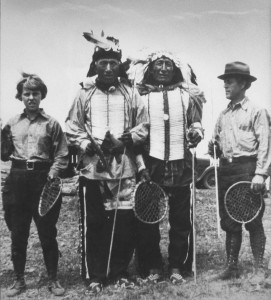
Hilda Neihardt, Black Elk, Standing Bear, John Neihardt

Tuesday, August 11, 2015

Institutional Change and the Reconstruction


I have been reading A Short History of Reconstruction by Eric Foner, and have posted this and this as I read.

The Civil War was very destructive, especially to the southern United States. The war decided that the United States was one nation -- indivisible. It resulted in abolition of slavery in the states in revolt during the war, and abolition of slavery for the entire nation through the 13th amendment to the Constitution immediately after the war. Thus a major focus of the Reconstruction was the reconstruction of political institutions after the war, reconstruction of economic institutions, especially those disrupted by the abolition of slavery, and reconstruction of the institutions of citizenship for to deal with the large number of former slaves who had been freed.
  • Political Institutions: the discussion focuses on who should vote. Should former slaves have the vote? How about Rebel leaders? When should voting rights be restored to the former Confederate states? How would it be decided if the voting had been fair and whether to seat those elected/
  • Economic Institutions: The key issue was how to institutionalize the work of the former slaves. If plantation agriculture was to continue, how would one institutionalize the interface that connected labor to the plantations? How many small farms for black families would be established and how would the relevant economic institutions be organized.
  • Citizenship Institutions: How would citizenship related institutions be restructured to allow former slaves to have citizenship rights and responsibilities? 
The choice of political institutions was influenced of course by the racism common in the southern and northern states. but also be the desire of the Republicans dominating the federal government to institutionalize a system that would keep their party in power.

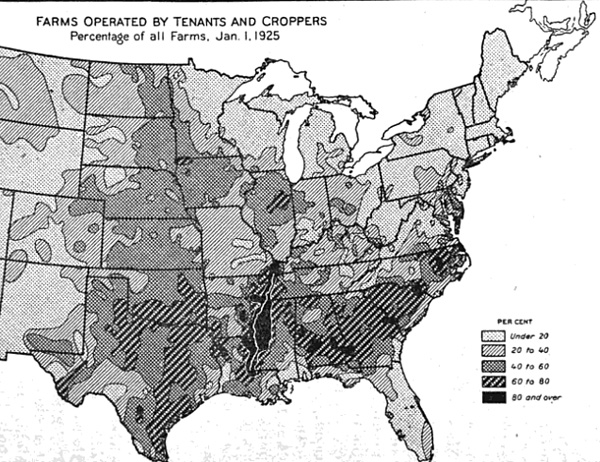
The freed slaves seemed to have wanted their own small farms that would have focused on subsistence production for the family plus some product for the market; this of course was a radical change from the plantation system of the deep south, a change that the blacks and their allies turned out not to have the power to obtain. Still it was a model that had been used by Sherman during the war (40 acres and a mule) and was a model used in the Homestead Act for the settlement of lands newly taken by the USA.

Since the plantation system survived, how would plantations recruit labor? Various options were tried. The principle one used for many years turned out to be sharecropping. Tenant farming (by black families of land owned by whites also emerged in the post-war south. However, there was also a mechanism used in which blacks were convicted of minor crimes, and then their labor sold to plantations in "work gangs" by officials of the government. The normal hiring institutions that had been assumed to be the outcome by northerners seem to have been little used.

Blacks were given citizenship as a birthright, and had rights to freedom, marriage, to testify in courts, to make contracts, and to own property, etc. It turned out that eventually the right to vote by blacks and to hold political office were initally denied in the south (and sometimes in the north), and were among the most controversial issues of the post-war period.

Beyond the Institutions Described Above

Today we understand that a culture includes many institutions, that the institutions influence one another, and some of the institutions that are less discussed in the book may have been quite important in the Reconstruction period.

Southern Black Culture

Blacks, whose marriages had not been respected in slavery, were very concerned with marriage institutions; as they had often been torn away from children in slavery, in freedom that wanted to institutionalize their rights to bring up their children. 

Former slaves quickly institutionalized their own churches and their own religious institutions, albeit ones that seem to us now to have been modeled after white churches and institutions with which they had been familiar.

Blacks had learned the value of education, and wanted schools. Barred from integrated schools, they quickly created black educational institutions. I assume that the first historically black colleges and universities came to be in this period, as well as adult literacy classes and schools for black children.

So too, blacks quickly developed communal organizations such as clubs, civic action groups, etc.. Recalling that Alexis De Tocqueville was struck by the number and importance of communal organizations in America, it is perhaps not surprising that many of the black institutions seem to have been strongly influenced in form and function by those in white communities.

White Southern Culture

I am no expert, but white southerners seemed more likely (than were blacks) to keep somewhat modified institutions that already existed, perhaps because they had more political and economic power with which to defend those institutions. One obvious exception is the KKK, which was developed to use force to reject black demands for improved status. As stated above, white plantation owners and managers ultimately substituted sharecropping, tenant farming, and use of prisoners for slave labor. thereby achieving high levels of production and export. (Eventually, mechanization would reduce labor needs for cotton farming and other forms of extensive agriculture.)

Northern Institutions

I recall that new institutions were being created in the north as well in the post war period. The transcontinental railroad and telegraph, supported in part by the national government through land grants are an obvious example. In education, the federal government again used land grants to establish a national system of land grant colleges. In the area of science and technology, a national system of agricultural field stations was created, linked to the land grant colleges and universities; the National Academy of Sciences was created.

Of course, the federal government innovated greatly during the Civil War. The military size was increased hugely. Institutions were created to support the soldiers, and in the aftermath of the war a system of National cemeteries was created.

A national currency replaced the many bank issued currencies, and a system of national banks was created. Federal bonds were issued to obtain money, and for the first time some were issued in small denominations for less than wealthy buyers. Wikipedia states:
Republicans enacted their legislation. At the same time they passed new taxes to pay for part of the war, and issued large amounts of bonds to pay for the most of the rest. (The remainder can be charged to inflation.) They wrote an elaborate program of economic modernization that had the dual purpose of winning the war and permanently transforming the economy. The key policy-maker in Congress was Thaddeus Stevens, as chairman of the Ways and Means Committee. He took charge of major legislation that funded the war effort and revolutionized the nation's economic policies regarding tariffs, bonds, income and excise taxes, national banks, suppression of money issued by state banks, greenback currency, and western railroad land grants.
And:
The industrial advantages of the North over the South helped secure a Northern victory in the American Civil War (1861–1865). The Northern victory sealed the destiny of the nation and its economic system. The slave-labor system was abolished; the world price of cotton plunged, making the large southern cotton plantations much less profitable. Northern industry, which had expanded rapidly before and during the war, surged ahead. Industrialists came to dominate many aspects of the nation's life, including social and political affairs.
Temporary measures of the federal government suggested that it might be able to more fully impose federal rules on states in the future. These included the Freedmens Bureau, and the creation of 5 military districts covering most of the Confederate states and installing governors of these districts appointed by the federal government.

This is only a partial listing of institutional changes that might be considered part of the post Civil War Reconstruction.

Monday, August 03, 2015

New Economic Institutionalization in the South After the Civil War


This is a continuation, following my previous post on A Short History of Reconstruction, Updated Edition by Eric Foner. Here I deal with Chapter 4 of the book which is titled "The Ambiguities of Free Labor".

With the abolition of slavery, the plantation economic system of the southern United States -- which had been based on slave labor, and which confounded race with social and economic status -- had to be rebuilt on a new foundation. We living today have seen how long it took Japan to develop its version of capitalism and more recently how different countries with their different cultures responded to the fall of Communism. The Russian experience seeking to find a new economic model to replace Russian Communism alone helps us to recognize the replacement of one set of economic institutions by another can be a long and difficult process!

The Republicans seemed so blinded by their "free labor" ideology that they completely underestimated the difficulty in getting plantation agriculture of the pre-war south converted into an economic system that depended on a labor market in post-war America. Foner points out that the outcome of such an institutional makeover is more easily seen retrospectively than during its course, and may differ from place to place (and from crop to crop). Sharecropping by black families on small parcels was the dominant outcome after a few years, with whites owning the land. The contracts between share cropper and land owner specified the crop to be grown and the share given to each party at the end of the growing season.

From our modern perspective, the assumption that white owners and black farm workers would quickly establish a mutual concern for the productivity of the land seems naive. We of course benefit from centuries of labor management and labor owner disputes, some so grave as to lead to violence. That the former slave owners (who had seen hundreds of thousands of armed former slaves in the Union army) and the former slaves (who had been almost uniformly the victims of coercive physical violence perpetrated by slave masters under the direction of plantation owners) would easily see a common interest is naive. To the normal disagreements between capital and labor over the share each would receive of the profits of the enterprise, was added the concern of the former slaves for the freedom of themselves and their families -- freedom that they linked to the control of land and the removal of coercive control of their labor by plantation owners. Plantation owners, once fearful of slave revolts, were in the post-war world surprised by the desire of former slaves for improved status and fearful that the black workforce would not provide the labor needed to run the economy.

Foner writes that late in the war and soon after the war, a significant amount of land was distributed to former slaves. The land had been confiscated from rebels or abandoned; it was seen as needed by the freedmen to feed themselves and their families and begin them on the course towards development of a free labor system. Soon after the war, however, the federal government confiscated most of this land from its freedmen owners and gave it to the former plantation owners. I don't understand the concept of property that would allow the government to give and then take away, without cause.

Coincidentally, two economists famous for their controlled studies of development projects have concluded that a model does seem to work. Their six country study (see also the discussion in The Economist) focused on poverty alleviation projects that included a variety of inputs: "a productive asset grant, training and support, life skills coaching, temporary cash consumption support, and typically access to savings accounts and health information or services." Inputs were continued for at least two years, and evaluated after three years. The approach worked, albeit with modest benefits in terms of increased capital, income and standards of living for the poor targets. It seems very unlikely that the Freedman's Bureau was in any position to provide support of this intensity to the millions of freed slaves/

Source: "U. S. Slavery"
Cotton has been grown in the southern United States for centuries; there a warm and relatively wet climate combined with rich soils of the coastal plains to provide a suitable growing environment, and there the raw cotton could be relatively easily transported to ocean ports to be shipped to the mills in the north and in England.

Clearly cotton was king before the Civil War. With the invention of the cotton gin at the end of the 18th century the hugely labor intensive task of removing the seeds from the valuable cotton fibers was replaced by a relatively simple mechanical process. Suddenly cheep cotton from the more mechanized cotton plantations in the U.S. south fed the efficient mills of the industrial revolution in England and the northern United States to create a super product -- low-cost, high quality cotton cloth -- sold via the trading networks that were established (especially by colonial Britain) throughout the world. Here are data on U.S. cotton exports in the latter half of the 19th century:
  • in 1860 cotton goods were the #1 export of the USA with a value of 58 million 1914 US$
  • in 1880 they were the #3 export with a value of 97 million 1914 US$
  • in 2000 they were the #7 export with a value of 196 million 1914 US$
  • in 1929 they were the #4 export with a value of 364 million 1914 US$
The United States is still the worlds leading exporter of cotton. 

I wonder if the need for a product of substantial worth in the south and of tariff income from cotton exports played a role in the decision of the federal government to give the land that been in cotton production back into the hands of plantation owners/ After all, those wealthy property owners would be likely to seek the profits from the commercial product. If so, then government acceptance and support for the share cropping system that devoted a great deal of the labor of the former slaves to producing cotton rather than subsistence crops seems reasonable.

Author Foner notes (in the following chapter of the book) that many influential people in the north also wanted cotton production to return to the south to produce inexpensive cotton in large amounts. Northern mills were dependent on cotton inputs, there was a shipping industry largely run from the north that had been employed transporting cotton, and there were of course related financial interests that would be endangered by mill closures and loss of shipping routes. Moreover, there were debts due from southern borrowers and government income that would be lost if the tariffs from cotton exports were to be lost. Thus northern interests were allied with southern interests in resuming cotton production, and that implied plantation production in 1865.

This map is from "37 maps that explain the American Civil War"; the source also provided this text:
The Civil War freed the slaves, and Reconstruction temporarily granted them basic political rights. But the settlement of the war made no provision for land reform or economic redistribution. The federally owned land of the West was secured for free (largely white) owner-operated farms, but the basic underpinnings of the Southern plantation economy were left intact. Newly freed slaves owned no land or farm equipment, and had little in the way of formal education. With Southern governments from the 1870s onward uninterested in providing any of those things, most of the rural black population was forced into a particularly unremunerative form of tenant farming known as sharecropping. In exchange for land to till, seeds to plant, and basic equipment, the sharecropper would do all the work and hand a large share of the proceeds over to the landowner. Discriminatory enforcement of laws against "vagrancy," barriers to education and the professions, and discrimination on railroads and other public accommodations made it exceptionally difficult for sharecroppers to move from job to job or bargain for better conditions.

Wednesday, July 29, 2015

About What Followed the Civil War: 1862 to 1877


I am beginning to read A Short History of Reconstruction, Updated Edition by Eric Foner, published this year. Foner's 1988 book, Reconstruction: America's Unfinished Revolution, 1863-1877, won the Bancroft, Parkman, and Los Angeles Times Book prizes; this shorter book has been updated to include some of the more recent scholarship. Foner's The Fiery Trial: Abraham Lincoln and American Slavery was published in 2011; it won the 2011 Pulitzer Prize for History, the Bancroft Prize, and the Lincoln Prize. Professor Foner has served as president of the Organization of American Historians, the American Historical Association, and the Society of American Historians. 
The Civil War resulted in two major changes in American institutions:
  • Slavery was abolished and all slaves were emancipated. Thus the plantation system of agriculture, as it had depended on slave labor, was also forced to end or to find new institutional mechanisms for the supply of labor.
  • Disunion was no longer an institutional option, as it had seemed to many Americans since the creation of the nation; thus the United States of America was thereafter a singular noun, rather than the plural noun it had been in the past. The federal government emerged from the Civil War transformed into a much more forceful institution, capable of raising armies numbering millions of men, with a much increased budget. New initiatives included creating a national currency, supporting the development of a trans-continental railroad and telegraph, instituting a national system of land grant colleges with its national system of agricultural research stations and extension services, and creating the Homestead Act by which the federal government used its ownership of land to foster settlement of the west and its economic development.
Perhaps even more serious, it changed America. Hundreds of thousands of young men had died in the war, and huge numbers of civilians had died as well. Much of the country, especially in the South, had been decimated and left in ruins; however, northern manufacturing industries sometimes had been quite successful during the war. Millions of former slaves were now freed, seeking to find new ways of living, or even surviving. Cotton, the nation's main export before the war, had not been exported (even to the northern mills) in large quantities during the war, and the nation had to deal with new international competition in the cotton market.

The term Reconstruction Era, in the context of the history of the United States, has two senses: the first covers the complete history of the entire country from 1865 to 1877 following the Civil War; the second sense focuses on the transformation of the Southern United States from 1863 to 1877, as directed by Congress, with the reconstruction of state and society.
It seems to me that it may be useful to use different words to differentiate between the two concepts.
  • One concept is Governmental Reconstruction Programs. We have now a body of  experience now with post conquest efforts: Afghanistan and Iraq, South Korea, Germany and Japan, World War I, the Spanish American War. The 13th, 14th and 15 amendments and the Congressionally mandated reconstruction programs were of significant albeit limited size.
  • The other concept is more general social and economic development, which is brings in northern and western development as linked to the development of the south in a now single nation (albeit one with great internal divisions). Again, half a century of development theory may be useful here.

Friday, July 17, 2015

Lone Star Rising -- The Texas Revolution Against Mexico


I just finished reading Lone Star Rising: The Revolutionary Birth of the Texas Republic by William C. Davis. I have posted three times before on this book:
If your ideas of the revolution that established the Lone Star Republic of Texas were formed by movies like The Alamo, this book tells a radically different story.

A sparsely settled area near the Gulf coast of the Caribbean in northern Mexico attracted settlers from the southern United States, seeking free land on which they could grow cotton using slave labor. They cared little that slavery was outlawed by the Mexican government, and they ignored requirements for receiving land grants such as loyalty to the government of the region and accepting the Catholic religion. The Anglo settlers, not unusual for their time,  were racists, with strong prejudice against people of African ancestry and Indians, not to mention Mexicans (who they saw as having European, African and Indian blood). The Mexicans, and perhaps the Criollos (those of Spanish ancestry who still dominated Mexican society) were also prejudiced against the Anglo settlers in the North (accepting them if they became more Mexican, created useful economic activities, and served as a barrier to the hostile Indian raiders).

We should remember how sparsely populated the state was at the time of the 1835-36 revolution (primarily of the Anglo settlers against the Mexican government). I quote from this source:
By 1750 some Indian tribes were using Spanish horses and French rifles to raid Spanish settlements in Texas. The plundering helps to explain why Texas was one of the most sparsely populated provinces on the northern frontier of New Spain. In 1790 the total population in Texas was 2,510, while in New Mexico it exceeded 20,000. At the same time, Indians thwarted efforts to establish catholic missions. In contrast to Texas, 40 percent of California’s Indian population had embraced Catholicism by 1803.....
Between 1821 and 1836 an estimated 38,000 settlers, on promise of 4,000 acres (1,620 hectares) per family for small fees, trekked from the United States into the territory.......
In eastern Texas 20,000 settlers and 1,000 slaves outnumbered the 5,000 Mexicans in the area by 1830.......Later the immigration was stopped. The Mexican government grew alarmed at the immigration threatening to engulf the province. Military troops were moved to the border to enforce the policy. Still there was illegal immigration. Immigrants crossed the border easily and by 1835 there were ten times as many Americans (30,000) as Mexicans. The settlers demanded greater representation and more power from the Mexican Government.
Author Davis points out that few of the people living in east Texas (the small area where the revolution took place) had experience in government (Sam Houston excepted; Davy Crockett, who had been a member of the U.S. Congress was killed at the Alamo). There were few lawyers (William Travis was an exception, but he too was to die at the Alamo), and indeed few professionals of any kind. A government and a military had to be created on the fly at the beginning of the revolution, and not surprisingly they were not created very well, nor were they to be very effective.

While Mexico was more populated, it too was seeking to establish new forms of government and had a weak military (albeit strong enough to impose its will through coups from time to time). Moreover, Mexico was seeking to establish governance over a large area with many diverse populations. Northern regions between Mexico City (and the seat of government) and the revolutionary area of Texas were in frank revolt against the central government. General Santa Anna was the strong man in control of the Government in 1835.

So Davis presents something of a "tragedy of errors" as the history of the revolution, a revolution fought on a tiny scale in a area that would have had little importance except for future events such as the Mexican American War.

SourceL Wikipedia
A convention of Anglos living in Texas -- having real issues relating to distant rule from the state capital of Coahuila y Tejas and from the national capital of Mexico City -- dithered among three alternatives: redress of grievances, separation of Texas from Coahila in Mexico, or independence of (some part of the Mexican territory of) Texas. A small military force of volunteer Texans (mostly Anglos) fought small Mexican garrisons at Goliad and San Antonio de Bexar, wining both in 1835.

General (and President) Santa Anna led a Mexican Army force to put down the Texas insurrection. With a corps of professional soldiers, the number in the force was increased by forced enlistments to 6,500. One can only imagine the state at which that army arrived at San Antonio after the long march, with limited provisions available from the areas through which it marched (which were themselves in economic trouble). Santa Anna:
  • Declared that there would be no quarter given to insurgents;
  • Began a siege of the Alamo which killed all the occupying Texans, but also resulted in the loss of a large portion of the professional troops in the Mexican force;
  • Divided his remaining force into several smaller forces, to be separated in the field, each with a different mission.
Following the Alamo, one of the Mexican forces took the town of Goliad, and after the surrender of the insurgent garrison, massacred the prisoners. The Alamo and Goliad massacres aroused anger and fear among the Anglo Texans, who were reinforced by volunteers from the United States.

There followed a retreat of the insurgents to the west, towards the Louisiana border, and of the civilian population; this disordered retreat came to be known as the Runaway Scrape; it apparently served to convince Santa Anna that he had little more to fear from the insurgent irregulars.

Contrary to Santa Anna's expectations, a force of insurgents comparable to his own portion of the Mexican invasion army confronted Santa Anna's force at San Jacinto. Apparently, the Mexican forces chose to take a siesta in the afternoon of April 21st, 1836 and the Texans chose that time to attack, winning a great victory; many Mexican troops were captured, including eventually General Santa Anna himself. Bargaining for his freedom and his life, Santa Anna ordered the rest of the Mexican troops to leave the disputed area, and signed a treaty. The Texas Revolution was effectively over.

Davis estimates (page 302) that some 700 Texas troops died, or about one-fifth of the total army of the Revolution. He estimates that as many as 1000 Mexican troops died and 500 more were wounded. Compared with the horrendous totals of the U.S. Civil War, this total campaign might count as a minor skirmish.

The Texas Lone Star Republic lasted until Texas became a state in 1845, and the territorial dispute that the Revolution left in its wake served as a pretext for the Mexican-American War, and the acquisition by the USA of  a huge block of what is now South Western states.

Disputed Territory
Source: Wikipedia
Territory in the upper right hand portion of the map is part of the USA
The history here is quite different than that of California (see my recent post on Father Junipero Serra). I have also posted on the administration of President Polk, including the Mexican-American War. I have tried to make the point that the history of the portions of the United States acquired from Mexico is quite different than that of the East Coast of the country.

I came away from the book disliking the protagonists of the Texas insurgency. Of course, they appear incompetent, but that was perhaps to be expected when civilians are asked to create a government and an army. As described by author Davis, the key members of the cast were self serving, duplicitous, and often greedy. The exception was the men who fought to the death at the Alamo, resisting the much larger Mexican army. To top it off, the constitution that they wrote for their new republic corrected what they saw as the principal failure of its model, the U.S. Constitution; the Lone Star Republic of Texas constitution made the institution of slavery permanent in that country -- no surprise that Texas entered the United States as a slave state, and seceded in to join the Confederacy.

I suppose that there is an audience who want endless details about the people who led and participated in the Lone Star rising, but I found too many names that I would not remember. Still, the book was very interesting, if only because it suggested how a small conflict in an out of the way corner of the world can affect later events, and how that conflict can be inflated in local memory.

Friday, July 03, 2015

A Thought About Indians and Texas


I am still reading Lone Star Rising: The Revolutionary Birth of the Texas Republic by William C. Davis. It tells how Spain weakened by the Napoleonic wars allowed revolutionary forces in the Americas to obtain independence for the once Spanish colonies. It also tells how the new Mexican republic was unable to quickly establish a strong state. Anglo immigrants to a relatively small area from Louisiana west, between the Caribbean and the Balcones Escarpment took advantage of the weakness of the Mexican Government to establish the Texas Republic.

The book seems to leave out the Indians (although it does deal with the Tejanos -- people of pure Spanish heritage and Mestizos). It mentions (63-54) Tlaxcalan Indians as residents of Texas (without mentioning that the tribe was located principally in Central Mexico, and the members found in Texas were colonists in Spanish times. The author does sometimes suggest that there are hostile Indians that are perceived by Texians as threats to their safety, without specifying their tribes. Davis mentions (page 178) that Edward Burleston had led Texas militia against Indians, again not specifying which tribe was involved. In Chapter 8, author Davis mentions that the Mexican soldiers who surrendered the Alamo to Texians were sent off with their weapons and a small canon in order that they might have protection against attack from Indians, again not specifying which tribe was of concern,

The Comanches

I think especially of the Comanches. Their territory, The Comancheria, was large, savagely defended, and served as a staging area for raids on nearby peoples. I would note this description from Wikipedia:
The area was vaguely defined and shifted over time, but generally was described as bordered to the south by the Balcones Fault, just north of San Antonio, Texas, continuing north along the Cross Timbers to encompass a northern area that included the Cimarron River and the upper Arkansas River east of the high Rockies. Comancheria was bordered along the west by the Mescalero Escarpment and the Pecos River, continuing north along the edge of the Spanish settlements in Santa Fe de Nuevo México. 
Today, this region makes up West Texas, the Llano Estacado, the Texas Panhandle, the Edwards Plateau (including the Texas Hill Country), Eastern New Mexico, western Oklahoma including the Oklahoma Panhandle and the Wichita Mountains, southeastern Colorado and southwestern Kansas.
The Comancheria 
Source
Pekka Hämäläinen (2008) argues that from the 1750s to the 1850s, the Comanches were the dominant group in the Southwest, and the domain they ruled was known as Comancheria. Hämäläinen calls it an empire. Confronted with Spanish, Mexican, and American outposts on their periphery in New Mexico, Texas, Louisiana, and Mexico, they worked to increase their own safety, prosperity and power. The Comanches used their military power to obtain supplies and labor from the Americans, Mexicans, and Indians through thievery, tribute, and kidnappings. (See Comanche-Mexico War) Although powered by violence, the Comanche empire was primarily an economic construction, rooted in an extensive commercial network that facilitated long-distance trade. Dealing with subordinate Indians, the Comanche spread their language and culture across the region. Their empire collapsed when their villages were repeatedly decimated by epidemics of smallpox and cholera in the late 1840s; the population plunged from 20,000 to just a few thousand by the 1870s.
The Apaches

 I quote from another Wikipedia article:
In general, the recently arrived Spanish colonists, who settled in villages, and Apache bands developed a pattern of interaction over a few centuries. Both raided and traded with each other. Records of the period seem to indicate that relationships depended upon the specific villages and specific bands that were involved with each other. For example, one band might be friends with one village and raid another. When war happened between the two, the Spanish would send troops, after a battle both sides would "sign a treaty," and both sides would go home. 
The traditional and sometimes treacherous relationships continued between the villages and bands with the independence of Mexico in 1821. By 1835 Mexico had placed a bounty on Apache scalps (see scalping) but certain villages were still trading with some bands. When Juan José Compà, the leader of the Copper Mines Mimbreño Apaches, was killed for bounty money in 1837, Mangas Coloradas (Red Sleeves) or Dasoda-hae (He just sits there) became the principal chief and war leader; in the same 1837 Soldado Fiero (aka Fuerte), leader of the Warm Springs Mimbreño Apaches, was killed by Mexican soldiers near Janos, and his son Cuchillo Negro (Black Knife) became the principal chief and war leader. They (being now Mangas Coloradas the first chief and Cuchillo Negro the second chief of the whole Tchihende or Mimbreño people) conducted a series of retaliatory raids against the Mexicans. 
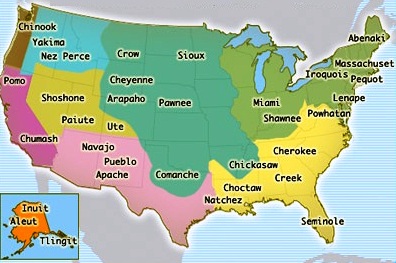
Indian Lands in the USA: Note the Navajo/Pueblo/Apache Territory (Source)
The modern term Apache excludes the Navajo people. Since the Navajo and the other Apache groups are clearly related through culture and language, they are all considered Apachean. Apachean people formerly ranged over eastern Arizona, northern Mexico (Sonora and Chihuahua), New Mexico, west and southwest Texas, and southern Colorado. The Apachería consisted of high mountains, sheltered and watered valleys, deep canyons, deserts, and the southern Great Plains.
It would seem that when the United States absorbed the Republic of Texas, and especially after the U.S. land acquisitions in the 1840s relating to the Mexican-American War, Texas expanded to its current size. Eventually, U.S. military force eliminated military threats to Texas from the Apaches and Comanches.

Monday, June 29, 2015

More on the Social Factors Relating to the Elvis Phenomenon and the Rise of Rock and Roll Music


I recently read Channeling Elvis: How Television Saved the King of Rock 'n' Roll by Allen J. Wiener. I previously posted on the technological infrastructure that was in place by 1958 that was involved in the Elvis phenomenon. I also posted on the culture that allowed the Elvis phenomenon to occur. Finally, I posted ideas about why Elvis lead the Rock and Roll revolution, and what there was about America at the time that allowed Elvis to do that. I had intended those to be my only posts on the book, but I find I have another, so here goes.

Yesterday I watched a TV discussion by Marilyn Irvin Holt on "Politics and Childhood During the Cold War". One of her points was that after World War II, Americans invested heavily in the new generation of children. She noted that they had similarly invested in children after World War I and the Civil War -- that such an investment in children may be a natural way for a country to follow a war. I think it was young people in the late 1950s who formed the first audience for Elvis and Rock and Roll. Maybe there was some relationship between the heavy investment these young people had had made in them which made them ready for a new music.

The 1920s been called the Jazz Age. A new music came out of Louisiana and its black communities and swept young people in the USA, and indeed in much of the world. Is there as parallel with Rock and Roll which also came from the south, from roots in the black community, and followed a World War? Rock and Roll came a little later after the war than did Jazz, the Charleston, and similar music, but then after World War II, in quick succession followed the beginning of the Cold War and the Korean War; they may have delayed a youthful demand for new music.


UNESCO was created after World War II, with the purpose of building the defenses of peace in the minds of men (because it is in the minds of men that wars start). The Allies who won the war had noted that the Nazis and the Fascists had worked hard to indoctrinate children into their ideologies, including introducing their propaganda into schools and text books. One of the first projects undertaken by UNESCO in Europe was to scrub the text books of that propaganda. I suspect that many teachers after the war sought to help kids learn how to think for themselves and avoid being excessively influenced by such propaganda. Indeed, Historian Holt suggests that there was an effort during the Cold War to help children think for themselves; the generation that went out on the streets to protest racial segregation and the Vietnam War (that of the 1960s) certainly seemed to me to think for themselves, rejecting many (bad) ideas of their elders.

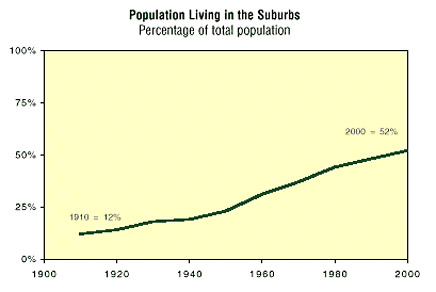
The Growth of the Suburbs

Source
Source
As these two graphs show, there was a long term population shift in the United States away from the rural areas toward urban areas and suburban communities. By 1960 something like 30% of Americans lived in suburbs, notably manufactured new communities of the Levittown type. These were relatively affluent communities. They also tended to be segregated, open only to whites. They were places where teenagers often had some disposable income, rooms of their own, and considerable freedom of action. Were the suburbs the hotbed of Rock and Roll as performed by Elvis Presley, who was most certainly White, and whose whiteness was very visible on the TV shows and the movies in which he appeared.

Other Factors Dismissed

There was concern among politicians at that time that there was a wave of "juvenile delinquency". Was there such a crime wave? The following graph suggests that there was not. Thus it seems improbable that serious juvenile crime was in any way related to the Elvis phenomenon.

Source

So too, the rise of Elvis and Rock and Roll seems to have preceded the rise of the use of illegal drugs in the USA. While the graph below is about numbers of people in prison and jail, it is suggestive. After the announcement of the "War on Drugs" the numbers shot up, and especially after the "Sentencing Reform Act" was passed, but there was no similar increase from 1940 to 1970. If there had been a big increase in drug use in the late 1950s and early 1960s one might have expected there to have been an increase in arrests, convictions, and people in jail.

Source

Friday, June 26, 2015

On the Factors Behind the Texas Revolution Against Mexico


I just finished Chapter 5 of Lone Star Rising: The Revolutionary Birth of the Texas Republic by William C. Davis. This complements earlier chapters that discuss the European context for the creation of the Texas Republic (see my previous post). In this chapter, author Davis addresses the Mexican context.

The Criollo leadership in the Viceroyalty of New Spain, long dissatisfied by the lack of influence and respect that they perceived that they received from their Spanish administrators, took advantage of Spain's weakness to begin an insurrection in 1811. Davis suggests that this was in part due to the revolutionary examples before them (United States, France) and part of a larger Hispanic American movement that involved parallel revolutions led by Bolivar (in northern Sourth America), San Martin (Argentina) and O'Higgins (Chile).

The revolution succeeded in that Mexico was created as a nation 1821, and a new Constitution was written in 1824. (Spain was not content with the loss of its huge colony, and continued it attempts to reconquer Mexico. Starting in the Caribbean, Spain eventually landed an expeditionary force at Tampico in 1829, but that force was repulsed. New Spain was huge, as the map below shows, spanning an area from Oregon to Panama, from Louisana to the Pacific Coast of California.

Unfortunately for Mexico and its people, there was little basis to establish a new nation. Various forces preferred a centralized or a federal government. Caudillos supported by army factions competed for national power (the army was perhaps the strongest national institution in the country). The Central American states separated from Mexico, and several of the states of what is now Mexico were in revolt against the government in Mexico City. The northern territories (shown as Alta California, New Mexico and New Philippines) were very sparsely populated -- often more Indian than Mexican.

The various governments in Mexico City had little time nor interest in the aspirations of those in the far north, and perhaps especially not for the Anglos who were moving into Texas (and also California) The Mexicans had outlawed slavery, and this was especially repugnant to the Anglo settlers of Texas -- southerners who had brought their slaves with them as necessary to the operation of the plantations (for King Cotton) that they were developing on their large land grants. This situation led to the Texas revolt in 1836 which created the Texas Republic (which was annexed by the USA in 1845.) The weakness of the Mexican government, also led to a revolt in California in 1846, the Bear Flag Republic, and (after the California gold rush of 1848) annexation of California and California statehood in 1850.)

Source


Saturday, June 20, 2015

Beginning to Read about the Revolutionary Birth of Texas


I have started reading Lone Star Rising: The Revolutionary Birth of the Texas Republic by William C. Davis. Author Davis begins the book early in the 19th century, putting the scramble for Texas in the context of the Napoleonic Wars which weakened Spain and thus Spain's hold on its colonies in the Americas, and resulted in the sale of the Louisiana territory by France to the United States. He also puts it in the context of the revolutionary fever that swept from the creation of the United States (and the French and Haitian revolutions) through the Spanish colonies in South America, and finally to Mexico.

Texas then was a region quite different than the State of Texas now. It was the agriculturally rich coastal plane that ended at the Balcones Escarpment (see map below). Far from Mexico City, this was a region under Spain with only a few thousand inhabitants owing allegiance to Spain, who were threatened by Comanches; that population actually decreased in the first decades of the 19th century. Not surprisingly, the region was attractive to filibusters, but none in the early part of the century managed to displace the Spanish rulers. With the success of the Mexican revolution, American settlers were invited into the region under conditions such as their accepting Mexican governance and the Catholic religion. Large amounts of land, cheap were a powerful attraction.

On page 13, Author Davis mentions José Gabriel Condorcanqui as starting the last major Indian uprising against the Spanish in 1781, an uprising that besieged Cusco. I think of Condorcanqui under the name he assumed, Túpac Amaru II. I also associate that uprising with Túpac Katari from Ayo Ayo, a village in Bolivia that I once visited.

The picture I get from the earliest part of the book is of adventurers with little capacity to achieve their wild ends failing again and again as they tried to steal a large and valuable piece of land from Spain. The Mexican government, in the years after the successful separation from Spain, was very weak and unable to exercise power over the very distant land of Texas. In this respect, Davis's book on Texas history also sheds some light on California history which was the subject of a recent meeting of the History Book Club to which I belong.

Source
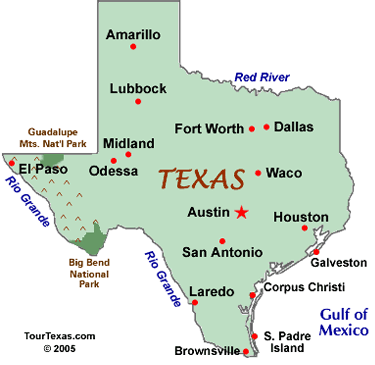
Texas Cities (Source)
Note that Galveston, San Antonio, Corpus Christi and El Paso -- all Spanish city names -- are in the south of the state. Houston and Austin, named after the heroes of the Texian Revolution against Mexico, are in the small Texas described in the first paragraph above.

Thursday, June 18, 2015

TV as a Factor in Elvis Presley's Career.


I just finished reading Channeling Elvis: How Television Saved the King of Rock 'n' Roll by Allen J. Wiener. I would not normally have chosen to read this, but it is a selection by the book club to which I belong and is written by a friend. I actually learned quite a bit from the book.

Elvis is of course a phenomenon, hugely popular in the late 1950s and early 60s, his popularity decreased. He went on a downward slide of use of (perhaps prescription) drugs, weight gain and crash diets, until his death at age 42 in 1977.

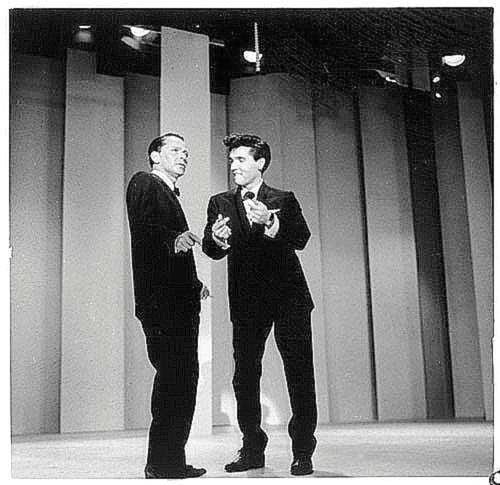
The book is very good at explaining how a certain kind of television show comes about and how it is made. For the early Elvis Presley television programs, he simply fit into a slot in a continuing variety show. His later shows were built around him (and in one case another established star -- Frank Sinatra). These were negotiated by his manager (Colonel Tom Parker), sometimes with the participation of his record company or a firm of agents.

Then one or two people were chosen to pull together the show. They would come up with a theme. Elvis would usually bring his own small band and backup singers. The producers/directors might add a network orchestra and dancers. There would be set design and construction. There would be a plan for the camera work, and the cameras and camera operators would be chosen. The book makes mention of the people working the sound system and the lights. There would be costume design, fittings, etc. as well as makeup. Sometimes new music would be selected or written for a TV show (coordinated with the record company, that would be thinking about issuing singles and albums to take advantage of the public interest that the TV special would generate). Colonel Parker would be looking at commercial tie-ins which might include sale of programs to live shows, sales of pictures and posters, fees to hotels or other businesses to be mentioned in the show, to food served in the venue. Since Elvis was such a gifted audience favorite, shows tended to have a live audience, and that would also involve arrangements, up to the selection of the lucky audience members. Finally, there would be an editing job to make a great show out of an abundance of film material. Moreover, network executives and representatives of the sponsors had to be consulted and their views taken into account (even if not accepted). The hour of light entertainment for the viewer was the result of a lot of work by a very gifted and skilled group of people.

I found myself looking into the technological changes that made the Elvis phenomenon possible: http://j.mp/1L3zzBw

I also thought about the more general cultural changes that were occurring during the 1950s and 60s: http://j.mp/1Li4MSz

What Was There About Society That Made the Elvis Phenomenon Possible?

After World War II, the American economy tooled up to meet the pent up consumer demand; people had money in their pockets and were willing to spend it on more comfortable housing, cars, and notably in terms of Elvis, electronics. Factories that had produced guns and ammo now used mass production techniques to meet the market demand with new and more affordable radios, cars with radios, record players, records, and starting in the 1950s, televisions. By 1956, a family might of an evening be found with the father in the living room watching the news and sports on TV, the mother in another room listening to top 40 music while doing chores, and the kids in still another room listening to records on the family record player.

The family still went to the movies, albeit less often, but might see one of Elvis' 27 movies (in the 60s), Mom and dad, or the teenage kids, or the whole family together might go out to a restaurant where they would hear music on the jukebox,

While by 1956 most families had a black and white TV (and would get color TVs in the 60s) the best entertainment was on one of the three networks. Thus, a program like The Ed Sullivan Show on Sunday nights would draw a huge audience, especially if there had been a lot of buzz about an act such as would occur when Elvis appeared in 1956.

Record stores were to be found conveniently to where most people lived, stocked with the latest 45 rpm hit singles and with hit albums. Even kids could now afford their products, and the top hits of the day sold like hot cakes.

The music audience had somewhat fragmented by the late 1950s and early 1960s, but there were indications that it was ready for something new. Elvis could draw a youth audience, some of the audience for country music, some of the black audience, and the audience for something new.

Then there was synergy. As more people bought his records, they were more interesting to radio disk jockeys and TV shows were more interested in featuring him. The jukeboxes brought in more money if they had his top hits, and so they did. People talked about his appearances on TV, and then went out to buy his records.

By the time Elvis arrived on the scene, the record industry was multinational, and he quickly got an audience abroad. For his 1968 television special, satellite broadcasting was possible, and in fact that special was the first to go world wide.

What Was It About Elvis That Allowed Him to Grow Rock and Roll So Big So Fast?

Allen Weiner, after his extensive interviews, seems to feel that Presley had a good voice and a good understanding of the music he performed (often based on the gospel music he heard as a child in church or the music of the black communities in which he lived as a young man). His overt sexuality worked at the moment in time that he was discovered and most popular. He was very good with audiences, and seemed to learn and repeat what worked with an audience.

I think that we also have to give credit to "Team Elvis". This fairly simple young man lucked out when he met the folk at Sun Records who recognized a talent in him, put him together with the right group, and made some good records. He was lucky to get on Louisiana Hayride, a well established show with a regional audience where he learned a lot about performing for the media.

He was exceedingly lucky when he signed on Colonel Tom Parker as his manager -- a man who had already developed a couple of music stars and who was full of ideas for getting Elvis' music before the public and able to negotiate the contracts to implement those ideas. The Team Elvis also included back up musicians and singers who fitted his music and stayed with him for years at a time.

When RCA Records signed him up, Team Elvis got their staff of people who got his records into the record shops, who got the radio disk jockeys to play his new releases, who helped get him good TV appearances, and who got his music onto the country's jukeboxes.

When Elvis got on a major TV show, others joined Team Elvis on a short term basis to build the audience for that show. When he did a TV special, the network PR staffs went all out. When he made a movie, the studio joined the team to publicize the film and to increase the buzz about Elvis.

And of course, fans by the million joined Team Elvis, buying his pictures and posters, playing his records for their friends, and adding to the buzz~

Final Comments

The book turns out to be very sad, telling a history of a nice young man with talent who becomes too famous and too rich too fast, loses his career and his health and dies young.

This book may not be for the died in the wool Elvis hater, nor the Elvis fan who knows all that it contains already, but I found it interesting and readable.

About the Culture in Which the Elvis Phenomenon Occurred"


I am reading Channeling Elvis: How Television Saved the King of Rock 'n' Roll by Allen Wiener. It occurs to me that I need to put this in a historical context, and others might find it useful as well. It is worth reading the Wikipedia entry on Elvis Presley.

The 1950s (The Silent Generation Comes of Age)

U.S. Population: 132.2 million in 1940, 151.3 million in 1950
U.S. Real GDP: $1.27 trillion in 1940, $2.27 trillion in 1950

Elvis Presley was raised in poverty, and had had only a relatively short career in the South before exploding into the national consciousness in the late 1959s,. Elvis began his TV career appearing multiple times on popular national TV programs in 1956 when he was 21 years old. He performed early in the years in six shows of Stage Show, hosted by Tommy and Jimmy Dorsey, a show that shared an hour time slot with Jimmy Gleason's very popular Honeymooners show. Then Presley appeared twice on The Milton Berle Show, again very popular, and The Allen Moore Show. There was an interview with Hy Gardner on a New York City station, and finally three appearances on The Ed Sullivan Show (the third in January 1957); the Sullivan Show appearances not only provided a large audience, but were a sort of "seal of approval" that Elvis Presley was a really big star! Elvis had four albums that topped the charts in the USA in the 1950s and 12 #1 singles plus two more that were in the top ten.

Consider a 16 year old girl in 1956 who was therefore born in 1940. Her parents had just lived through the Depression when she was born, the war was on in Europe, and Americans would fight World War II from 1941 through 1945. The Cold War would soon follow. The Korean War was fought from 1950 to 1953; President Eisenhower fulfilled a campaign promise and ended it. For a few years there was peace, and 1956 was for an American teenager a relatively peaceful time. That was the life experience of the girls in the audiences that screamed and made Elvis "the King".

I think there was a lot of interest in rebellious young people at the time. The Catcher in the Rye by J. D. Salinger.was published in 1951.  Marlon Brando starred in The Wild One in 1953. James Dean starred in Rebel Without a Cause in 1955. Jack Kerouac published On the Road in 1957.

As I look back on the run up to the birth of Rock and Roll and the sudden stardom of Elvis, my first thought is of the "moon-June" music that I associate with the network radio that dominated home entertainment prior to television invading every living room in America. But that is not a full picture:
  • "The Third Man Theme," redolent of Austrian cafes and featuring a zither solo, spent 11 weeks at number one on Billboard's U.S. Best Sellers in Stores chart in the 1950.
  • "Goodnight Irene," written by Leadbelly (a black man who was in and out of jail) as sung by the Weavers was named by Billboard as the number one song of 1950.
  • "The Tennessee Waltz, originally a country song, became a multimillion seller via a 1950 recording  by Patti Page.
  • "On Top of Old Smokey" -- a fok song -- was made hugely popular by The Weavers in 1951;
  • 'Auf Wiederseh'n, Sweetheart" was ranked #5 for 1952 on Billboard, and was the first song recorded by a foreign artist to make number one on the U.S. weekly Billboard chart.
  • 1953 saw "Vaya con Dios," "Eh, Cumpari!" and "C'est si bon" among Billboard's top 30 songs for the year.
  • "Shake, Rattle and Roll" by Bill Haley and His Comets made the top 30 in 1954.
  • Haley's "Rock Around The Clock' made number 2 in 1955.
  • Elvis Presley had 5 of the top 30 Bilboard songs in 1956, but Carl Perkins version of "Blue Suede Shoes," Tennessee Ernie Ford's "Sixteen Tons" and Fats Domino's "I'm In Love Again" also made the top 30.
Maybe the American audience was looking around for some new music (or at least some of its now fragmented portions) and Rock and Roll was successful in the mid 50s in reaching a portion of that audience. Wikipedia says:
Accompanying Presley's rise to fame, a cultural shift was taking place that he both helped inspire and came to symbolize. Igniting the "biggest pop craze since Glenn Miller and Frank Sinatra ... Presley brought rock'n'roll into the mainstream of popular culture", writes historian Marty Jezer. "As Presley set the artistic pace, other artists followed. ... Presley, more than anyone else, gave the young a belief in themselves as a distinct and somehow unified generation—the first in America ever to feel the power of an integrated youth culture."


In November 1956, Presley made his film debut in Love Me Tender. In 1958, he was drafted into military service. He resumed his recording career in 1960, although recordings made before his military service and on leave were actually released during the time Elvis was in Germany.

Colonel Parker, Presley's manager broke new ground as television, top-40 radio, jukeboxes, record sales, movies, in-person concerts, and commercial tie-ins (posters, photos, concert programs, and even food) were combined in a synergy to increase Elvis' fame, increase his record sales, and make money!

The 1960s (Early Baby Boomers Become Adults)

U.S. Population: 179.3 million in 1960
U.S. Real GDP: $3.08 trillion trillion in 1960

I remember the 1960s as hard years. There was the Bay of Pigs and the Cuban Missile Crisis at the beginning of President Kennedy's term in office. The Cold War turned hot in Vietnam -- brought into American living rooms by TV -- and American involvement escalated through the decade. The Anti-War movement grew, and people took to the streets to protest the war. Johnson decided not to run again for President in 1968, and Nixon won, in part on his promise to end the war -- but the war went on. Bombing of North Vietnam did not sap the will of the enemy. A massacre in My Lai by American troops badly shook American public opinion. So too did the Tet Offensive of 1968. President Nixon began secret bombing of Cambodia in 1969, a bombing that continued into 1970.  The U.S. public was shocked when college students were killed in 1970 by militia at Kent State University.

Foreign policy remained complex, demanding attention from government leaders if not from most of the American public. President Kennedy began the Alliance for Progress (in the Americas) and the Peace Corps. The Middle East demanded attention, as there was an Israeli-Egyptian War in 1967. As Cuba moved into the Soviet camp, Washington became concerned with Communist intrusion into other Latin American countries. Decolonization took hold after World War II, new nations in Africa and Asia took seats in international organizations, and often became surrogate battlegrounds for the Cold War principals; the political, economic and social development of Africa, Latina America and Asia became a concern. The former imperial European powers sought to adjust to their new, more-limited international role.

President Kennedy was assassinated in 1963, Martin Luther King, Jr. in April of 1968, and Bobby Kennedy in June of 1968. The Civil Rights Movement which had started in the 1950 continued and grew through the 60s. The movement contributed to the Civil Rights Act of 1964 and the Voting Rights Act of 1965, but also saw freedom riders killed and unforgettable televised police brutality against peaceful demonstrators in the South. A wave of inner city riots in black communities wracked the country from 1964 through 1970. President Johnson began a War on Poverty, assuring the country that it could afford guns and butter.

The Hippie movement, centered in San Francisco, captured the attention of the nation for a bit. While U.C. Berkeley got a lot of attention for the Free Speech Movement, university campuses across the nation became involved in counter culture activities. The Pill made more impact, and sexual mores were liberalized. Marijuana and other drugs were more in the news and more widely used.

The 16 year old girl Elvis fan of 1956 would be 26 in 1966. She might well be married and have children of her own, but she might also continue to be his fan. A new generation of young fans also had arrived, some having first heard Elvis on TV, radio or records at their mother's knee. Older fans were also recruited to the mix, including older folk. For that young mother, the world was perhaps a more threatening place than it had been  a decade earlier.

As to the music scene, I quote from Wikipedia:
During the early 1960s, Britain's new wave of musicians gained popularity and fame in the United States. Artists such as the Beatles paved the way for their compatriots to enter the US market. The Beatles themselves were influenced by many artists, among them American singer/songwriter Bob Dylan, who was a lyrical inspiration as well as their introduction to marijuana. Dylan's early career as a protest singer had been inspired by artists like Pete Seeger and his hero Woody Guthrie. Other folksingers, like Joan Baez and Peter, Paul and Mary, took the songs of the era to new audiences and public recognition. 
The music of the 1960s moved towards an electric, psychedelic version of rock, thanks largely to Bob Dylan's decision to play an electric guitar at the 1965 Newport Folk Festival. The newly popularized electric sound of rock was then built upon and molded into psychedelic rock by artists like The 13th Floor Elevators and British bands Pink Floyd and the Beatles. The Beach Boys' 1966 album Pet Sounds also paved the way for later hippie acts, with Brian Wilson's writing interpreted as a "plea for love and understanding." Pet Sounds served as a major source of inspiration for other contemporary acts, most notably directly inspiring the Beatles' Sgt. Pepper's Lonely Hearts Club Band. The single "Good Vibrations" soared to number one globally, completely changing the perception of what a record could be. It was during this period that the highly anticipated album Smile was to be released. However, the project collapsed and The Beach Boys released a downgraded version called Smiley Smile, which failed to make a big commercial impact but was also highly influential, most notably on The Who's Pete Townshend.......... 
The 1960s was also an era of rock festivals, which played an important role in spreading the counterculture across the US. The Monterey Pop Festival, which launched Jimi Hendrix's career in the US, was one of the first of these festivals. Britain's 1968–1970 Isle of Wight Festivals drew big names such as The Who, The Doors, Joni Mitchell, Hendrix, Dylan, and others. The 1969 Woodstock Festival in New York state became a symbol of the movement, although the 1970 Isle of Wight Festival drew a larger crowd. Some believe the era came to an abrupt end with the infamous Altamont Free Concert held by The Rolling Stones, in which heavy-handed security from the Hells Angels resulted in the stabbing of an audience member, apparently in self-defense, as the show descended into chaos.
The Beatles broke up at the end of the decade, but other British bands soldiered on,


Elvis Presley began the 1960s with a TV special costarring with Frank Senatra. It was very well received, and effectively restarted his career with a bang after his two years of army service. Elvis turned out 27 movies in the 60s, commercializing on his reputation. They were virtually all profitable for Elvis, Parker and the movie studio, but had little serious value as film or to Elvis' career as a musician. In 1968, having missed out on much of the musical excitement of the decade, he made another TV special, Elvis. Author Wiener sees this show as marking a comeback for Elvis due to the show's very large TV audience (even if it failed to garner great critical success). The following years were devoted to touring for concerts. Those in Las Vegas and Tahoe were lucrative and important as the locale for the creation of his stage performance, but he toured the country extensively, packing in the audiences and making himself and his manager, Colonel Tom Parker a lot of money. However, this was for Elvis the early stage of a downward slide, marked by addiction to pills, weight gain, family problems (he was married in 1967 and his only daughter was born a year later), and loss of motivation for his career.

Elvis recorded music during the period; it continued to sell, making money for Elvis and Parker. He had four number one albums and two more in the top ten in the USA from 1960 through 1964. and then not another until 1969.  Similarly, he had five #1 singles and five more that were in the top 10 from 1960 to 63, but only one #1 and two that hit #3 in the rest of the decade.

Elvis' home, and now visitors attraction


The 1970s (More Baby Boomers Become Adults/The Hippies)

U.S. Population: 203.2 million in 1970, 248.7 million in 1980
U.S. Real GDP: $4.71 trillion trillion in 1970, $6.50 trillion in 1980

The Vietnam War ground on. The release of the Pentagon Papers by The New York Times and The Washington Post in  1971 undermined trust in the government statements and in its Vietnam policy. The Paris Peace Accords were signed in 1973 but were not accepted. President Nixon ordered U.S. ground troops to cross the Cambodian border in 1970, seeking to interdict Vietcong supply routes. A "Vietnamization" policy was initiated strengthening the armament of Vietnamese forces, but withdrawing U.S. forces. By the beginning of 1972, over 400,000 U.S. personnel had been withdrawn, virtually all combat troops. With public opinion in the U.S, against the war, and Democrats controlling the Congress and against the war, the South Vietnamese were increasingly left to fight the Vietcong on their own. The final invasion and surrender of Saigon came in 1975, again playing on TV in American living rooms. The majority of Americans were happy to see American losses in Vietnam put to an end.

Vice President Spiro Agnew resigned his office in 1973 having been charged with bribery, conspiracy and tax fraud. A break in at the Democratic headquarters in the Watergate in June of 1972 unraveled into the Watergate scandal that would end the Nixon Administration and result in the first resignation of an American president. Day after day, newspapers screamed stories of illegal acts planned and carried out by White House operatives, a massive cover up, slush funds, and involvement reaching up to the president himself. A special prosecutor was appointed, key leaders in the Department of Justice resigned rather than carry out the president's orders, and President Nixon finally resigned from office on August 9, 1974.

1973 was the first of the oil shocks as the Oil Exporting Countries exercised their monopoly power by reducing exports and thus raising oil prices. Not only did this result in long lines at gas stations in the USA, but in a global financial crisis (the financing of needed oil imports) and in crucial fuel shortages for the South Vietnamese government that helped bring on its military collapse. There would be another energy crisis in 1979.

The 70s were a time in which women's issues came more to the fore -- women's rights and feminism. More women entered the workforce, Rowe vs. Wade in 1973 established a woman's right to abortion, and other changes advanced the lives of women. It was also a time when the environmental movement gained momentum. In 1970, the United States celebrated its first Earth Day in which over two thousand colleges and universities and roughly ten thousand primary and secondary schools participated.

That 16 year old girl of 1956 was 36 in 1976 -- possibly still an Elvis fan. The Presley fan base added men as well as women, and many younger than his now maturing original fans, but also older people, some of whom were drawn by his gospel music or his country tracks. But that 36 year old woman was now more mature, with more concerns in her personal life, and much more distrusting of government. Depending on her political ideology, she might be happy or disconcerted by the social changes in the country; she would have more political and cultural power, were she to choose to use it.

I quote from Wikipedia again on the music scene:
The early 1970s saw the rise of many diverse forms of popular and rock musical styles, including jazz rock (aka "fusion"), southern rock, folk rock, and soft rock, with the latter including recording artists such as The Carpenters, Carole King, and James Taylor. It also included the rise of such popular, influential rhythm and blues (R&B) and Motown artists as Stevie Wonder, The Temptations, and The Jackson 5. 
Funk, an offshoot of Soul music with a greater emphasis on beats, influences from rhythm and blues, jazz, and psychedelic rock, was also very popular. The mid-1970s also saw the rise of disco music, which dominated during the last half of the decade with bands like the Bee Gees, ABBA, Village People, Boney M, Donna Summer, KC and the Sunshine Band, etc. In response to this, rock music became increasingly hard-edged with British early metal artists like Led Zeppelin, Black Sabbath, and Deep Purple. Minimalism also emerged, led by composers such as Philip Glass, Steve Reich and Michael Nyman. This was a break from the intellectual serial music of the tradition of Schoenberg which lasted from the early 1900s to 1960s. 
Experimental classical music influenced both art rock and progressive rock genres with bands such as Yes, Pink Floyd, Supertramp, Rush, Genesis, King Crimson, Emerson, Lake & Palmer, Jethro Tull, The Moody Blues and Soft Machine. Hard rock and Heavy metal also emerged among British bands Led Zeppelin, Queen, The Who, Black Sabbath, UFO, Deep Purple, Uriah Heep, and Judas Priest. Australian band AC/DC also found its hard rock origins in the early 1970s and its breakthrough in 1979's Highway to Hell, while popular American rock bands included Aerosmith, Lynyrd Skynyrd and "shocksters" metalists Alice Cooper, Blue Öyster Cult, and Kiss, and guitar-oriented Ted Nugent and Van Halen. In Europe, there was a surge of popularity in the early decade for glam rock. The mid-'70s saw the rise of punk rock from its protopunk/garage band roots in the 1960s and early 1970s. Major acts include the Ramones, Blondie, Patti Smith, the Sex Pistols, and The Clash, while seminal band The Runaways would produce 1980s solo recording artists Joan Jett and Lita Ford. The highest-selling album was Pink Floyd's The Dark Side of the Moon (1973). It remained on the Billboard 200 albums chart for 741 weeks.
The Wikipedia discussion goes on to mention  art rock and progressive rock genres,  jazz-rock fusion and the beginning of Hip Hop music in the late 70s. John Lennon was assassinated in 1980.

Presley from Hawaii in 1973
Elvis continued his slide in the 1970s, with occasional partial recoveries. He toured a great deal but appeared less in the high prestige venues of Las Vegas and Tahoe and more in the rest of the country. He made one television special, Elvis: Aloha from Hawaii in 1973 -- the first television show shown to a worldwide audience (albeit by delayed transmission in the USA to avoid conflicting with the Super Bowl). The related album was his only #1 album in the 1970s. Elvis in Concert, a TV special focusing on the crowd responses to his concerts, was filmed in 1977 just before his death at age 42. It was shown after his death, and served as a sort of memorial. Two albums reached the top ten in 1977. Three other albums released in the 70s made it into the top 50. Only three of his singles made the top 50 in the USA in the 1970s, and only one of those was in the top 10.

Wikipedia sums up his career in these paragraphs:
Presley is one of the most celebrated and influential musicians of the 20th century. Commercially successful in many genres, including pop, blues and gospel, he is the best-selling solo artist in the history of recorded music, with estimated record sales of around 600 million units worldwide. He won three Grammys, also receiving the Grammy Lifetime Achievement Award at age 36, and has been inducted into multiple music halls of fame. Forbes named Elvis Presley as the 2nd top earning dead celebrity with $55 million as of 2011........ 
As the catalyst for the cultural revolution that was rock and roll, he was central not only to defining it as a musical genre but in making it a touchstone of youth culture and rebellious attitude. With its racially mixed origins—repeatedly affirmed by Presley—rock and roll's occupation of a central position in mainstream American culture facilitated a new acceptance and appreciation of black culture.
Many videos of Elvis are now available for viewing online.

Elvis circa 1977