
Showing posts with label ICT. Show all posts
Showing posts with label ICT. Show all posts
Monday, February 15, 2016
WOW Internet of Things Exploding: 50B Connected Devices By 2020


Monday, June 29, 2015
The Future is Now, and Watson is its Name
 |
| Tina Cascone demonstrates Watson, officially the Oncology Expert Advisor, at MD Anderson’s leukemia treatment center in Houston. |
There was an interesting article in The Washington Post yesterday about the extension of the Watson computer system of IBM to the field of Cancer diagnosis.
IBM is now training Watson to be a cancer specialist. The idea is to use Watson’s increasingly sophisticated artificial intelligence to find personalized treatments for every cancer patient by comparing disease and treatment histories, genetic data, scans and symptoms against the vast universe of medical knowledge.
Such precision targeting is possible to a limited extent, but it can take weeks of dedicated sleuthing by a team of researchers. Watson would be able to make this type of treatment recommendation in mere minutes.
The IBM program is one of several new aggressive health-care projects that aim to sift through the huge pools of data created by people’s records and daily routines and then identify patterns and connections to predict needs. It is a revolutionary approach to medicine and health care that is likely to have significant social, economic and political consequences.
Lynda Chin, a physician-scientist and associate vice chancellor for the University of Texas system who is overseeing the Watson project at MD Anderson Cancer Center, said these types of programs are key to “democratizing” medical treatment and eliminating the disparity that exists between those with access to the best doctors and those without.And:
Originally made up of a cluster of supercomputers that took up as much space at IBM as a master bedroom, Watson is now trimmer — the size of three stacked pizza boxes — and versions of it live in the server rooms of IBM’s various partners.And:
Among the most ambitious (of the Watson Cancer related) projects is a partnership with 14 cancer centers to use Watson to help choose therapies based on a tumor’s genetic fingerprints. Doctors have known for years that some treatments work miraculously on some patients but not at all on others due to genetics. But the expense and complexity in identifying genetic mutations and matching them up with potential therapies has made it difficult for more than a handful of patients to benefit from this new approach. The service is scheduled to launch later this year.
Meanwhile, Watson is continuing its on-the-ground training with cancer specialists.
In 2011, IBM announced that Watson had learned as much as a second-year medical student. Since then it’s graduated and has been doing residencies at some of the nation’s top cancer centers, including Memorial Sloan Kettering in New York and the Cleveland Clinic. In late September, Watson achieved another training milestone: It began its first fellowship in a specialty — leukemia — at MD Anderson.When Watson beat the best humans at a television quiz show, the capability of the approach was demonstrated. Now we see this advanced computer processing approach applied to problems of real importance. With its natural language capabilities, Watson can "read" and organize vast quantities of textual information, such as that from medical journals. With its very high speed (as compared with human thought) Watson can search its data base for information relevant to a specific issue/question -- in this case, "what is the appropriate treatment for this cancer in this patient".
This looks like an important amplification of human intelligence. I wonder where it will be used next -- foreign policy, intelligence analysis, where?
Wednesday, May 06, 2015
Moore’s law turns 50
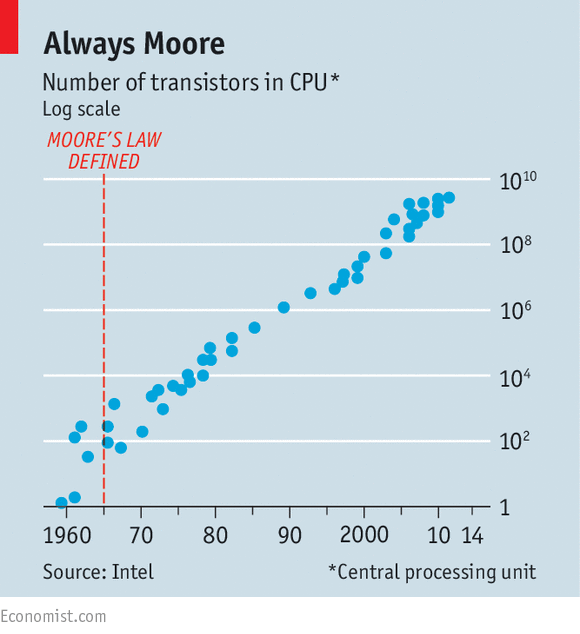
It is not so much that physical limits are getting in the way—even though producing transistors only 14 nanometres (billionths of a metre) wide, the current state of the art can be quite tricky. Intel says that it can keep the law going for at least another ten years, eventually slimming its transistors down to 5nm, about the thickness of a cell membrane. Other than shrinking circuitry further, it has also started to stack components, in effect building 3D chips.
Thursday, April 16, 2015
Daily Internet Usage

Daily internet usage (courtesy Monish Dutt) via Guy Pfeffermannn.
The USA and western Europe are as expected heavy users of the Internet. So too is the area of South America including Sao Paulo and Buenos Aires. Western Australia and New Zealand show up as heavy users (the outback not so much).
Sunday, April 05, 2015
Changes in the ICT Industry Market Value
 |
| Source: The Economist |
Monday, March 16, 2015
A Map of Every Device in the World That's Connected to the Internet
 |
| Source: GIZMODO |
Tuesday, February 10, 2015
Friday the 13th of February is World Radio Day

Celebrating a very appropriate technology, that can be tailored to meet many different needs.
Thursday, November 13, 2014
Tuesday, October 28, 2014
Potentially Useful technology not used to control Ebola in Africa
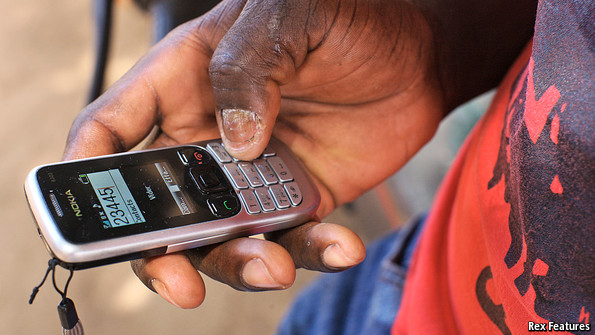
The current edition of The Economist tells a sad story. The epidemic of Ebola in West Africa is a tragedy for thousands of people already, and it is nowhere near being contained. While international response is now been geared up, it has been too little and too late to date. Data available from the firms providing cell phone service in the affected countries (and their near neighbors) potentially could be very useful in understanding the epidemic and planning for its containment. However, lack of response by the governments involved and the ITU has resulted in the lack of a legal environment enabling such an application of the information. I am going to quote at length from the article:
Phone companies use call-data records, or CDRs, to manage their networks and bill their customers. These records include a caller’s identity, the time of the call, the phone tower that handled it and the number called. Other data which the firms collect can identify where a phone is even if it is not being used, because phones constantly send out signals so that their location is known, to enable them to receive calls.
CDRs can therefore tell epidemiologists where people have been, when—and perhaps also where they are headed, based on their past movements. Analysing the records has proved helpful in tracking the spread of diseases on previous occasions.
For instance, a study conducted by the Karolinska Institute, in Stockholm, in the wake of the earthquake and cholera outbreak in Haiti in 2010, used CDRs from almost 2m subscribers, gathered over the course of 200 days, to provide a more accurate measure of where people fled than official estimates could manage. Another piece of research, published in Science in 2012 by researchers at Carnegie Mellon University, Harvard and elsewhere analysed a year’s worth of CDRs from 15m Kenyans. This suggested that many cases of malaria in Nairobi did not actually start in that city but were carried there from elsewhere. The telephone data were, moreover, able to identify the places that had the highest probability of spreading the disease—useful information for Kenya’s hard-pressed health service. And, in a third example of the value of CDRs in analysing epidemics, Vanessa Frías-Martínez and others at Telefonica Research in Madrid showed that, during the Mexican swine-flu epidemic in 2009, medical alerts did not achieve their aim of reducing mobility whereas shutdowns of shops, offices and so on imposed by the government did—and this, in turn, did reduce the number of infections below what might otherwise have been expected.And:
Since the first signs of the (Ebola) outbreak (in West Africa) earlier this year, researchers at Flowminder, a group of epidemiologists from the Karolinska, Harvard and elsewhere that has done much of the pioneering work on CDRs in health crises, have been in discussions with local mobile-phone operators. The group has tried to get access to the phone companies’ records, to build detailed maps of where people are, where they are travelling to, and the effects of government health warnings and travel advisories on the public’s movements.
At the same time, the mobile industry’s trade group, the GSMA, which has worked on technical standards and legal codes to facilitate access to CDRs, took the lead so that researchers could speak with one voice to request data. When the crisis escalated this summer, several United Nations agencies became involved as well.
But from then on it became a muddle. After lots of discussions in September, the process fell apart.Why?
Regulators in each affected country would have to order operators to make their records accessible to selected researchers, who would have to sign legal agreements specifying how the data may be used. Technically, this is fairly straightforward: the standards are well established, as are examples of legal terms. Orange, a big mobile operator, has made millions of CDRs from Senegal and Ivory Coast available for research use for years, under its Data for Development initiative. Rather, the political will to do this among regulators and operators in the region seems to be lacking........Because there is no precedent for using CDRs in an emergency like Ebola, it is hard to bring the parties together at a high-enough political or management level to make decisions.
Indeed, the UN agency overseeing telecoms standards, the International Telecommunications Union, is in the midst of a high-level diplomatic conference in Busan, South Korea, that will last until November 7th. Yet only a single meeting on CDR access was added to the agenda at the last minute.
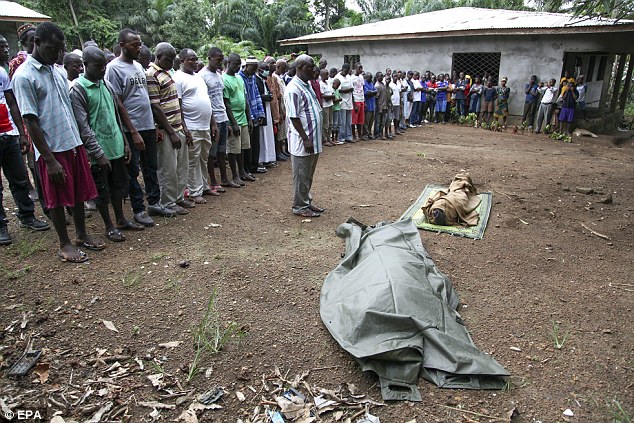 |
| Neighbors praying over the bodies of 2 Ebola victims in Liberia |
The virus is spread from person to person by contact with bodily fluids. Someone sick with Ebola Hemorrhagic Fever sweats, has mucus, vomits and has diarrhea -- and all of these substances can carry the virus and infect another person. Semen can carry the virus for up to 100 days after the infection, and can infect the sexual partner of an infected person. Worst of all is the blood of a victim, and Ebola victims bleed.
Health care providers are very much at risk of getting the disease from the patients that they serve, especially if they lack the protective gear they need, and especially if they are tired and overworked, as they are in West Africa today. Many have already come down with the disease, some have died. In the countries with widespread Ebola transmission, war has resulted in depletion of already scarce medical resources and the international community is still slow in sending in reinforcements.
Ebola has spread so fast in these countries in part because family members and friends -- who do not know how to maintain their own safety in the face of this disease -- have been trying to care for the sick in their homes. The homes often do not have piped water, much less the facilities for hygiene that we take for granted in richer countries. The traditional burial practices involve washing and preparing the body of the dead in ways that are very likely to transmit Ebola from a victim to the person preparing the body.
In addition, it is common for people feeling sick to leave the place where they are currently living to return to a home where they hope for better care; the dead are returned to the places where they were born or where their families live for burial. Thus the virus can move from place to place. If it moves from country to country the world is in trouble -- especially if it moves to new African countries or to crowded Asian countries equally ill prepared to control outbreaks.
Moreover, Ebola is a disease that we think recently moved from an animal host into human populations. It is an RNA virus, which mutates even more easily than DNA viruses. We worry that as the Ebola virus infects more and more people the chance of it evolving into a different (and perhaps even more dangerous form) increases.
In these circumstances, of course we want to take advantage of all the communication technologies to provide Ebola education to the public and to enable those fighting the epidemic to do so as effectively as possible. It is especially important that all the available means of tracking the epidemic and preventing its spread by utilized.
Saturday, October 11, 2014
Evolution of Human Communication

Erik R Kuhne posted this chart on Facebook with the following text:
The chart below shows these emerging technologies going back to Cave Painting, Language, Alphabet, Print ... up to the present. This graphic comes from Jude Umeh writing about DIGITAL INNOVATION "The development of computing and internet technologies, and the disruptive effect they had / are having on many traditional industries, is a prime example. In my 2007 book on digital rights management, I described the evolution of human communication (plotted over time and numbers reached) with an early infographic that also captured how computing and internet technologies have parallels with (and essentially re-create, re-interpret or replace) most prior communication technology and formats (e.g. spoken, written, visual, broadcast and telecommunications)."Architect Kuhne is one smart man, who combines the ability to think visually and technologically as one might expect from a very good architect with a futurist outlook.
It might be interesting to add to the chart. Mathematics is another way to communicate. There are the the non verbal means -- pictures (painting, photography, etc.), music, dance. How about the institutions we have added to facilitate communication -- schools, news organizations, etc.
Thursday, September 25, 2014
Internet Connectivity Map

This is a cartogram, a map in which the area of each country is proportional to its online population, based on 2011 data. So countries with large land areas but small populations — like Canada and Russia — appear shrunken, while dense, well-connected areas like South Korea and Belgium appear larger than life.
The most striking region is Africa. The continent has 1.1 billion people, more than three times the population of the United States. Yet thanks to dismal internet penetration rates, the entire continent shows up as smaller than the US.The total number of Internet users today is approaching 3 billion. That is about 42% of the world population. We can leave out infants and people who can not or choose not to connect, but there are still a lot of people who are unconnected.
Friday, August 29, 2014
A Map of Every Device in the World That's Connected to the Internet
|
| Source: GIZMODO |
Sunday, July 13, 2014
Who a couple of decades ago would have thought this possible?

Cisco, a tech company, reckons that by the end of this decade there could be some 50 billion things with web connections (see chart 5). Among them will be lots of consumer gear, from cameras to cars, fridges and televisions.The World Wide Web, which brought us websites and browsers, has changed our lives. Perhaps the Internet of things will do so again.
Friday, July 11, 2014
The Computer and me.

It occurred to me the other day that my experience with computers may be quite different than other peoples. For example:
- I got the idea that one could build one's own computer when Gordon Hughes, a high school friend, built one for a science fair in 1954 or 1955. (Gordon went on to invent the hard drive for computers.)
- I first programmed a computer in 1958, the SWAC at UCLA, in binary. That was taking my first computer course.
- I got a summer job as a computer operator in 1959, and was a teaching assistant in the Berkeley Engineering School computer lab that fall.
- I did computer simulations of a pattern transformation device and a perceptron in 1962.
- I taught the Basic computer language at UC Irvine in a class in 2004 or 2005.
- I worked in the computer facility of the Universidad Tecnica Federico Santa Maria from 1965 to 1967. During that time a taught a Fortran course and wrote the first Fortran manual in Spanish in Chile.
- I taught a course in Linear Programming at the Universidad Catolica de Valparaiso, Chile as a Ford Foundation Consultant in 1967.
- I verified the accuracy of the logical design of a digital computer in 1968 or 1969. It was later built and worked.
- In the early 1970s, working in a WHO health planning research project in Colombia, I did a some computer analysis of health systems.
- In the 1980s, I managed a project to produce four monographs on the use of microcomputers in developing countries[ tens of thousands of copies were distributed. My office also procured the first personal computer purchased by USAID and used it to automate records of its grants program. We also funded the creation of the Internet backbone for Costa Rica from that office, which later became the backbone of the Internet for Central America.
- During that time I also bought a very inexpensive home computer, programmed it for my young son to learn arithmetic, and also used it for statistical demonstrations in a course I was teaching.
- I bought my first serious home computer in 1997, using it for my home office and consulting activities.
- I served as a consultant to the InfoDev program and the Development Gateway program of the World Bank in the late 1990s and early 2000s. The first of those sought to make small grants to organizations in developing countries to promote innovative uses of computer technology. At the Development Gateway I was involved as a consultant to a network of computer research and training centers in developing nations.
- Now retired, I blog, tweet, use Facebook, and manage a couple of groups on Linked In. I sit before a computer screen for hours a day.
Sunday, June 08, 2014
Has the time for computer assisted education really arrived?

At $199 per pupil, per year, for tablet, set-up and software, Amplify looks pricey. But research by the Gates Foundation shows that spending on America’s schools has more than doubled in the past four decades......Amplify is the first ed-tech firm to deliver a product pre-loaded with the middle-school curriculum for America’s Common Core State Standards Initiative, which specifies what pupils in most states must learn by the age of 18. It claims its system, currently being piloted, means children progress far faster through literacy and comprehension material. Indications from broader independent studies are promising.
Kuepa, based in Buenos Aires, already provides courses for schools across middle-income Latin America. The Aakash tablet from Datawind, a firm set up in Canada by two Indian brothers, is selling for $64, and comes loaded with a basic school curriculum. India’s government aims eventually to provide every child with something similar.The intent to develop great hardware and software for schools has been around for many years, and in fact follows similar intent for radio, television, film strips, movies, etc. Lets hope it is now to be achieved.
Thursday, May 29, 2014

Monday, May 12, 2014
The Penetration of ICT Devices in the U.S. Population

There is a nice interactive chart from Pew Research Center showing the portion of U.S. adults who have various personal ICT devices.
Wednesday, May 07, 2014
Did you know about the Information Revolution in the first half of the 19th century?
 |
| Relating to the second half of the talk, on industrialization -- the sewing machine |
There is an interesting video of a talk by Merritt Row Smith on the Industrial Revolution in America. I want to focus on only the first part in which he spoke of the Information Revolution that took place here between the mid 1820s and the 1840s. He identified three major innovations that took place in that time frame:
- First was a reorganization of the postal service'
- Second was the introduction of rotary presses powered by steam engines that could print up to 500 pages a minute on both sides, at a much lower cost than the earlier hand operated printers; and
- Third there was the telegraph.
I recall that the United States at the time was a protestant country, and assume that many people who had learned to read to be able to read the bible, were also ready to read other things. I also assume that one of the key results was that newspapers were more widely available and affordable. I recall reading that newspapers were exchanged by post, and the news from a paper in one town might be soon printed by a paper in another town that had received the first town's paper.
Smith points out that this was a period in which large numbers of pamphlets were published and distributed, Thus the abolitionist groups published pamphlets and distributed them not only in the north, but also into the south. The success of those efforts led to other groups to print temperance and women's suffrage pamphlets. Thus ideas for reform circulated more widely than they might have earlier in our history.
The first telegraphy line in the USA was financed by the U.S. government, and ran from Baltimore to Washington, D.C. (I wonder if the purpose was to speed news between the Congress and the port of Baltimore, which was a major port in the USA at the time, with trade with the north and south as well as with Europe. A race was run when the line was completed, with a horse and rider and a train competing with the telegraph to get a message (on the nomination of Polk for President) from Baltimore to Washington. Of course, the telegraphy won handily, and there was little more difficulty in finding private finance to string telegraph lines across the country.
The first half of the 19th century also saw the development of water transportation in the United States, including the Erie Canal and other canals. The road system was extended and improved, And, of course, with the introduction of the railroads, the improved transportation system would have greatly facilitated the functions of the postal service, and presumably the shipment of paper stock and published materials.
The world changed. More information moved across the land, and moved faster and more efficiently than ever before.
Saturday, April 05, 2014
Soon, it is thought, things other than computers and phones will be most Internet connected.

Friday, March 14, 2014
Rates of adoption of electrical, media and ICT technology in the USA.

The graph is interesting. It suggests that it took 46 years after the introduction of electric lights in the 1870s for one-quarter of the American population to be wired, but only seven years for one quarter of the population to sign up for the World Wide Web after it was introduced a little more than two decades ago.
Of course, to hook up to the web via the existing telephone system using the existing computer infrastructure was perhaps easier than building the electrical network out to the population.
Subscribe to:
Posts (Atom)