
Showing posts with label obituary. Show all posts
Showing posts with label obituary. Show all posts
Monday, January 18, 2016


Tuesday, February 10, 2015
Carl Djerassi, the chemist behind the Pill, died on January 30th, aged 91

I met Dr. Djerassi first when he was the Chair of the National Research Council's Board on Science and Technology for International Development (BOSTID), and I began a two decade association with BOSTID as the manager of the grants from USAID that provided a major part of its funding.
Carl Djerassi was I suppose best described as a polymath. His career as a chemist was distinguished: he synthesized the chemical that made the first birth control pill possible.
He developed synthetic juvenile hormone in insects, preventing them becoming adults, for non-toxic control of mosquitoes and fleas, developed corticosteroids for inflammation—steroids had been a passion since the 1940s—and devised a way of detecting opiates in urine, used by the army in Vietnam.He was a professor of chemistry at Stanford University for many years. As an entrepreneur and expert in research management, he ran two research companies while on the Stanford Faculty. He owned a California winery that produced fine wines. He was an art collector. Later he wrote novels and plays.
I knew him as a man who cared about the poor in poor counties and was willing to devote time and effort to advising the government on how to use science and technology to better the lot of these people; he did so without pay.
I remember others associated with BOSTID, including George Bugliarello, Roger Revelle, Frederick Seitz, E.O. Wilson, Hugh Popenoe, John Gibbons, Joshua Lederberg and Frederick Robbins. Offhand I can think of two Nobel Prizes and two Pulitzer Prizes among these eight people. For those who have thought that leaders in fields of science and technology live in "ivory towers", knowing any one of these men would be a revelation. Each was brilliant in his own field of specialization, each had many skills, and each cared enough about the poor and needy to devote time and effort to their aid.
Wednesday, May 28, 2014

Wednesday, February 26, 2014
Tuesday, January 15, 2013
Aaron Swartz

Aaron Swartz, the 26-year-old technology wunderkind who killed himself on Friday, will be remembered as a great programmer and a provocative thinker. At 14, Mr. Swartz helped create RSS, the tool that allows users to subscribe to online information. He formed a company that merged with Reddit, the popular news and information site. He also co-founded Demand Progress, a group that promotes online campaigns on social justice issues.
Read more from the New York Times.
Thursday, November 03, 2011
A picture is worth 1000 words
 |
| Source: Jonathan Mak Long's blog |
This great design has more emotional impact than any article I have seen on the death of Steve Jobs. No wonder it has gone viral!
Thursday, October 06, 2011
A Thought About Steve Jobs

Steve Jobs was perhaps even more important than the news coverage of his death would suggest.
The Apple II was really the pioneer that made the idea of the personal computer something that a lot of us could believe.
The Mac, not too commercially successful itself, served to stimulate the industry to produce more and more user friendly machines.
Pixar changed the movie industry.
The iPod and iTunes changed the music industry.
The iPhone changed the telephone industry.
The IPad is not so much changing the computer industry as introducing a new category of devices.
I once was asked to give a talk in place of Steve Jobs, who had not been able to attend the meeting. Those poor people who got me instead of Steve Jobs lost out on both content and presentation.
Saturday, June 05, 2010
John Wooden's Pyramid of Success
 UCLA's great basketball coach, who died recently, had an impact on me and I suspect all of the university's students and alum.
Friday, April 16, 2010
Remembering Guy Stever
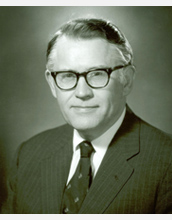
Image source: National Science Foundation
Dr. Guy Stever died recently at the age of 93. His was a most distinguished career. I can do no better to summarize it than to quote the description from his book, In War and Peace: My Life in Science and Technology:
Science came into Guy Stever s life as a pure and peaceful pursuit. It was only later, as he walked through the wreckage of wartime London that he began to see science as central to a desperate struggle to survive.I knew Dr. Stever through his service to the Board on Science and Technology for International Development (BOSTID) of the National Academies in the late 1970s and early 1980s. At the time he was the Foreign Secretary of the National Academy of Engineering, and I was the project manager of the USAID grant that funded BOSTID.
Past president of Carnegie Mellon University, former Chief Scientist of the U.S. Air Force, one-time Director of the National Science Foundation, professor at MIT for 20 years, member of the National Academies of Sciences and Engineering, and science advisor to two presidents Guy Stever was a central figure in twentieth century science consistently on the front lines, changing the fate of a nation.
In this thoughtful and candid memoir, Stever recounts an extraordinary life that reveals as much about the man as about the major scientific and technological events of his day. Born of humble origins and orphaned at an early age, Stever journeyed from a small town in New York to work alongside British comrades who were developing and refining the critical radar technology that was to turn the tide of the war against the Germans. As a technical intelligence officer, these harrowing wartime years took him from the beachheads of Normandy to the German slave-labor factories responsible for building the V-2 rockets.
Stever returned home committed to serving his country. He became intimately involved in America s nascent guided missile program and was to remain a key player in the anti-ballistic missile defense program that heralded the era of the Cold War. As the decades passed, Stever continued to exert lasting influence on countless scientific endeavors. He was instrumental in the formation of new institutions, from the creation of NASA in the post-Sputnik years to the merging of Carnegie Tech and the Mellon Institution, giving birth to Carnegie Mellon University. As Presidential Science Advisor to both Nixon and Ford, Stever shaped the very structure of contemporary presidential science advising. And he was to chair the oversight committee that redesigned the space shuttle boosters after the Challenger explosion.
Guy Stever s life offers remarkable insight into the twentieth century. Through his eyes, we relive the history of the past 50 years, witnesses to a tale of science and technology that is revealing in its scope and sweep.
I came to have great respect for his wisdom, his courtesy and his skill in the provision of scientific advise. Only later did I come to wonder at the willingness of this very important and very famous man to devote so much time and effort to helping develop science in poor nations and helping to make the fruits of science available to the poor in those nations. I was very fortunate to come to know the gentleman!
Tuesday, July 07, 2009
Thoughts occasioned by the reports of McNamara's death
Source: "'Terribly Wrong' Handling of Vietnam Overshadowed Record of Achievement," Thomas W. Lippman, The Washington Post, July 7, 2009.
If there is a lesson from Robert McNamara's life it is the limits of rationality and the inadequacy of our understanding. Vietnam was terrible, with an even worse loss of life to the Vietnamese that to the Americans, but it seems to me that the most important objective in the 1960s was to avoid a third world war or a war fought with weapons of mass destruction. That objective was accomplished in the 1960s and for the whole of the Cold War. History changes as historians discover more facts and choose different facts to emphasize in their histories. Perhaps at some future date McNamara's service as Secretary of Defense will be reinterpreted. Indeed, perhaps his service as President of the World Bank will be given more importance.
McNamara is reported to have had enormous energy and an unequalled ability to obtain, organize and recall information, but in retrospect said that he had not understood Asia nor Vietnam adequately. It has been said that he failed to obtain and listen to dissenting views adequately. Perhaps one of his failings was in in the choice of the information to which to attend.
Still, it seems like a lot of lesser men criticizing a very competant man for what in retrospect appear to have been failings in his policy.
If there is a lesson from Robert McNamara's life it is the limits of rationality and the inadequacy of our understanding. Vietnam was terrible, with an even worse loss of life to the Vietnamese that to the Americans, but it seems to me that the most important objective in the 1960s was to avoid a third world war or a war fought with weapons of mass destruction. That objective was accomplished in the 1960s and for the whole of the Cold War. History changes as historians discover more facts and choose different facts to emphasize in their histories. Perhaps at some future date McNamara's service as Secretary of Defense will be reinterpreted. Indeed, perhaps his service as President of the World Bank will be given more importance.
McNamara is reported to have had enormous energy and an unequalled ability to obtain, organize and recall information, but in retrospect said that he had not understood Asia nor Vietnam adequately. It has been said that he failed to obtain and listen to dissenting views adequately. Perhaps one of his failings was in in the choice of the information to which to attend.
Still, it seems like a lot of lesser men criticizing a very competant man for what in retrospect appear to have been failings in his policy.
Tuesday, October 28, 2008
Tony Hillerman is Gone
 The Washington Post published an obituary for Tony Hillerman today. He was an author who brought me and my wife many, many hours of pleasure. We have read all his 18 mystery novels set in the Navajo reservations of the Southwest, going back and rereading them periodically. We have also read others of his 30 books.
He told a good story, producing books full of the flavor of the landscape, and respectful of the Navajo culture and way of life. We already miss the anticipation of a new Hillerman book.
Monday, January 28, 2008

Thursday, October 11, 2007
"A Death in the Family"
Christopher Hutchins has written a very sad article in Vanity Fair about the death of a young soldier, Mark Daily, who was killed in action in Iraq.
An earlier Irish soldier from our extended family, Anthony O'Daly, was killed by his enemies, and memorialized in the following words:
Poem by James Stephens from "Reincarnations" (1942)
after the Irish of Anthony Raftery
There is a recording of Samuel Barber's setting of this piece on YouTube.
An earlier Irish soldier from our extended family, Anthony O'Daly, was killed by his enemies, and memorialized in the following words:
Since your limbs were laid out,Anthony O'Daly
The stars do not shine!
The fish leap not out in the waves!
On our meadows the dew
Does not fall in the morn,
For O'Daly is dead!
Not a flower can be born!
Not a word can be said!
Not a tree have a leaf!
For O'Daly is dead!
Anthony!
After you,
There is nothing to do!
There is nothing but grief!
Poem by James Stephens from "Reincarnations" (1942)
after the Irish of Anthony Raftery
There is a recording of Samuel Barber's setting of this piece on YouTube.
William T. Golden, Key Science Adviser, Is Dead at 97
New York Times obituary.
Among a great many activities in support of science and science policy in the United States, William Golden played a key role in the creation of the U.S. National Science Foundation, and the posts of science advisors in the White House and State Department. He is credited with helping to create the AAAS fellowship programs which have brought thousands of scientists to Washington to learn about and be involved in government policy processes (while he served in key roles in the governance of the AAAS). He also is credited for creation of the Carnegie Group which allows ministers of science from the G8 countries to meet regularly on an informal basis.
Among a great many activities in support of science and science policy in the United States, William Golden played a key role in the creation of the U.S. National Science Foundation, and the posts of science advisors in the White House and State Department. He is credited with helping to create the AAAS fellowship programs which have brought thousands of scientists to Washington to learn about and be involved in government policy processes (while he served in key roles in the governance of the AAAS). He also is credited for creation of the Carnegie Group which allows ministers of science from the G8 countries to meet regularly on an informal basis.
Monday, September 17, 2007
Tropical Agriculture Expert Donald Plucknett, 75
Read the obituary by Yvonne Shinhoster Lamb in The Washington Post, September 17, 2007.
"Donald L. Plucknett, 75, an expert in world food matters who in recent years was the president of his own agricultural research and development firm, died of leukemia Sept. 3 at Inova Fairfax Hospital....
"Dr. Plucknett, who had an extensive career in tropical agriculture, worked at the University of Hawaii for 20 years. He continued to gain recognition for his work with the U.S. Agency for International Development and as a senior adviser to the World Bank. He wrote or edited 20 books and more than 200 articles....
In Genebanks and the World's Food (1987), "Dr. Plucknett and his co-authors warned that the international decline of genetic diversity produces record harvests but creates crops that are delicate and defenseless against nature's threats.
They said that such events as the 1840s Irish potato famine and the 1980 Cuban boatlift -- which occurred soon after a fungus destroyed 90 percent of the tobacco crop in Cuba and left thousands unemployed -- might have been caused by nations' failures to cultivate enough plant varieties."
Dr Plucknett "was chief of soil and water management at the Technical Assistance Bureau from 1973 to 1976; deputy executive director of the Board for Food and Agricultural Development in 1978 and 1979; and chief of agriculture and rural development in the Asia Bureau in1979 and 1980."
He "joined the World Bank in 1980 and until 1983 served as senior science adviser to the Consultative Group on International Agricultural Research, which aims to increase food production and reduce poverty in developing countries through scientific research and research-related activities."
I knew Don Plucknett, and saw his work at USAID and at the CGIAR. He was a good man and played an important role in international agricultural research for many years. He will be missed!
"Donald L. Plucknett, 75, an expert in world food matters who in recent years was the president of his own agricultural research and development firm, died of leukemia Sept. 3 at Inova Fairfax Hospital....
"Dr. Plucknett, who had an extensive career in tropical agriculture, worked at the University of Hawaii for 20 years. He continued to gain recognition for his work with the U.S. Agency for International Development and as a senior adviser to the World Bank. He wrote or edited 20 books and more than 200 articles....
In Genebanks and the World's Food (1987), "Dr. Plucknett and his co-authors warned that the international decline of genetic diversity produces record harvests but creates crops that are delicate and defenseless against nature's threats.
They said that such events as the 1840s Irish potato famine and the 1980 Cuban boatlift -- which occurred soon after a fungus destroyed 90 percent of the tobacco crop in Cuba and left thousands unemployed -- might have been caused by nations' failures to cultivate enough plant varieties."
Dr Plucknett "was chief of soil and water management at the Technical Assistance Bureau from 1973 to 1976; deputy executive director of the Board for Food and Agricultural Development in 1978 and 1979; and chief of agriculture and rural development in the Asia Bureau in1979 and 1980."
He "joined the World Bank in 1980 and until 1983 served as senior science adviser to the Consultative Group on International Agricultural Research, which aims to increase food production and reduce poverty in developing countries through scientific research and research-related activities."
I knew Don Plucknett, and saw his work at USAID and at the CGIAR. He was a good man and played an important role in international agricultural research for many years. He will be missed!
Subscribe to:
Posts (Atom)