
Showing posts with label learning. Show all posts
Showing posts with label learning. Show all posts
Thursday, February 18, 2016


Wednesday, October 29, 2014
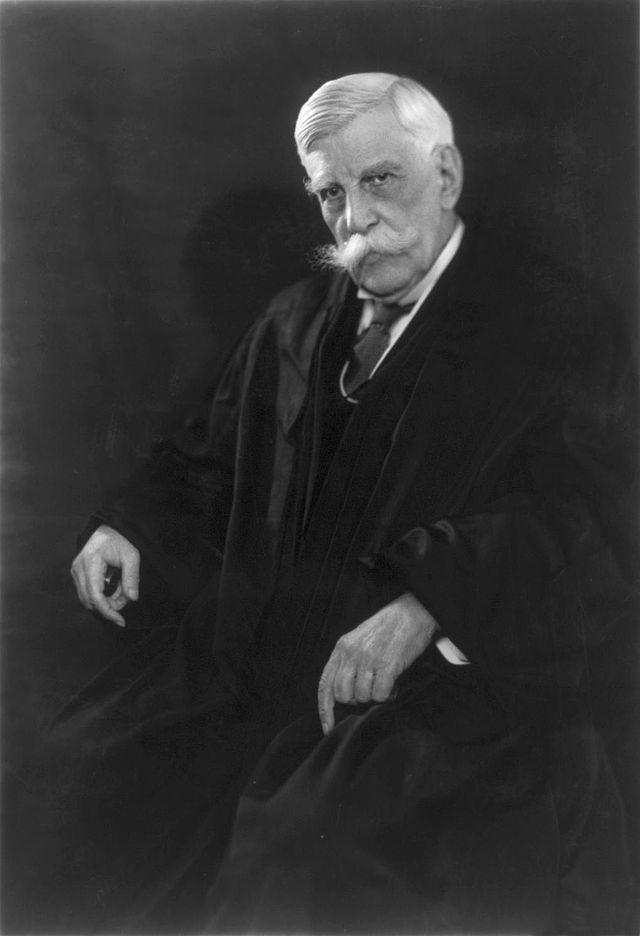
A thought triggered by Oliver Wendell Holmes Jr.
A mind that is stretched by a new experience can never go back to its old dimensions.I recently came across a comment on Facebook in which someone wrote that he would not study Islam because no Muslim had ever died in the service of the United States. Of course, he was wrong and many Muslims have served this country in the military, and some have been killed while doing so. I was even more bothered by the wrong headed idea that one could only benefit from studying ideas of people like oneself.
Oliver Wendell Holmes, Jr.
I recently came across this:
Shortly after his retirement from the bench in 1933, Supreme Court Justice Oliver Wendell Holmes Jr was paid a courtesy call by President Franklin Roosevelt who was surprised to find Holmes reading Plato's Symposium in the original Greek. Roosevelt asked Holmes why he was bothering to study Greek. Holmes, who was then 92 years old, replied, 'Why? To improve my mind."Of course, Oliver Wendell Holmes Jr, did serve in our country's army. As a young officer in the Union army, he was wounded at Ball's Bluff -- the closest battle to my home, the first battle of the Civil War, and the only battle in U.S. history in which a serving U.S. senator was killed. He was also wounded at Antietam, the bloodiest single day in American military history. He was wounded a third time at Chancellorsville. Like many Union soldiers, he suffered from (a near fatal case of) dysentery.
So why did he read Plato in the original Greek? Of course, Plato was one of the greatest thinkers in human history -- one of very few whose thinking has been studied for a couple of thousand years. And of course, reading in a foreign language exercises the mind in a different way than does reading in your native language, the language you speak every day and usually read and write in.
I don't understand Greek, and my junior high school Latin was never much good and is long forgotten. I do read Spanish, French and Portuguese. I feel that reading things written in these languages rather than in translation I sometimes see nuances that are not available in the English translation. Of course, one does not get the flow of the original language when reading poetry in translation, and in poetry it is how something is said as well as the nominal meaning of the words that counts. So reading Plato in the original Greek would presumably improve Holmes' mind more and differently than reading him in English translation.
The Facebook comment is especially wrong because its author failed to realize that by studying a culture other than his own he would have new experience, would experience the world in a new way. He would stretch his mind. If Holmes at 92 was still seeking to improve his mind, who are we to stop short at much younger age?
Moreover, in this smaller world, it well behooves us to understand other cultures, and a good place to start is by trying to understand the religions that they follow. It is easier to live in peace and harmony with others when you understand them.
Here are some other pieces of wisdom from OWH Jr.:
- A mind that is stretched by a new experience can never go back to its old dimensions.
- The language of judicial decision is mainly the language of logic. And the logical method and form flatter that longing for certainty and for repose which is in every human mind. But certainty generally is illusion, and repose is not the destiny of man.
- The main part of intellectual education is not the acquisition of facts, but learning how to make facts live.
- If there is any principle of the Constitution that more imperatively calls for attachment than any other it is the principle of free thought, not free thought for those who agree with us but freedom for the thought that we hate.
- A word is not a crystal, transparent and unchanged; it is the skin of a living thought and may vary greatly in color and content according to the circumstances and time in which it is used.
- Even for practical purposes theory generally turns out the most important thing in the end.
- Every idea is an incitement... eloquence may set fire to reason.
- Certitude is not the test of certainty. We have been cocksure of many things that were not so.
- Most of the things we do, we do for no better reason than that our fathers have done them or our neighbors do them, and the same is true of a larger part than what we suspect of what we think.
Friday, September 12, 2014
Embrace intellectual challenges
Interesting article from Salman Khan. I quote:
Dr. Carol Dweck of Stanford University has been studying people’s mindsets towards learning for decades. She has found that most people adhere to one of two mindsets: fixed or growth. Fixed mindsets mistakenly believe that people are either smart or not, that intelligence is fixed by genes. People with growth mindsets correctly believe that capability and intelligence can be grown through effort, struggle and failure. Dweck found that those with a fixed mindset tended to focus their effort on tasks where they had a high likelihood of success and avoided tasks where they may have had to struggle, which limited their learning. People with a growth mindset, however, embraced challenges, and understood that tenacity and effort could change their learning outcomes. As you can imagine, this correlated with the latter group more actively pushing themselves and growing intellectually.It seems to me that this must be only partially right.
- People should be rewarded for choosing good things to work on. Persevering in trying to flap your arms hard enough to fly like a bird is not going to work, no matter how much you persevere. Great scientists focus on important problems that are just within their reach, and they typically learn to do so by apprenticing with an older great scientist.
- People should learn not to attempt to solve the insoluble. As a Peace Corps volunteer I saw some very good people break under the stress of trying to find a way to help the development of people who were could not progress rapidly for too many reasons. This is a corollary to the earlier idea, that you should choose good things to struggle with,
- When do you reward someone for working hard on a problem? Perhaps you should encourage people to persevere in their effort, and praise the perseverance, but perhaps the reward should be reserved for success.
Monday, June 10, 2013
Some thoughts about organizational learning through ICT improvements.

There is an interesting article in Forbes on organizational learning as effected by information and communications technology. I have posted over the years on organizational learning, pointing out that most of the stuff I learned in the Graduate School of Administration years ago seemed to miss the point. If learning is any change that improves performance, then there are lots of forms of change that can be regarded as organizational learning (or organizational forgetting).
Some of the ways organizations learn are:
- by firing someone to replace him/her with someone with better, more relevant knowledge;
- by moving people within the bureaucracy, putting people where they can bring more pertinent knowledge to bear on issues of importance to the organization;
- by outsourcing tasks to other organizations that can bring knowledge more effectively (or cost effectively) to bear on those tasks (something increasingly possible with the Internet);
- by concentrating knowledge functions within the organization on core functions of the organization, so that sufficient knowledge and understanding (including management) can be brought to bear on those core functions;
- using technology to improve the speed of communication within the organization.
These days an organization can learn by improving its hardware and especially its software. Think for example of a company making commercial aircraft, which can improve its designs by buying the newest supercomputers and improving software to more accurately simulate the performance of an aircraft with a proposed design, or that can improve the computer aided design and manufacturing software, or that can more effectively use information and communication technology to manage its stocks and procurement.
I like to focus on the interfaces of an organization with its external world, and how they are institutionalized. For example, there is an interface with its customers and potential customers. The corporate website and e-sales have revolutionized this interface. Organizations can now learn by using the website to ask questions, and software to improve the way the answers are understood; software can also allow the public to ask questions and to provide answers; improving the software can improve those answers.
Improving data collection and data mining techniques can help an organization learn about its output markets and input markets;. So too data collection and analysis can help an organization to learn about its regulators and how to influence the regulations those regulators seek to enforce. Indeed, choosing better consultants for this function, improving the data collection, and improving analytic software for this data can all be considered aspects of organizational learning.
Think of a health maintenance organization, especially a large one. These days medical records are online. Adding new diagnostic imaging devices might be seen as a form of organizational learning, since using the new images physicians might make better diagnoses or equally good diagnoses more cost-effectively. Think about analyzing massive record sets of signs and symptoms, diagnoses, treatment prescriptions, and outcomes and using the results to provide feedback, perhaps changing standard practice or providing real time suggestions to physicians in their processes of ordering tests, interpreting results, diagnosing health problems, and prescribing courses of treatment. Would this not represent organizational learning in the broad sense described above? Could not technology be used for other large organizations involved in complex but repetitive tasks?
Monday, May 13, 2013
Thoughts from Chris Argyris

Chris Argyris contributed a lot to management theory. Here are some of his lessons from a recent newspaper article:
- knowledge is of minimal use unless it enables the recipient to take action
- it is harder, not easier as we would expect, to teach smart people how to learn
- focus on not just how to deal with the problems in a project, but why the project was undertaken in the first place and whether a better approach might work better.
A physician told me a long time ago that a rule of medicine is never to make a patient undergo a test unless the result will lead to some action (or avoid some action). That seems like good advice. Obtaining information costs money. Indeed, in an organization, obtaining information tends to use people's time and good will.
Thursday, April 25, 2013
Thinking broadly about thinking and education
 |
| /Source |
The deep genetic roots of our species show up in many ways. In sports, teams of even quite young players divide responsibilities with each player learning the special skills of his/her role in the game; only the youngest soccer players all try to do the same thing at the same time.
As civilization became more complex, knowledge and skill become more socially distributed. It may take a village to raise a child, but it takes a Silicon Valley to invent the Information Revolution, and a nation to run a modern economy. I believe that information is embodied in institutions and cultures as well as in genetics and the changes in the nervous system and muscles resultant from individual learning.
A modern organization has a structure and a set of procedures in which people function. The structure and procedures are, if you wish, software. In a large organization there is no complete documentation of the organization and procedures, indeed no one can fully explain them all. Yet the performance of the organization as a whole depends on the structure and procedures and not simply on the sum of the individual knowledge and skills of its members.
Similarly, information is embodied in other institutions. Consider markets. Even the weekly market in a small village depends on a structure -- what is sold where and when, and mechanisms to insure the trustworthiness of buyers and sellers. Sellers must be able to trust that payment is not made in counterfeit or debased money; buyers that weights and measures are fair and the products that they buy are not dangerous nor debased (such as watered milk). Even such a market will have people who mediate disputes between buyers and sellers. At the other extreme, the New York stock market is highly automated with complex organisations embodying a huge amount of information.
We also outsource knowledge and skill as individuals. Ever since the invention of books, people have depended on information stored in books rather than in their memories. It is far easier to recall where information is stored in a library than to memorize the content of the library; indeed, libraries incorporate information in the way they organize their books and in the catalog of the books; the librarian who catalogs books and helps the library user is another example of the social distribution of knowledge. In a professional library, the user may have the skill to utilize the knowledge in the books, but the librarian the skill to help find the right books quickly and efficiently (without the professional expertise to utilize the knowledge in the books).
An architect may use a powerful computer with powerful computer aided design software in creating the design for a building. It is very unlikely that the architect would have the skill to design the computer nor program the software. It is much less likely that the architect could manufacture the semiconductor chips that are integral to the computer. Yet the architects thinking is made quicker and deeper by the intelligence amplification of his computer and its software.
However, this is only one of many, many examples of the amplification of performance by information embodied in tools. The carpenter building the house designed by the architect is also using power tools that he could not himself design, themselves composed of materials he could not manufacture. Indeed, even a good carpenter works better with a well balanced hammer.
Schooling should take into account the social distribution of cognition. It should take into account that our application of knowledge and skill is mediated by the tools we use, the environment in which we work. To grossly oversimplify, schools should prepare students to function in society.
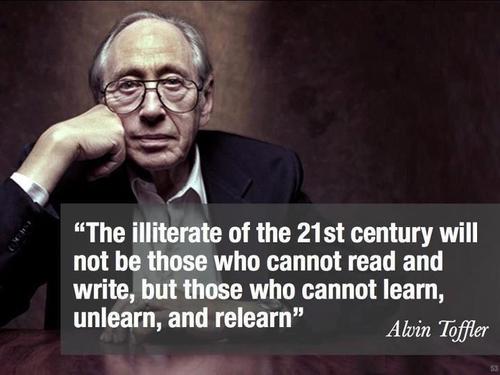
The job of schools is complicated by the fact that the graduates are going to be expected to function at high levels for decades, and that the society in which they are to function will change radically during those decades. Perhaps the most important functions of school will be to help students to love learning, to prepare them for lifelong learning. Indeed, schools should help students learn to integrate themselves into learning groups and learning communities; they will need to learn with other all their lives if they are to learn effectively and efficiently.
Friday, March 08, 2013
Still more on helping kids to learn, changing school indicators.

I think that the rate of social, economic, political and technological change is likely to increase. Children born today are likely to live through greater changes than did people who were born 70 or 80 years ago. As voters they will have more complex issues with which to deal. As investors they will face a more rapidly changing economy. They will probably live longer, but have to deal with more complex health issues. Their children will face still more rapid change, so as parents the kids born today will face more challenging parenting. As workers they will face more rapidly changing workplaces, and will need to adapt more during their working lives.
 |
| Everyday life 70 years ago |
One of the objectives of education for the children born today will be to help them learn to develop expertise quickly and well. That will mean learning how to learn quickly. It will also mean developing attitudes that embrace change when necessary or appropriate to do so, and to resist changes in values that are repugnant to morality or other important cultural values. It will include developing an enthusiasm for acquiring new information and developing new skills as well as a willingness to abandon outdated knowledge and no longer useful skills.
An important part of the life of the children being born today will be to create the rapid progress that will change their world and that of their children. Lots of them will be involved in creating new knowledge and new technology. Lots of them will be involved in protecting the environment and civilization from the unwanted side effects of progress. Again, schools will have to help students learn to create knowledge and technology, to protect the environment and society, and to care deeply about doing so.
It will be interesting to see how schools develop indicators to monitor their success in helping students to learn these things.
 |
| Source |
Tuesday, March 05, 2013
A thought on a framework for learning

the Standards Working Group of the Learning Metrics Task Force prepared a series of initial recommendations to identify the competencies, knowledge or areas of learning that are important for all children and youth to master in order to succeed in school and life. I have copied the summary table from the report of that Group.
I wonder if this is enough. For example, there seems to be nothing about skills that would be useful in many forms of employment -- butcher, baker, candle stick maker.
Do we not want children to be helped to develop character in school? If so, what do we want them to learn there?
We make critically important decisions in life emotionally -- who we will marry, how we will treat our children, our siblings and parents, how we will treat our friends and our enemies. Should children be helped in school to utilize their emotions effectively with their reason in making such choices? If so, what do we want them to learn?
I think the table is weak on helping kids to learn how to evaluate information and its sources and how to make good decisions, especially decisions under uncertainty and ignorance. I think the decision processes are different for different kinds of decisions, and children would be well served learning how to make decisions well of all these kinds. The decision making of a person in crisis (fireman fighting a fire, policeman interrupting a crime, pilot dealing with an emergency in flight) is quite different than that of a business person deciding on an investment. Both could be learned. But what do we want children to learn in this respect in school?
We have learned a great deal in recent decades about how the brain works, how our behavior is determined. We will almost certainly learn more in future decades. The learning goals for schools should reflect current knowledge of what actually goes on, providing help to the student for learning all the things that will help in life. It should also provide a basis for learning new things as they are determined to be important.

And more, including training the brain to work well. Me
Sunday, February 24, 2013
A thought about thinking about history.
I have been reading history for the past seven years. In that time I have perhaps 100 books. If I spent something like an average of 15 hours reading, considering and discussing per book, that might add up to 1,500 hours. That might be as much as an undergraduate history major spends in his/her history courses, but is far less that the 10,000 hours that might lead to expert knowledge. (And of course, I have been reading history, not doing historical research, so my knowledge is of a different order than that of a professional historian.) But I got to thinking about what I have learned.
Dante says: Knowledge doth come of learning well retained, Unfruitful elseI have also heard this quotation made suggesting that knowledge comes of learning committed to memory.
Machiavelli in The Prince
A theme of this blog is that we think with our brains, and that much of the operation of the brain is not available to conscious awareness. I suppose that in the time of Dante and Machiavelli, well retained learning was conceived to mean rote learning of texts, facts and perhaps stories. I may have read about the sweeping revolutionary movement of 1848 but I certainly don't have recall of the names of the many people that were mentioned in the book. I could tell a much simplified story of what happened. And I know that the events of the year were an important precedent for the Arab Spring, and I have a better ability to find information on 1848 than I had before reading a book on the time.
One of the things we know about the difference between expert physicians and medical students is that the expert diagnostician asks fewer questions to come to the same diagnosis. One assumes that this is the result of having better appreciation of the a priori probabilities of different diagnoses, perhaps having a better intuition of the questions that provide most information to distinguish among the probable diagnoses, and perhaps having better skills at observing signs and symptoms that provide information without questions. I assume that different brain operations are involved in all of these different aspects of "knowledge", and different forms of "memory" are involved in developing each kind of knowledge.
Is there a real distinction in the areas of the brain involved in each kind of processing, the processes themselves, and the ways that the brain is modified as a result of the intake of information between what we call "understanding" and what we call "knowledge"? Do different learning processes result in different parts of the brain getting better at performing different operations?
I suspect that I have learned something from all the reading of history, and I suspect that the Machiavelli quote does not capture the nature of the learning very well.
Sunday, December 16, 2012
A thought about continuing *self" education.

(I)n the world of informal learning—where most of us live during most of the day for most of our lives......Let me propose an "Informal Learning Core." ........it has three pillars: the learner, the mentor, and the materials.I think simple visual aids can be helpful, but we should recognize them as simplifications of the real world.
It seems to me that in the informal world we learn a lot from our peers, or even from others that we come into contact with only briefly. Thus the apex of Reich's triangle might be expanded to reflect the social networks of the learner(s).
I wonder about the term "mentors". I tend to reserve that term for people who in fact accept a role of helping another person to learn. But one often learns a lot from one's boss or one's clients -- people who help one to learn incidentally to accomplishing other purposes. Thus the "mentor" vertex might be shown also as including social networks.
In the context of "technology-based informal learning", it might be worthwhile to disaggregate "materials" into several categories, including "media" explicitly. In the informal world we learn from books, the Internet, television, radio, clubs, and other sources.
As the world changes more and more quickly, and as more and more of routine work is automated, it is important that we learn more and more outside of schools and as adults. So too, as the world get "flatter" and smaller, and as our roles as citizens and consumers become more and more demanding, it is also that we learn more and more outside schools and as adults. Technology-based informal learning already has a large role in our world, and that role should be increasing.
Saturday, November 24, 2012

Thursday, October 18, 2012
A Thought About Goal Setting
In tonight's UNESCO seminar, Frank Method spoke to the students about the formulation of the Education for All Goals. Frank is the most thoughtful education policy expert that I know. As part of his presentation he described the BHAG approach to goal setting. BHAG is an acronym for Big Hairy Audacious Goal.
We can look to "rocket science" for examples. The Germans during World War II set a goal of using unguided missiles to bomb England from the European mainland. When they did so, no one knew how to build such a missile, or indeed whether it would be possible in wartime conditions before the end of the war. (A similar BHAG might be the Manhattan Project to build atomic bombs during World War II.) There was a theoretical possibility. However, in order to achieve the goal one would have to build a team capable of doing so, build the manufacturing capability to produce the parts and the final system, test it, and deliver it.
When President Kennedy set the goal of landing a man on the moon by the end of the decade of the 1970s, it was also a BHAG. The defining characteristic of such a goal is that one could not simply follow existing approaches, but would rather have to rethink the entire approach. The goal of a man on the moon in a decade was big, in the sense that one would have to organize a huge effort in order to do so. It was hairy in the sense that no one quite knew how to manage such an effort, and indeed entirely new management systems had to be invented, utilizing the newly available capacity of computers, to manage the effort. It was audacious; while no one knew whether the goal could be accomplished when it was set, but the prestige of the presidency and of the nation had been attached to the program and failure would have been a serious blow to those reputations.
The song Follow the Drinking Gourd, here performed by Bill Schustik, was very popular during the folk music fad about the time of the Apollo space program, It suggests a different kind of goal. Slaves seeking freedom would more toward the North Star. They would of course never reach the star, but with good luck and hard work they would have a decent chance at attaining freedom.
I advance this as an example of a goal set not to be achieved, but to guide an effort that would result in more and better progress than might otherwise be achieved. I suggest that their may be real advantage in such goals.
The Education for All goal can be regarded as a goal of achieving a human right to basic education by 2015. That was reinterpreted as serving all the children in the world with at least primary school education by that date. Frank pointed out that even in the United States, there are a few children who don't complete primary school -- children with disabilities, illegal migrants, children in inadequate home schooling, etc. For many developing nations, the goal is still a distant dream.
Students should realize that there was considerable debate on what the goal should be, notably in two world meetings, one in 1990 and the other in 2000. It is possible, indeed probable, that more progress was made toward universal primary schooling as a result of the EfA process than would have been otherwise made. EfA mobilized efforts of developing nations and of donor agencies. It resulted in a system in which progress was measured and people held responsible for that progress.
On the other hand, in a world of limited resources, allocation of resources to primary schooling may have made them unavailable for other purposes. Would more vocational training have allowed industry to develop faster in developing nations? Would more university training of professionals allowed faster progress in the development of infrastructure, agriculture and industry, or better public health programs? We will, of course, never know.
How Does This Work Out in the Bureaucracy?
Development agencies use variants of the Logical Framework Approach. Projects are designed, managed, monitored and evaluated according to a framework in which defined inputs are used in an effort to produce specified outputs which in turn are expected to achieve specified purposes leading to defined goals.
I think that often the agency officer who designs a project -- setting its longer range purposes and goals in the design document -- does not administer the project through to completion, and is not held responsible in its final evaluation for the achievement of those purposes and goals.
On the other hand, that officer is frequently involved for some time in the project implementation and is held responsible during monitoring for the timely delivery of project inputs and production of their specified outputs, at least for a few years. Perhaps the most important input from the point of view of the donor agency is money. The outputs, in education for example, might be teachers trained, educational materials produced, schools built, etc.
Would bureaucratic success come from defining a project with modest input and output levels, ones that could surely be achieved, Would it come more fully from defining levels that would challenge the donor and the implementing agency to work to the utmost?
This brings us to the fundamental question of how should a project be specified so that it does the most good? The corresponding problem is how should people be evaluated on the basis of project performance. Should project schedules be reasonable and attainable and people held to meeting them? Might it be better to set ambitious goals that would motivate people to rise to new levels of performance, and people rewarded if they do indeed reach such higher levels? Indeed, when if ever are BHAG approaches appropriate?
I suspect that the wary bureaucrat will frequently design projects that will easily meet their monitoring targets, making the bureaucrat look good in the monitoring reports while he/she is still involved. In doing so, I suspect that projects often achieve less than they might. A system in which bureaucrats progress up the career ladder quickly by playing it save, but not by taking risks to achieve all that can be achieved, is likely not to produce as much as did our efforts in rocket science.
A Final Comment
Lifelong learning for all might be a "drinking gourd" goal. Would a eutopian society limit its concern for education to a few years of schooling? Would it not utilize many institutions in addition to schools to enable its members to realize their full potential at all stages of their lives.
There is little chance that we would achieve the full potential of lifelong learning in any society in the lifetime of anyone now alive. However, it might be useful to keep that in view as a guide star for our efforts in education. By doing so, we might reach better place than by any other approach to education.

Monday, February 13, 2012
Eric Mazur: Memorization or understanding: are we teaching the right thing?
This hour long lecture is worth watching if you teach!
Mazur describes his experience teaching college physics to pre-med students at Harvard. These students have learned to take tests well, as shown by high school grades and SAT scores. Almost all will have taken not only high school physics but advanced placement physics courses in high school.
He found after several years of teaching, that a significant portion of the students had learned algorithms for solving certain kinds of physics problems, but had not mastered the concepts underlying the use of those algorithms. He has changed his manner of teaching, developing relatively simple multiple-choice questions to use in classes expose the common misconceptions among his students. they are such that when used in the course of a semester, a small plurality of the students will get the right answer, but many or perhaps most will get the wrong answer. He has students provide the answers using clickers. When all the answers are in, he has students work with neighbors with different answers to come to a joint response. These are much more likely to be correct.
The students are also required to read the class texts and have problem solving labs with teaching assistants, but no "lectures" as we normally understand the term. Instead Mazur's large classroom sessions are primarily devoted to small group discussions of conceptual issues.
Mazur, I think correctly points out that a primary job of the college professor is to help his students learn. Moreover, the learning we want is not short term memorization of material (that will be forgotten quickly when the course is over) but the learning of concepts that the student will be able to apply in other contexts.
The problem that I have with this lecture is how to apply it to teaching graduate students in my courses. I have been trying to teach students interested in international organizations how to understand them well. I find that a seminar method in which they present a lot of the content helps. I also like projects, with a faculty member or outside expert providing guidance to each small project team to be a help. Classroom discussions play a part. So can case studies. But I think I need to think more about what Mazur is saying!
Thursday, October 27, 2011
Thoughts about community learning centers
 |
| A Community Learning Center in Indonesia |
I think of a community learning center in counter distinction to a school as responding not just to the learning needs of children but to lifelong learning demands, as providing learning opportunities in response to demands from the students rather than based on curricula from the school system, of using media to provide learning opportunities, and on a use of time different than that of school (short courses, classes at times convenient for adult students).
Apparently the community learning center movement represents a watershed change in our thinking about schooling benchmarked by publications from UNESCO: Learning to Be and Learning: The Treasure Within. By the 1970s it was already clear to some that schools were not doing the whole job. Of course, too many people in the world had too little schooling, many had forgotten much of what they had learned; perhaps more importantly, adults needed to learn new things to deal with the rapidly changing world in which they lived. Moreover, there was a recognition that while schools emphasized teaching kids things they would need to know to participate in social institutions as adults -- as a worker, a soldier, a citizen, etc. -- there was also a need to help people learn things that they wanted to learn for self actualization.
All of this is about a community learning center helping people in the community learn as individuals. There is another way, however, that we can construe "community learning". We can consider the way the community as a collective can learn.
The Delors Commission in its report, Learning: The Treasure Within, focused on four pillars:
- learning to know
- learning to do
- learning to be and
- learning to live together
Lets think about each of these in terms of the collective learning of a community.

- If knowledge exists somewhere in a community in such a form that the community can access that knowledge when it needs or wants it, then the community can be said to know. A community may "learn" in the sense of acquiring the knowledge by any of a number of methods. It can of course designate some members to the community to learn something new, perhaps sending them to a course. It can bring someone from outside the community with that knowledge to be part of the community, as when a community brings in a new teacher. It can change the structure of community institutions so that people with the knowledge can bring it more effectively to meet the needs of the community. Indeed, it can add information to a community library so that it can be located and utilized if the community needs it. It certainly is not the normal case that everyone in a community must learn something in order that the community as a collective can be said to learn that thing.
- In a rural community some of the most important "learning to do" involves trying to grow a new crop, to deal with a new plant pest or disease of the crops, or to otherwise to improve the productivity of its farming. Everett Rogers in his book Diffusion of Innovations describes how this generally occurs. An "early adapter" often surfaces from the community and tries the innovation. Of course lots of innovations turn out to be bad ideas, but some work. A few others seeing the success also adopt the innovation and so with further success it spreads. Thus the community as a whole learns which innovations work and which do not in that community's case.
- I would suggest that one way that a community "learns to be" is by building social capital, strengthening institutions within the community, building trust among its members.
- Of course some the point above includes community members "learning to live together" but we can extend the analogy to a community learning to live with other communities and with the larger society in which if finds itself. Again, one can view a community improving its linkages with other local communities and with the national government and other national institutions as community learning.
In all four of these respects, a community learning center can facilitate community learning. It can facilitate the transfer of knowledge into a community and help change a community so that it better uses the knowledge of its members; it can facilitate the processes by which a community tests innovations, rejecting those which don't fit and adopting those which do; it can help to organize a community serving as a focal point for community meetings and community projects; it can help to build linkages with neighboring communities and help a community both to learn about the larger society and to make its interests known to that larger society.
Wednesday, August 10, 2011
Various kinds of learning

As I have posted many times, people think with their brains, not with their minds. That is, while in one's mind one thinks logically, in practice there are all sorts of illogical aspects of any man's thinking. Indeed, I sometimes think that the mind sees it function as imputing rationality to the product of its brains thinking. There is a lot of research which suggests that different parts of the brain work in different "circuits" to produce different ideas and conclusions. Moreover, although the brain can use formal syllogisms to reach logical conclusions and can use mathematical techniques to perform complex calculations, it may also be influenced by emotions or by essentialism (as per the previous posting) to produce less than consistent results. That leads me to thinking a little about how we learn.
First, lets think about explicit knowledge. I know it is about a mile from the house in which I now live to the house in which I once lived. I know that because I have often walked between the two, I know how long it takes to do so, and I know how fast I walk. I also know because I have driven the distance and checked on the odometer of my car. Thus I have learned this piece of explicit information by direct experience, and indeed by use of an (unconventional) measuring instrument. Some science educators feel this discovery method of learning it best. I suspect that there is an advantage in having kids get some discovery experience as they study science, in part to obtain some implicit knowledge and skills relating to discovery (see later discussion).
Discovery is time consuming. I can learn the distance to another location more quickly be asking someone. Indeed, we learn a lot by others telling us. Indeed, I found living in societies in which there is much less printed information, people spend a lot of time talking about where things are to be found. Here we might ask for such information on a need to know basis, but in the past I would have looked up an address in a phone book. Today, I would use the Internet, as the Internet has become a memory aid or extension. Similarly, I recall that in Egypt, college students (at least a few decades ago) did not have much access to books, so they learned by listening to lectures from their professors and taking copious notes which they would later study. American college students at the same time learned much more from the expensive books that they were forced to buy.

There are things that you can not learn by direct experience. Those of you who follow this blog (or who click on the "book review" tag) will see that I read a fair amount of history. Clearly one can not observe the past directly, but books are a good way to learn facts about history, as well as to obtain an understanding of historical processes, and to learn to attach meaning to the historical facts one reads about. So too, however, are videos and other "hotter" media when they present historical information.
Implicit knowledge is sometimes the knowledge that you don't know you know. More accurately, it is knowledge that you have but have not articulated and made explicit. Generally, it is learned through a process of apprenticeship, observation and experience. It may be the knowledge of how to farm that a kid learns from watching and helping his parents on their farm, or that which a craftsman has learned in a formal apprenticeship, or even that which a scientist has learned from working under the guidance and supervision of an experienced scientist. Recall how many Nobel Prize laureates were trained in the labs of earlier Nobel Prize laureates; apparently the understanding of how to select important and tractable research problems and bring the research to fruition is tacit knowledge, obtained by contact with those who already possess it.
Skills I think of as acquired through drill and practice. Yet athletes often have quite explicit knowledge about their skills. Think of golfers who watch videos of their swings and work with coaches who provide explicit advice on how to improve the swing and thus to improve scoring. These professional athletes and their coaches can see much more than you or me even in real time, and many times more than the casual observer when using technology to improve their perception of the skill. Indeed, I suspect that they can identify exercises to strengthen muscles involved in a good swing and others to assure flexibility where that is needed.
If indeed we think with our brains, with all their evolved mechanisms and networks and their complex chemistry, tied to the rest of the body's nerves and chemistry, then we must amplify our concept of learning to consider how the body and brain can be modified (and developed) to produce (on the average, or in critical opportunities) better results of thinking. I suspect that in part we can learn in this way through the arts and humanities, as we come to emulate people (fictitious or real) who think in ways that we perceive as effective. So too, growing up in a nurturing environment with role models who think well, we might learn to emulate their thinking.

We are also social animals, who think collectively. Consider a game between two teams of five year old soccer players; both teams tend to clump around the ball with everyone trying to do the same thing. Compare that with world class adult soccer players who distribute themselves across the field, each playing his/her own roll, with a constantly changing pattern of players over the field as players respond to challenges and take advantage of opportunities while carrying out specific responsibilities. Of course, the adult players have developed their own individual skills, but they have also studied the came, played with and against increasingly better players over a period of years, and received expert coaching, all of which contributed to their learning to play effectively within a team. Considering World Cup teams, while all of the players will have achieved high levels of skills as individual and team players, a team will also participate in joint practice and will get better as the players get more and more experience playing together in the same team.
However, as is very clear, at this level teams get still better by replacing good players with still better players, replacing good coaches with still better coaches. A group of people can improve its performance not only by the individuals learning to perform better as individuals and as a group, but also by adding members with abilities needed by the group, and dropping members whose performance is less than optimal.
Increasingly we use information and communications technology (ICT) with which to amplify our thinking. Learning then has an aspect of improving the technology amplifying our thinking and improving our interface and use of technological aids to thinking. Indeed, as we increase our skill in utilizing ICT, we increase our ability to amplify our thinking by means of ICT. Information and communication technologies amplify human cognitive abilities in a way strictly analogous to the way in which mechanical power and machinery amplify human mechanical abilities. Telephone allows us to communicate at a distance, the cloud allows us to store and recall information with alacrity (and indeed to obtain information stored by others), and the computer allows us to calculate with alacrity.
As suggested above, ICT allows us even to improve our physical skills by improving our ability to observe and analyze our current skill levels and performance, ICT allows us more access to literature (remember e-books), drama, and other sources by which we can improve our emotional learning and the integration of our intellectual and emotional learning.
ICT also allows new modalities of group thinking as well as improvement in the speed and quality of group thinking. Consider the use of communications by teams in such organizations as the Secret Service when it protects the president; consider the use of groupware allowing a team to collaborate in an analysis and its communication.
On both an individual level and a group level, investing in ICT infrastructure, developing ICT skills, and building software and data capacity can therefore be conceptualized as a kind of learning; one can consider trade offs between such investments and investments in human capital through education and team building.
If one considers thinking in this broad framework, I suspect that one will develop new ideas about the role and process of schooling, of non-formal education, and of lifelong learning.
Sunday, August 08, 2010
How does an organization learn
I want to extend the previous posting which focused on technology to discuss how an organization learns. I defined technology as a body of knowledge about how to accomplish useful purposes embodied in devices, materials (such as pharmaceuticals and seeds), facilities and infrastructure, people and institutions. I will focus on the corporation, and indeed the formally organized business corporation.
Organizational learning is then a change in the knowledge embodied in an organization, and indeed I would suggest that "learning" implies either a change that directly improves performance or has the potential to improve future performance. We would not suggest that acquisition of new knowledge that is unrelated to any useful task would be organizational learning. (An employee picks up a piece of gossip about a movie star. Is that organizational learning? I define it not to be.)
Knowledge in an organization can be embodied in devices, materials, facilities and infrastructure, people, and institutional knowledge within the organization. Such knowledge may be technological, but it may also be of other kinds related to the organization's operation, such as knowledge of the market in which it sells its products, or the markets from which it obtains goods and services, or knowledge of government regulations, the general evolution of the economy, or many other topics. By "institutional knowledge" within the organization I mean knowledge embodied in its structure and procedures, formal or informal.
Given the previous discussion of technology, let us start with that kind of knowledge. Clearly it is important for organizations to gain technological knowledge. A common means of doing so is to acquire new facilities that allow for improved production. Even when such acquisitions are "turn key", they involve people in the organization learning to operate the new facilities, and changes in the organization's processes and structures to deal with the new facilities.
A process of critical importance to technology intensive firms is learning by acquiring new employees whose technological knowledge adds to that of current staff, and bringing that new knowledge to bear on issues where it benefits the firm. However, technology intensive organizations often improve performance by reorganizations which move people around to bring people with critical technological knowledge to work where they are most needed; this kind of reorganization too can be a form of organizational learning.
This brings up the problem of what is meant by "within an organization". I would suggest that bringing in a consultant to advise for a limited time on a specific issue may be seen as organizational learning. The consultant brings knowledge which he/she has gained to bear on the problems of the firm while being paid by the firm. Of course, the organization may "forget" that information when the consultant goes on to other corporations, unless he/she teaches the information to staff members who stay behind.
Incidentally, forgetting can be valuable. Think of "unlearning" things which prove counterproductive or which were once useful but are outdated.
Note that a number of pharmaceutical firms have chosen to buy biotechnology from small research and development organizations rather than try to develop strong biotechnology capacities within the firm. We would see the purchase of such a biotechnology as technological learning by the pharmaceutical firm. So too would be purchase of a small biotech firm by a large pharmaceutical firm to acquire its technology and technological capacity.
I would suggest, however, that there is something like a market for such new biotechnologies, with a number of firms seeking to develop and sell biotechnology, and a number of other firms seeking to purchase the technology. In any market or market-like institution there is learning both by those who would sell and those who would buy. In some cases the lessons are simple; in others they are complex, difficult and sometimes very expensive to learn. Thus even the decision to outsource, with the obvious element of losing knowledge that once was incorporated within an organization, normally will involve acquisition of other new knowledge.
Here is a metaphor. Someone has been preparing full meals at home from raw materials. The person discovers that it is possible to prepare better meals less expensively by purchasing per-prepared ingredients from several sources. Over time, the person loses some of the skills that once were used in preparing meals fully from raw materials, but has learned how to prepare better meals more efficiently. This kind of learning goes on all the time in McDonalds.
Banks have long been inventing software for different purposes. The "dusty deck" software remains even when the people who developed it have gone on to other jobs in other firms. Some of the knowledge involved in carrying out those purposes is embodied in the software (and in the people who use it, and the organizational procedures and structures utilized by those using the software.) Now some banks are consolidating there many data bases into a common software platform, and in so doing either buying the platform from outside or employing outside consultants -- both forms of organizational learning, as is the introduction of a new platform with greater technological capacity.
What shall we say about the voluminous data held by such banks? If the bank does not have the capacity to mine the data it is hard to say that it has knowledge. If, however, the new software allows the bank to now mine and utilize that data better, in some sense the data has been better internalized as "knowledge" and we can say learning has taken place.
I suggest that the border distinguishing an organization from the rest of the world is a fuzzy concept, and perhaps the border is best seen as somewhat amorphous. As mentioned above, consultants and contractors can be seen as within an organization sometimes, and other times as outside its border.
Consider an organization's website. Since the website will provide information about the organization to its visitors, clearly the servers and software in some sense embody knowledge of the organization. Most organizations also utilize their websites for automated transactions, and one may conceive as the knowledge of how to conduct such transactions for the organization to be embodied in the hardware and software providing the website. However, the users of the organization's website also must learn in order to more effectively find the information that they seek or to perform the transactions from their side. Some of that learning is transferable to other websites, but some of it is specific to one organization. Is it appropriate to attribute part of the user learning as "organizational learning" and part as more general learning of the user?
Some organizations will create technological knowledge by internal invention, deepening of craft skills and understanding, and research. This is especially true for large, high technology firms. Any firm or organization will be likely to create only a small part of the technological knowledge it comes to embody. Thus in technology, as in other forms of knowledge, a key issue is how the firm comes to obtain technological knowledge from outside itself.
I would suggest that as organizations grow larger, they need to duplicate embodiments of the same or similar knowledge. A firm will need more workers with similar skills and knowledge as it increases production. Each of the office workers in a firm may need his/her own personal computer and software, embodying copies of some of the firms knowledge, and as the office workforce increases more copies of that embodied knowledge will be employed. I suppose these too are forms of knowledge acquisition or learning.
We should be long past the idea that organizational decision making in large organizations is centered in one person or a small group of people. So the control of organizational learning should be considered a distributed function. On the other hand, organizations and especially formal organization, do have structures of authority, and some decisions related to organizational learning are more centralized than others. The board of directors with the advice of the leading operational officers may make decisions as to whether to buy a new plant or merge with another firm, while each employee will make some decisions independently on what job related skills or information to seek to acquire in what time frame.
It is a truism that the world is changing ever more rapidly and that as a consequence organizational success depends on learning to learn better and more rapidly. Figuring out how an organization will respond to this challenge is of course a hugely complicated task, but one facilitated by recognizing the complexity of organizational knowledge systems, the complexity of the embodiments of organizational knowledge, and the processes of organizational change.
Organizational learning is then a change in the knowledge embodied in an organization, and indeed I would suggest that "learning" implies either a change that directly improves performance or has the potential to improve future performance. We would not suggest that acquisition of new knowledge that is unrelated to any useful task would be organizational learning. (An employee picks up a piece of gossip about a movie star. Is that organizational learning? I define it not to be.)
Knowledge in an organization can be embodied in devices, materials, facilities and infrastructure, people, and institutional knowledge within the organization. Such knowledge may be technological, but it may also be of other kinds related to the organization's operation, such as knowledge of the market in which it sells its products, or the markets from which it obtains goods and services, or knowledge of government regulations, the general evolution of the economy, or many other topics. By "institutional knowledge" within the organization I mean knowledge embodied in its structure and procedures, formal or informal.
Given the previous discussion of technology, let us start with that kind of knowledge. Clearly it is important for organizations to gain technological knowledge. A common means of doing so is to acquire new facilities that allow for improved production. Even when such acquisitions are "turn key", they involve people in the organization learning to operate the new facilities, and changes in the organization's processes and structures to deal with the new facilities.
A process of critical importance to technology intensive firms is learning by acquiring new employees whose technological knowledge adds to that of current staff, and bringing that new knowledge to bear on issues where it benefits the firm. However, technology intensive organizations often improve performance by reorganizations which move people around to bring people with critical technological knowledge to work where they are most needed; this kind of reorganization too can be a form of organizational learning.
This brings up the problem of what is meant by "within an organization". I would suggest that bringing in a consultant to advise for a limited time on a specific issue may be seen as organizational learning. The consultant brings knowledge which he/she has gained to bear on the problems of the firm while being paid by the firm. Of course, the organization may "forget" that information when the consultant goes on to other corporations, unless he/she teaches the information to staff members who stay behind.
Incidentally, forgetting can be valuable. Think of "unlearning" things which prove counterproductive or which were once useful but are outdated.
Note that a number of pharmaceutical firms have chosen to buy biotechnology from small research and development organizations rather than try to develop strong biotechnology capacities within the firm. We would see the purchase of such a biotechnology as technological learning by the pharmaceutical firm. So too would be purchase of a small biotech firm by a large pharmaceutical firm to acquire its technology and technological capacity.
I would suggest, however, that there is something like a market for such new biotechnologies, with a number of firms seeking to develop and sell biotechnology, and a number of other firms seeking to purchase the technology. In any market or market-like institution there is learning both by those who would sell and those who would buy. In some cases the lessons are simple; in others they are complex, difficult and sometimes very expensive to learn. Thus even the decision to outsource, with the obvious element of losing knowledge that once was incorporated within an organization, normally will involve acquisition of other new knowledge.
Here is a metaphor. Someone has been preparing full meals at home from raw materials. The person discovers that it is possible to prepare better meals less expensively by purchasing per-prepared ingredients from several sources. Over time, the person loses some of the skills that once were used in preparing meals fully from raw materials, but has learned how to prepare better meals more efficiently. This kind of learning goes on all the time in McDonalds.
Banks have long been inventing software for different purposes. The "dusty deck" software remains even when the people who developed it have gone on to other jobs in other firms. Some of the knowledge involved in carrying out those purposes is embodied in the software (and in the people who use it, and the organizational procedures and structures utilized by those using the software.) Now some banks are consolidating there many data bases into a common software platform, and in so doing either buying the platform from outside or employing outside consultants -- both forms of organizational learning, as is the introduction of a new platform with greater technological capacity.
What shall we say about the voluminous data held by such banks? If the bank does not have the capacity to mine the data it is hard to say that it has knowledge. If, however, the new software allows the bank to now mine and utilize that data better, in some sense the data has been better internalized as "knowledge" and we can say learning has taken place.
I suggest that the border distinguishing an organization from the rest of the world is a fuzzy concept, and perhaps the border is best seen as somewhat amorphous. As mentioned above, consultants and contractors can be seen as within an organization sometimes, and other times as outside its border.
Consider an organization's website. Since the website will provide information about the organization to its visitors, clearly the servers and software in some sense embody knowledge of the organization. Most organizations also utilize their websites for automated transactions, and one may conceive as the knowledge of how to conduct such transactions for the organization to be embodied in the hardware and software providing the website. However, the users of the organization's website also must learn in order to more effectively find the information that they seek or to perform the transactions from their side. Some of that learning is transferable to other websites, but some of it is specific to one organization. Is it appropriate to attribute part of the user learning as "organizational learning" and part as more general learning of the user?
Some organizations will create technological knowledge by internal invention, deepening of craft skills and understanding, and research. This is especially true for large, high technology firms. Any firm or organization will be likely to create only a small part of the technological knowledge it comes to embody. Thus in technology, as in other forms of knowledge, a key issue is how the firm comes to obtain technological knowledge from outside itself.
I would suggest that as organizations grow larger, they need to duplicate embodiments of the same or similar knowledge. A firm will need more workers with similar skills and knowledge as it increases production. Each of the office workers in a firm may need his/her own personal computer and software, embodying copies of some of the firms knowledge, and as the office workforce increases more copies of that embodied knowledge will be employed. I suppose these too are forms of knowledge acquisition or learning.
We should be long past the idea that organizational decision making in large organizations is centered in one person or a small group of people. So the control of organizational learning should be considered a distributed function. On the other hand, organizations and especially formal organization, do have structures of authority, and some decisions related to organizational learning are more centralized than others. The board of directors with the advice of the leading operational officers may make decisions as to whether to buy a new plant or merge with another firm, while each employee will make some decisions independently on what job related skills or information to seek to acquire in what time frame.
It is a truism that the world is changing ever more rapidly and that as a consequence organizational success depends on learning to learn better and more rapidly. Figuring out how an organization will respond to this challenge is of course a hugely complicated task, but one facilitated by recognizing the complexity of organizational knowledge systems, the complexity of the embodiments of organizational knowledge, and the processes of organizational change.
Tuesday, May 04, 2010
Evidence that we evolved to learn from others

Source: Mairi Macleod, "To be the best, learn from the rest," The New Scientist, issue 2758.
The article examines a competition organized and run by Kevin Laland of the University of St Andrews, UK. He created a game of survival, taking place in a computer-generated world" and offered a tournament to produce the best learning strategies for the game with a €10,000 prize for the tournament winner.
Virtual agents would have the potential to acquire 100 possible behaviours, each with a different associated pay-off that would change over the course of the game. The pay-off represents the benefit an individual gains by performing a particular behaviour, its changing value reflecting the fact that information can become outdated as the environment changes......The competition drew more than "100 entries submitted from a variety of academic disciplines, ranging from philosophy to computer science."
Entrants to the tournament would start with 100 agents each, which would accumulate a repertoire of behaviours over their lifetime through learning. At every round of the game, each agent would have three options: innovation, in which they randomly acquired a new behaviour by individual learning; observation, in which they acquired a new behaviour by social learning; or exploitation, in which they used a previously learned behaviour and so gained its pay-off. The entrants had to devise a strategy that their agents would use to decide between these options. The challenge was to create the strategy that generated the most successful or "fittest" agents - a criterion measured by dividing an agent's accumulated pay-off value by the number of rounds it had survived.
So what did they discover? It seems a successful strategy rests primarily on the amount of social learning involved, with the most successful agents spending almost all their learning time observing rather than innovating. However, avoiding spending too much time learning either socially or individually was just as important. "Between a tenth and a fifth of their life seemed to be the optimal range," says fellow organiser Luke Rendell, also from St Andrews University. "If they did more learning than that it seemed that life was just passing them by."Read the published findings in Science, DOI: 10.1126/science.1184719.
Comment: This is an interesting research approach, tapping social behavior of ICT literate experts to explore a complex space by simulation. I especially like the challenge with a relatively small prize (compared to the time spent by the many contestants to theorize and program their approaches. The result is not a scientific proof that it is smart to spend a lot of time learning from others and a lot of time living, but it adds evidence to our common sense (which of course is predicated on the way our brains evolved to work and our culture evolved to have us work).
Sunday, February 28, 2010
Illiteracy Hurts More and More
Another article in the same issue of The Economist states:
Researchers at the University of California in San Diego (UCSD) examined the flow of data to American households. They found that in 2008 such households were bombarded with 3.6 zettabytes of information (or 34 gigabytes per person per day). The biggest data hogs were video games and television. In terms of bytes, written words are insignificant, amounting to less than 0.1% of the total. However, the amount of reading people do, previously in decline because of television, has almost tripled since 1980, thanks to all that text on the internet. In the past information consumption was largely passive, leaving aside the telephone. Today half of all bytes are received interactively, according to the UCSD. Future studies will extend beyond American households to quantify consumption globally and include business use as well.Estimates of the number of illiterates, such as the 700 million made by UNESCO, are clearly too low, depending on poor methods used in surveys, but one may assume that there are a billion illiterate adults in the world. They are increasingly distanced from the information society.
Friday, October 05, 2007
"The Brain/Education Barrier"
Kathryn Hirsh-Pasek and John T. Bruer's editorial in Science (Science 7 September 2007: Vol. 317. no. 5843, p. 1293) begins:
In an era of translational science, researchers often find themselves in the mixed company of policy-makers, legislators, and educators looking for "evidence-based" practice. That's how it was earlier this year in March, when a distinguished international group of neuroscientists and cognitive psychologists convened at the University of Chile in Santiago for the conference titled Early Education and Human Brain Development, which many Chilean ministers, educators, and scientists attended to learn how brain science might transform education. On day one, however, it became clear that myths about brain-based pedagogy dominated participants' thinking. The Chilean educators were looking to brain science for insights about which type of preschool would be the most effective, whether children are safe in child care, and how best to teach reading. The brain research presented at the conference that day was mute on these issues. However, cognitive and behavioral science could help.I think it is obvious that cognitive science and behavioral sciences hold information of potential value to educators (including self educators). That is not to say that brain research is not of great potential value in the promise it holds for the future. Indeed, I would guess that by the end of the century understanding of brain physiology and biochemistry, and the development of neuro-pharmacology will transform learning.
Sunday, April 15, 2007
How do Organizations Learn"
People too often consider organizational learning only in terms of human learning. Of course, organizations can learn by allowing (encouraging) organizational members to learn. Some other ways organizations can learn:
* Information is embedded and knowledge embodied in organizational structure and processes, and an organization can improve its performance (i.e. "learn") by investing in improvements in structure and process.
* Information is embedded and knowledge embodied in plant and equipment, especially these days in computer and communications equipment, and an organization can learn by adding to or improving the knowledge so embodied.
* An organization can learn by hiring someone who knows something than no one in the organization knows, or by firing someone who knows something that is not true.
* An organization can learn by bringing knowledge present within its community more fully and effectively to bear on the problems it faces.
* An organization can learn by outsourcing functions to other organizations if by doing so those functions are better or more efficiently accomplished.
Subscribe to:
Posts (Atom)