Showing posts with label public diplomacy. Show all posts

Saturday, April 12, 2014

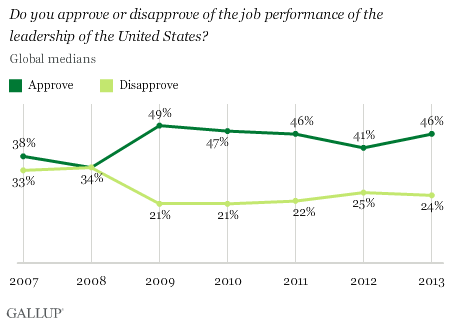
A Graph That Speaks for Itself!


Source: Gallup World Leadership Project

The United States, as the world's most powerful country, is probably never going to be popular with everyone. Under the Obama administration, no more than a quarter of respondents from this poll taken in 150 countries have disapproved of U.S. leadership, compared with more than one-third of respondents in the last year of George Bush's presidency. Last year 46% of respondents approved of U.S. leadership, while 24% disapproved -- both better grades than received by the Bush administration.

MSNBC's Rachel Maddow Show noted:
A few weeks ago, as part of a larger condemnation of Obama presidency, Mitt Romney insisted the last five years have been awful for the United States’ stature around the world. “It is hard to name even a single country that has more respect and admiration for America today than when President Obama took office,” the failed candidate said, adding, “Our esteem around the world has fallen.”

For the right, this is a common line of attack. Tea Party favorite Ben Carson recently argued, “Russians seem to be gaining prestige and influence throughout the world as we are losing ours.” Former Vice President Dick Cheney said on “Face the Nation” a month ago that America’s willingness to keep our commitments has been “in doubt for some time now” around the globe “because of the policies of the Obama administration.”
I see two possibilities.

  • Republicans don't understand how the United States is regarded abroad, or
  • Republicans don't tell the public the truth about the improvement Obama has made in our image abroad.
 Of course some may be badly informed, some may be speaking 'politician speak", and some may have another explanation.

Sunday, July 08, 2012

Engineering Diplomacy


Najmedin Meshkati has an article titled "Engineering Diplomacy: An Underutilized Tool in Foreign Policy" in the current issue of the new AAAS online journal, Science & Diplomacy. As a former engineer who worked a long time in foreign assistance, let me share some thoughts on the topic.

Diplomacy is based on power, and engineering is in my opinion one of the bases for U.S. power:
  • Military power: U.S. military power is based on technology more than manpower. Think of the role of aerospace engineers and electronics engineers in providing that technology.
  • Economic power: Engineers play key roles in designing, building and maintaining the infrastructure and industrial plant on which American economic power is based.
  • Soft power: Think of Egyptian President Mohammed Morsi, who received his PhD in engineering from USC and taught engineering at a California state college. Assuming that his experience was positive in those universities, think of the good will the United States banked for the future. Indeed, American engineering education and engineering services are widely admired and provide a basis for soft power.
I would also suggest that engineering can play an important role in achieving key foreign policy goals of the United States.
  • Security: I have already mentioned the role of engineering in assuring the technological leadership that ensures the military power so important to our diplomacy. I suspect that most of our military attaches are products of the military academies, and those academies turn out a lot of officers trained in fields of engineering. Think too of President Reagan's much loved phrase, "trust but verify". Much of our capacity to verify the control of security threats is based on engineering technologies.
  • Economics: A key function for diplomats is helping to assure the competitiveness of American firms in international markets. Of course the "engineering firms" that work in infrastructure projects are much involved in international business. Perhaps more important are the many high technology firms providing U.S. exports, many of which are dependent on engineering technology. Think for example of the role of chemical engineers in the manufacture of ethical pharmaceuticals.
  • Global systems problems: Increasingly U.S. foreign policy has to be concerned with global systems problems such as global warming, sea level rise, and desertification. Engineering plays a key role in the energy sector and thus in the control of greenhouse gas emissions. It is critical to efforts to assure the people have access to potable water and that farmers have access to water for their crops. Engineering has a critical technological role in assuring that development is sustainable. Indeed, engineers have critical roles in the production and distribution of information and pharmaceuticals needed to meet the challenges of global threats to health.
  • Humanitarian assistance and the reduction of poverty: Since the Marshall Plan, a major aspect of U.S. foreign policy has been foreign aid and in the larger sense, foreign aid workers are part of our diplomatic corps. Engineers are perhaps more important in reducing risks to man from natural disasters, but they play an important role in disaster relief. They also play a key role in infrastructure development which is basic to poverty alleviation in poor countries.
While we tend to think of diplomacy in terms of diplomats from our own country meeting with diplomats from another country to which they are assigned, diplomats also meet frequently with government officials and citizens of the countries to which they are assigned. While few countries assign diplomatic duties to professional engineers, many contacts are made with engineers. For example, many governmental leaders in China were trained as engineers, and many industrial leaders in all countries have engineering training.

There is also an important and continuing role for multilateral diplomacy. Think about the role of engineers in UNESCO, of agricultural engineers in the FAO, of biomedical engineers in WHO, of communications engineers in the ITU, and of industrial engineers in UNIDO. Often delegations to meetings of these and other international organizations will include engineers from the private sector or domestic government agencies combining multilateral diplomatic functions with their engineering professional duties. As an example, think of the roles that petroleum and mining engineers must have played in the negotiations of the Law of the Seas Treaty, or of the roles of nuclear engineers in dealing with questions of nuclear safety and non-proliferation,

We can consider several forms in which engineers contribute to diplomacy:

  • Engineering diplomatic infrastructure: Diplomats depend on an infrastructure which assures not only communication with the home country and access to information relevant to their duties, but also the security of their persons and their premises. Note, however, that with the elaboration of the global information infrastructure it is increasingly possible to conduct diplomacy via that infrastructure. More people abroad can access the websites of the U.S. government than could ever meet with an American diplomat. Obviously engineers must be considered in the development and maintenance of this infrastructure.
  • Engineering advice to diplomats: The diplomatic corps has tracks for consolar officers, economic officers, management officers, political officers, and public diplomacy officers (this last group work often in cultural fields). While the U.S. State Department does recruit people with engineering background, few of their officers in these roles have full qualifications as professional engineers. In consequence, it is often important that diplomats have access to professional engineers to obtain specific detailed advice needed for to fully understand and achieve their diplomatic objectives.
  • Engineering as part of the content of diplomacy: I can easily see situations in which professional engineers can themselves play a role in diplomacy. Think of Engineers Without Borders. Indeed, consider the long borders of the United States with Mexico and Canada; how many disputes along these borders can be and have been avoided by cross-border engineering collaboration to engineer appropriate infrastructure solutions, and in how many other borders can engineers catalyze similar solutions. 
  • Diplomacy for engineering. While much of the discussion above has focused on how engineers can help diplomats or take part in diplomacy, it is also the case that diplomacy has a role to play in helping engineers do their work. For example, think of diplomats working to assure that the civil engineering firms in their own country have equitable access to engineering contracts in other countries. Think of the role of diplomats in smoothing the path for engineers involved in cross national projects such as cross national road systems (e.g. the Pan American Highway system), air traffic control systems, and waterways (e.g. the St. Lawrence Seaway).
I would suggest that few people in the general population, and indeed not all diplomats recognize the wide range of situations in which engineers can be and should be involved in diplomacy.

Wednesday, June 13, 2012

Science and Diplomacy


The AAAS Center for Science Diplomacy has begun to publish an open access, online quarterly magazine titled Science and Diplomacy. It occurs to me to post some thoughts on the topic.

Let me first distinguish "science for diplomacy" from "diplomacy for science". Many of the science for diplomacy initiatives of the U.S. Department of State were bilateral agreements between governments to promote collaboration between scientists from the two countries. Typically these are negotiated on the assumption that scientists can collaborate on politically neutral topics (such as public health or astronomy) even if their governments are not getting along all that well, and that having some people talking together can not but help.

Sometimes diplomacy is needed to allow science to be conducted. For example, oceanographers pushed for the development of the UNESCO Intergovernmental Oceanographic Commission to facilitate the processes of getting approval from governments to conduct international oceanographic research such as research voyages that passed through the ocean territory of several different countries. Similarly, there is a border health agreement between the United States and Mexico that was negotiated diplomatically to allow, among other things, health research across the long border between the two countries.

Of course, advances in science and technology underlie much of the agenda of diplomacy. Since the creation of the atom bomb, a major focus of diplomacy has been the prevention of nuclear war and the reduction of the proliferation of atomic weapons. As Rio + 20 is bringing us back to think about sustainable development it is worth noting that without the development of space technology and the information on the global environmental problems gained from remote sensing, the "global systems problems" would not be on the agenda of our diplomats to nearly the extent that they currently are.

Apollo 8: Earthrise
I recall doing an evaluation of the U.S. Telecommunication Training Institute some years ago. USTTI core funding came from U.S. telecommunications companies and, more importantly, it was able to connect people in developing nations with training opportunities offered by corporations in the United States without charge. They did so because the marginal cost of offering a place in an existing course or a new session of a course offered regularly was nominal, and the corporation gained benefits from the international connections that it so gained. Importantly, the idea for USTTI as an initiative came from the U.S. delegation to the International Telecommunications Union -- an organization that makes decisions that are economically important to U.S. companies. The delegation wanted something to offer at an upcoming ITU meeting for short term impact. I discovered however, that the long term result of the program was that increasing numbers of delegates from other nations to ITU meetings had been trained in the United States and as a result an increasing portion of the participants in such meetings better understood and accepted the technical rationale behind U.S. positions.

The United States provides educational opportunities to hundreds of thousands of foreign students each year, many in science, technology and engineering. I recently heard that U.S. diplomats negotiating with their Chinese counterparts on international economic issues are having a relatively easy time since so many of those Chinese negotiators have graduate degrees in economics from the best American universities. The negotiators on both sides share a common language from Economics and a common grounding in economic theory.

I would predict that technology acquisition will play a more important role in U.S. diplomatic efforts to promote our economic efficiency. In the aftermath of World War II the United States produced half the world's goods and services and was not only the world's foremost producer of new technologies but had acquired a great deal of technology capability from Europe, much in the form of refugees from the war. I feel that five percent of the world's population producing half of its goods and services and having even greater technological domination is inherently unstable. Clearly the European Union and Asian nations are achieving some parity with the United States. Thus I predict that our diplomacy should now be working hard to help U.S. producers obtain technology from abroad and that that function should be increasing in the future.

U.S. foreign policy tends to focus on security, economics and somewhat on global systems problems. However, it also focuses on humanitarian efforts, especially those to reduce the worst aspects of poverty. Science and technology have been significant elements of U.S. foreign policy for decades. Indeed, one of the most successful elements of the Point Four program created by the Truman administration in the 1940s involved bringing Europeans to see American factories to learn about U.S. technology and technological practice.

I would point out that scientific programs with humanitarian purposes can also yield political benefits. I was privileged to manage the U.S.-Israel Cooperative Development Research Program which financed Israeli scientists to cooperate with counterparts from developing countries on research with humanitarian purposes, but which also helped build linkages between Israel and those developing nations. So too, I helped manage the Middle East Regional Cooperation Program which helped finance scientific linkages between Israel and its Arab neighbors on problems of mutual interest. Often these projects were managed through a U.S. scientific organization that reduced the political sensitivity for Arab scientists cooperating with Israelis. While the program had scientific achievements (such as the first demonstration of the importance of Hepatitis C in Egypt), it also broke new ground in understanding among the participants.

I recall that the U.S. Naval Medical Research Institutes in developing countries not only did medical research of benefit to the American military, but also were so valuable to the countries in which they worked that they were sometimes left as the most visible U.S. presence in countries with which we were at odds.

I have been especially interested in multilateral S&T diplomacy as well as bilateral. UNESCO has a significant program in the sciences and has been especially valuable in the support of international scientific professional organizations, but it has also help create international centers such as CERN and SESAME. However, WHO, FAO, and other mission agencies of the United Nations system have significant scientific and technological programs -- programs which are important to U.S. foreign policy interests. So too do the international financial institutes such as those of the World Bank.

I welcome the creation of the new AAAS journal on the important topic of science and diplomacy.
Monday, July 27, 2009

Three articles and a quotation

"It was Islam that carried the light of learning through so many centuries, paving the way for Europe's Renaissance and Enlightenment. It was innovation in Muslim communities that developed the order of algebra, our magnetic compass and tools of navigation, our mastery of pens and printing, our understanding of how disease spreads and how it can be healed. Islamic culture has given us majestic arches and soaring spires; timeless poetry and cherished music; elegant calligraphy and places of peaceful contemplation. And throughout history, Islam has demonstrated through words and deeds the possibilities of religious tolerance and racial equality."
Barack Obama


Bridges is a very good science policy magazine published by the Austrian Embassy in Washington, and made available free on the Internet. Here are three articles that I found interesting:

Thursday, June 04, 2009

"Science diplomacy: the case for caution"

David Dickson posted some thoughts on the SciDev.Net blog occasioned by a meeting organized in London by the American Association for the Advancement of Science (AAAS) and the Royal Society on the topic “New Frontiers in Science Diplomacy“. He points out, quite rightly, that scientists talking about diplomacy often throw out all of the epistemological discipline that characterizes science.
There has been much lively discussion on the value of international collaboration in achieving scientific goals, on the need for researchers to work together on the scientific aspects of global challenges such as climate change and food security, and on the importance of science capacity building in developing countries in order to make this possible.

But there remained little evidence at the end of the meeting on how useful it was to lump all these activities together under the umbrella term of “science diplomacy”.
According to Answers.com, diplomacy is:
The art or practice of conducting international relations, as in negotiating alliances, treaties, and agreements.
It is possible to consider "science diplomacy" in two senses:
  • diplomacy for science
  • science for diplomacy
In the first sense, one can include the diplomacy carried out:
  • to arrange for multinational support for mega-projects or programs, such as those of CERN or SESAME
  • to arrange for multinational clearances for cross border research, such as that needed to facilitate access to national waters for oceanographic research voyages
  • to allow donor support for efforts to build scientific capacity in developing nations.
Diplomacy, at least in the United States, is generally thought to focus on international economic affairs and secutity. It seems obvious to me that social sciences are relevant to both these concerns. The diplomacy of international economic negotiations must necessarily be informed by economic theory and data. The diplomacy of security should be informed by political science, history, and the other social sciences.

It seems to me that the physical sciences also have their place in science for diplomacy. Wars have been fought over water resources in the past, and will be in the future; hydrology can provide a basis of scientifically agreed upon information on which to base diplomatic negotiations to secure the peace. Similarly, geology can provide scientific information for negotiations over exploitation of mineral and fossil fuel resources. It would be foolish for a nation to embark on negotiations in the ITU on spectrum allocation without understanding the physics of electromagnetic communications.

More generally, however, I think the traditional view of diplomacy has to be expanded to include the diplomacy of global systems problems. Diplomats have to negotiate protections against the international spread of communicable diseases, and would be foolish to do so without the advice of epidemiologists. They must negotiate protections against climate change and its adverse effects, and would be foolish to do so without the advice of climatologists and other scientists. They must negotiate protections against international cyber-crime and cyber-attacks, and would be foolish to do so without the advice of experts involved in the emerging science of cyberspace.

These comments have been written in the spirit that science begins with taxonomy. I would further suggest that science depends on the formulation of specific questions. One question that might be asked is whether science has informed diplomacy in the past. A different question is whether science might inform diplomacy in the future. The sample one would construct to study the second of these questions would be quite different than that for the first.

Departing from science for the more comfortable realm of anecdote, I recall some years ago in a public meeting the U.S. Assistant Secretary of State for Oceans, Environment and Science said that her criterion for a science attaché was a person who could read and understand one or two articles in an issue of Scientific American. Since Scientific American is accessible to the intelligent layperson, I fear she thought that even a rather dim lay person could do the job. The failure of diplomats to adequately take advantage of science in the past of course should not imply that science is intrinsically useless for diplomacy, nor that efforts to strengthen the links between the scientific and diplomatic communities would not bear fruit.

Saturday, January 24, 2009

A new S&T cooperation initiative

According to the Jerusalem Post, Israel's President Shimon Peres wants to set up a council of developing countries that have binational agreements with Israel, with the aim of expanding research and development for the mutual benefit of all member states.
Peres, who is intently focused on the council, will raise the matter at the World Economic Forum in Davos next week during meetings with world leaders and heads of major companies.

The president "is keen on forming the council because agreements between governments are little more than just that."

"Now, it has to be both private and public," Peres said, "because governments have budgets, but they don't have money."

The plan, in principle, is to set up a series of foundations as offshoots of the council so that profits coming out of specific R&D in which individual foundations have invested will be returned in part to those foundations.

Israel has some experience in this field and would be willing to help other countries get started, said Peres.

Comment: I have some knowledge of the three U.S.-Israel binational foundations (science, agricultural research, and industrial research and development), and I would agree that Israel does indeed have some useful experience to share.

The President of Israel also is likely to understand very well how to use science as a diplomatic tool to improve relations with other nations. I was very much involved in the U.S. funded Middle East Regional Cooperation Program (MERC) as well as the U.S.-Israel Cooperative Development Research Program (CDR) which were explicitly designed to build better diplomatic relations for Israel with its neighbor states and with developing nations.

Of course these initiatives will not achieve their political objectives if they don't result in good research and development, and will best meet those objectives if they have economic and social payoffs.
JAD

Friday, June 06, 2008

"Iran Makes the Sciences A Part of Its Revolution"

Source: Thomas Erdbrink, The Washington Post, June 6, 2008.

This article, which begins by describing a presentation by a U.S. Nobel Prize winning scientist at Sharif University in Iran, suggests that the Iranian nuclear science program might be viewed in the larger context of Iranian efforts to advance in science and technology generally. Not only is the will to such progress consistent with millenniums of Iranian history, but it is related to the hopes for economic progress in the country based on technological innovation.

The U.S.-Iranian scientific program that is mentioned in the article appears to be run by Glenn Schweitzer from the National Academies of Science, and to involve Norm Neureiter's shop at the AAAS. The two have been leaders in the U.S. in the promotion of scientific diplomacy for decades.

Tuesday, January 01, 2008

Public Diplomacy

The State Department describes itself as implementing a comprehensive public diplomacy strategy based on three strategic objectives:
  • Offer people throughout the world a positive vision of hope and opportunity that is rooted in America's belief in freedom, justice, opportunity and respect for all;
  • Isolate and marginalize the violent extremists; confront their ideology of tyranny and hate. Undermine their efforts to portray the west as in conflict with Islam by empowering mainstream voices and demonstrating respect for Muslim cultures and contributions; and
  • Foster a sense of common interests and common values between Americans and people of different countries, cultures and faiths throughout the world.
Public Diplomacy has been a part of U.S. foreign policy at least since the time of Woodrow Wilson, and is a much larger part of the foreign policy of many other nations.

Public diplomacy has been the subject of a number of studies in recent years, including:
Our leaders have noticed that large numbers of people in the Muslim world think the United States Government is involved in an anti-Islamic crusade, that many or our European allies think the Government is not addressing their interests; that anit-American attitudes are growing in Russia and Latin America; and (I hope that they recognize) that many of the poor people and poor countries think the U.S. government does not recognize their legitimate needs and aspirations, putting our greed before their survival.

In the minds of many American leaders, public diplomacy is confused with propaganda. On the one hand, efforts in public diplomacy are hindered by rules and regulations that prevent the U.S. government from propagandizing at least its own citizens. On the other hand, it really appears that there has been a history of U.S. public diplomacy in fact being propaganda in the negative sense of "saying one thing while doing another".

If we want the people of the world to think we are fair, generous, responsible, even handed, and worthy of the leadership position among nations that our economic, political and military strength require, then we must actually be those things!

Public diplomacy should be a long term goal. A major element of public diplomacy must be education not only for Americans about other peoples but real education of other peoples so that they have both better lives and a more complex and complete understanding of the nature of the world and the relations among nations.

A major element of public diplomacy should be exchanges, and these exchanges should include not only educational exchanges, but cultural exchanges and scientific exchanges.

Communications have always been an important part of public diplomacy, but with the improving global information infrastructure they are of ever increasing importance. Freedom of the press and of information is an obvious objective and instrument of public diplomacy.

If we see public diplomacy as fundamentally achieving a situation in which countries understand each other, and peoples have a realistic understanding of the economic and political, not to mention physical world in which they live, then public diplomacy should be a shared interest among the nations of the world, or at least among those governments which feel truth is more to their benefit than lies.

For that reason, intergovernmental programs should be seen as critical elements in our public diplomacy strategy. UNESCO especially is a collaborative effort among nations to create peace by building its defenses in the minds of men, focusing strongly on exchanges among nations and among peoples that build mutual understanding. Yet few of the theorists seem to recognize the importance of United Nations and Bretton Woods Institutions as instruments of U.S. public diplomacy.