Showing posts with label domestic policy. Show all posts

Friday, August 07, 2015

Disinterested, evidence based policy decisions and emotional needs for action


I find myself worrying about the chasm between the way policy should be made and the bases of policy support by the public.

An example in the Bush administration's war decisions. 9/11 was a shock widely shared by the American public. The public after 9/11 would support almost any action to get back at the terrorists who planned the action. The Bush administration, as far as we can tell, made the right decision that Al Qaeda was responsible, and supported those in revolt against the Taliban in Afghanistan on the basis that the Taliban was sheltering Al Qaeda leadership. With the Taliban overthrown, the Al Qaeda leadership was in danger from American retaliation in the east of Afghanistan.

At that point, the Bush administration appears to have misused its intelligence assets and used spurious analysis to argue that Iraqi political leaders had also supported Al Qaeda, were implicated in the 9/11 attack on the World Trade Center, and had stock piles of weapons of mass destruction; all of these charges eventually proved false. However, the public and the Congress, still emotionally driven by anger after the 9/11 attacks, approved of a war on Iraq to be conducted in parallel with the action in Afghanistan, Osama Bin Laden got away in Afghanistan, the U.S. quickly conquered the Iraqi army and eliminated Baath party members from the Iraqi government and military, and then chose to embark on long and costly military efforts in Afghanistan and Iraq.

More American lives were lost in the Iraq and Afghanistan war efforts than were lost in the Twin Towers, thousands more Americans were wounded and/or disabled, and huge numbers spent years of their lives in the war zones away from families and friends. The casualties among Iraqis and Afghans dwarf the America casualties. The cost of the wars have still to be fully counted, but appear to be more than a trillion dollars. Perhaps most important, a large region of the world -- never too stable to begin with -- is now far less stable than it might have been.

My guess is that the Bush administration did not do due diligence in thinking through the causes of 9/11, nor the alternatives available to it, nor the effects of the actions it chose. However, those actions were easy to sell to the American public at the time that they were taken because the public was acting on the basis of emotion and not reason.

Policy should, I believe, be based on a reasoned judgement as to what is best for the nation. Emotional response to current events on the part of the policy makers tends to get in the way of good policy decision making. The public is more prone to emotional response to riveting events, especially those driven home by vivid media coverage, but public intellectuals should strive to keep a dispassionate, evidence based assessment of the situation before the public. Walter Cronkite, the most trusted newsman in America in his time, did yeoman work of that kind anchoring the news around Viet Nam and the Kennedy Assassination.

Good policy making involves drawing on people who have knowledge about the issues and peoples to be affected, and in situations such as planning wars in Iraq and Afghanistan requires reaching out to people outside of the normal framework; there were people in the USA, and indeed in government, who had expert knowledge about these countries, but they were not in the cabinet or the cadre of political appointees in the State Department, Defense Department, nor the Treasury Department. Good policy making would seem to require the president and his key advisers to be able to rise above their emotional responses to immediate events in order to look carefully at evidence and dispassionately consider alternative scenarios and their probabilities. It requires being able to consult with leaders of allies and consider carefully the views of leaders of other countries.

Saturday, March 15, 2014

U.S. Precedents to Consider when Thinking About Crimea.

The United States purchased the Louisiana territory from France in 1803. It purchased the Florida territory from Spain in 1819. It made the Gadsden Purchase from Mexico in 1853-54. It purchased Alaska from Russia in 1867. It purchased the U.S. Virgin Islands from Denmark in 1917.

Territories were acquired from Great Britain in 1818 and 1842 by treaties.

Texas and Hawaii were acquired by the United States after their residents had overthrown existing governments, established new states, and then applied for admission to the Union.


The United States acquired much of the southwest, Puerto Rico, and Guam by conquest (in the war with Mexico in the 1840s and the Spanish-American War of 1898). It also obtained sovereignty over the Philippines and protectorate status over Cuba in the Spanish American War.

Note that the administration of Puerto Rico has changed over the long period in which it has been U.S. territory.

According to Wikipedia:
An American Indian reservation is an area of land managed by a Native American tribe under the United States Department of the Interior's Bureau of Indian Affairs. There are about 310 Indian reservations in the United States, meaning not all of the country's 550-plus recognized tribes have a reservation—some tribes have more than one reservation, some share reservations, while others have none.
Also according to Wikipedia: The
United States Naval Station Guantanamo Bay............is located on 45 square miles (120 km2) of land and water at Guantánamo Bay, Cuba, which the United States leased for use as a coaling and naval station in the Cuban–American Treaty of 1903. The base is on the shore of Guantánamo Bay at the southeastern end of Cuba. It is the oldest overseas U.S. Naval Base, and the only U.S. military installation in a country with whom the United States has no diplomatic relations. Since 1959 the Cuban government has consistently protested against the US presence on Cuban soil and called it illegal under modern international law.
 According to UNESCO:
In 1932 Waterton Lakes National Park (Alberta, Canada) was combined with the Glacier National Park (Montana, United States) to form the world's first International Peace Park. 
Both parks were designated by UNESCO as Biosphere Reserves in the global network of reserves in 1976, and in 1995 as World Heritage sites. The two parks are administered separately; Glacier National Park is administered by the federal National Park Service under federal legislation.

Wednesday, March 05, 2014

When wages are low, owners take the lions' share and inequality persists.


Source: Robert Reich on Facebook
Note that there was an upturn during President Clinton's Democratic administration. The very low continuing level during the Obama administration may be due to the Great Recession and the policies of the Republican dominated House of Representatives that prefers budget cuts to economic stimulus.

Saturday, December 28, 2013

Interesting view of drug policy by conservative Nobel Prize winner


Milton Friedman won the Nobel Prize for Economics, and is known for his very conservative economic views. I am not qualified to judge his views on the economics of U.S. drug policy, but it seems clear to me that there is something wrong with a policy that puts so many people in jail, yet leaves us with so significant a drug problem.

I do have one quibble. It seems to me that Professor Friedman does not take into account the different susceptibility to addiction in different people. As far as I know, some people will experiment with addictive substance and not become addictive, while others will experiment in the same way and become addicted. You may blame people for the experimentation, but perhaps not easily addicted people for the addiction.

Saturday, August 03, 2013

Policy Changes Are Needed to Assure Affordable Access to Broadband Connectivity.


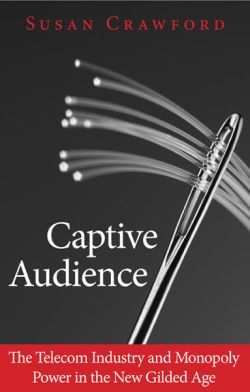
I just listened to Susan Crawford talk about her book, Captive Audience: The Telecom Industry and Monopoly Power in the New Gilded Age. She spoke for about an hour on After Words, the great weekend product on C-SPAN's Book TV. (You won't be able to watch the streaming video linked above until the broadcasts of the talk are completed this weekend. A video of a shorter presentation is included at the end of this post.)

She pointed out that people in the United States invented the Internet. (Indeed, people at UCLA -- at the time I was there as an undergraduate -- played an important role in the creation of computer networking and the Internet.) This country was in a great position to lead in the Internet revolution, but now a number of countries are way ahead of us in providing broadband connectivity to their people and their businesses.

She is convincing. It makes no more sense to have several pipes providing information to your home or office than to have several wires providing electricity or several pipes providing water. So there is a natural monopoly.

When cable was the major game in town we gave that monopoly to the cable companies. They were, at that time, purveyors of entertainment via a relatively small number of television channels. Today my FIOS line provides many channels of television, feeds two or three computer connections to the Internet, and provides phone service, and we are not heavy users. Homeowners buy, sell, work and manage their finances via the same line as they use for entertainment.

Crawford makes the case that we should treat the information pipe as a common carrier, a public utility. The firm that provides the pipe should not provide the content, and certainly should not have the monopoly on content. And the information pipe utility should be regulated as are other utilities. The problem is that the cable companies have gotten very large and very profitable, and want to maintain their privileges, and that many of our political leaders still believe in deregulation with ideological fever.

I suggest we need policies that make broadband internet connectivity a right of all Americans, and that we find ways to make it affordable for the poor. We also need to understand that the information pipes are an infrastructure that is of fundamental importance for out economic growth and international competitiveness. Regulations that break up monopolies are an important aspect of the implementation of such a policy.


Friday, March 29, 2013

A Thought about the federal budget


There is a good post by Nate Silver (the guru of election statistics) in his New York Times blog on the evolution of government expenditures. Since 1980, federal expenditures have varied between 20 and 25 percent of GDP. State and local government expenditures have varied between 12 and 16 percent of GDP. Having peaked during the stimulus after the 2008 crisis, total government spending is about 40 percent of GDP. He provides the following graph showing how the federal budget has evolved:


 The chart
documents the growth in federal government spending over the past hundred years as a share of gross domestic product spending is broken down into four major categories:
1. Entitlement programs, under which I classify government expenditures on health care programs; pensions and retirement programs like Social Security; and welfare or social insurance programs like food stamps and unemployment compensation.
2. Military spending
3. Interest on the national debt
4. Infrastructure and services, under which I include everything else — the pot that is often referred to as discretionary spending: education spending; fire services, police and the criminal justice system; spending on physical infrastructure including transportation; spending on science, technology, and research and development; and the category called “general government,” which largely refers to the cost of maintaining the political system (like salaries for public officials).
Compare the government expenditures with revenues:


Source of graph: usgoveernmentrevenue.com
The blue is for the federal government, the red for state and the green for local government. Generally state and local government do not run deficits but rather adjust spending to revenues.

The basic problem is that the federal government has accepted more and more responsibility for health care, social security and pension and welfare programs without adding funding for them. The funds have tended to come from reductions in other budget items.

  • The interest payments have been relatively low. Foreign nations have wanted dollars and wanted to invest in the United States and so interest rates have been low. As the debt increases, and as (perhaps) the dollar loses its luster, interest payments may be expected to increase.
  • Military expenditures have decreased as a portion of GDP, in part because the Cold War is over. Still the United States spends much more on the military than do other nations, or indeed than groups of nations combined. With the end of the wars in Iraq and Afghanistan, there will be a need to rebuild their weapons base. There will also be trillions of dollars of medical and pension costs for which funds have not been set aside and saved.
  • Federal expenditures for infrastructure and services totaled only about 2.5 percent of gross domestic product in 2011; moreover they include many things that are important for the continued growth of the GDP.
Silver also provides this figure:


Remember, government expenditures can grow at the same rate as GDP without increasing government share of the total. The protection and law enforcement is a small item in the total, but one that has been allowed to grow rapidly. Education, transportation and science and technology have been losing share, and we can't afford to economize on these areas.

The real problem is entitlements. My read would be that there are some savings to be had in making health care more efficient and perhaps some in welfare by increasing employment, but that we have to increase government revenue to pay for more pensions for our aging population and more government provided health care. 

To some extent this is a shell game: if we are not to deny health care to those who can not afford it, the funds have to come from somewhere. Shifting them to government does not increase the total burden on society. But the further implication is that federal government revenues should increase in step with the increase in health care and pension expenditures.

Here is one more graph to polish off this post:

Source: Morning Sun blog
The increase in the public debt to the size of the GDP is worrisome, and it is likely to increase further in the next few years. There is not much that can be done to reduce the expenditures of government, so increasing revenues seems necessary.

Monday, March 04, 2013

The Quest for Domestic Justice is Important to Foreign Policy


The Cold War was not only about preventing nuclear war between the United States and the Soviet Union, but about competition between two cultures. Much of it was about competition for the affiliation of people in the rest of the world to one or another of the systems. U.S. leaders developed a policy that had three major elements -- economic strength, military strength, and what we now call soft power.

Alliances in the Cold War
Source
There was a serious effort to demonstrate that American culture not only was linked to more affluence for its members, but also for movement towards a more just society. The civil rights movement, the Great Society policy of the Johnson administration, and foreign aid were all part of that third leg of policy.

Today, there is a clash of Islamic and Western cultures. We seek a foreign policy that will lead to better relations between the participants in these cultures while maintaining as much peace as possible. Economic strength continues to be important. It seems to me that military strength remains important, although fighting wars in Iraq and Afghanistan may not have been the best policy instruments. Soft power should again be the third leg of our stance.

Source
There are many things in American history of which we should be ashamed -- including slavery, the treatment of American Indians, racism, religious prejudice, and exploitation of poor immigrants. All societies have similar skeletons in their closets. However, the issue is not what we were but what we strive to be, and how much progress we make towards the better angels of our nature. Are we doing enough to promote justice domestically and internationally? I think not.

I suggest that we again need popular movements to promote a more just society, not only because we desire a more just society, but also because those movements would help our foreign policy as we strive to improve relations with the Islamic (and other) peoples and achieve a more peaceful and safer world.

Source

Wednesday, August 01, 2012

Davos 2010 - IdeasLab with MIT - Rebecca Saxe


My friend Emily alerted me to this video by her daughter-in-law, Rebecca Saxe, head of the Saxe laboratory at MIT.

 The key finding that I want to discuss is that there is a region in the brain that helps us to make moral judgments based on inferences on what another person is thinking. Moreover, Saxe's research suggests that that capacity is not always present, but requires maturation of the brain. A child of 5 will generally have an idea of intention, but it is not until children reach the age of seven that they attach moral culpability to bad intentions (in the absence of bad outcomes).

Consider these two situations:

  • You have a switch which controls the track on which a trolley car will run. If you put it in one position, five people in a stalled car down one line will die. If however, you switch it to the other position you will save those five, but another person on the second track will die.
  • You are standing on a bridge over a trolley line. A trolley is approaching from around a bend. There is a car stalled on the tracks just down the line from you and the five occupants will die if the trolley hits the car. There is a man standing on the bridge next to you. If you toss him off the bridge in front of the trolley, it will stop the trolley and the people in the car will be saved. 
Forgetting that there are other options (such as jumping off the bridge yourself to save the five people), most people will say in the first example that you should put the switch in the position that will save the most people. On the other hand, in the second example, they will say that you should not kill one person to save five.

I assume that the difference results from the way that the brain works. We have evolved as social animals, and apparently our brains have evolved to avoid killing a member of the group to save others, and that choice is built in the genes and matures with the maturation of the brain.

On the other hand, it seems that an emotionless actor (Mr. Spock on Star Trek) would always chose to save five people rather than one person.

I suspect that our moral thinking often (always) comes back to "what feels right". But should we make public policy on the basis of "what feels right" or what is more logical?

Here are two videos that you should watch in sequence in which Dr. Saxe describes the work in her laboratory:

Tuesday, April 17, 2012

Are Think Tanks Abandoning an Important Role?


As they become more political, however, think tanks — especially the newer and more advocacy-oriented institutions founded in the past decade or so — risk becoming both more conventional and less valuable. At a moment when we have too much noise in politics and too few constructive ideas, these institutions may simply become part of the intellectual echo chamber of our politics, rather than providing alternative sources of policy analysis and intellectual innovation.
Tevi Troy
Th' newspaper does ivrything f'r us. It runs th' polis foorce an' th' banks, commands th' milishy, controls th' ligislachure, baptizes th' young, marries th' foolish, comforts th' afflicted, afflicts th' comfortable, buries th' dead an' roasts thim aftherward.
Finley Peter Dunne"Newspaper Publicity" in Observations by Mr. Dooley
Cato
I ran across a couple of interesting articles on think tanks. Justin Logan provides an article in Foreign Policy magazine seeking support to keep the Cato Institute safe from a takeover by the Koch brothers, billionaires who have funded many very conservative civil society organizations. Logan sees Cato as a libertarian think tank that has been an important source of libertarian ideas and analysis. He fears that Koch representatives on the Cato board would make it more of a source of materials that endorse standard conservative positions, and less of a place for serious study and debate to analyze alternatives and produce innovative ideas.

Tevi Troy in an article in National Affairs suggests that while Washington Think Tanks have "come to play a central role in policy development" since World War II, in recent years they have been much more involved in political combat. We know that most people, including many policy makers, have a tendency to seek out things supportive of their beliefs rather than to seek the best independent evidence, whether that evidence challenges or supports their beliefs; people are more likely to seek arguments to bolster their preconceptions than to accept arguments that challenge their ideologically based positions.

Scientific institutions, in contrast, seek experimental evidence that tests their hypotheses, demand replication of observations and "double blinds" to assure that preference does not affect observation, and demand peer review (preferably by peers with a number of viewpoints) to challenge their beliefs. The greatest prestige in science goes to those who successfully overturn a paradigm. Think tanks should institutionalize similar approaches to policy analysis. They should not serve as script writers for politicians, developing arguments to support the position of the day. (There are enough places doing that already.)

On the other hand, scientists are notoriously ineffective in communicating science to the public and to their governments. Such failure to communicate would seem to be deadly for think tanks which are intended to influence policy.

The issue is how to combine strong policy analysis with strong communication, and to do that communication in ways that will influence the minds of policy makers. Not an easy challenge to which to rise.

Saturday, January 28, 2012

Finding the right categories and the right instruments of each category.


In his book, Rights Gone Wrong: How Law Corrupts the Struggle for Equality, Richard Thompson Ford focuses on the need for other approaches as well as legal means to secure human rights. I am not surprised that law enforcement is not the best way to win the hearts and minds. Indeed, I am reminded that the United States government seemed to believe that invasion and occupation was the approach to introduce democracy to Iraq and Afghanistan.

It seems to me that there might be two related problems. Ford mentioned in his appearance of CSPAN that the upper and middle economic class African Americans have different problems than the African Americans of the underclass. If one focuses on "the problems of African Americans" one might have great difficulty in finding solutions to their disparate sets of problems. It might be better to focus on the problems of the underclass, combining European Americans, Hispanic Americans, Asian Americans and Native Americans who belong to that underclass. and similarly to focus on the problems of the middle class.

To consider programs that might help all of the people in the underclass to deal with their problems more effectively, and to consider separate but simultaneous programs that might help the middle class is not "class warfare", it is simply a possible means of finding better solutions to people's problems.

The problems of the underclass might be a related cluster of poverty, segregated neighborhoods, poor educational and health services, being forced to live in high crime areas, class-based job discrimination, etc. It seems to me that integrating neighborhoods would be a good start, although I recognize that in some cases neighborhoods are self-segregated by people choosing to live together. (I live in a neighborhood with two good private schools primarily serving Jewish families, and it seems that more Jewish families are moving here to be close to the schools.)

While it seems to me that it might be possible to identify a limited number of cultural changes that could help poor people to solve a lot of these problems, and a limited number of tools to promote those cultural changes efficiently, I have no idea of how to do so. I am glad to see that there are efforts to improve educational services to the children of the poor in the hope that the schools will serve to integrate them into the mainstream society as the schools helped to integrate the children of immigrants for so many decades in America's past.

Monday, October 17, 2011

Domestic and Foreign Policy Don't Come Together Until the President


I have been reading The Commission: The Uncensored History of the 9/11 Investigation by Philip Shenon and posted on it initially and with a follow up.


I was reminded reading the book that the U.S. government has a fundamental divide between domestic and foreign affairs. In the case of the 9/11 intelligence the divide between the FBI's domestic charter and the CIA's foreign charter meant that information that might have been used to prevent the attack was never shared. Indeed, it appears that the National Security Council (the foreign policy advisory unit to the President) under President Bush didn't see that it had a charter that called for it to deal with foreign based terrorist attacks on the United States even after the terrorists arrived in the United States.


Even stranger, Shenon suggests that the Vice President, in the absence of the President, did not have the legitimate authority under the Constitution to order a plane attacking the White House (where he was at the time) to be shot down.


The separation of domestic and foreign policy might have made sense in 1789, but in our small world undergoing globalization seems to make little sense today. We need government in which all our agencies see both domestic and international aspects of their programs. Health, education, energy, intelligence and law enforcement all have both domestic and international aspects.