Showing posts with label democracy. Show all posts

Thursday, April 23, 2015

Recommending a website on the rise of political freedom and the decrease in violence


There is a very nice website produced by Max Roser that shows a decrease in violence worldwide, and seeks to provide at least a partial explanation -- all in graphs. Here are three drawn from the site:

\


Correlation does not necessarily mean causation, but it does seem likely the increased education leads to social changes that both promote democratic governance and decrease violence in a society.

Monday, November 25, 2013

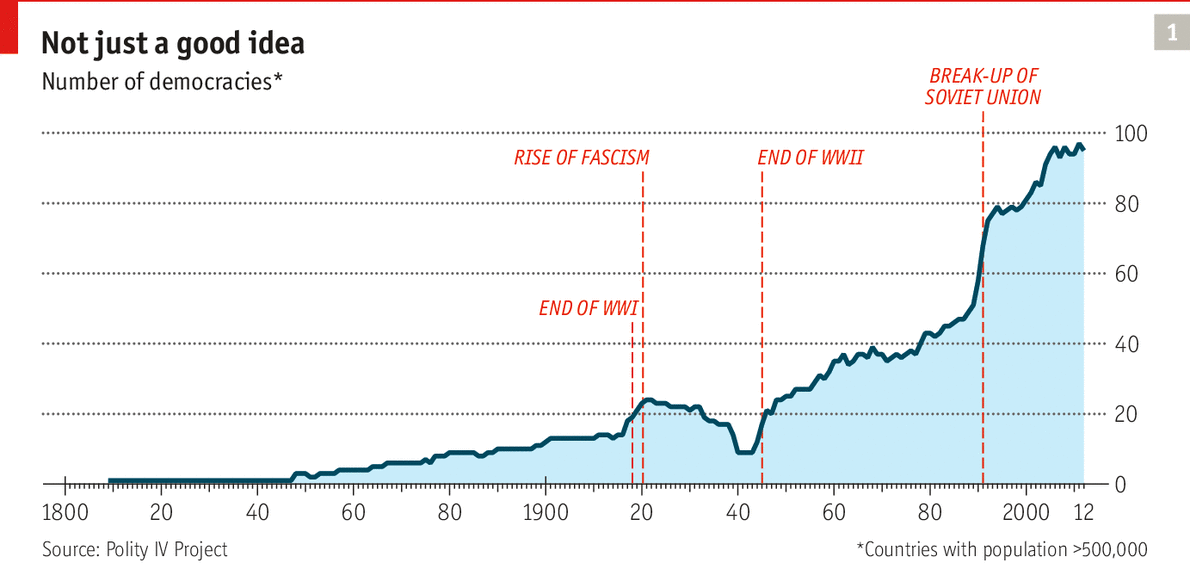
Thinking about the growth of democratic governance.


Source: The Economist
The United Nations currently has 193 member states, so there are still a lot of countries that are under other forms of government. Moreover, some democracies are more democratic than others.


Still, that idea of a government of the people, by the people, for the people seems to be gaining pretty wide acceptance.

If you look at the number of people living under democratic governments some democratic countries such as India and the United States are rather large. On the other hand, China is bigger still.

Thursday, June 06, 2013

We seem to need a broader word than "democracy"


The word "democracy" means rule by the people. I suppose that we could define an indicator, such as the portion of a country's population that has the vote to describe an aspect of democracy. When the United States was created, slaves and Indians were not citizens, women and children didn't have the vote, and people without property were not voters. By this kind of count, the USA in 1790 was not very democratic.

I have been reading about Russia under Stalin. There lots of people voted, but ballots only had a single candidate specified by the Party. Moreover, the elected bodies had little power to govern as compared with Stalin and his close associates. So the percentage of people voting is not a good indicator of the political power of the voters.

Assume that a party obtains a majority of the votes and takes power over the government. How much power does it really have? In the United States the Bill of Rights and other amendments of the Constitution define rights that the individual and the states have that the federal government may not transgress, no matter who is elected. We also have institutionalized things like the filibuster that allow a minority to block legislation desired by the majority party. We also seem to like to divide our votes, electing a president of one party and majorities in one or both bodies of the Congress of the other party. What do we call a system that has checks and balances such as those which protects the citizen and the minority in many ways from the power of the majority.

We also have a rule of law. A third branch of government provides protection of the citizens against the actions of elected officials. Indeed, it provides a conflict resolution system that protects citizens from each other.

I think we need a word that describes a complex set of institutions that give governing power to the people, but that protect the individual and the minority from excessive exercise of power by the government.

Friday, September 14, 2012

Population Density as a Predictor of Political Philosophy


Yesterday I posted some thoughts on  the geography of conservatism and liberalism in the United States. I included the following map:

Source
Compare that  map with the following map of population density:

Population Density 2007
Source
It seems rather clear that the higher the population density, the less conservative and more progressive the region.

The states with the highest density are (most dense first): New Jersey, Rhode Island, Massachusetts, Delaware, New York, Florida, Ohio and Pennsylvania. None of them has above average portion of conservatives. These states (with the exception of Pennsylvania and Florida) are core progressive states. (We generally think of their big cities as voting Democratic,)

The west coast progressive states are relatively large, and have regions of both high and low population density, but their urban metropolitan districts are large and the progressive urban populations outnumber the rural conservatives.

It would seem that there is something about the culture of high population density regions that correlates with progressive population. These are also regions with relatively high income, relatively high portions of people with college degrees, high portions of the population in managerial or creative industries, and more diverse populations. These are perhaps all implicated in producing a culture that votes progressive.

Friday, April 13, 2012

African Democracy Ratings


Angola to Sudan to Somalia has a horseshoe of authoritarian regimes. The hole is pointed south, and a horseshoe pointed down is supposed to mean bad luck. This one clearly means bad luck for a lot of people in those countries.

Tuesday, September 20, 2011

Thinking about Arab Spring


It seems clear that "Arab Spring" is an example of the contagion of an idea, reminiscent of the spread of revolutionary ideas in Europe in 1848. It appears that there is a spirit of the times in a large area with hundreds of millions of people. Clearly people in one city saw demonstrations occurring in other cities with which they could relate and began their own demonstrations; people in one country saw uprisings in other countries with which they could relate and began their own uprisings.

It seems also seems that countries in which the movement have been successful share socio-economic commonalities. They have populations with high proportions of young people, more educated than earlier generations, who have faced limited opportunities for economic success, and who have felt that their governments were unrepresentative, unresponsive to the demands of youths, and dependent on coercion for continuing in power.

Arab Countries
Source: Theodora.com
We have been describing this year's political contagion as "Arab Spring" and it is true that many of the countries in which demonstrations, uprisings and insurgencies have been taking place are countries in which people speak Arabic. I had a debate on this blog in 2009 as to whether Arab nations were culturally uniform. Based on my limited experience in Egypt, Jordan and Morocco and my reading I felt that there were important differences among these countries, and I continue to feel so. Still, language is an important aspect of culture, an important index of similarity among peoples and countries, of the feelings of commonality among countries and peoples.

Source: Freelanguage.org

As the map above shows, not all countries in which Arabic is spoken have Arabic as the only official language. Indeed, there are minorities in many Arab countries that speak other languages and there are differences in the Arabic spoken in different Arab countries.

It is not surprising therefore that the course of politics has been quite different this year in Tunisia, Egypt, Syria, Yemen, Bahrain, Lebanon, Morocco, Jordan, Sudan, Saudi Arabia, Somalia, and other Arab countries. Obviously the Palestinian peoples are facing very different problems than the Sudanese, the people of the Maghreb or the peoples of the oil-rich Gulf states.

Religion is also an important aspect of culture and the countries most involved in the Arab Spring movements have been Islamic. As the map below shows, there are significant differences in the fraction of peoples in different "Muslim countries" that profess the Muslim religion. Comparing this map with that of the Arab speaking world, it is clear that while 22 Arab countries are all Islamic, not all of the 54 Islamic nations are Arab. Indeed, There seems to be a significant contest for influence in the Islamic world among Arab Egypt and Saudi Arabia, Turkic Turkey, and Persian Iran. Moreover, as experience in Iraq has shown with considerable violence, there are peoples who profess different Muslim faiths who can not only differ in culture but who have killed each other over those cultural differences.

Source: Islamproject.org

Geography also counts, in the sense that natural resources, climate, neighboring countries, access to foreign markets, etc. all influence culture and have repercussions on the likelihood of violence and insurrection.

So too does history, and the history of the Arab countries is very long and very different. Egypt has been a regional cultural leader for thousands of years, influenced (in my opinion) by its Pharaonic, Greek and Roman past as well as by its Arab and Muslim roots; Syria has an equally deep past, but one with different aspects than that of Egypt. The Arab countries have different experiences in the 20th century in part related to the differences between British, French and Italian colonial policies, not to mention differences in the earlier experience with the Ottoman Empire. History leaves its mark on culture and thus on the response to the contagion of Arab Spring as well as on the underlying economic and political conditions that form the conditions that foster or discourage contagion.

I have spent decades working in Latin America. I began the experience with the assumption that the Latin American countries, especially the Ibero-American and Spanish-American countries were rather homogeneous. I emerged from those decades with the realization that countries "south of the border" are very different one from another. Indeed even countries very close to each other (Costa Rica and Nicaragua, Colombia and Ecuador) can be very different one from another. I think the same is likely to be true of the Arab countries and of the Islamic countries.

Tuesday, July 19, 2011

Does Schooling Promote Democracy

Source: The Economist

Sometimes it is better to look at the scatter plot than the regression line. It looks to me as if there may be little advantage of a year of schooling, that there is a relatively strong correlation of democracy and schooling over the six to nine years of education range, and that there may be decreasing returns to education with respect to democracy for more than nine or ten years of schooling on average.

Of course, correlation is not causation. It may be that increased freedom leads to more education, or that an underlying variable promotes both schooling and democracy (as measured by Freedom House).

I note too that there is a lot of variance around the regression line.

I also recall that the German Nazis and the Chinese Communists worked to see that the schooling in Germany and China did not promote democracy, but rather supported their authoritarian regimes.

Thursday, April 28, 2011

A thought about the digital divide and power

Joe Nye has recently published Soft Power: The Means To Success In World Politics and The Future of Power. The first deals with the power to persuade and the second deals with the balance between the power to command and the power to persuade.

I wonder whether one might not add a concern for cyber power. There has been a considerable amount of attention directed to the "digital divide", but I suspect that that divide is widely misunderstood. Most of the people who could or would read this blog have access to a personal computer and the Internet. When I started thinking about computers more than 50 years ago, the idea of more than a billion people with access to the information stocks of the World Wide Web, using search engines like Google, via their own personal computers, would have been seen as science fiction of the more fantastic kind. A decade ago, much of the discussion of the digital divide focused on the divide between those who had personal computers and Internet access versus those who did not. Now with the proliferation of cell phones, text messaging, and smart phones billions more have or will soon have access to the Internet; there remains a gap in internet access but it is narrowing; there is more of a remaining gap between those who have access to powerful personal computers and those who do not, but few of us begin to exploit that power.

I focus however on the fact that not only do rich countries have more money to spend per capita on information and communications technology than do poor countries, but they also tend to spend a greater portion of their GDP on that technology. Thus you find the U.S. intelligence community seeking to use computers to capture and screen a huge portion of all the telephone and Internet traffic in the world. The U.S. military apparently is using huge amounts of computer power to monitor battlefields and all the persons on the battlefield to provide all its soldiers with comprehensive information on which to act (including pilots in the continental United States operating drones over battlefields in other nations). Government hackers are presumably able to command huge information and communication technology resources to mount attacks on the cyber structure of enemy nations. Rich countries have ICT resources that can not be afforded or even approximated by poor countries, and that it not only a continuing digital divide but quite possibly an expanding one.

Arab Spring is being described as partially the result of the new social media which enabled disaffiliated youths and educated persons to organize massive demonstrations, and as such as an indication that the new ICT technology is promoting democratic movements. Maybe! But I suspect that the digital divide as described above will help some repressive regimes to deny democratic movements. Control of military ICT applications and massive expenses on intelligence applications may support coercion.

I tend to believe that movement towards knowledge societies will lead to demands for more responsive and beneficial governance. I am not sure that the technology per se will be  helpful, but the change in culture with education and increased expectations may.

Monday, April 25, 2011

Thank goodness we have a representative democracy with checks and balances

Sophia Rosenfeld had a piece titled "Beware of Republicans bearing ‘common sense’" in yesterday's Washington Post. I quote from it:
Once democracy is established and consolidated, common sense is rarely a match for the messy and complicated business of governing. No matter how many times politicians invoke the term today, there can be no such thing as a single, simple, common-sensical solution to the problems confronting the nation. The mind-boggling complexity of the issues surrounding climate change, economic recovery, multiple wars and, yes, federal and state budget deficits outstrips the authority of common sense either as the basis of workable policies or as a critique of those already on the table.
Rosenfeld looks back on the founding fathers with a lot of mythology. I think there are two big issues:

  • The founding fathers had more than "common sense", and people like Madison, Hamilton and Jay not to mention Robert Morris and Franklin did an amazing job of developing the Constitution that has functioned for a couple of centuries and been a model for many other governments.
  • They got a lot wrong, especially if one looks at the Articles of Confederation. Imagine a government without an executive branch, with no national currency, no power of taxation to pay for the military services fighting a war, etc.
The Constitution set up the House of Representatives as a vehicle for representative democracy (which I don't think existed in class-divided England much less the British Empire of the time), but provided checks and balances of the Senate, the Executive branch and the Judiciary. It also left the development to George Washington, who amply justified the judgment that he could be trusted. Finally, it was brief leaving room for development and correction in the processes for its implementation and it included provisions that allowed amendments.

A special report on democracy in California in the current Economist magazine attributes the decline in that state to reforms seeking more democracy gone wrong. California allows not only recalls and referendums but also initiatives that if passed can not be changed by the legislature. Moreover, the legislature is small (80 members of the Assembly and 40 of the Senate) as compared with the size of the state population, and has short term limits (maximum of 3 terms of 2 years for the Assembly and 2 terms of 4 years for the Senate). There are also a dozen statewide elected offices. According to the Economist, the voters don't understand the ballot propositions on which they are voting, much less the relations among them and the effect of their votes on the choices made by government, nor does the legislative body have the expertise to make good choices even if they had the power to do so. The whole system makes one appreciate more and more the work of the authors of the Constitution and the Federalist Papers.

A basic problem is the incredible ignorance of the public. Look for example at the following table which shows the percent of correct answers on a number of questions of what should be universally understood knowledge (taken from the NSF Science and Engineering Indicators 2004):
 Do you want to leave important decisions on your future to public opinion, or do you hope that they will be made by experts in government, with checks and balances to keep the more stupid results being fixed in stone?

Tuesday, March 01, 2011

Thinking about e-democracy

Alfred Chandler in his book The Visible Hand: The Managerial Revolution in American Business suggested that the corporation had become a major institutional form because it successfully handled information of a commercial sort better than did markets. More recently we have discovered that the Internet reduces market transaction costs and delays, and that corporations are increasingly concentrating of core competencies and outsourcing other functions via Internet mediated markets. Essentially, market institutions have regained the lead in dealing with some kinds of information that was through most of the 20th century better handled by corporation institutions.

Thus new communications and information technology has led to a change in the institutions in the business sector. It seems likely that ICT changes have also led to changes in government and civil society institutions.

In their classical book Risk and Culture, Douglas and Wildavsky attributed the growth in power of civil society organizations such as the Sierra Club to their increasing ability to distribute information and solicit donations at low cost; people could feel that they were helping to prevent pollution of the environment with a simple donation of a small amount of money. Surely the Internet has made the process simpler and faster than Douglas and Wildavsky would have imagined when their book was published in 1983. Surely with The Social Network up for an Academy Award for the best picture and the pervasiveness of Facebook and Twitter, it should be clear that ICT is having a major impact on the institutions of civil society.
"The basis of our governments being the opinion of the people, the very first object should be to keep that right; and were it left to me to decide whether we should have a government without newspapers or newspapers without a government, I should not hesitate a moment to prefer the latter. But I should mean that every man should receive those papers and be capable of reading them." --Thomas Jefferson to Edward Carrington, 1787
I suspect that democracy was in part an institutional response to a more educated public demanding a role in government, rejecting the idea that monarchs were divinely chosen and rejecting that force makes right. Representative government as it developed in the 19th and 20th century was in part made possible by improved media and transportation. It became possible for the public to learn quickly what government was doing regionally and nationally through mass media communication, but representatives would be responsible for bringing their constituencies views to the bureaucracy.

The role of social networks (Facebook, Twitter) in the political earthquake in North Africa has been widely reported and commented upon. Social networks have clearly played a role in person-to-person communication involved in organizing public demonstrations. Al Jazeera and Al Aribiya brought visual coverage to the world, drawing upon blogs, photos and videos from mobile phones, tweets and Facebook postings. In a less traumatic but still amazing development, in 2009 the effective use of the Internet helped an African American (with what most Americans thought to be a funny name) to be elected president of the United States.

I suspect that the new information and communication technology will lead to even more profound changes in the ways political institutions work. Communication will increasingly be from the people to their elected representatives, and among the people themselves. The may show up in large numbers, as is happening now in Wisconsin, organized by social networking and drawing on the media to gain public support. Transactions  between the governed and the government will be increasingly mediated by the Internet and take place on e-government sites. Political parties will continue to reengineer their processes using the technology. Indeed, the public will be able to deal more online with the bureaucracy. The bureaucracy too will use the Internet more to outsource functions, focusing more on its core responsibilities.

Tuesday, January 11, 2011

Caught in the net Why dictators are going digital

The Economist this week has a review of The Net Delusion: The Dark Side of Internet Freedom by Evgeny Morozov. The book makes a point that I have been making for years (although probably better than I have). The information and communications technology revolution is producing a variety of very powerful technologies. While some people may appropriate the power in ICT to promote democracy, coercive governments are likely to try to do so to suppress democratic movements and strengthen coercion.
In fact, authoritarian regimes can use the internet, as well as greater access to other kinds of media, such as television, to their advantage. Allowing East Germans to watch American soap operas on West German television, for example, seems to have acted as a form of pacification that actually reduced people’s interest in politics. Surveys found that East Germans with access to Western television were less likely to express dissatisfaction with the regime. As one East German dissident lamented, “the whole people could leave the country and move to the West as a man at 8pm, via television.”

Mr Morozov catalogues many similar examples of the internet being used with similarly pacifying consequences today, as authoritarian regimes make an implicit deal with their populations: help yourselves to pirated films, silly video clips and online pornography, but stay away from politics. “The internet”, Mr Morozov argues, “has provided so many cheap and easily available entertainment fixes to those living under authoritarianism that it has become considerably harder to get people to care about politics at all.”

Social networks offer a cheaper and easier way to identify dissidents than other, more traditional forms of surveillance. Despite talk of a “dictator’s dilemma”, censorship technology is sophisticated enough to block politically sensitive material without impeding economic activity, as China’s example shows. The internet can be used to spread propaganda very effectively, which is why Hugo Chávez is on Twitter. The web can also be effective in supporting the government line, or at least casting doubt on critics’ position (China has an army of pro-government bloggers). Indeed, under regimes where nobody believes the official media, pro-government propaganda spread via the internet is actually perceived by many to be more credible by comparison.

Think about the ability of governments to tap into land lines and cell phones and to use computers to screen traffic in order to identify people with opinions that they don't like and to track networks of people sharing such opinions.

In the democratic countries CCTV networks and high powered informatics are used to prevent crime, but coercive governments may define thought that they don't like as criminal and appropriate the technology for their own purposes.

Friday, December 31, 2010

The Election of Rutherford B. Hayes


Tim Wu, in his book The Master Switch: The Rise and Fall of Information Empires, tells a story about the election of Rutherford B. Hayes in 1876. It seems that while he was a longshot for the Republican nomination and for the final election, he was the choice of both the owners of the New York Times and of Western Union. It seems that they worked together to assure his election.

Western Union at the time had a monopoly on use of the telegraph lines; it had obtained much of the national network built by Union soldiers during and after the Civil War. It also owned the Associated Press, which was the only news service. Only the Associated Press was allowed to send news stories over the Western Union telegraph lines.

Wu tells us that Western Union and the AP only sent stories favorable to Hayes during the campaign, refusing both stories that were unfavorable to him and stories that were favorable to his opponents. Consequently, during the campaign Hayes' popularity improved.

In November apparently the Democrat, Samuel Tilden, won the popular vote but Republican Hayes was close. Wu tells us that Western Union passed all the cable traffic among Democrats to key Republican leaders, from which they discovered that the Democrats were having difficulties in the South. Cables went out to the Republican Governors of southern states and low and behold enough votes in the electoral college were disputed to leave the selection of the new president in doubt. The impasse lasted for months until a deal was brokered. Hayes would become President but as President he would withdraw the federal troops from the former Confederate states and cease to enforce Reconstruction policies.

If you think big corporations have too much political power now and if you think elections are dirty now, apparently they were worse in 1876. On the other hand, perhaps the lesson of this story is the need for eternal vigilance. If we do not protect our democracy, they there are surely people who would love to subvert it to get their own way.

I am just starting the book, but it seems very good. Wu is the person who coined the term "net neutrality" and the book appears to be a warning that -- if history is a guide -- that the open Internet could be monopolized by big business and government and as a result our access to information forced through a bottleneck which would have bad effects.

Tuesday, December 07, 2010

Democracy Is Looking Up in Latin America


Latinobarómetro has published its 2010 report on its survey of public opinion in Latin America. In the graph above, note that in most of the countries half or more of the respondents did not report that they were satisfied with their democracy. On the other hand, in almost all of the countries respondents were more positive than they had been in earlier surveys.

Tuesday, August 04, 2009

A Thought on Reading Zakaria

I continue to read Fareed Zakaria's The Future of Freedom it has occurred to me that everybody that he mentions who predicted the future of political systems was wrong. The administrators and theorists from the colonial powers in the past, to the people leading decolonization, to the international development specialists. Maybe the key conclusion of the book is that almost everyone is wrong about such predictions, and if someone is right we probably won't realize it until his/her predictions have been turned into history.

Friday, July 10, 2009

The Failed States Index


It is a sobering time for the world’s most fragile countries—virulent economic crisis, countless natural disasters, and government collapse.

Using 12 indicators of state cohesion and performance, the Fund for Peace, an independent research organization, and Foreign Policy magazine compiled through a close examination of more than 30,000 publicly available sources, ranking 177 states in order from most to least at risk of failure. The 60 most vulnerable states are listed in the rankings. This is the fifth annual issue of the report on the Index of Failed States.

Thursday, June 18, 2009

The Information Revolution and the Iranian Demonstrations -- a thought

There has been a lot of publicity noting that Iran is heavily "wired", with large numbers blogging and tweeting. Dishes receiving satellite TV broadcast are ubiquitous. Cell phones have multiplied there as everywhere and the network of personal phones is ubiquitous. Pundits have suggested that the huge demonstrations that have been occurring since the election would not have been possible without this infrastructure, not to mention that we would be unaware of the tumult in Iran without the information being sent out of Iran by regular citizens via the global information infrastructure.

What would you bet that the forces of conservatism are also "wired", that they are watching events via the information infrastructure, that they are burning up the wires and airwaves discussing what to do. If the decision is to use military force to stop the demonstrations, the military will no doubt utilize information and communication technology in all aspects of its preparations and actions.

What would you bet that the U.S., Israeli and other intelligence agencies are picking up huge amounts of traffic on the events, and are using lots of very high technology to observe and analyze what is happening.

If the 21st century technology is enabling the forces of opposition to mobilize and protest the elections, then too it is 21st century technology that may be used to suppress the movement.

I have in the past suggested that technology is a double edged sword, and that whether it will be used to enhance or suppress democratic processes is unclear, likely to depend on other circumstances in which it is applied. I still say so!