Showing posts with label Environment. Show all posts
Showing posts with label Environment. Show all posts
Sunday, November 01, 2015


Saturday, October 24, 2015
If true, this may be really, really bad news!
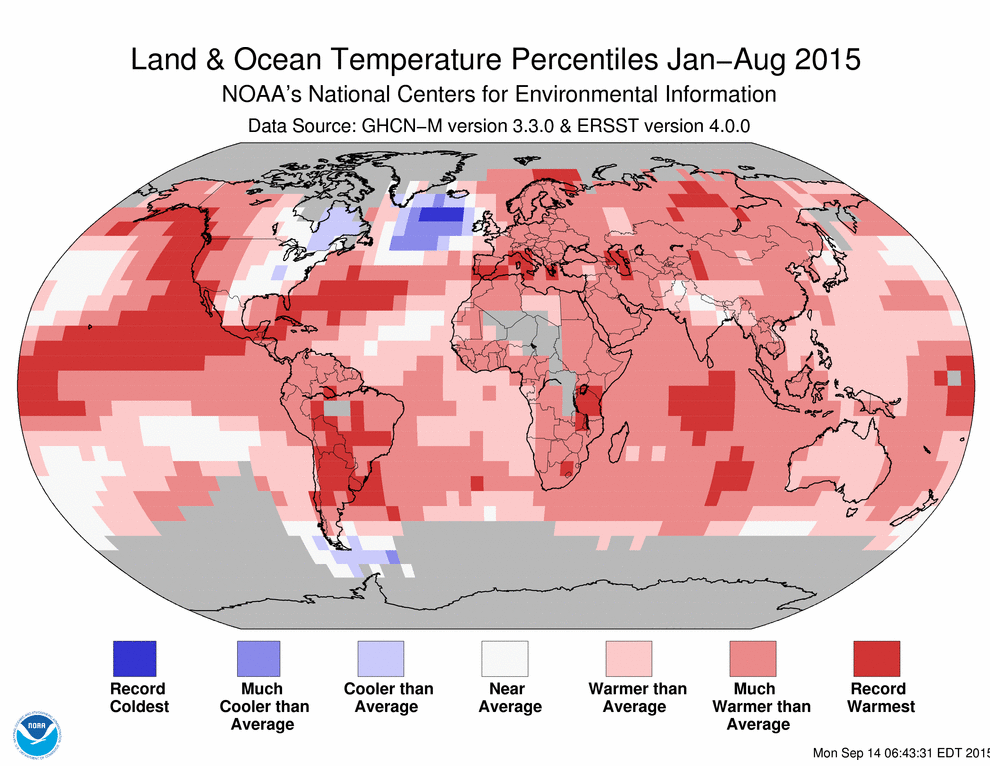
"(W)hile there may not yet be any scientific consensus on the matter, at least some scientists suspect that the cooling seen in these maps is no fluke but, rather, part of a process that has been long feared by climate researchers — the slowing of Atlantic Ocean circulation."
Read more at http://www.washingtonpost.com/news/energy-environment/wp/2015/09/24/why-some-scientists-are-worried-about-a-cold-blob-in-the-north-atlantic-ocean/
Monday, October 05, 2015
Improving Crop Yields to Respond to Global Warming and Population Growth
Climate change is expected to cause higher temperatures and more frequent droughts, changing the distribution of pests and diseases. Population growth will add to the pressure on productive land: the UN expects the number of people in the world to rise from 7.3 billion today to 9.7 billion by 2050. This, together with a switch to more meat-eating, will mean a big increase in the demand for food. The UN Food and Agriculture Organisation (FAO) says humanity will need 70% more food by then.
Dependence on a few staples worsens the consequences of any crop failure. Just 30 crops provide humans with 95% of the energy they get from food, and just five—rice, wheat, maize, millet and sorghum—provide 60%. A single variety of banana—Cavendish—accounts for 95% of exports. A fast-spreading pest or disease could see some widely eaten foodstuffs wiped out.
That makes it even more important to preserve the genetic diversity found in crop wild relatives and traditional varieties as an insurance policy. Alas, much of it has already disappeared. The FAO estimates that 75% of the world’s crop diversity was lost between 1900 and 2000. As farming intensified, commercial growers favoured a few varieties of each species—those that were most productive and easiest to store and ship.
According to Cary Fowler of the Global Crop Diversity Trust, an international organisation based in Germany, in the 1800s American farmers and gardeners grew 7,100 named varieties of apple. Today, at least 6,800 of them are no longer available, and a study in 2009 found that 11 accounted for more than 90% of those sold in America. Just one, “Red Delicious”, a variety with a thick skin that hides bruises, accounts for 37%.
Meanwhile urbanisation, pollution, changing land use and invasive species are threatening the crop wild relatives that survive. A study in 2008 concluded that 16-22% of those related to peanuts, potatoes and cowpeas (a legume grown in semi-arid tropics) will have vanished by 2055 as a result of climate change.So what if climate does change? Don't you just grow the same crops a few miles further from the equator? Well, what if the soils are different. What if there is not as much water in the new spot as the old one? What if you were on the western side of a hill, and the new spot is on the southern side, and the light conditions are different? What if there are different pests and diseases in the new spot? What if your machinery won't work as well in the new spot as it did in the old? I think that the world will need a lot of crop improvement to produce new varieties of major crops that will produce well under the new conditions.
One solution is pretty much out of the question. Most of the arable land is already in agricultural production. The world will no longer solve its food needs by putting unused arable land into production.
We could not do a lot be simply rationalizing our distribution and use of food. Obesity is harmful to the health of the obese as well as wasteful of food, and should be reduced globally. Cows are a very wasteful way to produce protein as compared with legumes, and the fat intensive diet found in the USA not only uses a lot of land to feed cattle, a lot of grain to fatten them, but also results in poor health in people who have too much fat in their diet. It would be great if the world could rationalize protein production, getting those who eat too much animal protein to stop doing so, increasing the production of vegetable protein, and distributing protein more appropriately so that fewer people are protein starved and fewer people eat too much of the wrong kinds of protein.
Ultimately, we will have to have better varieties of food crops, and that means varieties with genes that better suit them to produce well in the places that they will be planted. Those genes can come from already domesticated plants, or from the much larger source in non-domesticated species. They can be transferred into new varieties of crops by mass transfers of genes as in traditional plant breeding, and then subjected to a long process of selection to weed out the genes that don't improve the variety. Alternatively they can be transferred by much more scientific and efficient processes of biotechnology. Society will choose. but I think I know the better way.
Sunday, September 20, 2015
Great Video that will not convince climate change deniers.
This stunning new video from NASA shows how air pollution from Asia changes weather and climate around the world. http://on.nrdc.org/1EPSH18
Posted by OnEarth on Wednesday, January 28, 2015
Thursday, June 04, 2015
What Americans Believe About Climate Change is Related to Geography
However, it may be more related to where liberals live and where conservatives live than to what the local climate or weather is like.
In 2014, 64 percent of U.S. adults thought that global warming was happening while 18 percent thought not, and the rest didn't know.. (Check the Yale Project on Climate Change Communication website for a map)
 |
| Source: "What Americans Think About Climate Change in Seven Maps" |
Saturday, May 16, 2015
Wednesday, February 04, 2015
New Insights on U.S. Opinions on Science
New Pew Research Center surveys of citizens and a representative sample of scientists connected to the American Association for the Advancement of Science (AAAS) show powerful crosscurrents that both recognize the achievements of scientists and expose stark fissures between scientists and citizens on a range of science, engineering and technology issues.A new Pew Research Center report highlights these major findings from its surveys of Americans:
- 79% of adults say that science has made life easier for most people and a majority is positive about science’s impact on the quality of health care, food and the environment.
- 54% of adults consider U.S. scientific achievements to be either the best in the world (15%) or above average (39%) compared with other industrial countries.
- 92% of AAAS scientists say scientific achievements in the U.S. are the best in the world (45%) or above average (47%).
- About seven-in-ten adults say that government investments in engineering and technology (72%) and in basic scientific research (71%) usually pay off in the long run. Some 61% say that government investment is essential for scientific progress, while 34% say private investment is enough to ensure scientific progress is made.
However:
- Only 16% of AAAS scientists and 29% of the general public rank U.S. STEM education for grades K-12 as above average or the best in the world. Fully 46% of AAAS scientists and 29% of the public rank K-12 STEM as “below average.”
- 75% of AAAS scientists say too little STEM education for grades K-12 is a major factor in the public’s limited knowledge about science. An overwhelming majority of scientists see the public’s limited scientific knowledge as a problem for science.

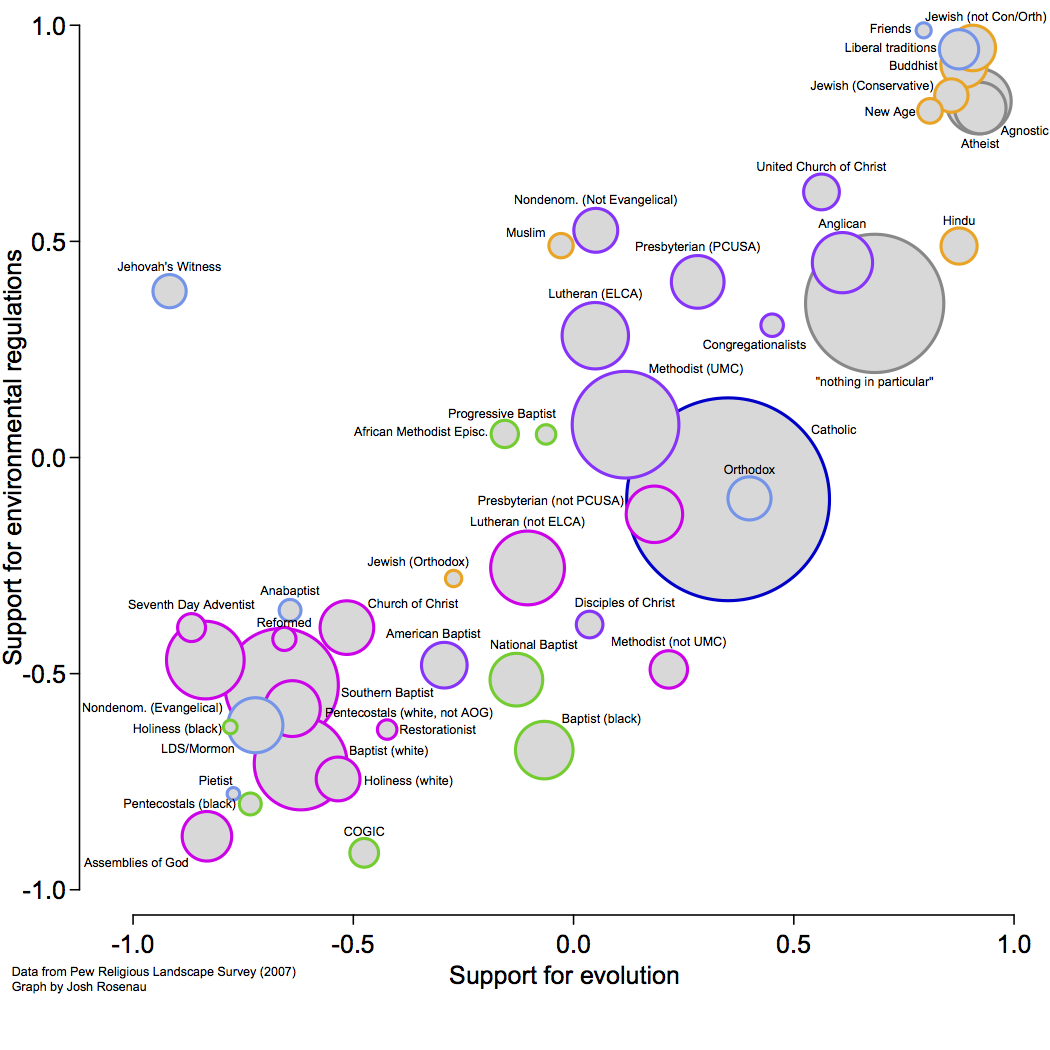
The public's general support for science is reassuring, but the differences between public views and those of the scientific community (shown in the figure above) are sometimes of concern.
- I have spent time looking at biotechnology, and I know from experience that the scientific community is very careful to assure the safety of foods that are produced from genetically modified crops. The public is I fear unaware of the dangers of traditional breeding, and too fearful of biotechnology. Of course, we need to continue to assure careful vetting of GM research and releases of GM crops, but the public fear is excessive.
- Similarly, while I worked for many years to assure that animals involve in the research programs I managed were treated ethically, I also recognize that their use was necessary. There is no question that ethical use of animals in research is justified by the benefits such research yields for mankind.
- Evolution is central to modern biological science, and the evidence for evolution is overwhelming. I don't mind what people believe, but I do mind when people insist that children's science classes not teach scientific consensus.
- The fear of vaccines is unjustified, and as the current measles epidemic shows, that fear leads to very serious consequences. While the MMR vaccine is very safe and very effective, the most recent data from the World Health Organization indicated that there were 145,000 deaths from measles in 2013. While measles was eradicated from the USA years ago, if Americans don't immunize their children, the disease can be reintroduced from Africa and Asia, where it is endemic in many poor countries.
- Similarly, the vast majority of scientists are convinced that humans are driving global warming through activities that cause increase in the release of greenhouse gases. I fear that the public has bought a false story from those who profit from businesses releasing those greenhouse gases (and the folk that they fund). Prudence demands that we act globally and quickly to reduce greenhouse gas emissions.
- It is not having more people in the world that is a problem per se, it is that more people with higher expectations for their lives put more stress on the environment. That makes is harder and harder to feed the billions of people and provide them all with decent lives. Global warming, pollution of land, air and water, deforestation, desertification, loss of biodiversity are only the most worrisome of the problems likely to arrive with the population increases we still expect.
Tuesday, January 13, 2015
Ranchers vs. Bison Huggers (Don't Try Hugging a Bison at Home!)

I quote from a column in The Economist:
THE most original political book of early 2015 is not formally about politics at all. Instead “The Battle for Yellowstone” by Justin Farrell, a young scholar at Yale University, ponders venomous rows that have shaken Yellowstone National Park in recent decades, and why they are so intractable. The rows turn on such questions as wolf re-introduction, bison roaming-rights and snowmobile access to that lovely corner of the Rocky Mountains.......
(Sociologist Farell) spent two years asking folk in and around Yellowstone why they are so cross. Beneath debates about science and economics he found arguments about morality and the proper relations between humans and nature—though those involved often do not, or will not acknowledge this. In short, all sides purport to be weighing what is true and false, while really arguing about right and wrong.
Pro-wolf biologists and officials call themselves dispassionate custodians of a unique place. But they give themselves away with quasi-spiritual talk of wolves restoring “wholeness” to a landscape damaged by man. Indeed, when the first Yellowstone wolves were released in 1995, the then-interior secretary, Bruce Babbit, called it “a day of redemption”. While living with pro-bison activists, a startled Mr Farrell heard them telling various furry specimens “We love you,” or “We are here to protect you, you big sacred boy,” and spouting bowdlerised Native-American teachings about the animals’ ancient souls (while simultaneously insisting, in many cases, that they distrusted religion and its works).
As for anti-wolf types, when offered financial compensation for wolf-attacks on their livestock, some turn it down—suggesting that more than economics is at stake. Dig a bit, and a culture war is raging between the “old West” of rugged ranchers and hunters, who once earned respect and status by taming nature, but who now find themselves called environmental menaces by “new West” incomers with big-city ideas about animal rights and natural ecosystems. Behind that local clash—pitting folk with gun racks on their trucks against those with bike racks, as Mr Farrell puts it—there lurks a still larger suspicion of the federal government. Many “old West” types see a plot to drive ranchers from the land. They talk of “federal wolves” undermining their property rights, and challenging the God-ordained duty of humans to protect their own families, and exercise dominion over Creation.Mr. Farell's book is not out yet, and I assume that the author of the article could not due it justice in a short space. I think there is a good point that the people most passionately arguing about Yellowstone are making their arguments based on ideological positions that are deeply held -- indeed, part of their view of themselves.
I see Yellowstone as a unique place, both for its beauty and the richness of its biodiversity. I want it preserved for that reason, while I am quite willing to see most of the country modified to meet human demands. I suspect that the ranchers who live near Yellowstone see it as part of their neighborhood. I am not happy when deer from the woods miles from my house get into my yard and eat my wife's tomatoes, and I suspect that the nearby ranchers have similar feelings related to Yellowstone.
Too bad! My view -- that the National Parks are a great American idea -- is widely shared by Americans and by the people all over the world, and in our democracy our will has prevailed for more than a century.
Sunday, December 14, 2014
The Qattara Project
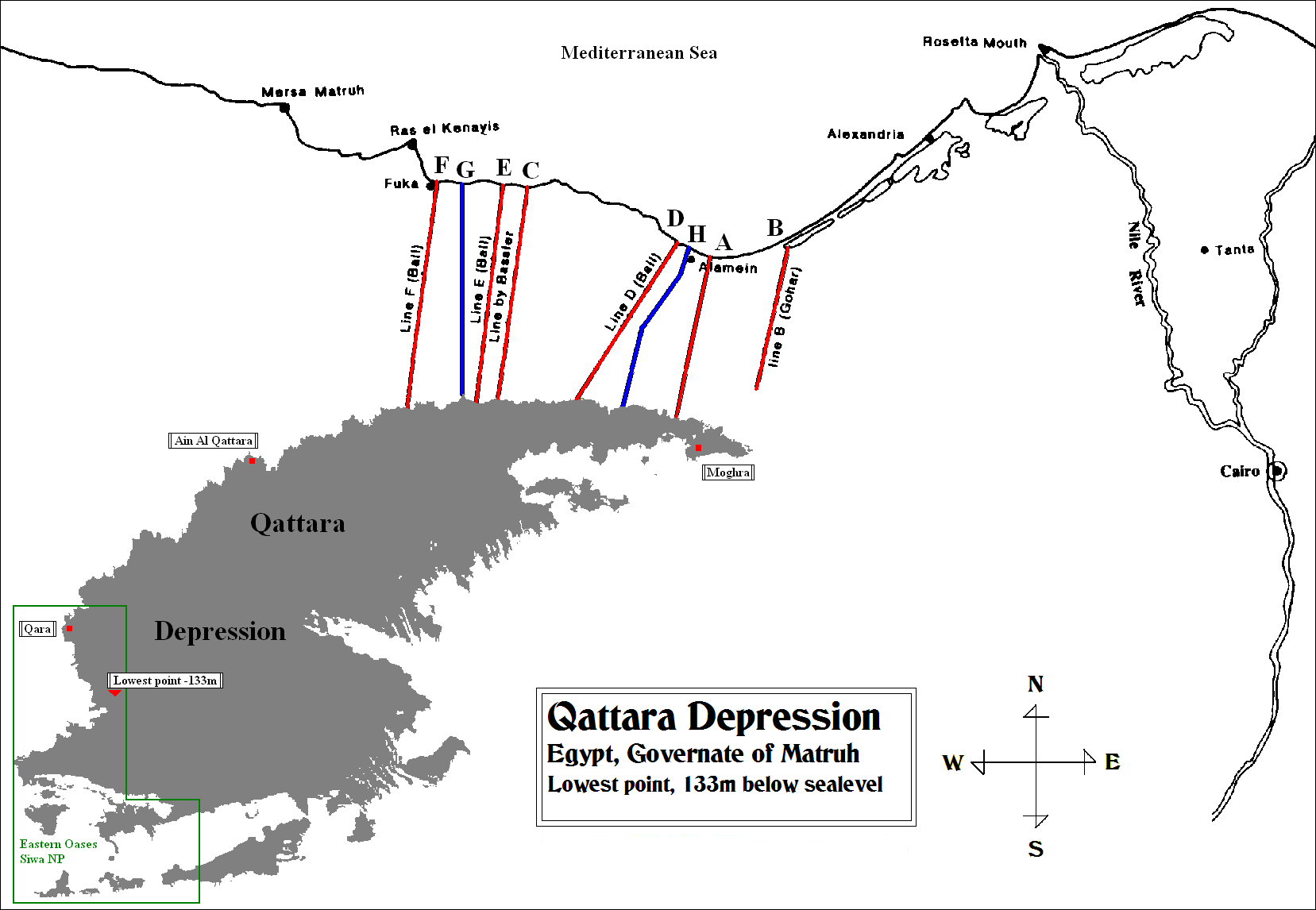
I quote from the source of this map:
The Qattara Depression, in Egypt, is a swathe of land about the size of Lake Ontario that sits near the Mediterranean Sea, at an average depth of 200 meters below sea level. The Qattara Project was the brain child of a German hydrolic engineer named Friedrich Bassler who proposed digging a canal from the Mediterranean to flood the area. After about ten years, the water inside the depression would reach sea level. But the desert climate in the area would cause it to evaporate relatively rapidly, leading to a further influx of seawater. This ongoing flow was to be used to generate hydroelectricity. At the same time, the new, massive saline lake could transform a largely uninhabited desert area into a series of viable fishing communities. The part of the project where you dig a massive canal never penciled out as remotely cost-effective, but for some time the CIA maintained an interest in the project as part of its Cold War efforts to pull Egypt out of the Soviet orbit.There used to be proposals to use nuclear energy to dig huge canals. I wonder if such an approach would be feasible. Would such an approach change the economics of the project? As energy becomes more expensive in the future, will this project become economically feasible?
How about if desalinization of water becomes less expensive? Would provision of potable water in the desert make the project more attractive?
Would the project help ameliorate sea level rise due to global warming? If so, would those benefiting from the savings be willing to help pay for the project?
This is an old "engineers dream"!
Monday, October 13, 2014
The world is complicated!
When you change one thing, others change in response. You may not realize what the overall impact of your action will be.
When they killed off the wolves of Yellowstone, they did not realize that they were changing the ecology of the National Park -- something that the nation had decided must not be changed. Fortunately, restoring wolves to the park is helping to restore the ecology.
Friday, September 26, 2014
This should be clear enough for almost everyone
Here is the source with information on the license.
The evidence is that global warming is taking place. The processes are complex, but the scientific consensus is that global warming is taking place so fast that there will be serious consequences within 100 years. It seems clear that the cause is the release of greenhouse gases by human activity.
Tuesday, September 23, 2014
The Daily Show helps John Holdren Show Up Congressional Know Nothings
After about a minute, this video gets to Congressional questioning of Presidential Science Advisor John Holdren. Three members of the House of Representatives Committee on Science, Space and Technology show their opposition to the scientific consensus that human activity is putting greenhouse gases into the atmosphere that result in global warming. Dr. Holdren shows how poorly those Congressmen understand their own arguments. Jon Stewart makes it all look funny.
It is not funny. Sea level will rise over future decades because glaciers and ice packs are melting, and because even water expands when it is heated. The oceans contain a huge amount of water, and heating it only a few degrees will increase the volume of the oceans enough to raise their surface area perceptibly. That will be bad news for coastal zones, especially when storms and hurricanes hit. That in turn will be bad news for people all over the world.
Climate change is likely to require farmers to change how they farm and foresters to respond to new threats to their forests. Global warming may expand deserts. It will threaten many species as the biospheres on which they depend are threatened.
We depend on the people who make our laws and ratify our treaties to do the right thing. If they don't have the knowledge to do so, we are in big trouble. On climate change, the scientific consensus is clear. If the legislators don't understand the science, they should be guided by scientists who do understand the evidence and who can guide the legislators. This will not happen if we elect legislators who are unaware of their own ignorance and/or are too pig headed to listen to those who know better.
Saturday, August 23, 2014
More on global warming
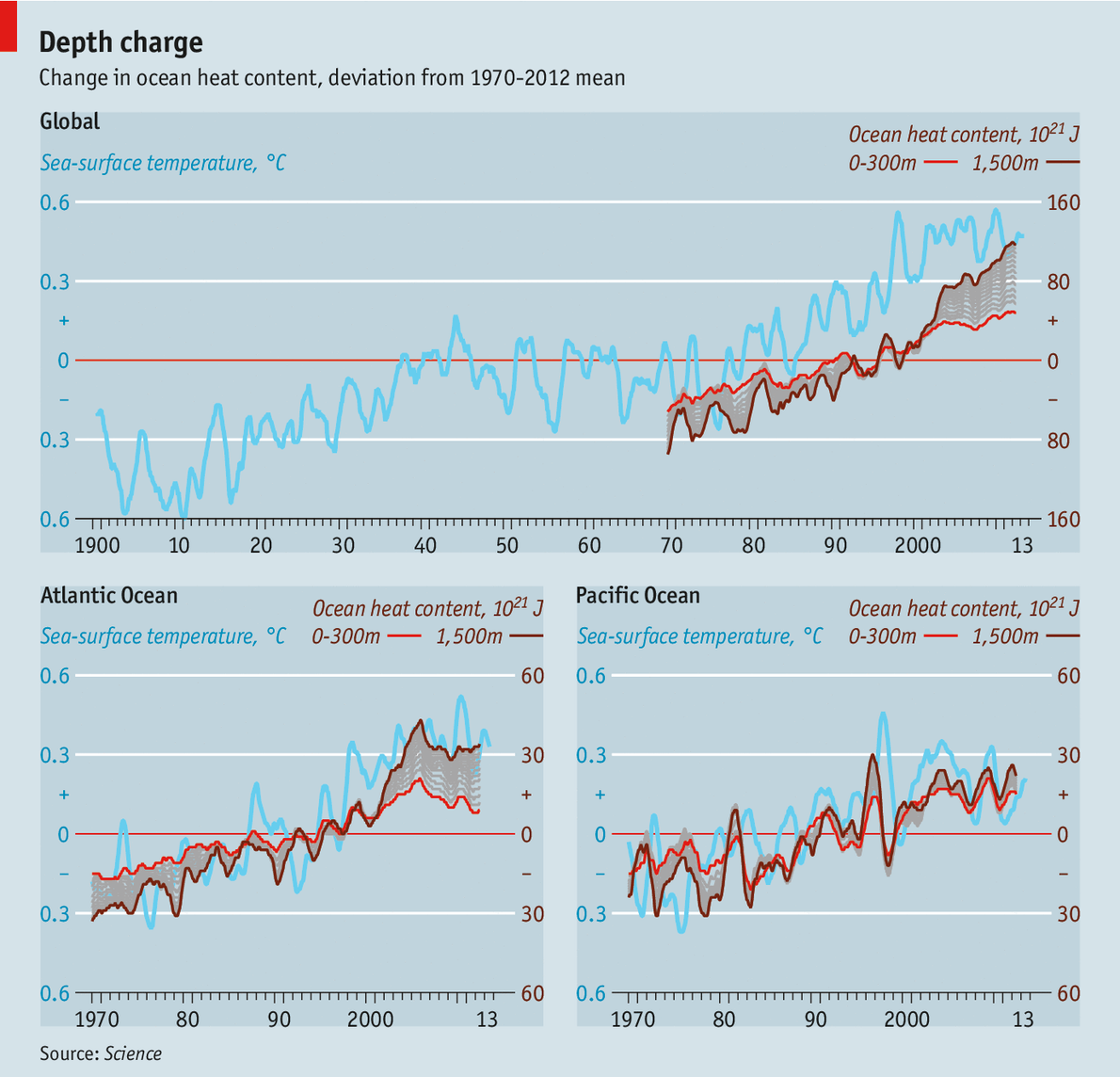
The current issue of The Economist has an article summarizing new research results. The research indicates that global average deep sea temperatures have been rising even more rapidly in this century than they had been since 1970. This would seem to explain the pause in the increase in global average air temperature. Clearly it takes a lot of energy to raise the temperature of a layer of the world/s oceans. The graphs above show the global average, and also that the Atlantic Ocean seems to have had a more rapid increase for several years starting in 2000.
Thursday, July 31, 2014

Wednesday, April 16, 2014
Funding for Global Public Goods versus Development Assistance/Poverty Aleviation
Helmut Reisen, an economist I am learning to value greatly, has an interesting post on his blog today.
He asks why the World Bank and others seem so cocksure that extreme poverty can be ended by 2030. I take their promise to be fluff intended to con donors into continued or increased funding to fight poverty. I fear that extreme poverty will still be with us in 2030, and that a lot of poverty that the World Bank defines as not to be extreme is very serious indeed.
He notes that a lot of funding categorized as development assistance is actually funding for "global public goods". Much of that funding would go for prevention of climate change and other environmental deterioration. I would note that some of the efforts to fight communicable diseases (such as the eradication of polio) might also be included as a global public good -- the benefits of eliminating the polio in the last few countries in which it is currently found will be enjoyed worldwide.
There would seem to be no argument against the countries with the most money spending some of that money globally to "buy" global public goods. We regularly use progressive taxes to pay for public goods.
Reisen would seem to be concerned that such funding is being labeled "development assistance" when it is actually intended for another purpose. I see that point. Still, developing countries too will benefit from those global public goods, and in many cases their people are more vulnerable to the deterioration of those goods.
Of course, in some cases we can have our cake and eat it too. Thus, for example, investment in energy efficiency can be a cost effective investment even without including the external benefits of reduced greenhouse gas emissions. So too, the investment in hydropower rather than fossil fuel generation plants may produce lower cost electricity as well as prevent greenhouse gas emissions.
I am afraid that I believe that the world will not do the right thing and reduce greenhouse gas emissions as much as we could or should. Indeed, I believe we will see deforestation, desertification, loss of top soil, destruction of coastal zones, depletion of water resources, air and water pollution, and other environmental destruction that we could and should have prevented. Investments now to help poor people in poor countries to prepare to deal with this onslaught will help avert future poverty and thus be perhaps a legitimate form of development assistance.
Is there an argument that donor nations can provide more money for poverty reduction and global public goods by deliberately mislabeling some of the global public goods funds as development assistance? In the USA, the climate deniers might have more sympathy for international expenditures labeled "development assistance" than for those labeled "climate change prevention and amelioration".
As an aside, it seems to me that "poverty alleviation" is one aspect of "development assistance", but only one aspect. Social and economic development would seem to me to be best seen as "a tide that lifts all boats". Thus I see development as involving capital accumulation, which seems always to result in the rich getting richer, the middle class getting "better off", with relatively little of the capital being accumulated by the poor. I also see general development of poor countries involving their increased competitiveness in global markets, and increased competition from the recipients (current or former) of foreign aid has not been popular with U.S. producers.
Let me end by quoting an especially useful part of the posting:
Assessing vulnerability which is independent of present policy is needed both to identify the most vulnerable poor countries and to design criteria for the allocation of international resources. Two kinds of vulnerability and the corresponding indices can be considered:
- Structural economic vulnerability (as measured by the UN Economic Vulnerability Index, EVI), the UN index thought to replace the non-transparent performance index CPIA. EVI is a composite consisting of 50% ´exposure´ (size, location, agricultural share) and 50% shock intensity (both natural and trade)[1].
- Physical Vulnerability to Climate Change Index (PVCCI), an indicator developed by Patrick Guillaumont (2013)[2] at the Fondation pour les Études et Recherches sur le Développement International (FERDI). PVCCI consists of 50% ´risks related to progressive shocks´ (flooding due to sea level rise; increasing aridity) and 50& ´risks related to the intensification of recurrent shocks´ (rainfall; temperature)[3].
1. A detailed presentation of EVI can be found in Patrick Guillaumont (2011), The concept of structural economic vulnerability and its relevance for the identification of the Least Developed Countries and other purposes (Nature, measurement, and evolution), UN-DESA, CDP Background Paper No. 12, ST/ESA/2011/CDP/12 ,September.
2. Patrick Guillaumont (2013), “Measuring Structural Vulnerability to Allocate Development Assistance and Adaptation Resources”, FERDI Working Paper No. 68, Ferdi: Clermont-Ferrand, March.
3. For detail, see P. Guillaumont and C. Simonet (2011), “Designing an Index of Structural Vulnerability to Climate Change”, FERDI Working Paper I.08, March.
Tuesday, April 15, 2014

Monday, April 07, 2014
From the Union of Concerned Scientists

CNN, Fox News, and MSNBC are the most widely watched cable news networks in the U.S. Their coverage of climate change is an influential source of information for the public and policy makers alike, but their accuracy varies significantly. All of them can take steps to improve their coverage of climate science: http://ucsusa.org/The Union of Concerned Scientists -- formed after the development of the Atom Bomb and gained fame as the publisher of the Bulletin of Atomic Scientists -- is a distinguished scientific organization. One of my former colleagues is there. They are likely to be very good in judging the quality of information provided by the news networks.scienceorspin
Saturday, March 01, 2014
How Wolves Change Rivers
The reintroduction of wolves to Yellowstone has helped to restore the Yellowstone ecosystem towards its natural state, as the video shows. However, the wolves are under continuous threats due to political pressures against the protection of wolves. Apparently the politics in Wyoming and Montana are especially opposed to federal government efforts to protect national parks and especially sensitive to the fears of people owning sheep and cattle.
Wednesday, February 26, 2014
The Oceans Are in Trouble. Is Congress Part of the Problem?
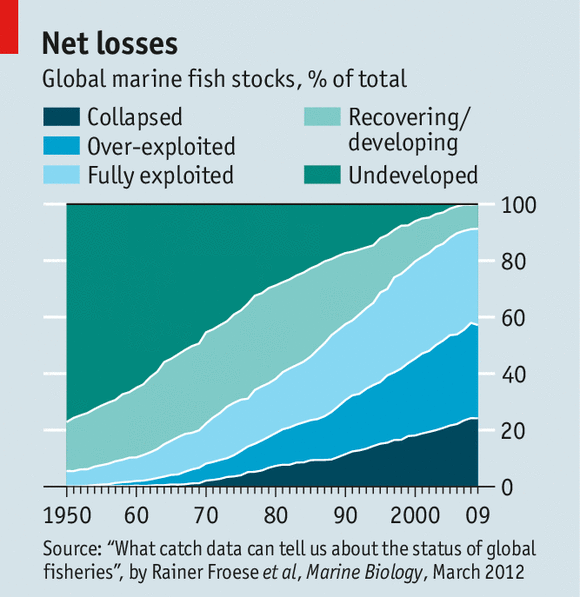
The oceans are vitally important to mankind. The oceanic environment is deteriorating, and international cooperation is vital to its protection. UNESCO could facilitate some of that cooperation, but the U.S. Congress has blocked U.S. funding for UNESCO. The Senate has more than a dozen treaties awaiting ratification, some submitted more than 30 years ago.
ABOUT 3 billion people live within 100 miles (160km) of the sea, a number that could double in the next decade as humans flock to coastal cities like gulls. The oceans produce $3 trillion of goods and services each year and untold value for the Earth’s ecology. Life could not exist without these vast water reserves—and, if anything, they are becoming even more important to humans than before.This article in The Economist indicates that the oceans are deteriorating because we haven't managed to develop common property institutions that work to protect them. Fisheries are being over exploited. Large areas are oxygen depleted and dead. Coral reefs are in trouble. Acidification of ocean waters is occurring and likely to become dangerous. Further treats are in view from off shore drilling and deep sea mining. Climate change may threaten the ocean currents, with profound consequences.
The Economist
UNESCO is the international agency leading in ocean science, and it hosts the Intergovernmental Oceanographic Commission. Its World Heritage Center implements the World Heritage Convention; it has declared Papahānaumokuākea, an oceanic World Heritage site, accepting the U.S. plan for its protection and conservation of its resources. The United States has not paid its assessed contributions to UNESCO for more than two years, and is banned by the Congress from any funding for the Organization.
The following international treaties relating to ocean protection have been submitted to Congress, but never ratified:
- Vienna Convention on the Law of Treaties, done at Vienna May 23, 1969, and signed by the United States on April 24, 1970; submitted to Senate November 22, 1971.
- Maritime Boundary Agreement between the United States of America and the Republic of Cuba, signed at Washington December 16, 1977; submitted to Senate January 19, 1979.
- Amendment to the 1973 Convention on International Trade in Endangered Species of Wild Fauna and Flora (CITES), done at Gaborone April 30, 1983; submitted to Senate October 4, 1983.
- Convention on Biological Diversity, done at Rio de Janeiro June 5, 1992, and signed by the United States at New York on June 4, 1993; submitted to Senate November 20, 1993.
- United Nations Convention on the Law of the Sea, done at Montego Bay December 10, 1982 (the “Convention”) and Agreement relating to Implementation of Part XI of the Convention, done at New York July 28, 1994 (the “Agreement”); Agreement signed by the United States on July 29, 1994; submitted to Senate October 7, 1994.
- Stockholm Convention on Persistent Organic Pollutants, done at Stockholm May 22, 2001, and signed by the United States on May 23, 2001; submitted to Senate May 7, 2002.
- 1996 Protocol to the Convention on the Prevention of Marine Pollution by Dumping of Wastes and Other Matter, 1972, done at London November 7, 1996, and signed by the United States March 31, 1998; submitted to Senate September 4, 2007.
- Agreement on the Conservation of Albatrosses and Petrels, with annexes, done at Canberra June 19, 2001; submitted to Senate September 26, 2008.
- Annex VI on Liability Arising From Environmental Emergencies to the Protocol on Environmental Protection to the Antarctic Treaty (Annex VI), adopted on June 14, 2005; submitted to Senate April 2, 2009.
- Agreement on Port State Measures to Prevent, Deter and Eliminate Illegal, Unreported and Unregulated Fishing, done in Rome November 22, 2009 and signed that day on behalf of the United States; submitted to Senate November 14, 2011.
- Convention on the Conservation and Management of High Seas Fishery Resources in the South Pacific Ocean, done at Auckland, New Zealand November 14, 2009 and signed on behalf of the United States on January 31, 2011; submitted to Senate April 22, 2013.
- Convention on the Conservation and Management of High Seas Fisheries Resources in the North Pacific Ocean, concluded in Tokyo on February 24, 2012 and signed on behalf of the United States on May 2, 2012; submitted to Senate April 22, 2013.
- Amendment to the Convention on Future Multilateral Cooperation in the Northwest Atlantic Fisheries, adopted in Lisbon, Portugal September 28, 2007; submitted to Senate April 22, 2013.
The Environment -- Knowing the Cost but not the Value
The Economist has a tutorial on economic measurement of "ecosystem services". It identifies four approaches:
- If the service has an output, then it is sometimes possible to value the environmental input. Thus an estimate of the value of bees has been made based on the value of the crops that they pollinate.
- "(I)f market prices are affected by nature, a value can be derived from them. Thus an apartment in New York with a view of Central Park is worth considerably more than one without such a view."
- "(P)eople’s behaviour—for instance the costs that they are prepared to bear to visit a national park—reveals the value that they place on unpriced goods."
- "(P)eople can be asked whether and how much they prize aspects of nature." This method applies primarily to non-use value.
Perhaps there is another way. Think about the smog that now makes life miserable in Chinese cities. In some way, it may be compared to the air pollution that once afflicted London. London cleaned up its air, and then cleaned up the buildings that its air pollution had soiled. It was willing to pay the costs of substituting other fuels for coal and cleaning those buildings. That cost, updated to current conditions, might be an estimate of the value of clean air in a city (of a given population size). Other major efforts to clean up air and water (reduction of smog in Los Angeles, the U.S. Clean Air and Clean Water programs, etc.) might suggest values people attach to environmental quality.
The article goes on to state:
Some of the numbers derived from these methods are distinctly dodgy, but conservationists argue, fairly reasonably, that it is better to have mediocre estimates than none at all. They lend force to environmentalists’ arguments and can usefully be fed into cost-benefit analyses. Governments thinking of planting forests or creating nature reserves, for instance, can put sensible numbers on the value people attribute to them, and thus work out whether the land in question would be better used for agricultural or recreational purposes.I am not sure that mediocre estimates are always better than none, especially if they will be misused. A decision to forego an environmental service because a government is unwilling to pay the preservation cost might be taken to suggest -- inappropriately -- that the value of the service is less than the cost would have been to protect it. It may simply be that the government was short sighted, or that it failed to find means to mobilize financial mechanisms to capture the needed portion of the value.
I think of "natural resources". How much are oil and gas fields worth before they have been located? How much were the fields now being exploited by fracking worth before the fracking technology was developed to exploit them, and the costs of alternative sources became high enough to justify the development and application of the new technology? How much were the off shore or the deep water oil reserves worth before they were located, before the technology was developed for their exploitation, and before alternative, lower cost sources were running out? The point is that something becomes a resource only when the technology exists to find it and it is found, and when the technology exists to exploit it.
So how many "natural resources" are to be found in biodiversity and other aspects of nature about which we know little or nothing now. Assuming that there is no value because we have not yet developed the technology to create value seems a serious mistake.
How about other approaches.
Rights
What if we were to say that great apes and other primates have a right to exist as species? Rights "trump" cost-benefit analysis. We do now take a rights based position on the treatment of animals used in research. They have to be housed, fed and treated humanely, even if it costs a lot to do so. Indeed, it appears that chimpanzees are no longer to be used in medical research because they have suffered too much in the past from such use, and because the species is in some danger as a species.
Perhaps rhinos, elephants, whales, bison, wolves and other species have similar rights to exist. Indeed, perhaps they have rights to exist in nature, and not merely in zoos or gene banks.
Duty
The World Heritage Convention implies that countries have a duty to protect things because they are of such cultural or natural value that they must be preserved for future generations. It would I suppose be possible to value Yellowstone and Yosemite by what the government could get selling them off as real estate -- that would be at least a lower bound on the actual monetary value. But would it not be better to simply say that we have a duty to future generations to keep these wonders pristine?
Subscribe to:
Posts (Atom)