Showing posts with label psychology. Show all posts

Monday, October 12, 2015

What Some People Can Do With Their Minds' Eyes, Ears, et cetera


Seeing

Oliver Sacks, in his book The Mind's Eye, describes coming home as a child with a model of the skeleton of a small animal. His mother, a surgeon and scientific illustrator, took the model and peered at it for quite a while. She then gave it back to him and got our her drawing paper and instruments. She produced a fine drawing of the model. She then thought for a bit, took another piece of drawing paper and made another drawing of the model. this time rotated 30 degrees. She did this again and again until she had made another drawing of the model in the same position as the first drawing. She then compared the two drawing to prove that they were identical.

Neither Oliver Sacks nor I could really understand what she did nor how she did it. Neither of us has a Mind's Eye; neither of us thinks in pictures. We are among a small minority of men who have a condition called aphantasia. However, I suspect that few people have developed such a capacity manipulate visual images, and thus most people would be amazed at Sacks' mother's performance.

Sculptors

I knew a wood carver in Colombia named Juan de la Cruz Saavedra. He was a simple man. He had begun adult life cutting cane -- a really hard job. He made an occasional wood carving at that time in his live. and someone who saw hes collection told him he could go into the city where people would buy such things. So he tried, and was amazed to find that it was true, and that people bought his wood carvings. He was even more amazed when a gun named Pablo Picasso saw some of his carvings and arranged for a gallery in Paris to exhibit and sell them.

In chatting with Juan I discovered that he saw the figure he wanted to make in piece of wood. and would cut away the excess to make the figure visible to others.

One day I learned that he had begun reading the bible and was really taken by the bible stories. I asked if he would like to make a carving of one of those stories, and he said he would like to make a carving of The Apocalypse. I said I would buy it if he would do it.  He went out to the mountains and found an amazing complex aerial root system, then carved it to show a dozen or so figures. When he delivered the piece, he asked if I could see the figures adequately, or if he should remove more wood to make them appear more clearly.


I gather that Michelangelo chose a block of marble that he could see contained the sculpture he wanted to produce and he then removed the excess marble. That was perhaps not so simple. I am told that David's feet are bigger than would be expected on a real man. That was necessary to have enough marble at the base of the statue to sustain the weight of the huge statue. So the sculptor perhaps also understood that he must engineer a structure that would stand up to its own weight -- perhaps not surprising as he was also the architect who completed St. Peter's Basilica.

Painters

I once chatted with a "naive street artist" in Bogota and he told me how he made his paintings. He would choose a canvas board and place it on his easel. He would then look at the board until he saw a complete painting. If he liked it, he would apply paint to the board (apparently as one might paint by the numbers). If he did not like the image, he would have to put the canvas board out of sight for some time; if he saw it too soon, he would still see the rejected painting on it. After a few weeks, however, it would again be blank, and he could imagine a new painting on that canvas board and decide if he wanted to paint it.
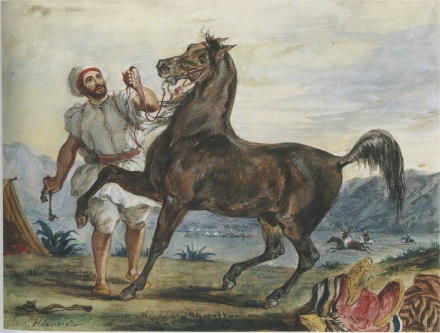


I recall reading about an instance in which the painter Eugene Delacroix left other painters scratching their heads. It seems that there was a competition, but the rules states that each painter had to make his painting in the gallery in which they were to be shown. The gallery was to be open to the painters for three days, and each painter was to complete his painting from start to finish in that time.

Delacroix apparently showed up an hour or two later than the other painters. He painted a horse and rider. Without any preliminaries, he began painting a hoof of the horse. Having completed a finished hoof, he continued up the leg. He continued painting, simply moving on the an adjacent area when he had finished one; he never returned to modify an area once painted. After several hours, he had completed the painting, which was correct both in its placement within the frame and in every detail of the image. He then left the gallery and the other painters, all of whom were still in the earliest stages of their work. One can only guess that he had a complete view of the painting in his mind's eye, and simply copied the mind's eye view on the canvas.

The story above may be apocryphal, but Delacroix has been quoted as telling an assistant to draw sketches every day because "when it came to painting, it was necessary to depict without difficulty what one saw in the mind's eye, and a quickness of hand, which could not be obtained without these exercises, was essential."

Hearing

When I was a teenager, when I was about to go to sleep, I would entertain myself playing orchestral music in my mind's ear. I only remember doing so when I was in that drowsy state that just precedes sleep. I was not replaying music I had actually heard when awake, but making up the music in may head as I went along.

These days I hear a voice, lets say my alter ego, in my minds ear -- it is my normal way of conscious thinking. As I sit as the keyboard typing this, I hear the words in my minds ear, and they appear on the screen (sometimes with typos), usually without conscious awareness of the choices being made as my fingers touch the (usually) appropriate keys.

My son, who is a professional writer of computer games, tells me that when he is writing a scene between two characters, he hears two distinct voices in his mind's ear, each with its regional accent and distinctive way of speaking.

I remember chatting with a friend who was a composer. He mentioned that in reading a score while listening to a performance of music, he would occasionally think to himself, "so that is how you score that sound".

I read someplace that Mozart was unique among musicians in that he held an entire piece of music in his mind, from start to finish. Apparently, musicians tend to follow music instant by instant as it is performed or heard, but not Mozart. Here is a quote from Wikipedia on Mozart's musical imagination:
Mozart wrote everything with a facility and rapidity, which perhaps at first sight could appear as carelessness or haste; and while writing he never came to the klavier. His imagination presented the whole work, when it came to him, clearly and vividly. …. In the quiet repose of the night, when no obstacle hindered his soul, the power of his imagination became incandescent with the most animated activity, and unfolded all the wealth of tone which nature had placed in his spirit …. Only the person who heard Mozart at such times knows the depth and the whole range of his musical genius: free and independent of all concern his spirit could soar in daring flight to the highest regions of art.
Beethoven went deaf years before he died, stopped preforming music in public, but continued to write music. One wonders how he knew what the music he was writing in his later years actually sounded. Perhaps he could play it in his mind's ear?

Taste and Smell

I recently heard an interview with a pastry chef. He was asked how he began to learn his trade, and he answered that he learned first from his mother. He said that even now if he closed his eyes he could taste his mother's madeleines. We know that a taste is produced by the sense cells in the mouth and those in the nasal cavity as air from the mouth is transferred to the nasal cavity. It is the brain that integrates the messages from the two sets of sensory receptors. I wonder if an MRI for that baker would show the areas of the brain involved in smell functioning when he closes his eyes and imagines his mother's cookies. Does he have a mind's taister?

My wife tells me she too can taste again things her mother used to cook in her mind's taster. My son recounts an especially disgusting taste he experienced as a boy when he took an evil tasting medicine with chocolate chip cookies; thinking of the mess, he again tastes it in his mind's taster. 

I like a French TV series titled Blood on the Vine. The principals in the show are oenologists who can identify wines by taste, who write about wines, and who consult about problems what wineries are having producing fine wines. It would seem that such experts can recall in detail the flavor of a wine that they have tasted, and can describe its taste components. Do they have an ability to replay material stored in the brain on demand, producing a conscious mind's taister? Or do they simply have the ability to taste the components of a wine's flavor, the vocabulary to describe those components, and good memories for the list of descriptors?

Touch

The sense of touch is apparently one of the earliest senses to be active in a baby. It not only allows one to tell if a surface is smooth or rough, hot or cold, but also carries a great deal of emotional weight and information.  According to Wikipedia:
Haptic memory represents SM (sensory memory) for the tactile sense of touch. Sensory receptors all over the body detect sensations such as pressure, itching, and pain. Information from receptors travel through afferent neurons in the spinal cord to the postcentral gyrus of the parietal lobe in the brain. This pathway comprises the somatosensory system. Evidence for haptic memory has only recently been identified resulting in a small body of research regarding its role, capacity, and duration. Already however, fMRI studies have revealed that specific neurons in the prefrontal cortex are involved in both SM, and motor preparation which provides a crucial link to haptic memory and its role in motor responses.
Thus there would seem to be the systems in the brain that would allow the conscious mind to recreate a virtual representation of the body and how touching would feel. The mind's mirror might make it possible to create a virtual representation of how another would feel stimulation of the body. Do masseurs use such a representation to plan a massage? Do torturers use such a representation to plan a course of torture? Do lovers use such a representation to plan how to please their partners? I have no idea, but it would seem possible to discover such action if it exists by research.

Proprioception and Sense of Space

In high school I was on the rifle team. In a match, each marksman fired 20 rounds from a 22 rifle at a target 50 feet away. Five rounds were fired from each of the prone, sitting, kneeling and standing positions. In the prone position, a firm structure of bones supported the rifle and muscles were hardly used. Once in position, the main concern was controlling breathing, controlling heart beat, getting the sights of the rifle on target, and letting off a round at the exact moment when the sights were perfectly lined up. In each of the succeeding positions, the bone support was less stable, and muscles came more into play. A good high school marksman would score a perfect 50 points in the prone position, hitting a .22 in circle with each of the five shots; sitting scores might be 49, kneeling in the low 40s and standing in the 30s. By my senior year our team won the city championship and I was chosen for the Los Angeles city rifle team.

Of course, a lot of practice on the team was actually on the rifle range, shooting at targets. A coach would be present to make suggestions if he thought them warranted. At home, I normally would do homework sitting on the floor in the "sitting position" so that it became unstrained and comfortable. I would however, regularly rehearse match firing in bed before going to sleep, recreating the situation in my mind but not physically. Could one call this a "mind's body"?

I ask myself if high level athletes in certain competitive sports make mental models and mentally compare their performance with those proprioceptive mental models.
  • Tiger Woods occasionally changes his golf swing. Does he create a mental model of the sensory input from his muscles and bones that would occur when he executes the new swing perfectly, and would he plan out how to change the swing in order to more nearly achieve the model?
  • Greg Louganis is an American Olympic diver who won gold medals at the 1984 and 1988 Olympic Games on both the springboard and platform. Did he create a mental model of sensory input from his muscles and bones that would occur with perfection in each of the dives he mastered?
  • Does an Olympic champion gymnast create such a model for each exercise in his/her routine?
I don't know, but I think it possible. Here is what one reference says on the topic:
Mental imagery, often referred to as visualization, is when an individual imagines him or herself performing in the absence of physical practice.  When visualizing, an individual utilizes all of his or her senses in order to recreate an event. In the particular event, the individual should imagine performing to the best of their abilities.   Many other athletes have begun incorporating mental imagery into their training regimens and claim that it has lifted their games to new levels. 
Apparently women tend to give directions using landmarks while men give directions using north, south, east and west, and estimates of distances. (A half hour driving at 30 miles an hour is equal to 15 miles). And apparently, these tendencies are coded in our genes due to different evolutionary factors that influenced the natural selection of women and of men. Researchers seem now to be discovering how spacial information is encoded in the brain.

My son tells me that he keeps his bedroom pitch black at night. He understands its space well, and can move around in the dark, reaching up at the right time and in the right place to touch the bed-side table lamp if he wishes, or sitting not only where he knows the bed to be in the dark, but at the right place on the bed that his head will just hit the pillow when he lies down. He is able to map his movements exactly to the mental map he has of the room.

I can take a virtual tour of my house. In each room I know were each piece of furniture is located, where each window sits in the wall (and its approximate dimensions). On such a virtual tour, I can stand in my mind at any point in any room, and virtually point to each piece of furniture. (I feel a virtual representation of my hand and arm moving to do the pointing.) Thus I suppose that my son and I each have virtual maps in our minds, which we can call up, but which are not imaged in the mind's eye.

My Friend's Orthopedic Surgeon

A friend recently had an orthopedic surgeon repair what she termed her frankenankle. Thinking about the mental activity of the surgeon, he had to visualize the problem, using the original x-rays. He then had to visualize the solution, involving a rod to reinforce the bone and stabilize it and related structures. Note that he had not only to designate a rod strong enough to do the job, but also connectors that would hold the rod in place when subjected to his patient's weight. He also had to choose the supports to tie the rod firmly to the bone, and the other devices shown as plates in the diagram. 

He then had to plan the surgical intervention to install the things he had thought up. This meant making incisions in a swollen ankle and then placing the rod and screwing in the supporting screws to the bone. No doubt
experience helped, and I assume that he learned his craft from surgeons
who had  gone before. Still this seems like a mental task that would challenge the ability of Oliver Sack's mother (see top paragraph above) and I would bet that the surgeon not only had a mind's eye, but one that would support considerable structural engineering imagination.

Final Comment

The term "mind's eye" seems to be in common use. Perhaps the brain also has the ability to recreate other sensations, as in a mind's ear, a mind's nose. a mental map, a mind's taster, and a mind's structural engineer. I have aphantasia, and have essentially no access to my mind's eye (except when drowsy or asleep and dreaming). I assume that others differ in their conscious abilities to access and use other mental representations of forms of information that they have obtained via their sensory systems. There seem to be many specific medical terms for loss of abilities to use certain senses -- forms of agnosia. Perhaps we need a comparable vocabulary to deal with abilities to think using recreations of different forms of sensory experience.

Monday, October 22, 2012

Teleological Thinking May Be Hard Wired in Our Brains.


Chris Mooney, one of my favorite science writers, provides a summary of a new research result in an article in Psychology Today. He writes about an experiment in which four groups of subjects were asked to judge false statements of the form:
"Trees produce oxygen so that animals can breathe," and "Germs mutate in order to become drug resistant."
Endorsing such a statement implies that the person making the judgement is assuming conscious purpose where no such purpose exists. Clearly trees are not producing oxigen with the intent of helping animals to breath, nor are germs deliberating and deciding to mutate for a purpose of their progeny surviving antibiotic use by their hosts. The fallacy here is assuming teleology -- assuming design and purpose analogous to that found in human actions -- in non-reasoning entities.

All four groups sometimes responded indicated the false assumption of teleology. People trained in science and the humanities made fewer teleological assumptions than did college undergraduates (College in the graph above) or college graduates without post graduate degrees (Community). The interpretation is that the advanced training enables those with graduate degrees to make better decisions about intentionality.

When required to respond quickly the probability of erroneous answers increased in all groups. The interpretation is that the brain's initial response to such suggestions is to assume intentionality, but that people who have learned to avoid that assumption can with time make more rational judgments. Lacking time, they are more likely to produce the teleological response.

This is of course a warning to us all not to assume too much. I myself tend to conclude that when things go wrong, the problem is more often one of incompetence or bad luck, rather than malice. This is still another example that we often think with our brain, not necessarily with our conscious (rational) mind.

Tuesday, June 12, 2012

Honesty is the best practice for remaining honest


I quote from an article in The Economist:

A new book by Dan Ariely, “The (Honest) Truth about Dishonesty”, may reinvigorate the discussion. Mr Ariely is a social psychologist who has spent years studying cheating. He also teaches at Duke University’s Fuqua School of Business. He has no time for the usual, lazy assumptions. He contends that the vast majority of people are prone to cheating. He also thinks they are more willing to cheat on other people’s behalf than their own. People routinely struggle with two opposing emotions. They view themselves as honourable. But they also want to enjoy the benefits of a little cheating, especially if it reinforces their belief that they are a bit more intelligent or popular than they really are. They reconcile these two emotions by fudging—adding a few points to a self-administered IQ test, for example, or forgetting to put a few coins in an honesty box. 
The amount of fudging that goes on depends on the circumstances. People are more likely to lie or cheat if others are lying or cheating, or if a member of another social group (such as a student wearing a sweatshirt from a rival university) visibly flouts the rules. They are more likely to lie and cheat if they are in a foreign country rather than at home. Or if they are using digital rather than real money. Or even if they are knowingly wearing fake rather than real Gucci sunglasses. They are more likely to lie and cheat if they have been stiffed by the victim of their misbehaviour—companies that keep customers in voicemail hell are frequent victims. And people are more likely to break their own rules if they have spent the day resisting temptation: dieters often slip after a day of self-denial, for example.
I am not sure that deciding that a treat at the end of a day of dieting would be "dishonest", but I take the point.

I would suggest further that lying and cheating are a slippery slope. The more you do it, the easier it is to do it again. Strict probity has the advantage of helping one to remain honest.

Sunday, May 13, 2012

Emergence may not be enough


Teleonomic processes that have emerged and evolved in our institutions frequently seem to have worked to the benefit of society, but not always. Can we afford to depend on them continuing to work for our species which is increasingly capable of doing harm to itself and our environment?


Fifty years ago I was working in the early days of computer neural network modeling, using simple methods train model networks to recognize patterns. We used both selection and adaptation in the process, and built a device (the Astropower Decision Filter) that illustrated the potential of the approach. The ADF got a fair amount of publicity.

That work was an early example of what has come to be known as "emergence":
the way complex systems and patterns arise out of a multiplicity of relatively simple interactions.
It has influenced my thinking in many ways over the decades.

Source
In a recent post, I suggested that one could regard the Civil War as a pattern emerging out of the interplay of millions of peoples behavior in the charged atmosphere of the 1850s and early 1860s, directed through the political institutions of the time and contingent upon "external" events that occurred during that time. I suspect that many wars can be so regarded -- with horrible results predicted by few if any of their proponents. After a losing war, I would bet that most people on the side most responsible for its start would regret their actions, and perhaps even those on the winning side would also wish they had worked harder to find a better solution.

In like manner, I suggest that one can regard economic bubbles and crashes as patterns emerging out of the interplay of millions of people's economic behavior in specific emotional atmospheres, directed thought economic institutions and contingent upon external events. Social crises such as the rise of drug abuse and criminal networks similarly can be regarded as emerging from the actions of people (unaware of the full implications of their behavior) under the influence of social institutions and contingent on events.

The political, economic and social institutions mentioned above themselves emerge from interactions of people within society. They also evolve, once in existence, and evolution is a process of emergence. In these cases, the development of institutions can perhaps best be perceived as the result of both teleologic and teleonomic processes -- of planning and of unplanned processes that produce orderly patterns.

At one point about 1970, in graduate school studying public administration, I got very interested in ideas that decision making in organizations was less than ideally rational. Important decisions in organizations are often made by small groups, based on incomplete information and understanding, and often by processes that are not optimal but rather dependent on the idiosyncrasies of the participants. Indeed, I came to believe that the behavior of large organizations is similarly the result of both teleologic and teleonomic processes. In our modern societies, formal organizations are also important institutions. Indeed, we now hear that some corporations are too large to fail, but very large organizations turn out to be difficult to manage and prone to failure.

As I have suggested in the past, we think with our brains, not with our "rational minds". Our plans and decisions are influenced by our emotions; our decision processes are less than the rationality too often postulated for "economic man". It is also becoming increasingly clear that the way we behave is strongly influenced by our genetic makeup. For example, there is now evidence that gene deletions and duplications on the seventh chromosome can produce changes in social cognition (increasing risk for the failed social instincts typical of autism in the one case, and the extreme social attention typical of Williams syndrome in the other). As Edward Wilson points out, we are a eusocial species, and our genetically determined fascination with groups and social interactions underlies both our institutions and our behavior within those institutions.

Some very good things have emerged from the modern world. Never in human history have so many people been so health, so wealthy, and so informed. Some very bad things also have emerged; wars in the 20th century killed many tens of millions of people. So did diseases, some of which were new such as the Spanish Flu or AIDS. The Great Depression led to the phrase, when the United States sneezes Chile catches pneumonia.

However, the paragraphs above suggest that somewhat rational humans, with genetically determined mental processes evolved by survival in very different environments, interacting in processes mediated by institutions we only partially understand, have made very bad mistakes in the past and have failed to meet very large challenges.

Society is not only getting bigger but is getting more connected. People living today can expect to live in a world with eight to ten billion people by 2050. Globalization is reflected in much closer economic links among nations. Technological and economic growth have resulted in a much greater "footprint" of mankind on the earth; indeed we now seem likely to produce unprecedented global environmental catastrophes. And above all, everything but man himself is changing with increasing rapidity.

While mankind hopes for development to reduce global poverty, reduce the global burden of disease, and decrease losses due to war and conflict, we have to worry about increasing the scale of dysfunctional emergence. Can we really depend on good things to emerge from a world we understand so poorly, or for catastrophic things not to emerge?

I don't have an answer, but it seems to me that it would be a good idea to have a really major global social science research program on how patterns emerge from societies and the dependence of those patterns on political, economic and social institutions, as well as how the institutions themselves emerge and evolve. We should also be risk adverse. Lets not let political processes lead us too close to war, economic processes lead us too close to crashes nor to risks of crashes to big to withstand.

Click on the emergence label to the right for more on this topic.

Source

Friday, September 30, 2011

Why people make bad decisions about rare events


 Daniel Kahnemann and Nassim Taleb discuss biases, the illusion of patterns as well es the perception of risk and denial

These guys are very good, and it is very surprising to me that they know each other well and talk all the time. The key points here are:

  • Rare events occur.
  • It is generally easier to model common events than rare events.
  • People have two predictive systems, an intuitive one and an analytic system.
  • People have limited rationality.
  • If you provide a simple model that works almost all of the time, and you don't have a model that predicts both the common and the rare events, then people will use the simple model.
  • The intuitive predictive system will tend to expect things to continue; thus you will intuitively feel that a simple model that has worked successfully many times in the past will continue to work.
  • (Apparently) your intuitive system feeling that the future will continue as the past will tend to overpower your analytic system which tells you that a rare event may occur.
  • If you build fragile systems, when the rare event does occur things will break.
This analysis explains why people live in beach communities subject to hurricanes, why Tokyo is built in a place where it may be destroyed by earthquake and typhoon, and why the financial system crashed in 2008.

Nobel Laureate Kahnemann made the point that it is wrong to assume that the firms are agents with independent will. The decisions made for firms are made by people in those firms. The incentives, risks and time frames of firm executives are not those of "the firm", its investors nor the general public. The financial meltdown was in part due to executives making decisions that paid off in terms of their own objectives and time frames but bankrupt their firms. Talib points out that the result was that a lot of these firms were capitalist while the simple predictions were paying off (and executives went home with big pay envelopes) but became socialist when the rare event of the financial crash occurred (and the state was asked to pay the costs).

While the context of this talk given two and a half years ago was the financial crisis, the deep structure applies to many situations. I very much like Talib's point that one should build structures and systems where possible so that rare events do not cause human catastrophes. Build earthquake resistant houses, hurricane resistant buildings, and bubble safe financial institutions.

The problem of course occurs in Haiti where day to day survival is so tough, where people are living in a continuing state of disaster, that you can't really expect them to move to places safe from earthquakes and tsunamis nor build safe houses rather than the shacks that they can barely afford.

Tuesday, August 30, 2011

Fundamental attribution error


Image source


The fundamental attribution error in decision making (also known as "correspondence bias" or "attribution effect") describes the tendency to over-value dispositional or personality-based explanations for the observed behaviors of others while under-valuing situational explanations for those behaviors. The fundamental attribution error is most visible when people explain the behavior of others. It does not explain interpretations of one's own behavior—where situational factors are often taken into consideration. This discrepancy is called the actor–observer bias.

Saturday, November 20, 2010

Older is not better, at least for thinking

My friend Julianne pointed me to this article in Scientific American which describes a study which found that older people are not more risk adverse than younger people, but they are less accurate in making decisions that avoid the probability of loss. A useful tip for those of us who are surely in the "older" category.

I note the more general statement from the article:
This hypothesis matches up with what psychologists know about cognitive aging. "There's a pretty straightforward story," says Scott Huettel, a cognitive neuroscientist who studies decision-making and aging at Duke University's Center for Cognitive Neuroscience. "More or less all of our cognitive abilities decline throughout the life span." A large body of research has shown that a wide variety of skills, including memory, analytical reasoning and processing speed, decrease as we age. The one thing that stays constant or even increases, Huettel says, is crystallized intelligence, a person's accrued knowledge about the world—in other words, experience.
I can provide first hand evidence that this is true. On the other hand, even us old guys can learn and become faster and more accurate on a specific task if we work at it.

Wednesday, September 08, 2010

A thought on experimental philosophy

The New York Times has an article today about an experimental approach to the study of philosophy. I quote a section describing an experiment:
Shaun Nichols and I (Joshua Knobe) thought that people might be drawn toward one view by their capacity for abstract, theoretical reasoning, while simultaneously being drawn in the opposite direction by their more immediate emotional reactions......

To put this idea to the test, we conducted a simple experiment. All participants in the study were told about a deterministic universe (which we called “Universe A”), and all participants received exactly the same information about how this universe worked. The question then was whether people would think that it was possible in such a universe to be fully morally responsible.

But now comes the trick. Some participants were asked in a way designed to trigger abstract, theoretical reasoning, while others were asked in a way designed to trigger a more immediate emotional response. Specifically, participants in one condition were given the abstract question:

In Universe A, is it possible for a person to be fully morally responsible for their actions?

Meanwhile, participants in the other condition were given a more concrete and emotionally fraught example:

In Universe A, a man named Bill has become attracted to his secretary, and he decides that the only way to be with her is to kill his wife and three children. He knows that it is impossible to escape from his house in the event of a fire. Before he leaves on a business trip, he sets up a device in his basement that burns down the house and kills his family.

Is Bill fully morally responsible for killing his wife and children?

The results showed a striking difference between conditions. Of the participants who received the abstract question, the vast majority (86 percent) said that it was not possible for anyone to be morally responsible in the deterministic universe. But then, in the more concrete case, we found exactly the opposite results. There, most participants (72 percent) said that Bill actually was responsible for what he had done.
I think this is a very interesting approach. Of course we live in our universe, not Universe A. My answer for the question in our universe is that since we can predict probabilities of someone committing a specific kind of act (e.g. stealing, selling drugs) from factors describing their background (e.g. parents criminal records, income, neighborhood in which the person was raised), people who appear to have a high a priori probability of committing that act are less morally responsible for actually doing so than would be people with a low a priori probability of committing the act. Indeed, if in the future science evolves sufficiently to better predict the likelihoods of "immoral" acts, say using information about genetics and conditions that influence brain functioning such as prenatal conditions and chemical influences during childhood, then our assignment of moral responsibility should be lower.

If moral responsibility is a probabilistic assessment, that probability is a function of both the variability of peoples' behavior and of our ignorance. Some people behave as might be predicted and some do not. But we don't know what the real probabilities of conformity or non-conformity to optimum predictions, since we can not make those optimum predictions.

More relevant to the theme of this blog, people think with their brains and those brains function not by pure logic but also by emotion and other non-logical influences. Decision making is thus not perfectly logical.

Tuesday, September 07, 2010

Research suggests better ways to learn

I quote from an article in The New York Times:
(T)here are effective approaches to learning, at least for those who are motivated. In recent years, cognitive scientists have shown that a few simple techniques can reliably improve what matters most: how much a student learns from studying.

The findings can help anyone, from a fourth grader doing long division to a retiree taking on a new language. But they directly contradict much of the common wisdom about good study habits, and they have not caught on.

For instance, instead of sticking to one study location, simply alternating the room where a person studies improves retention. So does studying distinct but related skills or concepts in one sitting, rather than focusing intensely on a single thing.

“We have known these principles for some time, and it’s intriguing that schools don’t pick them up, or that people don’t learn them by trial and error,” said Robert A. Bjork, a psychologist at the University of California, Los Angeles. “Instead, we walk around with all sorts of unexamined beliefs about what works that are mistaken.”

Take the notion that children have specific learning styles, that some are “visual learners” and others are auditory; some are “left-brain” students, others “right-brain.” In a recent review of the relevant research, published in the journal Psychological Science in the Public Interest, a team of psychologists found almost zero support for such ideas. “The contrast between the enormous popularity of the learning-styles approach within education and the lack of credible evidence for its utility is, in our opinion, striking and disturbing,” the researchers concluded.

Ditto for teaching styles, researchers say. Some excellent instructors caper in front of the blackboard like summer-theater Falstaffs; others are reserved to the point of shyness. “We have yet to identify the common threads between teachers who create a constructive learning atmosphere,” said Daniel T. Willingham, a psychologist at the University of Virginia and author of the book “Why Don’t Students Like School?”
The article illustrates the difference between knowledge obtained by controlled research and validated by replication and peer review versus that obtained from popular discussions based on anecdotal evidence.

How does this tie into a blog focused on knowledge for development? It should be obvious, the more knowledge one gains and the more easily one gains it, if the knowledge is indeed credible, the better. Good learning is central to the concern for knowledge for development.

Wednesday, February 10, 2010

What NYT stories you are likely to send on to your friends

Source: "Will You Be E-Mailing This Column? It’s Awesome," By JOHN TIERNEY, The New York Times, February 8, 2010

I quote:
Researchers at the University of Pennsylvania have intensively studied the New York Times list of most-e-mailed articles, checking it every 15 minutes for more than six months, analyzing the content of thousands of articles and controlling for factors like the placement in the paper or on the Web home page.....

according to the Penn researchers, Jonah Berger and Katherine A. Milkman. People preferred e-mailing articles with positive rather than negative themes, and they liked to send long articles on intellectually challenging topics.

Perhaps most of all, readers wanted to share articles that inspired awe, an emotion that the researchers investigated after noticing how many science articles made the list. In general, they found, 20 percent of articles that appeared on the Times home page made the list, but the rate rose to 30 percent for science articles, including ones with headlines like “The Promise and Power of RNA.”
Comment: There may be something here as to how people socially construct knowledge in the Internet age, or at least how people who read the New York Times and use the Internet do.

I have been posting recently about how conspiracy theories spread and why people from red states and people from blue states (politically) have different views. In both cases I think the phenomena are related to the social construction of beliefs, and the University of Pennsylvania research may shed some light on the process of social construction. After all, it seems probable that we are more likely to be influenced by information we receive warranted by people we like and respect, especially if they are sending on information from a respected source. So it is interesting to see what distinguishes stories that people email to their friends. JAD

Tuesday, February 02, 2010

The Hidden Brain

The Washington Post published a review by Peter Kramer of The Hidden Brain: How Our Unconscious Minds Elect Presidents, Control Markets, Wage Wars, and Save Our Lives by WP reporter Shankar Vedantam. I quote:
This clever unconscious (of Freud and the early psychoanalysts) has fallen on hard times. While contemporary research finds that mental processes occurring outside awareness shape our decisions, the unconscious revealed in those studies is stodgy. It uses simple mechanisms to warn us of risks and opportunities -- and often it is simply wrong.

In "The Hidden Brain," Vedantam reviews this new science and applies it speculatively to practical circumstances in which our subconscious leanings might mislead us. How investors choose stocks, how soldiers obey leaders in battle, how spouses respond in arguments -- these consequential behaviors can be shaped by automatic mental routines that preempt our reason. But Vedantam's greatest interest is in the influence of unexamined thought on politics, and it is here that he makes his most dramatic claims.
Comment: I have enjoyed the columns published occasionally in the WP by Vedantam, and indeed have sometimes posted quotations and comments on those columns as part of the effort in this blog to point out that we think with our (evolved) brains and not with out (supposedly rational) minds, and our decisions are often biased in ways we do not recognize.

Thursday, December 03, 2009

Another finding from the psychology of thought and emotion

Source: "Random Samples," Science, Volume 326, Number 5956, Issue of 20 November 2009

I quote:

Pollsters know that how they phrase a question can powerfully affect the answers they get. Now researchers have shown that a metaphor people read can influence their opinions in a completely different context.
In a study led by psychologist Mark Landau of the University of Kansas, Lawrence, and colleagues, 69 undergraduates read one of two articles about airborne bacteria. One version stressed bacteria's threats to health.

Then students read an essay about post–Civil War economic growth in the United States. One version was written in neutral language; the other used body-related metaphors, such as "the United States experienced an unprecedented growth spurt and is scurrying to create new laws that will give it a chance to digest" millions of innovations.

Finally, participants were asked whether they agreed with statements about immigration policy. Students who had read the "nation as organism" text were more likely to agree with statements such as "an open immigration policy would have a negative impact on the nation." A control question about the minimum wage showed no difference between the two groups.

The researchers report in the November issue of Psychological Science that the body metaphor affected only students who had first read about harmful bacteria. The students' ethnicity did not affect the results. Psychologist Brian Meier of Gettysburg College in Pennsylvania says it's a "pretty tight" study and adds to evidence that "metaphors are more than just communication devices but reflect the way we think."
Comment: Still another example of the fact that we think with our brains and not just with our "minds". We are not as rational as we might think. JAD

Saturday, November 14, 2009

Science helps overcome habits of mind

Elizabeth Culotta has an article titled "On the Origin of Religion" in a recent Science magazine (Science, 6 November 2009: Vol. 326. no. 5954, pp. 784 - 787). I quote extensively from one portion of the article:
According to the emerging cognitive model of religion, we are so keenly attuned to the designs and desires of other people that we are hypersensitive to signs of "agents": thinking minds like our own. In what anthropologist Pascal Boyer of Washington University in St. Louis in Missouri has described as a "hypertrophy of social cognition," we tend to attribute random events or natural phenomena to the agency of another being.

When it comes to natural phenomena, "we may be intuitive theists," says cognitive psychologist Deborah Kelemen of Boston University (BU). She has shown in a series of papers that young children prefer "teleological," or purpose-driven, explanations rather than mechanical ones for natural phenomena.

For example, in several studies British and American children in first, second, and fourth grades were asked whether rocks are pointy because they are composed of small bits of material or in order to keep animals from sitting on them. The children preferred the teleological explanation. "They give an animistic quality to the rock; it's protecting itself," Kelemen explains. Further studies have confirmed this tendency. Even Kelemen's own son—who "gets mechanistic explanations of everything"—is not immune: At age 3, after hearing how flowers grow from seeds, his question was, "Who makes the seeds?"

The point of studying children is that they may better reflect innate rather than cultural biases, says Kelemen. But recent work suggests that it's not just children: Kelemen and Krista Casler of Franklin & Marshall College in Lancaster, Pennsylvania, found the same tendency to ascribe purpose to phenomena like rocks, sand, and lakes in uneducated Romany adults. They also tested BU undergraduates who had taken an average of three college science classes. When the undergrads had to respond under time pressure, they were likely to agree with nonscientific statements such as "The sun radiates heat because warmth nurtures life."

"It's hard work to overcome these teleological explanations," says Kelemen, who adds that the data also suggest an uphill battle for scientific literacy. "When you speed people up, their hard work goes by the wayside." She's now investigating how professional scientists perform on her tests. Such purpose-driven beliefs are a step on the way to religion, she says. "Things exist for purposes, things are intentionally caused, things are intentionally caused for a purpose by some agent. ... You begin to see that a god is a likely thing for a human mind to construct."
I suggest that people seek patterns in what they perceive -- the appearance of order. This is not a novel observation, and indeed the survival value of recognizing patters is so obvious and large that I suggest it is common not only to man but to other species. How can an organism find food or avoid being eaten if it can not recognize patterns indicating where food is to be found and where predators are likely to lurk.

I also tend to agree that people impute intentionality to the things that they perceive. While usually it is assumed that there is an imputation of intentionality only when order is perceived, it is possible and I suggest likely that there is an imputation of intentionality when disorder is perceived. Thus when ones plans do not result in the order one expects, one may assume the intervention of forces with a malevolent intent. Indeed, when one sees lack of pattern, one may assume that an external force has intentionally randomized things or "messed things up". Thus the intuitive alternatives may be represented by the bottom row on the matrix.
The thrust of a couple of centuries of science has been to explore the explanation of natural and social phenomena as the result of natural processes and not planning. I suggest that modern science has shown how order may emerge without planning as the result of properties of statistics, of natural or market selection, or of feedback. As a result of centuries of scientific analysis it now is possible to understand order as unplanned.

Similarly, science has suggested in quantum mechanics, genetics and other areas that there are things in nature that are best understood as unordered and unplanned.

Perhaps even more important has been the willingness of science to treat all explanations as tentative, recognizing that (at least at the current state of knowledge) there are things we can not explain and that current explanations may be flawed or erroneous.

Implications for Decision Making

If we are genetically and culturally predisposed to search for patterns, then it seems likely that we are often going to see patterns where they do not in fact exist.

So too, if we are genetically and culturally predisposed to impute intentionality, then it seems likely that we are often going to see intent where none exists.

It may well be that we assign too much confidence to the patterns we observe and the intentions we impute. Decision making may well be improved by reducing the confidence we assign to such observations and making judgments more tentative, seeking further evidence to challenge such observations and imputations. Science has progressed by seeking observations specifically designed to challenge hypotheses, rather than to add evidence to support them.
When something goes wrong in an organization, some people first suspect malevolence, but I tend to suspect bureaucracy gone awry or incompetence.

Monday, July 13, 2009

"The fewer the competitors, the harder they try"

Source: "Encouraging competitiveness: Psyched out," The Economist, July 9th 2009

The article describes research conducted by two behavioural researchers, Stephen Garcia at the University of Michigan and Avishalom Tor at the University of Haifa in Israel, in which they have demonstrated the likelihood that people put out less competitive effort the larger the group of people against which they are competing.
In their report on the matter in Psychological Science, Dr Garcia and Dr Tor dub their discovery the “n-effect” since “n” represents any numerical value in mathematics. If confirmed, it may mean not only that examination halls should be kept small— or, at least, the same size for all participants so that the playing field is level—but also that other competitive activities should be scaled down for best results.
Comment: I suspect this is a result that it is worth pursuing. For example, in organizations it may be useful to divide competitive classes into relatively small comparison groups to stimulate high performance by the individuals. JAD

Monday, May 25, 2009

Thinking about thinking and Mark Kac


When I was a young research engineer, I had the opportunity to work with Mark Kac during a summer. Kac was a very great mathematician, a Fields Prize winner. He had come to the lab in balmy southern California for a summer as a vacation from his post as a full professor of Mathematics at Rockefeller University. Two of my colleagues in the lab had been his graduate students in the past.

Professor Kac was a colorful man, and there were many stories of his totally logical approach to situations that seemed to defy logic. I might be able to add one.

On arrival he informed me and my colleagues that he had noticed over the years that he produced good mathematical results at a rate of four per year. Moreover, it didn't seem to matter whether he worked hard or not during that year. Therefore, the logical thing was not to work hard. Therefore he proposed to take it very easy for the next couple of months. In fact, he did so! However, in the final month of the summer he started working long hours, and indeed at the end of the summer published a major paper in a prestigious journal.

In retrospect, I wonder whether he had trained his subconscious mind to work while his conscious mind was taking a break. Perhaps in those first couple of months that summer while he appeared to be taking it easy and enjoying the southern California weather and sites, he was also mulling over a critical problem faced by our laboratory, and when he was ready to put thought to paper, that thought was mature and ready to crystalize and share.

In any case, that summer provided a rare opportunity for me to get to know a man with a really great intellect!

Saturday, May 23, 2009

6 Heads Are Better than 2

From Science magazine:
A study of the gregarious house sparrow suggests that individuals in larger groups are swifter at solving new problems than those in smaller groups—findings that add a behavioral dimension to the ecological costs and benefits of group living. Using wild-caught birds that were then acclimatized to experimental aviaries, Liker and Bókony investigated whether group size affected the success rate at which birds figured out how to obtain seeds from a familiar feeder when access was blocked with a transparent lid. The larger groups, which contained six birds, were able to dislodge the lids roughly 10 times as quickly as smaller groups of two birds—a pattern that was consistent across all individuals in the groups. Also, birds from urban environments were faster than birds from rural backgrounds. Increased success at problem-solving in larger groups may reflect a wider diversity of experience and skill among the individuals in the group and may constitute an adaptive advantage in complex habitats.
Comment: Interesting. I wonder if this extends to other social species. JAD

Are Perceptions of Patterns and Intentionality Inherited

Michael Shermer has an article in the current issue of Scientific American suggesting that we have evolved both to see patterns and to perceive the patterns that we see as intentional. I think he must be right that the perception of patterns is a survival trait. Our ancestors had to learn where to find food and how to avoid predators and those skills involve pattern recognition. Where they concluded that it was dangerous to have one's path crossed by a black cat or that knocking on wood could protect from bad luck, the costs were small.

More interesting is his suggestion that people evolved to attribute intentionality to a perceived pattern. Of course, if one is avoiding being eaten by a predator is it probably useful to assume that the predator is actively seeking a meal. However, our ancestors tended to believe that if one was sickening, it must be because some thing or some one willed one to get sick.

I have often thought that the development of a body of understanding of processes that could produce order without intentionality was not only one of the great advances of science, but a major cultural advance. We can see how markets can set clearing prices, how evolution can produce a web of complex species, and indeed how organizations can behave in ways none of their members fully understand. If Shermer is right, substituting intellectual for instinctive understanding is even more impressive than I had thought.

Friday, May 15, 2009

"Living abroad gives you a creative edge"

From The Economist of May 14, 2009:
As they report in the Journal of Personality and Social Psychology, William Maddux of INSEAD, a business school in Fontainebleau, France, and Adam Galinsky, of the Kellogg School of Management in Chicago, presented 155 American business students and 55 foreign ones studying in America with a test used by psychologists as a measure of creativity. Given a candle, some matches and a box of drawing pins, the students were asked to attach the candle to a cardboard wall so that no wax would drip on the floor when the candle was lit. (The solution is to use the box as a candleholder and fix it to the wall with the pins.) They found 60% of students who were either living abroad or had spent some time doing so, solved the problem, whereas only 42% of those who had not lived abroad did so.
Comment: I suppose that living abroad gives one practice in accommodating to unexpected situations and challenging assumptions to find new solutions to day to day problems. JAD

Saturday, May 02, 2009

"A desirable consistency is not a property of deliberative minds."

My friend Julianne pointed out this article by Art Markman in Psychology Today. It summarizes research that suggests that we can better predict our future preferences by quickly reporting our intuitive responses to questions than by trying to apply analysis to the issue. The author attributes the phenomenon to the fact that our brains bring more to bear on the intuitive response than our minds can mobilize for the analysis.

Friday, April 17, 2009

"Narrative Thinking and Decision Making"

My friend Julianne pointed out the website for this monograph by Lee Roy Beach. Beach writes in the Abstract:
Cognitive narratives are the stories we tell ourselves to make sense of our experience. They provide continuity between the past and present and allow us to make plausible forecasts about what the future will be if we do not intervene to change it. Decision making is the act of evaluating the desirability of the forecasted future and, when it falls short of our values and preferences, choosing appropriate interventions to ensure that the actual future is more desirable than the forecasted future. In short, decision making is the process through which we manage the development of our narratives and, in doing so, manage the progress of our lives.
He goes on in the long Abstract to build a strawman, the rational economic man of some aspects of Economics, against which to contrast his model of decision making in the context of narrative thinking. In so doing, he ignores a lot of modern economic thought and the literature on decision making in organizations.

Still, the idea of decision making as responsive to narrative is I think very interesting. It suggests concern on the individual's decision making with respect to a private narrative as well as concern for group decision making based on the groups socially constructed narrative.

The monography can be downloaded from the site in a PDF file.

Thanks to Julianne!