Showing posts with label biography. Show all posts

Sunday, November 08, 2015

Advanced S&T Projects from USAID


Some years ago I wrote an article for the USAID Impact Blog, (Unfortunately, the article was labeled "50th Anniversary: The Program of Scientific and Technological Cooperation" and published on its 30th anniversary.) Still, I think the piece is still useful as a history of a U.S. initiative in science and technology. You will find it here: https://blog.usaid.gov/2011/01/50th-anniversary-the-program-of-scientific-and-technological-cooperation/

In 2007, an article was published in IIP Digital about the Middle East Regional Cooperation Program. That program was also managed by my office, and the article draws heavily on the information and comments provided by David O'Brien, who now manages MERC.  You will find the article here: http://iipdigital.usembassy.gov/st/english/article/2007/10/20071018111900lcnirellep0.2568476.html#axzz3qvJlop9i

Sammy El-Shall discusses nanotechnology, and specifically a nanotechnology project in which his is involved under the MERC program in a transcript published on the State Department website. You will find it here: http://m.state.gov/md212167.htm

Monday, September 14, 2015

Los Angeles in the 40s and 50s -- Growing Up


The History Book Club to which I belong discussed Our Kids by Robert Putnam last week. In the process, several described their own high school experience, complementing Robert Putnam’s description of many school experiences in the book. I thought I might share something about growing up in west Los Angeles and attending public schools there from 1946 until high school graduation in the summer of 1955. Los Angeles was a unique place to grow up in that time.

My parents, European immigrants, moved to Los Angeles in late 1945 and bought their first car and first house in early 46. The house had two bedrooms and one bathroom, typical of the 1930s houses in our lower middle class price range. I should not have expected to grow up in so vibrant a community.

As an 8 year old, my first Los Angeles friends were the kids of my age on my block.
Paul's Dad, 1912
  • Paul (who also went to school with me). His parents, both school teachers, were divorced, and Paul lived with his mother and older sisters. His father, a college graduate, also had a law degree, but never practiced law. His father was very unusual in that he had been on the 1912 U.S. Olympic team with Jim Thorpe, and had brought home the gold medal for the high jump. His father was the best U.S. athlete in the Decathlon and qualified for the 1916 Olympics in that event as well as the high jump, but those games were not held (due to the outbreak of World War I). Paul did not graduate from college, eventually opened and operated his own camera store.
  • Dean, my next door neighbor, went to the MGM studio school. His parents were also divorced, and he lived with his mother and older brother. His father -- when I met Dean -- was staring as Curly in the original Broadway production of Oklahoma (in 1937 he had sung the role of the prince in Snow White -- Disney's first feature length film). Dean and his brother Guy were then already professional actors, Dean the more successful of the two; he would win a Golden Globe a couple of years after we met for his performance in Gentleman’s Agreement. It was through Dean and Guy that I met such actors as Margaret O’Brien, Claude Jarman Jr., Lionel Barrymore and Allen Ladd. NeitherDean nor his brother graduated from college, but both went on to successful acting careers – some 300 credits on the International Movie Data Base (both had starring roles in TV series that counted as single IMDB entries). His brother later started an acting school.
Dean's Dad, 1945
In primary school I added up some lifetime friends who went all through public school with me. The closest were:
  • Allen: I don’t remember his parents’ background. Allen did well through college, becoming President of the Young Democrats and Secretary General of the Model UN in his senior year at Berkeley. Graduating he became a peace activist, going to jail for a year in the mid 60s after an anti Vietnam rally;  that turns out to be a good career move in the peace movement, and he had a long career in the American Friends Service Committee. Along the line he picked up a master’s degree and taught classes at Berkeley.
  • Anthony: His parents were divorced, and both remarried. There were thus four parents  --  three with PhDs and a full professor at USC (who did not have a PhD). Anthony lived with his mother and stepfather in apartments in our neighborhood. His stepfather, Ingolf, I knew well, in part because he took our gang of kids hiking, camping and mountain climbing from the sixth grade to the summer between 11th and 12th grades. Included among Ingolf’s friends that I remember: Nobel Laureate novelist Thomas Mann, Tommy Dorsey, Benny Goodman, Victor Borge, Igor Stravinsky, Arnold Schoenberg, Aaron Copeland, Gertrude Laurence, and Leonard Bernstein. Ingolf was a department head at Tanglewood, Director of the Ojai Music Festival, Director of the Evenings on the Roof concert series, conductor of the Borge radio show orchestra, and ghosted some of Schroeder’s piano playing in the Peanuts TV cartoons. Michael Tilson Thomas (Ingolf’s student and now conductor of the San Francisco Symphony Orchestra) conducted the orchestra for the tribute recording of Ingolf’s works issued after Ingolf’s untimely death. Anthony’s mother’s was a friend of Ralph Bunch from their days as undergraduates at UCLA.  (He was, of course, the top U.S. official in the UN and a Nobel Peace Prize winner). Anthony’s biological father was the head of the script department at MGM, and wrote children’s books after he retired. Anthony got a teaching credential and a PhD, taught for a while a Michigan State, but moved to England where he ended his career as the chair of the English Department of the American High School in London. He has published several books since retiring from teaching.
  • Dick: His parents moved from South Dakota to LA where his father worked in the Douglas Aircraft Co. factory; I believe his work was highly skilled and involved making models for parts of Douglas airplanes that would be part of the production process. I think both parents were high school graduates. Dick got a PhD in Neuroanatomy, got tenure in the USC medical school faculty, went back to get a second PhD in psychology and then worked as a consulting psychologist.
In junior high school I added Mike to my circle of friends.
  • Mike’s parents were high school grads and divorced; he lived with his Mom and younger brother. Mike decided to be an actor and dropped out of college, taking acting and dance classes instead. After a personal crisis he changed religion, finished college, and went to divinity school, getting a graduate degree and becoming a Presbyterian minister. However, later he spent time in Japan studying acting technique for the No theater; he qualified in Japan for women’s roles in No drama (not many Americans did that). He has published at least one successful book on church liturgy. He worked as a minister for most of his adult life eventually leading a large church. Now retired, he performs occasional on the stage of a local professional theater.
In high school I added a few more friends:

Luana in Coppola's first film
Gordon's memoir
  • Luana: I didn’t know her parents. She started her career as an actress immediately after high school. She was Peter Fonda’s love interest in Easy Rider, starred in Francis Ford Coppola’s first film, and was the girl under the pendulum In The Pit and the Pendulum (81 IMDB acting entries before her untimely death). She starred in the title role in the national touring company of The Reluctant Debutant and starred across from Rex Harrison in a Broadway play that lasted only one night. She later had three scripts that she wrote made into films. She studied acting with Jeff Corey. (Soon after high school, not yet supporting herself by acting, she had a job as a messenger. She convinced a fellow messenger to come along with her to acting class on evening; thus began the career of Jack Nickolson.)
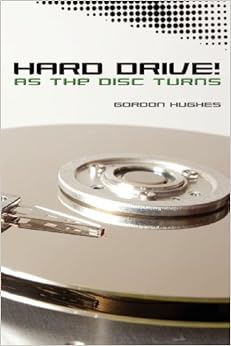
  • Gordon: I didn’t know his parents. Gordon got an undergraduate degree and a PhD from Cal Tech. His published memoir tells about the important role he played at Seagate in the invention of the personal computer hard drive. He continues to do research and development of computer memory technology.
  • Mark: His parents were as far as I knew high school grads; his father was at one time a professional musician. His uncle was with a professional musician with the San Francisco Symphony Orchestra. Mark got a bachelor and masters degree from U.C. Berkeley. He eventually became the head of the metallurgy lab at Sandia and then the head of the special projects division. I understand that late in his career he became a well known volcanologist, studying volcanoes in Hawaii and the Mt. St. Helens eruption.
My own parents: Both were immigrants. Dad was a secondary school grad and Mom did not complete secondary school. Dad was a middle manager in a big corporation during our years in California. Mom was a stay at home mom for most of the time, but worked part time later. At one point, Dad was the office manager for the building owned by the company; since it provided the Screen Actors Guild with a suite of offices in the building, he served as office manager for SAG and got to know two SAG presidents rather well: George Murphy and Ronald Reagan. Later Dad became purchasing agent for office furniture, equipment and supplies for the company headquarters. It was at that time that Reagan asked him as a favor to set up his campaign office in LA for his first run for governor, which Dad did. Mom when I was a teenager worked a couple of days a week for the Mitchell family. He was a named partner in a law firm that specialized in the movie industry, and she was the daughter of a man whose company was one of several that build Hoover Dam. I got bachelors, masters, and PhD degrees from campuses of the University of California.

The basic point is that our middle class neighborhood had good schools. My friends and I had many role models provided by parents and parents’ friends. Some school friends went on to higher education some did not. All of my close school friends seem to have done well in their chosen careers.

Let me add a few more entries from my college days (1955 to 1959) at UCLA. They too indicate the richness of the Los Angeles environment in which I grew up.

  • Chris, a friend made at UCLA whose father had a brief period in the limelight as Elsberg's Psychiatist when the break in of his office by President Nixon's "plumbers" was revealed to the public. These events ruined his practice and embittered him for life. Still, to me he represented the important and useful role that one could assume in adult life with the proper education. Chris went on to a long, successful career as an engineer.
  • Jimmy, a Japanese America who was sent to school in Japan before World War II, and got stuck there during the war. He joined the U.S. army in Japan after the war and served in Korea. He Chris and I were inseparable in Engineering school, graduated together, and he went on to a long career as an engineer.
  • Myron Tribus taught me Thermodynamics at UCLA, and his teaching approach influenced my own teaching. His accounts of his experience doing operations research during World War II I think influenced my own career choices much later. He left UCLA to become Dean of Engineering at Dartmouth College's Thayer School of Engineering. He became Assistant Secretary of Commerce for Science and Technology in the Nixon administration, and since President Nixon did not have a formal Science Adviser, served in that role as well. He then became Senior V.P. for Research & Engineering in Xerox Corp.
  • Linus Pauling is still the only person to have received two undivided Nobel Prizes, one in Medicine for his discovery of the structure of hemoglobin and the Nobel Peace Prize for his opposition to the spread of atomic weapons. On two different occasions he took several hours to chat with me, an undergraduate from a different university. He continues to remind me that grace is not inconsistent with greatness.


Saturday, August 22, 2015

Circles in Los Angeles When the Movie Business was LA's Major Business


Don Factor (son of Max) and I -- with a couple of friends -- produced the first edition of Nomad magazine in 1959.

Don Factor produced the movie That Cold Day in the Park. Luana Anders acted in the movie.

Luana was a friend from high school; we graduated in the same class.

Luana, began her career as an actor immediately after high school, but like many young actors had to take non-acting jobs to make ends meet. She was a messenger. She also attended the acting classes given by Jeff Cory. She convinced a fellow messenger to attend with her. He was Jack Nicholson.

Luana and Jack acted together in Easy Rider. Also in Easy Rider was Dennis Hopper.

Dennis Hopper acted in Blue Velvet with Dean Stockwell. The two became best friends.

Dean was my next door neighbor for some six or seven years when we were kids. We were friends at the time.

Anthony Linick was also involved in the production of the first issue of Nomad with Don and me. He has been a friend of mine since childhood. He also knew Luana in high school and was in the same graduating class.

Anthony's father was head of the script department for MGM. Dean was on contract with MGM when I knew him.

Anthony's grandfather, who had been the owner of a string of movie theaters, was a friend of Louis B. Mayer. My uncle and aunt worked for Mayer's daughter and her husband, William Goetz, a movie producer and studio executive.

Anthony's stepfather, Ingolf Dahl, was a well known musician who occasionally worked as a studio musician (e.g. he ghosted Schroeder playing the Pathetique Sonata in the Peanuts cartoon). I knew Ingolf quite well; he took a group including Anthony, me and some of our friends mountain climbing and camping from 1949 to 1955.

Ingolf was a friend of Sol Babitz, who among other things was the first violinist for Fox Studios. I knew Sol slightly, introduced by Ingolf. I attended some of the funtions Sol organized.

Sol was the father of Eve Babitz. I met her a few times at functions arranged by her father, when she was a young girl. She later became a reporter for Rolling Stone.

Eve Babitz appeared on the film, The Cool School, about the Los Angeles art scene. Also appearing in the film were Don Factor, Dennis Hopper and Dean Stockwell.

I could go on and talk about the links through my Dad, who for a while was the office manager for the Screen Actors Guild (under George Murphy and Ronald Reagan) or those via my mother's employer, Shepard Mitchell, named partner is a law firm that was deeply involved in the movie industry, or my friend in the college days, Paul Glass, whose father was production manager at Fox studios. But you get the point. I lived in Los Angeles from 1945 to 1959, and at that time it was much smaller and making movies was a big part of what went on there. Not only did people you came into contact with work in the movie industry, but people you knew in one place came to meet people you know in another place due to their common links to the movies.

Saturday, July 25, 2015

Basic Library for my Cousins


Here is the Wikipedia entry for Blind Raftery.

Raftery's poems; songs of life, love and liberty (my Grandmother's  and Julia Heneghan's brother, John Patrick). (Also available here free online.)

Reincarnations by James Stephens (English language versions of Blind Raftery poems)

Songs Ascribed to Raftery by Douglas Hyde (This is the book by the former President of Ireland, reflecting his collection of Blind Raftery's works; bilingual.) (Also available here free online.)


Poets and Dreamers: Studies and Translations From the Irish by Lady Gregory (This book by one of the founders of Ireland's Abbey Theater, reflects stories about Blind Raftery collected by the author and some of his poems translated into English. The Blind Raftery material is in the first part of the book.) (Also available free online.)

Blind Raftery by Criostoir O Flynn (relatively new, bilingual edition)

The old Irish bank note with the first verse of Blind Raftery's "Raftery the Poet" in Gaelic on the blackboard.
Mise Raifteirí an File
(I am Raftery, the poet)
by Antoine Ó Raifteirí

I am Raftery the poet,
Full of hope and love,
With eyes without light,
Calm without anguish.

Going back in my travels
With the light of my heart
Weary and tired
To the end of my journey.

Look at me now
And my back to the wall,
Playing music
To empty pockets.

Monday, May 04, 2015

Growing up in Los Angeles Long Ago


I grew up living in a lower middle class neighborhood in Los Angeles, and I think it was an amazing place for a kid to live at the time.

I moved to Los Angeles in 1945 at the age of eight, and lived there until 1959 when I graduated from UCLA. My father had been transferred from his job in Massachusetts to the new Rexall Drug Company office in Los Angeles. The company would later be renamed Dart Industries. My parents were immigrants, Dad from Ireland and Mom from England. Mom did not work, at least for the first few years in Los Angeles, and Dad was in administrative posts in the company headquarters.

Mom and her sister had come to the USA in the 1920s and worked in the household of Ambrose Clark. He had inherited a fortune made from the Singer Sewing Machine Company. She left that work when she married Dad. Every once and a while she would tell stories about the Clark household -- their traveling in their five privately owned railroad cars from their New York compound to their South Carolina mansion, or their taking the entire first class of an ocean liner to travel from the USA to England so that not only family members but also maids and valets could have first class cabins.

My aunt returned to England, but she and her husband returned the USA after the war; then they worked as English servants in the homes of wealthy families. As I remember, one home was that of Paul Mellon in the Virginia hunt country. In the 1950s they moved to Los Angeles where they worked for movie producer William Goetz and also for the director/producer/writer King Vidor. I remember visiting my aunt and uncle as a kid when the Goetz family was out, wondering around looking at their multi million dollar collection of French impressionist paintings. Normally my aunt and uncle's relationship to the members of the household and guests must have been very correct, but I recall the became friends with Danny Kaye who apparently treated everyone alike.

Mom would occasionally help with catering for a big event at one of the households, and eventually was convinced to work part time at the home of Shepard Mitchell and Ruth Wattis Mitchell. He was a named partner in a Beverly Hills law firm; she was a sculptor, daughter of one of the founders of the Utah Construction Company. I recall that my senior year in college I was a finalist for a fellowship to Cambridge University, but the other finalist won; the Mitchells then offered to pay transportation, living and all other costs for me to get a graduate degree at Cambridge -- nice people! (I went to U.C. Berkeley as a teaching assistant.)

For a part of Dad's working life he was manager of the building occupied by his company's central offices, but also the Screen Actors Guild. As a result he became friendly with George Murphy (later Senator Murphy) and Ronald Reagan. On Reagan's request, Dad helped set up the Los Angeles campaign office for Reagan's first campaign for governor of California. Justin Dart, the president of the company for which Dad worked, became one of the "kitchen cabinet" of advisers to President Reagan. Dad's direct boss and good friend at the company once told me I should look up his old friend since I was working in Washington -- the old friend was Senator Jesse Helms! (I never did.)

Dean Stockwell and Margaret O'Brien
in The Secret Garden (1949)
Our next door neighbors were the Stockwells. There were two sons, Dean and Guy; Dean was about my age and Guy a few years older. Both were child actors, and both went on to have long acting careers as adults. Since Dean and I were friends, I got to meet and play with other child actors such as Margaret O'Brien and Claude Jarmen Jr. I also got to meet a few adult actors, such as Lionel Barrymore and Alan Ladd. The parents were divorces. Guy and Dean's father was Harry Stockwell, a broadway singer/actor who lived in New York. Harry would visit his son's from time to time, and I recall one visit when he discovered my parents had never seen the Broadway musical, Oklahoma. (Harry starred as Curly in the original Broadway production.) So Harry stood in our living room and without instrumental accompaniment sang the libretto for us!

Michael Tilson Thomas, Ingolf's student
conducting works by Ingolf Dahl
One of my friends from primary school on was Anthony Linick. His book, The Lives of Ingolf Dahl, is basically a biography of his stepfather, Ingolf, but it also covers a lot of my Los Angeles childhood since Ingolf served as our leader on many camping and climbing expeditions. Ingolf and his wife had a huge collection of friends from Gertrude Lawrence, to Benny Goodman, Leonard Bernstein, and Igor Stravinsky to Thomas Mann. But Anthony's mother also had friends of her own, such as her college friend, Ralph Bunche who was the highest ranking U.S. citizen in the United Nations at the time and a Nobel Peace Prize winner.

Anthony's father was for a time the director of the script department at MGM -- think of the people he must have known. (Incidentally, Anthony's complicated parental roster included Professor and Dr. Dahl and Dr. and Dr. Linick.) While I didn't meet a lot of Anthony's parents friends, I did get told the story of the Ring Cycle on a camping trip, and great names came up in conversation from time to time.

Primo Carnera
Anthony. in his book, points out that Primo Carnera lived in our neighborhood. The former world heavyweight boxing champ also went to the church my family attended. I remember shaking hands with him and seeing my fairly large hand disappear in his huge mitt. Paul Richards, another friend my age, lived down the block, and his dad was a gold medal Olympic high jumper.

A lot of my friends from secondary school went on to get doctorates in one field or another. Special note might be made of Gordon Hughes, the smart kid in our high school class who seems to have gone on to invent the hard drive technology used in this and most other personal computers; read his book. Mark Davis, who lead our ROTC unit and was the best shot on the all city rifle team, went on to head key departments in one of the government research labs.

By the time we got to college, Anthony Linick brought new friends into our circle, notably Don Factor (son of makeup magnet Max Factor), Paul Glass (son of movie producer Gaston Glass), and Fred Myrow (son of composer Josef Myrow). Another friend introduced me to Herb Siegel who became a close friend; Herb's wife was a student of Corita Kent, Peter Voulkos and Richard Diebenkorn. Herb and Sue later introduced me to their friend Harris Wolford (a Kennedy staffer, early Peace Corps official, and eventual U.S. Senator.)

Luana Anders, Dennis Hopper and Peter Fonda
in Easy Rider

Of course, there were lots of other actors around. I went to high school with Luana Anders, who was more of a friend of a friend than a close friend of mine. She eventually was in lots of movies (e.g. Easy Rider and Francis Ford Coppola's Dementia 13). Luana starting out got a messenger job, and once convinced a fellow messenger that he ought to go along with her to Jeff Cory's acting class; her messenger friend was Jack Nicholson.

College exposed me to people with different interests, although my closest friend in engineering school, John Fielding, is the son of the man who had his 15 minutes of fame as "Ellsberg's Psychiatrist". Paul Baran, the inventor of packet switching (one of the key technologies underlying the Internet) got his masters degree from UCLA the same year I got my bachelors degree from the same small department in the engineering school. Vint Cerf is a little younger than I, and didn't get to UCLA until after I had left. (I didn't get to know him and Bob Kahn, his co-inventor of the Internet, until much later.) It should be clear that UCLA's computer team in the engineering school was something special at the time. Myron Tribus was one of the professors who made an important impression on me; he was one of the original operations researchers in World War II, went on from UCLA to a position of Assistant Secretary for Science and Technology in the Department of Commerce (serving as the de facto science advisor to the president at the time), and also had important academic administration positions at Dartmouth and MIT. Tom McGrath tried to teach me to write poetry, and in the process made a lasting impression as a man and as a writer. As a student, I also got to meet Linus Pauling, who was nice enough to spend a few hours chatting with me and a friend a couple of times even though I was an undergraduate at another school at the time; Pauling is of course the only may to have won two undivided Nobel Prizes; he almost won a third.

Boelter Hall: an Engineering Building on the UCLA Campus
Dean Boelter, the dean of the engineering school while I was there, was a distinguished engineering educator. I only met him twice during my four years at UCLA. The first time I was a senior, and called into his office. He asked me if I knew why a member of the engineering faculty was always elected "the ugliest man on campus" (i.e. the one who had most money donated to charity in his name). I didn't, and he explained that each year he selected a senior engineering student and gave him the responsibility of fixing the election, and that that year I was the lucky student. (My candidate did win.) The second meeting, he brought three of us graduating seniors into his office and told us about his camping trip to the high sierras the previous summer with his son. I came to the conclusion that he was a lot like everyone else, but more so!

As I look back, I wonder how many kids with immigrant parents who lived in a lower middle class neighborhood had so many creative people in their lives, or at least in the lives of their parents and friends' parents. I suppose that it happens in Washington, D.C. and other "creative cities", but I still think I was very lucky. I came out of Los Angeles knowing that it was possible to be a Nobel Prize winner, a politician successful on a national scale, a movie star, a world class athlete. a musician, writer or poet, an educator, or a significant technological innovator. Of course, I was lucky enough to live in a neighborhood where parents valued schooling and encouraged their kids to study hard. The schools were good, and in California at the time, if you got good grades in secondary school you could go to a great public university essentially free. Many of the folk described above were themselves the product of very upward mobile lives and careers.

Saturday, April 25, 2015

A biography of Father Junipero Serra


I just finished reading Junipero Serra: California's Founding Father by Steven M. Hackel. Serra (1713 to 1784) is regarded in California as one of its founding fathers. A Franciscan priest, he is expected to be formally declared a saint during the visit of Pope Francis to the United States later this year; it would be the first time that the formal recognition of sainthood had been performed in the United States.

One impression from the book is the  arrogance of the imperial peoples. The Spanish claimed a huge chunk of the Americas, ignoring the people who were already there; claiming Alta California, they worried about the Russians,, but not about the sovereign rights of the California Indians.

The U.S. Americans proclaimed "Manifest Destiny" almost as soon as they possibly could, bought a big swath of North America from the French, and took another big swath from the emerging Mexican state. The Spanish Catholics had little doubt that theirs was the only true religion. (What, you say that those traits are still found in American culture and foreign policy?)

I think it useful to describe the book in terms of three sections.

Mallorca

Serra was born in Mallorca, an island off the coast of Spain, the largest of the Balearic Islands. He grew up there, joined the Franciscan Order there (where he took the name Junipero -- Juniper in English -- after one of the followers of Saint Francis), studied and taught there, received his doctorate in Philosophy there, and was ordained a priest there.

I knew very little about the island before reading the book except that it is now favored by British tourists seeking to escape the winter weather of their islands. Author Hackel provides a brief history of the island and descriptions of life there during the 18th century. I found that discussion interesting and useful.

Mexico/New Spain

Serra volunteered to serve as a missionary priest in Mexico -- then known as New Spain. He made the long and dangerous journey there, traveling first from Mallorca to Spain. then across Spain. and then to embark on what was in the 1700s a long and somewhat perilous sea journey, and then by land to Mexico City -- again a somewhat dangerous trip.

In New Spain he first served as a teacher in Querétaro. He also conducted what sound to me like revival meetings, traveling around the country to hold meetings at which he spoke to encourage Catholics to renew their faith and live by the dictums of that faith. Later he was a leader of the Franciscan missions in Sierra Gorda, where for some nine years he truly experienced the difficulties of converting Indians to Catholicism and bringing them to mission life.

California

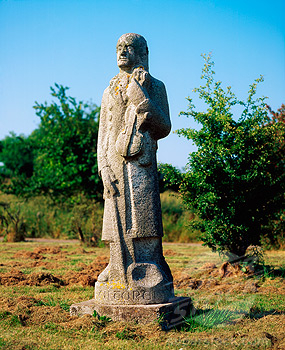
Statue of Father Serra in the
Mission San Diego de Alcalá
In 1768, after the Jesuits had been expelled from their missions in Baja California, the Franciscans took over their administration, seeking to save the missionary effort. Father Serra became the Father President for the Franciscan missionaries involved in the effort.

Serra is best known, at least in the United States, as a founding father of California. The year after the Franciscans took control of the missions in Baja California, the colonial government decided to move into Alta California (what is now basically the state of California) in order to block any potential effort to further colonize the region by the Russians. It was decided by the government to send an expedition with two purposes:
  • to establish pueblos in key locations with military presence, and
  • to establish missions to convert the Indian population to Catholicism.
The Franciscans were again put in charge of the missionary effort, and Father Junipero Serra was again made the head of the effort. Father Serra himself baptized a large number of converts; after he was granted the right to perform the sacrament of confirmation (usually reserved for bishops of the Catholic church) he also confirmed thousands of Indians (as having achieved a mature understanding of their faith), Since his landing in Mexico he had suffered from leg problems, and in the last years of his missionary work was in severe ill health.

Internet source for map
Serra and the Indians

Steven Hackel writes that there were 310,000 Indians in Alta California when Serra started creating missions there. (I don't know how an accurate estimate could have been made.) Serra sought to gather Indians to live in the mission communities, and indeed to learn Spanish farming techniques to grow their own food. Hackel notes that since the Indians had no immunity to the communicable diseases brought by the Spanish to the New World, and since the missions were in occasional contact by ship with Mexico, epidemics arrived from time to time, spreading rapidly through the relatively dense mission communities of Indians; the mortality was terrible.

I wonder whether the missions are especially to blame for the destruction of Indian culture and the decimation of Indian populations in California. In the 19th century, a large number of land grants were given in Alta California by the newly independent government of Mexico. I suspect that the result was a loss of the traditional lands of the California Indians, and that event in turn would have led to high mortality rates, especially as some would have joined communities of hacienda workers at the newly established haciendas. With the 1849 gold rush, the influx of U.S. and foreign migrants took a further  huge toll on the Indians.

I also know from long experience as a development professional that many of my efforts and those of my colleagues failed. We had hundreds of years more experience to learn from than did Father Serra, and I sympathize with the failures he must have encountered in his long career. Building new, successful communities that involve major cultural change by the people who are to live in those communities is hard, and it is marked with major failures. I give more credit to Father Serra for trying and trying again after failures, than I criticize him for those failures.

Was Serra Saintly?

Serra was a Franciscan, and accepted the simple life style and oath of poverty of that order; indeed, Hackel indicates that Serra may have been even more devote than most of his fellow Franciscans. He certainly took large risks to become a missionary, abandoning what would have been a safer and perhaps less severe life in Mallorca. In the management of his missions he clearly drove himself very hard -- to the point of illness and even death.

I think Serra believed that only Catholics had a chance of going to heaven and living in eternal bliss with God; he would have believed that the Indians of Sierra Gorda and California in their native state violated the first commandment, putting false gods before the God of Abraham and Jesus Christ; moreover, the Indians would have been violating the ten commandments in many other ways. Serra would have believed that while all people sinned, only Catholics through the Church's sacraments could repent, have their sins forgiven, and finally die in a state of grace. Thus I think he believed that while Christians had the chance of heaven, heathen Indians were doomed to the other place for all eternity.

Assuming I am right, Serra would have believed that only the conversion of the Indians to Catholicism could save their souls and give them the chance of going to heaven. Moreover, he would have believed that their chance of heaven would be greatly enhanced living at a mission where they could take the sacraments on a regular basis and benefit from the teaching and guidance of the missionaries. Moreover, I think he would have believed that an Indian that continued to live in the traditional way with his/her tribe (or who left the mission to return to tribal life) even having converted to Catholicism, was in great peril of lapsing from the Catholic religion and losing out on eternity in heaven.

Thus I think Serra was willing to brave dangers, undergo sickness and injury, and live a simple and often uncomfortable life in order to grant the gift of eternal heavenly life to others. I think he believed that he managed to do so directly to thousands he baptized and/or confirmed and indirectly to many more through his missionary work and his leadership in the creation of missions. His companions and colleagues as well as many others thought his life and accomplishments to be saintly.

It is a commonplace statement in the study of history that one should not apply the moral standards of today to the people of the past. It is at least important to try to understand what those people believed and the roots of their behavior. Even today, many people think Junipero Serra went to heaven for his behavior during his life, and indeed pray to him for help in their own lives.

Final Comments

My parents and I moved to California when I was in the third grade and I grew up there. So I studied Junipero Serra in grammer school, visited missions, and was familiar with El Camino Real (the royal highway) which connected the missions and is still honored in markers on California roads. I lived for years within 20 or 30 miles of Mission San Juan Capistrano and knew about the clock like arrival of the swallows there (commemorated in a poem and song).

I also live about the same distance from Hemet, the site of the annual Ramona padgent; Ramona, the heroin of a California novel adapted in several media, was an orphan of mixed European-Indian ancestry, who was raised by Spanish foster parents. and who fell in love with an Indian man. The story, a tragedy, is set just after the Mexican American War.

Perhaps more to the point, I was trained as a Peace Corps Volunteer to work with the Mapuche Indians in the south of Chile. As part of that training I spent a month in a town of Tarascan Indians in Mexico. There I got the chance not only to know some of the people of the town, but to visit with the town priest, the latest in a hundreds of years long chain of priests serving that community; he showed me the church records going back hundreds of years.

Tupac Katari, Ayo Ayo's most famouscitizen, leader of an Indian revoltin the 1780s.
Much later I got to visit Ayo Ayo, a town of Aymara in altiplano Bolivia. There too I got to meet some of the people, and I got to visit the church which was also hundreds of years old. The priest there (also continuing a long history of ministry to the Indians) showed me church records of births, marriages and funerals going back centuries.

I did not get to work with the Mapuche as a PCV, but my friends who did learned how hard development is for Indian communities. I had my own failures both as a PCV and later.

I have come to have a lot of respect for American Indians and their (many different) cultures. While I understand that cultures change, as Spanish and Mexican culture have changed, I also have some caution about the cultural change I advocate.

Clearly the 37 million people who live in the state of California today arrived as a tidal wave that would not be resisted by the native California Indians. Indeed, the modern Californians are healthier, longer lived, and better educated than the peoples that they displaced. Still.....

In conclusion, let me say that I learned a lot from this book, both about Father Serra and about the world in which he lived. The book is short and quite readable, but also well researched and well documented. Perhaps most important, it advanced some very interesting questions that made me think and were worthy of that work.


  • Here is a post I made to provide background information for those reading about Junipero Serra
  • Here is a brief article by author Hackel on Father Serra. 
  • Here is a video news report triggered by the Pope's recent announcement that Father Serra is to be recognized as a saint; Hackel is included as an expert.


Thursday, March 26, 2015

Vaccines


I saw The Vaccine War on television the other  day. You should know:

  • The development of vaccines to prevent communicable diseases has been one of the reasons that life expectancy improved so dramatically in the 20th century. Communicable diseases used to kill children by the millions in Europe and the United States, and no longer do so. The major communicable diseases that continue to kill people by the million worldwide are killers in those areas where modern public health services have not arrived, or for a few diseases -- such as malaria or HIV/AIDS -- where vaccines have not yet been developed.
  • As science progresses and more is learned about the immune system and disease agents, vaccines are getting more efficacious and safer. Research and development on vaccines for a communicable disease do not stop simply because a vaccine has been developed -- when people see how a better vaccine is possible, they try to develop it.
  • Regulatory agencies work to assure that only the most efficacious, effective and safe vaccines are in use all all times.
Think about immunizing your kids this way:

If your children's school needed some supplies that were not in the school budget, parents might well organize some activity to raise supplementary funds to buy those supplies. If you could participate but chose not to do so, you would be a freeloader. If other parents took up the slack, that supplies might still be bought. If too many parents choose to be freeloaders, the campaign will not work and all the kids will suffer.

If your church needs an expensive repair of the roof, the people who attend the church are likely to organize to raise the needed funds. If you don't participate in the effort, you are freeloading -- after all it is your church. If too many freeloaders are in the congregation, the roof doesn't get fixed, more damage occurs and the bill gets higher to do the necessary repairs.

Say you decide that traffic laws should apply to everyone else but not to you, so you drive after you have had a few drinks. exceed speed limits when you feel like it, and try to beat red lights. You may kill yourself or someone else, but more likely you will be seen driving this way by the police and you will be stopped and ticketed for breaking the law. If your conduct is flagrant enough you will be arrested as a criminal.

Communicable diseases have tipping points that determine what will happen if someone catches the disease in your community. If a high enough fraction of the people are immune, the disease may infect a a few people after it arrives in the community, but will soon die out. If too few people are immune, then an epidemic will occur and a lot of people will get sick from that disease. Sometimes conditions are just right and new vulnerable people will arrive in the community to take the place of those who have died of the disease or achieved immunity, and the disease will stay on as endemic. Public health immunization campaigns are the means by which communities assure that the vulnerability is below the tipping point.

There are some people in almost all communities who can not be immunized -- infants whose immune systems have not yet fully developed, old people whose immune systems no longer function well due to the aging process, and people with some medical conditions. We accept that some people will not allow their children to be immunized because of religious convictions in part because their numbers are small and adequate levels of immunity can still be maintained in the community 

As far as I am concerned, the people who don't have their children immunized due to sloth. or superstitious fear (that is fear of side effects not justified by medical information) are freeloaders. If there are too many such freeloaders, epidemics will take place such as the measles epidemic occurring now in the United States. Some people who get the disease will just be sick for a while, some will be permanently disabled due to the disease, and some will die of it. (I had mumps as an adult, before the MMP vaccine was developed, and I know from personal experience that that was serious enough to hospitalize me for a weak with fever and complications.)

If there continue to be too many freeloaders and periodic epidemics, stricter public health laws will be passed and enforced. Those who then fail to immunize their kids will be criminals.

I have some credentials to write the above message:
  • I wrote my Ph.D. dissertation on mathematical models in health planning;
  • I worked as a health planner in the World Health Organization, the U.S. Office of International Health, USAID, and the White House.
  • I managed research programs on the epidemiology of infectious diseases. One of them helped clarify the causes of pneumonia in children in developing nations, helping WHO to revise it standards for treatment of lower respiratory disease in children. Another showed Hepatitis C to be a far more prevalent disease in Egypt than had been believed or even thought possible, leading it to be recognized as a major public health challenge.
  • I managed research program on the application of biotechnology in bio-medical research. Eventually I directed the Office of Research of USAID, served as the U.S. Commissioner on the United Nations Commission on Science and Technology for Development, and as a consultant to the World Bank, Brazil and Mexico on programs to strengthen research management.

Wednesday, January 21, 2015

A thought about education


I saw a news broadcast the other day about a school in California that had a special program which it described as life preparation. High school age kids from a poor neighborhood were taking a course preparing them for jobs in the health service industry. They had a lot of on site training for entry level jobs.

On the one hand, I think it is great that these kids, who come from families where parents may not have finished high school and certainly did not go to college, are likely to get jobs right out of high school -- jobs other than flipping burgers in fast food restaurants.

On the other hand, I wonder if they are not being shifted off into a side track that is going to be a dead end. Will they be able to get more education later, shift into higher paying jobs, and have careers that will offer real upward social and economic mobility.

My Dad finished high school but my mother did not. Most of my close friends similarly had parents who had not gone to college. But my did wanted me to go to schools that had good academic preparation and chose to buy a house in the catchment area for such schools. A lot of my fellow students did have parents with college educations, and a lot of them expected to at least graduate from college -- many planned careers that would involve graduate degrees.

So my close friends and I rather naturally adopted the aspirations of the majority of our fellow students. Moreover, we all went on not only to graduate from college, but to get graduate degrees; I got a Ph.D. Dick was the exception -- he got two doctorates.

We tended to change careers, and the educational preparation helped us to do so. It also helped the country -- one of my high school friends went on to invent the computer hard drive.

In a globalized economy, where America competes with low income countries, people with relatively little education may be competing with people in those low income countries on the basis of pay -- dooming the yanks to low pay. The folk with little education are also likely to be challenged by automation of their jobs. While people with hands-on service jobs may see their incomes rise somewhat with the rise of the general economy, they may also face more competition for those jobs with people who have not received the necessary education to get jobs in creative industries, especially as others in their boat have lost their jobs to automation.

Tuesday, November 18, 2014

How I think.


A young cousin is doing research on dyslexia and got me thinking about how I think. As readers of this blog might know, I am interested in thinking anyway. Long in the past I did some neuro-modeling, and read some about brain science.

I think in words. Sometimes. however, I think about location in kind of a proprioceptive way -- imagining how I would reach out for something or point to something. I do not think in pictures. If someone asks me to visualize something I know well -- say the exterior of my house -- nothing happens. I remember the visual appearance of things in words; the door is brown, the siding is white.

I remember reading how a German chemist came about conceiving of the structure of the benzene molecule day dreaming about a snake devouring its own tail; that is difficult for me to even imagine; I just don't think in images, much less in animated images.

I can not spell well. Thank goodness for spell checkers on computers. When my second grade teacher sent home a message that she thought I was dyslexic (because I made letter inversions trying to spell words) my father decided to teach me how to spell. He said spelling was easy; you just visualize the word and write down the order in which the letters appear in your mind's eye. (He had a photographic memory, literally.) I don't have a mind's eye. His guidance was like telling a deaf person to listen to music and just write down the notes.

My wife does crossword puzzles and copy editing for pleasure; her sister used to be a professional editor, and her niece is now one. I think they have a different relationship to written language than I do; I simply don't see misspellings and I am very slow on language arts compared to them.

I am not very good at recognizing faces. If I recognize a face, but the person is met in a different context than usual, I am often at a loss for the name or the original context. Others seem to be better able to recognize a former child actor when that person is playing an adult role. Comparing myself to people I know well, my ability to link name to face seems definitely second rate.

I was trained as an engineer (many years ago) and of course took the basic course in engineering drawing. I did learn to infer the three dimensional form of an object from its two dimensional projections, but I do so by logical inference -- not be visualization.

I have learned to read graphs and like them. So too, I can follow the diagrams that others use to develop and explain their thoughts. However, I don't think I am especially good at dealing with these visual presentations. I have used Power Point in teaching and public speaking, but I don't think I am very good at the use of those aids. (I do think that Gapminder, which uses animated graphs and videos is brilliant.)

I am tone deaf, and have little ability to recognize music, even music I should know well.

I don't want to give the wrong impression. I have had a lot of schooling (BS, MSEE, Ph.D). I have traveled more than most people and read quite a bit. I am competitive and tend to do well on tests. For example, as a senior in high school I took the Iowa Test, used to measure educational accomplishments of the students of the Los Angeles School District; I was told I got the high score in the city. In my late 20s I took the Graduate Record Exam for entrance into grad school. It was then standardized, with a score of 500 for the average college graduate, with a range from 200 to 800. My total for three tests (verbal, quantitative and engineering) was 2430.

I seem to have a good memory for what is said. I can sit through a meeting, not take notes, and write a fairly coherent summary of what went on; people tell me that is rare. As a student I did not really understand why people took notes of lectures; I seemed to remember the salient points, and writing notes often seemed to be a distraction. At age 77 I am beginning to have more problem remembering names than in the past -- thank goodness for Google and I am using associative approaches more often. I sometimes search for a word, typically recalling the first letter.

I seem to be relatively good at logic. I did well on related courses from basic algebra, to deductive logic, to advanced calculus. At one time I was a pretty good bridge and chess player.

My doctorate major was operations research -- mathematical modeling for the solution of practical problems -- and I have worked with professional statisticians and economists. I have taken quite a bit of mathematics at a college and graduate level. I seem to be good at mathematical thinking.

I have a lot of background in computers, and at one time was a pretty good programmer. (The development of the field has pretty much made those skills unnecessary, and I have not used them in a long time.)

English is my native language, but I also speak Spanish (accented) and read French and (less well) Portuguese. Compared to people I know, my ability to learn languages is quite limited; my class actually drove our teacher to tears by mass incompetence in high school Latin.

I am aware that some of my thinking is not done by my conscious mind. I am not here writing only about reflexive actions, or the way subconscious desires may influence ones conscious thoughts and decisions. I have had the experience waking up thinking about something or seeing an answer in the morning to a problem I was mulling over in the evening. When I am pondering how to solve a problem, sometimes I "get a hunch" -- a feeling that if pursue a certain line of reasoning the problem will yield to analysis. Those hunches have led to discovery of new algorithms and new proofs. I assume the hunch comes as a result of stuff going on in my brain of which I am not consciously aware.

I have read that about 6 out of 10 people think primarily in pictures, about 3 out of 10 verbally, and among the remainder are kinesthetic thinkers, and "logical/mathematical thinkers (who learn via systems, categories and links) as well as a handful of other types." I would guess that I am primarily a verbal thinker, with a relatively strong component of logical/mathematical thinking and some kinesthetic thinking tossed in.

Wednesday, December 25, 2013

Ingolf Dahl plays Schroeder playing the Pathetique Sonata


Ingolf Dahl, the stepfather of my friend Anthony Linick, took us and our friends hiking and camping many times during my youth. He was also a professor of music at USC, a composer, a conductor, and a fine pianist.

He is credited with recording the Pathetique Sonata for Schroeder. I think he must have enjoyed the idea of ghosting this video.

Among his friends that I know of were Igor Stravinsky, Leonard Bernstein, Michael Tilson Thomas, Benny Goodman, Edgar Bergen, Victor Borge and Gracie Fields.

Happy holidays and a happy new year!

Wednesday, November 13, 2013

I have been called "a Development blogger"


I occasionally am invited to serve as a guest blogger on other sites. Here is a list of contributions to such sites:

Global Solutions Blog
Global Memo (Multilateral Elections and Appointments in the United Nations System)
Zunia (Expert Perspectives)
For a number of years I was the principal blogger on:

Saturday, January 14, 2012

Living through the Cold War


Source of the Cold War map
I tend to forget that I am much older than most Americans and that they don't share my memories of living through the Cold War. I did not suffer in that war in any serious way, but it was an influence for a very long time.
  • In school in the 1940's I went through "drop drills" where we ducked under our desks to practice self defense in case there was an atomic bomb attack on Los Angeles.
  • In high school, which I started while the Korean War was still being fought, I took ROTC rather than physical education and joined the rifle team, thinking military skills would be likely to be needed at some future date.
  • As an undergraduate at UCLA I had to sign a loyalty oath in order to take up a position as a teaching assistant. On one occasion camping in the desert east of Los Angeles, I saw an atom bomb blast. Although it was 200 or more miles away, it brightened the sky as a false dawn before the actual dawn.
  • As a graduate student at UC Berkeley I not only had to sign the oath again, but I discovered that the student cooperative boarding house where I got my meals was on the California Attorney General's List of possible subversive organizations.
  • On graduating and starting work as a research engineer, I had to obtain a security clearance. On one occasion I was told I could not see a memo that I had written and that I was to explain to a superior because it was then classified beyond my level of clearance. Of course I was working for firms that made a large portion of their funds through defense contracting, although I was working on civilian projects. A machine I worked on was sent to the Soviet Union as part of a traveling computer and electronics show, part of the effort to ease Cold War tensions. I was surprised to learn that a book in which I had co-authored a chapter was translated into Russian and published in the USSR.
  • As a Peace Corps volunteer in the 1960s I discovered that my group was greeted on arrival in country by a headline stating that 45 new CIA spies had arrived disguised as PCVs. The Peace Corps was targeted by Communist groups, including an invasion of the Peace Corps offices. The university at which I taught was closed for a year by a student strike, part of a broad multinational youth movement of the time. I worked for a time on a project that was initiated by a U.S. labor organization later identified as funded by the CIA; the project fell through with considerable damage to the people it was supposed to help. My wife's nursery school had two mothers' groups, one Communist and one Christian Democrat.
  • When I joined the World Health Organization in 1970, a colleague took me aside to explain who could be trusted and which were the agents of the USSR in the Department. One Russian colleague was abducted from Geneva and imprisoned in a mental institution in Moscow, apparently for transgressing the security rules of the USSR. The university in Colombia in which our offices were located was occupied by leftest students; the military retook the university in a confrontation in which 14 students were killed, rioting spread to the city and eventually some 25,000 people were arrested and imprisoned in the sports stadium; the university remained closed for a year, during most of which time we too could not reach our offices.
  • Returning to the United States and taking a government job working in foreign assistance, I again had to go through the security clearance process. While the development assistance projects that I worked on were not political in any way that I could tell, the priorities set in the allocation of foreign aid to countries and regions must have been. I recall when I was a member of the national committee for IIASA a couple of Russian researchers were thrown out of a Scandinavian country accused of gathering information for the USSR. After the Soviet Union was broken up, I managed a couple of programs funding scientists from the former Soviet Union as part of the response to the ending of Communism. So too, we provided some help to former Warsaw Pact nation scientific administrators interested in learning how we managed research funding here.
I suppose that I was as little involved in the Cold War as might have been possible, but still the events such as the creation of the Berlin wall and the Cuban missile crisis affected me as they did everyone.


Tuesday, July 28, 2009

Frances Perkins

Source: "Frances Perkins: A life of labour," The Economist, July 23rd 2009.

I only recently became aware of this hero of the Depression.

As America’s first female cabinet secretary, Perkins masterminded the introduction of unemployment insurance and Social Security (public pensions), with crucial ramifications. She spearheaded a radical overhaul of labour laws, introducing a minimum wage, a 40-hour work week and a ban on child labour. During her tenure, which lasted for all 12 years of Roosevelt’s presidency, workers won the right to collective bargaining, and union membership exploded.
She is the subject of a new biography:
The Woman Behind the New Deal: The Life of Frances Perkins, FDR’s Secretary of Labour and His Moral Conscience. By Kirstin Downey.Nan A. Talese; 458 pages; $35.Buy from Amazon.com.

Monday, June 23, 2008

Marie-Anne Pierrette Paulze

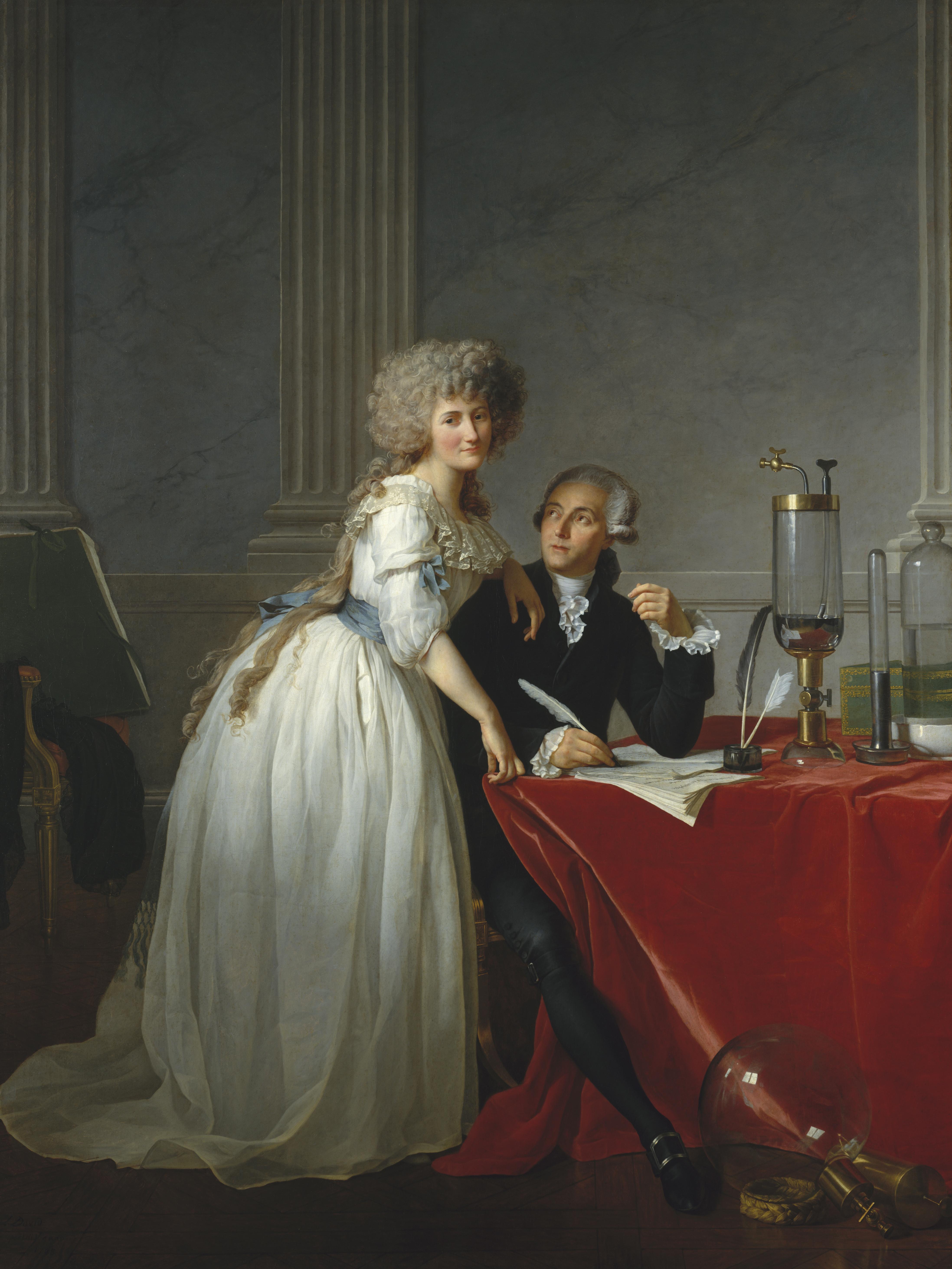
David's portrait of Marie-Anne and her husband.

This is a lady who probably needs a good biography.

Married at 13 to Antoine-Laurent de Lavoisier, who was known as the father of modern chemistry, she not only assisted in his laboratory but translated scientific reports from English for his benefit. Lavoisier who was appointed gunpowder administrator under the French monarch, went on among many other accomplishments to establish the finest chemical laboratory of his time, and to coin the names for oxygen and hydrogen. Marie received formal training in chemistry from Jean-Baptiste Bucquet and Philippe Gingembre. Trained as an artist by the great French artist Jacques-Louis David, she illustrated the reports of Lavoisier's research with drawings of his experiments. After Lavoisier was executed during the French Revolution, she retrieve his laboratory notes and published the final documentation of his work, Mémoires de Chimi.

She was later courted by Pierre-Samuel duPont de Nemours, economist, friend of Thomas Jefferson, founder of the American Dupont family and namesake of the Dupont Company, but married instead Benjamin Thompson. He too had an amazing life, born in Massachusetts, he served in the state militia and in the British Army, was knighted by Great Britain, served as Minister of War of Bavaria, was made "Count Rumford", and was himself a distinguished scientist (also an expert on gunpowder who invented the wax candle and did pioneering work on thermodynamics).

Two hundred years ago, her contributions to science would not have been formally acknowledged, but one suspects that they were significant. In any case, she lived in exciting times, and was clearly at the center of the action!

Read this transcript of a radio program about her.

Check out her entry in Wikipedia.

There is a new biography of Lavoisier by Madison Scott Bell which should be good, and a new fictionalized biography of Count Rumford by Nicolas Delbanco which is getting some publicity. Someone should do a biography of their wife, or perhaps a miniseries if they can find an adequately beautiful actress!