Showing posts with label engineering. Show all posts

Sunday, December 14, 2014

The Qattara Project


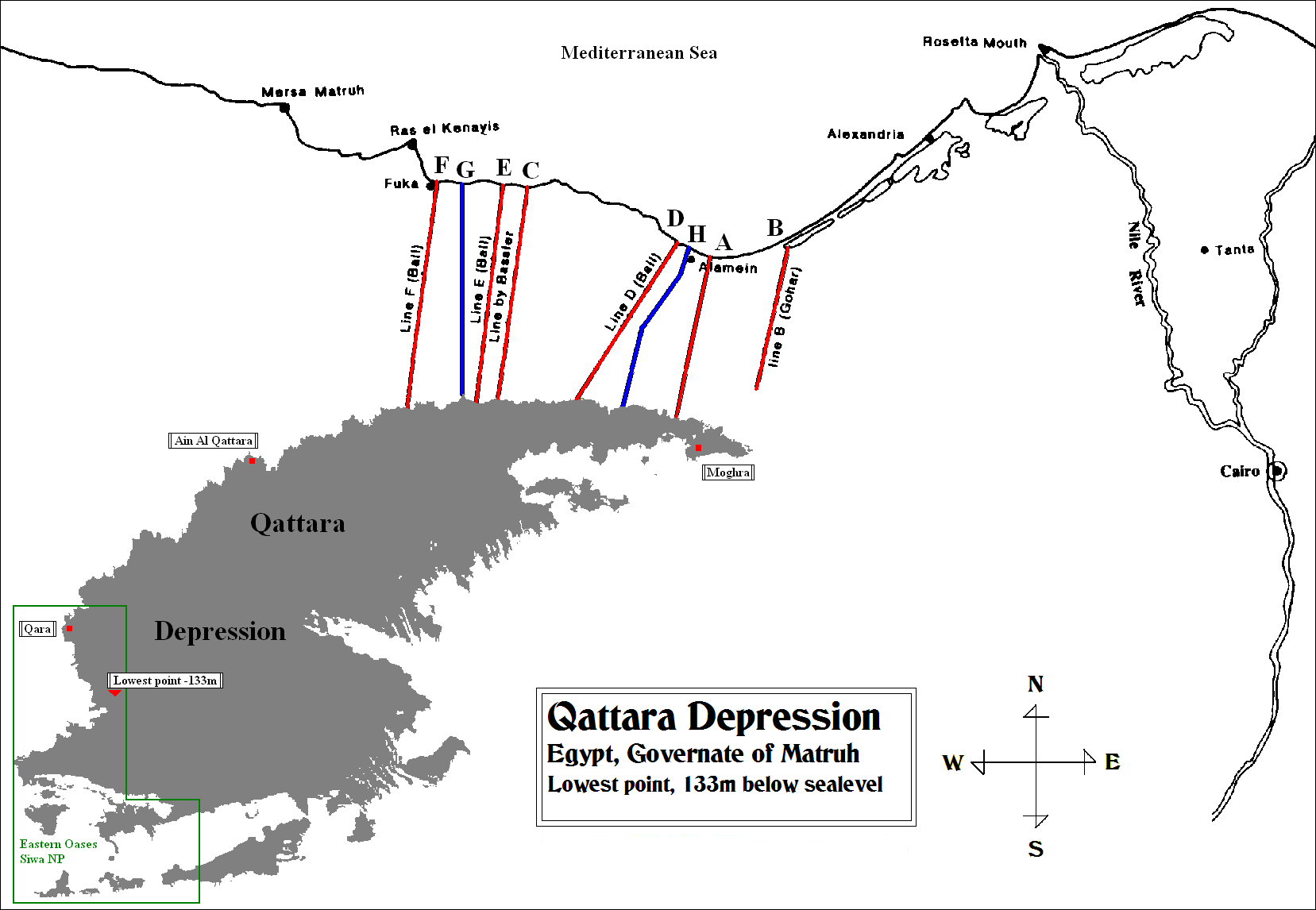
I quote from the source of this map:
The Qattara Depression, in Egypt, is a swathe of land about the size of Lake Ontario that sits near the Mediterranean Sea, at an average depth of 200 meters below sea level. The Qattara Project was the brain child of a German hydrolic engineer named Friedrich Bassler who proposed digging a canal from the Mediterranean to flood the area. After about ten years, the water inside the depression would reach sea level. But the desert climate in the area would cause it to evaporate relatively rapidly, leading to a further influx of seawater. This ongoing flow was to be used to generate hydroelectricity. At the same time, the new, massive saline lake could transform a largely uninhabited desert area into a series of viable fishing communities. The part of the project where you dig a massive canal never penciled out as remotely cost-effective, but for some time the CIA maintained an interest in the project as part of its Cold War efforts to pull Egypt out of the Soviet orbit.
There used to be proposals to use nuclear energy to dig huge canals. I wonder if such an approach would be feasible. Would such an approach change the economics of the project? As energy becomes more expensive in the future, will this project become economically feasible?

How about if desalinization of water becomes less expensive? Would provision of potable water in the desert make the project more attractive?

Would the project help ameliorate sea level rise due to global warming? If so, would those benefiting from the savings be willing to help pay for the project?

This is an old "engineers dream"!

Sunday, October 05, 2014

Is science true?


Bayes Theorem
Source
I suppose I have been conditioned to think in terms of Bayes Theorem. Our estimates of probability are subjective. While there are serious biases, evidence supporting a hypothesis increases our belief that the hypothesis is true, while evidence contradicting a hypothesis decreases our belief that the hypothesis is true.

Ideally scientists should never totally believe in a scientific theory; they should always hold the possibility that a theory is not true, but can be replaced by an alternative that more adequately explains observations. Newtonian physics was great at predicting the paths of planets around the sun and balls shot from cannons on earth; Einstein's physics reduced to Newton's for those applications and better predicted the path of light from distant stars around the sun. Thus Physicists accepted Einstein's theory to replace Newton's as more nearly true. They still search actively for a theory that is still more nearly true than Einstein's.

Scientists seek observations that disagree with the predictions of current theories, for when they can find such an observation it may be a clue to the nature of a better theory. However, they know that such observations are likely to be anomalous -- the result of experimental error of a statistical fluke. One of the functions of peer review is to search for experimental errors or errors in reporting of results.

I suppose an observation that disagrees with previous theory is that IQs as measured by existing tests have tended to increase from year to year (the Flynn Effect). Psychologists are seeking to find better theories of human intelligence that predict such a change, and/or better means of observing the individual's level of intelligence.

Scientific gold is a prediction from a new theory that differs from the corresponding prediction of accepted theory, and that is implementable in an experiment or controlled observation. Thus Einstein, from his theory of relativity, predicted an observation of the apparent location of a distant star (the light from which passed close to the sun during a total eclipse) that differed from that from Newton, and the observation when finally made proved his prediction accurate.

There is all the difference in the world between guessing the nature that a new theory might have from an observation versus accurately predicting an improbable observation from a new theory. The distinction is similar to the distinction between using statistics to test a hypothesis versus drawing a hypothesis from statistical analysis of observations. In the second case, a new set of observations is required to make the hypothesis more credible.

Incidentally, Baysian analysis explains something about scientific publications. I have lived through more than 20,000 days; the sun always came up. Bayes might say that I am pretty sure that the sun will also come up tomorrow. The observation that it did so today is not very interesting because it does not much change my estimate of the probability that it will come up tomorrow. Research results that add a tiny bit of confidence to an already well accepted hypothesis are not likely to be published. On the other hand, a very surprising observation (that changes credibility of what is currently believed)  is likely to be published in scientific journals; it is also likely to be wrong. The equipment may have malfunctioned; the dials may have been misread, the experiment may have been poorly conceived or planned. Thus, other scientists should seek to replicate the observation in their own laboratories to assure that that originally reported was not an error or a statistical fluke. Indeed, it is he very publication of the results that encourages others to try to replicate them.

Two aspects of science thus stand out:
  • Many results reported in scientific journals will turn out not to be replicable (and reported results should not be "believed" until they are replicated.)
  • Scientific consensus tends to be credible because the assertions have proven resistant to many challenges and have been supported by many observations.
The 97 percent of scientists who believe that the cumulative effect of man's activity on earth over many years will lead to climate change is thus very credible; as I interpret the precautionary principle, we should act to ameliorate the risk of catastrophic consequences of climate change.

Good Enough for Practical Purposes

I suppose that our confidence in the scientific consensus about human activity causing destructive climate change is good enough for the practical purpose of taking preventive action.

In like manner, Newton's theory that the attraction of gravity on an apple is proportional to the product of the masses of the earth and an apple, and that therefore the acceleration of an apple falling from a tree is the same for big and small apples, is good enough for our practical purposes of avoiding falling apples and catching them before they hit the ground.

All engineers tend to feel that we don't need "truth" and "exact predictions" to do good engineering. Good enough theory and good enough predictions -- combined with margins of safety -- lead to practical solutions.

Science is not true, but a lot of science is true enough for practical purposes!

Sunday, March 23, 2014

The World is Going To Need a Lot of Engineers, Soon!


I quote from The Economist:
It will cost $57 trillion to build and maintain the world’s roads, power plants, pipelines and the like between now and 2030, reckon consultants at McKinsey (see chart). That is more than the value of today’s infrastructure. By one estimate, infrastructure spending currently amounts to $2.7 trillion a year (about 4% of global output), yet $3.7 trillion is needed.
That also means we will need engineers to build that infrastructure -- Civil Engineers, Electrical Engineers, Electronics Engineers, and Agricultural Engineers. We will also need engineers to work on the factories and homes that will be served by that infrastructure, and engineers to develop the mechanical, electrical and electronic machines that will utilize the infrastructure.

Recall that to increase the number of working engineers, the world has to accumulate their number over the years, providing each cadre with opportunities for professional growth during its career. If more graduates are needed each year, then the engineering schools will need to build the added capacity to train those engineers, which in turn means that the world will need to educate the engineering educators. It takes time to produce an engineering profession and there is barely enough time to do the necessary by 2030.

Saturday, May 25, 2013

Geographic Distribution of High Scores on the SERI index.


Science and Engineering Readiness Index (SERI) State by State
Many states are failing the nation in preparing their students for future careers in the knowledge economy. Unfortunately Maryland, my own state, is not among the nation's leaders as judged by this index.

The Science and Engineering Readiness Index (SERI)  incorporates results from the National Assessment of Educational Progress (“NAEP”, conducted periodically by the U.S. Department of Education), Advanced Placement Examination results in calculus and physics, the physics course-taking results from the American Institute of Physics National Survey of High School Physics Teachers and information on teacher certification requirements in science compiled by the National Council on Teacher Quality (NCTQ).  The information from these sources is gathered into three scores on mathematics performance, science performance and teacher qualifications.  The scores are then used to assign each state a single composite score.

Source
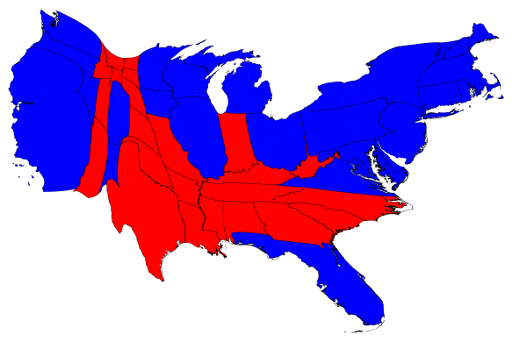
The map above shows the 2012 presidential election results on a population cartogram (state sizes are adjusted to reflect their populations). Fortunately the North Eastern and Mid Atlantic states that have high performance on the SERI index also have large populations. I note that many of the states that voted Republican (red) in the last election are among those that are not teaching enough STEM to their high school students.

Saturday, July 14, 2012

Still More On Engineering Diplomacy


There is a report titled "Science, Technology, and American Diplomacy: Background and Issues for Congress" by Deborah D. Stine. The report of the Congressional Research Service, published in June 2009, provides a useful overview of the role of science, technology and engineering in U.S. foreign policy as seen from the Congress. The date of publication suggests that the document was intended as a review of policy for those assuming office in 2009, and thus could not fully represent the policies of the Obama administration.


Of course, the Congress has an important role in setting policy for engineering diplomacy and in appropriating funds to implement that policy. Of course, members of Congress are politicians and few have engineering skills or background. Engineers do serve on Congressional staffs, and importantly there are fellowships available to allow engineers to serve for a year or two on such a staff. Perhaps more important, engineers can provide advice to Congress through scheduled hearings. Even more important, engineers acting either in their private capacity or as representatives of the organizations in which they work can take the initiative to recommend foreign policy positions to their Representatives and Senators.

Stine's report is also useful pointing out that there are many agencies of the executive branch involved in engineering diplomacy. While I tend to focus on the State Department and USAID, I recall an important role for the Office of Science and Technology Policy in the White House. It is also the case that virtually all of the "domestic" agencies have international interests. This is certainly true of the National Science Foundation and the Departments of Health and Human Services, Energy, Agriculture, Commerce and even Interior. In an increasingly globalized world, diplomatic approaches can be used to advance the mission of virtually every part of government. I would note especially that the mission agencies of the U.S. government are often best able to deal with the specialized agencies of the United Nations system (e.g. Department of Energy with the International Atomic Energy Agency, Department of Health and Human Services with the World Health Organization) and with the related departments of the International Financial Institutions such as the World Bank.

One might even mention that the judiciary branch of government may have a role in engineering diplomacy. Cases may be brought to federal courts with strong technical components, indeed with a mixture of economic and technical concerns for which engineers have special competence. There are mechanisms by which the courts can call upon the engineering profession for technical advice on the issues involved in such cases.

We think of foreign policy as a concern of the federal government, but state and even local governments organize international travel seeking to promote foreign investment in their territories or foreign sales of their industries. Here too, engineers can play an important diplomatic role as members of delegations and advising on priorities for international activities. Indeed, they can help finance these efforts.

Note too that engineers engage in international professional work both as agents of the organizations that employ them and as volunteers. I would suggest that it is useful for them to be conscious that in these roles they are also citizen diplomats. Their behavior reflects not only on the profession but on the nation.
A fundamental question is why the United States should invest in international S&T diplomacy instead of domestic research and development (R&D) and science, technology, engineering, and mathematics education (STEM) activities, which are facing budget constraints. Deborah Stine
 At the end of World War II, the United States GDP was about half of the world GDP. The United States had a historic role in engineering innovation (think of Edison and Ford, or even earlier, the American system of manufacturing). During the war, America had pioneered in big technology development efforts (radar, atomic bombs, etc.). Moreover, the United States obtained very important engineering and technological capabilities from Europe before, during and after the war. This was a very anomalous situation. One can not expect a country with five percent of the world's population to produce half or more of the world's inventions and technological innovations permanently.

Today Europe has comparable engineering and technological capacity with the United States and Asian nations are fast advancing to comparable strength. As a result, it is important that we actively scan the world for inventions and innovations that would strengthen American engineering and take appropriate steps to transfer technology from abroad to the United States. This function is more important than is generally recognized, and it is likely to become still more important in the future. It should be seen as an important and increasing function of STEM diplomacy, one in which engineers must play a key role.

Here are two recent posts on engineering diplomacy:


Friday, July 13, 2012

More on Engineering Diplomacy


Good public policy needs engineers to be good public policy makers. There isn’t much new or better that happens in the world today that isn’t made possible by some innovation in engineering. But all the changes that make life better also make life a bit more complicated. To deal with these complications, we develop public policies, laws, and regulations to provide the framework for the operation of an orderly beneficial society.
John Sununu
This post complements a recent one that has been surprisingly popular.

I was just reading an article from several years ago by Norm Neureiter who had been the Science and Technology Adviser to the Secretary of State. He pointed out that he had always assumed that engineering was subsumed under "science and technology" until challenged by engineers at a meeting of professional engineers. I too have long assumed that it you are talking about technology of course you are talking in part about engineering (and in fact there is engineering science as well). But I too have come to feel that it is better to use the term "science, technology and engineering".

I suppose the flagship role of engineers is to make things that work well and efficiently. Where it is easy to do so, we don't need professionals. Where the technology involved gets complicated or difficult to understand, the professionals come to the fore. So engineers are often working with cutting edge techniques and reducing them to practice. But engineers are almost always worrying about costs and sustainability. They want to build things that not only work, but are profitable to operate and that will last.

I started my career as an engineer and after a few years working as a senior research engineer and teaching, I joined the Peace Corps in the 1960s. As a volunteer. I spent a couple of years in an engineering school in Chile. There I taught some but mostly worked in the computer center. I had the opportunity to develop computer programs that helped

  • evaluate whether the utility company in Chile should invest in a dual purpose sea water desalinization and electric power generation plant for the northern desert,  
  • automate the location of towers for high tension wires, and
  • a company decide to expand its production line and increase local employment.
I also turned over software to Santiago (that worked) to synchronize traffic lights, but that software was never again used. The experiences at a PCV were life changing, and eventually I went to work full time in international development. The Peace Corps is an opportunity for engineers to serve as "citizen diplomats", and important if poorly understood role.

Later in my career I was involved in the funding of grants for scientific research as part of our foreign aid program. Admittedly, the research was justified by its potential for eventual application, but it was scientists who were doing the research. I came to realize that their attitudes were different than those I had internalized as an engineer. For that reason, diplomacy needs engineering sensibility as well as that of scientists, even scientists explicitly working towards developing technologies.

One of the issues that Neureiter raises is why engineers might join the government when that calls for them to stop doing the kind of engineering for which they trained and indeed work that they like, even when such a decision needs to be explained to their engineer friends. That decision has its benefits. For example, I convinced my colleagues in the U.S. Agency for International Development (USAID) that we should be investing in information and communications technology and notably in the early 1990s that we should do something to promote the transfer of Internet technology to developing nations. As a result, we made a small grant to a university in Costa Rica to build an academic backbone for the Internet in that country; NASA came through with bandwidth on their satellite channel to the United States. The diplomatic impact was great -- the Vice President of Costa Rica came to Washington to sign the grant. More important to my mind, the Costa Rica backbone rapidly grew into a backbone for Central America. I had the pleasure of believing that due to our effort, a whole region got online months or even years faster than they otherwise would have.

I have had the opportunity to help develop projects for USAID and the World Bank that were intended to stimulate science, technology and engineering in developing countries. For example, I worked on part of a loan program in Brazil that was planned to provide $1.2 billion in loan funding for the sector. The government in borrowing that amount was pledging not only to promote the development of scientific, technological and engineering capacity in the country for more than a decade, but also to complement the borrowed funds with additional funding from its federal budget. How many engineers get the satisfaction of helping to move a whole country so much in so useful a direction? Incidentally, working in multinational organizations raises issues of the role of the citizen in multilateral diplomacy.

Of course, engineers often leave day to day engineering to do something else. Many good managers benefit from training and experience as engineers. John Sununu, whose quotation begins this post, left engineering to lead a university, to become a governor of his state, and to become the White House chief of staff. So too, some engineers opt for a career as diplomats, even choosing to work in the economic, political, or management services of the State Department.

Neuriteiter was instrumental in greatly expanding the role of STE fellows in the State Department. I helped to expand the role of STE fellows in USAID. About a third of the fellows stayed in government, many of those who came to USAID stayed in government. For them the fellowship was a good way to find a new direction for their careers. On the other hand, I think that those who returned to academia or the private sector after a year or two in USAID also benefited from their experience, bringing new knowledge and understanding to the rest of their career. Certainly their service in USAID benefited the U.S. foreign aid program, and decades after we initiated the fellowship programs in USAID they continue.

I would point out that a young engineer who becomes a career diplomat will not fully develop his professional toolkit as an engineer, and in fact will find his engineering skills becoming rusty and outdated while serving his country abroad (and while developing other skills and abilities as a diplomat). Young people serving fellowships in government also do so before they have fully developed the full range of abilities of senior engineers and engineering managers. Senior fellowships are a very useful complement to the participation of more junior fellows and engineers in career service. Still, there is a very important role for senior engineers in providing advice to the government through advisory committees and the like

Neureiter refers to the National Academy of Engineering listing of the 20 greatest engineering achievements of the 20th century. I note that many of these achievements were realized in the United States and western Europe, but have not yet reached much of Africa and Asia, nor indeed parts of the Americas. There remain huge challenges of developing the infrastructures in these regions. There are real challenges and opportunities for American engineers in completing the penetration of these achievements globally. Indeed, it seems likely that opportunities for engineers in this area will only be available if other engineers work as diplomats or provide engineering advice to their governments.

Wednesday, July 11, 2012

Here is a prize for engineering


The Queen Elizabeth Prize for Engineering is a new global engineering prize that will reward and celebrate an individual (or up to three individuals) responsible for a ground-breaking innovation in engineering that has been of global benefit to humanity.

The first winner of the £1million prize will be selected by a distinguished and eminent panel of judges from across the world. The prize will be presented by Her Majesty, the Queen in the spring of 2013.

During the search for a winner, the Queen Elizabeth Prize for Engineering will discover and celebrate stories of engineering success, raise the international public profile of engineering and inspire new generations of engineers to take up the challenges of the future.

The Water Cycle


Sunday, July 08, 2012

Engineering Diplomacy


Najmedin Meshkati has an article titled "Engineering Diplomacy: An Underutilized Tool in Foreign Policy" in the current issue of the new AAAS online journal, Science & Diplomacy. As a former engineer who worked a long time in foreign assistance, let me share some thoughts on the topic.

Diplomacy is based on power, and engineering is in my opinion one of the bases for U.S. power:
  • Military power: U.S. military power is based on technology more than manpower. Think of the role of aerospace engineers and electronics engineers in providing that technology.
  • Economic power: Engineers play key roles in designing, building and maintaining the infrastructure and industrial plant on which American economic power is based.
  • Soft power: Think of Egyptian President Mohammed Morsi, who received his PhD in engineering from USC and taught engineering at a California state college. Assuming that his experience was positive in those universities, think of the good will the United States banked for the future. Indeed, American engineering education and engineering services are widely admired and provide a basis for soft power.
I would also suggest that engineering can play an important role in achieving key foreign policy goals of the United States.
  • Security: I have already mentioned the role of engineering in assuring the technological leadership that ensures the military power so important to our diplomacy. I suspect that most of our military attaches are products of the military academies, and those academies turn out a lot of officers trained in fields of engineering. Think too of President Reagan's much loved phrase, "trust but verify". Much of our capacity to verify the control of security threats is based on engineering technologies.
  • Economics: A key function for diplomats is helping to assure the competitiveness of American firms in international markets. Of course the "engineering firms" that work in infrastructure projects are much involved in international business. Perhaps more important are the many high technology firms providing U.S. exports, many of which are dependent on engineering technology. Think for example of the role of chemical engineers in the manufacture of ethical pharmaceuticals.
  • Global systems problems: Increasingly U.S. foreign policy has to be concerned with global systems problems such as global warming, sea level rise, and desertification. Engineering plays a key role in the energy sector and thus in the control of greenhouse gas emissions. It is critical to efforts to assure the people have access to potable water and that farmers have access to water for their crops. Engineering has a critical technological role in assuring that development is sustainable. Indeed, engineers have critical roles in the production and distribution of information and pharmaceuticals needed to meet the challenges of global threats to health.
  • Humanitarian assistance and the reduction of poverty: Since the Marshall Plan, a major aspect of U.S. foreign policy has been foreign aid and in the larger sense, foreign aid workers are part of our diplomatic corps. Engineers are perhaps more important in reducing risks to man from natural disasters, but they play an important role in disaster relief. They also play a key role in infrastructure development which is basic to poverty alleviation in poor countries.
While we tend to think of diplomacy in terms of diplomats from our own country meeting with diplomats from another country to which they are assigned, diplomats also meet frequently with government officials and citizens of the countries to which they are assigned. While few countries assign diplomatic duties to professional engineers, many contacts are made with engineers. For example, many governmental leaders in China were trained as engineers, and many industrial leaders in all countries have engineering training.

There is also an important and continuing role for multilateral diplomacy. Think about the role of engineers in UNESCO, of agricultural engineers in the FAO, of biomedical engineers in WHO, of communications engineers in the ITU, and of industrial engineers in UNIDO. Often delegations to meetings of these and other international organizations will include engineers from the private sector or domestic government agencies combining multilateral diplomatic functions with their engineering professional duties. As an example, think of the roles that petroleum and mining engineers must have played in the negotiations of the Law of the Seas Treaty, or of the roles of nuclear engineers in dealing with questions of nuclear safety and non-proliferation,

We can consider several forms in which engineers contribute to diplomacy:

  • Engineering diplomatic infrastructure: Diplomats depend on an infrastructure which assures not only communication with the home country and access to information relevant to their duties, but also the security of their persons and their premises. Note, however, that with the elaboration of the global information infrastructure it is increasingly possible to conduct diplomacy via that infrastructure. More people abroad can access the websites of the U.S. government than could ever meet with an American diplomat. Obviously engineers must be considered in the development and maintenance of this infrastructure.
  • Engineering advice to diplomats: The diplomatic corps has tracks for consolar officers, economic officers, management officers, political officers, and public diplomacy officers (this last group work often in cultural fields). While the U.S. State Department does recruit people with engineering background, few of their officers in these roles have full qualifications as professional engineers. In consequence, it is often important that diplomats have access to professional engineers to obtain specific detailed advice needed for to fully understand and achieve their diplomatic objectives.
  • Engineering as part of the content of diplomacy: I can easily see situations in which professional engineers can themselves play a role in diplomacy. Think of Engineers Without Borders. Indeed, consider the long borders of the United States with Mexico and Canada; how many disputes along these borders can be and have been avoided by cross-border engineering collaboration to engineer appropriate infrastructure solutions, and in how many other borders can engineers catalyze similar solutions. 
  • Diplomacy for engineering. While much of the discussion above has focused on how engineers can help diplomats or take part in diplomacy, it is also the case that diplomacy has a role to play in helping engineers do their work. For example, think of diplomats working to assure that the civil engineering firms in their own country have equitable access to engineering contracts in other countries. Think of the role of diplomats in smoothing the path for engineers involved in cross national projects such as cross national road systems (e.g. the Pan American Highway system), air traffic control systems, and waterways (e.g. the St. Lawrence Seaway).
I would suggest that few people in the general population, and indeed not all diplomats recognize the wide range of situations in which engineers can be and should be involved in diplomacy.

Thursday, December 01, 2011

Asian Receive Most American S&T Doctorates!


I quote from The Economist:
Between 1996 and 2007, 28% of the science and engineering doctorates awarded in America went to Chinese; 11% to Indians; 9% to South Koreans; and 7% to Taiwanese. Japanese, by contrast, picked up just 2% of them. That stymies the exchange of ideas on which good science depends.
Some of the advantages of educating the new generation of PhDs from Asia in the United States are:
  • They in turn may well produce a generation of their own students in their home countries who are more favorably disposed towards the United States than they might otherwise have been;
  • Many of them on return to their own countries will enter scientific careers with strong collaboration with American scientists, thereby increasing the productivity of American science without increasing its cost.
  • Many of them will serve as technological links between America and their home countries, opening markets abroad for U.S. technology and high technology products.
  • Many of them will stay in the United States, contributing to American innovation rates and thereby creating jobs.
Of course, the utility of educating foreign scientists and engineers does not diminish the importance of educating American young people in science and engineering!

Friday, August 12, 2011

Engineering: Issues, Challenges and Opportunities for Development


As UNESCO undertakes a new engineering initiative you may wish to review the major report on world engineering introduced in the World Engineers Convention in 2008 and published in 2009.

Read:

Sunday, November 14, 2010

Tuesday, July 20, 2010

A Thought About Engineering and Technology

Brian Arthur in his book, The Nature of Technology: What It Is and How It Evolves, has a chapter on engineering. The term "engineer" can refer to a member of one of the engineering professions or it can be a verb for a kind of manipulation. Arthur seems to use the term in a slightly different fashion, focusing on professional producers and users of technology rather than artisanal or journeyman producers and users of technology. I presume that he would say that the medical profession "engineers" medical technology, while others would consider engineering to apply primarily to the technology used by civil, mechanical, electrical, chemical and other engineering professions.

I am reminded of the traditional distinction between doctors of medicine (who were gentlemen educated in Latin) and surgeons (who came from the plebeian barber surgeons). Even today British surgeons are addressed as Mr. rather than Dr. reflecting that old distinction between medical practitioners who work with their hands and those who do not. There was a similar difference between French and English civil engineers in the 19th century; the French were trained through institutions of tertiary education while the English learned their profession through apprenticeship with senior civil engineers. The English were reportedly proud of their practical, hands-on approach.

It is interesting that some of my engineer colleagues are now using the term "science, technology and engineering" as if engineering is not fundamentally technology.

Arthur talks about electrical and chemical engineering as professions that emerged with the emergence of new technological domains that required a scientific background. They may be contrasted with military and civil engineering which were the earliest fields to emerge as requiring professional engineers. Of course, all engineers today are produced in colleges of engineering, have a grounding in science, and approach their work with strong analytic capabilities and a "toolkit" of engineering knowledge and technique.

It occurs to me that there is a significant difference in engineering practice according to the scale of the output. That would be typified by the range from the engineer building a road or a dam to the engineer designing a new personal computer to be sold as a commodity. I suspect that this is indeed a continuum, with intermediate stages. Thus there are engineers working to produce high performance race cars or space craft of which only a small number of units will be produced.

I think Arthur would agree that broadly defined, a road or a dam could be termed a device. In both cases the engineer would be concerned with the means of production of the desired device, albeit a construction project in the civil engineering case versus a production line in the electronics engineering project.

The civil engineer who is planning a road or a railroad is using his engineering synthesis skills to plan the construction, and is making choices for the bedding and surface of the route as well as for the cuts, tunnels, and grades to be used. Failing to recognize the importance of the technical choices to be made and the technology involved in building and maintaining civil works may be part of the reason that developing nations so often fail to develop adequate cadres of civil engineers.

Note also that there is a difference between engineers working in the public sector versus those working in the private sector. Both may have been trained in the same schools and have passed the same professional examinations, but the civil servant is doing engineering to achieve a public purpose while the the engineer in a commercial organization is of course concerned with the profits of the firms investors.

A strong engineering profession is fundamental for developing a strong infrastructure of roads, railroads, canals, airports, ports, electrical power systems, potable water and sewerage systems, and irrigation. These systems are critical to the economic productivity of the entire society. So too, in these days, a strong engineering profession is critical not only to manufacturing but also to technologically sophisticated industries such as medicine and financial services. In all these fields, professional engineers are needed both for their technological mastery but also for the professionalization that breeds responsibility and ethical conduct.

I have suggested that UNESCO strengthen its support for engineering, a support that would include emphasis on engineering education and for engineering professional societies (as well as professional certification and regulation of the professions). Such an effort would contribute to UNESCO's program supporting capacity development in less developed nations, and indeed only UNESCO among the UN agencies has a charter that would allow such a broad support of engineering capacity development. (Of course, the UN system should coordinate for such support, with FAO helping to support agricultural engineering, WHO helping to support biomedical engineering, the ITU helping to support electronics engineering, etc.)

Sunday, August 16, 2009

Greatest Engineering Achievements of the 20th Century

The National Academy of Engineering has a nice website with the results of a voting process on the greatest engineering accomplishments. The 20 items selected are all important, and the site provides a great deal of modern technological history in a very accessible format.

I would note that the way in which the candidate achievements were defined helped to determine the results. For example, the list includes radio and television, computers, telephone, and the Internet. If one instead defined the global information infrastruture, combining all four of those categories, the magnitude of the engineering accomplishment might be even more impressive. Today well have many billions of devices connected in a globe-spanning network that could not have been imagined at the start of the century.

Similarly, the global multimodal transportational system is a transcendental engineering achievement of the 20th century, as is the global energy infrastucture which combines electrification and petroleum systems and their components such as hydro-electric dams, nuclear power instalations, oil pipelines, supertankers, and docking facilities, deep ocean drilling rigs, and a global automated control system.

In the same can be said of the global urban infrastructure. At the end of the 20th century most people in the world lived in cities, a situation that probably could not have been imagined at the beginning of the century. Cities such as New York, Tokyo and Mexico had not only built buildings to house millions of people, but had also developed hugely complex infrastructures to bring people, energy, information, food, water and supplies into the cities and to remove the wastes. Not only were a few cities built, but thousands organized into a global complex network of urban centers of graduated sizes.

I find that as impressive as are the individual engineering technologies, the huge engineered networks are even more impressive aspects of the accomplishments of engineers in the last century.

Sunday, February 22, 2009

How Important Are Engineers in Development?


I find few people seem to understand how important it is to have enough engineers in a developing nation. Just think about it:

Engineers design and manage the construction and maintenance of the transportation infrastructure: roads, railroads, ports and airports, not to mention pipelines.

Engineers are also responsible for the potable water and sewerage systems, including the urban systems for disposing of rain runoff.

They design and manage the electrical infrastructure including power plants.

They are responsible for the dams and irrigation systems.

They play a key role in the construction industry.

Electrical, mechanical and chemical engineers as well as industrial engineers are critical to the development of any advanced manufacturing industry.

Mining engineers manage the extraction of mineral resources, joined by petroleum engineers and hydrolics engineers in providing access to underground resources.

Engineers develop the telecommunications infrastructure, and they build the transmission towers for radio and television broadcasting.

A couple of years ago I was told that Uganda, a country with some 25 million inhabitants, had only 500 professional engineers. Is it to wonder that Uganda's ports are decrepit, most of its railroads no longer function, its electrical system provides too little electricity and has frequent blackouts, and its manufacturing industry is to use a euphemism, "challenged".

One problem faced by developing nations with weak engineering professions is how much of the limited engineering manpower should be invested in training the new generation of engineers. Another -- discouraging -- problem is how to assure that the nation utilizes all of the available engineers effectively to build and maintain the engineered infrastructure. And of course, a nation must find a way to keep the engineers it trains, which involves paying them a living wage and providing them with professionally rewarding work.

Friday, January 02, 2009

"World Engineers' Convention Identifies a Shortage of Engineers"

President Lula addressing the Convention

Source: Tony Marjorem, UNESCO, December 2008

The World Engineers' Convention was held in Brasilia on December 5, 2008 with the participation of UNESCO. President Lula of Brazil addressed the participants, describing the needs for engineers in his country, and the inability of the university system to train enough engineers to meet national needs.

There are in many countries shortages of engineers to address national priorities in infrastructure, energy, manufacturing, construction, transport and communications. In the oil and gas and mining industries, for example, recent peaks in the price of commodities were partly attributed to the shortage of engineers. Engineering and technology are also vital for sustainable development and addressing climate change mitigation and adaptation – where shortages of engineers to develop renewable energy are also indicated. The same is true for many fields of engineering - civil, mechanical, electrical and electronics, chemical and new and emerging areas such as materials engineering and nanotechnology.

Friday, November 28, 2008

Infrastructure for the 21st Century

The Obama campaign indicated that his administration would invest in the American infrastructure. It seems likely that those investments would be part of the stimulus for the economy needed to get us out of the recession, or to avoid a worse recession. All that is to the good.

Lets be sure that we take the opportunity to invest in the infrastructure we need for the 21st century. As we invest in energy infrastructure, lets invest in wind, solar and biogas energy as well as the energy sources of the 20th century, not forgetting to invest in energy saving infrastructure. And lets think seriously about Warren Buffet's idea of using natural gas for our trucking fleet, investing in the delivery infrastructure as well as the wells.

Thinking about transportation, should we rebuild the railroad infrastructure and use policy instruments to encourage rail use? Aren't trains much more energy efficient than trucks? And how about wiring our vehicles and roads to make them safer and more energy efficient.

Are we at a point were we should rethink our sewage system to save water? One would think that would be important in at least some areas of the country.

In terms of water, should we reconsider agricultural policies? Most of our water is used for irrigation, and the ground water resources are being depleted in some important regions. How about reducing meat consumption, achieving health benefits, while reducing the need for feed grains and the environmental impact from feeding lots.

I hope that the White House Office of Science and Technology intervenes to assure that we use technological foresight in planning the investments in the infrastructure.

Check out the EPA Sustainable Infrastructure for Water & Wastewater website.

Tuesday, October 21, 2008

"Logistics in Africa: Network effects"


Source: The Economist, October 16th 2008.

"African trade has not changed much since the end of the colonial era. Unprocessed raw materials go out; finished goods come in. The trade imbalance is vividly illustrated by the ships sent from Asia to pick up empty containers left at African ports. Within Africa, moreover, it is difficult and costly to move goods. The continent has only a few broken-down railways. It has nothing resembling a transcontinental motorway. Even the British colonial dream of a road connecting Cape Town with Cairo failed.

"Today, getting a container to the heart of Africa—from Douala in Cameroon to Bangassou in the Central African Republic, say—still means a wait of up to three weeks at the port on arrival; roadblocks, bribes, pot-holes and mud-drifts on the road along the way; malarial fevers, prostitutes and monkey-meat stews in the lorry cabin; hyenas and soldiers on the road at night. The costs of fuel and repairs make even the few arterial routes (beyond southern Africa) uneconomic. A study by America’s trade department found that it cost more to ship a ton of wheat from Mombasa in Kenya to Kampala in Uganda than it did to ship it from Chicago to Mombasa."

Comment: The map indicates that Uganda is relatively better served by transportation infrastructure than are other African nations. Maybe so, but when I was there a couple of years ago land and lake transportation costs were still very high. There was no oil pipeline, and oil products had to be trucked in from the coast at very high cost. Most of the colonial railroads no longer functioned, and the one that did was in bad shape and expensive. The port facilities on Lake Victoria had deteriorated badly. The secondary road system that would connect the largely rural population with markets was very inadequate. And of course the other aspects of physical infrastructure -- energy, communications, water, sanitation -- were similarly underdeveloped. The lack of an adequate physical infrastructure was very costly to extractive, manufacturing and service industries and was a major disincentive to investment in these sectors.

There was a huge need for professional engineers, and for an industry that would utilize professional engineering services to build and maintain the nations physical infrastructure. Of course, a poor African nation also needs sources of financing to make the investments in infrastructure. That fact in turn leads to difficult questions of political-economy which could not be addressed in this posting, even were I competent to address them. JAD

Sunday, September 21, 2008

STE4D and poverty alleviation


This is a gross oversimplification, but my time working for USAID led to the belief that that agency had two different sets of objectives for foreign assistance. For some countries for which the United States seeks political leverage, the program focuses on financial assistance at high levels according to the interests of the governments in power. For other countries, the humanitarian objectives dominate, the program is more modest and directed at poverty alleviation.

Similarly, my time with the World Bank led me to believe that its loan programs were directed by the borrowing countries to areas that would generate income needed to repay the loans. The resources provided on subsidized bases to the poorer nations were more focused on poverty alleviation.

From the point of view of science, technology and engineering for development (STE4D), it matters quite a bit whether the focus in increasing GDP or poverty alleviation. I do believe that in countries with strong pro-poor policies, increasing GDP per capita is a good way to reduce poverty, and in those countries STE4D can combine direct interventions aimed at poverty alleviation within the propoor policy and measures to improve GDP more generally.

In general, I think, the STE4D efforts to improve GDP will be oriented toward the more productive industries, including extractive industries, often toward exporting industries, and often in urban areas. While they will recognize the needs for more labor intensive approaches than would be used in developed nations, they will often focus on relatively capital intensive enterprises. The politics in the United States of using U.S. taxes to subsidize the transfer of technology to developing nations to support the development of export industries is not very attractive. Investments in science and technology to support human resource development for these industries is more acceptable, and so one does see STE education, educational technology, biomedical research and medical technology included in even the assistance to poor nations.

While I can and have helped develop both kinds of programs, I am much more interested in STE4D applied specifically to poverty alleviation. Generally such programs focus on:
  • agriculture, both to alleviate hunger and to improve the incomes of the agricultural workforce including subsistance farmers;
  • health, to alleviate the illness that is one of the worse burdens of poverty;
  • environment, since the poor are so vulnerable to the worsening of their poverty due to the degradation of their environment;
  • what is termed "Appropriate Technology" being that which is used in the productive activities of the poor, such as technologies for residential housing, cooking, clothing, etc.
There should be, but seems seldom to be, an emphasis on engineering science and technology. A significant impediment for poor people seeking to raise themselves out of poverty is the inadequacy of the infrastructure that serves them. They don't have good roads, and so pay more for the goods they buy and get less for the goods they sell. They don't have access to electricity nor telephone services, nor even broadcast media. Their potable water and sanitation infrastructure is weak, so they spend a lot of time carrying water and get sick more than they should. Their fields are not irrigated, their agricultural water supply uncertain, and thus their agricultural productivity limited.

Indeed, there is also a need for engineering technologies such as development of artisanal foundries, lime kilns, and brick kilns, small scale mining and forestry, etc. I would even suggest that the introduction of information and communications technology for microfinance enterprises is a significant element within an STE4D poverty alleviation strategy.

It is (now) widely recognized that there are areas of tropical agriculture, infectious diseases, tropical fisheries and tropical forestry in which research and development needs to be subsidized internationally in order to meet the needs of poor people in developing nations. The R&D done in rich countries does not adequately meet these needs, and commercial firms don't find sufficient market incentives to develop technologies for people living on less than one or two dollars a day.

It is perhaps less recognized that the needs for technologies specific to poor countries is very broad. For example, these countries need to develop road construction materials that use their own mineral resources and do not have excessive maintenance requirements. Mobile phone technologies may be quite different for the dense populations of frequent phone users in developed nations versus the sparse rural populations of low-frequency phone users of poor countries. A low price computer with software in local languages linked to local legal requirements might be quite different than one designed for sale in the United States or Western Europe. Scrap metal used by foundries differs from country to country, and foundry technology should be optimized for the characteristics of the country. The criteria for an appropriate medical technology -- affordability, need for professional administration, patient requirements to comply with treatment regimens, genetic makeup of the population, likely co-existing diseases, etc. -- make the choice of medical technology country dependent.

As a result of the need to adapt technology to local needs, there must be a considerable STE capacity in country devoted to STE4D for poverty alleviation. The local people would select internationally available technologies, adapt them to local circumstances and develop new technologies for local use.

Unfortunately, support for agricultural research and development oriented toward poverty alleviation and development of Appropriate Technologies has withered, and is likely to suffer still more in the coming economic hard times. There are still a few billion very poor people in the world who will suffer more than necessary in the future for lack of adequate investments in STE4D for poverty alleviation.
Saturday, August 02, 2008

Offshoring Is Transforming U.S. Engineering

Another new report from the National Academies.

Summary:
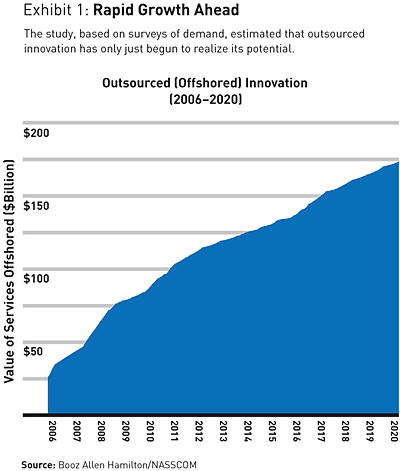
Offshoring of engineering activities has increased significantly in recent years across a range of industries, and will continue to expand in scale and sophistication, according to a new workshop summary from the National Academy of Engineering. The impact of offshoring has been mixed so far, with some U.S.-based companies benefiting while some individual U.S. engineers have lost their jobs or experienced slower salary growth, says the report.

Source for the figure: "Innovators without Borders"
by Kevin Dehoff and Vikas Sehgal
Strategy + Business