Showing posts with label Food. Show all posts

Monday, October 05, 2015

Improving Crop Yields to Respond to Global Warming and Population Growth


A couple of weeks ago there was an article in The Economist titled "Agricultural biodiversity: Banks for bean counters". I quote extensively from the article:
Climate change is expected to cause higher temperatures and more frequent droughts, changing the distribution of pests and diseases. Population growth will add to the pressure on productive land: the UN expects the number of people in the world to rise from 7.3 billion today to 9.7 billion by 2050. This, together with a switch to more meat-eating, will mean a big increase in the demand for food. The UN Food and Agriculture Organisation (FAO) says humanity will need 70% more food by then.
Dependence on a few staples worsens the consequences of any crop failure. Just 30 crops provide humans with 95% of the energy they get from food, and just five—rice, wheat, maize, millet and sorghum—provide 60%. A single variety of banana—Cavendish—accounts for 95% of exports. A fast-spreading pest or disease could see some widely eaten foodstuffs wiped out. 
That makes it even more important to preserve the genetic diversity found in crop wild relatives and traditional varieties as an insurance policy. Alas, much of it has already disappeared. The FAO estimates that 75% of the world’s crop diversity was lost between 1900 and 2000. As farming intensified, commercial growers favoured a few varieties of each species—those that were most productive and easiest to store and ship. 
According to Cary Fowler of the Global Crop Diversity Trust, an international organisation based in Germany, in the 1800s American farmers and gardeners grew 7,100 named varieties of apple. Today, at least 6,800 of them are no longer available, and a study in 2009 found that 11 accounted for more than 90% of those sold in America. Just one, “Red Delicious”, a variety with a thick skin that hides bruises, accounts for 37%. 
Meanwhile urbanisation, pollution, changing land use and invasive species are threatening the crop wild relatives that survive. A study in 2008 concluded that 16-22% of those related to peanuts, potatoes and cowpeas (a legume grown in semi-arid tropics) will have vanished by 2055 as a result of climate change.
So what if climate does change? Don't you just grow the same crops a few miles further from the equator? Well, what if the soils are different. What if there is not as much water in the new spot as the old one? What if you were on the western side of a hill, and the new spot is on the southern side, and the light conditions are different? What if there are different pests and diseases in the new spot? What if your machinery won't work as well in the new spot as it did in the old? I think that the world will need a lot of crop improvement to produce new varieties of major crops that will produce well under the new conditions.

One solution is pretty much out of the question. Most of the arable land is already in agricultural production. The world will no longer solve its food needs by putting unused arable land into production.

We could not do a lot be simply rationalizing our distribution and use of food. Obesity is harmful to the health of the obese as well as wasteful of food, and should be reduced globally.  Cows are a very wasteful way to produce protein as compared with legumes, and the fat intensive diet found in the USA not only uses a lot of land to feed cattle, a lot of grain to fatten them, but also results in poor health in people who have too much fat in their diet. It would be great if the world could rationalize protein production, getting those who eat too much animal protein to stop doing so, increasing the production of vegetable protein, and distributing protein more appropriately so that fewer people are protein starved and fewer people eat too much of the wrong kinds of protein.

Ultimately, we will have to have better varieties of food crops, and that means varieties with genes that better suit them to produce well in the places that they will be planted. Those genes can come from already domesticated plants, or from the much larger source in non-domesticated species. They can be transferred into new varieties of crops by mass transfers of genes as in traditional plant breeding, and then subjected to a long process of selection to weed out the genes that don't improve the variety. Alternatively they can be transferred by much more scientific and efficient processes of biotechnology. Society will choose. but I think I know the better way.

Tuesday, November 11, 2014

A Meta-Analysis of the Impacts of Genetically Modified Crops

"We carry out a meta-analysis of the agronomic and economic impacts of GM crops to consolidate the evidence....... 
"On average, GM technology adoption has reduced chemical pesticide use by 37%, increased crop yields by 22%, and increased farmer profits by 68%. Yield gains and pesticide reductions are larger for insect-resistant crops than for herbicide-tolerant crops. Yield and profit gains are higher in developing countries than in developed countries......... 
"The meta-analysis reveals robust evidence of GM crop benefits for farmers in developed and developing countries. Such evidence may help to gradually increase public trust in this technology."
Wilhelm Klümper and  Matin Qaim, PLOS ONE, November 3,2014
This is an in depth confirmation of the value of biotechnology applied to the development of improved crop varieties and agronomic practices. The scientific article is summarized in an article in The Economist. I quote also from that article:
Commercial genetic modification for crops comes in two forms. One makes them resistant to insect pests. The other confers tolerance to glyphosate, enabling farmers to spray their fields with this herbicide and kill off all the other plants (ie, the weeds) in them. As a consequence, the study found, herbicide-tolerant crops have lower production costs—though this was not true for insect-resistant crops, where the need for less pesticide was offset by higher seed prices, and overall production costs were thus about the same as for unmodified crops. With both forms of modification, however, the yield rise was so great (9% above non-GM crops for herbicide tolerance and 25% above for insect resistance) that farmers who adopted GM crops made 69% higher profits than those who did not. 
Many poor countries eschew GM crops, fearing they will not able to export them to areas which ban them, notably the European Union. This has a big opportunity cost. Dr Qaim and Dr Klümper found that GM crops do even better in poor countries than in rich ones. Farmers in developing nations who use the technology achieve yields 14 percentage points above those of GM farmers in the rich world. Pests and weeds are a bigger problem in poor countries, so GM confers bigger benefits.
Genetically modified crops, that is crops using cultivars that have had genes introduced by modern methods from biotechnology, have been used for more than two decades. To the best of my knowledge the regulatory methods to assure their biosafety have worked and there have been no health problems associated with the GM crops that are not also found with traditional crops; indeed they are probably safer. The research, as demonstrated by the meta analysis cited above, indicates that they produce more food and feed from the farmers fields and increase farmers incomes. Perhaps we need to reduce the fear that a portion of the public feels about these crops.

Saturday, October 18, 2014

Tuesday, October 14, 2014

Be thankful for artificial foods


Thanks to Calestous Juma for this infographic.

Sunday, September 14, 2014

Food Is Weird: Understanding Agriculture in the Developing World


In which John Green flies in a helicopter with Bill Gates in Ethiopia, investigates a new form of cursing, and discusses agricultural reform--specifically, how the UN's World Food Program is trying to improve maize yields in Ethiopia. If you can break the vicious cycle of low incomes leading to low harvests, agricultural productivity per hectare (NOT HECTACRE) can increase dramatically, as we've seen in China and Brazil. It seems boring, I know, but this is a big reason hundreds of millions of people have emerged from poverty in the past 30 years. So hopefully it will happen in Ethiopia! But, as usual, the truth resists simplicity.
This guy talks fast, and simplifies, but I think he is right about the fundamentals. Helping farmers earn more by growing more food that will reduce hunger is a very good thing to do, and it is basic to the social and economic development of poor countries. Since the poorer the country the greater the portion of its population is involved in low productivity agriculture, helping the poorest farmers to do better is a great tool to reducing extreme poverty.

One thing that the video does not mention is that it takes research and development to create the better seeds that John Green is talking about. It also involves technology to produce the fertilizer that farmers need. And there is technology needed to detect and deal with the pests and diseases that so frequently destroy crops in developing countries.

Behind every great man there is a good woman, and behind every successful farmer there is a good technology.

Sunday, August 31, 2014

With hunger a huge problem, don't spread false information on farming.


I am really annoyed by this article in The Guardian. I quote:
Kumar, a shy young farmer in Nalanda district of India's poorest state Bihar, had – using only farmyard manure and without any herbicides – grown an astonishing 22.4 tonnes of rice on one hectare of land. This was a world record and with rice the staple food of more than half the world's population of seven billion, big news 
It beat not just the 19.4 tonnes achieved by the "father of rice", the Chinese agricultural scientist Yuan Longping, but the World Bank-funded scientists at the International Rice Research Institute in the Philippines, and anything achieved by the biggest European and American seed and GM companies. And it was not just Sumant Kumar. Krishna, Nitish, Sanjay and Bijay, his friends and rivals in Darveshpura, all recorded over 17 tonnes, and many others in the villages around claimed to have more than doubled their usual yields........ 
That might have been the end of the story had Sumant's friend Nitish not smashed the world record for growing potatoes six months later. Shortly after Ravindra Kumar, a small farmer from a nearby Bihari village, broke the Indian record for growing wheat.
I suggest you watch this video from The Guardian which shows one of the farmers described in the article. It shows what seems to be a simple man proud of his accomplishments as a farmer.

This story got picked up by others. Here is a quote from one such follower:
Another Bihar farmer broke India’s wheat-growing record the same year. They accomplished all this without GMOs or advanced seed hybrids, artificial fertilizer or herbicide. Instead, they used a technique called System of Rice [or root] Intensification (SRI). It’s a technique developed in Madagascar in the 1980s by a French Jesuit and then identified and promulgated by Cornell political scientist and international development specialist Norman Uphoff.
Do you really believe that application of the farming system developed for growing rice could be used to grow wheat, and the result would be record yields? The article even suggests that it improved potato yields for another farmer.

Here is a report from a world leader in agricultural research, Achim Dobermann. I quote:
The Guardian article suggests that Mr. Kumar and other farmers achieved something beyond what can be achieved by scientists and GMO companies, and that they used only farmyard manure and no herbicides. The much more detailed article in Agriculture Today shows almost the opposite. No GM rice is grown anywhere yet. However, all five record farmers grew commercial rice hybrids from Bayer or Syngenta; their seed was fungicide-treated (carbendazim); they used intensive tillage (two deep plowings plus two puddling operations); they applied green manure, farmyard manure, mineral fertilizer (N, P, K), and other nutrient input products (poultry manure, vermicompost, phosphorus-solubilizing bacteria, micronutrient foliar spray of zinc sulfate); and some also used herbicide (2,4-D) for additional weed control. These are in fact very intensive input management practices, perhaps not something that many poor, small farmers could afford.
Here is the link to the Agriculture Today article mentioned.

I believe Dobermann and not the Guardian -- that the farmers used hybrid seed, both artificial and processed natural fertilizers, and chemical inputs.

Scientists from the International Rice Research Institute and from China doubted the accuracy of the yield reports.  Here is what Dr. Dobermann says in the article cited:
In summary, given what we know about the upper limits of nutrient supply from soils in that region, I conclude again that the actual yield may have been in the 10–12 t/ha range at best. Japanese researchers studying SRI fields in Madagascar have shown a clear linear relationship between nutrient supply (enhanced by deep plowing as also done in Bihar) and rice yield, irrespective of other SRI management practices, but also not exceeding yields of about 10 t/ha.
And this from an article quoting a distinguished Chinese scientist:
China’s most renowned agricultural scientist has described as “120 per cent fake” claims that farmers in Bihar harvested a world record 22.4 tonnes of rice from one hectare of land without using herbicides or genetically modified (GM) seeds last year. A national icon, Yuan Longping is known here as “the father of hybrid rice” for developing varieties that enabled China to transform its grain output. His rice varieties were subsequently introduced widely in the world, and marked a record yield of 19.4 tonnes a hectare.
OK, a few farmers in Bihar claimed huge yields in various crops. The claims were picked up and shared by politicians, newspapers, and various factions opposed to modern agricultural techniques. The farmers got famous, and at least one of them got prize money from the government. Clearly most of the people who picked up on the story spread false information.

This is not a critique of Oxfam and its Indian collaborating organization that provided extension services to the farmers promoting good farming practice. It is important in growing rice when you transplant, what density you plant at, how you irrigate your crop, how you treat the soil, how well you control weeds, what fertilizer you use, and how you deal with pests and diseases.

People should also recognize that improved crop varieties have been responsible for huge increases in crop yields. Among other things, varieties have been developed to provide resistance to diseases and pests and to utilize water and nutrients more effectively.

As the Indian farmers and extension workers recognize, there is an appropriate place for water and chemical inputs. As all recognize, good farming practice counts. Smart farmers use all the tools that they can get to efficiently increase the yield of their crops.

Scientific breeding has produced improved cultivars and they are important. Since the first domestication of crops, crop variety improvements have been sought, and they always come from genetic changes in the crops grown. Ancient practice was random and very slow. For most of the 20th century, scientific breeding was more directed by knowledge and faster than in the distant past; the development of hybrid varieties for some crops greatly improved the effectiveness of breeding of those crops. We have been dependent on hybrid corn (and chickens) for many decades. New techniques of biotechnology utilize even more knowledge, are still faster, and make fewer genetic changes to improve a variety; they are safer in part because the new varieties are so extensively safety tested.

As the world population moves to 11 billion by the end of the century, and as climate change increases and increases the challenges faced by farmers, lets not spread false information and fear about the science we need to feed people.

Saturday, August 23, 2014

Interesting Map -- Green is the Vegetable Intensive Diet.


Source: The Washington Post

If you grow corn, you can produce corn for human food, corn for animal feed, or corn for alcohol fuel. Presumably:
  • If people eat the corn grown of the farm, all the calories go to people. 
  • If animals eat the corn, how much of the corn goes to nourish people depends on which animals. If you feed the corn to a pet, none gets to people; if you feed it to chickens, it that corn produces a considerable amount of protein for people's nourishment; if you feed it to cows, less protein gets to people per bushel of corn.
  • If the corn is used to produce alcohol to be added to gasoline, it may help to get corn, beef, eggs, milk and chicken to market, but it doesn't do much for nutrition.
In poor countries, people eat a lot of plant food and little meat; the meat that they do eat is likely to be from animals that produce relatively more protein for humans per pound of feed. Thus they get a lot more calories out of the crops that they grow than we do.

Of course, food that gets to the food system does not all get to be eaten. There are a lot of losses from the farm to the table. (And not all the food that is eaten is used efficiently by sick people.)

If the world population keeps growing (and it is predicted to hit 11 billion by 22000, it may be appropriate to switch away from meat and get more of our protein from vegetables. That is probably a good idea for health anyway. Homo sapiens evolved as omnivores, not carnivores. The heavy meat diet that many Americans eat takes a tole on their health.

Monday, January 20, 2014

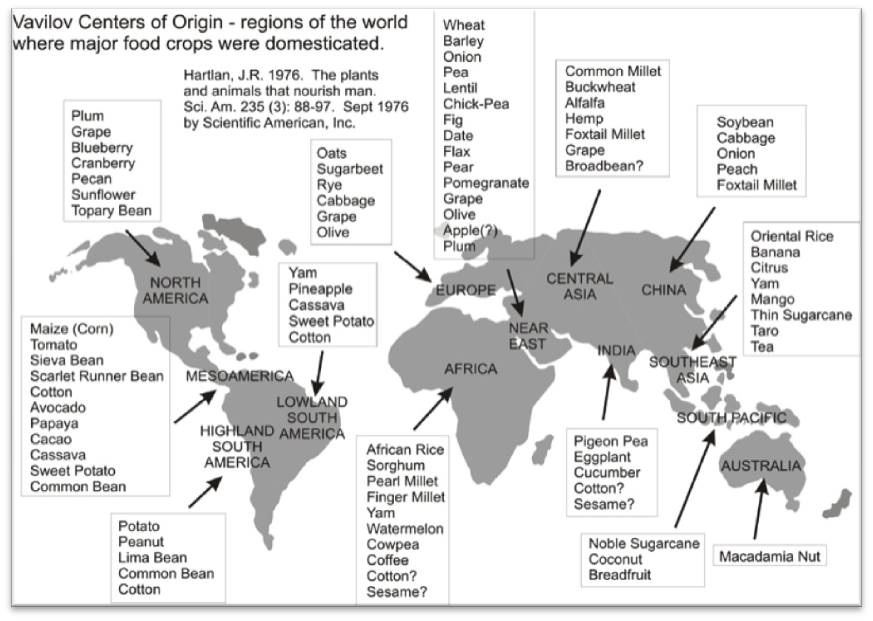
You Probably Owe More Than You Know to Other Parts of the World


 I am not sure that all of these are correct. For example, I thought apples were from central Asia rather than the Middle East. But the point is true that our food crops and lifestock were domesticated in many regions, and much of the progress of the world has come from the diffusion of high yield crops to new areas where they supported population and economic growth.

I believe that there are other crops that could be made to yield more and could bring increased productivity to new regions, but have been left behind.

Thanks to Calestous Juma for posting this.

Monday, August 27, 2012

Why do land prices vary so much across the world?


Source: The Economist
I quote:
The price of land in America’s corn belt is ten times greater than in Canada’s main farming provinces, now among the cheapest places in the world to grow grain. In Argentina, the government’s unpredictability has undermined investor confidence. Political uncertainty in Russia and Ukraine (not shown) has also kept farmland prices low, even though those countries are among the world’s most fertile.
One would assume that the price of land should reflect the income that can be generated from the land. At some level, the higher the agricultural yield from the land, the higher the price should be for the land. Land which is improved, for example land supplied by irrigation, also is worth more than unimproved land.

As the quotation suggests, the greater the risk to profit from the land, the lower the price; political risk is one aspect, but climate risk would also be counted by the farmers.

Other factors go into producing crops, such as seeds and chemical inputs and labor. The higher the productivity of labor, all other things being equal, one would assume the higher the value of the land.

It is also the case that markets for products count. If food prices are controlled at low values (e.g. to keep urban consumers happy), then the price of land is likely to be low as well. As transportation costs for grains dropped during the 19th century, the price for locally produced grains fell in England. That led to a drop in the price of farm land in England.

Still one wonders why there should be more than a 30 to 1 ratio between the lowest and highest price of land in the table. Could it be that there is still a lot of agricultural land in the world that is not producing nearly as much food as it might due to lack of investment, lack of use of the proper inputs, lack of mechanization, lack of good management, and poor agricultural policy?

Wednesday, July 18, 2012

Bad News on American Food Production this year.


Source: The Economist
I quote the explanation of these trends:
Barely a month ago American farmers were expecting bumper harvests and the prices of grains and oilseeds were falling. Since then a severe heatwave has hit the Midwest, wilting crops and sending prices soaring. Soyabeans have hit a record of over $16 a bushel. World stocks of the oilseed, which is crushed for animal feed, are already low following a drought in South America. Forecasts of end-season stocks in America, the biggest producer, have been cut by 7% in a month. The forecast for maize stocks has also been reduced since June, by 37%, and yields will be the lowest since 2003. Higher feed prices will depress American meat and poultry production, and are likely to affect other food prices as well.
This is not good news for the U.S. economy, which has enough problems already. It is unlikely to be a major problem at the American supermarkets since so much of the price of food here is packaging and distribution. Agricultural exports are also important in our balance of payments, and that also is a big problem.


The impact on poor people in poor countries will be hunger. Those folk spend a large part of their incomes on food, and the food they are able to buy is mostly composed of grains and legumes. The failure of the U.S. harvest will drive up prices for wheat and corn, but there is a substitution effect so the demand for other grains will also go up. The poor will take the blow in their wallets and in their stomachs.

Wednesday, August 24, 2011

The Price of Corn is Going Up

Source: The Economist
"The price of corn is up by almost a quarter since the start of the year, to around $7.30 a bushel and is forecast to keep rising."


My one day as a member of the Agriculture Policy Committee of the U.S. Government was marked by the discovery by another member that their previous decision on feed grains affected the price of food grains. Everything connects to everything else.


We may see the price of beef and poultry go up, and people in developing countries may see the prices of the basics of their diet go up because of the subsidies we are providing for the production of alcohol for fuel from corn.


"Next season, for the first time, more corn could be used to make ethanol than to provide animal feed."

Tuesday, December 21, 2010

The Economist Quarterly Technology Review

Last week The Economist published the latest of its great Quarterly Technology Reviews. These articles seemed especially relevant to this blog:

I want to comment specifically on Vertical Farming: Does it really stack up? The article describes efforts to build multi-story glass houses that produce crops hydroponically all year round and that can be located in cities where those crops would be consumed. It suggests that the energy costs of artificial lighting and other functions for skyscrapers that would be required to produce large amounts of food would be so great as to surpass the transportation costs of bringing food from outside the city.


The article points out that hydroponic farming in one-story glass houses can produce 20 times as much food per acre as traditional farming on the land. I conclude that there is a real opportunity for:

  • rooftop, sheltered, hydroponic gardening in urban areas, 
  • for school greenhouses, and even 
  • for urban hydroponic greenhouses that would serve as parks. 
There is also room for increases in peri-urban greenhouses that would have high levels of production and low transportation costs. This would be especially true if they could be located in areas in which transportation services used for people or other goods could be used without further energy input to carry produce to market.

Thursday, January 01, 2009

If you have bananas in the future, thank Uganda

Panama disease in Hawaii
Photo: Scot Nelson


Source: "Banana: R.I.P.: They're in trouble. Can biotechnology save the fruit?" Dan Koeppel, TheScientist.Com, 30 May 2008.

Bananas are grown from clones since the fruits are sterile. The bananas sold in the United States are of a variety called Cavendish. Fifty years ago the bananas sold in the United States were of the Gros Michel variety, but that variety was essentially wiped out by Panama disease - or Fusarium wilt of banana. There was some panic in the banana industry until the Cavendish was found that was both resistant to the disease and of adequate quality (although not as good as the Gros Michel). Now a new strain of Panama disease is wiping out the Cavendish in Asia and Australia. It is probably just a matter of time until it reaches the Americas, which are the source of bananas sold commercially here.

Biotechnology is a likely tool in the effort to save the commercial banana, and thus to save an extremely important export industry for a number of developing nations. Some initial success was achieved with rapid DNA screening methods for early detection of infection, but those have not been adequate in Australia where they were developed and used.

A better bet is GM plants, although it will be a major effort to develop varieties that are safe to eat, acceptable in taste and appearance to consumers, transportable, and commercially viable for the farmer. It may take even longer to get consumers to overcome superstitious fear of GM foods.

We could get along without bananas, but there are millions of people who depend on plantains, their close cousins, for their very survival. Plantains too are threatened by the Fusarium disease.

The article states:
Right now, regulations have prevented even publicly funded research organizations from testing more than a handful of transformed bananas in the field. Most of this research has been conducted under the auspices of Bioversity International, an umbrella group that works mostly on food security issues. The bananas being field tested were developed though a collaborative effort between Ugandan and Belgian scientists in Leuven, Belgium, and are being grown at experimental plots in Uganda, a country where about 80 percent of some local diets is made up of the fruit, and where the consequences of a banana wipe-out would be disastrous. The millions of people like those in Uganda who depend on bananas to survive would be the real beneficiaries of a better banana.

Transgenic plants in field, Uganda
Photo: Andrew Kiggundu

Monday, December 22, 2008

The ALLIANCE FOR A STRONGER FDA

The Bush administration has shorted the budget and staff of the Food and Drug Administration during its term in office. The Alliance for a Stronger FDA is trying to build public support to encourage the Obama administration to reverse the decline. Here is a quote from an Alliance publication:
In recent years, the public financial commitment, in the form of appropriations from Congress, has increased much more slowly than costs have risen. New challenges, such as protecting the public from avian flu and bioterrorism, have drawn additional funding from traditional activities. New public health initiatives have not received adequate financial support, including the Critical Path Initiative to modernize the drug development process. Other pressing needs are underfunded, such as helping consumers make sound dietary choices to prevent chronic diseases, and ensuring the safety of the vast array of products that FDA regulates. In addition, public confidence in the FDA needs to be maintained at the highest level. The FDA’s own Science Advisory Board has recently concluded the FDA lacks the ability to properly perform its job due to insufficient resources.
Comment: I would guess the first priorities are to improve guarantees that imported foods are wholesome to develop a system to monitor adverse consequences of uses of FDA approved drugs. JAD

Wednesday, July 30, 2008

More on the failure of the Doha Round

According to the Irish Times:
TALKS TO agree a global trade deal have collapsed, raising question marks over the future of the multilateral trading system established by the World Trade Organisation (WTO)

A bitter dispute between the US and India over safeguards to protect poor farmers in developing countries prompted the breakdown after nine gruelling days of negotiations......

Diplomats said the failure of negotiators to agree on the basis for a WTO deal in Geneva this week would result in at least a year's delay in the Doha round and could kill it off altogether. No further talks are expected before a US presidential election scheduled for November and analysts have warned that protectionism is taking root in many states.

Peter Sutherland, the Irish chairman of BP and a former director general of the GATT - the forerunner to the WTO - said the failure was bad for the global economy and held serious implications for the WTO institution and the whole concept of multilateralism.

"If states cannot even work together on something as obvious as world trade then how can we effectively address other issues that require a multilateral response such as climate change," said Mr Sutherland, who presided over the last global deal in 1994.

The breakdown in the talks came despite an earlier draft agreement between developed economies such as the EU and US and developing countries over the level of tariff and subsidy cuts in the agriculture and industrial sectors. But a dispute principally between the US and India - which also included Indonesia and China - over a safeguard mechanism to protect farmers in developing states from agricultural imports prompted the collapse.
Comment: The Irish, who should be pretty impatrial, seem to give half the blame to the United States, which I interpret to mean the Bush administration. My sympathy does go out to the poor farmers in India and China, who are often just surviving, and would have a tough time dealing with unrestricted competition in some cases. JAD

Saturday, May 31, 2008

Lost Crops of Africa

Friends and colleagues at the National Academy of Sciences have produced a long series of monographs on underexploited technologies with potential economic value for developing nations. Under the leadership of Noel Vietmeyer and Mark Dafforn, the series explored plant and animal species and varieties that might be used to greater advantage if further developed and more widely exploited. I note especially the three volumes on Lost Crops of Africa:

Tuesday, October 16, 2007

World Food Day

Today is World Food Day. It is a day not only to remember that there are 800 million hungry people in the world -- more than the total populations of the United States, Canada and western Europe -- but to resolve to try to do something to help.

I note that the United States, which is the major donor of food aid, has cut the amount of grain provided in that aid in half since 2000. The Bush administration has other priorities!

Food aid is tough to use well. Too often in the past it has been used as a means to subsidize farmers in this country while undermining farmers in developing nations by giving the consumers in their markets free food. It can also be appropriated by the wrong people and used for evil ends.

But it can be very useful, making up for shortfalls in food production due to floods or droughts, supporting people in emergencies such as the one occurring in Darfur, or as compensation for subsistence farmers diverted from their farming for useful projects such as road construction or soil conservation,