Showing posts with label Knowledge Systems. Show all posts

Monday, June 29, 2015

The Future is Now, and Watson is its Name


Tina Cascone demonstrates Watson, officially the Oncology Expert Advisor,
at MD Anderson’s leukemia treatment center in Houston. 

There was an interesting article in The Washington Post yesterday about the extension of the Watson computer system of IBM to the field of Cancer diagnosis.
IBM is now training Watson to be a cancer specialist. The idea is to use Watson’s increasingly sophisticated artificial intelligence to find personalized treatments for every cancer patient by comparing disease and treatment histories, genetic data, scans and symptoms against the vast universe of medical knowledge. 
Such precision targeting is possible to a limited extent, but it can take weeks of dedicated sleuthing by a team of researchers. Watson would be able to make this type of treatment recommendation in mere minutes.

The IBM program is one of several new aggressive health-care projects that aim to sift through the huge pools of data created by people’s records and daily routines and then identify patterns and connections to predict needs. It is a revolutionary approach to medicine and health care that is likely to have significant social, economic and political consequences. 
Lynda Chin, a physician-scientist and associate vice chancellor for the University of Texas system who is overseeing the Watson project at MD Anderson Cancer Center, said these types of programs are key to “democratizing” medical treatment and eliminating the disparity that exists between those with access to the best doctors and those without.
And:
Originally made up of a cluster of supercomputers that took up as much space at IBM as a master bedroom, Watson is now trimmer — the size of three stacked pizza boxes — and versions of it live in the server rooms of IBM’s various partners.
And:
Among the most ambitious (of the Watson Cancer related) projects is a partnership with 14 cancer centers to use Watson to help choose therapies based on a tumor’s genetic fingerprints. Doctors have known for years that some treatments work miraculously on some patients but not at all on others due to genetics. But the expense and complexity in identifying genetic mutations and matching them up with potential therapies has made it difficult for more than a handful of patients to benefit from this new approach. The service is scheduled to launch later this year. 
Meanwhile, Watson is continuing its on-the-ground training with cancer specialists. 
In 2011, IBM announced that Watson had learned as much as a second-year medical student. Since then it’s graduated and has been doing residencies at some of the nation’s top cancer centers, including Memorial Sloan Kettering in New York and the Cleveland Clinic. In late September, Watson achieved another training milestone: It began its first fellowship in a specialty — leukemia — at MD Anderson.
When Watson beat the best humans at a television quiz show, the capability of the approach was demonstrated. Now we see this advanced computer processing approach applied to problems of real importance. With its natural language capabilities, Watson can "read" and organize vast quantities of textual information, such as that from medical journals. With its very high speed (as compared with human thought) Watson can search its data base for information relevant to a specific issue/question -- in this case, "what is the appropriate treatment for this cancer in this patient".

This looks like an important amplification of human intelligence. I wonder where it will be used next -- foreign policy, intelligence analysis, where?

Sunday, June 14, 2015

How Accurate Are DNA Identifications/


As I understand it, courts sometimes use DNA identification to incriminate or clear suspects. Material found at the scene of a crime is found to contain human cells, the DNA is identified, and then compared with the DNA of a suspect.

Popular sources seem to suggest that it is very, very unlikely that two people have identical DNA, or that the wrong person will be identified from a DNA test.

Lets say that the laboratory reports back that the suspect's DNA matches that of the sample from the scene. What does that actually mean?

According to Wikipedia:
Monozygotic twinning occurs in birthing at a rate of about three in every 1000 deliveries worldwide.
So, as I understand it, 0.3 percent of individuals in the population share identical DNA with an identical twin. Unless the existence of such an identical twin can be ruled out, the most one can say is that there in not more than one chance in 333 that someone else left that specific DNA trace at the scene of the crime.

Say that investigators try to rule out the possible existence of a monozygotic sibling. We know that mistakes happen in hospitals and that there are other ways that twins are separated at birth without their ever later learning of that occurrence. So, even if efforts have been made to assure that the individual in question does not have an identical sibling somewhere, that investigation should not be considered absolutely conclusive.

Add in the possibility of error in the lab -- mixing up the crime scene sample with that from another crime scene, mixing up the suspect's sample with that from another person, mistakes in reading the DNA test results, deliberate falsification of the findings. The confidence provided by DNA testimony goes down further.

How about the possibility that the DNA sample taken from the crime scene is not that of the person who committed the crime, but that of some other person? Is it not possible that that does occur? How would you estimate its probability?

How many judges or jurors would be able to really understand the testimony of a DNA witness, properly estimate the probability of a suspect being responsible for the crime from the DNA evidence alone, or able to combine the probabilities arising from the DNA evidence with that from other sources (eye witness testimony, circumstantial evidence, exculpatory evidence offered by the defendant, etc.?

I am not comfortable with the accuracy that the judicial process might achieve in cases involving DNA evidence. Still, such evidence obviously should influence verdicts if available. The question is how to be sure that it appropriately influences verdicts.

Tuesday, March 10, 2015

The Great Caliphates -- The time of Huge Islamic Empire and Muslim Leadership of World Knowledge


I have just finished reading The Great Caliphs: The Golden Age of the 'Abbasid Empire by Amira K. Bennison. There is an earlier post on the book.

The fifth chapter of the book focuses on Islamic knowledge during the time of the Abbasid, Umayyad and Fatimid Caliphates. The Caliphates began in the European "Dark Ages", and were for a time the repository of much of the world's advanced knowledge.

Of course, the Koran is the key source of Islamic knowledge, regarded as the revelation by God to the Prophet Mohammed. However, you have to know how to read to understand the Koran, and early in the days after Mohammed there was an effort to translate books that would help in the understanding of the Koran. (Think of the reading comprehension tests we give to school kids who "already know how to read" to test how much they understand of what they do read. Think of the task of the Supreme Court to figure out the intent of laws and the intent of the Constitution, and thus whether the law is in contravention of the Constitution.)

In addition, especially in the early days of Islam, there was an effort to document the practices of Mohammed and the Muslims he gathered around him as well well as to record his teachings (the Sunna and the Hadiths). Bennison describes a process in which scholars first sought to record the things that could be remembered by people who lived around Mohammed and who actually heard him speak, then the memories of people who had the information from direct sources, and ultimately from sources further removed. This then led to a work of scholarship to identify the sources and statements that were truly reliable and to screen out those which were likely to have been added in error. Bennison goes on to describe the further interest in the tools of logic and analysis that had been earlier developed and were available from Latin, Greek and other sources (involvinging translation into Arabic). This, according to Bennison was followed by elaboration of several major schools of jurisprudence in Islamic Law. (Remember, that Islam in western terms is both a religion and a system of government, with Islamic law governing what most Americans would regard as aspects of secular behavior as well as religious behavior.)

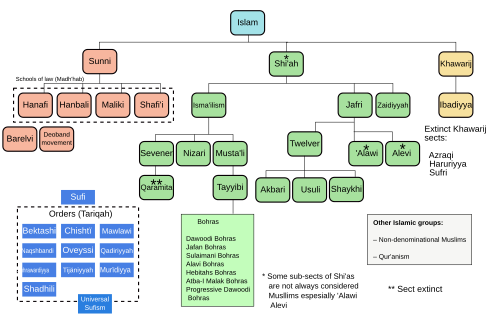
Overview of the major schools and branches of Islam
Source: Wikipedia
Somehow I had an impression before reading this book that being a Muslim was primarily a function of behavior -- the Five Pillars of Islam. Bennison writes about theological arguments and debates, and logic and philosophy being studied to add rigor to Islamic theology. Having read the book I came away with feeling that there was some parallel among the early Jewish efforts to put together what we now think of as the old testament of the bible, the early Christian efforts to put together the new testament of the bible, and the Muslim efforts to put together the Sunna and the Hadiths -- each community of faith seeking to establish the most accurate and reliable record of the founding documents of their faith.

The book goes on to discuss the major effort of translation that was undertaken in the Caliphates. Geometry and mathematical texts from other cultures were translated to support the work of government officials (e.g. taxation) and those constructing canals and other "engineering" and building works. Astronomical texts were translated to support the work of Islamic astronomers who made observations and updated calendars. There was also translation of astrological works and other works which we would now see as pseudo- or pre-scientific.

Al-Farabi statue at al-Farabi Kazakh National University

Bennison goes on to describe the original work in philosophy, theology and science of Arab scholars of the time, especially those who synthesized large bodies of knowledge, some of whom became known in the west (e.g.  Ibn Rušd or Averroesibn Sīnā or Avicenna and al-Farabi) While hundreds of these early Islamic savants are known to history, their numbers are tiny compared to the global scientific and scholarly workforce today. On the other hand, these men saved much of classical knowledge, storing it in numerous libraries during the "dark ages" of Western Europe so that it became available to Renaissance scholars when the rest of the world was ready to resume the march of knowledge.

This chapter was hard to read in that it identified a lot of books by authors I did not know, with only the sketchiest description of their contents. The chapter made the point that there was an intellectual explosion at the time, but left me unsure of its content and somewhat confused.

I also wondered about the practical technologies. I assume that there was a spread of agricultural technologies; as Jared Diamond points out, these could spread more easily east-west in the Eurasian land mass than in other regions of the world. and that spread contributed to economic development. Textiles were perhaps the leading industrial product of the time; was there a development and spread of textile technology via the trade routes of the Caliphates? How about the building technologies of the Romans, and especially their road building abilities, How about the qanat technologies of the Persians and other irrigation technologies; were Egyptian water raising technologies spread or the Archimedes' screw. Was there development of camel-based transportation technology and routes that enabled the Berbers and Arabs to extend trade and Islam through the Sahara? The book points out that the Arab-Muslims early developed naval power in the Mediterranean and sea trade in the Indian Ocean, but how did ship building technology progress in the time of the Caliphates? Geography must have progressed given the travel and trade of the time, but the work of al-Idrisi is only mentioned in passing late in the book. Perhaps I am simply recognizing a limitation of the sources from the historic record; perhaps people didn't write about such things or the records did not survive.

The final brief chapter of the book deals with the legacy of the Caliphates. As happens with empires, they grow and then decline. The Caliphates were created by Arab-Islamic conquerors. The ethnic Turkish military that the Abbasid Caliphs eventually depended upon became the basis of the Ottoman empire. Mongols took over much of the eastern Abbasid empire, becoming Muslims themselves in the process; eventually the last Caliph was killed by a Mongol ruler. Christians reclaimed Spain and Sicily from Arab-Muslim control. Thus, one can see political legacies of the Caliphates even as the Arab-Muslim political control of the huge region of its former empire declined.

Perhaps more important was the intellectual legacy. As Christians reconquered Spain, for a while there was a vibrant community of Arabs, Jews and Christians who translated great books from Arabic into Latin (see The Ornament of the World: How Muslims, Jews and Christians Created a Culture of Tolerance in Medieval Spain by Maria Rosa Menocal). The Arab learning may too have stimulated a rebirth of interest in ancient knowledge and the development of new knowledge in Byzantium, and knowledge from the Caliphates found its way into humanist hands triggering and fueling the Renaissance.

I found this book of considerable value in broadening my view of early Islamic history and the debt that the world owes to the Caliphates. I would have liked to see a glossary, and perhaps more visual aids but that is quibbling with the author's choices which overall led to a short book full of information that many readers from the West will not have previously known.

Monday, October 06, 2014

How good is the legal knowledge system?


In a post yesterday I wrote about the way scientists seek to validate hypotheses by finding experiments that might disprove them. If scientists find many hypotheses that follow from a theory and are unable to find evidence that any of them are false, then the confidence in the theory increases. Moreover, scientists replicate each other's work to assure that no errors creep in, and their work is subject to peer review.

I recently heard a very experienced FBI agent discuss how he and a task force he had led conducted a major investigation. I suppose that like all mystery readers, I recognize the detective looks for motive, means and opportunity. I also know the distinction between a "person of interest" and the "suspect", where the law enforcement officers restrict the use of the term "suspect" to those believed to be more likely to have committed the crime.

In the case being described there were apparently a couple of thousand suspects, all of whom could have had motive, means and opportunity.

The FBI agent said that, on the basis of analysis provided by an informant, he became convinced that a specific suspect was indeed the guilty man. At that point, the investigation was transformed in character, and the task force concentrated on finding evidence that would stand up in court to convict that one suspect. I don't see a better alternative, but there is something suspect about an investigation that seeks evidence to demonstrate a preconceive idea.

The protection -- in theory -- in our legal system is that there is an adversarial process in which lawyers for the prosecution and defense both have full access to all the evidence that has been collected by law enforcement. The defense lawyer can also develop and present independent evidence supporting the innocence of his client. Finally, a defendant is not to be convicted of a crime unless guilt is proven beyond a reasonable doubt, as determined in a fair trial.

In the example given by the FBI agent, justice was probably done. Still, one wonders if the defense could muster resources comparable to those of the government's task force, and whether judgement of the existence of reasonable doubt is always adequate.

Are there cases when an innocent person accepts a guilty plea to a lesser charge in order to avoid a trial that he/she can not afford to lose, and can not afford to get the best defense?

The legal system I suppose provides "good enough" decisions on guilt, but the epistemology is not as strong in my opinion as that of the scientific system.


Tuesday, July 29, 2014

Naomi Oreskes: Why we should trust scientists


This blog is about knowledge, and its application for development. In my posts I have from time to time suggested that knowledge attested to by the scientific community is worthy of your credence, that it is more likely to be true than knowledge from many other sources. In this brief video talk, Naomi Oreskes explains why that is true.

Tuesday, May 20, 2014

Why people don't believe what the evidence indicates to be true


There is an interesting New Yorker article that deals with the persistence of false beliefs. I am going to do violence to the article's thesis, but my take on it is as follows:
Take a proposition A. If you feel that you are the kind of person who believes proposition A, it will be hard to get you to believe proposition A is not true by citing evidence or emotional appeals to the dangers of acting in accord with belief in proposition A. If proposition A is simply a value free statement, the belief can easily be changed.
So a statement such as "Malaria was a significant cause of illness in Michigan during the summers in the early 19th century" might be thought to be false, but that belief might be easily changed by reading a historical account stating it to be true.

On the other hand, if you understand yourself to be a strong partisan of your political party, and if you feel that a certain position on climate change is a fundamental tenet of your party,  it may be very hard to get you to change your position on the reality of climate change. Republicans tend to deny human action is causing global warming, but may freely acknowledge that many scientists publicly endorse that belief.

If you feel that your religious affiliation is a fundamental element of your personal identity, and if you feel that a tenet of your religion is the literal truth of the biblical creation story, it may be very difficult to get you to believe in the "big bang theory" and evolution. Indeed, educated Christian fundamentalists will often report that scientists strongly support the big bang theory and the theory of evolution,  but they themselves -- the Christian fundamentalists -- do not believe them.

This is a very different situation that scientific skepticism. Scientists should demand evidence supporting a proposition before they give it credence. They should demand replication of experiments to assure that specific experimental results are neither the result of experimental error of statistical anomaly.

So too, scientists should retain skepticism of even well supported theories. Thus, scientists should be willing to reject a long held theory if a better one comes along. Even Newton's theory was replaced by Einstein's after hundreds of years of evidence supported Newton. Einstein's theory provided predictions consistent with Newton's in most circumstances, but Einstein suggested experiments that would distinguish between the two theories and his theory's prediction proved more accurate for those instances.

Monday, August 01, 2011

Some thoughts about classes of knowledge

One of the definitions of technology is the organized body of knowledge underlying the ways we make things and do practical, productive things. Whether or not you like that definition, I want to think about that body of useful knowledge.

Source
There is also a body of fundamental knowledge about nature, man and society, prototypically scientific knowledge. We normally think of pure science as not useful, not technological. However, I would suggest that the two bodies of knowledge are not mutually exclusive. For example, human anatomy is both fundamental knowledge and, when in the hands of a surgeon, knowledge applied in making effective medical interventions. Human anatomy, although applied by artists and sculptors to make their products more lifelike, could not be applied widely and effectively for surgery until there were developments of anesthesia and antisepsis.

I think this situation in which knowledge exists which can not be applied applied without the development of complementary knowledge may be fairly common. Think for example of the development of electricity, where people had to discover how to generate electricity relatively efficiently from mechanical energy produced by steam engines, how to transmit it relatively efficiently, and how to transform electrical energy into something really useful (electric light) before commercial electrical systems became feasible. So too, they had to learn how to transform electrical energy efficiently back into mechanical energy before it could be applied to locomotion (trolleys, electric locomotives) or to power machines (made possible by knowledge accumulated in the industrial revolution).

Incidentally, there are many situations where technological knowledge exists and is used without much understanding of the fundamental phenomena that underlie its utility. Acupuncture works, but with due apologies to its practitioners, I doubt that we understand why. Great swords were made for centuries, by sword makers who understood very little metallurgy. Gothic cathedrals were built in the middle ages by masons who had very little understanding of the physics of mechanical forces.

There is considerable interest now in translational knowledge, that which must exist or be developed before fundamental knowledge can be applied in the form of practical technological knowledge. We know that stem cells have the potential to be used therapeutically in applications such as spinal cord repair, but we don’t have the knowledge of how to actually to do that. I suppose that, in the campaign to eradicate smallpox, while the vaccine was available for a long time, translational knowledge had to be developed as how to apply the vaccine efficiently, how to deliver it in usable form in the difficult conditions of poor tropical countries, and especially how to run an eradication campaign effectively in difficult conditions.

Potentially useful knowledge that can not be used, may well be lost. Think of Mendel’s knowledge of genetics that could not be used well until the evolutionary synthesis, which lay buried in old journals until it was rediscovered many decades later. Think of the knowledge that Babbage and Lady Lovelace created that was buried until the development of electronic computers made it viable for productive purposes. Penicillin was discovered decades before Fleming rediscovered it, but could not be utilized until experts in commercial fermentation discovered a commercially feasible way to produce the antibiotic.

Sometimes the limitations on the utility of potentially practical knowledge are social and/economic. World War II provided the conditions that made it necessary and possible to develop penicillin, radar, computers and other technological knowledge. Gutenberg found conditions suitable for the development and dissemination of printing technology; earlier printing was developed for the production of amulets containing verses from the Koran, but the conditions for the further development and dissemination of the technology did not exist and the knowledge was lost.
Source: Martin Roell

We know that there is an important difference between technological innovation and technological invention. The first is economically important, and usually the result of first utilization of an existing technology in a new situation; technological innovation involves more fundamental novelty such as that needed to justify a patent granting monopolistic use of the knowledge. The point I would make is that the productive application of existing knowledge in a new situation in a developing nation may be limited not only by the lack of a supporting social and/or economic matrix, but also be the lack of the requisite complementary knowledge in the community of interest. Indeed, once useful knowledge that existed in the past in now rich countries, that has been lost, might still be used productively in poor countries were the propitious social and economic conditions now exist.

The development of the appropriate knowledge systems, and the dissemination of the appropriate complementary and fundamental knowledge for the application of innovative technological knowledge in poor nations may be more difficult and more important than is generally recognized in the development community.

Saturday, July 30, 2011

The quality of scientific knowledge (and engineering knowledge)

Sir Paul Nurse on the Charlie Rose show

Nobel Prize winner, Sir Paul Nurse says that there are three key aspects of science that result in the high quality of scientific knowledge:
  1. Scientists seek to incorporate huge amounts of experience in their theories.
  2. Scientists are skeptical.
  3. Scientists work as a community, so that when a consensus emerges from the debates among a large number of skeptical scientist it is likely to be especially trustworthy.
People too often reject negative information. Science is built on the idea that all hypotheses should be refutable, and indeed that experiments must be made and replicated in an effort to refute hypotheses. Indeed, the greatest kudos go to scientists who successfully challenge the most widely accepted “common knowledge”. Think about Darwin and his challenge to the Great Chain of Being, Newton and his challenge to the rejection of action at a distance, or Einstein and his challenge to Newtonian physics.

Scientists ideally attribute only a limited credence to the best established scientific facts and very actively seek to challenge new experimental findings by replicating experiments and observations; they also actively seek to challenge the interpretation of observations.

When a theory has been tested by the generation of very many hypotheses generated from the theory, each of which has survived many replications of experimental observations intended to falsify the hypothesis, and each of which has survived scientific challenges of the interpretation of theory into hypothesis and hypothesis into observation, then that theory gains credence.

On the other hand, engineering knowledge gains credence when the bridge stands for a century carrying heavy traffic, or when a chemical processing plant has produced ton after ton of product safely and efficiently for a decade or two. Engineering knowledge is codified in codes of practice, both legal and professional, in standards, in formal training programs, and in long processes of apprenticeship for the transfer of tacit knowledge, 

Thursday, June 24, 2010

Book distribution as an element of cultural diplomacy


There is a new book out:
BOOKS AS WEAPONS: Propaganda, Publishing, and the Battle for Global Markets in the Era of World War II by John B. Hench
There is a streaming video of an interview with the author on C-SPAN and a useful review of the book.

Hench describes a program of the U.S. Office of War Information during and immediately after World War II to distribute books published in the United States to Europe to improve the understanding of European intellectual elites of the United States, its culture, and of the development of the U.S. culture during the war years when communication had been cut off. The program is compared with efforts of the United Kingdom and meant to counteract the propaganda about the United States that had been disseminated by the Nazis.


This program is part of what I (and many others) would term "cultural diplomacy". Dick Arndt's book, The First Resort of Kings: American Cultural Diplomacy in the Twentieth Century, is I believe the definitive history of U.S. efforts in cultural diplomacy.

I would point out that UNESCO was created with part of its mission to counteract propaganda. Thus with strong U.S. support, one of UNESCO's first post war programs reviewed text books used in Europe in order to remove falsehoods and other propagandistic elements that had been introduced by the fascists.

Hench points out that sales of U.S. published books in post-war faced the challenge of the poverty of Europeans whose national economies had been wrecked by the war. UNESCO sought to help Europeans get access to text books through a vouchers program that allowed purchases with local (ofter heavily devalued) currencies.

Hench does not focus on the post war programs for the distribution of books. Had he done so he might have learned from the evaluations of such programs. Indeed, he seems not to be aware of the number and nature of such programs. There is a good report from the Library of Congress (U.S. Books Abroad: Neglected Ambassadors by Curtis Benjamin) on U.S. international book programs that you might find useful.

One of my favorite programs of this kind was the Regional Technical Aids Center project (in two phases: RTAC I and II) supported by USAID. That program was run for more than 20 years to provide U.S. text books, translated into Spanish, to Latin America. Several evaluations are available from the USAID Development Experience Clearinghouse (do a search on the Clearinghouse database to find them).

It seems to me that the distribution of books published in the United States can have a huge impact improving the understanding of the United States by the intellectual leaders of other nations, and especially the positive opinions of Americans and U.S. culture. This will happen best if the distribution is not undertaken as propaganda managed by bureaucrats to achieve a desired effect, but rather as an effort to make the best of American non-fiction and fiction available to those who have a need or an interest in the works.

Monday, June 21, 2010

A thought about research on mental illness


Homeostasis is the property of systems, especially applied to biological systems, that regulates the internal environment in order to maintain stable, constant conditions. It has been suggested that the nervous system, faced with psychotropic drugs, will invoke homeostatic mechanisms that return the action of the nervous system to its pre-drugged condition. You can see that such a mechanism would be useful if for example a person with a normal brain were to accidentally ingest a substance which included a component that affected perception or brain functioning. It has been suggested that medication of people exhibiting symptoms of mental illness might trigger such homeostatic mechanisms that would over time return the brain to its pre-medicated conditions of mental illness.

The "gold standard" for assessing the safety and efficacy of a new drug is the randomized, double blind case control study. These studies are expensive and are time limited. It has been suggested that such a study of continuing medication with a psychotropic drug might show results that would, were the study continued long enough disappear due to the homeostatic systems of the nervous system. However, if the homeostatic mechanism were to require some years to function, most case-control studies would miss the effect due to early termination. Thus drugs might be approved on the basis of short term effects that would not be useful for long term use, and indeed might be counterproductive.

What do you suppose the medical profession would do if, after some years of use, such drugs were challenged? The practitioners would have experienced the short term efficacy with their patients, who would leave care or would be seen to have relapses. It seems to me that the common perception would be that the drugs were efficacious. Moreover, the group-think of the clinical community would tend to respond negatively to what it might perceive as a challenge to its common knowledge and general practice. The response of the drug companies profiting from the sale of the drugs and faced with possible liability were it proven to be of limited use or indeed capable of worsening the presenting condition can easily be imagined.

One public protection against such situations would be good medical records and systems for tracking the long term success of patients with chronic conditions receiving long term drug treatment.

Monday, June 07, 2010

What is good journalism

Good journalism, according to Carl Bernstein, is "a simple matter but difficult to achieve", namely "trying to obtain the best attainable version of the truth."

I wonder if, in that definition, it might be better to replace "version" with "approximation". I am not sure I like the idea that there are different versions of truth, other than the different versions that different people might hold of the same truth.

I also wonder if the function of the journalist is simply to "obtain" that approximation rather than to convey the information that would enable the public access to the best approximation of truth.

The truth about what? Bernstein is famous for his work with Bob Woodward in exposing the Watergate conspiracy. Using that as the example, consider several truths:
  • The truth about the event of June 17, 1972 in which a group of men broke into the offices of the Democratic National Committee.
  • The truth about the effort of the Republican campaign officials to obtain information about the Democratic plans for the election campaign.
  • The truth about the efforts of Republican campaign officials to use unfair and sometimes illegal steps to ensure a win in the election.
  • The truth about the overall efforts of the Republican campaign in the election.
  • The truth about the role of President Nixon and his inner circle of White House advisors to subvert election procedures and then to cover up what they had done.
  • The truth about the weaknesses in our democracy that if corrected might prevent such abuses in the future.
Some of these "truths" would be instrumental in revealing others. Some of these truths seem more important than others. Perhaps good journalism is revealing the best available approximations of a series of truths to create an effective narrative to help the public understand an important issue of public policy.


Tuesday, May 25, 2010

A thought about UNESCO and the Knowledge Society

I like to think of information as that which is transmitted from source to receiver, from person to person. Knowledge is an internalization of information. I know something or I do not. I may not understand or remember information that is provided to me.

UNESCO and the ITU held the World Summit on the Information society in the last decade. The International Telecommunications Union naturally focuses on information, for that is what is transmitted through telephone systems. I suggest that UNESCO also has a focus on information within its communications and information program, but the more important cross-cutting theme of UNESCO is knowledge.

UNESCO's flagship program, the education program, seeks to improve knowledge by helping people to learn. Interestingly, it also these days includes an emphasis on "information literacy", or the ability to judge the credibility of information and information sources.

UNESCO's science programs can be seen as promoting the global scientific system's ability to generate high quality information and the ability of that system to organize knowledge.

In my opinion, one of the most important aspects of UNESCO's culture program should be to promote cultural change that strengthens information and knowledge related institutions while fostering appropriate values and attitudes towards knowledge.

A key element of the overall program of UNESCO is to promote the improvement of knowledge in the societies of member states about the societies of other member states, and to do so in ways that promote peace.

Thus it seems to me that promotion of knowledge societies might be seen as a cross cutting priority of UNESCO -- an area in which synergies among its programs can and should be fostered.

Friday, May 14, 2010

Video: Science as a way of knowing / Skepticism as a way of deferring knowing


Video: Science & Skepticism

Posted using ShareThis

Eugenie Scott, the Executive Director of the National Center for Science Education, discusses science as both a method and a body of knowledge obtained via that method, and as such as a way of knowing. She describes skepticism as a process of deferring judgement until adequate evidence allows reasonable certainty, and thus as a way of deferring knowing.

I found this useful, but also was annoyed by some of the simplifications. Especially:
  • A lot of science is simply observation and the recording and sharing of observations. Think of astronomy or systematic botany.
  • A lot of science is taxonomy -- grouping observations into classes based on similarity. While this is obvious in systematic biology, think of Newton. He had the great insight that the falling apple and the orbits of the planets were similar processes, to be explained by a common theory.
Dr. Scott stressed testing of hypotheses, which of course is also a very, very important aspect of science.

I might have stressed more the social construction of scientific knowledge than she did, recognizing that authoritative scientific knowledge is based on the sound functioning of the institutions created in science to warrant scientific statements.

Monday, May 03, 2010

Knowledge, Rights and the Desire for Knowledge

I have been posting on the general topic of knowledge for development for some years now. I tend often to focus on knowledge for economic development. I believe that knowledge of resources, of how those resources can be used well to produce goods and services, and about the institutions involved in the economy can be used at all stages in economic development to increase productivity and improve the physical conditions of life.

It seems clear to me that knowledge can also be a key factor in political development. I think the American founding fathers had it right when they said that governments are instituted among men in order to secure their rights, and people need to know how better to do so, and how better to manage their governments. Knowledge is the key to good government policies, and that transparency that allows people to know about the actions of those with power helps to control the corruption that so negatively affects governance in so many societies.

I suggest that knowledge is also central to social and cultural development, and indeed a population in which knowledge is widely spread and valued seems to be an important index of social and cultural development.

I see the rights to create and share knowledge as being fundamental, and of course instrumental to development. Freedom of investigation and freedom of speech seem obviously both intrinsically and instrumentally valuable.

It seems to me that many people in many countries are willing to trade these freedoms for security. Of course, there are survival needs that take precedence over the desire for knowledge and freedom if survival is threatened. Does the starving man stop the search for food to have a stimulating conversation? However, people seem often willing to give up knowledge-related rights for comfort rather than survival.

Of course, rights to knowledge should be but often seem not to be combined with a thirst for knowledge. That thirst is a cultural trait, and the respect for cultural diversity would seem to be perverted if it is interpreted as a relativistic acceptance of passivity in the acquisition of knowledge.

Why do some cultures incorporate a thirst for knowledge -- think of Jewish or Hindu. Why has anti-intellectualism been characteristic of so many Americans for so long a time? How does one attack American black culture's too frequent attribution of a thirst for knowledge in its young members as selling out to the larger society? Why do schools so often dampen children's thirst for knowledge rather than reinforcing it?

Of course some answers are easy. The thirst for knowledge should be encouraged in the young, not discouraged. The knowledgeable and wise should be respected; those who acquire and utilize knowledge for development should be encouraged, not discouraged. Yet where do people start, especially in those societies in which the power elite have developed anti-knowledge policies and institutionalized anti-knowledge practices?

With half the world's population, some 3.5 billion people, living at the threshold of survival, how do you empower poor people in poor countries to want more knowledge?

Perhaps knowledge for development policies should be based on approaches which combine:
  • cultural approaches to increasing the thirst for knowledge
  • socio-economic approaches to giving people the luxury of searching for knowledge without endangering their very survival
  • political approaches to dis-empowering those who would deny their fellows access to knowledge or benefits from the utilization of the knowledge they acquire.


Monday, February 01, 2010

Intelligent Design on Trial

I saw a rerun of the NOVA program that devoted two hours to the court case in which parents sued the school board of a small town in Pennsylvania to prevent the teaching of "intelligent design" in their schools. The court found that Intelligent Design was a rerun of "Creationism", a Christian belief that the Old Testament is literally true and that modern scientific theories of evolution were not. A Supreme Court decision had already decided that teaching Creationism violated the Establishment clause of the U.S. Constitution, and the court decided that Intelligent Design did so as well.

Both Creationism and Intelligent Design are based on the premise that species did not evolve by natural variation and natural selection, but rather that species arise from time to time independently, fully articulated, by divine or at least intelligent design.

I tend to like the position which I understand to be that of the Catholic Church, that if ones religious beliefs conflict with ones understanding of the natural world, as informed by science, one has probably misinterpreted the theology or the science.

I was most impressed by the obvious unwillingness of the proponents on Intelligent Design in the local community to acknowledge that they did not fully understand the Theory of Evolution. They seemed more certain of their theology than I could imagine was justified by their study of religion; certainly many people who have devoted their whole lives to the study of Christian theology are much less certain than these Pennsylvania businessmen. I was especially taken by the willingness of one of the former members of the school board to say on camera that the judge in the case and his 100+ page decision was wrong about the Constitution and the Law -- what possible basis did the man have to believe he knew better than the judge?

It is really interesting the way that a community sharing a belief will have members reinforce each other's beliefs, and the way what should be public humiliation by refutation of those beliefs can be turned into reinforcement of belief by the "true believers".

Building a Knowledge Society for All


This publication, Building a Knowledge Society for All, points out that while transition to knowledge-based economies is progressing, the gap between developing and developed countries is widening. It highlights that adequate information and communication infrastructure and the proper employment of ICTs in education can help to tackle challenges.

Wednesday, January 13, 2010

"Cut This Story"

Michael Kinsley has this article in the current edition of The Atlantic. He makes the key point in the opening paragraph (as a good journalist should):
ONE REASON SEEKERS of news are abandoning print newspapers for the Internet has nothing directly to do with technology. It’s that newspaper articles are too long. On the Internet, news articles get to the point. Newspaper writing, by contrast, is encrusted with conventions that don’t add to your understanding of the news. Newspaper writers are not to blame. These conventions are traditional, even mandatory.
His primary gripe seems to be described here:
Once upon a time, this unnecessary stuff was considered an advance over dry news reporting: don’t just tell the story; tell the reader what it means. But providing “context,” as it was known, has become an invitation to hype. In this case, it’s the lowest form of hype—it’s horse-race hype—which actually diminishes a story rather than enhancing it. Surely if this event is such a big, big deal—“sweeping” and “defining” its way into our awareness—then its effect on the next election is one of the less important things about it.
He also complains about just plane bad writing, and about flowery additions that provide no information to the reader. In all of this he is of course correct.

I have another gripe. Let me illustrate with paragraphs three, four and five of the lead story from today's Washington Post, on the earthquake in Haiti. I choose this because it is the lead story from a nationally important paper which also happens to be my local paper. William Branigin and Michael D. Shear write:
"People are out in the streets, crying, screaming, shouting," said Karel Zelenka, director of the Catholic Relief Services office in Haiti. "They see the extent of the damage," he said, but could do little to rescue people trapped under rubble because night had fallen.

"There are a lot of collapsed buildings," Zelenka said in a telephone interview from Port-au-Prince. "This will be a major, major disaster."

He reported that poorly constructed shantytowns and other buildings had crumbled in huge clouds of dust. Near the CRS headquarters, a supermarket was "completely razed," he said, and a gasoline station and a church were reduced to rubble. Among the worst-hit areas was the impoverished Carrefour section of Port-au-Prince near the sea.
The writers apparently seek a "pleasing verisimilitude" by quoting a person who is on the scene. Unfortunately, with the electricity off and radios and televisions not working, the person on the scene has very little important information for the Washington or the American reader. In this case, the interviewee was not only a victim of the quake himself but also an official of an agency that would be expected to provide relief services to other victims, and later might be able to provide real information. (The TV coverage, with a huge amount of time to fill, interviewed people who had recently returned from Haiti and people with family members in Haiti -- people who had even less real information to share with the audience.)

Of course when a magnitude 7 earthquake occurs at a shallow depth within a few miles of city center of a city with two and a half million desperately poor people there will be a lot of deaths, a lot of people panicking, and a lot of property damage. Quantitative data would be informative, but of course quantitative information was not available when the edition went to press.

On the Internet, one could read that the quake had happened. One could check on a photo gallery to see for oneself some examples of the damage that had been done. Indeed, one could check Google Videos for film coverage of the earthquake.

So people are reading the newspapers less and using the Internet more! When the American revolution took place two centuries ago, communications were poor and newspapers often published news that was weeks old but which had just arrived locally. News magazines took over the job of publishing news that was days old, but to compete with newspapers had to take a different, more analytic slant. Now, I suggest, newspapers should do the same thing, recognizing that the Internet and broadcast media to provide minute by minute information, and finding a niche in which the newspaper provides more thoughtful and analytical information as to what the news "means". Maybe newspapers should be smaller, not with less news, but with news stories better written, shorter, and focused on what the factual information in the story means.

Knowledge is not only internalized data and information, but understanding. We need to know what the facts and images mean. Information systems need to adapt to changing technology. The newspaper has to adapt not only to the better means that its reporters use to get information and the better technology to disseminate that information, but to the changing competition from other media as they also adopt improved technology.

Knowledge systems go beyond information systems as they focus not only on the communication of information, but on helping users to create knowledge. Knowledge systems too change with the technology, and the role of the newspaper in 21st century knowledge systems will surely be different than it was in 20th century knowledge systems. Lets hope it is better in the sense of helping to impart useful knowledge efficiently, and not simply in the sense of making money for the owners of the media.

Saturday, January 09, 2010

A Thought on Judicial Knowledge Systems


The Washington Post today has an article that deals with an impact of the Information Revolution on U.S. courts. It provides an
example of how modern technology and an information-saturated culture are testing centuries-old notions of how juries and judges mete out justice. The issue garnered national attention recently in Baltimore, where five jurors were accused of using a social-networking site to inappropriately discuss the ongoing trial of the city's mayor.

Judges and legal experts are particularly concerned about how technology and culture are affecting jurors and a defendant's right to a fair trial. The Internet has provided easy and instant access to newspaper archives, criminal records, detailed maps, legal opinions and social-networking sites, such as Facebook, all at the anonymous click of a mouse in jurors' homes or on the tiny keyboards of their cellular phones.
Trial by jury in a criminal matter is intended to reach the best possible decision as to the guilt of the defendant(s). It seems to me that the courts should utilize information and communications technology as effectively as possible to inform the jurors and to help them analyze the evidence.

The adversarial process of course encourages the prosecuting and defense lawyers to present their evidence using the best available technology. I suspect, however, that they may have a bias toward convincing jurors of the quality of their theses rather than maximizing the information available.

The court would seem to have little incentive to utilize information and communications technology to improve communication with the jurors. Nor do I see courts having any incentive to utilize technology to improve the process of jury deliberation.

It would seem useful for legislative bodies to consider whether the courts are being overly traditional in their failure to use information and communications technology and to consider whether changes in the law would encourage technological improvements to enhance the quality of jury decisions.

Saturday, January 02, 2010

More about Knowledge Systems


In my last posting I focused on knowledge systems in various institutions. I have been reading a great book, The Killer Angels by Michael Shaara, which gives a fictional but I think very accurate picture of leadership during the battle of Gettysburg during the Civil War. It exemplifies, almost as a side issue, an important part of the knowledge system of the military, army intelligence. The Confederate Army of Northern Virginia depended on cavalry lead by Jeb Stewart for intelligence about the Union forces of the Army of the Potomac. Stewart, according to the book, went off on an extended raid into Pennsylvania leaving the Confederate army blind, a dereliction of duty so serious that a number of Confederate generals asking Robert E. Lee to court marshal Stewart. Of course the military has other knowledge systems such as those dealing with logistics, personnel, and facilities but military intelligence is crucial when the military actually engages in battle.

I guess, like many people, I first thought of knowledge systems in the context of formal organizations, and the prototypical models for large formal organizations are the military and the church.

I suppose that Catholics and Protestants differ fundamentally with regard to their knowledge systems: Protestants ascribe authority primarily to the bible and the individual's reading of the translated texts while Catholics ascribe authority more to the interpretations and analyses of members of the church hierarchy, especially of the Pope. I don't know much about Islam, but clearly the Koran is central to the theology of the religion, but fatwas issued by religious authorities also have a place in the Muslim knowledge system. Perhaps all the world religions reach their own balance between the authority of written sources and that of authorities who have special knowledge and legitimization within the structure of the religious organization.

Other institutions also have their own knowledge systems. Consider for example the market. A market is not a formal institution but has its own knowledge system. A stock market, for example, has a system which allows potential buyers and sellers to track the prices of stock transactions, as well as a system that helps buyers and sellers find each other. We also find ancillary systems such as the information provided by companies, information which is warranted by auditors and regulated by the government.

I would suggest that even the most informal organizations, such as communities, include knowledge systems. I suppose the social networks that are so important to the Internet exemplify such knowledge systems. There is both a way to find information about members of the community, and ways to communicate information among members.

In the process of social and economic development, then, development of the knowledge systems becomes critically important, yet seldom recognized function.

An Aside On Arab Knowledge Systems

Incidentally, I have just been reading "What Arabs Read: A Pan-Arab Survey on Readership" by Hany Hanafy. He is an Egyptian professor of English literature, and in the paper he comments on a 2007 survey of reading habits in Arab nations. He suggests that Egyptians read very little, and that a significant portion of their reading may be the Koran but that few can easily understand the classical Arabic in which the Koran is written. Moreover, Egyptians apparently write less than the world average, and thus much less than do people in the most text emphasizing cultures.

If people don't read and write they tend to lose the ability to do so. Think about the implications for the plethora of knowledge systems on which a society must depend. Communication is more oral and less written. It is more necessarily synchronous and thus less asynchronous, thus harder to arrange. Information may be more often lost or degraded when left to memory rather than written.

Moreover, the process triggers viscous cycles. Fewer readers mean less money for news media, resulting in more spartan bundles of content in those media. Fewer media means that those which exist are easier to control by coercive governments. Focus of limited reading on the texts of religious institutions means less focus on reading of knowledge sources within economic, political, and commercial institutions.

We know that education is a key to social and economic development, and Americans believe that the three R's are the key to education -- reading, writing and 'rithmatic. Thinking about reading and writing in the context of the plethora of knowledge systems that make modern society work helps to explain why.

Friday, January 01, 2010

A Thought About Prosecutorial Misconduct

In several recent cases important federal government prosecutions have been halted or overturned due to judicial determinations that prosecutorial misconduct had occurred. The New York Times tells of a judgment against the prosecutors in the Blackrock case (security guards charged with killings in Iraq) and the Justice Department requesting an overturn of the conviction of Senator Ted Stevens. There is also a recent decision throwing out the case against members of the Broadcom corporation,

The judicial knowledge system uses adversarial processes to seek to establish whether a defendant is guilty of criminal conduct. Prosecutorial misconduct screws up the truth seeking process. In general the process seems to work reasonably well in establishing whether someone is guilty of a crime or (alternatively) coming to a definitive statement that the criminal act can not be proven. When a case is dismissed with prejudice due to prosecutorial misconduct it is not the same as a formal decision that guilt of the defendant has not been established beyond a reasonable doubt, but simply that the government authorities have themselves misbehaved.

I suppose there is a parallel between scientific misconduct, in which the scientific knowledge system fails to establish the reliability of a scientific observation and prosecutorial misconduct. Both represent failures of knowledge systems, both damage the confidence in the systems themselves, and both leave questions of fact unsettled. Of course, other knowledge systems also fail due to human misbehavior -- the editorial systems of news organizations when reporters falsify stories, and the mistakes made by legislative organizations when lobbyists get false information used as the basis of legislation. Human institutions are fallible!

I recall the controversy over the charges of politicization of the Justice Department by the Bush administration. I wonder whether the rash of decisions of prosecutorial misconduct represent a symptom of a malaise in Justice due to the way the Department was administered by the Bush administration.