Showing posts with label Obama administration. Show all posts

Tuesday, December 02, 2014

The Obama Administration is managing immigration better than did earlier ones.


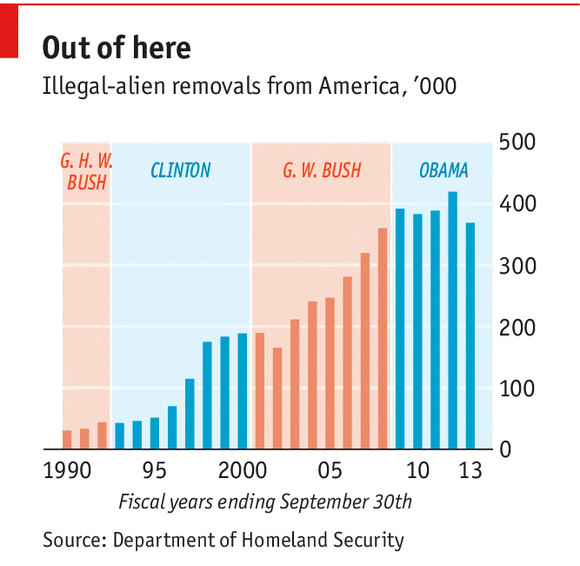
This chart from The Economist shows that the number of unauthorized immigrants in the USA increased from 1990 to the start of the Great Recession, and that in the last years of the Bush administration, some of those illegals went home. The Obama administration has kept the number relatively constant, in spite of the economic recovery.

The second chart shows that the Obama administration, implementing the laws, has deported more illegals than had previous administrations, deporting more each year than had the Bush administration in its last, most active year. That there has not been an increase in illegal residents is due in part to the deportations, but also to increased effectiveness of the efforts to prevent illegals from entering the country.

The recent executive order, quoting the Council of Economic Advisers via The Economist:
will boost GDP in the next decade by between 0.4% and 0.9%, mostly because of provisions unrelated to illegal immigration. These give foreign entrepreneurs more ways to get into America, allow the spouses of skilled visa-holders to work, and let foreign-born science graduates spend more time in America doing their training.
More needs to be done. The bill passed by the Senate last year but blocked by the House Republican leadership would be a good start. 

Friday, August 08, 2014

Interesting data on the U.S. federal government workforce.


Source
Note that federal government employment excludes active duty military personnel (but includes civilian employees of the Department of Defense). It does not include the people working for the legislative branch nor the federal courts. Note also that the government employment does not include the workforce in the private sector working under government contracts. There are many times as many contract workers as actual federal employees. The spikes are for census years, when large numbers of people are hired to conduct the census.

I would note that a president in the first year of his first term heads a government with a budget negotiated by his predecessor. The graph shows, interestingly that under the administration of conservative Republican icon Ronald Reagan, the federal government bureaucracy increased as a percentage of the U.S. population. I has decreased in percentage of the population in the Obama administration after the first year. Perhaps Obama is not the big government Democrat some people think him to be.

Tuesday, June 18, 2013

A thought on listening to an Obama interview on the Charley Rose Show.


A couple of comments on the Obama interview on the Charley Rose show.

  • Of course the Obama administration is continuing (with modifications) some of the controversial programs of the previous Bush administration. Some of those programs were worth continuing, (Even a stopped clock is right twice a day.) Moreover, the president's key job is to implement the laws passed by the Congress and signed by whatever president is in office when the Congress passes the act.
  • Perhaps the most important concern for the president is the security of the people of the nation. We have focused on safety from terrorist attacks, but a broken health care system is more dangerous to Americans than the acts of terrorists. A third world war would be more dangerous still, and the security of the nation in terms of such global threats depends on a strong military, a strong economy, and a strong political system. Obama is rightly concerned with the recovery from the Great Recession, but also with building infrastructure, industry and human and intellectual capital for the long term economic success of the nation.
  • "Don't just do something, sit there and think." I like that slogan for a president who is Commander in Chief of the military and takes the lead on foreign policy in our system of governance. Talking heads can pontificate on what should be done, in spite of the fact that they don't begin to have the intelligence available to the president. Ultimately, the buck stops on the desk in the Oval Office in the White House. The decisions on Syria should be taken step by step. I read Obama as saying that the Assad administration in Syria has lost the support of most Syrians, and that a political solution will have to change that administration and have sufficient political support from the various factions within Syria and from the involved foreign powers. We have to have some trust in the folk running our government, recognizing that even when they make errors after taking into account all the information that they have, those errors are likely to be less than those we would make in our ignorance.
Check out this article in The Daily Beast.

Sunday, May 26, 2013

Quotation


"[Barack Obama] is a thoughtful and a resolute leader who understands that America is strongest when her economic power, her diplomatic power, and her military power align with the power of our principles -- the beliefs we share in freedom, in justice, and in the dignity of every human being."
Governor Martin O'Malley

Thursday, November 15, 2012

Quotation: President Obama on Climate Change


There’s no doubt that for us to take on climate change in a serious way would involve making some tough political choices, and you know, understandably, I think the American people right now have been so focused and will continue to be focused on our economy and jobs and growth that, you know, if the message is somehow we’re going to ignore jobs and growth simply to address climate change, I don’t think anybody’s going to go for that. 
I won’t go for that. 
If, on the other hand, we can shape an agenda that says we can create jobs, advance growth and make a serious dent in climate change and be an international leader, I think that’s something that the American people would support.
President Obama in a press conference

Thursday, August 23, 2012

The United States and UNESCO: An Anecdotal History


The United States played a key role in the founding of the United Nations Educational, Scientific and Cultural Organization (UNESCO). During its history, Americans have played important roles in defining programs for UNESCO: examples are Philip Coombs in the foundation of the International Institute for Educational Planning (1960s), Roger Revelle in the creation of the Intergovernmental Oceanographic Commission (1960s), Raymond Dasmann in the creation of the Man in the Biosphere Program (1960s and 70s), Russell Train in the creation of the World Heritage program (1970s), and James Billington in the creation of the World Digital Library (2000s). Yet the United States withdrew from UNESCO in 1984, almost crippling the organization in the process. It rejoined UNESCO in 2003 and has remained (but is currently withholding its financial contributions to the Organization).

U.S. participation has depended on the climate of the Cold War, on the heat of the North-South debate, and on the perception of U.S. interests in the War on Terror. That participation has been the subject of debate within the United States -- a portion of the culture wars in which conservatives have often expressed opposition to and progressives support for UNESCO. Generally, there has been more support for UNESCO in Democratic administrations and less in Republican administrations.

Prehistory: After World War I, the League of Nations was created, a forerunner of the United Nations. Despite political refusal of the U.S. Government to join the League, the U.S. civil sector turned special attention to cultural issues in world affairs, primarily in education and science.

The League’s International Cooperation Committees (ICCs) in every country included a U.S. privately-organized and funded ICC, located at Columbia University, which enlisted giants of intellect among its members. World War II cut off this activity.

Included in the League was the International Committee on Intellectual Cooperation, which included such leading intellectuals of the day as Henri Bergson, Albert Einstein, Marie Curie, Thomas Mann, Paul Valéry, Salvador de Madariaga and Béla Bartok. The secretariat of the Committee, the International Institute of Intellectual Cooperation (IIIC) was established in Paris.

The International Bureau for Education (IBE) was organized is Switzerland with the participation of several governments. It also functioned in the inter-war years, The United States and Britain did not participate in but France and other European nations did, and the IBE formed one of the bases for UNESCO.  Both the IIIC and the IBE were incorporated in UNESCO at its founding.
Source

Planning for UNESCO During the War Years: In London exile, a Committee of Allied Ministers of Education (CAME) began meeting in 1940 to plan for the reconstruction of education systems when the war ended. The Department of State’s Sumner Welles sent a delegation in May 1944 to participate in the CAME deliberations; the delegation was headed by William Fulbright, then a Congressman who would later become Senator from Arkansas in 1945, the creator of the Fulbright Fellowships program. He was assisted by Archibald MacLeish, an intellectual who had lived in France and spoke fluent French, who during his life was a lawyer, poet, playwright, Librarian of Congress, and Assistant Secretary of State. (Macleish won three Pulitzer Prizes, a Tony and an Academy Award.)

The Allied Ministers elected Rhodes Scholar Fulbright to the chair; he and his delegation promptly expanded the discussion to the post-war rebuilding of education, not only in Europe but everywhere. The Preparatory Commission for the program of UNESCO received reports from committees dealing with education, social science, natural science, mass media, libraries, museums, the fine arts, and letters and philosophy. Joseph Needham (U.K.) saw the initiative as a vehicle for his hopes to create an intergovernmental organization to help build scientific capabilities worldwide, and started to build support for the S to be added to UNESCO.

William Benton should also be mentioned in this history. He had been a founder of the Benton and Bowles advertizing agency, a pioneering enterprise in the use of media. He was also publisher of the Encyclopedia Britannica, who was appointed Assistant Secretary of State for Public Affairs in 1945 and served in that post until 1947. One must assume that he was influential in assuring that UNESCO would include a focus on Communication. Benton went on to be a United States Senator and later Ambassador to UNESCO (1963-1968).

The United States had unprecedented influence at this time. President Roosevelt had given high priority to the establishment of international organizations replacing the League of Nations -- organizations that would seek to prevent future world wars. World War I had resulted in some 15 million deaths and World War II perhaps an additional 70 million. Many nations were decimated by the war, their economies in ruins. Alone among the great powers, the United States had emerged from World War II with its farms and factories in full operating order; it has been estimated that the United States was producing half of the world’s goods and services at the time. Moreover, the United States had played a key part among the Allies in winning World War II, providing both its logistic support and millions of troops.

The Founding of UNESCO: While the United Nations was established to deal with political issues, including the Security Council, and the Breton Woods organizations to deal with economic issues, the decision was made to create UNESCO to deal with intellectual issues. In the phrase of Archibald MacLeish, “since wars begin in the minds of men, it is in the minds of men that we must begin to build the defenses of peace.” Thus UNESCO was charged with a broad charter to work through education, science, culture and communications to build those defenses.

In November 1945, representatives of 37 countries signed UNESCO’s constitution, and the organization came into operation in November 1946 following ratification by 20 signatories. Back home, newly elected Senator Fulbright enlisted bipartisan support for two Senate Resolutions (1944, 1945) – one pledging to support a multilateral educational agency for the world. The idea succeeded because of the bipartisan leadership of Fulbright and “Mr. Conservative,” Ohioan Robert A.Taft.

In the preparation for UNESCO, in spite of the difficulties in the war years, nine major meetings were held around the United States to acquaint American leaders with the idea of UNESCO and to seek the advice and consent of the public for the ideas. The Congress passed authorizing legislation for the U.S. National Commission for UNESCO, calling for up to 100 members, with a unique element that three-fifths of the members would be nominated by non-governmental organizations (and appointed by the Secretary of State). The NatCom was to advise the Government on UNESCO policy, to represent U.S. educational, scientific and cultural leaders in UNESCO deliberations, and to link UNESCO programs with the U.S. intellectual communities. Initially headed by Milton Eisenhower, university president and brother of General (soon to be President) Eisenhower, the NatCom had a very distinguished membership. Milfton Eisenhower also served as a member of the UNESCO Executive Board in 1947.

Controversial Beginnings: The organization has been controversial. The United States denied efforts to make it the vehicle for post-war aid to Europe, preferring to program reconstruction aid bilaterally through the Marshall Plan. There were fundamental cultural differences between Anglo-Saxon and European continental approaches to education and culture.

Julian Huxley
The first Director General of UNESCO was Julian Huxley. The Grandson of Thomas Henry Huxley, an agnostic known as “Darwin’s Bulldog” for his defense of the theory of evolution, Julian Huxley was a zoologist distinguished for his synthesis of Darwinian evolutionary theory with genetics. He had a close association with the British secular humanist movement and was known for his left wing political views. A member of a distinguished family, including his brother, novelist Aldus Huxley, and his half brother, Nobel Laureate biologist Andrew Huxley, Julian had headed the London Zoo and served on a commission seeking sites for universities to be created in British Africa.. Later he served as President of the British Eugenics Society and was a founding member of the World Wildlife Fund. Few people would have been more likely to draw the opposition of the conservative side of the American culture wars, and his term of office was limited to two years (rather than six) at the initiative of the United States.

Joseph Needham, the first Assistant Director of UNESCO in charge of its natural science program, was perhaps equally likely to draw American conservative fire. He was a distinguished biochemist who left his post at Cambridge University to serve as the head of the Sino-British Scientific Cooperation Office in China during World War II. Needham served in UNESCO until 1948, returning to Cambridge where he embarked on an encyclopedic study of the history of science and technology in China, a study that radically revised Western understanding of that history. Needham was also well known for his leadership in British nudism, lived in a ménage a trios with his wife and Chinese former graduate student. He was closely associated with the Chinese Communist government, and had been involved in studies which charged American use of biological warfare against the Communists in both World War II and the Korean War.

Alliances in the Cold War
Source

The Cold War: At the founding of UNESCO, there were disputes between the Soviet Union and the United States about membership. Eventually negotiation achieved a settlement in which Argentina (whose membership was supported by the United States and opposed by the USSR) was admitted to UNESCO membership, and the Government of Poland in exile (whose membership was also supported by the United States and opposed by the USSR) was denied membership.

UNESCO, like other agencies of the United Nations system, became a venue for Cold War activity. The Soviet Union did not become a member state until 1954 in a deal that allowed satellite nations of the Ukraine and Belarus also join. In 1952–54 Poland, Hungary and Czechoslovakia temporarily withdrew from the Organization. From 1954 until the fall of the USSR in 1991, the United States continued to confront USSR Communist ideology in UNESCO for a with American democratic-free market ideology.

During the McCarthy era, the United States government put pressure on UNESCO to fire U.S. citizens suspected of Communist leanings. Luther Evans, the American former Librarian of Congress who served as UNESCO Director General from 1953 to 1958, was forced to let go from the Organization seven Americans charged with Communist sympathies. (John W. Taylor became Deputy Director-General of UNESCO in 1950 and was appointed acting Director General upon the resignation of Jaime Torres Bodet in 1952. Evans had served on the Executive Board from 1949 to 1953.)

The first person to be designated U.S. Ambassador to UNESCO was Athelstan Spilhaus who served as the U.S. representative to the UNESCO Executive Board from 1954 to 1958. Born in South Africa, a U.S. citizen after 1946, Spilhaus was a distinguished scientist who worked in meteorology, oceanography and cartography and an inventor. He is estimated to have reached 12 million people a week with his comic strip providing education on scientific matters, and was the father of the Sea Grant program creating centers of excellence in oceanography in American universities. Thus he continued the sequence of distinguished Americans involved in UNESCO.

North South Issues: Later UNESCO became a venue for North-South controversy. In the late 1950s and early 1960s, UNESCO membership began to expand rapidly with newly independent countries. Membership continues to expand, with consequent changes in the worldview and program priorities of UNESCO members.

In UNESCO, as in the United Nations system as a whole, governance is based on one-nation, one-vote, while contributions are assessed by a formula based on the Gross Domestic Product of the member state. Thus China with its huge population has the same voting power as a small island nation, and the United States, paying 22 percent of UNESCO’s assessed budget has the same voting power as a member state paying almost no assessed contribution. The budget of UNESCO continued to grow over several decades, and so too grew the U.S. assessed contributions, while the influence of the United States in the General Conference and Executive Board fell. There was obvious consternation in the U.S. Government over these trends.
Myrna Loy

Howland H. Sargeant is the only U.S. citizen to serve as the Chairman of UNESCO's General Conference, in 1961. A former Assistant Secretary of State for Public Affairs and President of Radio Liberty, Sargeant brought his wife, actress Myrna Loy with him to Paris -- no doubt as a major aid in gaining the attention of the other delegates.

The Constitution of UNESCO gives great power to the Director General. Of the first six Directors General, two were from the United States and three were from Western Europe. The sixth was from Mexico, distinguished for the literacy program that he headed when Minister of Education in that country, and elected when the General Conference met in Mexico in 1947. In 1974, Amadou M’Bow from Senegal became Director General. This proved to be a culture shock for the American government and the American Ambassador to UNESCO, Jean Gerard (a political appointee who had received her law degree four years before her appointment as Ambassador). Some describe a cultural divide between the French educated M’Bow and American diplomats, others describe concerns over the transparency and efficiency of his administration of the Organization.

In the 1970s, there was a move of developing nations at the United Nations in support of a New International Economic Order. While many nations had achieved political freedom, many nations were still mired in an economic system in which they exported raw materials to metropolitan countries at low prices and imported products and services from those metropolitan countries at high prices; political freedom had not come with economic prosperity and poverty was endemic. The concern for a new order expanded to include proposals for a New International Information Order; countries in Africa, Asia and Latin America were getting their news from AP/UPI, Reuters and AFP which paid little attention to their events or views.

Sean MacBride
UNESCO appointed a high-level committee headed by Sean MacBride to study communications, focusing not only on the concerns of the developing nations but also on the changes in the media that were appearing on the horizon. MacBride, an Irish lawyer and politician who was a founding member of Amnesty International, had received the Nobel Peace for his work for human rights. His name is associated with the MacBride Principles for international firms doing business in Northern Ireland. The son of a father who was executed for his part in the Irish Easter Uprising and a mother who was a famous Irish nationalist, MacBride was early in his career the Chief of Staff for the Irish Republican Army.
The report of the committee, now widely known as the MacBride Report, has been increasingly well regarded in the decades since it was issued, but it was rejected by the developing country representatives to UNESCO who substituted their own report for discussion in a UNESCO General Conference. The debate was controversial, and was widely covered (negatively) by the international press.

In 1973, the U.S. National Commission for UNESCO added some star power as Shirley Temple joined the Commission. Long after her career as a child actress, having already served as a U.S. representative to the United Nations, Shirley Temple Black was conversant with both multialteral diplomacy and the arts.

Representatives of the conservative Heritage Foundation had long advocated U.S. withdrawal from UNESCO. They gathered strength from a number of factions, including some concerned with the impact of UNESCO on U.S. education, others concerned with threats they perceived to U.S. sovereignty, and still others concerned with the political tone of UNESCO debates. They also developed a collegial relationship with conservatives in Margaret Thatcher's United Kingdom.

In 1983, conservative forces in the United States used the controversy over the New International Information Order as well as concern for the efficiency of UNESCO to successfully lobby for U.S. withdrawal, and the U.K. and Singapore followed suit the following year. UNESCO, losing a third of its budget, managed to survive and moved steadily forward, but more slowly and without U.S. leadership.  U.S. NGOs, especially in science, ignored the withdrawal and maintained close relations, but American political leadership for most areas of UNESCO cooperation was paralyzed.

Israel-Arab Debates: The state of Israel came into being with the support of the United States and by a vote in the United Nations. With the creation of Israel, came the prototypical UNESCO problem. There have been three wars between Israel and its Arab neighbors, and the conflict has simmered for decades in the failure of the parties to find a solution recognizing the rights of Palestinians and Israelis as they view those rights. Points of conflict have included the intangible heritage of peoples, world heritage sites, importantly those in Jerusalem, the history of peoples, the ways in which children are taught in schools about the conflict, and the control of natural resources. Debates on the conflict have taken place in academia and the media. UNESCO’s efforts to promote a culture of peace, dialog among civilizations and dialog among religions all come to play.

Egypt, Lebanon, Saudi Arabia and Syria have been members of UNESCO since 1946, Israel since 1949 and Jordan since 1950, so the Arab-Israeli situation has been on the UNESCO agenda since the inception of the organization. (The Palestinian people have an observer status.) As the number of member states of UNESCO has increased, the Arab nations have added supporters from Africa and Asia in the UNESCO forums. The United States has been a continuing ally, sometimes in a small minority, of Israel in those forums. In general, the debate in UNESCO has been reasoned, and the parties amenable to finding solutions that were not destructive to the Organization and helpful to the parties. Yet the Arab-Israeli controversy has been a continuing preoccupation of the U.S. delegations to UNESCO.

Palestine was admitted as a member state of UNESCO in 2011,. When the Palestine Liberation Organization first proposed admission two decades before, the U.S. Congress put a "poison pill" into law calling for the United States Government to withhold its contributions to UNESCO were Palestine to become a member. In spite of the provision and after a contentious debate, the General Conference in an unusual split vote, did admit Palestine. Currently, contributions are being withheld.

While out of UNESCO: Although the United States was not a member of UNESCO between 1984 and 2003, U.S.-UNESCO relations did continue. There was a small State Department monitoring group, and many agencies of the U.S. Government continued in touch with the relevant UNESCO programs. Similarly, many U.S. non-governmental organizations continued to have strong interest in and  linkages with UNESCO. The State Department legal staff concluded that those UNESCO international conventions and agreements that the United States had ratified remained in effect, and they continued to be implemented.

Americans for the Universality of UNESCO was active during this entire period. Jack Fobes, an American who had been the Deputy Director General of UNESCO and later the head of the U.S. National Commission for UNESCO, organized AUU with the dual purpose of advocating the return of the United States to UNESCO and of providing a source for information on and experience with UNESCO when it should be needed. AAU has since been renamed Americans for UNESCO, and continues in operation.

Reagan administration attitudes towards UNESCO continued quite negative after the withdrawal. In the latter part of the Clinton administration the State Department conducted a review of UNESCO which found significant improvements in its administration. Moreover, UNESCO Directors General Federico Mayor (1987-1999) and Koichiro Matsuura (1999-2009) had been seen as far more acceptable in terms of U.S. interests. It had been thought that the Clinton administration would call for reentry into UNESCO, but that did not happen.

The politics of East-West relations, North-South relations, and Israeli-Arab relations were all tangled in a complex web. The U.S. and the USSR would often be found on different sides of issues, such as those in relations between Israel and its Arab neighbors or the New World Information Order. Each sought allies in UNESCO debates from emerging nations.

Post 9/11: As the George W. Bush administration prepared for the invasion of Iraq after 9/11, the White House was searching for a positive initiative that the President could make in his major address to the United Nations General Assembly; reentry to UNESCO fit the bill. With both an initiative from a President at the height of his popularity and support from Democrats in Congress (notably Tom Lantos), reentry sailed through domestic politics.

Laura Bush
The Bush administration appeared to have an inconsistent approach to UNESCO. First Lady Laura Bush took an active role in the Organization, serving as an Honorary Ambassador for UNESCO, leading an important initiative in support of UNESCO’s literacy programs, and hosting a level meeting; a Laura Bush Travel Fellowship was created to be administered by the U.S. National Commission for UNESCO. On the other hand, the reconstituted U.S. National Commission for UNESCO was limited to providing advice to the Bush administration, and then only on request for such advice. The long-standing U.S. Committee for the Man and the Biosphere Program was dissolved. The Bush administration was adamantly opposed to a proposed Convention on the Protection and Promotion of the Diversity of Cultural Heritage, casting a lone vote against the Convention and against the funding for the secretariat to administer the convention in the General Conference of 2005. Ambassador Louise Oliver also created a controversial policy that all contact between the UNESCO secretariat and U.S. based organizations were to pass through the State Department, reversing a long established policy of openness. On the other hand, UNESCO proved a valuable ally in promoting educational reforms in Iraq and Afghanistan, and the SESAME project was a valuable initiative establishing scientific linkages between Israel and its Islamic neighbors.
Jill Biden

The Obama administration was involved in the 2009 election, reputedly working behind the scenes to oppose the election of the Egyptian nominee who was on the record as opposed to cultural exchanges with Israel and who stated that he would personally burn any Israeli books found in Egyptian libraries. Jill Biden, the wife of Vice President Biden, herself an educator, has played a visible role in UNESCO higher education activities. There have been unprecedented reciprocal visits between the UNESCO Director General Bokova and Secretary of StateClinton, Ambassador David Killion has embarked on a move visible program with UNESCO, while the National Commission, which had languished in the latter days of the Bush administration is being revived and its mission expanded. UNESCO continues to play an important role in its fields of competence in Afghanistan, Iraq and Libya, indirectly supporting U.S. foreign policy interests in those countries. The Obama administration has requested that the law requiring that contributions be withheld from UNESCO (due to its admission of Palestine as a member state) be revised to allow the President to waive the provision if such funding is found to be beneficial to U.S. foreign policy objectives.

The number of Americans on the UNESCO staff, especially in senior positions was reduced in the  period in which the United States was not a member; that number has begun to increase, but the United States still has fewer staff members than its population would justify. Peter Smith, appointed Assistant Director General for the Education Sector shortly after the United States return to the Organization, proved controversial and he resigned from UNESCO in 2007. The second senior appointment of an American to UNESCO, Gretchen Kalonji the Assistant Director General for the Natural Science Sector, appears to be better accepted.

As this is written, the relations between the United States and UNESCO are again on rocky grounds. The United States iz withholding its contributions to the Organization. Some non-governmental organizations militate continuation of that policy. Non-governmental organizations have also militated against UNESCO awarding a science prize named for an African dictator, another topic that has come up in several recent meetings of the Executive Board. Withholding the U.S. 22 contributions to UNESCO has caused the Organization significant financial problems. If withholding continues, the United States will lose its vote in the 2013 General Conference.

UNESCO Director General Irina Bokova
Concluding Remarks: Today UNESCO has 195 member states and seven associate members, and an annual budget in excess of $500 million (in assessed contributions and extra-budgetary funds). This is a remarkably small and tight budget with which to fulfill its large and expanding mandate. Its staff includes some 2,000 people, about one-third of whom are located in 58 field offices around the world. Unique among U.N. agencies, there is a National Commission linked to UNESCO in each member state, including in the United States. There are UNESCO Centers with more or less direct connections to the organization, and networks of World Heritage Sites, Bioreserves, Geoparks and Wetlands catalyzed by and linked to UNESCO. There are also networks of UNESCO chairs in universities, some 3,700 UNESCO clubs around the world, and 8,000 associated schools.

Looking back over its first six decades—two of them without the United States – impressiveachievements can be attributed to UNESCO’s efforts. The prospects of world war with weapons of mass destruction have receded, perhaps in part due to UNESCO’s efforts to build the defenses of peace in the minds of men.

  • In education, consider worldwide progress has been made since 1946 in literacy, in school access and participation rates (Education for All), in science education, in the schooling of women and girls, in the free flow of cultural materials and books, in the upgrading of educational planning and analytic tools, in teacher training, in the growth of school libraries, in continuing education, in “non-formal” education, in the use of education media and information technologies, in improved educational statistics, in standardization of student credentials, and in the greatly increased international perspectives of most universities. 
  • In the natural sciences, UNESCO helped with the creation of the European Nuclear Center (CERN) where the World Wide Web was invented; UNESCO operates the Trieste Institute for Theoretical Physics; UNESCO’s oceanographic and hydrographic programs are mapping the Indian Ocean and building early-warning systems for tsunamis and producing agreements on interconnected water use and management; UNESCO supported the Human Genome Project (1997), the formulation of national science policies, science and technology education, the Man in the Biosphere project (MAB, 1970), and applying science and engineering to socio-cultural change. 
  • In the social sciences, the world has been forced to look more closely at human rights, reliable statistics, and the free flow of information; 130 nations have ascribed to the Convention on Doping in Sports. 
  • In culture, UNESCO’s flagship World Heritage Convention, introduced by the U.S. in 1972 after UNESCO led the celebrated rescue of the Abu Simbel monuments; member states have now voluntarily guaranteed the protection of 890 World Heritage sites around the world. UNESCO has labored for decades on a general history of Africa and on the documentation of Silk Routes between Asia and Europe.  
  • In communications, UNESCO has assisted in the growth of libraries (including the new Biblioteca Alexandria – a modern Alexandria Library) and book production and translations, while monitoring the growth of the Internet. It has become a major worldwide guardian protecting journalists and press freedom, trivializing the fears of 1983. UNESCO is beginning to face the social, educational and economic reasons behind the dangerous Digital Divide, is quietly looking into the intellectual roots of terrorism, and is attacking the idea of “clashing civilizations” through cross-cultural dialogue.
Millions of Americans each year visit sites in the United States and abroad that have been designated as World Heritage sites. American educators, scientists and cultural leaders continue to be involved in UNESCO programs. Networks catalyzed by UNESCO, such as its Associated Schools and University Chairs, include American institutions and individuals. Indeed, UNESCO’s influence extends far into American society.

American foreign policy tends to focus on security and economic issues. Our security these days requires promotion of a culture of peace, a dialog among religions, and understanding among nations – all UNESCO specialties, As Dick Arndt has written, cultural diplomacy is “the first resort” of kings. In that sense, UNESCO is a first resort in building international understanding valuable for both our security and our economy, albeit a resort that is poorly recognized not only by the public but by many American professional diplomats. American foreign policy is increasingly having to deal with what one might consider to be global systems problems, such as environmental degradation, communicable diseases, international migration. Here too, UNESCO is a valuable multilateral tool of our diplomacy

In sum, UNESCO is an enormously complex institution, both in its means and in its ends. No one fully masters all the intricacies of its history, its programs, and its operations, but students find it challenging and rewarding to attempt to do so. The United States was a central and influential player in its creation. Distinguished American intellectuals played an important role in the Organization in its first four decades. However, there were factions in the United States who opposed U.S. membership in the Organization, and those factions succeeded in the atmosphere of the early 1980s in convincing the Reagan administration to withdraw from UNESCO. Factions favorable to UNESCO, in the post 9/11 atmosphere, convinced the Bush administration to rejoin UNESCO. American participation in the Organization involved political officials in the White House and Congress, professional diplomats and government functionaries in many government agencies, leaders of non-governmental and private sector organizations involved in partnerships with UNESCO, and members of America’s educational, scientific, cultural and communications communities.

Monday, August 20, 2012

Employment is better due to the action of the government in the last five years.


Here are a couple of results from a panel of expert economists:
Source:  Thinkprogress.org
Source: IMG Forum

As you consider the problem of unemployment, realize that we are better off than we might have been, and the reason is the action that the government took. Obama deserves a lot of the credit for that action. He helped create a consensus during the last year of the Bush administration, and got the Congress to pass useful legislation before the new Congress took office in 2011.

Friday, August 17, 2012

Young people flocking to show desire to be American citizens


Yesterday thousands of young people applied for a two year freedom from deportation. They were responding on the first day to a new program created by the Obama administration.

Basically, the administration has said that the Congress has not authorized enough budget to the Department of Homeland Security (DHS) to find, process and deport a major portion of the illegal immigrants currently in the United States, so it is not giving priority to a class of those immigrants who are not a threat.

The young people in question were brought to the United States by their parents before the age of 16, so they have no culpability themselves for illegal immigration. They will have been in the United States for at least five years. They will not have a criminal record. And they will have a U.S. high school diploma or have served in the military. The young people who apply will pay for the processing of their application, so this is a budget neutral decision. Qualifying young people will be given a two year guarantee of safety from deportation; if the Congress passes new immigration legislation in that period, of course the young people will be subject to that legislation.

In so far as the young people are serving the United States in the military, or who have done so and received an honorable discharge, I would grant them immediate citizenship. If they volunteer to put their lives on the line for the nation, they deserve citizenship. Certainly they do not deserve deportation.

Think about a typical young person who was brought to this country by his parents at age 10, 8 or 10 years ago, who has completed high school here. Almost all that he can remember occurred here. His friends are here. He is unlikely to know how to live successfully in the home country of his parents. Without the new program, he is unlikely to be able to get further education or training, and unlikely to get a good job. DHS papers guaranteeing two years here should allow him to get on with his life. Deportation would be a great hardship. I think the new program is morally right!

I find the action of the Obama administration to help these young people now to be timely, late if anything. The only immorality involved is the effort of some Republican politicians to unjustly criticize the action in their attempt to obtain political advantage by appealing to the most bigoted among us.


Saturday, August 11, 2012

The Supreme Court long ago decided the state could use policy power for public health.


I quote from Wikipedia:
In the case of Jacobson v. Massachusetts, 197 U.S. 11 (1905), the Supreme Court of the United States on February 20, 1905, upheld the authority of states to enforce compulsory vaccination laws. The Court's decision articulated the view that the freedom of the individual must sometimes be subordinated to the common welfare and is subject to the police power of the state...... 
The Supreme Court reaffirmed its decision in Jacobson in Zucht v. King (1922), which held that a school system could refuse admission to a student who failed to receive a required vaccination.
Not being a lawyer, I don't understand why these precedents were not used to justify the individual mandate clause of  the Patient Protection and Affordable Care Act. Police power would seem to allow for fines. Requiring people to obtain insurance to pay for medical services is surely likely to improve public health, both in reducing the prevalence of communicable disease and thus the probability of transmission to others, and also to reduce the incidence of complications of existing conditions.

Saturday, June 16, 2012

This should be more widely appreciated.


Source 
This would seem to be in current dollars. Remember that we had double digit inflation in the Carter administration due to the oil shocks. It seems to me that the data that would be more interesting would be the rate of growth of government spending relevant to the rates of inflation and to the rate of growth of the GDP.

It is important to realize the budget cycle of the U.S. government. The fiscal year is from October 1 to the following September 30. Presidents submit budget proposals to the Congress in January. The executive branch of government spends months prior to the submission in preparing their proposals. While an incoming president does review budget priorities after the November election, he does not then control the executive branch and is busy staffing his new administration,

The Congress after it receives the proposed budget, reviews and revises it and is to pass its budget bills by September 30th. Sometimes Congress does not get its work done in time and passes continuing resolutions to provide temporary funding to allow government activities to continue in the new fiscal year while the appropriations are finalized.

The Obama administration inherited high government spending, and more important, high levels of deficits; it also inherited from the Bush administration an economy in need of stimulus. The Bush administration in 2008 had also done the heavy lifting in preparation of the budget submitted in January 2009 (Obama's first year in office), and he faced a Republican House of Representatives in 2011 that created deadlock in the budgetary processes.

In short, I don't think the appropriations record to date is much of a basis for evaluation of Obama's fiscal policy.

He seems to have a pretty good take on the need to continue stimulating the economy to create jobs in the short run, as well as the need to cut the deficit and bring down the ratio of government debt to GDP in the next decade, and also the need to invest in education, science and technology, and infrastructure for the long run strength of the economy. Given a functional Congress he might do a pretty good job of balancing these objectives in a second term.

Tuesday, May 22, 2012

When you spend more, shouldn't you get better quality?


Source: The Economist
We did get Obama in 2008, as compared with Bush in 2000 and 2004, so  maybe quality did go up. But the Congress in 2010 was not notably better than the lower cost Congresses elected in non-Presidential elections.

Saturday, March 24, 2012

Agenda 21 is not new and not dangerous


Lake Fontana in Great Smokey Mountains National Park
On my recent trip to the Great Smokey Mountains National Park I was stopped by a local resident who seemed very concerned about  Agenda 21, which he ascribed to President Obama. A little searching on the Internet led to a number of links filled with misinformation. I doubt that I can do much to reassure those concerned with potential threats of Agenda 21 to rural America, but I will try to explain in the following paragraphs why they should not be worried.

Southern Appalachian timber harvest in the 1900s
Americans should be worried about environmental problems. The Great Smokey Mountains National Park was in fact created to restore a greatly depleted region of the southern Appalachians and to preserve what little was left of its pre-Colombian native forest. It is a beautiful place, but the American Chestnut trees that represented some 60 percent of the Park's forests 60 years ago are now gone, killed by a chestnut blight introduced from abroad. The Fraser Firs in the Park are now threatened by an introduced insect. Air pollution is increasing and acid rain is causing problems in the Park. If we want our children and our grandchildren to have the Park to enjoy in relatively pristine state, we have to act to protect it.

Agenda 21 is "a comprehensive plan of action to be taken globally, nationally and locally by organizations of the United Nations System, Governments, and Major Groups in every area in which human impacts on the environment." It, together with the Rio Declaration on Environment and Development, and the Statement of principles for the Sustainable Management of Forests, was adopted by more than 178 Governments at the United Nations Conference on Environment and Development (UNCED) held in Rio de Janerio, Brazil, 3 to 14 June 1992. UNCED, also known as the Earth Summit, was  held during the period in which George H. W. Bush was president of the United States.

"Ghost" Fraser Firs killed by the Balsam woolly adelgid on Clingmans Dome,
Great Smoky Mountain National Park
The United Nations Commission on Sustainable Development (CSD) was established by the UN General Assembly in December 1992 to ensure effective follow-up of the Earth Summit. Indeed, Agenda 21 can be seen as the benchmark for the addition of environmental concerns to the global agenda that had once focused on economic growth and the reduction of poverty.

 I find it hard to imagine people really concerned with the concept of "sustainable development". "Development" is intended to mean both social and economic development, and in the context in which the word is used internationally, to imply a broad process of social and economic development, including the reduction of poverty, the improvement of health and wellbeing, and the increase of participation in political processes.

Haiti-Dominican Republic border from the air, showing Haitian deforestation
Global warming, deforestation, desertification, loss of biodiversity, water pollution, loss of top soil, air pollution, depletion of water resources, coastal zone degradation, destruction of fisheries, depletion of oil resources and the list goes on. The depletion of natural resources, which after all form a significant portion of the capital that countries use for economic development, has been a problem in the past in now developed countries, and is today an increasingly visible problem in developing nations. These problems seem to most gravely affect the poor, both rural and urban, in the poorest countries.

There is also an increasing understanding that there may well be problems of resource depletion arising at a global level that may in a few generations create development problems on a global scale. The Earth Summit resulted in a consensus of the nations of the world that there is a responsibility now to take reasonable measures to assure that the rapid development that we have enjoyed for so many decades can be sustained into the indefinite future. The intent of Agenda 21 was to begin that process of assuring sustainable development.

There have been follow up meetings to the Earth Summit and another major meeting is scheduled for this year, Rio +20, marking the 20th anniversary of the initial UN conference. Of course, the United States Government will send a delegation to this important event, and of course the United States Government is planning its positions for the conference now, including developing a set of initiatives to announce in Rio (where Rio +20 will be held).

It would seem that the Obama administration's decision to create a White House Rural Council has been linked in the minds of some with Agenda 21. The mandate for that Council seems to make clear that the purpose of the Council is to improve coordination among federal government agencies in order to improve the cost-effectiveness of government programs in rural areas and "to promote economic prosperity and quality of life in rural America".

Tuesday, March 13, 2012

The rich grew richer faster after Reagan than did the rest of us.


My friend Julianne alerted me to this graph from Lane Kenworthy's blog, Consider the Evidence. It provides another way of showing what happened in the U.S. economy since Ronald Reagan was elected. The top lines show how the average income has evolved in the United States since 1950 and the lower lines show how the median income has evolved. From 1950 to 1980, the two increased in step -- increases in the productivity of the economy as a whole were shared in such a way as not to make the distribution of income more unequal.

After 1980, the median and the average income levels diverged. The median income continued to grow, but more slowly than the average income. What that means is that the rate of growth of high incomes was greater than the rate of growth of low incomes; the higher income people appropriated more of the growth of the economy for themselves than the poor or than they had previously.

Incidentally, during a period that roughly corresponds to the Clinton administation, the median and average incomes increased at the same rate. The divergence occurred primarily in the Reagan and two Bush administrations -- which of course lasted for 20 years.

Tuesday, February 28, 2012

Reassessing Bill Clinton


If someone says its not about the money, its about the money.
If someone says its not about the sex, its about the sex.
If a politician says its not about politics, its about politics.

I saw the American Experience program about Bill Clinton. It got me to thinking.


It looked in the program as if Clinton may have been seduced by Monica Lewinsky at a moment when he was especially vulnerable -- the government was shut down by the House of Representatives led by Newt Gingrich, the Democrats having lost control in the mid term election of Clinton's first term. Of course, he was wrong to be involved in an extramarital affair and wrong to try to cover it up. But do we want to elect the nicest guy president or do we want to elect the guy who will do the most for the country?

Clinton managed to get legislation through a Republican Congress in his second term of office. For the only time in recent memory, the federal budget was in balance. Employment was high. Economic growth was high. There was not talk about whether the United States had lost its competitive edge as Amazon, EBay, Apple, Microsoft, Google, were flying high or about to do so. He got wellfare reform into law, even over the objection of some Democrats. When Al Qaeda bombed two embassies, Clinton bombed them back, but didn't overreact by taking the country into two wars nor establishing sets of threat level indicators to fuel paranoia.

The Republicans seemed more interested in getting Clinton out of office than in good governance, as the Republicans seem today to be more interested in getting Obama out of office than in good governance. The public saw that that was true in 1996, and kept Clinton in office; lets hope that the public sees what has happened in the Obama administration and votes accordingly.


Thursday, February 16, 2012

Saturday, January 28, 2012

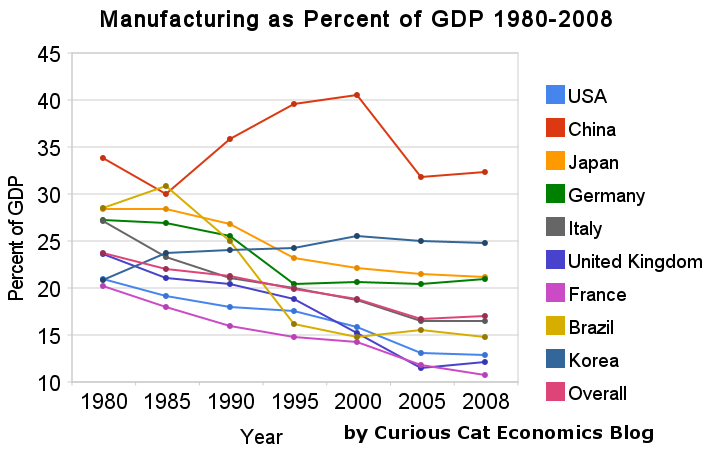
Understanding U.S. manufacturing statistics


Source: Curious Cat


The United States has a service economy, and as the figure shows U.S. manufacturing has decreased as a portion of the U.S. economy to something on the order of 12 or 13 percent in 2008. However, that has to be put in context.

According to Shopfloor from last year:
The United Nations Statistics Division compiles global data on manufacturing value-added, and its most recent data shows the United States continues to lead, with close to 21 percent of all global manufacturing output in terms of constant dollars (real manufacturing value-added in 2009). China is the second largest, with about 15 percent of global manufacturing.
President Obama proposed to strengthen U.S. manufacturing and bring back some manufacturing jobs to America, and that of course is a good idea. It will help our economy somewhat and will held decrease unemployment, but that initiative will not change the U.S. economy back to the manufacturing economy of the past. The initiative should be something that will draw Republican support in the Congress this year, and be perhaps a small victory from a dysfunctional Congress.

Tuesday, November 15, 2011

Herman Cain on Libya


This is an odd response. I would have assumed that Cain would have thought about foreign policy before choosing to run for president, and that he and his staff would have realized that he would be asked questions about Libya and Arab Spring, so I would have expected him to come loaded to respond. Clearly Cain did not want to say that Obama had done the right thing, yet clearly the Libya policy was a great success of the Obama administration. The United States was able to support the EU and the Arab League in opposing a dictator. The U.S. military support was critical to the overthrow of the Gaddafi government, and was accomplished with no loss of American lives, almost certainly saving many Libyan lives. Cain seems to have been saying that he didn't know how much information Obama had about the Gaddafi opposition in making decisions with respect to Libya, that he could not say what information would be critical in making those decisions, but that Obama might not have gotten enough information when he was making the decisions. One is left suspecting that Cain would have waited too long seeking information that simply did not exist anywhere, and would have missed a major opportunity. The fundamental point is that perhaps the key job of the president is keeping the nation safe in a dangerous would and keeping the nation prosperous in an increasingly globalized world. Foreign policy knowledge and skill should be a key concern in choosing a presidential candidate. The Republican candidates that are thought to have a chance for the nomination don't seem to know much about foreign policy, and the candidates that do know something about foreign policy don't seem to have a chance with to get the nomination.

Sunday, November 13, 2011

Sometimes it is best to admit lack of certainty, collective wisdom is often better than that of the individual


Barack Obama, Christina Romer and Lawrence Summers
 during a news conference in Chicago, November 24, 2008.
I recently heard Ron Suskind talking about President Obama's advice from his economic policy team in 2009. He described Obama as using his considerable skills unsuccessfully in an attempt to obtain a consensus from the very capable economists. If economists of that quality could not agree on the details of a policy that would be both feasible and useful, what do you think is the likelihood that any of the lawyer-politicians now running for office has the right answers for the economy based on thorough understanding of economic theory, historical data and professional modelling and analysis? Right! Probability vanishingly small!

What then are the Republican candidates doing? They are pretending to know more than they do, and they are playing to the prejudices of the factions of their parties that they need to secure the party nomination. This probably tells us more about the failings of our popular democracy than about the politicians themselves.
Image Source: Frugal Cafe
Clearly we need to get people back to work, increase the rate of growth of the economy, reduce the federal debt, improve the balance of international trade and payments, and deal with the aftermath of the housing bubble and with the personal debt crisis. Clearly it is going to take time to get out of this mess.

Clearly the international context counts. The European politicians seem far to likely to screw up the economy of the Euro zone and lead the world into another depression. The Chinese, Indians, Brazilians, Russians and other nations are seeking to increase their economic productivity and are likely to succeed and in doing so to change the balance of the global economy.

The last thing we need is for a repeat of the debacle of the Congressional debate on the debt limit increase of last summer. I think it is time for the politicians to admit that they might not individually have the right answers to the world's economic crisis and begin to negotiate in good faith to find some kind of balanced approach. It is probably more important to act than to find the best solution. The ideal is the enemy of the good. It is certainly important for our political leaders to show that they are cooperating to find a good path through the economic thickets, and thereby to build public confidence in the economic future. Lack of confidence can be self-fulfilling.

Thursday, October 27, 2011

People in the News


Steve Jobs
We are all grieving for Steve Jobs who died way too early. Still, in a life too short by decades, he revolutionized the personal computer a couple of times, the tablet computer, the cell phone, the movie industry and the music industry while building one of the world's largest and most valuable company. He was the illegitimate son of a Syrian Muslim graduate student father and American woman graduate student.

Barack Obama is not only President, but the certain candidate for the Democratic party for a second term. He has passed legislation to stimulate the economy and prevent a new depression and to reform our governmental system of health care financing, finished the war in Iraq, oversaw efforts that have killed Bin Laden and decimated Al Qaeda, led the free world in assistance that has led to the overthrow of Gaddafi and seen democratic revolutions in Tunisia and Egypt overthrow their undemocratic governments, allowed gays and lesbians serving in the military to stop lying about their identities, stimulated governmental support for science, technology, education and the infrastructure, and moved to reinforce integrity in government science. He is the son of a polygamous Kenyan Muslim graduate student father and American woman student.

Herman Cain is currently the leading candidate for the Republican nomination for President. He is  a syndicated columnist, and radio host. He is the former chairman and CEO of Godfather's Pizza and a former chairman (Omaha Branch board 1989–91), deputy chairman (1992–94) and chairman (1995–96) of the board of directors of the  Federal Reserve Bank of Kansas City. Before his business career he worked as a mathematician. He is an African-American. His mother was a cleaning woman and domestic worker, and his father worked as a barber, janitor and chauffeur.

Paul Nurse has just left his job as President of Rockefeller University to move to England to assume the job of President of the Royal Academy. He won the Nobel Prize in Physiology and Medicine for his scientific work. British, he immigrated to the United States and lived here for some seven years. He was the illegitimate son of a woman who was herself illegitimate. He was raised by his grandmother and grandfather (both also illegitimate) who pretended to be his biological parents.

I wonder how much talent this country wasted in the past through prejudice against foreigners, Muslims, Africans, African-Americans and the offspring of unmarried parents? I wonder how much we are wasting now by equally stupid prejudices?