Showing posts with label Innovation. Show all posts
Showing posts with label Innovation. Show all posts
Tuesday, August 18, 2015


Sunday, December 14, 2014
New Invention Data -- You Have to Interpret Carefully
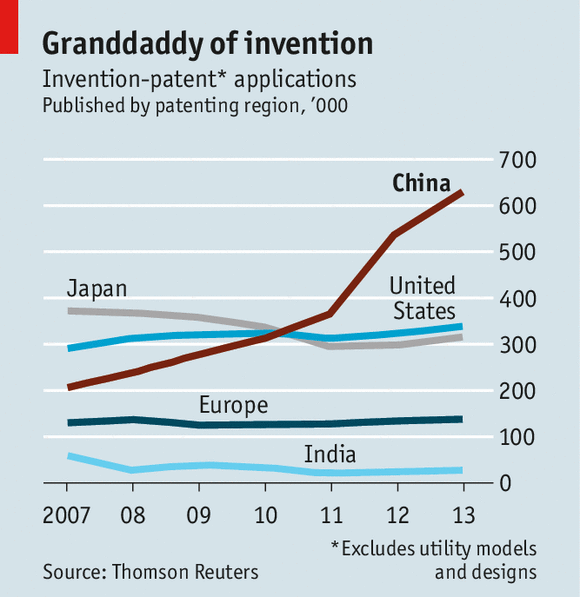
I quote from the article from The Economist from which I drew this graph:
(T)he explosion of patent filings is not the result of local researchers suddenly coming up with twice as many ingenious inventions: it is a response to a government order. As the report acknowledges, “the growth in output is driven by the 12th Five-Year Plan and the associated Chinese National Patent Development Strategy”. Bureaucrats have decreed that local firms will apply for 2m patents by 2015. Thanks to various subsidies and incentives, China looks set to hit that target........Of the desired 2m filings, many will be for “utility” or “design” patents, which are less substantial than “invention” patents.....
Only about 5% of patents filed by local firms in China last year were also filed abroad, whereas over a third of patents originally filed by local firms in Japan were also filed elsewhere.
Almost all of the growth in China’s invention patents over the past three years has come from local firms, not from the Chinese divisions of multinationals.I remember also that China is by far the most populous country in the world. The per capita patent rate would still be low, even were all those reported were legitimate.
While invention fuels international competitiveness, and in that respect threatens other countries, so too the more invention that goes on globally, the better for the average person everywhere.
Wednesday, September 17, 2014
What were the 10 greatest innovations ever

Braden Kelley, who shared this image, gave his ideas on the top 10 innovations of all time. I suppose I should leave out the use of tools and the management of fire as innovations that may have predated Homo sapiens. So lets see what I come up with:
- Agriculture / domestication of food plants
- Domestication of animals
- Clothing and shoes
- Buildings
- Pottery and glass
- Metal tools
- Markets
- Government
- Boats
- Money
Tuesday, August 26, 2014
A lot of interesting ideas in this!
I like the ideas that economic growth in a capitalistic economy comes from solving people's problems. It is innovations in technology and enterprises that commercialize those innovations that provide new solutions to new problems and better solutions to old problems. By assuring opportunities for education and upward mobility for all, we maximize the rate of production of people who can and do solve problems, and thus we maximize the wellbeing of people, and we see the economy grow.
Trickle down doesn't work. The plutocrats don't innovate, and their acquisitiveness tends to be at the expense of the majority, tamping down upward mobility for the majority, and thus reducing growth. If the majority have less money, not only will they buy less, but the total purchasing in the economy will go down. Then employment will go down and society is in a viscous cycle.
Government policies can intervene and help, or can intervene and contribute to the problem. In a democracy the choice should be ours.
If this man lived in a country with upward mobility, he would probably be rich!
Monday, July 28, 2014
Negative correlation between religiosity and technological innovation.
Thanks to my friend Guy for identifying "Forbidden Fruits: The Political Economy of Science, Religion, and Growth" by Roland Benabou, Davide Ticchi and Andrea Vindigni. I quote from the astract in which the authors cite "a new fact":
in both international and cross-state U.S. data, there is a significant negative relationship between religiosity and innovativeness (patents per capita), even after controlling for the standard empirical determinants of the latter.Perhaps there is a deeper cultural variable. I would suppose that the more deeply conservative a culture, the more it might be marked by religiosity and the slower it would be to adopt new technologies. Correlation is not causation! Still the figures shown in the paper are worth thinking about.
Tuesday, June 17, 2014
The Future of Technological Innovation
 |
| Economist Robert Gordon, left, and Economic Historian Joel Mokyr |
I have two reservations:
- Economists tend to focus on GDP, and Gordon in particular is portrayed as doubting that the level of technological innovation will allow continued economic growth (as measured by growth of GDP) comparable to that of the last couple of centuries. I am not sure that is the best measure of the objective of technological innovation. I am 17 years past my early retirement from government and a dozen years past the formal retirement age, not yet unable to think, and glad that advances in hygiene and medicine have allowed me to live this long. As Mokyr seems to be saying, technological advances that reduce the externalities (not measured by GDP traditional measurements) have been important recently. Perhaps the Internet which makes knowledge and entertainment less costly and more available is also valued but not measured by GDP.
- It is hard to predict future waves of technological innovation. Sometimes when one is in the early stages of such a wave, especially clever people can extrapolate into the future (e.g. Moore's Law on the trends in chip power and cost). I think we still have advances from biotechnology, neurobiology, cognitive science, nanotechnology, genomics as well as continuing innovation based on the Internet, sustainable energy technology and other areas.
Sunday, March 23, 2014
Innovate by Nature: Sujata Bhatia at TEDxUNC
Interesting talk. I have tried the technique of providing one-on-one and one-on-small team projects to help students learn to innovate, and I like the process. Of course, innovation is often the combination of a new idea with an old idea. Indeed, that is why innovations often come from collaborations between people from different fields -- where each brings an idea from his/her own field that is new to the other. Sorry for the bad sound quality.
Sunday, December 01, 2013
Viola organista made by Sławomir Zubrzycki
This instrument was based on an idea first proposed by Leonardo Da Vinci. People had produced versions over the centuries, but none had survived in playable state. Starting in 2009, Sławomir Zubrzycki created the harpsichord-shaped, bowed, stringed instrument he plays in the video above.
There is a big difference between having an idea for an invention and reducing it to practice.
Read more......
Incidentally, I played this YouTube video using my laptop computer via Chromecast on my TV )for the better sound). I hope Da Vinci would have appreciated that possibility.
Monday, November 18, 2013
Thinking about innovation and inventions

I am not sure that I fully agree with the idea behind the article. It seems to miss the idea of accumulation of innovations and deepening of technology that make an idea more and more workable.
It also seems to miss the idea of technological systems. In order to make electrical distribution commercial, it was necessary to invent generators and means of powering them, to develop means of distributing the electrical power, and a first device using the electricity to perform a service people would pay for. Then all sorts of additional apps could be invented and commercialized from electric motors to electric chairs.
I suppose development was first based on the invention of agriculture. Plants and animals were domesticated all over the world, and farmers improved yields by selecting improved varieties and improving farming systems. They learned how to harness animals to pull plows and to use manure to nourish plants. They learned that legumes could restore the yield of fields that had been exhausted by their use growing grains. Early on they developed means to store and distribute water to their fields. On this basis there has been a continuing effort to develop better ways to improve varieties, machinery to increase the farmer's productivity, better fertilizers, etc.
There are, I suppose, many ways to group technologies. Let me suggest that it may be useful to group the infrastructure technologies. Thus roads, aqueducts, waste disposal and sewerage, and ports might be identified. Energy infrastructure, including but not limited to electrical power would also be included in this category. Infrastructure clearly saves a huge amount of human labor, allowing it to be moved to other productive activities. The health benefits of abundant household water and a hygienic environment also contribute hugely to human capital.
Communication technologies might be included within the category of infrastructure, but they might alternatively be included within the category of information technologies, which would include books and printing, computers, scientific instrumentation, magazines, remote sensing, with the enabling inventions such as transistors, integrated circuits and fiber optics.
Then perhaps a category for manufacturing technologies, from the mechanical devices that revolutionized the production of fabrics, to manufacturing processes, the production line, and robotics.
I think there would also be a category for service technologies -- those involved in government, education, finance, wholesale and retail trade, etc.
Monday, June 24, 2013
If 2/3rds of our people live in urban areas that produce 3/4ths of our GDP why do we give so much political power to rural areas?

I quote from an interesting speech by Bruce Katz of the Brookings Institution
The real heart of the American economy lies in 100 metropolitan areas that after decades of growth take up only 12 percent of our land mass, but harbor two-thirds of our population, generate 75 percent of our gross domestic product and, on every single indicator that matters—innovation, human capital, infrastructure—punch above their weight at dizzying levels.
This is the power of concentration and agglomeration: the network effect of firms, universities, institutions fertilizing ideas, sharing workers, extending innovation, enhancing competitiveness and catalyzing growth.And:
In the aftermath of the Great Recession, U.S. cities and metros are recognizing that with our federal government mired in partisan gridlock and most states adrift, they are essentially on their own to grapple with super-sized economic, social and environmental challenges. The cavalry is not coming. Washington is not riding to the rescue.
Fortunately, cities and metros—and the networks of leaders who govern them—mayors for sure but also business, civic, community, business, labor and environmental leaders—are responding with pragmatism, energy and ambition to, as we say in America, “get stuff done.”
Tuesday, June 04, 2013
Nick Hanauer "Rich people don't create jobs"
I agree that it is likely that rich people usually don't hire people unless they perceive that there is unmet demand for what those people would produce, and that they, the rich will get still richer as a result of the production and sale of those goods and services by others. Thus, as economists suggest, if people don't have jobs and consequently don't have the money to buy things that they want and need, a simple way to get the economy moving is to get those people more money. They will go out and buy stuff, and businesses will hire people to produce more stuff, and the folk with jobs will be able to buy stuff without government subsidies. Besides, as Warren Buffet has said, it isn't fair that he, a billionaire, is taxed at a lower rate than his secretary. But I also think that long term economic progress is built on a foundation of finding better ways to do things. If people hadn't developed electric power systems, electrical devices, electronics, etc. we would be a whole lot poorer. Some of the billionaires got that way be building new companies that got big and profitable by doing things better, or by doing new things that people wanted done, and they did create jobs. Most of the rich people today did not get rich by doing that! Not taxing those who are already wealthy is not likely to promote wealth creating innovation in society.
Thursday, May 30, 2013
Innovation for Economic Development
Participants from the 2012 session of Innovation for Economic Development at Harvard Kennedy School discuss their Executive Education experience.
Steven Johnson: Where good ideas come from
People often credit their ideas to individual "Eureka!" moments. But Steven Johnson shows how history tells a different story. His fascinating tour takes us from the "liquid networks" of London's coffee houses to Charles Darwin's long, slow hunch to today's high-velocity web.
Sunday, April 07, 2013
Steven Johnson: "Chance Favors the Connected Mind"
This talk makes sense to me. Of course, lots of people have innovative ideas and very few of them turn out to result in something like GPS.
Tuesday, March 19, 2013
Rosen on the History of Technology
If you drink from a straw there is clearly a perception that you are sucking up liquid. In fact we know that you are creating a vacuum, and it is the pressure of the atmosphere on the liquid in the glass that is pushing the liquid up the straw.
Newcomen, when he invented his steam engine, had the perception that one could drive a piston in a cylinder if the pressure on one side of the piston was different than that on the other side. If one side of the piston was exposed to the air, air pressure would be applied to that side. Steam pressure applied to the other side could drive the piston towards the end of the cylinder open to the air. By removing the steam and creating a (partial) vacuum, the pressure would be lowered to less than the air pressure and the piston could be returned. Newcomen realized that by condensing the steam in a closed system, he could create that partial vacuum.
His steam engine was good enough to make a lot of money pumping water out of the coal mine that were beginning to fuel England in the early 18th century. They were, unfortunately, very inefficient. It took James Watt to recognize the fact that much more efficient steam engines could be built, to discover the key invention to do so, and to start the commercial development of those improved steam engines.
He also describes the evolution of patent law that provided a profit motive for people to invent new devices with practical applications and profit from their commercialization. That is an interesting story. The kings of England had issued patents giving monopoly power over specific markets to favored subjects. Edward Coke changed English patent law requiring that there be some invention to justify the granting of a patent. (His law also specified the length of a patent's monopoly as 14 years, twice the seven years of the apprenticeships of his time.)
Francis Bacon added the requirement to patents that the invention would have to be publicly disclosed. Thus not only did patents give people economic incentives to invent, but they allowed other inventors quickly to learn about and improve every patented invention. Thus by the end of the 17th century the basis in patent law that was critical for the industrial revolution had been created in England. Rosen identifies patenting in this modern sense as the most powerful idea in the world.
He also describes the development of measurement and quantification, its spread to those seeking to invent. Measurement of latent energy, the dependence of boiling point on atmospheric pressure, and other things was critical to the advance of the steam engine. Indeed, improved measurement was critical to other inventions during the industrial revolution and since.
He also describes the improved linkages between people who worked with their hands and worked for a living and those who lived on income and had created knowledge as an avocation. The artisans became more literate and numerate, and some rose to prominence by their experimental and inventive abilities.
Basically, he describes a significant change in institutions that combined most auspiciously in England in terms of the technological revolution that was part of the industrial revolution.
Friday, March 08, 2013
Diversity and Innovation
ABSTRACT
You know what innovation is:
- A culture to be developed and a process to be managed
- Having new ideas and successfully implementing them
- Often incremental, but could be disruptive
- Could be beneficial to various fields
But do you know:
- what are the pros and cons of having diverse teams for innovating?
- What kind of diversity matters? Culture? Training? Functions? Role? ...
- In which circumstances diverse groups are more successful than homogenous groups?
Those are the questions that will be discussed.
About the Speaker:
Alain-Pierre Lilot, with his experience in innovation, in launching new businesses and in multicultural and international team management, brings his expertise and his experience in innovation management and in multicultural and multidisciplinary management to companies and to postgraduate students.
Thursday, March 07, 2013
Can Kids Develop Inventive Intuition and Can Schools Help Them Do So?
He suggests that Leonardo da Vinci, a great inventor by anyone's standards, probably visualized his inventions, as did the architects who built the cathedrals and many other early inventors. In the case of Leonardo his invention was probably based on his artistic training and also involved his trained ability to represent what he saw in his mind's eye with his hands by drawing or painting.
Rosen seems not to recognize that artists and sculptors often develop their original ideas through drawings or through small sculptures. Models were common in naval architecture and I believe also in monumental architecture, as they are in architecture today.
I have talked to a sculptor who told me that he would look at a piece of wood and see what was hidden within it. His work was simply to slice away the material that hid the sculpture from others. Indeed, I was asked at one point when he delivered a commissioned work whether I could see the figures adequately, or whether he should clear away more. I have talked to a painter who told me that he would look at a canvas until he saw the painting and if he liked it he would apply paint; if he didn't like it he would have to put the canvas away since the image would remain in his perception even thought the canvas was unpainted.
In the case of Newcomen, he was able to work metal with his hands in the days when that was done by blacksmiths, the days before metal working machinery. He knew of an earlier steam engine and worked for years to extend the basic concept to something far more useful and commercial. The Newcomen steam engine involved many innovations which together made his steam engine more rugged, safer and more efficient than its predecessor. Rosen suggests that Newcomen's inventiveness was as much in his ability to imagine what a part would feel like in his hands as in his ability to imagine what the engine would look like when he could see it with his eyes.
 |
| Illustration of the Newcomen atmospheric engine for pumping water. |
I know that the things I invented were based on intuition that something could be invented and intuition as to how it could be done. That intuition is not consciously constructed, but I suspect comes out of the brain, raising to consciousness. The way it presents itself to consciousness probably depends on how a person's consciousness functions -- people who think in pictures see images of innovations, people who think in words tell themselves of innovations. Indeed, if Leonardo's brain and body had learned to make images and Michelangelo's tomake sculptures, the unconscious processes might well have occupied nervous pathways established and strengthened by their learned trades.
Can children learn to be inventors? I suspect that few will turn out to be Leonardos or Einsteins, but that all kids can learn to find ways to build on the inventions of others with their own innovative improvements. Indeed, I am pretty sure that all inventors do that.
I recently posted on a framework for learning being developed by a lot of smart people. But I am not sure that they recognized that schools should help kids to learn to develop their own imaginations, and that this would depend fundamentally on the way each kid's brain, nervous system, and consciousness worked. I think schools should help kids learn to invent, and that a framework for learning would include the many ways people can invent.
Thursday, February 07, 2013
Is a consensus developing on aspects of a U.S. innovation policy?
I quote from an article that argues for innovation and against excessive government regulation:
(A) bipartisan consensus that innovation is part of America’s identity is leading to emerging areas of agreement. For example, political leaders agree that U.S. policies should encourage the best and brightest from around the world to come here and stay once they get their degrees, particularly highly trained STEM students. Politicians also agree that startup businesses are good and Americans should be allowed to fund the entrepreneurs who present the best ideas. That’s why both parties supported the 2012 JOBS Act which eased rules on crowd funding and the restraints of Sarbanes-Oxley.The article cites some sexy new business models.
I am glad to hear that the consensus is developing on at least some elements of an innovation policy.
It seems self evident to me that certain kinds of education, certain kinds of physical and institutional infrastructure, and certain kinds of government support for R&D stimulate innovation. Perhaps a consensus will emerge on at least part of that agenda.
I doubt that teaching modern dance, expanding the legal institutions dealing with tortes, or doing research on public opinion will contribute to innovation, and maybe we can get some consensus on what not to fund in the name of innovation (such a Congressional pork).
Saturday, December 08, 2012
A thought about innovation and government
When one sees discussions of innovation they seem usually to be focused on those which will lead to increases in GDP. Sometimes these days innovation is proposed as creating industries that will increase employment. This is true even though many of the innovations in U.S. manufacturing have been those which increase labor productivity, keeping industry internationally competitive but reducing the workforce.
My previous post however focused on innovations that tended actually to both reduce GDP and to reduce employment. Thus, innovations which prevent illness, and thus the demand on palliative and curative health services, tend to reduce health service expenditures and thus the demand for doctors, nurses and other health workers. Similarly, the innovations that increased agricultural productivity often result in lower prices for agricultural products and have seen a great reduction in agricultural employment.
We can suggest simply that the benefits from a technological innovation may be appropriated by the suppliers of capital, by workers, or by consumers. Not surprisingly there is a considerable political interest in funding the National Institutes of Health, not only because its research is likely eventually to benefit the pharmaceutical industry, but because it is likely to benefit patients. Indeed, were we to make the argument that NIH funding would be justified because they would increase the size of our health service industry and create more demand for doctors and nurses, we would be likely to see Congress quite concerned.
In a larger sense, government investment in the fundamental research that is likely to produce future technological innovations should be considered in terms of the benefits to all three -- consumers, workers and investors. Indeed, there might be a larger role for government in promoting innovations that benefit people while reducing labor and GDP.
Saturday, November 17, 2012
Subscribe to:
Posts (Atom)