I have been posting on my experience with the One Laptop Per Child XO computer I bought. I ordered it on November 12th, received it on December 20th, and opened and tried to get it to work on December 25th. No luck. I can get it to show an on light, and was able to charge the battery, but the screen stayed dark and there was no sound. Click on the "olpc" label at the end of the posting to see the whole story.
On my second call in which I actually spoke to someone I got an agreement to have someone call me who would be authorized to issue a Return Merchandise Authorization. After two days, I got a call, but unfortunately I missed it. (You have to go to the bathroom once and a while.) The message said that I should call the number I had been calling, and anyone there could issue the RMA.
I called at 9:05 this morning, and discovered that there is now a different phone message, which automates the handling of complaints about computers that don't work. After about ten minutes I got an operator. She took all my information which took about another ten or fifteen minutes. Note, that I had already done this whole business twice before -- name, address, phone number, date of purchase, confirmation number, serial number of the machine, date of delivery, was the box damaged, what was wrong with the computer.
At this point I was wondering if I could simply return the computer and get a refund (I was quite willing to forgo the donation of $200 for a computer for a kid abroad and the shipping cost). I was told that since I had opened the shipping box, I did not qualify for a refund.
However, if I ship the computer to Brightstar, they will look at it, and if they decide it doesn't work, they will repair it under warranty and send it back. Otherwise they will just send it back (and I can use it as a doorstop.) I was warned that if I did not return it in six days, they would not accept the return. I was also told to expect a one month turn around on the review, possible repair, and return of the computer.
More later.
Meanwhile, BBC today reports that Intel is pulling out of the OLPC partnership due to "philosophical differences".
Showing posts with label olpc. Show all posts
Showing posts with label olpc. Show all posts
Friday, January 04, 2008


Monday, December 31, 2007
The continuing saga of my one laptop per child
I posted on December 26th that my XO computer that I purchased on November 12th and opened on Christmas Day did not work. I posted on December 27th that the manual and response to my email did not help, and that a phone call did not result in anything but a promise to call back.
I sat by the telephone for a whole day, waiting for a call which never came.
I found one suggestion online that there may be a bad connection to the mother board since there is neither a sound nor a screen response when the computer is turned on -- only the green light that the power is on. I found one place that said one could open the box without voiding the warranty since the idea is that kids will feel free to learn about the machine. I found another place where the instructions said that opening the box would void the warranty, so I have not opened the box.
I am now convinced I need to invoke the warranty. In order to return the computer for repair or replacement, I need to obtain a Return Merchandise Authorization. In order to do so, I needed to call the number given.
I called many times yesterday, getting a response each time that there were no lines available. I finally got a recorded message telling me to wait for an operator. I waited so long that my phone battery went out, and hung up.
I called this evening, New Years Eve, after 7:00 pm, and got through to an operator after about five minutes. It took 15 minutes for him to take my information. He then told me that he could not issue a Return Merchandise Authorization, as that could only be done by a supervisor. He said that they are very busy. He put on the form he filled out that I should be contacted as soon as possible, and told me it would be two to four days.
I don't know how teachers in developing countries are supposed to deal with this system, much less the young children who are to get these computers.
I sat by the telephone for a whole day, waiting for a call which never came.
I found one suggestion online that there may be a bad connection to the mother board since there is neither a sound nor a screen response when the computer is turned on -- only the green light that the power is on. I found one place that said one could open the box without voiding the warranty since the idea is that kids will feel free to learn about the machine. I found another place where the instructions said that opening the box would void the warranty, so I have not opened the box.
I am now convinced I need to invoke the warranty. In order to return the computer for repair or replacement, I need to obtain a Return Merchandise Authorization. In order to do so, I needed to call the number given.
I called many times yesterday, getting a response each time that there were no lines available. I finally got a recorded message telling me to wait for an operator. I waited so long that my phone battery went out, and hung up.
I called this evening, New Years Eve, after 7:00 pm, and got through to an operator after about five minutes. It took 15 minutes for him to take my information. He then told me that he could not issue a Return Merchandise Authorization, as that could only be done by a supervisor. He said that they are very busy. He put on the form he filled out that I should be contacted as soon as possible, and told me it would be two to four days.
I don't know how teachers in developing countries are supposed to deal with this system, much less the young children who are to get these computers.
Thursday, December 27, 2007
Experience with One Laptop Per Child
As I wrote yesterday, the XO computer I bought from One Laptop per Child does not work. I opened it two days ago, turned it on, and the only thing that happened was that a green light went on indicating that the computer was on, and a yellow light went on indicating that the battery was charging. The screen stayed blank. Eventually the yellow light changed to green, indicating that the battery had charged, but nothing else changed. I tried rebooting, to no avail.
It took some time to fire up another computer and find the supporting documentation for the XO on the web. (The touching faith of the XO designers that it would be good for kids to figure out how to work the machine without instructions was becoming more and more annoying.) No help.
On Christmas day I got a negative response from the telephone help desk, not surprising on that holiday. Then I emailed to the help people, and several hours got a suggestion that I reboot the machine (quorws from the online instructions). I dutifully did so, with the same negative results. Yesterday morning I called the help desk and after about 15 minutes on hold got an operator who took may name, address and phone number and said someone would get back to me. I also sent another email message to the help desk. No response to this time.
More later.
It took some time to fire up another computer and find the supporting documentation for the XO on the web. (The touching faith of the XO designers that it would be good for kids to figure out how to work the machine without instructions was becoming more and more annoying.) No help.
On Christmas day I got a negative response from the telephone help desk, not surprising on that holiday. Then I emailed to the help people, and several hours got a suggestion that I reboot the machine (quorws from the online instructions). I dutifully did so, with the same negative results. Yesterday morning I called the help desk and after about 15 minutes on hold got an operator who took may name, address and phone number and said someone would get back to me. I also sent another email message to the help desk. No response to this time.
More later.
Wednesday, December 26, 2007
Experience with One Laptop Per Child
I joined the buy one-donate one program of One Laptop Per Child on November 12. It took more than a month for my machine to arrive. I didn't open it until yesterday. It didn't work. Turning it on, there was a little green light that showed it was on, and nothing else.
The instruction manual that comes with the machine is useless if the machine does not work. It does have information on a link to the Internet, which does have information. How a kid with a computer that doesn't work is expected to access the internet manual is not clear to me.
I tried calling, and got a fairly useless message. I sent an email to the help desk, and got a suggestion a few hours later that I reboot the machine, which I did for the nth time, and got the same nothing. The message suggested that I call the help desk, or send another email asking for help.
I called the help desk and this time, after waiting for about ten minutes, got an operator who asked me for my confirmation number, which I never could find. She however, did find my information using my name and address. She then told me that someone would email me or call me shortly.
More information later.
The instruction manual that comes with the machine is useless if the machine does not work. It does have information on a link to the Internet, which does have information. How a kid with a computer that doesn't work is expected to access the internet manual is not clear to me.
I tried calling, and got a fairly useless message. I sent an email to the help desk, and got a suggestion a few hours later that I reboot the machine, which I did for the nth time, and got the same nothing. The message suggested that I call the help desk, or send another email asking for help.
I called the help desk and this time, after waiting for about ten minutes, got an operator who asked me for my confirmation number, which I never could find. She however, did find my information using my name and address. She then told me that someone would email me or call me shortly.
More information later.
Monday, January 08, 2007
One Laptop Per Child User Interface
Read "Software on low-cost laptop for schoolkids could be more revolutionary than its economics" by BRIAN BERGSTEIN in the Nevada Appeal, January 8, 2007.
The new OLPC has a user interface that uses a metaphor different than that used in "commodity" PCs in the mass market.
Here is an article on the system from One Laptop per Child News.
Check out this website with a Demo video provided by 90 percent of everything usability blog.
The new OLPC has a user interface that uses a metaphor different than that used in "commodity" PCs in the mass market.
Here is an article on the system from One Laptop per Child News.
Check out this website with a Demo video provided by 90 percent of everything usability blog.
Tuesday, October 03, 2006
Low Cost Computers for People in Developing Nations

Read "Splitting the Digital Difference" in the Economist of September 21st, 2006. (Subscription required.)
The personal computer revolutionized life and work in developed nations because so many people could afford PCs. PC manufacturers have made PCs commodities in OECD countries by dropping prices year after year. They have also increased the power of the PCs, no doubt striking a balance between price and power to maximize their profits. My nephew, who is a "computer guy" for a big company recently pointed out that home computers are more powerful than those you find in the workplace. Companies, buying lots of PCs opt for machines that cost less but have enough power for the day to day work of word processing, spreadsheet creation, and making presentations. (They in fact don't want the powerful machines that are so great for games, for obvious reasons.)
I suggest a result of the business decision is that PCs today are much more powerful than those we used 15 or 20 years ago but still too expensive for wide distribution in developing nations. Many alternatives were tried. Large numbers of computers are discarded in developed countries as users upgrade, and the discards are often quite usable. Some have tried shipping used computers to developing nations. Indeed, there have been projects started to recondition used PCs for developing country users.
Donor organizations have provided loan and grant funding for computer purchases (usually for critical, high-value applications)
Meanwhile some relatively low-cost computing devices have come on the market, including PCs labeled as "game machines", PDAs, etc.
People started to look at the possibility of developing low cost, low power computers that would be good enough to get a really wide market in developing nations.
Probably the most famous such effort is the Simputer, which has been the subject of interest and discussion for several years. (The Simputer Trust was founded in 1999.) Amida makes Simputers for the commercial market in India, but still does not sell them internationally.
One Laptop per Child (OLPC), a non-profit association with close links to MIT and dedicated to research to develop a $100 laptop, has been getting a lot of publicity in the past year or two. It has announced some big deals to provide large numbers of laptops to specific developing nations, while others have formally reject such purchases. (See my earlier posting and still earlier posting.
Brazil in 2005 announced a "Computers for All" program that was to sell a half million computers at prices not to exceed US$440 (including open source software), and that were to be available on an installment plan.
The Ndiyo Project is based on the recognition that computers can multitask, and the in many developing countries applications a single PC can serve many users, if each of those users has a simple, inexpensive workstation. It has been developing a low cost connector box to link a number of workstations to a PC via standard cables. (Ndiyo, pronounced 'nn-dee-yo', is the Swahili word for "yes". Ndiyo is a donor-supported non-profit UK organisation.)
Microsoft® FlexGo™ is looking at a business model that allows people to make a downpayment on a low-cost computer, and then use a pay-as-you-go system similar to that used in pre-paid mobile phones.
FlexGo is a rent-to-buy arrangement in which the customer determines the frequency of payments. People pay around half the price of the computer and software at the start and then pay to use it by buying scratch cards. Once their credit is depleted, the machine goes dark, just as a mobile phone does. But after about two years of use, Microsoft estimates, the full price of the PC and the software has been paid, and the owner then has unlimited use of it. Craig Fiebig of Microsoft says this approach can open up an untapped market. In a trial in Brazil 30% of participants said that they could not otherwise have afforded to buy a PC.
Forty or fifty years ago, when I started in this business, hardware costs dominated our thinking, but software became the more important cost, and then Internet connectivity costs became a factor. Not only have many free and open source software solutions become available for PCs, but "Microsoft has developed a scaled-down version of its Windows operating system for developing nations, called XP Starter Edition." Moreover, competition is reducing Internet access costs, and new technologies are extending Internet access.
There remains a digital divide in access to personal computing, but adequate, affordable devices are becomming more common. I worry more about the digital divide in human resources -- people able to utilize the technology fully.
I worry even more about the digital divide in organizational ICT applications. A lot of the money spent on ICT in developed nations is not on the PCs and software, but on expensive tools for complex tasks. These remain beyond the reach of developing nations.
Monday, November 28, 2005
The $100 dollar computer for developing nations
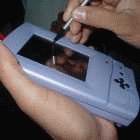
The Simputer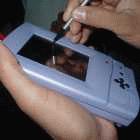
There has recently been a spate of publicity (e.g. the Christian Science Monitor) for the MIT designed laptop announced at the World Summit on the Information Society.
The idea of a low cost computer for developing nations is not new. We have been posting resources on the ICT for Development community page of the Development Gateway for some time on the Simputer and other efforts to develop low-cost computers. The Simputer has been a disappointment, but I recently read that it is to deliver a large number machines to the Indian army.
A good article on the past problems experience in Brazilian initiatives is provided by Paulo Rebelo on CNET News.com. But Brazil has just created a program combining low cost hardware, open source software, easy and cheap credit, and commercial distribution to put 500,000 low-cost computers in people's hands in the next six months. The Brazilian machines are to be priced at no more than US$ 440, which is competitive due to the high costs of imported computers in Brazil. iT is a computer produced at very low cost by Asiatotal.net, which the project leaders plan to give away (using subsidies one presumes).
In the United States, Wal-Mart offered a $400 computer retail as a "door buster" on Black Friday (the day after Thanksgiving, and traditionally the busiest shopping day of the year). Dell is currently selling entry-level PCs for $299; Gateway for 349.99. The Personal Internet Communicator is a bare bones PC which, without monitor, I found for sale at $129 at Radio Shack. Thin client systems, which seem to me to be an interesting alternative for school use, are advertised for under $200.
Reconditioned computers are available for less. The Computers for Schools association and the Computers for Schools program (in the United States and Canada respectively) seem to be successful in refurbishing donated computers and giving them to schools, bringing the cost way down. The approach has been extended to Latin America and the Caribbean via Computadoras para Comunidades
Now a number of companies have seized on the commercial opportunity offered by low price computers and the opening of new markets. They seem to be developing even more innovative ideas for low cost computers. The Microsoft x-Box 360 seems to be quite a powerful PC, selling for $300 as announced. (Clock speed 3.2GHz, 512 MB of RAM, 20 GB hard drive, Internet enabled, HD display capacity). Nintendo's gameboys should also illustrate what could be done in creating an affordable e-learning device to reach the huge potential market. The new Gamboy micro sells for about $100.
The Fly Pentop Computer seems especially interesting, abandoning the PC metaphore in favor of the paper and pencil metaphor. This cute gadget, costing $100 plus $35 for software) would seem to open new fields for educational computing.
The inclusion of people concerned with pedagogy, and not just engineers, seems to me very important in projects intended to put computers in schools. The MIT team includes Symore Papert, a trail-blazing educator. I would love to see a breakthrough in the way technology is used to enable kids (and adults) to learn.
Most ICT is commercialized for markets in rich countries. The trade-off between cost and powerful features tends to be made in favor of features. For niche markets, lower cost devices with fewer features find a place.
Moore's law continues to operate, and the power of microchips continues to increase as the price continues to decline. The PC's continue to decline in price, and continue to become more affordable in developing nations.
On the one hand, many teams are recognizing that the computer market in developing countries is potentially huge, and almost unserved. On the other hand, many projects have failed to develop a low cost computer on anything like the schedule they proposed.
I suggest the computer that finally reaches a mass market of the poor in developing nations will be different than that reaching the mass market in rich countries. Lower cost devices with free software and simpler features are likely to be involved, as compared with the market preferences in the U.S. and Europe. I suspect that it will be teams in Asia who first develop products to successfully tap that market.
There has recently been a spate of publicity (e.g. the Christian Science Monitor) for the MIT designed laptop announced at the World Summit on the Information Society.
The idea of a low cost computer for developing nations is not new. We have been posting resources on the ICT for Development community page of the Development Gateway for some time on the Simputer and other efforts to develop low-cost computers. The Simputer has been a disappointment, but I recently read that it is to deliver a large number machines to the Indian army.
A good article on the past problems experience in Brazilian initiatives is provided by Paulo Rebelo on CNET News.com. But Brazil has just created a program combining low cost hardware, open source software, easy and cheap credit, and commercial distribution to put 500,000 low-cost computers in people's hands in the next six months. The Brazilian machines are to be priced at no more than US$ 440, which is competitive due to the high costs of imported computers in Brazil. iT is a computer produced at very low cost by Asiatotal.net, which the project leaders plan to give away (using subsidies one presumes).
In the United States, Wal-Mart offered a $400 computer retail as a "door buster" on Black Friday (the day after Thanksgiving, and traditionally the busiest shopping day of the year). Dell is currently selling entry-level PCs for $299; Gateway for 349.99. The Personal Internet Communicator is a bare bones PC which, without monitor, I found for sale at $129 at Radio Shack. Thin client systems, which seem to me to be an interesting alternative for school use, are advertised for under $200.
Reconditioned computers are available for less. The Computers for Schools association and the Computers for Schools program (in the United States and Canada respectively) seem to be successful in refurbishing donated computers and giving them to schools, bringing the cost way down. The approach has been extended to Latin America and the Caribbean via Computadoras para Comunidades
Now a number of companies have seized on the commercial opportunity offered by low price computers and the opening of new markets. They seem to be developing even more innovative ideas for low cost computers. The Microsoft x-Box 360 seems to be quite a powerful PC, selling for $300 as announced. (Clock speed 3.2GHz, 512 MB of RAM, 20 GB hard drive, Internet enabled, HD display capacity). Nintendo's gameboys should also illustrate what could be done in creating an affordable e-learning device to reach the huge potential market. The new Gamboy micro sells for about $100.
The Fly Pentop Computer seems especially interesting, abandoning the PC metaphore in favor of the paper and pencil metaphor. This cute gadget, costing $100 plus $35 for software) would seem to open new fields for educational computing.
The inclusion of people concerned with pedagogy, and not just engineers, seems to me very important in projects intended to put computers in schools. The MIT team includes Symore Papert, a trail-blazing educator. I would love to see a breakthrough in the way technology is used to enable kids (and adults) to learn.
Most ICT is commercialized for markets in rich countries. The trade-off between cost and powerful features tends to be made in favor of features. For niche markets, lower cost devices with fewer features find a place.
Moore's law continues to operate, and the power of microchips continues to increase as the price continues to decline. The PC's continue to decline in price, and continue to become more affordable in developing nations.
On the one hand, many teams are recognizing that the computer market in developing countries is potentially huge, and almost unserved. On the other hand, many projects have failed to develop a low cost computer on anything like the schedule they proposed.
I suggest the computer that finally reaches a mass market of the poor in developing nations will be different than that reaching the mass market in rich countries. Lower cost devices with free software and simpler features are likely to be involved, as compared with the market preferences in the U.S. and Europe. I suspect that it will be teams in Asia who first develop products to successfully tap that market.
Thursday, November 17, 2005
"Annan presents prototype $100 laptop at World Summit on Information Society"
Read the entire MIT press release.
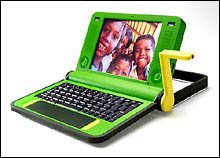
"U.N. Secretary-General Kofi Annan unveiled the first working prototype of the $100 laptop Nov. 16 at the World Summit on the Information Society in Tunis, Tunisia."
I heard a radio program broadcasting a discussion of whether developing nations really need a cheap laptop, or whether there isn't some better way to spend scarce resources than buying computers for school childred. It seems to me that this is the old question, "what good is a baby". Babies grow up. Computer prices come down, and become more affordable in developing nations.
The MIT effort is just one of several to develop an ultra-low cost computer for developing country markets. Eventually someone will probably do it. It might well be a firm looking for a cheap commodity computer for a rich country market that stumbles into a mass developing country market.
I frankly don't think Nicolas Negroponte and Symore Papert, whose names seem to be associated with this project, are likely commercial entrepreneurs. I recall that they created the "World Center" in Paris some two decades ago to promote the dissemination of personal computers to developing nations. It went out of business after a few years. I don't know, but I somehow doubt that they will succeed in creating a $100 million per year business selling cheap computers to the education market in developing nations. But I don't really care.
These are two of the most creative guys anywhere. The MIT Media Lab has triggered many, many innovators in new directions. Papert has influenced a generation or two of people involved in creating the technology to enable e-learning. They lead, and others will follow.
The telephone has been around a lot longer than the computer, and it still has not reached the full developing country population. But the creation of modular phones has suddenly and dramatically increased the rate of penetration of the phone network into poor nations. Eventually something similar will happen for the computer and the Internet.
I did my first computer programming in 1958. It was not much before that that the president of IBM famously estimated that the total market for computers might be four or five machines. We must already have a global computing network vastly more powerful that would have been the case had every person in the world obtained a 1950's technology computer. The power of the global computer network in 2050 is far beyond my comprehension or ability to predict.
The first investments in a revolutionary technology may not be very attractive in terms of returns in the short run. But they are necessary if a country or society is to learn to use the technology. There is already much more computer capacity installed in developing nations than I could have imagined when I first went to transfer the technology to Chile in 1965. The developing world is learning to utilize a network that will (in historical terms) be ready for use in the blink of an eye!
Monday, October 03, 2005
Latest on the $100 per child laptop
A non-profit association, One Laptop per Child (OLPC), has been created to implememt the initiative launched early this year by the MIT Media Lab. Currently, the proposed $100 machine is to be a Linux-based, full-color, full-screen laptop that will use innovative power (including wind-up), a flash memory, and puts all the components behind the screen. It is to be WiFi- and cell phone-enabled, and have multiple USB ports. The machines current specifications are: 500MHz, 1GB, 1 Megapixel. Currently the estimated price has come down to $130, but apparently the design effort is continuing. Low hardware cost is to be achieved by simplifying systems, using novel display technology, and economies of scale by producing these machines by the million. When the machines pop out of the box, they are to immediately make a mesh network of their own, peer-to-peer, and it is intended also to connect them to the Internet at very low cost. Five initial companies are reported to have committed to this project: AMD, Brightstar, Google, News Corporation, and Red Hat, as well as the 2B1 Foundation. The Economist magazine reports that China, Brazil, Egypt, Thailand and South Africa have said they will buy one million of the machines each, and that the Governer of Massacheusetts said the state would purchase one for every secondary school student when they became available.
Read the article in the Economist (subscription required):
and an Interview with Nicholas Negroponte
Read the article in the Economist (subscription required):
and an Interview with Nicholas Negroponte
Subscribe to:
Posts (Atom)