Showing posts with label media. Show all posts

Tuesday, July 22, 2014

Research Results vs. Popular Opinion -- GMOs


I quote from a recent article on GMO foods:
The facts about GMOs and the science of biotechnology are indisputable. In an effort to catalog the science on GMOs, a team of Italian scientists summarized nearly 2,000 studies about the safety and environmental impact of GMO foods. These scientists could not find a single instance where GMO food posed any harm to humans or animals. GMOs are safe and healthy. 
Studies over the past 30 years -- by such groups as the World Health Organization, the Food and Drug Administration, and the National Academies of Science -- have produced no evidence of health or safety harms. On the contrary, all of them have concluded that GMOs are as safe as, or safer than, conventional or organic foods. Recently, Jon Entine of the Genetic Literacy Project explained on the John Stossel program that "we've eaten about 7 trillion meals in the 18 years since GMOs first came on the market. There's not one documented instance of someone getting so much as a sniffle."

Tuesday, June 10, 2014

If you watch television you are likely to be choosing to be misinformed.


Via the National Review
My son points out that the most credible sources of television news are probably Al Jazeera America and BBC America.

Fortunately, with the Internet we can get news from a variety of good newspapers around the world. It helps if you read several languages, but even limiting oneself to English there are a number of credible newspapers. There are also magazines, and you can read more that TV will broadcast on a story.

I think this is really a problem. If people believe the least credible sources to be the best sources and watch them, they are going to believe a lot of false information and biased reports. They are then going to support the wrong policies and politicians. That has gotten the world into wars and holocausts, and can get mankind into still deeper problems now that we have the ability to destroy much of the environment and many of ourselves.

Just thought I would share this too:

Source

Wednesday, December 18, 2013

Bill Moyers Essay: The End Game for Democracy


Moyers is an old fashioned liberal. I don't always agree with his view of the world. But I think he is right here in saying that the people with influence in Washington are too often concerned with things other than the welfare of the nation, and that the news media don't provide us with the information we need to assure that the public interest is paramount in legislation and regulation.

Friday, May 24, 2013

Safety is everyone's business


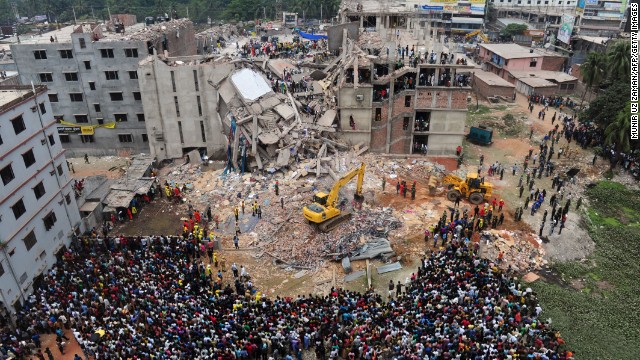
It is one month since an eight story building collapsed in the outskirts of Dhaka killing more than 1000 people. Reporters have been assigning responsibility to prevent similar disasters. It occurs to me that the responsibility for safety is shared. Here are some of the responsibilities:

  • The workers themselves have a responsibility for their own safety. I might have suggested to any one of them that she not work in a dangerous facility. I might have suggested that collectively they might have gone on strike until the company provided a safer workplace. Unfortunately, a worker who refused to work in an unsafe workplace in Bangladesh might starve.
  • The workers in the garment factories are often unmarried young women, and one might thing that their families should take more responsibility for their safety. Unfortunately, their families are also poor and poorly equipped to take economic risks to protect the young workers.
  • The managers and supervisors in the garment factories have a responsibility for the safety of the workers as well as for their own safety. They might insist that the companies provide safe working places. Of course, they would likely be replaced by less ethical people if they did so, and might have problems finding other jobs.
  • The owners and stockholders in the manufacturing companies have a responsibility for the safety of the workers. To the extent that that responsibility is shared, it can be avoided. Their profit margins are slim, and might disappear driving them out of business were they to really protect the safety well. Moreover, some are greedy and unethical, and those are willing to make money off of the risk of their workers.
  • Building owners have a responsibility for the safety of the buildings that they are renting out. Their incentives are similar to those of the company owners.
  • Builders have a responsibility not to build unsafe buildings. Of course, if they refuse contracts to do so, other more greedy and less ethical builders may do so to get the contracts and the ethical builders may lose or go out of business. The builder may also depend on architects and engineers to design safe buildings, and be professionally unable to judge the safety of the buildings that they are constructing. The builders who built the original five stories of the building that collapsed apparently constructed a safe structure until others added the unsafe additional three stories that over stressed foundations and the structure of the lower floors.
  • Architects and engineers have an ethical responsibility for the safety of buildings constructed under their professional oversight.
  • Governments have a responsibility for the safety of the workplace and construction. However that responsibility is limited by the legal authority given the government. More practically, it is limited by the expertise and resources available to the government agencies. And of course government employees may be corrupt of lazy.
  • Of course, people seeking to profit from the risks taken by the workers tend not to like government regulation, and often have the economic and political power to resist it.
  • The public in Bangladesh has the responsibility for its own institutions. It must assure that people who endanger workers through greed or corruption are prosecuted, that regulations are strong enough to protect the workers, and that government is strong enough and ethical enough to enforce the regulations. Unfortunately, that is a shared responsibility and thus easily avoided. Bangladesh is also poor in financial and human capital, and the public may not be able to demand a government that is adequate to protect the workers.
  • Downstream companies that profit from the risks borne by workers in Bangladesh's garment factories also have a responsibility for the safety of those workers. They are poorly placed to assure that safety both geographically and administratively. Of course, by avoiding that responsibility and taking advantage of low prices, they make more money. Moreover, the company that pays the price of the safety of those upstream workers depends on the ultimate consumers being willing to pay more for the final product.
  • International organizations don't have the authority to demand that products sold in international markets are produced by workers whose safety is adequately protected.
  • In theory governments could regulate to assure that imported products were produced by safe workers. The United States for example has regulations to assure that imported drugs are produced in such a way that they are safe for American consumers. We have not charged our governments to provide this kind of regulation.
  • Consumers have an ethical responsibility not to safe a few cents per garment that they buy if that saving comes at the expense of the safety of the workers producing those garments. Of course, an individual refusing to buy a shirt at Walmart is not going to protect a worker in Bangladesh. Consumer pressure can only be influential if it is organized.
  • So how about the civil society organizations that could organize consumers? How about the media that could inform the consumers enabling their anger to fuel organization and fund NGOs? Well I haven't seen reporters and editors blaming themselves for focusing on meretricious stories rather than important ones.
So workers in poor countries will continue to suffer injury and death, and we will continue to get cheep consumer goods via global corporations.

Saturday, April 13, 2013

Thinking about guns in America


Recently we were contacted by Horacio Gutierrez, an independent researcher who contributes to Slate’s tally and wanted to draw our attention to one recent murder in particular – that of Cathy Byus, 34, who was shot and killed by her husband in Shawnee, Okla., last week. Three years earlier, Gutierrez told us, Cathy’s parents were shot to death by three escaped prisoners who came across them while they were camping. She was their only child.
Joe Nocera in The New York Times
This morning my news station woke me with a reporter complaining about all the coverage we have been getting lately of individuals killed by guns. She was holding the position that the details of children accidentally killing other children would leave the listener with an incorrect perception of gun violence in the United States. Thus, few would realize that the largest number of gun deaths in the United States result from suicides.

Of course, part of the problem is that the gun lobby has influenced the Congress to bar the government from collecting and reporting statistics on gun violence. Indeed, the Congress keeps government health agencies from doing research on gun violence. So there are few accurate statistics on guns and gun violence available to the media.

I note however that PBS Newshour has been showing the pictures of the service men killed in Iraq and Afghanistan for years. No one seems to have complained that viewers of PBS Newshour are likely to believe that more Americans are being killed by insurgents and terrorists than by other Americans.
According to the FBI Uniform Crime Report, between 2006 and 2010 47,856 people were murdered in the U.S. by firearms, more than twice as many as were killed by all other means combined. 
Wikipedia reports 4,977 American military killed in combat in the Iraq and Afghanistan wars and an additional 1,303 killed in non-combat events.
I too regret the lack of good statistics on guns and gun related violence in the United States I also regret lack of research on why people use guns to commit violent acts against themselves and others, and the lack of research on the effectiveness of alternative approaches to promote gun safety.

However, and this is the point of this post, I recognize that statistics and scientific research can only go so far to promote public understanding of the problem. We think with our brains and our emotions. If we want a full intellectual and emotional understanding of the problem with guns in our society, I think we have to combine statistics and research reports with stories of real people who suffer from gun violence and gun accidents (as well as real people who benefit from and enjoy gun ownership).

I am old enough to remember the difference in the public reaction to the Vietnam war as compared with Korea and World War II. I think it was due to the photos coming back from Vietnam and the television coverage. "Seeing is believing." "A picture is worth 1000 words." A video is worth a lot of dry, tabulated statistics. The Sandy Hook massacre got to people emotionally and helped us to understand gun violence, and that is a silver lining to a very dark cloud.

 Image of the Slate Map / April 13, 2013
Source: "How Many People Have Been Killed by Guns Since Newtown?, Slate
How is this for a startling statistic?
There are more than 129,817 federally licensed firearms dealers in the United States, according to the latest Bureau of Alcohol, Tobacco, Firearms and Explosives numbers (as of Aug. 1). Of those, 51,438 are retail gun stores, 7,356 are pawn shops and 61,562 are collectors, with the balance of the licenses belonging mostly to manufacturers and importers of firearms and destructive devices.........Grocery Stores in the U.S. (2011) 36,569 (source: Food Marketing Institute)
"Guns in America, a Statistical Look", ABC News

Thursday, March 21, 2013

You may link Obamacare more than you know.


Chart: Many provisions of Obamacare remain popular, three years in. Many of them get at least two-to-one support, but (a) most Americans still have no idea what's in the law; and (b) the most popular provisions are the ones Americans don't know about, while the least popular provisions are the ones Americans do know about. Details on the blog.

http://maddowblog.msnbc.com/_news/2013/03/21/17401638-as-obamacare-turns-three-the-politics-havent-changed?lite

Monday, August 27, 2012

Thinking about standards for information quality


Maria Armoudian presented a book talk on Book TV in which she explained that she began the research for her book by reading peer reviewed journals. Peer review is a means for validating the truth claims in submitted journal articles. Note, however, that science involves not only peer review, but replication of results. Journal articles are withdrawn after publication when the reported results repeatedly fail to be replicated by other laboratories. Indeed, articles may be withdrawn after publication simply because there is convincing evidence brought forth of misconduct by the authors relating to that article.

Armoudian focuses on journalism. Good journalistic standards involve both ethical commitment to investigative reporting by the writers and serious editorial review combining fact checking, and the legitimacy of the framing of stories and of the conclusions that are drawn. She suggests, and I agree, that the New York Times does a pretty good job of maintaining good journalistic standards (although errors creep in), and that in the golden age of television journalism, ABC, CBS and NBS network news also did so.

She suggests that in cases of genocide, the local media abandoned such standards in favor of hate mongering, and that combined with other factors, the message from the media was accepted by the public empowering murderous rampage.

Today, the audience of the three major network news programs is on the order of one-third of that of the golden age and their news budgets are down. Many newspapers, threatened by the Internet, have cut staffs. Many of the media sources from which people are getting their news and their information seem to have abandoned accepted journalistic standards in favor of maximizing market share and advertising income.

How can we improve journalistic standards and adherence to them? Scientific journals are evaluated in part by citation analysis. The more frequently the articles from a journal are cited by scientists, the higher the rating of the journal. It is assumed that when authors cite an article it is because they have found it useful in further scientific research. A journal that publishes many such articles may be considered to publish "good stuff". I note that scientific laboratories are often judged in terms of the number of peer reviewed articles that they publish, weighted by the rating of the journals in which they are published.

One way to improve journalistic standards is to publicize clearly the independent evaluations of the journalism of different sources. Alternatively, one could aggregate evaluations of the individual stories from a newspaper, magazine, or network.

We now have legislation that has entertainment graded with age specific limitations. How about legislation that has articles or media carry required grades of the quality of their content?

We have a long history of requiring broadcast media to broadcast news, and of licensing stations or refusing licenses on the basis of the quality of the news services that they provide to the public. That policy was based on the fact that the broadcast spectrum was limited and was owned by the public. It was therefore a legitimate governmental function to allocate the spectrum to those who would best use it in the public interest. The governmental review itself encouraged high journalistic standards.

I would suggest that public attention is also limited. We do regulate speech, legislating against libel and slander. On the other hand, the movies avoided governmental regulation to assure child friendly content by self regulation.

Monday, April 30, 2012

A thought about world news


I have been listening to Barrie Dunsmore talking about his book, There and Back: Commentary by a former Foreign Correspondent. He seems to be concerned with the weakening of the foreign coverage of American TV network news and American newspapers, and on the weakening of the knowledge of the American public of both current events and the background needed to understand current events. He does note the quality of the PBS news.

I have on my television, in addition to the three major U.S. networks and the U.S. news networks, access to BBC World News, France 24, Deutsche Welle, NHK and importantly Al Jazeera. I also have CSPAN for authors presenting their non-fiction works.

I still subscribe to my local newspaper, The Washington Post, which is one of the better papers in the United States. I get The New York Times email newsletter. I also subscribe to The Economist. But via the Internet I can easily see the Irish Times, the Guardian, and other papers. While I read four languages, I find that using Google News and Google Translate I can find and read other languages. I regularly download articles from All Africa, Time of India and other foreign sources.

And of course, I get news via Facebook, Twitter, and Linked In.

It occurred to me that Barrie Dunsmore is from a generation that wanted its foreign news from American foreign correspondents reporting from abroad, while I tend to prefer my foreign news from reporters reporting from their own countries. I also find it interesting to find reports from several international news services of important stories.

My basic point is that more and better news coverage is available to the average American today than ever before.

I agree with Dunsmore that such riches demand that Americans be more information literate than they were in the past. In the golden days of American major network news, the networks seemed to do a better job than they do now of editing the news to select the important, challenge the false, and put things in context. Today Americans need certain skills to find the best available coverage, and to evaluate alternative sources of a single story.

I read some of the same polls that show that the average American is less knowledgeable of the world and its history than he/she should be, and that the schools are not doing the job that they should be in teaching civics, geography and history. Nor do they seem to be doing a good job in imbuing young people with an interest in news and a desire to learn about the world.

I wish I had a solution that would help. We have a gourmet banquet of news available to news bulimics.

Sunday, April 29, 2012

A thought about balance in the media


I quote from "Scientists vs farmers? How the media threw the climate ‘debate’ off balance" by Natalie Latter:

In Britain, for example, the BBC has determined that it no longer has to present “both sides of the story” on climate change. It considers the science is settled, and not up for debate. 
But in Australia, the idea persists that “balance” is achieved by giving a large portion of media space to sceptics.
Latter goes on to discuss the need to make policy based on the best information and the problem in Australia that instead of debating the best policy to meet the challenge of greenhouse gas emission people there are instead debating which is the best information -- a question that is really already settled in the most knowledgeable community, that of the scientists.

Source

Here in the United States the media is I fear more like that of Australia than Britain. Informing the public does not require airing the opinions of cranks when they challenge the conventional wisdom, but it does require airing the opinions of experts when they challenge the opinions of cranks. You may ask why cranks get air time, but when they are candidates for major offices or supported by big money, that happens. But when it does happen, the media should correct their misinterpretations of reality.

Perhaps more of a problem is the failure of the media to focus on the important in favor of the entertaining. There are something like 16,000 murders in the United States per year, and in the last decade none by Muslim terrorists. There are some 42,000 deaths in traffic accidents per year. You would never realize the differences in the importance of these problems by attending to the media.

Supposedly we are losing editorial judgment in the rise of the Internet, but I don't see that the editorial input has been as much in disseminating the important as in disseminating candy for the mind that draws audience.

Tuesday, February 14, 2012

How to Institutionalize Investigative Reporting in the Future


The Kojo Nnamdi Show on public radio had an interesting show on the future of investigative journalism, and links to the video shown above. Both raise the question of how muckraking journalism is to be institutionalized (and paid for) in the future. As newspapers are facing more and more competition from other media they are laying off reporters, and investigative journalism is expensive in reporter time as well as money.

The progressive movement in the United States a century ago was fueled by muckraking reporters and public interest in their articles exposing corruption in government and for profit organizations. It seems to me that we need very much to continue the tradition of investigative reporting, and I hope that all the existing ways that it is conducted continue in operation. But clearly, we need new approaches as well.

It is also important that we push for legislation requiring transparency in government, corporations and civil society. That would include required audits to assure that the information that is made available is credible. Making sure that credible information is readily available should help investigative reporters in their work of compiling and interpreting the data and communicating it to the public including to those in responsible positions who can resolve the problems that are uncovered and disclosed.

I suggest that the problem is different in poor nations than in affluent ones. The poor countries often have more need for investigative reporting to expose problems and make them known to the public, while they have less developed news outlets, and of course poverty.

The Center for Public Integrity and The Center for Investigative Reporting are doing investigative reporting, and represent new institutional models providing that function. These organizations are financed by foundations and by donations from the public. (I encourage such donations.) Perhaps we could see similar civil society organizations  I rather like the idea of stand alone investigative reporting centers, at least for some kinds of investigation.

Newspapers and magazines have been supported by subscriptions, and advertising. Commercial radio and television (including the news networks) have been supported by advertising, and public radio and television (which have very good news services in the United States) have government and foundation support as well as donations from the public. The USIA has government support for its international news services, as do public networks from many other countries. Internet news sources have been supported by advertising and by donated services. Reuters, Agence France Press, and United Press International are examples of news services which play the role of intermediary distributers as well as reporting services.

These illustrate the range of possible financial sources -- sale of news to other outlets, subscriptions, advertising, government and foundation grants, and donations from the public of funds and/or services. I would suggest that Wikileaks is another approach which makes information available to both the public and to reporters.

I rather like partnerships with schools of journalism, accounting, management, public administration (etc.) what would involve university students in investigative journalism under the guidance and supervision of experienced journalists. So too, internships might have an important role. Students make great interns, and learning skills of investigative reporting should be of value to students in many disciplines.

I would also note that crowd sourcing might be useful. In recent reporting exposing conflict of interests in Congressmen and the legislation that they sponsor, David Fallis of the Washington Post faced a daunting task of reviewing huge numbers of Congressional earmarks to determine which if any resulted in benefits for their proponents. This seems a great illustration of something that would be possible to achieve at low cost to the investigating organization through crowd sourcing.

I suspect that developing countries could use more help in developing and institutionalizing investigative reporting. UNESCO provides some assistance, with its very limited funding, training reporters, and UNESCO protests harm to reporters. Reporters Without Borders provides some help, such as fighting censorship and advocating the protection of reporters. Donor assistance in this area would have to be provided very carefully, since many governments would see outside governmental support for investigative reporting as a dangerous and improper intrusion into their sovereignty. Still, making funds available to organizations such schools of journalism, the Center for Public Integrity and the Center for Investigative Reporting to enable them to meet with, cooperate with and assist colleagues in developing countries might be useful and appropriate.


Wednesday, February 08, 2012

The Media Helped Fuel the Age of Reform


In Chapter V of The Age of Reform by Richard Hofstadter, he traces part of the stimulus of the reform movement to the rapid increase in the number of newspapers in the United States from 1870 to 1899 and the explosive growth of newspaper readers. Associated with the growth were a dramatic increase in exposes and human interest stories, content which drew readers' interests. The changes also brought new sources of income to the papers and diminished their dependence on the political sources that they had previously needed.

By the turn of the 20th century, the public was learning about corruption not only as a theoretical problem, but as something that identified people were doing in their cities and states, corruption that was affecting them personally. The human interest stories were (metaphorically) rubbing the public's nose in the destitution of a large part of the population of the United States and the pain that that poverty caused.

In some sense, I am reminded of the current situation in which the Tea Party movement and the Occupy movement are fueled by an awareness of the inequities of the current situation. On the other hand, it is not clear what the media have done or are doing to create this awareness. Of course, many people are out of work and many have lost their homes -- so many that most of us know someone affected.

The media have done a good job of explaining that the very rich have not suffered while so many of the rest of us are in economic trouble. They have shown the gridlock in Washington as politicians jockey for position in the upcoming elections rather than working hard to find solutions to the nation's problems. They perhaps could do a lot more to show the degree to which politicians have sold out to corporations and the rich, and to return to the muckraking that brought down the Nixon administration and so embarrassed the Reagan administration.

Sunday, July 10, 2011

The Internet has passed Newspapers and Radio as a source of information

The Economist of July 9, 2011 has a special report on the News Industry, showing the changes that the industry is facing with the changing global information infrastructure. It is interesting that, while print media are in decline in developed nations, they are growing in countries with emerging economies.

Saturday, January 08, 2011

Are we in a temporary quandary about how to deal with the glut of information?

Someone, I am not sure who but it may have been Alex Wright, said that we are not the first society to face a glut of information, in the sense that suddenly much more information is available to one generation than had been available to its parents. The development of printing, of the motorized printing press, the telegraph, the telephone, radio, and television (?) may all have had that impact. It was suggested that one way of dealing with that glut is to select the information one wants to hear rather than the information one should want to hear -- to attend to the information that agrees with what one already believes rather than to attend to that which tends to change one's beliefs.

This seems to be a problem today. People often listen to the talk radio hosts with whom they agree rather than to the radio shows most likely to provide high quality information. The cable news channels get an audience by broadcasting to the converted often, rather than broadcasting the most valid information about novel events that may have future importance to the world and the nation. On the Internet we link on social networking sites with our friends, presumably with people that we generally agree with, rather than with the most knowledgeable people. On Twitter, are Ashton Kutcher and Demi Moore, the most connected tweeters really the most informative?

Tim Wu writes in his book, The Master Switch: The Rise and Fall of Information Empires, about the history of new information technologies. In each there seems to be a cycle in which there is a cacophony of expression. Take the telephone, in which the Bell system sought to monopolize the business telephone services in large cities, especially in the East of the United States. Lots of local telephone services were developed serving rural markets that were of little interest to AT&T. Not only did these have community lines in which people could listen in on each other's conversations, but some provided community broadcasts of news, gossip and entertainment marked by a special signal (e.g. eight rings). Wu cites case after case in which ownership of the medium was centralized, as by AT&T monopolizing the telephone system and NBC and CBS creating networks of owned local radio stations. He leaves open the question of what will happen with the Internet.

The mass media -- radio, television, newspapers and movie news -- as they achieved market dominations tended to develop also an ethical commitment to provide news of high quality. While the FCC provided some oversight for the broadcast media, there seems to have been a fairly serious effort in many media to provide high quality information services. The BBC in the UK and public radio and television in the United States may have been leaders in this effort, but the national newspapers such as the Times of London, the New York Times, and the Washington Post also developed reputations for covering news broadly and well.

As Derek de Sola Price pointed out, the Internet is the first information infrastructure that makes point to point communication comparable in cost to one-to-many mass media communication. I wonder whether, as a result, it will be harder to centralize control over the Internet. Of course, the fiber optic cables on which the Internet digital packets flow will tend to be under central control, but with Net Neutrality laws we may be able to assure many voices will be heard via the Internet.

One may hope that many sources of information publishing on the Internet will have the discipline to provide high quality information. One may hope that the general population will develop information literacy, learning to choose among Internet sources for quality of information. Perhaps too there will be a role for civil society organizations to provide information to help the public to judge the quality of information, as the League of Women Voters helps voters judge the quality of assertions of political candidates and their supporters. Perhaps too there will be a role for government in regulating to block the most egregious misinformers.

Elinor Ostrom points out that a commons may be sustainably productive, avoiding "the tragedy of the commons", if society develops institutions for that common property that work. Can we develop such institutions for the information commons of the Internet that allow good information to drive out bad, that give voice to many who are now voiceless, and that keep us from being drowned in spam, phishing, and hate?

Saturday, March 06, 2010

A couple of thoughts about the media

It is important to look to the news media for that which it can provide, but to look to other sources to obtain more complete understanding of the reasons events take place and of possible future courses of events.
We are human, fascinated by certain kinds of events. We often pay more attention to the story of a single person than to a trend that affects millions. We will watch a TV news segment about a celebrity, a plane crash, or a bloody crime because we are hard wired to be interested in such things. Newspapers and television networks recognize these interests and provide content to match those interests, both because that is what they do best and because that is how they make money.

However, that kind of information produces a poor and inadequate understanding. It is the McDonnald's of mental nutrition -- fine for a snack but not a good complete diet.

It seems to me that if you want to understand what is going on in Iraq or Afghanistan, in reform of U.S. health care or financial regulation, or global warming or global environmental degradation you have to spend time reading in depth treatments of the subject. Expecting the news media to digest complicated problems and feed them to you in bite size pieces is simply foolish.

The United States seems subject to periodic bouts of paranoia.
Think of the fear of domestic anarchists and communists after World War I, the fear of Japanese Americans in World War II that led to imprisoning more than 100,000 children, women and men in concentration camps, the red scare after World War II that allowed McCarthyism (my boarding house at Berkeley was on the California Attorney Generals list of suspect organizations). Today we seem to be involved in a similar fear of jihadists not only abroad but in the U.S. Government.

Fool me once, shame on you; fool me twice, shame on me!

Of course all of these bouts of paranoia had a germ of truth, but each was characterized by fear entirely out of proportion to the threat involved. The problem with such irrationally excessive fear is, in part, that it diverts attention from greater threats that require real public support to reduce.

The risks are real and large from our broken health care financing system, from our excessively dangerous road transportation system, and I would guess from nuclear proliferation and global climate change. We should be focusing on these risks.

I suggest that we not ignore those who monger false risks or who inflate tiny risks, but actively fight against the diffusion of their foolishness, at least by denying them access to the media that should be credible.

Saturday, January 16, 2010

Why Are We So Often Passive in the Face of Need: A Thought Based on 2 Different Stories

There is an article in the Sunday Washington Post magazine by Shankar Vedantam suggesting that we can worry more about a dog left to die on a drifting ship than about mass murder in Rwanda in part because our brains are simply not evolved to comprehend disasters affecting huge numbers of people. He also summarizes an alternative explanation:
The philosopher Peter Singer once devised a dilemma that highlights a central contradiction in our moral reasoning. If you see a child drowning in a pond, and you know you can save the child without any risk to your own life -- but you would ruin a fine pair of shoes worth $200 if you jumped into the water -- would you save the child or save your shoes? Most people react incredulously to the question; obviously, a child's life is worth more than a pair of shoes.

If this is the case, Singer asked, why do large numbers of people hesitate to write a check for $200 to a reputable charity that could save the life of a child halfway around the world -- when there are millions of children who need our help? Even when people are absolutely certain their money will not be wasted and will be used to save a child's life, fewer people are willing to write the check than to leap into the pond.

Our moral responsibilities feel different in these situations; one feels immediate and visceral, the other distant and abstract. We feel personally responsible for one child, whereas the other is one of millions who need help. Our responsibility feels diffused when it comes to children in distant places -- there are many people who could write that check. But distance and diffusion of responsibility do not explain why we step forward in some cases.


The second article, by Philip Kennicott, is also in The Washington Post.
The images coming out of Haiti are more graphic than those from recent natural disasters, and the ongoing wars in Iraq and Afghanistan. It's not clear if this reflects the magnitude and proximity of the disaster, or some change in the willingness of newspapers and other media to accurately present the full horror of the earthquake that devastated the desperately poor nation on Tuesday afternoon.
If the media follow conventions (of polity society) that result in our failure to fully appreciate the moral imperative to provide humanitarian aid, that alone might help to explain why we can donate to save a local cat or dog while remaining passive in the face of endemic hunger and disease in poor nations and even in the face of mass death that could be averted.

Of course, the mass media tend to broadcast stories that "interest" their audiences, and apparently their executives feel they can find more audience for the peccadillos of celebrities than for humanitarian crises abroad. Perhaps we should use the political and information tools at our disposal to encourage the media to be more responsible in broadcasting the important rather than the meretricious.

I find the response of President Obama to the crisis in Haiti to be an interesting exception. He has moved the U.S. Government response to cabinet level, rather than leaving it to the much lower level responsibility of USAID as has been done in the past, and has gone to the public to express concern, where many previous presidents have remained mute in the face of foreign disaster.

Could his exceptional behavior be the result of having seen the face of poverty as a child in Indonesia? Could it be a broadening of his definition of the social group with whom he feels solidarity, in part because he has learned to include relatives in Kenya and step-family in Indonesia as family? Could it be because, like Jimmy Carter, he comes from a nuclear family that feels and taught singular humanitarian impulses? Could it be because as a community development worker he lived with poverty and need in the United States?

The continual improvement of the global communications and transportation infrastructure means that people are no longer isolated by geographical location. The growing economic power of modern society means that we have increasing ability to help people in need wherever they are. The continually growing capacity of military technology implies increasing needs to learn to live in peace. It may be helpful to figure out why Obama empathizes with Haitians in order that we may encourage others to do so.

Thursday, January 07, 2010

More on the Decline of the Washington Post

Amanda Silverman has an article in The New Republic describing how a new partnership between the WP and The Financial Times, an organization financed by Pete Peterson's Foundation, led to the publication of a Financial Times article quoting officials of other organizations funded by Pete Peterson's Foundation, which supported policies long advocated by Pete Peterson. One problem with the article apparently was that it did not acknowledge the financing from Peterson's surrogates.

Silverman writes:
In TFT’s defense, Post executive editor Marcus Brauchli told the Times that the Post editors were the ones to “conceive” the story and then commissioned TFT to write it.
Comment: I don't think that a partnership with another organization relieves WP editors from the responsibility of acknowledging interests, especially financial interests, behind the articles it publishes, especially if they are published as news.

Silverman suggests that others feel even more strongly:
Dean Baker, the co-director of the Center for Economic and Policy Research, argued that in publishing the piece The Washington Post had ceased to exist as “a serious newspaper,” and subsequently over a dozen wonks and academics called for the Post to end its partnership with the “propaganda arm for ideologues.”

Tuesday, December 15, 2009

True of the UK, and also true of the US

The following is from Developments:
Television is lagging a long way behind its audiences. The UK has an increasingly ethnically diverse population, and people travel abroad for work, leisure and gap years. We consume music, food, clothes and media from around the world, and have interests and hobbies which connect us to a range of different places. Yet what we see on television doesn’t reflect this.

This was the conclusion of a recent piece of research, The World in Focus. The study asked how TV, as people’s main source of information about the wider world, portrays developing countries and show these interconnections. Are we being given enough or the right information and impressions of the rest of the world and our place in it?

Wednesday, December 09, 2009

The Washington Post is on the way down!

NASA's Blue Marble -- the only planet we have

James Fallows points out, for The Atlantic, that The New York Times did a much better job covering the story of the leaked emails on climate change than did The Washington Post. I quote his conclusion:
In this case one big-time paper, the Post, sticks with "critics contend," while the other presents a contrast between "decades of peer-reviewed science" and politically-motivated opposition. Moreover, the NYT presents the controversy as something that might get in the way of deliberations in Copenhagen; while the Post presents it as a scandal in which "wonky" emails may not constitute "proof" that climate change is a "lie or a swindle" but still justify introducing "lie" and "swindle" as possibilities.

Not to overdramatize, but: in a way the papers are betting their reputations with these articles. The Times, that climate change is simply a matter of science versus ignorance; the Post, that this is best treated as another "-Gate" style flap where it's hard to get to the bottom of the story. While I don't claim to be a climate expert, the overwhelming balance of what I've read convinces me that the Times's approach is right.
So how does The Washington Post respond. It publishes an op-ed piece by failed Republican Vice Presidential candidate Sarah Palin titled "Copenhagen's political science". She writes:
With the publication of damaging e-mails from a climate research center in Britain, the radical environmental movement appears to face a tipping point. The revelation of appalling actions by so-called climate change experts allows the American public to finally understand the concerns so many of us have articulated on this issue.
"Climate-gate," as the e-mails and other documents from the Climate Research Unit at the University of East Anglia have become known, exposes a highly politicized scientific circle -- the same circle whose work underlies efforts at the Copenhagen climate change conference. The agenda-driven policies being pushed in Copenhagen won't change the weather, but they would change our economy for the worse.
It has been suggested that climate science is "not settled" but is still in flux. In one sense that is true, and in another it is dramatically false. It is true that thousands of scientists are working hard to measure the climate and the factors which drive climate change and to elucidate the complex global systems of interaction between sun, land, sea and atmosphere, and that it is very likely that they will improve our understanding of climate greatly in coming decades.

It is not true that there is serious debate among scientists as to whether anthropogenic global warming is taking place nor whether global warming is likely to get worse over the coming decades. The vast majority of scientists agree on these conclusions, and in fact there has been an unprecedentedly serious effort to document that agreement for the benefit of policy makers.

Let me argue by analogy. The theory of gravity is not settled, in the sense that scientists are still working to reconcile it with quantum theory and to discover a fundamental particle accounting for gravity. Still, since Newton theory has been adequate to predict very accurately the paths of comets and planets, and indeed to predict the return of comets and the existence of previously unknown planetary objects by disturbances in the orbits of known ones. With Einstein's theory, it became possible to explain gravitational lensing and to predict orbits of satellites with sufficient accuracy to allow our GPS systems to work. The theory of gravity may not be complete, but it is adequate for practical purposes.

So too, our understanding of climate change man not be complete, but it is adequate for the practical purpose of developing policy to reduce the emissions of greenhouse gases and to ameliorate the negative consequences to people of the changes we will not avoid. This is especially true if we accept the "precautionary principle" that we should take out insurance against problems that are not certain to arise, but which might with reasonable probability arise.

It is not the science of climate change that is political, but the reaction of Sarah Palin. Unfortunately, other politicians are seeking to deny the science and polls indicate that a significant number of American voters are being misled by their propaganda.

It should be clear that there are some rich people who will lose potential profits in the short run if and when regulations are put in place to reduce greenhouse gas emissions, and that there are very large numbers of poor and middle income people who will suffer greatly unless those regulations are put in place. Do you suppose Palin is seeking funding from and reflecting the interests of the rich minority or the majority?

Who believes that journalism major, soccer mom, failed governor and failed candidate Palin knows anything about climate science anyway?

The Washington Post, historically a great newspaper, seems to be losing the groove. Not all opinions are equally worthy of newspaper space. Some are credible, some are simply wrong!

Thursday, December 03, 2009

plus ça change, plus c'est la même chose


From The Economist:
Last year 610 films were released in America, up from 471 in 1999. Cable and satellite television are growing quickly, supplying more channels to more people across the world. More than half of all pay-television subscribers now live in the Asia-Pacific region. Online video is exploding: every minute about 20 hours’ worth of content is added to YouTube. The internet has greatly expanded choice in music and books. Yet the ever-increasing supply of content tailored to every taste seems not to have dented the appeal of the blockbuster. Quite the opposite.

Sunday, November 01, 2009

A Thought on Journalism


I saw a PBS program late last night honoring a few of those journalists who hold a mirror to our societies, reporting on the misuses of power we entrust to national leaders. Some of these risk death to get the stories.

The program featured some of the few American reporters who got the story right about the Bush administration's charges against Iraq and Saddam Husein prior to our invasion of that country. Even these reporters do their job in the face of sanctions, but at least they are not in peril of their lives, as are reporters in Russia and other countries who expose the abuse of power.

In the case of the Bush administration, the reporters cited the success of the administration in setting the agenda. The other side of that coin is the failure of the editors of so many American papers to set their own agenda and to do so in ways that hold those in power to public responsibility for their actions and the effects of those actions.

Haaretz, the Israeli newspaper came off very well on the program due to their coverage of the impact of Israeli policies on the Palestinians. It was stated that the circulation of Haaretz has been reduced as readers unwilling to face the hard truth about Palestinian suffering desert the paper.

Which brings me to the moral of this posting. If reporters are willing to put their lives on the line, and editors and publishers are willing to risk circulation and even the lives of their papers to put the facts before us, we the people have the responsibility to read the truth that they provide, no matter how painful.

Information literacy, the ability to judge the quality of information we receive from various sources, should be accompanied by information responsibility -- the duty to attend to the important credible information no matter how distasteful or disturbing and to act upon that information.