Tuesday, October 01, 2013

Here is an initiative that might do some real good.


EKOCENTER is a modularly designed kiosk with Slingshot at its core, transformed from  a 20-foot shipping container into a hub of community activity, offering  clean, safe drinking water, alongside other services, such as access to wireless communication, electricity, vaccination storage, and more tailored to address community needs. Slingshot is a water purification system.
A consortium of donors, including the Coca Cola Company has committed itself to place between 1,500 and 2,000 units in the form of EKOCENTERs, “downtowns in a box,” or Slingshot water purification systems to deliver further services beyond clean water, in Africa, Asia, Latin America and North America. Through this commitment, we aim to deliver 500 million liters of safe drinking water, while promoting greater local development in communities that need it most.


The slingshot described in the video was designed to produce 1000 liters of water a day, or to serve a village of 1000 people with an average of 10 liters of potable water per person per day.

So 2000 of these units would serve 200,000 people. This will not transform the world, but it might transform the world for those people in those villages!

Of course, the question is whether the villages will be able to maintain the centers and water purifiers. Villages that don't have potable water don't tend to have a lot of technological capacity.  The donors may find a networking solution to provide the needed maintenance, others have found ways to finance and maintain village communication centers. If so, and if the people will understand and accept distilled water for drinking, then this is a nice project. If not, then we will see more white elephants placed in the middle of more poor villages.

What do the non-essential government employees do?


I was one of the non essential government employees furloughed in 1995. Let me share what I did and you judge whether it was worth doing.

I worked to implement programs that the Congress mandated. When the Congress appropriates money for a program, the executive branch is legally bound to implement that program. Indeed, the executive branch can not legally implement programs for which the legislative branch does not allocate funds.

The programs that I worked on funded research as part of the U.S. development assistance program. Some of our programs:

  • Recognizing that pneumonia killed huge numbers of children in developing countries, we funded a number of projects around the world to find out what diseases were actually causing those diseases and killing the kids. A number of U.S. scientists collaborated in the program donating their time. The results clarified those causes and were used by the World Health Organization in redefining the guidelines for treatment of childhood pneumonia. Those guidelines are used around the world.
  • A small grant was used to bring a researcher to a U.S. lab and led to the first fast diagnostic test for Lyme Disease.
  • A research project showed a previously unrecognized but huge problem with Hepatitis C in Egypt. This was part of project that the Congress chartered to promote scientific cooperation between Israel and its Arab neighbors. The Congress felt, and I agree, that scientific cooperation helps to build ties across borders, and thus this project helped make the peace process work better. It also helped deal with a huge health problem in Egypt.
  • A small project enabled the U.S. National Institute of Standards and Technology pioneer in research on carbon based transistors. The Congress had passed a budget to help Russian scientists after the fall of Soviet Communism. NIST applied for a travel grant to bring a Russian scientists to its U.S. labs. That scientist had developed transistors on a carbon base in his Russian lab and published, but others had been unable to replicate the research, and his results were doubted. The scientist was able to replicate the results in the NIST lab. Carbon based transistors, if they can be produced commercially, should be faster than silicon based ones in use today.
  • One of our grantees demonstrated that sugar cane varieties could be grown with symbiotes in their stems and leaves that fixed nitrogen from the air and made it available to the plant. Last I heard, one-third of Brazil's sugar cane was grown without nitrogen fertilizer using the fruits of this research. One impact was that it became less expensive to grow sugar cane, leading to lower cost biofuel for Brazil's fleet of cars, leading to less air pollution. Perhaps more important, the research identified a new approach to biological nitrogen fixation that might be used in other "grasses" such as corn.
  • In one of the rare "capacity building" projects we funded, we provided a $150,000 grant to the universities in Costa Rica to build an Internet backbone. That backbone was linked to the United States using unused capacity of a NASA satellite. It was quickly sued as the base of a country wide Internet network, which was then extended through Central America.
I left government shortly after being furloughed in 1995, so my memory of advances based on our program is out of date. We funded hundreds, if not thousands of small projects, and I have only given results of a very few of them. That our work was deemed non essential did not mean that it was without value.

Monday, September 30, 2013

Progress In assuring children the right to at least primary education.


This graph is from a good website provided by The Guardian newspaper.

The Millennium Development Goals were set by the United Nations in 2000. Targets were set for 2015, and while most will not be achieved, UN Secretary General Ban Ki-moon called the goals “the most successful global anti-poverty push in history”.

The education goals should be understood in relation to the Education for All movement headed by UNESCO. Net enrollment rates for primary education have increased globally from 83 percent in 2000 to 90 percent in 2011.

Of course, the heavy lifting in getting kids to school has been done by the people in the countries themselves, led by a massive effort by the governments of poor countries and supported by the global donor community. UNESCO's roll has been to monitor progress in Education for All, to make that progress well known internationally, and to provide forums for educational leaders to diagnose problems and re-energize their ambitions. Perhaps more important, UNESCO and UNICEF provided rallying points for the global community of educators and people supporting education for all, helping them to mobilize for the effort.

Why Are American Health Care Costs So High?


In which John discusses the complicated reasons why the United States spends so much more on health care than any other country in the world, and along the way reveals some surprising information, including that Americans spend more of their tax dollars on public health care than people in Canada, the UK, or Australia. Who's at fault? Insurance companies? Drug companies? Malpractice lawyers? Hospitals? Or is it more complicated than a simple blame game? (Hint: It's that one.) 
For a much more thorough examination of health care expenses in America, I recommend this series at The Incidental Economist: http://theincidentaleconomist.com/wordpress/what-makes-the-us-health-care-system-so-expensive-introduction/... The Commonwealth Fund's Study of Health Care Prices in the US: http://www.commonwealthfund.org/~/media/Files/Publications/Issue%20Brief/2012/May/1595_Squires_explaining_high_hlt_care_spending_intl_brief.pdf... Some of the stats in this video also come from this New York Times story: http://www.nytimes.com/2013/06/02/hea... This is the first part in what will be a periodic series on health care costs and reforms leading up to the introduction of the Affordable Care Act, aka Obamacare, in 2014.
So why don't we have a single payer system, and why doesn't the government negotiate prices with providers? You know the answer. Our politicians are more committed to the current system than to the welfare of the people. Could that be because companies like the control that their provision of health insurance to their employees provides, especially since they can charge it off to their customers? Could it be because the companies hire lobbyists and provide campaign contributions?

Sunday, September 29, 2013

The Economist on Today's Slow Pandemic


I quote the article in its entirety:
No news is often good news. AIDS has dropped out of the headlines in recent years, and that is because, in the battle between virus and people, people are winning. 
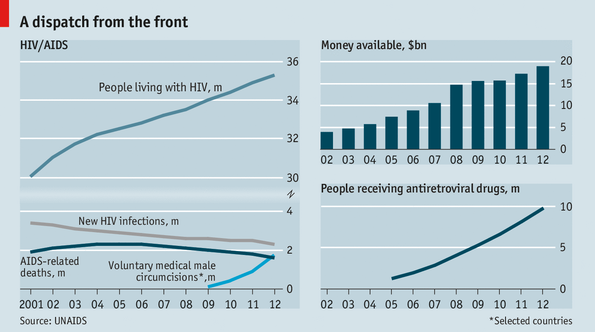
This year’s report by UNAIDS, the United Nations agency charged with combating the disease, confirms that optimistic picture. Though AIDS is not beaten (it still kills 1.6m people a year), this number is down from a peak of 2.3m in 2005. And the number of new infections per year has fallen by a third, to 2.3m, since 2001. Paradoxically, the number of those infected is rising. But this is because they are living longer. These trends are mostly the result of the spread of antiretroviral drugs, which are now taken by almost 10m people. They are paid for by a rise in the money spent on AIDS in poor and middle-income countries, to $18.9 billion in 2012. 
Africa’s men (and Africa is still the seat of the epidemic, with 70% of cases) have also responded enthusiastically to the discovery that circumcision vastly reduces the risk of infection. Some 1.7m a year of them are now having their foreskins snipped off in 14 countries looked at by UNAIDS.
We still don't know how to cure HIV infection. We still don't have an HIV vaccine. The reason the prevalence is going up is because more people are being infected with HIV each year than are dying with their HIV infection.  35 million infected people, 10 million dependent on expensive drugs for the rest of their lives for survival, and almost two million new infections a year doesn't sound like good news to me!

Thursday, September 26, 2013


Monday, September 23, 2013

Institution Building for Sustainable development


Jeffrey Sachs has an article in The Economist in which he states:
CLIMATE science tells us unequivocally that we need to “decarbonise” much of the energy system by the middle of this century. Yet advanced techniques for extracting fossil fuels—fracking, new deep-ocean drilling and the like—dominate today’s economic and political discussion. These measures may temporarily boost the economy but they would end up crowding out investments in low-carbon technologies. A boomlet in fossil fuels is bound to be a dead end. Short-term priorities and long-term needs are at odds. 
This disconnect also exists in the realm of jobs policy. Youth unemployment is stuck in the stratosphere in part because conventional jobs have succumbed to advances in information technology, robotics and outsourcing, leading to lower employment and a decline in earnings among unskilled youth in particular. In response economists obsess about policies to manage demand. But that will not address these structural changes. New strategies in education and training, and in smoothing the tricky school-to-work transition, are also needed. 
These examples illustrate the difference between mainstream economics and the policies that are needed to deliver sustainable development. Standard economic policies aim for growth, full stop. Sustainable development aims for growth that is broadly shared across the income scale and that is also environmentally sound. Mainstream economics divorces the short term from the long term. There may be big problems ahead—climate change, food scarcity, demographic shifts and poorly trained young people—but macroeconomists prefer to improvise today and worry about the future later. That approach also suits politicians, aligning the policy cycle with the electoral cycle. But it is not a recipe for producing robust, inclusive growth.
As the United Nations approaches the topic of "Sustainable Development Goals" for the next few decades, Sachs recommends "overhauling our technological systems" using a system that consists of:

  • "backcasting" from desired end goals to identify the steps needed to achieve each goal;
  • "road-mapping" to map out the way to accomplish each step toward the goal achievement; and
  • "global cooperation" to actually follow the road map and achieve the goals.
He is modelling his approach after that which was used to first put a man on the moon and to plot the human genome. Of course, that approach has value and is useful in many applications. In the ones identified, where money was available, the institutional problems were relatively simple. I fear the institutional problems in achieving sustainable development over the long term are more intractable.

Think about restoring economic growth to the United States. Here are some of the issues I see before us:
  • We will have to tame the influence of the greedy one percent. Over decades we have moved to a point in which a tiny group of the super rich is appropriating all the increases in productivity of our economy. It is clear from history that "trickle down" is not a sustainable economic growth strategy, but the super rich have achieved such influence over our political policy makers that trickle down is institutionalized as our development policy.
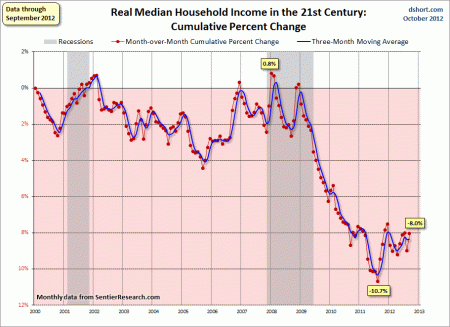
  • We will have to reverse the thinning of the middle class. We believe that a robust middle class is the key to robust, sustainable economic growth, but the median real income of the middle class is decreasing. Other countries have shown that it is possible to institutionalize policies that preserve the middle class, but doing so seems to be out of our reach.
  • We are a consumer society. We would rather let the government borrow and spend rather than pay the taxes or forego government services, so the public debt increases. We would rather import more than we export so that we can enjoy cheap imported goods, and are seeing our nation's debt to other countries increase. As individuals we have for decades spent more than we earn, building a huge consumer debt. As a result, we are not accumulating capital needed to rejuvenate our infrastructure, build productive capacity, and innovate technologically at a rapid enough rate. How do we institutionalize an society that invests adequately in its own future?
  • When my son studied in Ireland a couple of decades ago he was struck by the attitude of the Irish students who were studying not so much the things that most interested them as the things that were most likely to lead to productive professional careers. In the United States we have millions unemployed who need jobs and a million jobs for which we can not find qualified applicants. Part of the problem is that our education and training system is not producing people with the right skills, and part is that our culture is not demanding enough of that service from the education system. How do we institutionalize a system that produces the workforce needed for a dynamic economy?
  • We are a prejudiced society. Women in the workforce still face a glass ceiling. So too do our minorities. Blacks and Hispanics face discrimination. Worse, too many young blacks and Hispanics are on the streets or in jails, rather than in schools or in entry jobs that will lead to careers as productive citizens. How do we institutionalize a more fair and just society in which we waste none of our human potential?
Sustainable development over the 21st century will require major institution building that will be far more difficult than building NASA or the Human Genome Project. Jeff Sachs prescription is useful, but falls short of the mark.

Sunday, September 22, 2013

Lets make a lot of mistakes, but lets learn from them.

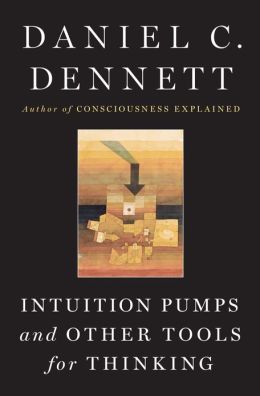
“If you are not making mistakes, you’re not taking enough risks,” Debbie Millman counseled. “Make New Mistakes. Make glorious, amazing mistakes. Make mistakes nobody’s ever made before,” Neil Gailman advised young creators. In Intuition Pumps And Other Tools for Thinking (public library), the inimitable Daniel Dennett, one of our greatest living philosophers, offers a set of thinking tools — “handy prosthetic imagination-extenders and focus holders” — that allow us to “think reliably and even gracefully about really hard questions” — to enhance your cognitive toolkit. He calls these tools “intuition pumps” — thought experiments designed to stir “a heartfelt, table-thumping intuition” (which we know is a pillar of even the most “rational” of science) about the question at hand, a kind of persuasion tool the reverse-engineering of which enables us to think better about thinking itself. Intuition, of course, is a domain-specific ability that relies on honed critical thinking rather than a mystical quality bestowed by the gods — but that’s precisely Dennett’s point, and his task is to help us hone it."Intuition Pumps: Daniel Dennett on the Dignity and Art-Science of Making Mistakes" by Maria Popova in Brain Pickings

Without comment


Update from The Economist magazine


A barrage of new statistics on American living standards offers some grounds for optimism. A typical American household's income has stopped falling for the first time in five years, and the poverty rate has stopped rising. At last, it seems, the expansion is strong enough at least to stabilise ordinary people's incomes. But the main message is a grim one http://econ.st/1bty1jZ

Did you know?


Source
Congress fiddling while the economy burns: "Ben Bernanke highlighted three reasons why policy makers had decided to hold off scaling back its bond purchasing. Those were: the low labour force participation rate, drags on economic growth due to congressional wrangling over a looming budget deadline, and the recent rise in mortgage rates." BBC News

Saturday, September 21, 2013

International Peace Day - 21 September


Visualizing the early spread of Arab Islam.


Historical Evolution of the (Western) Roman Empire
Source: Wikipedia Fall of the Western Roman Empire

Historical Evolution of the Byzantine (or Eastern Roman) Empire
Source: Wikipedia Decline of the Byzantine Empire
This may seem obvious, but I was just struck by the fact that the expansion of the Arabs and the related early expansion of Islam was related to the decline of Rome.

In 632, the year Mohammed died, the Arabian peninsula was united and Muslim.

The Roman empire was at its largest extent around the end of the 1st century CE. In the beginning of the 5th century CE the Roman empire was divided into a Western and an Eastern empire, and by the end of that century the Western empire had fallen.

The Sassanian Empire which arose in Persia in the 3rd century CE expanded until it was in conflict with Rome. There was a destructive Byzantine-Sassinid war from 602 to 628 which weakened both sides, and a civil war in the Sassanian Empire in the following decade. I assume that the Arab conquest of the Sassanian Empire from 632 to 634 was facilitated by the weakening of the Sassanians. So too, the conquest of Egypt by the Arabs would have been facilitated by the weakening of the Byzantine Empire. The spread of Arab control to the west in north Africa and into the Spanish peninsula would have been relatively easy in the turmoil after the fall of the Western Roman Empire, and indeed some of that turmoil had preceded the fall and helped lead to it.

Friday, September 20, 2013

Montgomery Planning Board advances master plan for White Oak Science Gateway

Source: The Washington Post
The Montgomery County Planning Board approved a land-use blueprint Thursday that officials hope will eventually transform the long-neglected White Oak section of the eastern part of the county into a “new Silicon Valley” for medical and life sciences research. 
The five-member board voted unanimously to send the White Oak Science Gateway Master Plan to the County Council and County Executive Isiah Leggett for review. The project’s anchor would be LifeSci Village, a joint venture of the county government and Percontee, a private developer.
 This is a great place for life science research, with the NIH headquarters, a number of existing firms, and access to a number of universities. The initiative should provide good jobs in the county and add to the tax base! It may also help people through research findings and help the national economy.

Conservative lobbyist kills plan to encourage kids to study science!


From Inside Higher Ed:
The U.S. House of Representatives was set to vote last week on a bill that would create the position of "science laureate" -- a national title to honor an accomplished scientist and promote science, akin to the U.S. poet laureate. But backlash from a conservative group led lawmakers to pull the proposal from the floor. 
The legislation, co-sponsored by Democratic Rep. Zoe Lofgren of California and Republican Rep. Lamar Smith of Texas, would have allowed the president to appoint up to three science laureates who would serve for one or two years, as decided by the president, and allowed for their reappointment.,,,,,,,,,,,
But concerns from Larry Hart, director of governmental relations at the American Conservative Union, about the bill’s journey through Congress and its contents delayed the voting process. 
Since the vast majority of scientists believe that greenhouse gas emissions are causing global warming, new science laureates would almost surely also believe that the data show that to be true. That might add to the pressure to do something about greenhouse gas emissions, and what companies would possibly object to that?

Wednesday, September 18, 2013

So far, so good!

Source: The Economist
As the guy was heard saying as he fell past the 10th floor of the skyscraper on his way to a crash!

For most people, the economy is not growing


Source: Pew Research Center
Median real household income is lower for all four groups since 2000. Asians are doing relatively better economically, not because they get preferences, but because their culture leads them to high levels of education and they work hard.

Note that blacks have less than half the median income of Asians.

I suspect that there is something important that does not come out of median income. Inflation is measured on the basis of a market basket of goods purchased by consumers. It is a general estimate, but in fact the way more affluent people spend their money is different than the way poor people do. Medical costs have been increasing faster than most goods and service costs. Thus people spending more of their income on health services may be seeing their buying power go down faster than average.