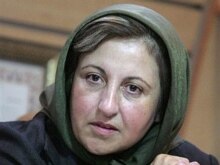
 Haleh Esfandiari
Haleh Esfandiari has been imprisoned, interrogated for many hours, and is now facing charges of espionage in Iran. She is a 67 year old scholar, the head of the Middle East program of the Woodrow Wilson International Center for Scholars. She is known for teaching Persian language and literature at Princeton, for efforts to improve the lives of women in the Middle East, and for organizing scholarly activities for the Woodrow Wilson Center. This grandmother, who was arrested while visiting her 93 year old mother, seems to me to be the most unlikely of spies.
I just heard an interview with her husband, Shaul Bakhash -- himself a noted Middle East scholar. He said that Iranian intelligence authorities suspected her of creating international networks of scholars, under the suspicion that those networks would help foment a "velvet revolution".
It seems at first glance that their fears are simply foolish. The Woodrow Wilson International Center is not likely to create a network sufficiently organized nor powerful to threaten regime change in a sovereign state, much less one as large and well shored up as Iran. But considering the leaders of a sovereign nation to be acting foolishly is not itself wise!
I have just been posting on my other blog on the Dialog Among Civilizations. Of course the United Nations and UNESCO promote that dialog in the pursuit of peace, not violence. Still, I believe that dialog among educators, scientists, and cultural and media leaders can lead to changes in government of the kind that will reduce the threat of war. Indeed, I think the velvet revolutions in the countries formerly under Communist governments were indeed the results of changes in the way that their peoples thought. Of course, a velvet revolution is preferable to a violent civil war!
I wonder whether there is deep cultural division underlying the confusion with which the U.S. population perceives this arrest. The United States is a democracy with a strong tradition in its political culture favoring the free expression of ideas. While that culture demands that the state not support any religion, the creators of the that political culture thought that freedom of speech and vigorous open discourse should challenge the parties in power, and indeed should challenge religions and religious belief. They were the products of the enlightenment, and thought that belief should be based on reason. Iran is a theocracy, and those in power do not seem to see as desirable any challenge to their political power, to their religious beliefs, nor to the political beliefs that stem from their religion. This fundamental cultural division might well put an Iranian-American scholar in jeopardy in Iran, to the extent that a scholar may have internalized American political philosophy. The division certainly makes it hard for people of the two nations to understand each other and each other's actions.
Iran is a major Middle Eastern power, with a globally important economy due to its oil exports, and a large Diaspora; its Persian peoples have a millennia long history of relations with other peoples. There would seem to be no alternative but for the government of Iran to allow networks to form that will communicate across its borders. Indeed, Iran's government structure involves both democratic and theocratic elements, and those democratic elements require freedom of expression. I hope that Iranian leadership will find ways to open discussion, and to promote international communication of their nation;s educational, scientific and cultural leadership, as well as of their nation's political leadership. To fail to do so will be to condemn Iran to a lagging position in the world, a position inconsistent with its intellectual history and the physical welfare of its people.
In any case, I join with many others in hoping for the release, unharmed, of Haleh Esfandiari.


No comments:
Post a Comment