Read the complete article from The Economist. December 14th 2005. (Subscription required.)
"Japan's style of innovation failed it in software and biotechnology in the 1990s. It might work better in robotics, aerospace and other burgeoning technologies."
"Japanese firms have not counted for much in software, the internet, biotechnology and other high-growth industries over the past decade. Japan can boast no equivalent of Microsoft, Google, Amazon or eBay. Its entire software industry has failed to make an impression on the world......Although a handful of Japanese pharmaceutical firms have developed a few profitable drugs, Japanese companies are also far behind the rest in biotechnology and medical devices. Japan's lack of success is not for want of trying. The country continues to lead the world in research and development, investing 3.2% of its GDP in R&D, compared with 2.6% in America and 2% in the European Union. Moreover, unlike western countries, where government and university labs generate lots of breakthroughs, Japan performs more of its R&D in big companies."
"Instead, the country's failure has much to do with its method of management and organisation. This won extravagant praise in the 1980s, when western writers and businessmen flocked to Japan for answers, and when the “lean” production manufacturing techniques pioneered by the likes of Toyota changed the world. The Japanese way of running companies has since fallen out of fashion, however."
"A few Japanese bankers have set up funds to promote venture capital (or at least what passes for it in Japan). The government has also converted all of Japan's national universities into public corporations, in a bid to shake up scientists' civil-service mentality and make them more flexible and innovative. New clusters and consortia are popping up all over the Japanese islands, to promote better links between university laboratories, government budgets and corporate R&D. Between 2000 and 2003 the number of start-ups created to commercialise discoveries at Japanese universities rose from 315 to 800."
"Yet to focus on the slow pace of reform in Japan is to miss an important point: that there are many ways to innovate, and no single approach is “right” for all times and technologies. Japanese companies are already very good at—indeed, lead the world in—many types of innovation. The reason they lost their edge in the 1990s is not so much because their approach to innovation was “wrong”, as because it was ill-suited to the sectors dominating that decade. The next few years could easily be different, since the battle over next-generation technologies may well be in areas that suit the Japanese far better than biotech and software ever did." (Emphasis added.)
"In biotech and software America gained a clear edge from its ability to let lots of start-ups experiment with new techniques and business models, and to commercialise ideas from university research laboratories as quickly as possible. America's other advantage is in basic scientific research. Its universities dominate rankings of the best in the world and are well integrated with government and business laboratories. In other technology-heavy sectors, however, including several that Japanese companies are betting on, the university laboratory and the entrepreneur's garage have less of an advantage over a big Japanese corporation with extensive business experience and a giant R&D budget.
"The American start-up method works very well when hundreds or thousands of potential business models might succeed—and the best way to find out which is to allow each brave or disgruntled genius to try out his own approach. Many fail, but a few succeed.
"In other industries and technologies—such as cars and electronics in the 1970s and 1980s—a better way to innovate is to learn by doing. If 100 start-ups try, all might fail before they learn anything useful or before they come up with a product or service they can sell. A big company is often better suited to such fields. Not only can it offer its innovators a more reliable source of investment capital, but it also has links to consumers, which it can use quickly to improve the next generation of whatever it is making. A big company in a new field can afford to make products with initial drawbacks, provided it learns quickly to overcome them.
"As they once did in cars and electronics, Japanese companies are today pursuing future technologies in several industries by making things first and only then pausing to think about how to improve them or put them to new uses. This leaves them at a familiar disadvantage in blue-sky research. But the idea—which has worked well enough in other industries to turn Japan into the world's second-biggest economy—is to keep getting better, eliminating costs and boosting quality, while rivals in America and Europe waste precious time at the drawing board. When Japanese companies do it right, they can innovate so quickly that they leave western competitors gasping for air."
Thursday, December 22, 2005


"Get planting"
Read Peter Campbell's full review of The Secret Life of Trees: How They Live and Why They Matter by Colin Tudge in the London Review of Books. (Subscription required.)
Exceprts:
"Despite the variety of introduced species, if you confine yourself to England’s managed, temperate landscape the picture you get is very limited. Alan Mitchell’s Trees of Britain and Northern Europe, a field guide which reckons to include ‘every species and large-growing cultivar to be seen in the countryside, parks and gardens of Europe north of the Mediterranean littoral’, is a book of modest proportions. The rainforest is a different matter, as is the foggy, rain-free Californian coast, as is the Cerrado of Brazil or the eucalyptus forests in Australia; and the central theme of Colin Tudge’s The Secret Life of Trees is variety and the evolution of variety: variety in form, in adaptation, in kinds of dependence – most trees need to cohabit with soil fungi, some need insects, birds or fruit bats to pollinate them and spread their seed, some are parasitic on other trees.
"Tudge makes the British experience seem truly insular. He writes, for example, about ‘the wondrous Reserva Florestal Adolfo Ducke’, which covers a hundred square kilometres of Amazon rainforest. Two thousand times smaller than Britain, it has forty times as many native trees – 1300 species. That in itself raises a question: why are there so many more species in the tropics than in higher latitudes? Tudge goes through the theories (not all of them – there are in print, he says, about 120 recognisably distinct attempts at an explanation). He finds no clear winner but thinks two ideas are particularly cogent. First, that away from the tropics ice ages wiped the slate clean again and again, leaving tough terrain in tough climates where only the adept survive. Second, that in the tropics the pressures are biological rather than physical, and that pressure from parasites, which a species of fewer, widely spaced individuals is better able to counter, is a major reason for diversity."
"Knowledge about the ways in which growth, morphogenesis and reproduction are regulated has been advanced through studies of a few species. One, Arabidopsis thaliana, has become a model organism because it has a short life-cycle, produces abundant seed and is easy to manipulate genetically. The insight into plant life which has come from such single-species studies has begun to make sense of plant form and function at the level of the cell. This science is, to borrow the old terminology, ‘natural philosophy’. The term ‘natural history’ better fits descriptions and analyses which emphasise the variety of species, their adaptations and their interdependence in communities. The work of the ecologists, foresters, field botanists and taxonomists that Tudge draws on is of that kind."
"Tudge ends his book with a secular sermon. The modern world, he says, is governed by the idea – call it a principle – that the only measure of right policy is an increase in the volume and money-value of goods and services; that this destroys the possibility of a sustainable relationship between us and our planet; that fertile land is taken over by mechanised agriculture, to the benefit of the few; that the many, forced off the land, gather in the slums of cities which already contain half the world’s population; that burning fossil fuel to drive our industries is leading to deleterious climate change; and that our only hope lies in a new kind of politics, a democracy in which people realise where their true advantage lies and are able to prevent governments and businesses standing in the way of its achievement."
Europe must get its act together on science aid
Read Devid Dickson's editorial in SciDev.Net. (December 19, 2005)
"The European Union is still struggling to meet commitments by its member states to increase science capacity in developing countries. To achieve this, closer alignment is needed between its efforts to boost research and to alleviate global poverty."
"The European Union is still struggling to meet commitments by its member states to increase science capacity in developing countries. To achieve this, closer alignment is needed between its efforts to boost research and to alleviate global poverty."
"Resistance to Bird Flu Drug Reported"
From "Findings" in The Washington Post. (December 22, 2005)
"In a development experts called alarming, two bird flu patients in Vietnam died after developing resistance to Tamiflu, the key drug that governments are stockpiling in case of a large-scale outbreak. The experts said the deaths were disturbing because the two girls had received early and aggressive treatment with Tamiflu and had gotten the recommended doses. The new report suggests that the doses doctors now consider ideal may be too low........The study in today's New England Journal of Medicine was led by Menno de Jong of the University of Oxford."
"In a development experts called alarming, two bird flu patients in Vietnam died after developing resistance to Tamiflu, the key drug that governments are stockpiling in case of a large-scale outbreak. The experts said the deaths were disturbing because the two girls had received early and aggressive treatment with Tamiflu and had gotten the recommended doses. The new report suggests that the doses doctors now consider ideal may be too low........The study in today's New England Journal of Medicine was led by Menno de Jong of the University of Oxford."
Wednesday, December 21, 2005
"Research as Empowerment?"
Go to the Communications Initiative website for this paper.
"This 62-page report offers information based on a series of seminars organised by the Toronto Group which seek to examine evidence-based policy and practice in health and social care. Additionally it explores the issue of extending the involvement of service users in research.
"The seminars, which took place in different locations in England, covered four topics: involving service users in traditional or mainstream research; involving service users in peer review; involving people from black and minority ethnic communities in research; and emancipatory research.
"According to the report, one of the fundamental barriers to the empowerment of service users in mainstream research remains the unequal relationship between the researcher and research participants. For instance, the report describes research carried out on the subject of Britain’s black and minority ethnic communities where they are viewed as ‘objects’ of research, rather than as potential participants in the research process. The report describes another obstacle based on expectations since service users and researchers may have different ideas about the purpose of the research.
"Some of the issues described in this report center around perspective. For instance, the report suggests that white researchers may not address the questions that people from black and minority ethnic communities see as a priority. "Researchers may focus on people’s experience of using services, rather than on people’s perspectives on what they consider to be important." As a result individual’s priorities are not identified and therefore not acted upon. As a further example, the report refers to the fact that people who are seen as having power in the research-commissioning process "are not actively committed to listening to the view of service user reviewers..." According to the report, this can lead service users to feel that their views are ignored.
"The report makes note of the fact that research carried out by service users is rarely published in peer-reviewed journals and as a result does not gain recognition from other parts of the research community, or from those who judge the quality of research. According to the report, this is changing because some mainstream research funders are beginning to make the involvement of service users in research a requirement for funding."
"Global Trend: More Science, More Fraud"

Read the full article by LAWRENCE K. ALTMAN and WILLIAM J. BROAD in The New York Times. (December 20, 2005)
"Science is often said to bar dishonesty and bad research with a triple safety net. The first is peer review, in which experts advise governments about what research to finance. The second is the referee system, which has journals ask reviewers to judge if manuscripts merit publication. The last is replication, whereby independent scientists see if the work holds up.
"But a series of scientific scandals in the 1970's and 1980's challenged the scientific community's faith in these mechanisms to root out malfeasance. In response the United States has over the last two decades added extra protections, including new laws and government investigative bodies.
"And as research around the globe has increased, most without the benefit of such safeguards, so have the cases of scientific misconduct."
Tuesday, December 20, 2005
Welcom back to an old friend and colleague

Go to the People section in Science of 2 December 2005. (Subscription required.)
Francesca Grifo
Political science: Working on biodiversity issues at the U.S. Agency for International Development and the National Institutes of Health, botanical systematist Francesca Grifo learned that policymaking is often guided by factors other than peer-reviewed science. She hopes to reduce the chances of that happening as director of a new permanent program on scientific integrity at the Union of Concerned Scientists (UCS). Grifo most recently worked as a policy instructor at Columbia University and curator of the American Museum of Natural History. She came to UCS this fall to make science a stronger force in the political arena. “Just because you’re right and just because you have your data doesn’t mean science takes the day,” she says.Among the challenges she wants to tackle are inadequate protections for whistleblowers, questionable appointments to federal scientific advisory boards, and the role of science in decisionmaking. To those who label UCS as partisan and liberal, she says “we’re focusing on this Administration because that’s what’s happening now.”
"The Arab Drift Into Scientific Obscurity"
Read the full article by Faisal Sanai, Arab News, . (20 December, 2005)
"In this era of globalization, a nation’s growth within the maturity module is determined by its scientific progress. Scientific progress in turn, is measured by the nation’s overall research publication in key peer-reviewed journals. This, to put it metaphorically, is the 'Holy Grail' of the research community.....
"It appears that Arab scholars across the expanse of the Middle East have become mere patrons of development rather than the pioneers they once were.
"Our scientific community is in deep hibernation. Not since the pre-Renaissance era has there been such a dearth of medical research. There is a malaise that seems to afflict Arab academic output and it has reached epidemic proportions. And the situation is only getting worse. There is now a pressing need for this issue to be addressed before we become the victims of our own neglect."
Facts, Rhetorical Statements and Quantification
I want to use this posting to consider statements of intentionality, whether they should be considered to be factual, and how to interpret their meaning. I will try to relate the thoughts on intentionality to the theme of social and economic development, and especially to the “goals and objectives” specified for development programs and projects.
President Bush’s speech Sunday night provides an opportunity for doing so. I will try to refrain from commentary on the Iraq war itself. There is an abundance of such comment already, and by people much more worthy of attention on the subject than I. The speech, however, provides vehicle for discussing some questions important to the topic of Knowledge for Development, and thus to the theme of this blog.
President Bush stated:
Of course, a moment’s consideration reveals that there are many options before the United States with respect to Iraq – an infinite variety. Indeed, “victory” and “defeat” are not options but outcomes, and there are many possible outcomes, ranging from the more to the less desirable. Bush’s is a rhetorical statement, not a statement of fact.
And, of course, political leaders must use rhetorical statements to gather political and popular support for the policies they advocate. To try to limit politicians to statements of fact would annoy them, frustrate us, and fail ignominiously.
Social and economic development is a political issue, and politicians use rhetoric all the time in its discussion. Indeed, stakeholders in development of all kinds argue for their positions. They (appropriately) use rhetorical techniques in making their arguments. The goals and objectives specified for development projects may often be seen as statements designed to gain support for the projects, or to motivate stakeholders in implementing those projects. Yet they are often treated as statements of belief, or indeed as statements of fact.
Bush also stated:
What does “victory mean? If it means prosecuting the war until its original goals are met, it is not clear how victory could be achieved. How could the United States eliminate the weapons of mass destruction from Saddam Hussein’s Iraq and stop it from sponsoring terrorism, if there were not WMDs nor sponsorship of international terrorism in the first place?
The decision to go to war in Iraq was complex. Probably more complex than could have been described in public statements. I think that an exhaustive attempt to describe the rationale for the war would have been a “poor argument”. Such a listing would not have succeeded in gaining the public support in the United States nor the acquiescence of other government which the war required. However, even if they did not describe the deliberations, the decision makers in the U.S. government must have considered the move in terms of the complex interplay of international economic and security policy – e.g. energy, Israel, stability in the Middle East, preparedness and alternative uses of U.S. military resources. Domestic policy must have been considered; it must have been concluded that economic conditions did not preclude a war, and that the administration could obtain domestic support to initiate the war.
The Bush Administration will be judged, by history and possibly in future elections, on the basis of its past decisions. But the selection of a course of action today depends on the situation today and how it is understood. How is the situation in Iraq to be improved? That decision will of course be influenced for each stakeholder by that stakeholder’s responsibility for the current situation.
So too, development programs and projects must be advanced at each moment according to the situation at that moment, and the responsibilities of the stakeholders for that situation, not on the basis of the original assumptions and plans, and certainly not to slavishly follow the original rhetoric.
Bush also stated:
At one level, this statement reflects “goal structuring”. The original concerns for WMDs and terrorism were part of overriding goals for security and peace. So too, the planned removal of the Saddam Hussein government was surely always recognized to require subsequent efforts to put something in its place; subordinate goals would always have been recognized for the adequacy of that substitute governance.
At another level, the statement reflects “goal creep” – “a democratic Iraq that can defend itself” and “a model of freedom for the Middle East” may now be goals of the Bush administration, but seem unlikely to have been original goals of a President who explicitly insisted in the election of 2000 that, if elected, he would not allow U.S. military forces to engage in "nation building."
At still another level, the statement is rhetorical, intended to build support for an increasingly unpopular Bush administration and for the war effort.
Of course goals should be structured, rhetoric should be employed by politicians to gain support for their efforts, and goals should change as situations evolve, and especially as new information accrues that changes the probabilities of the nature of the situation and the outcomes to be expected from alternative actions.
It would be idiocy to conduct the war in Iraq after three years as if the situation had not changed, and as if the initial assumptions which justified the war had not been proven erroneous.
The Lesson I Draw
Development projects and programs, too, are conducted with goals and objectives based on (sometimes erroneous) assumptions, which in turn are based on incomplete (and sometimes false) information. Moreover, explicit goals and objectives may be rhetorical statements, rather than the most accurate possible statements of expected results. Often it is foolish to continue implementing these programs when the situation changes, or those assumptions are proven false. Yet, I fear, that is exactly what happens in many cases, because program monitoring and evaluation judges success or failure in terms of the original, explicit goals and objectives. In evaluating programs, do we not wish to consider first the evolution of the situation itself, and not the degree to which that evolution was predicted? Indeed, should statements of goals and objectives not be chosen to contribute most to the desired direction of that evolution?
The Role for Quantification
I was surprised to hear President Bush state, in a televised interview last week, that he had not considered explicit estimates of casualties and deaths of U.S. military in making the decision to go to war, nor explicit estimates of Iraqi casualties or deaths from the action nor from the dislocations that would inevitably follow the invasion. Perhaps the considerations were implicit; there must surely be levels of casualties that would have been considered so great as to foreclose the possibility of war. Surely the possibilities of these levels actually occurring must have been considered too distant to change the decision to go to war.
In postings on this blog, I have suggested that the timing and body counts from the next flu pandemic are not amenable to statistical estimates, but are really uncertain. History provides only some ideas of what might happen, and how likely worst case scenarios might be. Equally, we can not provide good estimates on the effects of alternative actions in averting the disease, disruption and death from a future flu pandemic. Yet knowing something about the numbers is important. Knowing that 50 million deaths could occur from a pandemic flu requires some action, and knowing that the probability that such a pandemic will evolve from the current A/H5N1 flu is increasing lends urgency to such action. Knowing that such a pandemic is quite unlikely, and knowing that tens of millions die per year from other preventable causes suggests limits to the resources we devote to flu.
Quantification is important. I understand that quantitative models of battlefield casualties are now quite robust and reasonably accurate; they should have been (and probably were) used in the run up to the Iraq invasion. In many cases such as that of a flu pandemic, however, the parameter values for the available models are guesstimates rather than scientific based estimates. Even so, such models can be useful. Their real utility requires that decision makers have deep understanding to inform the confidence to place in the projections and the reliance to place upon them.
In the case of Iraq, the decision to invade changed everything – not only in Iraq, but in the Middle East and the United States. To go back to a metaphor used in the days of the Raj, it was a critical move in the great game. I can not imagine any but the most qualitative estimates being made of the effects of the move on the evolution of political systems in the Middle East, nor on the Israeli-Arab peace process. But of course, such qualitative estimates should have been and must have been made.
Quantification has become increasingly important in development circles in recent decades. This is perhaps a legacy of the computer age, or of Robert McNamara, or of the evolution of management processes in our time. But too often, quantification has become a ritual, followed by people who really don’t understand the implications of the methods and numbers that they use. Both qualitative and quantitative methods are important in planning moves in “the great game” of development. Neither is a magical device for attaining truth.
President Bush’s speech Sunday night provides an opportunity for doing so. I will try to refrain from commentary on the Iraq war itself. There is an abundance of such comment already, and by people much more worthy of attention on the subject than I. The speech, however, provides vehicle for discussing some questions important to the topic of Knowledge for Development, and thus to the theme of this blog.
President Bush stated:
Now there are only two options before our country -- victory or defeat.
Of course, a moment’s consideration reveals that there are many options before the United States with respect to Iraq – an infinite variety. Indeed, “victory” and “defeat” are not options but outcomes, and there are many possible outcomes, ranging from the more to the less desirable. Bush’s is a rhetorical statement, not a statement of fact.
And, of course, political leaders must use rhetorical statements to gather political and popular support for the policies they advocate. To try to limit politicians to statements of fact would annoy them, frustrate us, and fail ignominiously.
Social and economic development is a political issue, and politicians use rhetoric all the time in its discussion. Indeed, stakeholders in development of all kinds argue for their positions. They (appropriately) use rhetorical techniques in making their arguments. The goals and objectives specified for development projects may often be seen as statements designed to gain support for the projects, or to motivate stakeholders in implementing those projects. Yet they are often treated as statements of belief, or indeed as statements of fact.
Bush also stated:
From this office, nearly three years ago, I announced the start of military operations in Iraq. Our Coalition confronted a regime that defied United Nations Security Council Resolutions -- violated a cease-fire agreement -- sponsored terrorism -- and possessed, we believed, weapons of mass destruction. After the swift fall of Baghdad, we found mass graves filled by a dictator -- we found some capacity to restart programs to produce weapons of mass destruction -- but we did not find those weapons.
It is true that Saddam Hussein had a history of pursuing and using weapons of mass destruction. It is true that he systematically concealed those programs, and blocked the work of UN weapons inspectors. It is true that many nations believed that Saddam had weapons of mass destruction. But much of the intelligence turned out to be wrong. And as your President, I am responsible for the decision to go into Iraq.
Yet it was right to remove Saddam Hussein from power. He was given an ultimatum -- and he made his choice for war. And the result of that war was to rid the world of a murderous dictator who menaced his people, invaded his neighbors, and declared America to be his enemy. Saddam Hussein, captured and jailed, is still the same raging tyrant -- only now without a throne. His power to harm a single man, woman, or child is gone forever. And the world is better for it.
What does “victory mean? If it means prosecuting the war until its original goals are met, it is not clear how victory could be achieved. How could the United States eliminate the weapons of mass destruction from Saddam Hussein’s Iraq and stop it from sponsoring terrorism, if there were not WMDs nor sponsorship of international terrorism in the first place?
The decision to go to war in Iraq was complex. Probably more complex than could have been described in public statements. I think that an exhaustive attempt to describe the rationale for the war would have been a “poor argument”. Such a listing would not have succeeded in gaining the public support in the United States nor the acquiescence of other government which the war required. However, even if they did not describe the deliberations, the decision makers in the U.S. government must have considered the move in terms of the complex interplay of international economic and security policy – e.g. energy, Israel, stability in the Middle East, preparedness and alternative uses of U.S. military resources. Domestic policy must have been considered; it must have been concluded that economic conditions did not preclude a war, and that the administration could obtain domestic support to initiate the war.
The Bush Administration will be judged, by history and possibly in future elections, on the basis of its past decisions. But the selection of a course of action today depends on the situation today and how it is understood. How is the situation in Iraq to be improved? That decision will of course be influenced for each stakeholder by that stakeholder’s responsibility for the current situation.
So too, development programs and projects must be advanced at each moment according to the situation at that moment, and the responsibilities of the stakeholders for that situation, not on the basis of the original assumptions and plans, and certainly not to slavishly follow the original rhetoric.
Bush also stated:
America, our Coalition, and Iraqi leaders are working toward the same goal -- a democratic Iraq that can defend itself -- that will never again be a safe haven for terrorists -- and that will serve as a model of freedom for the Middle East……..I have never been more certain that America's actions in Iraq are essential to the security of our citizens, and will lay the foundation of peace for our children and grandchildren.
At one level, this statement reflects “goal structuring”. The original concerns for WMDs and terrorism were part of overriding goals for security and peace. So too, the planned removal of the Saddam Hussein government was surely always recognized to require subsequent efforts to put something in its place; subordinate goals would always have been recognized for the adequacy of that substitute governance.
At another level, the statement reflects “goal creep” – “a democratic Iraq that can defend itself” and “a model of freedom for the Middle East” may now be goals of the Bush administration, but seem unlikely to have been original goals of a President who explicitly insisted in the election of 2000 that, if elected, he would not allow U.S. military forces to engage in "nation building."
At still another level, the statement is rhetorical, intended to build support for an increasingly unpopular Bush administration and for the war effort.
Of course goals should be structured, rhetoric should be employed by politicians to gain support for their efforts, and goals should change as situations evolve, and especially as new information accrues that changes the probabilities of the nature of the situation and the outcomes to be expected from alternative actions.
It would be idiocy to conduct the war in Iraq after three years as if the situation had not changed, and as if the initial assumptions which justified the war had not been proven erroneous.
The Lesson I Draw
Development projects and programs, too, are conducted with goals and objectives based on (sometimes erroneous) assumptions, which in turn are based on incomplete (and sometimes false) information. Moreover, explicit goals and objectives may be rhetorical statements, rather than the most accurate possible statements of expected results. Often it is foolish to continue implementing these programs when the situation changes, or those assumptions are proven false. Yet, I fear, that is exactly what happens in many cases, because program monitoring and evaluation judges success or failure in terms of the original, explicit goals and objectives. In evaluating programs, do we not wish to consider first the evolution of the situation itself, and not the degree to which that evolution was predicted? Indeed, should statements of goals and objectives not be chosen to contribute most to the desired direction of that evolution?
The Role for Quantification
I was surprised to hear President Bush state, in a televised interview last week, that he had not considered explicit estimates of casualties and deaths of U.S. military in making the decision to go to war, nor explicit estimates of Iraqi casualties or deaths from the action nor from the dislocations that would inevitably follow the invasion. Perhaps the considerations were implicit; there must surely be levels of casualties that would have been considered so great as to foreclose the possibility of war. Surely the possibilities of these levels actually occurring must have been considered too distant to change the decision to go to war.
In postings on this blog, I have suggested that the timing and body counts from the next flu pandemic are not amenable to statistical estimates, but are really uncertain. History provides only some ideas of what might happen, and how likely worst case scenarios might be. Equally, we can not provide good estimates on the effects of alternative actions in averting the disease, disruption and death from a future flu pandemic. Yet knowing something about the numbers is important. Knowing that 50 million deaths could occur from a pandemic flu requires some action, and knowing that the probability that such a pandemic will evolve from the current A/H5N1 flu is increasing lends urgency to such action. Knowing that such a pandemic is quite unlikely, and knowing that tens of millions die per year from other preventable causes suggests limits to the resources we devote to flu.
Quantification is important. I understand that quantitative models of battlefield casualties are now quite robust and reasonably accurate; they should have been (and probably were) used in the run up to the Iraq invasion. In many cases such as that of a flu pandemic, however, the parameter values for the available models are guesstimates rather than scientific based estimates. Even so, such models can be useful. Their real utility requires that decision makers have deep understanding to inform the confidence to place in the projections and the reliance to place upon them.
In the case of Iraq, the decision to invade changed everything – not only in Iraq, but in the Middle East and the United States. To go back to a metaphor used in the days of the Raj, it was a critical move in the great game. I can not imagine any but the most qualitative estimates being made of the effects of the move on the evolution of political systems in the Middle East, nor on the Israeli-Arab peace process. But of course, such qualitative estimates should have been and must have been made.
Quantification has become increasingly important in development circles in recent decades. This is perhaps a legacy of the computer age, or of Robert McNamara, or of the evolution of management processes in our time. But too often, quantification has become a ritual, followed by people who really don’t understand the implications of the methods and numbers that they use. Both qualitative and quantitative methods are important in planning moves in “the great game” of development. Neither is a magical device for attaining truth.
Monday, December 19, 2005
Customs Agents Seize Counterfeit Bird Flu Drug
Read the full article from the Associated Press in the Washington Post. (December 19, 2005)
Since the first package was intercepted on November 26, 2005, customs agents have seized 51 packages, each containing as many as 50 counterfeit capsules labeled generic Tamiflu.
Since the first package was intercepted on November 26, 2005, customs agents have seized 51 packages, each containing as many as 50 counterfeit capsules labeled generic Tamiflu.
"Lives Lost As Vaccine Programs Face Delays: Efforts to Get Medicine To Poor Children Falter"
Read the full article by Justin Gillis in the Washington Post. (December 19, 2005)
"Companies have developed two vaccines that theoretically could save the lives of several million children over the next decade, but efforts to get them to the poor countries that need them most are lagging.
"One vaccine, which protects against a life-threatening form of pneumonia, has been available to children in the United States for five years and has had a dramatic impact on disease here. The other, a vaccine that protects against a deadly form of diarrhea, is poised for a rollout soon among middle-income countries in Latin America.........
"The efforts have faltered amid a dizzying array of snafus, misjudgments and business difficulties. One company cannot produce enough vaccine, and studies needed to support widespread use of another have been slowed by behind-the-scenes squabbling. The problems have proved so vexing that the vaccines are expected to take an additional three to five years to reach the poorest villages."
The Diseases
Rotavirus
* Is an intestinal germ that is, worldwide, the most important cause of severe diarrhea in early childhood.
* Causes many hospitalizations but few deaths in wealthy countries.
* Is estimated to kill 440,000 every year, mostly young children in poor countries.
Pneumoccus
* Is a germ that can cause pneumonia, ear infection and brain inflammation, especially in young children and people with weakened immunity.
* Kills people in wealthy countries but disease rates are falling due to a vaccine.
* Has a vaccine not widely used in poor countries.
* Kills an estimated 1.6 million people every year; nearly half are young children.
SOURCES: Centers for Disease Control and Prevention, World Health Organization via the Washington Post
Sunday, December 18, 2005
The State of the World's Children 2006
UNICEF photo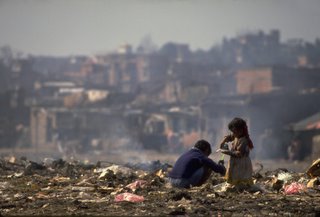
Go to UNICEF's website for the report.
From the Executive Summary:
"Exclusion acts against children in all countries, societies and communities. At the national level, the root causes of exclusion are poverty, weak governance, armed conflict and HIV/AIDS. Statistical analyses of key MDG (Millennium Development Goals) indicators related to child health and education show a widening gap between children growing up in countries with the lowest level of development, torn by strife, underserved by weak governments or ravaged by HIV/AIDS and their peers in the rest of the developing world. These factors not only jeopardize these children's chances of benefiting from the Millennium agenda, they also increase the risk that they will miss out on their childhood and face continued exclusion in adulthood......
"Swift and decisive action (is required) in four key areas:
"Our commitments to children demand that every effort be made to reach them. But how can we reach those children living in the shadows? How can we ensure their inclusion in essential services and their visibility by protecting them from harm, abuse and violence and encouraging their participation in society? Three conclusions emerge:

Go to UNICEF's website for the report.
From the Executive Summary:
"Exclusion acts against children in all countries, societies and communities. At the national level, the root causes of exclusion are poverty, weak governance, armed conflict and HIV/AIDS. Statistical analyses of key MDG (Millennium Development Goals) indicators related to child health and education show a widening gap between children growing up in countries with the lowest level of development, torn by strife, underserved by weak governments or ravaged by HIV/AIDS and their peers in the rest of the developing world. These factors not only jeopardize these children's chances of benefiting from the Millennium agenda, they also increase the risk that they will miss out on their childhood and face continued exclusion in adulthood......
"Swift and decisive action (is required) in four key areas:
* Poverty and inequality. Adjusting poverty-reduction strategies and expanding budgets or reallocating resources to social investment would assist millions of children in the poorest countries and communities."At the extremes, children can become invisible, in effect disappearing from view within their families, communities and societies and to governments, donors, civil society, the media, the private sector and even other children. For millions of children, the main cause of their invisibility is violations of their right to protection.......
* Armed conflict and 'fragile' States. The international community must seek to prevent and resolve armed conflict and engage with countries with weak policy/institutional framework to protect children and women and provide essential services. Emergency responses for children caught up in conflict should include services for education, child protection and the prevention of HIV transmission.
* HIV/AIDS and children. Greater attention should be given to the impact of HIV/AIDS on children and adolescents and to ways of protecting them from both infection and exclusion. The Global Campaign on Children and HIV/AIDS will play a significant role in this regard.
* Discrimination. Governments and societies must openly confront discrimination, introduce and enforce legislation prohibiting it and implement initiatives to address exclusion faced by women and girls, ethnic and indigenous groups and the disable.
"Our commitments to children demand that every effort be made to reach them. But how can we reach those children living in the shadows? How can we ensure their inclusion in essential services and their visibility by protecting them from harm, abuse and violence and encouraging their participation in society? Three conclusions emerge:
* Understanding the plight of excluded and invisible children and the factors behind their marginalization, and then focusing initiatives on these children, must form an integral part of national strategies on child rights and development."Governments bear the primary responsibility for reaching out to excluded and invisible children and need to step up their efforts in four key areas:
* The root causes of exclusion and the factors making children invisible must be addressed. Even well funded, well targeted initiatives for disadvantaged families and children risk failure if the overall conditions that foster poverty, armed conflict, weak governance, the uncontained spread of HIV/AIDS and discrimination persist.
* All elements of society must recommit to their responsibilities to children, including the creation of a strong protective environment.
* Research: Strong research is essential to effective programming, but reliable data on these children is currently in short supply."Other actors also have a role to play. Donors and international organizations must create an enabling environment through bold and well conceived policies on aid, trade and debt relief. Civil society must acknowledge its responsibilities to children and be part of the solution. The private sector must adopt ethical corporate practices that ensure that children are never exploited. The media can become a vehicle for empowerment by providing people with accurate information and by challenging attitudes, prejudices and practices that harm children. Finally, children themselves can play an active part in their own protection and that of their peers."
* Legislation: National legislation must match international commitments to children. Legislation that entrenches discrimination must be amended or abolished.
* Financing and capacity-building: Legislation and research on excluded and invisible children must be complemented by child-focused budgets and institution-building.
* Programmes: Service reform to remove entry barriers to essential services for excluded children is urgently required in many countries and communities. Packaging services can increase access, as can the use of satellite and mobile services for children in remote or deprived locations.
Mooney "addresses a vitally important topic and gets it basically right."
Read the full review by JOHN HORGAN of The Republican War on Science in the December 18, 2005 New York Times. (free registration required)
(Chris) "Mooney charges George Bush and other conservative Republicans with 'science abuse,' which he defines as 'any attempt to inappropriately undermine, alter or otherwise interfere with the scientific process, or scientific conclusions, for political or ideological reasons.' Science abuse is not an exclusively right-wing sin, Mooney acknowledges. He condemns Greenpeace for exaggerating the risks of genetically modified 'Frankenfoods,' animal-rights groups for dismissing the medical benefits of research on animals and John Kerry for overstating the potential of stem cells during his presidential run.
"In 'politicized fights involving science, it is rare to find liberals entirely innocent of abuses,' Mooney asserts. 'But they are almost never as guilty as the Right.' By 'the Right,' Mooney means the powerful alliance of conservative Christians - who seek to influence policies on abortion, stem cells, sexual conduct and the teaching of evolution - and advocates of free enterprise who attempt to minimize regulations that cut into corporate profits. The champion of both groups - and the chief villain of Mooney's book - is President Bush, whom Mooney accuses of having 'politicized science to an unprecedented degree.'"
"Agreement Reached at Trade Talks"
Read the full article by KEITH BRADSHER in the New York Times (free registration required).
"The world’s leading trading nations reached an agreement here on Sunday evening resolving a series of narrow but troublesome issues that have blocked a global trade agreement for the last three years."
The article goes on to enumerate the key elements of the agreement.
"The world’s leading trading nations reached an agreement here on Sunday evening resolving a series of narrow but troublesome issues that have blocked a global trade agreement for the last three years."
The article goes on to enumerate the key elements of the agreement.
"WTO Reaches Agreement on Cuts in Agriculture, Cotton Subsidies"
Bloomberg.com just published a story with the following opening paragraphs:
This is good news, but perhaps not as good as we might have thought. Yesterday, the Washington Post published an article by Paul Blustein titled, "World Bank Reconsiders Trade's Benefits to Poor". The article states:
To assist developing countries prepare for negotiating multilateral trade reform under the Doha Development Agenda, the World Bank put up a good website. Empirical analysis of the effects of possible Doha trade reform scenarios appear in two new books produced by the World Bank:
These are in addition to the World Bank's Trade website which provides an entry to its overall work on trade and development.
The 149 members of the World Trade Organization approved a proposal aimed at steering global trade negotiations toward a deal on cutting tariffs and agriculture subsidies by the end of next year.
The agreement outlines plans for the U.S. and European Union to scale back their farm subsidies and open their markets to more products from the world's poorest nations in a bid to prevent a collapse in global trade talks. The deal is a first step as negotiators try to reach a new WTO deal next year......
The EU said it would scrap export payments for farm goods by 2013 and the U.S., under pressure from four West African nations, agreed to expedite deep cuts in payments to cotton growers. Both said they would allow in duty-free almost all the textiles, toys and sneakers that 32 of the world's poorest countries can send them. (emphasis added)
This is good news, but perhaps not as good as we might have thought. Yesterday, the Washington Post published an article by Paul Blustein titled, "World Bank Reconsiders Trade's Benefits to Poor". The article states:
The bank estimated three years ago that freeing international trade of all barriers and subsidies would lift 320 million people above the $2 a day poverty line by 2015. Now, however, bank economists project the figure at between 66 million and 95 million people. And even that assumes the WTO negotiators would completely abolish tariffs, quotas and other obstacles to commerce -- a fanciful scenario, calculated only to show what a maximum deal would produce.
Assuming a more plausible outcome in which the WTO members agree to some deep cuts in tariffs and subsidies while stopping short of pure free trade, the reduction in the number of people below the $2-a-day line by 2015 would be only about 6.2 million to 12.1 million people, the bank now reckons. That is less than 1 percent of the people living below the line.
To assist developing countries prepare for negotiating multilateral trade reform under the Doha Development Agenda, the World Bank put up a good website. Empirical analysis of the effects of possible Doha trade reform scenarios appear in two new books produced by the World Bank:
* Agricultural trade reform and the Doha development agenda, and
* Poverty Impacts of a WTO Agreement
These are in addition to the World Bank's Trade website which provides an entry to its overall work on trade and development.
Saturday, December 17, 2005
"Still, a Wounded Military"
The following is from Foreign Policy, "The Top 10 Stories You Missed in 2005"
One hopes that an important reason that the wounded to killed ratio is high is that our troops are surviving things that would have killed in the past. Still, I am concerned that so few citizens have knowledge of the real cost of the war to the U.S. military. Perhaps more worrying is the lack of knowledge of the public about the real cost in lives lost to Iraqis of the war -- those killed by violence, and those who die of poverty because the economy is in shambles, or who die due to the failures of an overstressed public health system in the country.
In last year’s list, we pointed out that the health of the U.S. military was in serious decline. At 7 to 1, the ratio of wounded to dead in Iraq was the highest of any conflict in recent memory, including Vietnam, where the ratio was 3 to 1. A year later, the story is worse—and still largely ignored. In 2005, the most common number cited regarding the war in Iraq was the more than 2,100 U.S. soldiers that have died. When the number of wounded was mentioned, the Pentagon figure of more than 15,500 U.S. troops, or the Army Medical Department’s total of 20,748 medical evacuations, was usually rolled out. Today, the wounded-to-dead ratio remains near 7 to 1 by this official count. But a Department of Veterans Affairs (VA) report released in October tells a bigger story. Its data shows that 119,247 veterans of operations in Iraq and Afghanistan have sought VA healthcare. Of those, 46,450 were diagnosed primarily with musculoskeletal problems, such as joint ailments and back disorders. More than 36,800 veterans, or 31 percent of those the VA cared for, were treated primarily for mental disorders. Not even the VA had anticipated the number of soldiers they would be asked to help. In June, the agency told lawmakers that it had underestimated the the number of Iraq and Afghanistan veterans, and required $1 billion in emergency funding.
One hopes that an important reason that the wounded to killed ratio is high is that our troops are surviving things that would have killed in the past. Still, I am concerned that so few citizens have knowledge of the real cost of the war to the U.S. military. Perhaps more worrying is the lack of knowledge of the public about the real cost in lives lost to Iraqis of the war -- those killed by violence, and those who die of poverty because the economy is in shambles, or who die due to the failures of an overstressed public health system in the country.
"International migration, remittances, and the brain drain"

Go to the World Bank webpage with links to the book's chapters.
" Knowledge of the economic effects of migration, especially its impact on economic development, is rather limited. In order to expand knowledge on migration, and identify policies and reforms that would lead to superior development outcomes, this volume presents the results of a first set of studies carried out on the subject. Current demographic trends in both developed and developing countries are pointing toward significant, potential economic gains from migration. The labor forces in many developed countries are expected to peak around 2010, and decline by around 5 percent in the following two decades, accompanied by a rapid increase in dependency ratios. Conversely, the labor forces in many developing countries are expanding rapidly, resulting in declines in dependency ratios. This imbalance is likely to create strong demand for workers in developed countries ' labor markets, especially for numerous service sectors that can only be supplied locally. There are large north-south wage gaps, however, especially for unskilled and semiskilled labor. Part 1 of this book, Migration and Remittances, examines the determinants of migration, and the impact of migration and remittances on various development indicators, and measures of welfare. Among these are poverty and inequality; investments in education, health, housing and other productive activities; entrepreneurship; and child labor and education. It focuses on different source countries, use data collected via different methodologies, and employ different econometric tools. Their results, however, are surprisingly consistent. Part 2, Brain Drain, Brain Gain, Brain Waste, focuses on issues related to the migration of skilled workers, that is, the brain drain. It presents the most extensive database on bilateral skilled migration to date, and also examines a number of issues associated with the brain drain, that have not been emphasized in the literature so far, uncovers a number of interesting and unexpected patterns, and, provides answers to some of the debates. This volume deals essentially with economically motivated south-north migration, whose principal cause is, in most cases, the difference in (the present value of) expected real wages, adjusted for migration costs."
Download a PDF file with the entire 292 page book.
Friday, December 16, 2005
"What do bibliometric indicators tell us about world scientific output?"
Read the full issue of the Bulletin.

"Bibliometric indicators discussed in this bulletin show that the distribution of scientific production around the world is changing: developed countries’ share of world scientific publications has declined over the last 20 years. Some developing regions are increasing their production in this field (Latin America, Asia) but others are not (Africa)."

This issue of the UNESCO Institute of Statistics (UIS) Bulletin on Science and Technology Statistics presents a bibliometric analysis of 20 years of world scientific production (1981-2000), with a particular emphasis on developing countries. UIS Bulletin on Science and Technology Statistics, Issue No. 2, September 2005. (PDF, 6 pages.)
Bolton at the United Nations
Read "The Arsonist" By Mark Leon Goldberg in the January 2006 issue of The American Prospect Online Edition. (Published December 14, 2005.)
Bolton was the man most responsible for the complexity of the negotiations at the mid-September 2005 United Nations World Summit. "A month earlier, the newly minted, recess-appointed U.S. ambassador had sent negotiations into a tailspin when he submitted some 750 alterations to a 39-page text known as the “summit outcomes” document. Bolton’s most eye-popping suggestion at this summit, billed as a renewal of the UN’s 5-year-old pledge to help poor countries, was that all 14 references in the document to the anti-poverty Millennium Development Goals (MDGs) be deleted......
"The Prospect has learned that, in the end, it took (U.S. Secretary of State Condoleezza) Rice’s personal intervention to set things right. On September 5 she participated in a conference call with UN Secretary-General Ko? Annan and British Foreign Minister Jack Straw on the subject of UN reform. The next day, Bolton sent a letter to his UN counterparts relenting on the issue. Finally, to put all lingering questions about U.S. support of the MDGs to rest, President Bush himself stated America’s ?rm commitment to them in his September 14 speech to the UN General Assembly.......
"By December, a looming crisis over the UN budget was testing Bolton and Rice’s relationship once again. At the time of this writing, the United Nations was in chaos. Ko? Annan had just canceled a trip to Asia to oversee negotiations over the UN’s biennium budget, which was being derailed by an American threat to withhold support for the UN’s two-year operating budget until a number of management reforms are passed. With a December 31 deadline looming, Bolton proposed that the world body adopt a three- or four-month interim budget -- just enough time to force other member states to accept the reforms.
"These reforms are backed by Europe, Canada, Australia, New Zealand, Japan, and the secretary-general himself. Yet Bolton’s strong-arm tactics led their representatives to warn that his proposal would starve the United Nations and disrupt other important UN business like peacekeeping operations.
"The rumor mill at the Vienna Café (in the basement of the UN building in New York) has suggested that Bolton must have bypassed Rice and received support for holding the UN budget hostage from the president himself -- a view widely held as the truth among UN diplomats. Regardless of the accuracy of this rumor, Bolton’s move is paradigmatic of his self-defeating approach to the UN: Instead of banding together with powerful allies, he alienates them. And in doing so he empowers adversaries like Iran, Venezuela, Cuba, and other spoilers content with a UN that is tied in knots. Critics feared that Bolton’s tenure would be problematic for American interests. The evidence suggests it’s been even worse."
"In his ?rst six months at the UN, John Bolton has offended allies, blocked crucial negotiations, undermined the Secretary of State -- and harmed U.S. interests. We expected bad; we didn’t expect this bad."
Bolton was the man most responsible for the complexity of the negotiations at the mid-September 2005 United Nations World Summit. "A month earlier, the newly minted, recess-appointed U.S. ambassador had sent negotiations into a tailspin when he submitted some 750 alterations to a 39-page text known as the “summit outcomes” document. Bolton’s most eye-popping suggestion at this summit, billed as a renewal of the UN’s 5-year-old pledge to help poor countries, was that all 14 references in the document to the anti-poverty Millennium Development Goals (MDGs) be deleted......
"The Prospect has learned that, in the end, it took (U.S. Secretary of State Condoleezza) Rice’s personal intervention to set things right. On September 5 she participated in a conference call with UN Secretary-General Ko? Annan and British Foreign Minister Jack Straw on the subject of UN reform. The next day, Bolton sent a letter to his UN counterparts relenting on the issue. Finally, to put all lingering questions about U.S. support of the MDGs to rest, President Bush himself stated America’s ?rm commitment to them in his September 14 speech to the UN General Assembly.......
"By December, a looming crisis over the UN budget was testing Bolton and Rice’s relationship once again. At the time of this writing, the United Nations was in chaos. Ko? Annan had just canceled a trip to Asia to oversee negotiations over the UN’s biennium budget, which was being derailed by an American threat to withhold support for the UN’s two-year operating budget until a number of management reforms are passed. With a December 31 deadline looming, Bolton proposed that the world body adopt a three- or four-month interim budget -- just enough time to force other member states to accept the reforms.
"These reforms are backed by Europe, Canada, Australia, New Zealand, Japan, and the secretary-general himself. Yet Bolton’s strong-arm tactics led their representatives to warn that his proposal would starve the United Nations and disrupt other important UN business like peacekeeping operations.
"The rumor mill at the Vienna Café (in the basement of the UN building in New York) has suggested that Bolton must have bypassed Rice and received support for holding the UN budget hostage from the president himself -- a view widely held as the truth among UN diplomats. Regardless of the accuracy of this rumor, Bolton’s move is paradigmatic of his self-defeating approach to the UN: Instead of banding together with powerful allies, he alienates them. And in doing so he empowers adversaries like Iran, Venezuela, Cuba, and other spoilers content with a UN that is tied in knots. Critics feared that Bolton’s tenure would be problematic for American interests. The evidence suggests it’s been even worse."
Thursday, December 15, 2005
Trust for America's Health Flu Warnings
Go to the Trust for America's Health webpage on a possible flu pandemic.
A few days ago there was a large add in the Washington Post with the headline:
The add is apparently based on a report published on the Trust for America's Health website titled A Killer Flu?. That report contains numbers describing the potential impact on the United States of a flu pandemic;
The figures are based on a guess by the World Health Organization "that an avian flu epidemic could impact 25 percent of countriesÂ? populations." Data from the Hong Kong flu epidemic of 1968-69 was apparently available describing the percentage of the persons thought to be infected who were hospitalized for flu and who died of flu. The Hong Kong flu epidemic hospitalization and death rates were then multiplied by three to get the "estimates" given above.
The important point is that these are guesses. Their epidemiological backing is more apparent than real. The portion of the population that will get sick with a future flu is of course not known, although -- as we all know -- a lot of people do get the flu each year. However, the U.S. Government pandemic flu website reports:
Thus the numbers of U.S. deaths of the 1957 and 1968 pandemics are far below even the lower value included in A Killer Flu?.
Perhaps some deconstruction is required. The add was posted by the Working Group on Pandemic Influenza Preparedness. It consists of:
The websites given for the add were those of the Trust for America's Health and The Association of Professionals in Infection Control and Epidemiology (APIC).
The Trust website lists a very distinguished Board of Directors and Advisory Council including former high ranking political officials and leaders of schools of public health. Its budget tops US$2 million per year, mostly from foundation grants,
APIC is a professional society serving infection control professionals, including physicians, nurses, and epidemiologists. Its efforts seem most focused on the control of infections occurring in health care facilities.
I have no doubt that all the organizations forming the Working Group are vitally concerned with improving health. They are all oriented toward the domestic health issues in the United States. And they would all seem to share an interest in increased government funding to prepare to ameliorate the effect of a global flu pandemic on the population of the United States. Note the following from a statement of purpose by the Working Group:
While I do not doubt the sincerity of the opinion expressed, it seems likely that the organizations in the Working Group (and their members) would benefit from an increase in government funding of flu prevention efforts.
We don't know whether there will be a flu pandemic. If there is one, we don't know how many people will get sick from the flu, nor how severly ill they will be. In the last century, only the Spanish flu pandemic of 1918 killed as many as 500,000 people in (the much less populated) United States. The damage done by the 1957 and 1968 pandemics was terrible, but their damage was much less than that of 1918. The numbers published by the Working Group seem well tailored to getting the government to increase funding for flu preparedness. Soo too does their publication in a large add taken out in the nation's capital's most prominentnt newspaper. But those numbers must be understood as guesses, not conservative estimates based on strong scientific evidence.
We simply don't know if there is one chance in a hundred that 500,000 people will die in this country of a flu pandemic in the next few years, or one chance in a thousand, or even one in ten thousand! The decision of how much to spend on pandemic flu prevention is clearly a political one, and one that will be made under conditions of uncertainty.
A few days ago there was a large add in the Washington Post with the headline:
How Bad will the pandemic flu be? As bad as 500 Katrinas.
The add is apparently based on a report published on the Trust for America's Health website titled A Killer Flu?. That report contains numbers describing the potential impact on the United States of a flu pandemic;
Number of deaths: 541,433 (low death rate: 180,478; high death rate 1,082,866)500,000 deaths would indeed be 500 times the death toll of Katrina!
Number of hospitalizations: 2,358,089 (low severity/hospitalizations 786,032; high severity/hospitalizations: 4,716,192)
Number of cases: 66,914,573
The figures are based on a guess by the World Health Organization "that an avian flu epidemic could impact 25 percent of countriesÂ? populations." Data from the Hong Kong flu epidemic of 1968-69 was apparently available describing the percentage of the persons thought to be infected who were hospitalized for flu and who died of flu. The Hong Kong flu epidemic hospitalization and death rates were then multiplied by three to get the "estimates" given above.
The important point is that these are guesses. Their epidemiological backing is more apparent than real. The portion of the population that will get sick with a future flu is of course not known, although -- as we all know -- a lot of people do get the flu each year. However, the U.S. Government pandemic flu website reports:
# 1957 influenza pandemic caused at least 70,000 U.S. deaths and 1-2 million deaths worldwide
# 1968 influenza pandemic caused about 34,000 U.S. deaths and 700,000 deaths worldwide
Thus the numbers of U.S. deaths of the 1957 and 1968 pandemics are far below even the lower value included in A Killer Flu?.
Perhaps some deconstruction is required. The add was posted by the Working Group on Pandemic Influenza Preparedness. It consists of:
# American College of Occupational and Environmental Medicine
# American Lung Association
# American Public Health Association
# Association for Professionals in Infection Control and Epidemiology
# Association of Public Health Laboratories
# Campaign for Public Health
# Center for Biosecurity of the University of Pittsburgh Medical Center
# Foundation for Environmental Security and Sustainability
# Infectious Diseases Society of America
# Service Employees International Union
# The Federation of American Scientists
# Trust for America's Health
The websites given for the add were those of the Trust for America's Health and The Association of Professionals in Infection Control and Epidemiology (APIC).
The Trust website lists a very distinguished Board of Directors and Advisory Council including former high ranking political officials and leaders of schools of public health. Its budget tops US$2 million per year, mostly from foundation grants,
APIC is a professional society serving infection control professionals, including physicians, nurses, and epidemiologists. Its efforts seem most focused on the control of infections occurring in health care facilities.
I have no doubt that all the organizations forming the Working Group are vitally concerned with improving health. They are all oriented toward the domestic health issues in the United States. And they would all seem to share an interest in increased government funding to prepare to ameliorate the effect of a global flu pandemic on the population of the United States. Note the following from a statement of purpose by the Working Group:
It is clear that that the revised pandemic flu preparedness plan issued by DHHS reflects the professional judgment of leading health and scientific experts. Our concern is that that AdministrationÂ?s budget request does not provide sufficient resources to assure nationwide implementation of all aspects of the plan, including state and local public health preparedness efforts, hospital surge capacity and related priorities, and the U.S. obligation to support international efforts to identify and contain a flu pandemic overseas.
While I do not doubt the sincerity of the opinion expressed, it seems likely that the organizations in the Working Group (and their members) would benefit from an increase in government funding of flu prevention efforts.
We don't know whether there will be a flu pandemic. If there is one, we don't know how many people will get sick from the flu, nor how severly ill they will be. In the last century, only the Spanish flu pandemic of 1918 killed as many as 500,000 people in (the much less populated) United States. The damage done by the 1957 and 1968 pandemics was terrible, but their damage was much less than that of 1918. The numbers published by the Working Group seem well tailored to getting the government to increase funding for flu preparedness. Soo too does their publication in a large add taken out in the nation's capital's most prominentnt newspaper. But those numbers must be understood as guesses, not conservative estimates based on strong scientific evidence.
We simply don't know if there is one chance in a hundred that 500,000 people will die in this country of a flu pandemic in the next few years, or one chance in a thousand, or even one in ten thousand! The decision of how much to spend on pandemic flu prevention is clearly a political one, and one that will be made under conditions of uncertainty.
Books About the History of Flu Epidemics
I attended a book discussion meeting last night about John Barry's The Great Influenza: The Epic Story of the Deadliest Plague in History. During the discussion, the following books were also recommended.
I have previously recommended The Swine Flu Affair: Decision-making on a Slippery Disease by Richard E. Neustadt and Harvey V. Fineberg.
I guess the theme of this posting is that history is sometimes a guide for future action, and the history of the flu is heavily documented. I would note that there is a "fallacy of availability" in decision making. We should not plan for the future assuming that the most easily recalled event is the most probable event to be repeated in the future. The 1918 flu pandemic was the worst in recorded history, and is not likely to be repeated. While many experts agree that a flu pandemic will occur in the future, and indeed within a time frame more likely to be counted in years than in decades, that pandemic may be more like the lesser flu pandemics of the last three centuries.
Developed nations are likely to take effective steps to limit the effects of a pandemic on their citizens. Medical care has advanced enormously since 1918, and the lethality of flu is likely to be greatly reduced for those who can benefit from modern medicine. Unfortunately, most of the world's people are not so lucky, and if a pandemic rages in the poor countries of Asia, Africa, and Latin America, modern transportation systems will probably assure that it reaches the richer nations of the world as well.
Of course, preparation for a pandemic is appropriate. Even one chance in a hundred of a catastrophe killing tens of millions of people demands serious public health efforts. The question is how much preparation, and how urgently. As I have pointed out before, many prudent measures are essentially without cost -- their benefits even in the absence of a pandemic exceed their costs. Such measures would include improving epidemiological surveillance systems, development of improved vaccine production technology, improved vaccines for avian flu, creating stocks of vaccines (when they are available) and antiviral drugs, improving poultry raising techniques to help farmers avoid danger to their flocks, and seeking to assure that medical care facilities are adequate to meet emergency needs.
Perhaps some of the simplest approaches are among the most important. Thus I would stress public education about hand washing, the need to avoid contact with (and eating) sick animals, and the importance of reducing contacts of and with people with the flu.
It has been estimated that 17 million people die a year because they are too poor to live. They, there families and their countries can't come up with the resources for even simple, life-saving treatments. Some 9,000 people die each day of AIDS, while only a small fraction of AIDS patients receive antiviral medication. The world has to balance spending money on a possible flu pandemic against spending to save lives that otherwise would surely be lost to diarrhea, other respiratory infections, or malaria. Indeed, it costs so little to save a life from these diseases of poverty that investments in flu preparedness would have to be very cost-effective to be economically justified.
Recall that two of the three pandemics that actually did occur in the 20th century were an order of magnitude less lethal than the Spanish flu. Reducing a death toll to a half million people, as compared with the one million who might otherwise die sounds very important and useful, until one realizes that the US$7.1 billion flu initiative announced by the White House could save millions of lives if applied effectively to the diseases of poverty.
For example, the Copenhagen consensus last year reported:
I suppose, however, that this prescription is pretty bloodless. Perhaps one should read not only the formal histories, but fiction that conveys the human dimension of the tragedy of the 1918 flu might help. Great writers have produced such fiction. Katherine Anne Porter's novela, Pale Horse, Pale Rider, describes her own experience with the 1918 flu. So too, Thomas Wolfe's Look Homeward Angel contains a chapter based on the death of Wolfe's brother from the flu in 1918.
Flu: The Story Of The Great Influenza Pandemic by Gina Kolata
America's Forgotten Pandemic: The Influenza of 1918 by Alfred W. Crosby
The Devil's Flu : The World's Deadliest Influenza Epidemic and the Scientific Hunt for the Virus That Caused It by Pete Davies
The Monster at Our Door: The Global Threat of Avian Flu by Mike Davis
I have previously recommended The Swine Flu Affair: Decision-making on a Slippery Disease by Richard E. Neustadt and Harvey V. Fineberg.
I guess the theme of this posting is that history is sometimes a guide for future action, and the history of the flu is heavily documented. I would note that there is a "fallacy of availability" in decision making. We should not plan for the future assuming that the most easily recalled event is the most probable event to be repeated in the future. The 1918 flu pandemic was the worst in recorded history, and is not likely to be repeated. While many experts agree that a flu pandemic will occur in the future, and indeed within a time frame more likely to be counted in years than in decades, that pandemic may be more like the lesser flu pandemics of the last three centuries.
Developed nations are likely to take effective steps to limit the effects of a pandemic on their citizens. Medical care has advanced enormously since 1918, and the lethality of flu is likely to be greatly reduced for those who can benefit from modern medicine. Unfortunately, most of the world's people are not so lucky, and if a pandemic rages in the poor countries of Asia, Africa, and Latin America, modern transportation systems will probably assure that it reaches the richer nations of the world as well.
Of course, preparation for a pandemic is appropriate. Even one chance in a hundred of a catastrophe killing tens of millions of people demands serious public health efforts. The question is how much preparation, and how urgently. As I have pointed out before, many prudent measures are essentially without cost -- their benefits even in the absence of a pandemic exceed their costs. Such measures would include improving epidemiological surveillance systems, development of improved vaccine production technology, improved vaccines for avian flu, creating stocks of vaccines (when they are available) and antiviral drugs, improving poultry raising techniques to help farmers avoid danger to their flocks, and seeking to assure that medical care facilities are adequate to meet emergency needs.
Perhaps some of the simplest approaches are among the most important. Thus I would stress public education about hand washing, the need to avoid contact with (and eating) sick animals, and the importance of reducing contacts of and with people with the flu.
It has been estimated that 17 million people die a year because they are too poor to live. They, there families and their countries can't come up with the resources for even simple, life-saving treatments. Some 9,000 people die each day of AIDS, while only a small fraction of AIDS patients receive antiviral medication. The world has to balance spending money on a possible flu pandemic against spending to save lives that otherwise would surely be lost to diarrhea, other respiratory infections, or malaria. Indeed, it costs so little to save a life from these diseases of poverty that investments in flu preparedness would have to be very cost-effective to be economically justified.
Recall that two of the three pandemics that actually did occur in the 20th century were an order of magnitude less lethal than the Spanish flu. Reducing a death toll to a half million people, as compared with the one million who might otherwise die sounds very important and useful, until one realizes that the US$7.1 billion flu initiative announced by the White House could save millions of lives if applied effectively to the diseases of poverty.
For example, the Copenhagen consensus last year reported:
Combating HIV/AIDS should be at the top of the world's priority list. That is the recommendation from the Copenhagen Consensus 2004 expert panel of world-leading economists. About 28 million cases could be prevented by 2010. The cost would be $27 billion, with benefits almost forty times as high.Prorating, Bush's flu initiative, if used against AIDS in developing nations, could avert seven million cases (1/4th of the full initiative), and thus seven million deaths, most of people in the prime of life.
I suppose, however, that this prescription is pretty bloodless. Perhaps one should read not only the formal histories, but fiction that conveys the human dimension of the tragedy of the 1918 flu might help. Great writers have produced such fiction. Katherine Anne Porter's novela, Pale Horse, Pale Rider, describes her own experience with the 1918 flu. So too, Thomas Wolfe's Look Homeward Angel contains a chapter based on the death of Wolfe's brother from the flu in 1918.
Wednesday, December 14, 2005
Intermittent Preventative Treatment (IPT) Against Malaria
Read the full news story by Gretchen Vogel in Science. (Science 9 December 2005: Vol. 310. no. 5754, pp. 1606 - 1607. Subscription necessary.)
"Evidence so far suggests that this simple and inexpensive treatment, called IPT for intermittent preventative treatment, may significantly slash the disease burden in young children. Nearly 1 million children die each year of the disease.....
"In an effort to weigh the costs and benefits as quickly as possible, researchers in 2003 formed the IPTi consortium. (The 'i' is for infants.) The group, which includes WHO, UNICEF, and scientists from 14 institutions in 11 countries, received $28 million in funding from the Bill and Melinda Gates Foundation......
"The first data on IPT in infants--which helped inspire the formation of the consortium--were remarkable. In 2001, Schellenberg and his colleagues reported that in a study of 700 babies in Tanzania, IPTi cut rates of clinical malaria by almost 60% compared with rates in infants who received a placebo. Another Tanzanian study in 2003 showed that IPTi reduced malarial fevers by 65% in the first year of life.
"But more recent studies suggest that such dramatic results can't be expected everywhere. In a trial of nearly 1500 infants in Ghana, described in October in the British Medical Journal, treatment cut malaria episodes by just 25% compared to a placebo. Hospital admissions for anemia, one of the most dangerous malaria complications, were 35% lower in the treatment group......
"At the site in Ghana, the disease is transmitted during the 6-month rainy season, when residents face about 10 times the rate of infective mosquito bites as faced by those in the Tanzanian study. Greenwood notes that for a subset of Ghanan babies who received their first two doses during the rainy season, results were nearly as good as those in Tanzania; it reduced clinical cases of malaria by 52% and anemia by 72%.
"But mosquito bite rates and differing seasons of infection can't explain all the differences seen in IPTi trials. Results from a trial in Mozambique, first reported last month in Yaounde, 'are not as exciting as we'd hoped for,' admits Andrea Egan of the University of Barcelona in Spain, who coordinates the IPTi consortium. A study of 1500 infants, also living in an area of moderate year-round transmission, showed a 22% reduction in clinical malaria rates compared to rates in babies who received a placebo but no difference in anemia rates."
I have always been told that the most likely strategy to be effective against malaria is a mixed strategy, combining a wide variety of measures. Even if a malaria vaccine is developed, it will probably not be a "silver bullet" which alone can erradicate the disease. A mixed strategy will probably still be required. IPT may well be an important tactic to be included in future strategies.
Tuesday, December 13, 2005
"FluMist Excels In Key Trial, Maker Says"
Read the full article by Michael Rosenwald and Justin Gillis in The Washington Post of December 12, 2005.
A new version of its nasal-spray influenza vaccine had proved superior for young children to the standard flu shot in a large global test, according to its maker, MedImmune Inc. In a test of 8,492 children in 16 countries, the standard injected vaccine was compared with a new version of a vaccine (FluMist), which is delivered as two puffs of mist in the nose. Only 3.9 percent of children receiving FluMist got the flu, versus 8.6 percent of those who received standard flu shots, a 55 percent drop. This is the third, and by far the largest, study to show superiority for FluMist.
"Several hurdles remain for FluMist, most notably whether the Food and Drug Administration will even approve the product for children under 5 and, if so, whether the agency will let the company claim superiority over flu shots. The study confirmed previous findings that FluMist poses a slight risk of precipitating wheezing episodes among some children........
"While FluMist is intended mainly for use against seasonal flu, a version could be developed rapidly for a more dangerous strain. Because it is a live vaccine that induces immunity by reproducing in the body, it would most likely be effective with one low dose, whereas studies suggest an injected vaccine would require two large doses a month apart.
"In principle, the nasal vaccine could offer crucial advantages in a pandemic, allowing authorities to make many more doses and protect many more people in a given period."
Monday, December 12, 2005
The Jhai PC and Communication System
Go to the Jhai Computer website.
The Jhai PC and Communication System seeks to respond to expressed needs of poor people for telecommunications, business opportunities, and enhanced education. Jhai's business systems and way of doing development are seen as working together with new solid-state, low-wattage computers. The Jhai PC can be powered by any power source and uses a high-bandwidth wireless network. The Jhai Foundation reports that people from 80 countries have contacted its staff, and that the Foundation is moving forward with a "Proof of Concept". The system is designed for: "micro-lending accounting and accountability, microbusiness, small business, human rights, disaster relief, agricultural extension, remote health clinic communication and business functions, telemedicine, e-learning, distance learning, curriculum enhancement, vocational education, disabled special needs, technical education, women's empowerment, coffee and other agricultural co-operatives, e-government, human network building, and ecological protection."
Lee Thorn, the Chair of the Jhai Foundation recently wrote:
The Center for Development of Advanced Computing (government of India) in cooperation with Jhai, is planning to develop and engineer a PC for India that can be produced in large volume, along the broad lines of the Jhai PC, with a target selling price of $200, including Operating System and basic application software suite in English and Indian languages. The turn-around is quite short. Mission 2007, of which Jhai is a member, has garnered the support of the Indian government, the private sector, professional organizations and civil society organizations to undertake an information and communication technology (ICT) roll out that will positively effect the economic well-being of people in 600,000 villages. MS Swaminathan Research Foundation and Datamation Foundation Trust with Jhai's help, will test the advanced socio-economic development systems of these two world famous ICT and development organizations and the new Indian PC in early 2006 to demonstrate appropriate training, connectivity choice, content decision-making, capacity building and coordination services that can used as one template for Mission 2007 efforts as it
>develops Knowledge Centres country-wide.
Wednesday, December 07, 2005
The Avian Flu
Read the full article by Canice Nolan in Bridges, an online magazine published by the Austrian Embassy in Washington's Office of Science & Technology.
"At the national level, governments around the world are drafting preparedness plans for use at national down to local levels. Currently in Europe, 49 out of 52 governments have completed plans, and the US published its plan in early November. These should be based on international guidelines (of the WHO, FAO, and OIE) where possible and tailored for national needs. It is the European Commission’s view that there should be country-ownership of these plans if they are to work.
"At the international level, the (European) commission fully supports the work of the three most involved international organizations – the WHO, the FAO, and the OIE. Indeed, these organizations have been working on avian flu for decades and on a possible pandemic for many years. Much has already been done to provide advice and support to affected regions. Much more could be done, but it is often the case that the technical experts are limited by resources.
"To this end we can only commend the organization by the US of a meeting of the International Partnership for (or is it against?) Avian and Pandemic Influenza last September. This effectively raised the political profile of this topic around the world. It was followed by International Ministerial meetings in Canada, Europe, and Asia.
"Early in November, it was the subject of a major meeting in Geneva, convened by the WHO, FAO, OIE, and the World Bank. This meeting brought many sectors together at a high level to discuss global and national response strategies against avian flu and action plans as well as country needs assessments and financing gaps. It will be followed by a ministerial donors pledging conference in Beijing in mid-January 2006, co-sponsored by the Government of China, the European Commission, and the World Bank. The international donors’ community will be invited to pledge support to national action plans of least developed countries affected or at risk of Avian Influenza. The principle of aid effectiveness requiring donors’ harmonization and alignment (Paris Declaration – OECD-DAC) was recognized in Geneva. The Beijing conference will further examine the possibility of establishing common joint financing mechanisms."
WTO Members OK amendment to make health flexibility permanent
WTO members on 6 December 2005 approved changes to the intellectual property agreement making permanent a decision on patents and public health originally adopted in 2003. That waiver made it easier for poorer countries to obtain cheaper generic versions of patented medicines by setting aside a provision of the TRIPS Agreement that could hinder exports of pharmaceuticals manufactured under compulsory licences to countries that are unable to produce them. This provision will now be formally built into the TRIPS Agreement when two thirds of the WTO’s members have ratified the change. The members have set themselves until 1 December 2007 to do this. The waiver remains in force until then. The webpage links to a:
> Press release;
> Text of the decision (Draft text — final versions are unchanged and will be available soon)
> Chair's statement and Corrigendum.
"Taxed to Death"
Read the full paper by Roger Bate, Richard Tren and Jasson Orbach, AEI-Brookings Joint Center for Regulatory Studies, April 2005.
Abstract: "This paper examines the role that tarriffs, domestic taxes, and regulatory requirements pose on access to essential drugs and devices for the diseases that afflict the developing world, especially HIV/AIDS. While aid has increased in recent years and the price of many drugs has fallen, access to medicines and devices has not increased greatly. There are numerous reasons for this. The major one, discussed in this paper, is the barrier imposed by recipient countries themselves. For example the combined tax and tariff barrier in India until recently was over 60% and in Monocco it currently stands at 38%. Only just over a third of Indians have access to essential drugs and it is likely that a reduction of these financial impediments would increase access. Removal of these barriers would therefore likely save thousands of lives across the developing world. Southern African countries generally have fewer tariff barriers. But if South Africa removed its 14% sales tax, HIV patients could afford more food, and many are currently malnourished. Furthermore, many Southern Africna countries, such as Namibia, impose regulatory constraints (expensive and time consuming registration of products already approved in US/EU), which reduce access to essential medicines.
Abstract: "This paper examines the role that tarriffs, domestic taxes, and regulatory requirements pose on access to essential drugs and devices for the diseases that afflict the developing world, especially HIV/AIDS. While aid has increased in recent years and the price of many drugs has fallen, access to medicines and devices has not increased greatly. There are numerous reasons for this. The major one, discussed in this paper, is the barrier imposed by recipient countries themselves. For example the combined tax and tariff barrier in India until recently was over 60% and in Monocco it currently stands at 38%. Only just over a third of Indians have access to essential drugs and it is likely that a reduction of these financial impediments would increase access. Removal of these barriers would therefore likely save thousands of lives across the developing world. Southern African countries generally have fewer tariff barriers. But if South Africa removed its 14% sales tax, HIV patients could afford more food, and many are currently malnourished. Furthermore, many Southern Africna countries, such as Namibia, impose regulatory constraints (expensive and time consuming registration of products already approved in US/EU), which reduce access to essential medicines.
Tuesday, December 06, 2005
USAID: ICT for Development
This is the U.S. Agency for International Development's topic page on ICT4D. It links to the report "Information and Communications Technology for Development: USAID's Worldwide Program". It also links to the USAID Worldwide ICT Inventory Database and the "USAID Worldwide ICT Inventory Summary Findings".

Grand Challenges in Global Health Awards
Read the full article by DONALD G. McNEIL Jr. in the New York Times of 12/6/2005. (Registration required.)
The Gates Foundation funds a great program: The Grand Challenges in Global Health. The program funds innovative research to ammeliorate the major health problems of poor nations; Its one ironclad rule -- "grantees may patent anything they discover, but must make it available cheaply to poor countries." "It was designed "to make sure that innovation wasn't reserved just for big-ticket items like cancer and heart disease," according to Dr. Carol A. Dahl, the foundation's director of global health technologies.
The program was originally announced at $200 million, but raised to $450 million after 1,600 proposals arrived. Grants were announced in June, and the first meeting of 275 grantees was held recently.
The winning teams "came from as far away as Australia and China, with research partners all over Africa and Southeast Asia. Over three days in a Seattle hotel, the 43 team leaders delivered 10-minute summaries of their plans, quizzed foundation officials about details of the grants and discussed possible ethical quandaries with bioethicists from the University of Toronto."
December 5th, 2005: International Volunteer Day
Sorry to be late in recognizing this day!
International Volunteer Day takes place on December 5th each year and is officially recognized by the United Nations. It is a day on which volunteers around the world are recognized and celebrated for their contributions and dedication.
“At the heart of volunteerism are the ideals of service and solidarity and the belief that together we can make the world a better place."
-- UN Secretary-General Kofi Annan
International Volunteer Day takes place on December 5th each year and is officially recognized by the United Nations. It is a day on which volunteers around the world are recognized and celebrated for their contributions and dedication.
Monday, December 05, 2005
A Forest Herbarium: A photo study of medicinal plants and herbs
Go to the website for Andrea Ottesen's exhibit at Brookside Gardens.
Star Anise
Andrea Ottesen
This is an exhibit of prints of digital photographs of plants used for medicinal purposes. It is more, in that the prints are formal compositions suitable for publication in a botanical text. Thus, the exhibit in a botanical garden is of scientific works. The prints are also quite beautiful, and thus the exhibit also qualifies as an art exhibit. Ottesen has the rare ability to combine artistic sensibility with scientific rigor. So much for Snow's two cultures!
Star anise, pictured above, is the source of shikimic acid used in the production of Tamiflu. Thus in a world facing a possible pandemic of bird flu, the plant has become an important resource.
Ottesen is working with Jim Duke, documenting medicinal plants. It is the economic botanists, like Duke and Ottesen, who comb through ethno-medical concepts, combine them with chemical and other knowledge, and identify plants with potential medical -- and thus economic -- value. When Tamiflu was licensed to Roche, the company refused to manufacture the product until and unless a satisfactory commercial source of shikimic acid could be identified. I don't have direct knowledge, but I am willing to bet that it was the work of botanists like Duke and Ottesen that the inventors sought out as they tried to find the necessary source.
In a time of threatened biodiversity, systematic biology is increasingly important to inventory and describe the natural world. Providing examples of the economic and social value of the genetic resources in plants is fundamental to creating a proper appreciation of that which we seek to protect, and that which we are so much in danger of losing. The example of star anise and Tamiflu, in the face of a potential avian flu pandemic, is especially potent.
That a botanical illustration can make the point with such beauty is more than gratifying. Ms. Ottesen is to be congratulated!
Star Anise
Andrea Ottesen

This is an exhibit of prints of digital photographs of plants used for medicinal purposes. It is more, in that the prints are formal compositions suitable for publication in a botanical text. Thus, the exhibit in a botanical garden is of scientific works. The prints are also quite beautiful, and thus the exhibit also qualifies as an art exhibit. Ottesen has the rare ability to combine artistic sensibility with scientific rigor. So much for Snow's two cultures!
Star anise, pictured above, is the source of shikimic acid used in the production of Tamiflu. Thus in a world facing a possible pandemic of bird flu, the plant has become an important resource.
Ottesen is working with Jim Duke, documenting medicinal plants. It is the economic botanists, like Duke and Ottesen, who comb through ethno-medical concepts, combine them with chemical and other knowledge, and identify plants with potential medical -- and thus economic -- value. When Tamiflu was licensed to Roche, the company refused to manufacture the product until and unless a satisfactory commercial source of shikimic acid could be identified. I don't have direct knowledge, but I am willing to bet that it was the work of botanists like Duke and Ottesen that the inventors sought out as they tried to find the necessary source.
In a time of threatened biodiversity, systematic biology is increasingly important to inventory and describe the natural world. Providing examples of the economic and social value of the genetic resources in plants is fundamental to creating a proper appreciation of that which we seek to protect, and that which we are so much in danger of losing. The example of star anise and Tamiflu, in the face of a potential avian flu pandemic, is especially potent.
That a botanical illustration can make the point with such beauty is more than gratifying. Ms. Ottesen is to be congratulated!
"Climate Official's Work Is Questioned"
Read the full article by Juliet Eilperin in today's Washington Post.
U.S. climate negotiator, Harlan Watson, "has spent the past week in Montreal touting the administration's record on climate change. He said there is no reason the United States and other countries that oppose mandatory carbon dioxide limits should have to talk about what should be done once the Kyoto Protocol, which aims to cut global greenhouse gases by 7 percent by 2012, expires........
"A Feb. 6, 2001, fax sent to the White House by oil giant Exxon Mobil proposed involving Watson more closely in international climate negotiations. The document -- which Exxon Mobil spokesman Russ Roberts said was sent by the company but not written by any of its employees -- suggested asking House Speaker J. Dennis Hastert (R-Ill.) to make Watson, who at the time worked for the House Science Committee --'available to work with the team' of Americans attending international climate change meetings........
"Bush ultimately picked Watson in 2001 for the lead negotiator's job.
"The memo, which was provided last week to The Washington Post by the advocacy group Environmental Defense, also urged the Bush administration to appoint to prominent international posts several Americans who have questioned dire global warming scenarios."
"Nanotechnology Regulation Needed, Critics Say"
Read the full article By Rick Weiss in the Washington Post. (December 5, 2005)

Atomistic: a Ni based superalloy with highly engineered composition and nanostructure tailored for specific mechanical properties.
Originally uploaded on Flickr by jurvetson.
Momentum is building in the U.S. "Congress, environmental circles and in the industry itself to beef up federal oversight of the new materials, which are already showing up in dozens of consumer products. But large gaps in scientists' understanding of the materials are slowing the development of a regulatory scheme. Equally unresolved is who should pay for the additional safety studies that everyone agrees are needed......
"An estimated 700 types of nanomaterials are being manufactured at about 800 facilities in this country alone, prompting several federal agencies to focus seriously on nano safety. Yet no agency has developed safety rules specific to nanomaterials. And the approach being taken by the Environmental Protection Agency, arguably the furthest along of any regulatory body, is already facing criticism by some as inadequate.....
"Congress has begun to take note. At a House Science Committee hearing Nov. 17, environmental and industry representatives alike said federal spending on environmental, health and safety implications of nanotechnology should be $100 million to $200 million a year, or about 10 percent to 20 percent of the government's $1.1 billion nanotech development budget for fiscal 2006.
"By contrast, the government is slated to spend $39 million this year on research whose 'primary purpose' is to investigate those issues, said Clayton Teague, director of the National Nanotechnology Coordination Office. He said that figure is 'probably appropriate,' given the overall federal investment and the modest number of products on the market.
"But David Rejeski of the Woodrow Wilson International Center for Scholars (Project on Emerging Nanotechnologies), which last week released a new inventory of U.S. nano research, said federal spending on studies truly devoted to environmental and health concerns is actually only $6 million, with some topics still completely unaddressed."
Check out the Nanotechnology for Development community page of the Development Gateway.
Sunday, December 04, 2005
"An ocean current in the North Atlantic is getting weaker. That may be bad news for north-west Europe"
Read the full article from the Dec 1st 2005 issue of the Economist. (Subscription required.)
"Since 1957, the International Geophysical Year, the south part of the North Atlantic has been studied from time to time by taking measurements along latitude 25°N from the Canary Islands to Florida. This line marks the point where the maximum amount of heat is being shifted around, and is also a place where the separation of the individual currents is easy to follow (seabed features further north tend to break the currents into separate streams).
"Five such transects have been taken, the three most recent being in 1992, 1998 and the one Dr Bryden is reporting, which was done in 2004. Within the usual margins of error, the results in 1992 were the same as those of the earlier two. In 1998, though, the DSRF (Deep Southerly Return Flow) showed an appreciable drop in flow. And in 2004 it had dropped further. The surface flow of the Gulf Stream past Florida, though, was unchanged. And, to complete the equation, the volume carried by the subtropical recirculation had increased to compensate for the drop in the DSRF. The result, when the numbers were crunched, suggests that the volume of water being carried by the Atlantic Conveyor Belt has dropped by 30%.
"If that is correct, and more importantly, if it were sustained, the result for places such as Britain would be a 1°C drop in average temperature—enough to be noticeable. If it were not merely sustained, but got bigger (and the 2004 figure was larger than that for 1998), the temperature drop would be greater. And if the conveyor belt stops altogether, as it has in the past on more than one occasion, Britain's climate would come to resemble that of Newfoundland. The questions, of course, are why is this happening, and can anything be done?"
Sometimes forewarned is not forearmed! It will be quite a while before evidence can be gathered on this phenomenon that will convince the Bush Administration, and it will be much longer until the trends in greenhouse gas emisions that cause global warming can be affected. Let us hope that this the climate of the British Isles is not going to get to be like that of New Foundland. Still, the knowledge that this might happen is valuable!
Moreover, the news demonstrates the wisdom of the "precautionary principle". We know very little about the mechanisms of climate and climate change, and our experience with man-made impacts on global systems is still very limited. While we are shooting in the dark, we better be very careful not to hit anything important!
"Snared in the Web of a Wikipedia Liar"
Read the full article By KATHARINE Q. SEELYE in the 12/4/05 edition of the New York Times. (Registration required.)
"Wikipedia is a kind of collective brain, a repository of knowledge, maintained on servers in various countries and built by anyone in the world with a computer and an Internet connection who wants to share knowledge about a subject. Literally hundreds of thousands of people have written Wikipedia entries.
"Mistakes are expected to be caught and corrected by later contributors and users.
"The whole nonprofit enterprise began in January 2001......
"It has, by most measures, been a spectacular success. Wikipedia is now the biggest encyclopedia in the history of the world. As of Friday, it was receiving 2.5 billion page views a month, and offering at least 1,000 articles in 82 languages. The number of articles, already close to two million, is growing by 7 percent a month. And Mr. Wales (Jimmy Wales, its founder) said that traffic doubles every four months.
"Still, the question of Wikipedia, as of so much of what you find online, is: Can you trust it?
"And beyond reliability, there is the question of accountability."
Reliability is of course related to the likelihood that you will find the same information on repeated visits -- important, and questionable on a site which anyone can change. Validity is perhaps a more important criteria, and indeed more like what most people mean by "can you trust it?" As with all knowledge for development, invalid information leads to poor understanding and mistaken efforts.
Accountability is an important factor to consider when seeking to estimate the validity of information. If the person who provides the information is accountable for the quality, that helps. Indeed, I suspect this is a problem faced by all open source efforts -- how do you hold volunteers, often annonymous, accountable for what they do?
Science Special Issue: Brain Development
Go to the special issue of Science magazine. (November 4, 2005, subscription required.)
This issue of Science has a large section devoted to summarizing research result on brain development.
I point especially to the editorial, "Pedagogy Meets Neuroscience", by Elsbeth Stern. She writes:
This issue of Science has a large section devoted to summarizing research result on brain development.
I point especially to the editorial, "Pedagogy Meets Neuroscience", by Elsbeth Stern. She writes:
It has become dangerously fashionable to label general—even trivial—pedagogical advice that is not grounded in scientific fact as “brain-based learning.” For instance, findings about rapid synaptic proliferation in young children’s brains have nurtured hopes that cognitive capabilities can be increased by teaching infants vocabularies and basic facts with audiovisual material. But proponents of these early education programs have conveniently overlooked the lack of direct empirical evidence linking neurological and learning processes. It is far from clear whether children who are encouraged to memorize isolated facts early in life show better long-term retention than their peers......we need to scale down unrealistic expectations. Otherwise, there is a danger that new efforts to incorporate research in this area into education could be stymied by falsely raising the hopes of the public and policy-makers.....
Thanks to these (empirical and) more traditional areas of research, we understand a great deal about what has gone wrong in learning environments when otherwise competent students fail to learn. Research on learning and instruction has provided precise and applicable knowledge about how to design powerful learning environments in many content areas. What we now know about the conditions under which pictorial representations aid in teaching advanced concepts goes far beyond the recommendations of so-called brain-based learning.
Nevertheless, certain groups of learners do not benefit sufficiently from educational environments developed in accordance with state-of-the-art research on learning and instruction, and here is where collaboration among traditional research disciplines and neuroscience may be promising......Neuroscience may also be able to show how prior experiences can improve learning, going beyond psychological explanations......
Neuroscience alone cannot provide the specific knowledge required to design powerful learning environments in particular school content areas. But by providing insights into the abilities and constraints of the learning brain, neuroscience can help to explain why some learning environments work while others fail. As part of interdisciplinary collaborations, neuroscience is poised to help structure the future classroom. This would be “evidence-based” reform worth supporting.
Bioethics website
Go to the Bioethics.net website.
The American Journal of Bioethics (AJOB) maintains this website. It links to the journal itself, but also provides news.
The AJOB Blog, blog.bioethics.net, is very interesting. At the moment it provides a lot of information about the scandel developing around the Korean stem cell research program.
The American Journal of Bioethics (AJOB) maintains this website. It links to the journal itself, but also provides news.
The AJOB Blog, blog.bioethics.net, is very interesting. At the moment it provides a lot of information about the scandel developing around the Korean stem cell research program.
Friday, December 02, 2005
Microsoft
Read the special report in the Economist about Microsoft. (Subscription required.)
There is an interesting Special from November 24 in the Economist on Microsoft.
Microsoft continues to dominate the markets for office suites and operating systems for PCs with MS Office and Windows, and is making a lot of money and showing very high percentage of profits over sales in these lines. But, according to the article, it is striving to build market share in game machines. This effort seems especially important as the game machine is a strong candidate to be the living room master device, with the convergence of television, cable, Internet, digital music, etc.
Microsoft is also seeking market share in operating systems for mobile phones. And thirdly, it is seeking to take a major share of the Internet Protocol Television (IPTV) market.
These will, according to the Economist, represent a small portion of Microsoft's business, and a smaller portion of its profits for a few years.
Thursday, December 01, 2005
Regarding the nomination of Ellen Sauerbrey to be Assistant Secretary of State
I sent Senator Paul Sarbanes a message regarding my concern about the nomination of the nomination of Ellen Sauerbrey to be Assistant Secretary of State for Population, Refugees, and Migration. His reply included the following:
I agree with Senator Sarbanes. Positions requiring Senate confirmation are all important. The responsibilities of the Assistant Secretary of State for Population, Refugies and Migration are diverse and increasingly important as globalization increases migration and as the United States engages in a war against terrorism. Facing a possible flu pandemic, there is still further need to focus on migrants and refugees as especially vulnerable and especially likely to carry epidemics. As I am sure Senator Sarbanes fully understands, the position requires a very high level of diplomatic skills, since it involves negotiations with many nations -- each with its own culture and concerns -- over extremely sensative issues of great importance to the United States.
There seems to be little indication that Ms. Sauerbrey has the knowledge nor the understanding to do the job well.
During the course of Ms. Sauerbrey's confirmation hearing, I asked about her qualifications for the job and the extent of her background in refugee issues. In my view, the position to which she has been nominated is an extremely important one, requiring not only significant management experience, but also substantive expertise in refugee relief and resettlement. The seriousness with which this post has traditionally been approached is reflected in the resumes of the individuals who held it previously, each of whom had many years of relevant experience.
In light of the need for rapid and effective response to natural disasters and humanitarian emergencies, I am concerned that Ms. Sauerbrey may not be sufficiently qualified for this particular position. I will be sure to keep your views in mind as the Committee continues its consideration of this nomination.
I agree with Senator Sarbanes. Positions requiring Senate confirmation are all important. The responsibilities of the Assistant Secretary of State for Population, Refugies and Migration are diverse and increasingly important as globalization increases migration and as the United States engages in a war against terrorism. Facing a possible flu pandemic, there is still further need to focus on migrants and refugees as especially vulnerable and especially likely to carry epidemics. As I am sure Senator Sarbanes fully understands, the position requires a very high level of diplomatic skills, since it involves negotiations with many nations -- each with its own culture and concerns -- over extremely sensative issues of great importance to the United States.
There seems to be little indication that Ms. Sauerbrey has the knowledge nor the understanding to do the job well.
Subscribe to:
Posts (Atom)