Tuesday, February 14, 2006

Thinking About Policy in Time

The Perception of Time

I suppose we all remember how, as children, our perception of time stretched or tightened according to the circumstances. In anticipation of an exciting event, time could stretch endlessly. Bored, time could hang heavy. Yet in an exciting game, time could pass in the blinking of an eye. Summer vacation could stretch like an eternity in prospect, and seem to have flashed by in retrospect. All of these are examples of perception of duration – if you will the length of the period between events, or between the present moment and some event. Einstein said it best:
"Put your hand on a hot stove for a minute, and it seems like an hour. Sit with a pretty girl for an hour, and it seems like a minute. THAT'S relativity."

We do have internal clocks. There is a famous story of Galileo measuring the swing of a pendulum using his pulse as a timing device. Many people report feeling hungry or waking up at the same time every day, without use of a clock; some report being able to set an “internal alarm” to alert them to wake at a given moment. But our perceptual clocks seem to be variable speed. Thus when emerges from the state of “flow,” more time will have passed than seems possible. “Bullet time” or the experience of slow motion is reported, usually in emergency situations, where events seem to slow down (or time speeds up).

We think about time, Einstein notwithstanding, as a continuum divided by “now” into “future” and “past”. Things are “early” or “late” according to their position with regard to a “now” point on the time continuum. One event is “before” or “after” another depending on whether it is earlier or later than the “now” of the other event. But the scale of the continuum varies. “Now” can be this instant, this minute, today, this year, or even this epoch according to the context. “A long time ago” in the context of a child’s life, may be “a short time” in the context of his grandfather’s life, and “now” in the context of “geological time”.

As we locate ourselves in space, we locate ourselves in time. It is daytime or nighttime. It is winter, spring, fall or summer. When I owned a sailboat, I was usually aware of whether the tide was ebbing or flowing, even when I was not on the water. We know the day of the week, and the month of the year, and I suspect that in ancient times people knew offhand the phase of the moon. Devote Moslems, I am sure, know which of their five daily occasions for prayer was last and which is next, as medieval Christians knew where they were in terms of the daily liturgy of the hours, or sailors knew their place in the tolling of the watch bells.

Closely linked to the perception of duration are perceptions of the speed with which events occur. Thus many people report that as they get older, “time seems to fly;” that is that the perceived duration between events diminishes. Many people report that the pace of modern life is increasing, again that the perceived duration between events is decreasing with modernization. (This is indeed, the theme addressed in this posting.)

John Bolton has recently pushed for a daily briefing at the UN that would start “on time”. His perception of “on time” is likely to differ from that of representatives to the UN from other countries, since that perception seems to vary widely from culture to culture. My experience with U.N. meetings was that they started hours after their announced times, in part because everyone knew that they would, but I presume in part because many participants came from cultures were “on time” is a very flexible concept. We expect trains and airplanes to be on time, and indeed the effects of two trains or two planes occupying the same space at the same time makes timekeeping critically important. But there is a different perception in my world of whether one is “on time” depending on whether it is for work, for a social occasion, or for an airplane.

There is a closely related question of when two events are sufficiently close in time to be treated as simultaneous. We believe that a causal event must precede the caused event, so perhaps a definition of simultaneity is when two events occur such that neither could be the cause of the other. But again, our perception of when two events happen at the same time is quite flexible. We might consider two events happening in the distant past as happening at the same time if they were in the same century, while we might be very concerned with microseconds in the ordering of signals in a computer.

Perceptions of the “appropriate times” or “appropriate durations” seem very cultural. I find it difficult to realize that an invitation to come by at 7:00 requires more precision if it applies to dinner and less if it applies to a party; arriving at precisely the time indicated is a very bad idea if one is attending a UN event, as one will be alone.

Technological Revolutions

The history of society-changing technological innovations is well known:
· Energy technologies, moving from muscle, water and wind power, and wood burning, to fossil fuels, steam engines, internal combustion engines, jets, electricity, and nuclear power;
· Transportation technologies moving from foot and animal power, to railroads, automotive transportation, from sailing ships to steamboats, to ships powered by internal combustion engines, to nuclear ships;
· Communication technologies moving from telegraph, to telephone, radio (including wireless and television), microwave, fiber optics, satellite, and the Internet.
· Information technologies, with printing bringing us books, magazines and newspapers, photography, and computers.
· Mechanization, bringing the automated factory, robots, etc.

Perhaps less commonly underlined is the evolution of instrumentation, including time pieces, telescopes, microscopes, chemical instrumentation, etc. As the instrumentation changes the range of our perceptions, it also induces changes in our perception of metrics, and specifically of the metrics for the measurement of time.

Clearly we can communicate faster over longer distances than ever before, we can move faster over longer distances than ever before, and we can carry more over greater distances than ever before. These changes affect our perceptions of scale, and in an Einsteinian parallel, our perceptions of time.

A Couple of Examples of the Temporal Effects of Technology

The mobile or personal phone has changed perceptions of time. In the past, with land lines, there were office and home phones. We used each at specific times. You could communicate with a colleague at the office during only those hours in which he/she was actually in the office. (The answering machine, which made asynchronous communication possible, made one way communication possible at any time.) The personal phone blurs the distinction between “office time” and “home time”, allowing colleagues to communicate about work at any time, (or for family members to communicate any time). The technology had dramatically changed our perception of acceptable delays in communication.

Email has been the first “killer app” of the Internet, and it has introduced a new sense of time to asynchronous point-to-point communication. In the past snail mail may have been faster than it is today, but it was still very slow compared to email. In the 18th century, weeks or months might pass between a major event, and its news reaching world capitals. With the railroad and steam ships, mail moved faster, and with the telegraph it could move very fast indeed. But today, with much broader channel capacity, we can watch the Olympics in real time, or indeed view a thousand landscapes in real time using online webcams. Internet technology has again changed what we consider to be happening now, and what we consider to be an acceptable delay in communication.

Institutional Responses

Institutions change in response to the technological changes. Thus large organizations were created to manage the railroads and factories, and eventually to manage other social systems. There seems to be evidence now that the largest organizations are utilizing the Internet to outsource functions, enabling them to downsize.

Markets have expanded. Once the image that the word “market” created was that of a town market, with venders hawking their wares in the town or market square. With the advent railroads and the telegraph, organizations could and did market to regions. Advertising was institutionalized to enable large organizations to reach large numbers of consumers in these regional markets. During the first period of globalization (before World War I) and the current period (since World War II) some markets reach worldwide. Today our prototypical image might well be the global stock market, with trades happening in milliseconds, and happening somewhere on the globe any hour of the day or night.

I would suggest the proliferation of international and multinational organizations like the United Nations or the World Bank is another symptom of institutional response to the growth that technology enabled of the global infrastructure and of global traffic over that infrastructure. There are now thousands of international and multilateral organizations, forming an institutionalized global web that simply did not exist before the 20th century.

People seem to have migrated as long as we have history, and before. Migration has increased with the change in technology. Emigration from Ireland was so great in the 18th century that Irish culture evolved specialized forms, including departure wakes for departing family members who presumably would never be seen again, (and whose letters might cease to arrive at any time). The departing were literally mourned as dead. Kinship institutions again changed in the 20th century, as visits home became more affordable in both time and money, enabled by the ongoing technological revolutions. I have heard the Irish say that the typical Irish family is a father, a mother, two children, and a visiting American cousin! Kinship institutions are again changing in the Internet era.

World religions, once widely decentralized, have seen the center reach out more to interact with the periphery was travel and communications have improved. The death of Pope John Paul II triggered not only a global television event, but the travel of hundreds of thousand of people to Rome to participate directly in the ceremonies – something that would not have been possible in earlier times. Moreover, the Pope’s travel and global visibility would not have been possible in earlier times; the technological revolutions allowed him to play a symbolic role in the church never before possible, and thus to touch the lives and hearts of huge numbers of people to an unprecedented extent.

Institutional Time

I would suggest that different institutions institutionalize the ideas of time differently. Thus we may think of “organizational time”, “market time”, “kinship time” or “religious time”.

Large organizations are the natural habitat of the time clock. “On time” in large organizations tends to mean precise adherence to announced schedules. Indeed, the assembly line introduces a regimentation of time unknown to previous generations. But organizational time also depends on the size of the organization, with small organizations often much less focused on timekeeping. It also depends on organizational culture.

I was involved for many years in a program bring post-doctoral scientists for a year or two each into a government bureaucracy. It was interesting that the scientists worked long hours, but not necessarily the bureaucratic hours of the colleagues in their new setting. A difference I think between the academic scientific setting in which they had learned the rules of work time, and the bureaucratic setting which determined the rules for the rest of us.

Different markets work on different times. I have gone to markets (in developing countries) where one bargained over the price of each item. To accept a first offer would have been foolish, and indeed a rude rejection of the sellers expectations. In the United States, one buys at a fixed price, and the transactions are much faster (albeit, less fun). On the other hand, in the computerized trading on international financial markets, transactions occur in a tiny fraction of a second, making the fixed-price transactions described above seem extremely long.

In the Catholic Church, the time scale of greatest concern is probably millennial. A papal encyclical is issued every few years, and there is a Vatican Council every few decades. Other religions have quite different views of time and the critical cycles of time.

Some Examples

Once, I would suggest, people didn’t pay much attention to time. Even in the Middle Ages, people had few clocks. People probably worked pretty much when they pleased during the day. Days changed in length with the seasons, and so too did the daily chores. People counted time in days, weeks, months and years.

Farm time probably hasn’t changed much. Crops still take a season from planting to harvest. Livestock still take years to mature, and are governed by an age old reproductive cycle.

As we think of global warming, we consider the history of climate over millennia. We project changes out a century in the future. We think of changes in the rates of production of greenhouse gasses in terms of decades. I don’t think our ancestors tried to understand things on this scale, nor to change things over such periods of time.

I have a scientist acquaintance who studies chemical reaction times, using supercomputers to simulate reactions, and doing experiments that seek to measure changes in tiny fractions of a second. His clock runs fast!

Other scientists seek to understand the evolution of the universe from the Big Bang, and think in terms of tens of billions of years.

We now use a much wider variety of time scales in our thinking.


Economic Time

Once we thought that a job in a big corporation gave lifetime security. That no longer seems to be true. Giant firms do change, and firms in the automotive and airline businesses that have had stabile workforces for decades now find they are downsizing in a big way. The time scale for change in these organizations has become shorter than the time scale for the careers of skilled and unskilled workers.

So too, it was once assumed that building heavy industry assured the economic success of the nation. Now too, that idea is being adjusted or discarded.

I was impressed by an Israeli agricultural viewpoint. We think of farmers as having a very long time frame. You plant an orchard, and your children are still selling the fruit when they inherit the farm. Israeli farmers export into the European market. They have advantages of a Mediterranean climate and relatively good supply routes to that market. At one time they had a strong position in citrus exports, and more recently in ornamentals and cut flowers. But they face strong competition from high tech (greenhouse) agriculture in some European countries, and from other Mediterranean countries with even shorter supply lines and cheaper labor. So Israel competes for export markets on the basis of innovation. If it develops a new agricultural product, and a market for that product in Europe, it can expect only a few years of domination of that market until competitors seek to use their competitive advantages to muscle in.

A friend told me recently that he was advising low income countries interested in entering the ICT export industries not to bother with fabrication plants, since if they were successful their advantages of low wages would melt away, and the plants would move to countries with still lower labor prices. I think the suggestion may have been wrong.

In today’s global economy, poor countries are going to have to develop industries based on their low cost labor. A plant that provides jobs for people for a few years or a decade is an asset, and after all those people are probably doing (much) better economically than they would otherwise. But such a plant is more, it offers a basis for development of a follow-on enterprise that can provide more employment and more economic growth later. That basis may be in the skills developed by workers, in the development of an industrial cluster of mutually supportive enterprises, or in the development of financial, managerial, educational or physical infrastructure that can be used for other purposes.

Some Policy Implications of Thinking in Economic Time

One policy implication would seem to be for poor countries to grab the opportunities that they can, and to utilize the competitive advantages that they possess as best they can.

A second it that such countries should recognize that their small companies and their new industries have little inertia in the international markets. Consequently, rapid change is likely to be a fact of life. The country should always be on the lookout for the next opportunity, always on the lookout for the next threat from competitors.

I think a policy domain is needed that allows firms that have lost their edge to fold, and that encourages entrepreneurs who sense a new opportunity to venture. Legal and administrative structures should be built to allow this.

I think the workforce should be educated with a breadth of knowledge and skills that allows workers to change jobs, to change employers, and to change fields of work when it becomes necessary (or advantageous) to do so.

Churning of the economy will produce a lot of short term losses as well as gains. Educating people so that they can seize more of the opportunities, and cultural adaptation to change are only part of the answer. The social safety net has to be strong and universal, assuring that the losers don’t lose too much.

Managers should be trained to manage change, and to develop organizations with the flexibility to adapt and grow, but also to close down organizations and start new ones when such becomes appropriate.

Technology policy is called upon to promote innovation and to enhance productivity. Maintenance of productivity in a developing country involves not only changing technology to adapt to changing factor costs (as wages increase, capital becomes more or less scarce, etc.), but deepening technology mastery for those technologies in place.

Environmental Time

It is, I think, only with the development of satellite remote sensing, computer models, and technology capable of organizing and analyzing huge data bases that scientists have had the ability to perceive environmental changes on a global scale. In the past, such change would have been too diffuse and too slow to notice. The signal of anthropogenic change would have been too hard to detect in the noise of natural environmental variation.

The human population of the earth has grown on the average at a few percent per year for a couple of centuries, but over that time period it has increased several fold. Similarly, per capita income of the world’s population has increased on the average at a few percent per year for a couple of centuries, but over that time the total economic activity of mankind has grown several fold. Our technologies have enabled mankind, during this period of growth, to increase its footprint on the earth greatly.

It is fortunate that we now have the technology to perceive and begin to measure global environmental change, because mankind is now in the process of screwing up the global environment big time. The global environment involves huge systems with enormous inertia. They take huge inputs to change, and react over centuries. It seems clear that anthropogenic inputs made over a couple of centuries are changing these systems in the current century. Undoing the damage can be expected to take a comparable period, and in some cases the changes may not be possible to undo.

The atmosphere is of the earth is big, and although mankind has been putting gaseous waste into the atmosphere in increasing amounts for centuries, it has taken a long time to put enough into the air to make a difference. Technological change, population growth, and economic change have resulted in much more waste pouring into the atmosphere. Some of it is taken up by the oceans, and indeed some by plants, and some washes out in the rain (resulting in some cases in acid rain, with its own problems). We now see a strong likelihood that we will dump enough pollution into the atmosphere to raise temperatures globally significantly by the end of the century.

The results of that happening will be melting of glaciers and polar ice, rising sea level and inundation of coastal zones, changes in ocean circulation patterns, changes in weather patterns, more violent storms (and perhaps more hurricanes, at least in some areas), and changes in the availability of surface water. Some heavily populated places will become uninhabitable. Mankind will be faced by emergence of new diseases and diseases in new places as a result. Agricultural patterns will have to change and crops migrated with the changing weather patterns.

We see deserts advancing, in part due to the effects of human use of the desert margins. We see forests disappearing, largely due to people cutting them down. Coral reefs are threatened in many places. Fisheries are being depleted. Huge amounts of soil are eroding, blowing away, or being polluted by salts or other dangerous contaminants, with a long term negative effect on agriculture. In many cases we don’t have either the science or the technology to reverse the effects, even if we think in century long time scales.

It has been estimated that some 40 percent of the photosynthetic activity taking place on the surface of the continents is being utilized in the service of mankind. If the population keeps growing at the projected rate, and incomes grow at rates that are acceptable politically, there soon won’t be enough photosynthetic activity to satisfy all the demands that the larger, more affluent population will place upon it – we will have to change something. Some of the changes will, of course, be good. People in rich countries, for example, will probably eat less meat (it takes a lot of grass to produce a pound of steak), and go to a healthier diet; many people in Africa and Asia will begin to escape from chronic malnutrition. But, eventually there would seem to be a limit.

Similarly, a significant portion of the surface fresh water of the earth is already being used by mankind, and underground fresh water is being depleted much faster than the aquifers can be recharged. Population increase and increasing affluence both increase demand for water. Again, there won’t be enough, and adjustments will have to be made. Some will, again, be good, as people should learn to use less water. But I grew up in California, where people still remember the Owens Valley war, as Los Angeles and the farming community in the valley fought over water rights. I fully expect to see countries in the Middle East and South Asia fighting over water before the end of the century.

Biological diversity is diminishing. There are some encouraging counterexamples, such as the possibility that the bald eagle can be removed from the endangered species list in the (lower 48) United States. But critical habitats are disappearing all over the globe. Once a species has been reduced past a critical point, the loss it irretrievable. I value the idea of an earth teaming with life, involved in an enormously complex web, as a good in itself. But the loss of biodiversity has cultural and economic implications as well. Thus, we are surely losing species that would have great economic value in the future, were they to remain long enough that we could learn how to exploit them. Probably a greater loss is in the genetic riches that those species contain, which we will lose before we can use biotechnology to transfer into places where it will do us most good.

Policy Implications of Environmental Time

Policy makers must adhere to the “Precautionary Principle”. That is, they must take precautions that present policies, created under conditions of uncertainty, don’t result in irreparable or very difficult to repair environmental damage.

National policy makers, especially in the United States and other countries with large environmental footprints, must stop thinking about the environment nationally, and start instead to think of global environment and its problems. They must be willing to give up short term economic benefits to avert long term environmental costs.

Policy and institutions must make businesses internalize not only the local environmental costs of their actions, but the externalities that those actions contribute to internationally. We need, generally, environmentally sensitive economic policies/

Technology policy will be critical. Thus we need to develop more efficient, less polluting energy technologies. Agricultural technologies will have to be developed, disseminated, and used to protect soils and preserve water. We will need to find alternatives to wood, Recycling technologies must be improved. Transportation efficiency must be improved.

Education policy should help people to understand environmental concerns, and to think about the long term environmental implications of human activity, and the policies that influence the activities. It should prepare people to manage organizations, governments, and technology to preserve, protect and restore the environment.

Policy Makers Must Simultaneously Facilitate Rapid Economic Change and Inhibit Rapid Environmental Degradation

The U.S. House of Representatives faces election every two years, the President every four years. Of course, incumbents have an advantage, and most are reelected, but our politicians often think in terms of the next election. Executives of large corporations, who tend to be politically influential as well, tend to think about the next quarterly profit statement. Their remuneration is often tied to the current year’s stock price increase, and that must influence their orientation to time.

It will be harder for a camel to pass through the eye of a needle, than for politicians and business leaders to act in the ways necessary for continuing success in the evolving economic time or in the ways needed to avoid real problems in our evolving environmental time.

I think therefore we need civil society and the voters to step up to the plate!

Monday, February 13, 2006

"How Countries Get Rich"

Read the whole paper by Peter Timmer on the Center for Global Development website. (02/13/2006)

Summary: "In an address to the Economic History Association in 1980, Richard Easterlin famously asked "Why isn’t the whole world developed?" Frustrated with economic theorists and their models of perfect markets, Easterlin focused on differences in educational levels across countries and the importance to the development process of institutions and historical path dependency.

"In this CGD Brief, How Countries Get Rich, C. Peter Timmer revisits this question, beginning with the contention by Adam Smith that peace, low taxes, and good government will lead a nation to prosperity. Timmer updates this view by analyzing the role that investments in education, technology and trade have made in the rapid progress of countries like South Korea, Singapore, and Brunei. He concludes that the "miracle" of getting rich lies in creating a durable set of institutions--some public, some private--that encourage the "Smithian conditions" as well as economic openness for long periods of time."

About the Digital Divides

Abstract: The term "digital divide", which started as a catch phrase has been adopted by so many people that there is now a "digital divide" literature. Most of this literature deals with the divide in access to ICT infrastructure that is found between and among nations and between and among income groups. This blog posting points out that there are many other digital divides, including affordability and availability, facility in using the technology, content, language, and cultural. A major divide, albeit one difficult to measure, is the divide in the benefits received from ICT. The world's richest man, for example, has gotten more economic benefit from the ICT revolution not because he is more connected or more adept at using the technology, but because he has commanded the means to appropriate more of the economic benefits of the revolution than have others. Key digital divides are those among the effectiveness of nations in appropriating the technology to build economic, social or military advantages.

Jeffrey James just got me thinking about a couple of topics relating to the "digital divide". More of a slogan than a scientific term, "digital divide" is now the topic of a large body of literature. The ICT4D community page of the Development Gateway links to more than 350 items labled "digital divide". I think there are several digital divides, and that people often don't recognize their variety. Here is a short essay on the topic:

About mobile versus land lines:

The market for mobile telephones has expanded rapidly in poor countries, and in many countries there are now more mobile phones than land lines. Some people have suggested that this revolution has reduced the telephone access divide. In contrast, I think the main effect of the mobile revolution may be to increase the telephony divide. I suspect that the affluent are adding personal phones to their home and office phones, more than the poor in developing nations are getting a mobile phone to substitute for an unavailable land line. The difference between one who is fully networked at all times by a variety of media and the totally disconnected is greater than the former difference between those who had land lines and those who didn't!

About the dimensions of the digital divide:

James suggested, and I think he is right, that there are various dimensions of the digital divide. The divide most discussed is the access divide, and it of course differs according to the technology. Thus there is still a radio access divide, a television access divide, several telephone access divides, a computer access divide, an Internet access divide, etc.

I sometimes distinguish physical access, availability, and affordability. Thus there may be a public phone in a village, but it may be locked up most of the time. Or phone calls may be priced so high as to be out of the reach of the poor for all but the most urgent communication. So there are differences among these divides as well.

Eszter Hargittai did some work a while back on an ICT skill gap. That too that is form of a "digital divide". Long ago I looked at some heavy Internet users, and discovered that they were not only on the Internet a lot, but they used many other programs -- word processors, spreadsheets, presentation managers, etc. Two people can have equal access to the Internet, but have totally different experiences if they differ greatly in their facility in using the technology.

I remember back -- in ancient times -- to when I was a teaching assistant in an electronics lab at the University of California. Each semester, the first day of class showed a radical difference in behavior of the foreign students and the students from the United States as the entered the lab for the first time. The former would clump in the middle of the isles, as far as possible from the equipment; the latter would be all over the equipment, playing with it! I suggest this illustrates a cultural divide. Those who come from homes, communities, and societies full of digital devices (as the Americans did) may find spill-over from skills and attitudes that they have developed beneficial as they find new technologies or new applications. Those who come from digitally deprived environments (as did the majority of the foreign students) will not be so lucky.

There is a networking gap. We know that there are networking economies, and the more people are on a communications network, the greater the benefits are for each member. What good is a telephone if you don't know anyone who has a phone? Two people with equal access to telephones, don't have equal access to people to call if one is in a sparsely networked society and the other in a richly networked society.

Similarly, there is a content divide. In rich countries, the stock of content on the Internet has been building for more than a decade. Some of this content is useful in all of cyberspace, but a lot of its value decays with distance. I went looking on the Internet for a print shop yesterday, for example. I found a dozen locally. Indeed, Google local mapped them for me. I didn't want to find one in another country. In much of Africa, even if you got access to the Internet, I don't think you could expect to find many of your local businesses in cyberspace, and the websites you did find might well be sparsely furnished (and perhaps poorly designed).

There is also a language divide. We are lucky to speak the major language of the Internet. UNESCO recently published some work on the languages on the Internet that indicated that the domination of English content is diminishing. But if one is limited to one of most of the world's 6,000 spoken languages, cyberspace is pretty barren. Similarly, there is work going on to produce office software suites in many languages, but there are huge numbers of languages with no available software.

There are divides in terms of what you can do even if you are connected, speak the language, and know how to use the technology. One can shop by phone or Internet only if there is a payment system and a delivery mechanism you can trust. You can conduct business with the government electronically only when the government in question provides the e-government service you need. You can use accounting software or tax preparation software only if such software exists tailored to the accounting or tax laws that apply to you. (And it the market for such software is small, the cost is going to be high.)

James mentioned, and he is right, that there is also a divide in the benefits people receive from the digital. Bill Gates gets more economic benefit from the information revolution than anyone else, not because he is the most connected and most adept, but because he has property rights over a bigger portion of the profits from the industry than anyone else.

Many digital divide studies miss the most important divides!

Rich countries spend more per capita on ICT than do poor countries, in part because they have more money to spend. Some developing countries spend a larger portion of GDP on ICT than do some rich countries, but there is a tendency for rich countries to spend a larger portion of their GDP on ICT than do poor countries.

I suggest that the demand for some ICT saturates, and as spending on ICT increases, the pattern of spending changes. The rich don't simply buy more phones, radios, televisions, computers, etc. They do buy more, but they also buy differently.

One thing that rich countries do with their greater ICT buying power is to buy technology that creates comparative advantages in international commerce. They buy the ICT that goes into building their competitive advantage in high-tech fields, including manufacturing of microchips, aircraft, and pharmaceuticals, as well as ICT-intensive services that are increasingly traded in international commerce.

So there is a economic digital divide in the competitive advantages that different countries are creating with ICT!

There is comparably a social digital divide as some nations are much better able to take advantage of the technology to educate and inform their peoples. These same countries are more able to wire their social and political institutions. Knowledge and understanding have intrinsic value. They also have instrumental value, and the countries on the right side of the social digital divide will probably be better governed. If we are lucky, they will be more humane, but don't count on it!

And I will not even mention the military digital divides, like that which made the Iraqi military sitting ducks when attacked by the coalition.

Sunday, February 12, 2006

Institutions in Development

The June 2003 issue of Finance & Development, highlighting this topic, contained the following thought provoking articles:

"Root Causes: A historical approach to assessing the role of institutions in economic development"
Daron Acemoglu
A look at the impact the different types of institutions established by Europeans in their colonies had on subsequent economic development, and the implications for development today. (88 kb, pdf file)

"The Primacy of Institutions (and what this does and does not mean)"
Dani Rodrik and Arvind Subramanian
The authors come up with some striking results about the importance of institutions that have broad implications for development and lending conditionality. (87 kb, pdf file)

"Testing the Links: How strong are the links between institutional quality and economic performance?"
Hali Edison
A study of the links between institutional quality and economic performance analyzes the degree to which sound institutions affect development, growth, and the volatility of growth. (57 kb, pdf file)

"Institutions Matter, but Not for Everything: The role of geography and resource endowments in development shouldn’t be underestimated"
Jeffrey D. Sachs
The role of geography and resources in development shouldn’t be underestimated; poor countries need special help to overcome development obstacles, says the UN Secretary-General's special advisor on the UN Millennium Development Goals. (107 kb, pdf file)

"Institutions Needed for More than Growth: By facilitating the management of environmental and social assets, institutions underpin sustainable development"
Christian Eigen-Zucchi, Gunnar S. Eskeland, and Zmarak Shalizi

Quotations from Albert Einstein

You see, wire telegraph is a kind of a very, very long cat. You pull his tail in New York and his head is meowing in Los Angeles. Do you understand this? And radio operates exactly the same way: you send signals here, they receive them there. The only difference is that there is no cat.

Not everything that counts can be counted, and not everything that can be counted counts. (Sign reported in his office.)

Imagination is more important than knowledge.

Anyone who has never made a mistake has never tried anything new.

Great spirits have often encountered violent opposition from weak minds.

Technological progress is like an axe in the hands of a pathological criminal.

Two things are infinite: the universe and human stupidity; and I'm not sure about the the universe.

Saturday, February 11, 2006

What does it mean when senior advisors quit and go public?

Yesterday's news, as in the Christian Science Monitor, reported:
Paul Pillar, former national intelligence officer for the Near East and South Asia, wrote that the Bush administration did not use intelligence to inform their decision about going to war in Iraq, but instead "cherry-picked" data that justified a decision that it had already reached.
In January and in October I posted on Larry Wilkerson's comments on decision making in the White House. Wilkerson was Chief of Staff in the Department of State, and he severly criticized the Bush Administration's approach to making decisions with regard to the Iraq war.

Richard A. Clark, according to Sourcewatch, "was the counter-terrorism adviser on the U.S. National Security Council when the September 11 attacks occurred. He resigned in January 2003 as 'anti-terrorism czar.' after serving in the White House under three presidents (George H.W. Bush, Bill Clinton and George W. Bush). In 2004, he published a book, Against All Enemies: Inside America's War on Terror--What Really Happened, which was highly critical of the Bush administration's handling of counterterrorism both before and after September 11."

According to same Sourcewatch entry, "Rand Beers, the official who succeeded Clarke after he left the White House, resigned in protest just one month later--five days before the Iraqi war started--for precisely the same reason that Clarke quit." Beers joined the Kerry campaign staff. Beers is quoted in the Washington Post in 2003 speaking out on the Bush Administration:
"The administration wasn't matching its deeds to its words in the war on terrorism. They're making us less secure, not more secure," said Beers, who until now has remained largely silent about leaving his National Security Council job as special assistant to the president for combating terrorism. "As an insider, I saw the things that weren't being done. And the longer I sat and watched, the more concerned I became, until I got up and walked out."
Michael Scheuer, the head of the CIA's Osama bin Laden unit left his job and wrote Imperial Hubris: Why the West is Losing the War on Terror which was stongly critical of Bush Administration decision making about the war in Iraq.

A Comment:

I was just thinking how very unusual it has for senior civil servants in our government to resign in protest and go public with their concerns about the Administration. That so many have done so in response to the Bush Administration's decision making about Iraq is exceptional. I am not sure that the media and the public understand the weight of this criticism.

Senior civil servants of this rank are, in my opinion, much more knowledgable that the political officers to whom they report. They rise to such positions after decades of effort, and in competition with the cream of the civil service. As a group, they adhere strongly to an ethic of presenting as complete and unbiased an analysis as they can, and leaving the decision making to the elected officials. As a group, recognizing that going public with disagreement with those decisions will tend to weaken the influence of the analytic professionals on the politicians, they only quit and go public rarely and under extreme circumstances.

One resignation in protest of such a person could be a fluke. A series of such resignations is grounds for serious concern!

"Censorship Is Alleged at NOAA: Scientists Afraid to Speak Out, NASA Climate Expert Reports"

Read the full article by Juliet Eilperin in the Washington Post of February 11, 2006.

"James E. Hansen, the NASA climate scientist who sparked an uproar last month by accusing the Bush administration of keeping scientific information from reaching the public, said Friday that officials at the National Oceanic and Atmospheric Administration are also muzzling researchers who study global warming......'It seems more like Nazi Germany or the Soviet Union than the United States,' said Hansen, prompting a round of applause from the audience..........

"New School President Bob Kerrey, a former Democratic senator from Nebraska, said he invited Hansen to speak because he was "very concerned" about what he called the administration's efforts to steer the debate over global warming: 'It's not only inappropriate; it stifles the very debate we're trying to have today, and that we need to have on this issue.'

"Kerrey said of Hansen, 'He's not a radical; he's a scientist who's studied the issue. Let the disagreement occur without stifling one side of the argument.'

The article speaks for itself!

Friday, February 10, 2006

Statistical Analysis of an Unlikely Source Sheds Light on Flu Epidemiology

Christopher Niebylski alerted me to a recent article on an analytic technique that could help in dealing with a pandemic flu. Indeed, he posted on the technique in the Policy Alchemist.

His information came from a good post on the Science Blog. This in turn was apparently triggered by an article in Nature magazine. And I traced the source back to "Trace the Money", a press release from the Kavli Institute for Theoretical Physics at the University of California, Santa Barbara. This in turn leads to an earlier Nature article, "The scaling laws of human travel" by D. Brockmann, L. Hufnagel & T. Geise.


So what is this all about?

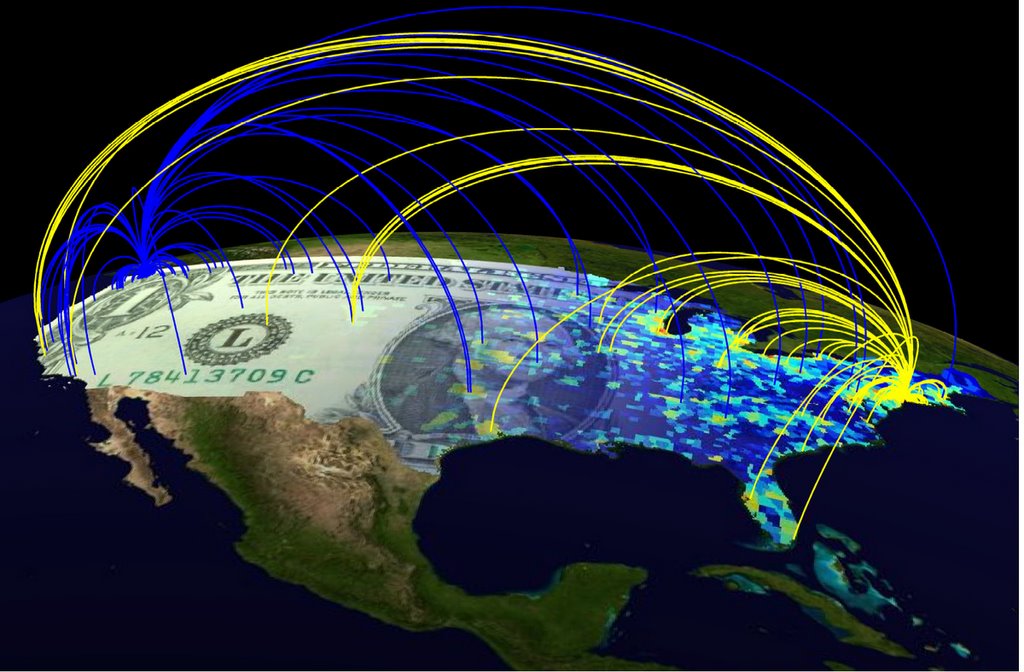
Where's George is a website that allows the user to enter the serial number of a piece of U.S. currency and a zip code, and find out whether that bill has ever been entered into Where's George before, and if so, the related geographic locations. Since people enjoy seeing where their money has been, a lot of people have entered information about these bills. The result is a database with a half million data points, each describing the travel of a single bill.

Brockmann, Hufnagel and Geise analysed this data base. They discovered that the distance traveled by the bills per unit time could be described by a statistical distribution with very simple parameters. The distribution was such that there was a significant chance of bills moving very long distances in relatively short periods of time.

Now, bills in circulation don't move from place to place by themselves; they move in peoples pockets. Consequently, one can infer that the distribution of movement of people is similar to that of the bills they carry. It would be very expensive to do a specific study to determine the distribution of geographic movement of a large population, but using the data from Where's George as a surrogate, the authors of the study were able to infer the properties of that distribution of the movement of people.

The authors have made a further inference. People carry germs, and specifically they sometimes carry a flu virus. If we have a pandemic flu, people will carry the disease virus. The distribution that describes the movement of money should also describe the movement of the flu virus, at least in the early stages before people change their travel patterns in response to the disease or the threat of disease.

If we hope to prevent a pandemic, public health officials would love to contain outbreaks of the disease to the local area in which they occur. The difficulty of doing so depends on how much people travel. This statistical work based on the movement of money then provides important input to the understanding as to whether containment will work.

Unfortunately, the information seems to suggest that there is a significant probability that someone from a small area will make a long journey before quarantine would be likely to be effective. If we see lots of outbreaks of a highly contagious, highly lethal flu, it will be very hard to contain and there may be a pandemic.

But this appears to be a nice piece of statistical analysis, and one that lead to an unexpected and interesting result. The authors are to be congratulated on recognizing an unexpected source of data that sheds light on what may be a critically important phenomenon.

Sources of Economics Papers

RePEc (Research Papers in Economics) is a collaborative effort of hundreds of volunteers in 53 countries to enhance the dissemination of research in economics. The heart of the project is a decentralized database of working papers, journal articles and software components. All RePEc material is freely available. The RePEc database holds over 362,000 items of interest, over 261,000 of which are available online.

NEP: New Economics Papers is an announcement service which filters information on new additions to RePEc into edited reports. The goal is to provide subscribers with up-to-date information to the research literature. As of 1 January 2006, there were 39,436 subscriptions from 16,782 unique addresses distributed throughout the world. The reports are generated by subject-specific editors.

Among the NEP listserves that pertain most closely to this blog are:
* nep-dis Digital Economics & Information Society
* nep-dev Development
* nep-eff Efficiency & Productivity
* nep-ict Information & Communication Technologies
* nep-ino Innovation
* nep-knm Knowledge Management & Knowledge Economy
* nep-tid Technology & Industrial Dynamics

Thursday, February 09, 2006

The Scientist : Lies, Damn Lies… and Scientific Misconduct

The Scientist : Lies, Damn Lies… and Scientific Misconduct:

"It’s not clear how many more hits scientific integrity can take: An MIT researcher is fired for fabricating a dozen papers. A pharmaceutical company omits data from key publications about side effects. A South Korean stem cell researcher admits to a stunned nation that, “blinded by work and a drive for achievement,” he submitted a “fake it before you make it” article to Science. It appears that research misconduct has taken its place among the epidemics that scientists need to worry about."

"Critic of Genetically Modified Food Is Deported"

The Washington Post informs us that Jose Bove has been deported back to France. "Bove, a French citizen, came to the United States at the invitation of the National Family Farm Coalition to speak at an agriculture conference at Cornell University."

The Associated Press via Newsday adds that "after arriving Wednesday afternoon at John F. Kennedy International Airport, Bove was detained and questioned by customs officials......He was returned to France that evening."

The BBC provides a profile of Bove. He is an occassionally-jailed, radical activist very concerned about GM crops and the entry of GM foods into the food chain, perhaps most widely known for his role in the destruction of a branch of McDonalds in 1999.

His deportation comes the day after the World Trade Organization ruled that Europe's six-year ban on biotech crops violated trade rules. The Associate Press informs that:
The United States and the European Union were again at loggerheads over trade issues Wednesday, with each claiming a World Trade Organization report had favored its position on EU curbs on imports of genetically modified foods.
This is one of more than 400 articles Google News returned from a search on the topic "WTO’s ruling on biotech food bans".

I don't agree with Bove's position on GM foods, and less with his tactics. But I assume that the folk at the National Family Farm Coalition and Cornell University would have contained any danger he might present to McDonalds or the people of the United States during his brief visit. Is it not better to give critics of GM technology a forum to talk about their views than send them away unheard?

The Deutsch syndrome of denying open fora to critics of policies the Bush Administration favors seems to be with us still, even if Deutsch has departed.

The Politics of Science

Read the full editorial in the Washington Post. (February 9, 2006.)

Describing the Deutsch case, the editorial remarks that his "attempts to manipulate science and scientists, although unusually blatant, were not unique" and goes on to cite several other recent cases. It concludes:
In every administration there will be spokesmen and public affairs officers who try to spin the news to make the president look good. But this administration is trying to spin scientific data and muzzle scientists toward that end. NASA's Mr. Hansen was right when he told the Times that Mr. Deutsch was only a bit player. "The problem is much broader and much deeper and it goes across agencies," he said. We agree.

Wednesday, February 08, 2006

A Scale of Difficulty of Comprehension

John Barry, in the opening chapter of his book, The Great Influenza: The Epic Story of the Deadliest Plague In History, points out a great difference between biomedical sciences and the physical sciences. Astronomy, physics and chemistry made their great leaps forward dealing with systems that are relatively simple, and that obey relatively straightforward laws that can be expressed in mathematical equations. Biomedical sciences seek to understand systems that evolved, adapting the preexisting structures and machinery to new functions over and over again. As a result, evolved systems do not function simply, and are not easily described.

He uses the example of building a house today, using the best available technology, to achieve energy efficiency. That is compared to retrofitting a centuries old house to improve its energy efficiency. The functioning of the first would probably be much more intuitive and easy to describe than the functioning of the latter, with its centuries of accumulated modifications designed for different times and different purposes.

Perhaps Barry underestimates the complexity of modern cosmology, but I think his point is interesting and useful. Evolved systems don’t necessarily compartmentalize functions into different, easy to understand anatomical units, and, like the panda’s thumb, don’t always come up with elegant solutions (at least to those who don’t understand the starting point and the path that led to the solution). (And perhaps we would have a different mathematics if calculus had not evolved to describe bodies in motion, and we would today be concerned that physical motion was not easy to describe with the computer programs designed to model complex systems.)

When studying infectious processes, the biomedical researcher is confronted with not only the evolution of the human host, but of the virus, bacteria, fungus or parasite. Indeed, the coevolution of human and parasite seems to me to present special difficulties as both organisms have structure and process that are cobbled together from the parts made available by previous evolution, but influenced not only by the internal needs of the one organism, but by the history of responses of the other. The case of STDs suggests that the biomedical scientist have to face not only the biology of the disease, but its sociology.

Not only are biological systems evolved, but they are homeostatic – they have processes that seek to keep internal conditions uniform even as external conditions change. You infect an animal, and its immune system fights the infection (in ways that are largely invisible). You damage an organ, and the body adapts to replace the organ's function or to minimize the impact of its loss. Homeostasis makes life hard for biomedical scientists. Look how difficult it is to do nutrition research, or to understand the physiological effects of pollutants.

I am a fan of the TV show, House. It points out that “patients always lie”. Think how hard that makes life for the doctor. Not only is he dealing with an evolved, homeostatic system, but one with a will of its own, who lies to the doctor about the things which may or may not have caused the medical problem.

Which brings me to social systems. Many consider social systems to be planned, and indeed planning is an important part of the development of social systems. But I am a believer in theories of limited rationality, and I find that many social systems have structures and behavior that their members do not fully understand; these systems evolve over time in response to external influences and to the choices made by their members with incomplete information and understanding. If anything, the interplay of planning with incomplete information, the accomodation of conflicting interests by satisficing compromises, and unplanned change due to feedback and selection processes built into the social systems themselves would seem to make social systems even more difficult to understand than pure evolutionary systems that one might study in simple organisms. The pseudo rationality of leaders seeking to explain the changes that occur as the sole result of planning, combined with the rhetoric needed to justify or gain support for policies, seems to make the situation still more difficult to study.

Not only does one have to understand their history to have a fair chance of understanding how social processes have evolved and thus how they work, but those social systems too have evolved homeostatic and evolutionary mechanisms that are subtle and often difficult to understand. Moreover, societies are composed of actors with wills of their own, who will often deliberately or incidentally deceive the student of society. And the student is him/herself a member of a culture, with his/her own cultural blinders. Amazing, when you think about it, that we have any social science at all!

This blog is generally on the theme of "knowledge for development". This rant is simply to point out how complex the world is. As we seek, for example, to make health policy for developing nations, we are confronted not only with the difficulties of understanding the human body, the disease agent and their interplay, but the social factors involved. To change the situation, we are will advised to understand the social institutions involved, including those of the health service systems and the larger economic, social and political systems in which they are embedded. The farther up the chain we go, the more challenged the scientists who are working to provide us the basic understand on which to build our policies and technologies.

A half a loaf and a book are better than a whole loaf!

"Yo, si tuviera hambre y estuviera desvalido en la calle no pediría un pan; sino que pediría medio pan y un libro. Y yo ataco desde aqui violentemente a los que solamente hablan de reinvendicaciones economistas sin nombrar jamas las reinvendicaciones culturales que es lo que los pueblos piden a gritos.

Bien esta que todos los hombres coman, pero que todos los hombres sepan."


Federico Garcia Lorca

The Tangled Bank

Tangled Bank is seen by its organizer as "a version of the "Carnival of the Vanities" for science bloggers." The "Carnival" is a weekly showcase of good weblog writing, selected by the authors themselves (that's the vanity part). Every other week, one of the crew behind Tangled Bank highlights a collection of interesting weblog articles in one convenient place, making it easy for everyone to find the good stuff.

The crew is specifically restricting itselves to articles in the field of science and medicine, very broadly defined. The weekly compendium of great science weblog articles will be called the Tangled Bank, after Charles Darwin's famous metaphor.

This website provides links to the weekly issues on the individual blogs of the crew members.

INFECTIOUS DISEASES: Tackling Neglected Diseases Could Offer More Bang for the Buck -- Vogel 311 (5761): 592a -- Science

INFECTIOUS DISEASES: Tackling Neglected Diseases Could Offer More Bang for the Buck -- Vogel 311 (5761): 592a -- Science:

"Public health efforts in the developing world are missing out on a bargain, say a group of researchers and health policy leaders. At a meeting here* and in a recent paper, they argue that the ramped-up efforts against the Big Three--HIV/AIDS, tuberculosis, and malaria--will yield far bigger dividends if they are coupled with an attack on so-called neglected diseases such as hookworm, schistosomiasis, and leishmaniasis. These infections make their victims more susceptible to the Big Three, the researchers contend."

UK Technology Transfer Training: Phillips: 3 February 2006

ScienceCareers.org | UK Technology Transfer Training: Phillips: 3 February 2006:

"Commercialising ideas generated in the lab--the role of a technology-transfer professional--is an expanding career in the United Kingdom. The University Companies Association (UNICO) estimates that there are approximately 1200 technology-transfer professionals in the United Kingdom working in academia, with many others working in industry or consultancies. The figure is rising at an estimated 20% per year."

The Deutsch Affair at NASA

I have posted a couple of times on the climate for public announcements on scientific opinion at NASA. Part of the information concerned George C. Deutsch, a 24 year old presidential appointee at NASA who reportedly limited reporters' access to a top climate scientist and who told a Web designer to add the word "theory" at every mention of the Big Bang.

In case you don't remember, here is part of the coverage from Irrigular Times:
Dr. James Hansen is director of the Goddard Institute for Space Studies for NASA. As such, it is his professional responsibility to follow NASA’s mission “to understand and protect our home planet” (those words come right from NASA’s mission statement).

Yet, around the time that climate data revealed that 2005 was the hottest year for planet Earth on record, Dr. Hansen said he began receiving intimidating telephone calls telling him to stop informing Americans of the growing problem of global warming, as documented by a mountain of scientific evidence. The calls warned him of “dire consequences” if he continued to talk about global warming. His interviews with the news media were cancelled, and Dr. Hansen was told that other officials, who knew enough to stay in compliance with the President’s orthodoxy.

George Deutsch, a public affairs officer for NASA, told Dr. Hansen that he could not talk to anyone at National Public Radio because NPR was part of the liberal media. Deutsch told one of Dr. Hansen’s colleagues, Leslie McCarthy, that it was his job to make the president look good. Of course, that’s not what any public affairs officer of the federal government is hired to do. They are hired to serve the American people by telling them the truth about what the government knows, not to serve the political agenda of the President.

Andrew Revkin reported in yesterday's edition of the New York Times:
George C. Deutsch, the young presidential appointee at NASA who told public affairs workers to limit reporters' access to a top climate scientist and told a Web designer to add the word "theory" at every mention of the Big Bang, resigned yesterday, agency officials said.

Mr. Deutsch's resignation came on the same day that officials at Texas A&M University confirmed that he did not graduate from there, as his résumé on file at the agency asserted.

Officials at NASA headquarters declined to discuss the reason for the resignation.
The article also mentions:
Mr. Deutsch, 24, was offered a job as a writer and editor in NASA's public affairs office in Washington last year after working on President Bush's re-election campaign and inaugural committee, according to his résumé. No one has disputed those parts of the document.

According to his résumé, Mr. Deutsch received a "Bachelor of Arts in journalism, Class of 2003."

Yesterday, officials at Texas A&M said that was not the case.

"George Carlton Deutsch III did attend Texas A&M University but has not completed the requirements for a degree," said an e-mail message from Rita Presley, assistant to the registrar at the university, responding to a query from The Times.
Apparently Nick Anthis, a blogger on a Rhodes Scholarship at Oxford discovered that Deutsch had not graduated from Texas A&M, and publicized that information on his blog, the Scientific Activist. (The blog incidentally, seems quite good, and likely to be of interest to the readers of my blog.)

This has generated a lot of traffic in the blogosphere. Eschaton's posting "Bye George", for example, has more than 400 comments on his announcement. Bad Astronomer Blog's rant about Deutsch has more than 200 comments. Its blogger's posting on Slashdot has generated more than 450 comments to date.

A Blogpulse search gives the following trends:


Now Josh Marshall on (the great) Talking Points Memo reports "George C. Deutsch......has been forced to resign." A recent posting on Slashdot also seems to imply that Deutsch has been forced to resign. I don't know if it has been by force of circumstances, or as a result of a discrete talk with his NASA boss, but I'm glad to hear he succummed to that force.

World of Crap has done us the favor of looking up Deutsch's publications from his days on the Texas A&M Battalion. This young man, not surprisingly, seems to be a conservative true believer, with a contempt for what he characterized as "the liberal media".

I am concerned with the Bush Administration's treatment of scientific results, especially those results that would suggest stronger environmental policies or those which would challenge the beliefs of religious conservatives. Part of the problem I think is that he, as spokesperson, attracted people with excentric views and personal agendas to his campaign, and they in turn mole into government jobs from their campaign jobs. Of course, campaign workers get government jobs whenever their candidate wins, but the tendency concerns me when it gets antiscientific zealots into science related jobs. When they fake their credentials, and no one catches the fakery, and/or when they extend their power and no one imposes fair limits, we all suffer! Maybe outrage expressed in the blogosphere will help correct the problem!

Tuesday, February 07, 2006

Comments on the U.S. Government Budget Proposal

See:

"Bush's Budget Bolsters Pentagon: $2.77 Trillion Plan For 2007 Would Trim Most Agencies" by Amy Goldstein, The Washington Post, February 7, 2006.

"Domestic Programs Take the Hit: Budget Would Increase Security Spending but Cut or Curb 141 Programs", The Washington Post, February 7, 2006.

Re The Competitiveness Initiative:
* The Department of Commerce's budget falls under Bush's proposals, to $6.139 billion, with increasing spending on the president's "American Competitiveness Initiative" offset by cuts in other areas. The budget for Commerce that concentrates on competitiveness -- the National Institute of Standards and Technology -- would fall as well, from $757 million to $581 million. But that is mainly because Bush is proposing -- as he has repeatedly in the past -- to eliminate the Advanced Technology Program and slash the Manufacturing Extension Partnership Program, both of which were Clinton administration favorites. Spending would rise to $540 million for NIST's scientific and technical research and services and construction of research facilities.

* Education advocates expressed disappointment that the budget for the Education Department provides no new money for Title I funding for poverty aid to school districts, and fails to increase the federal Pell Grants, a need-based financial aid program for college students. Title I funding is up since Bush took office, but there has not been an increase in Pell grants for five years. The $63 billion budget eliminates 42 programs.....As part of Bush's American Competitiveness Initiative, funding has been increased to improve math and sciences education in K-12. There is $100 million proposed for America's Opportunity Scholarships, which offer vouchers to attend private schools and expanded tutoring for students who attend poor-performing public schools -- an initiative Congress has previously rejected. The budget provides $200 million for School Improvement Grants to help states meet No Child Left Behind Act proficiency goals, but Democrats say that is insufficient. And there is $1.475 billion for a new program to help at-risk high school students struggling to reach grade level in reading and math.

Re Foreign Policy & Foreign Assistance:
* Spending for the State Department and key international affairs programs would climb by $3.7 billion to $33.9 billion. Reflecting Secretary of State Condoleezza Rice's interest in public diplomacy, the proposal would boost spending on educational and cultural programs by 11 percent, to $474 million, with an emphasis on Muslim countries. The budget reserves $115 million to foster training in foreign languages such as Arabic and Urdu by Americans. At the same time, Voice of America would eliminate radio service in Russian and other languages. A big chunk of the money is $3 billion for the Millennium Challenge Corp., a relatively new foreign aid tool that would tie aid to a country's meeting certain criteria. The budget would reduce aid in such areas as development assistance and child survival and health. It would expand a new office devoted to reconstruction and stabilization in post-conflict countries, and would create a $75 million fund to quickly deploy civilian personnel to unstable regions.

Sounds like there is a lot of doublespeak to me!

The Scientist: "Is Peer Review Broken?"

Read the full article by ALISON MCCOOK in The Scientist. ( Volume 20, Issue 2, Page 26, 1 February 2006.)

The most prestigious journals are flooded with submissions, and may reject half or more without peer review.

"An abundance of data from a range of journals suggests peer review does little to improve papers. In one 1998 experiment designed to test what peer review uncovers, researchers intentionally introduced eight errors into a research paper. More than 200 reviewers identified an average of only two errors. That same year, a paper in the Annals of Emergency Medicine showed that reviewers couldn't spot two-thirds of the major errors in a fake manuscript. In July 2005, an article in JAMA showed that among recent clinical research articles published in major journals, 16% of the reports showing an intervention was effective were contradicted by later findings, suggesting reviewers may have missed major flaws."

Monday, February 06, 2006

New Chief for OISE at the NSF

Dr. Thomas Weber is the new Director of the Office of International Science and Engineering (OISE) of the National Science Foundation, effective February 12, 2006.

Partnerships for International Research and Education

Read the January 30, 2006 announcement of the first set of grants under the PIRE program.

This program of the U.S. National Science Foundation Program aims to fortify international research collaborations and engage U.S. scientists and engineers. The first 12 grants awarded in the program range in size and duration, with most about $2.5 million over five years. These PIRE awards support projects in such areas as the formation of distant galaxies, nanoscience for clean drinking water, computer speech recognition and language translation, patterns of learning by children of immigrants, seismic activity in the Earth's mantle under Africa, and plants and animals unique to Patagonia. (Click here for a listing of current grants.)

Computers in Schools

Source: OECD via The Economist, February 2, 2005.

Sunday, February 05, 2006

"In Bush's Budget Plan, Shifting Priorities"

Read the full article by ROBERT PEAR in The New York Times, February 5, 2006. (Registration required.)

"President Bush wants to spend more on bird flu and the physical sciences next year, but would freeze the budget of the National Institutes of Health and would slightly cut federal support for research on cancer and heart disease, two of the leading killers of Americans, budget documents show."

The budget of the federal government it too complicated for a lay person to really understand. Thus intelligent comment is difficult. The shift from research on cancer and heart disease to development of improved vaccine production technologies could be very beneficial. But might it be better to cut back somewhere else? How important is it to have manned travel to the planets, compared to improving fundamental understanding in the sciences and engineering. Are the tax cuts really that important? And of course, a significant part of the budget problem is a war that appears to have been started due to a misunderstanding of the threat posed by Iraq.

Saturday, February 04, 2006

More on NASA's "Closed Mouth Policy"

Read the whole article by ANDREW C. REVKIN in the New York Times. (February 4, 2006; registration required.)

"A week after NASA's top climate scientist complained that the space agency's public-affairs office was trying to silence his statements on global warming, the agency's administrator, Michael D. Griffin, issued a sharply worded statement yesterday calling for "scientific openness" throughout the agency.

"'It is not the job of public-affairs officers,' Dr. Griffin wrote in an e-mail message to the agency's 19,000 employees, 'to alter, filter or adjust engineering or scientific material produced by NASA's technical staff.'.......

"Other National Aeronautics and Space Administration scientists and public-affairs employees came forward this week to say that beyond Dr. Hansen's case, there were several other instances in which political appointees had sought to control the flow of scientific information from the agency.

"They called or e-mailed The Times and sent documents showing that news releases were delayed or altered to mesh with Bush administration policies."

EPA Science Panel in Conflict with EPA Administrator

"Irate scientists say the administrator ignored or misconstrued their recommendations in proposed new rules on soot and dust pollution." (By Janet Wilson, Los Angees Times, February 4, 2006.)

"In an unprecedented action, the Environmental Protection Agency's own scientific panel on Friday challenged the agency's proposed public health standards governing soot and dust.

"The Clean Air Scientific Advisory Committee, mandated by Congress to review such proposals, asserted Friday that the standards put forward by EPA Administrator Stephen L. Johnson ignored most of the committee's earlier recommendations and could lead to additional heart attacks, lung cancer and respiratory ailments.....

"Some panel members called the administrator's actions 'egregious' and said his proposals "twisted" or "misrepresented" their recommendations.

"'We are obligated to recommend something beneficial to public health,' said the panel's longest-serving member, Morton Lippmann, a professor of environmental medicine at New York University School of Medicine.

"After a teleconference Friday lasting nearly four hours, the committee members decided to write a letter to Johnson laying out the scientific evidence for their conclusions and urging him to reconsider his proposals......

"It was the first time since the committee was established under the Clean Air Act nearly 30 years ago that the committee had asked the EPA to change course, according to EPA staffers and committee members."
EPA officials are taking public comment on the proposed rules through April and plan to meet a court deadline to adopt final standards by September.
My sympathies are strongly with the scientific panel. Of course, I am suspicious of the willingness of this Administration to impose adequate environmental regulation on industry to begin with. If you want to support the scientific advisory panel, consider registering a comment on the proposed regulation.

Here is the facet of the EPA website on National Ambient Air Quality Standards for Particulate Matter. It has a wealth of background documents on this regulatory action that can be downloaded.

You can submit a comment on the proposed regulation. Click here for the Federal Register's formal documentation of the proposed rule.

Submit your comments, identified by Docket ID No. EPA–HQ–OAR–2001–0017 by one of the following methods:
• http://www.regulations.gov: Follow the on-line instructions for submitting comments.
• E-mail: a-and-r-Docket@epa.gov.
• Fax: 202–566–1749.
• Mail: Docket ID No. EPA–HQ–OAR–2001–0017, Environmental Protection Agency, Mailcode: 6102T, 1200 Pennsylvania Avenue, NW., Washington, DC 20460. Please include a total of two copies.
• Hand Delivery: Environmental Protection Agency, EPA West Building, Room B102, 1301 Constitution Avenue, NW., Washington, DC. Such deliveries are only accepted during the Docket’s normal hours of operation, and special arrangements should be made for
deliveries of boxed information.

Press Briefing by Administration Officials on American Competitiveness Initiative

Go to the webpage for the Cabinet level briefing held February 1, 2006.
Source: Office of Science and Technology Policy

The Bush Administration, having essentially flat-lined S&T in the budgets for the last couple of years, is proposing big increases, mainly to fall in the budgets of future Presidents. We will see what the Congress says to this proposal. Let us hope they support it!

Thursday, February 02, 2006

Darwin Day - Lincoln's Birthday

On February 12th, 1809 two great men were born–Abraham Lincoln, Emancipator of American Slaves and Charles Darwin, founder of the Theory of evolution.

February 12, 2009 will be the 150th Anniversary of the publication of Darwin's famous book On The Origin of Species. The day has been chosen for an International Celebration to show appreciation for Darwin and for his achievements.

Until 1971, both February 12 and February 22 were observed in the United States as federal public holidays to honor the birthdays of Abraham Lincoln (February 12) and George Washington (February 22).

In 1971, the President proclaimed one single federal public holiday, the Presidents' Day, to be observed on the third Monday of February, honoring all past president of the United States of America. This year, the third monday falls on February 20th.

President Bush seeking to abolish "human-animal hybrids"

In the State of the Union Address, President Bush said:
Tonight I ask you to pass legislation to prohibit the most egregious abuses of medical research: human cloning in all its forms, creating or implanting embryos for experiments, creating human-animal hybrids, and buying, selling, or patenting human embryos.
Christianity Today considered this "what may prove to be the most profound paragraph in the State of the Union address." It specifically looked at the chimera phrase:
The third abuse is making a human-animal "hybrid" or "chimera." This is a being that is part-human, part-animal. Scientists have already been playing around with genes, switched from one animal (or plant) to another. The same principles could be used on humans. One team wants to use rabbit eggs to provide a home for human DNA, to make an embryo that is mostly human but a tiny bit rabbit—in order to kill it for stem cells. All of these Frankenstein efforts must be stopped in their tracks.
The transfer of genes between species is indeed done frequently by scientists, as it is a very valuable technique for many kinds of research.

Many genes are highly conserved among species. Essentially the same gene is found in different species. That is, the sequence of nuclaic acids is very similar in genes from one species to another. It is the genome, the entire sequence of genetic information that makes the difference.

A metaphore: all writers in the English language should spell words the same way. It is the order of words in a work that distinuishes one piece of writing from another. Indeed, cognates are words that are spelled the same way or in very similar ways in different languages. Sometimes we use a term from another language if it is apropos.

P. Z. Myers writes in Pharygula, "Creating chimeras is legitimate and useful scientific research."
Down syndrome is a very common genetic disorder caused by the presence of an extra chromosome 21. That kind of genetic insult causes a constellation of problems: mild to moderate mental retardation, heart defects, and weakened immune systems, and various superficial abnormalities. It's also a viable defect, and produces walking, talking, interacting human beings who are loved by their friends and families, who would really like to be able to do something about those lifespan-reducing health problems. We would love to have an animal model of Down syndrome, so that, for example, we could figure out exactly what gene overdose is causing the immune system problems or the heart defects, and develop better treatments for them.

So what scientists have been doing is inserting human genes into mice, to produce similar genetic overdoses in their development. As I reported before, there have been partial insertions, but now a team of researchers has inserted a complete human chromosome 21 into mouse embryonic stem cells, and from those generated a line of aneuploid mice that have many of the symptoms of Down syndrome, including the heart defects. They also have problems in spatial learning and memory that have been traced back to defects in long-term potentiation in the central nervous system.

These mice are a tool to help us understand a debilitating human problem.
Similarly, William Weir writes in the Hartford Courant
Most examples of chimeric research (from "chimera," the Greek word for a goat/lion/serpent combination) don't look like strays from Dr. Moreau's island. At Stanford University researchers injected human brain cells into the brains of mice. The researchers also plan to develop a mouse with 100 percent human brain cells. Though they doubt it would develop human characteristics, researchers say they would terminate the project at any sign that it would.

Similar experiments have been conducted elsewhere for research on Parkinson's disease and other neurological disorders.
Clearly President Bush wants to prohibit something to do with genetic transfer, and apparently some on the religious right support such a ban, but it is not clear to me what is to be banned, and why.

When in 2001 Bush banned use of new lines of stem cells in research, the initiative was apparently badly staffed out, and his information on the number of stem cell lines available has proven false. The majority of Americans now seem to feel that the stem cell lines can be derived ethically, and that the potential scientific and medical benefits from a vigorous program of stem cell research justify the work. Is Tuesday's announcement similarly poorly staffed out? Is it likely to result in legislation that will be ultimately disavowed by the public, but that will slow important research during its lifetime?

The Bush Administration has used the State Department to push its agenda on stem cell and related research in international fora. Is it now likely to push a ban on "human-animal hybrids" internationally? I hope not!

Wednesday, February 01, 2006

Influenza-related Reports and Testimony Issued since October 1, 2000

This is the Government Accounting Office archive of recent reports on flu. (Showing 17 items.)

Peru Wants Artifacts from Machu Picchu Back from Yale


Archaeologists have usually been employed by organizations in rich countries, especially in the past, while archaeology has often been done in poor nations, where many of the richest archaeological sites are to be found. While the plundering of archaeological treasures by conquering nations is ages old, the removal of artifacts by archaeologists to their foreign museums and universities is more of a 20th century phenomenon.

In 1911, Machu Picchu was brought to the attention of the West by Hiram Bingham, an American historian then employed as a lecturer at Yale University. He began the archaeological studies there and completed a survey of the area. A collection of artifacts from Machu Picchu eventually wound up at Yale, where they apparently stayed in storage for decades.

Yale's Peabody Museum in 2002 created an exhibition using this material. After a national tour, the exhibition was mounted at the Peabody Museum itself on September 10, 2005. (There is an article on the exhibit in the Yale Bulletin and Calendar, marking the start of the tour.)

Peru maintains that much of the material held by Yale and used in the exhibition belongs to the Government of Peru (in the name of the people of Peru). Yale, according to the New York Times
Yale has staunchly rebuffed Peru's claim, stating that it returned all borrowed objects in the 1920's and has retained only those to which it has full title
Thus, according to the Guardian
Oscar Maurtua, the foreign minister, added: "We are convinced that we have sufficient proof to win in court." He added that Lima would prefer an out-of-court settlement. Any court action would probably be held in Connecticut.

A spokesman for Yale, Tom Conroy, told the Associated Press news agency that the university had been having discussions with the Peruvian government. "We are hoping for a resolution that is satisfactory to all involved," he said.
Machu Pichu is a UNESCO World Heritage site. According to the National Geographic, it is visited by more than 300,000 people per year. Indeed, it is one of the most important tourist destinations in Peru and in Latin America. The availability of the artifacts found at the site is not only a matter of national heritage, but of the attractiveness of the site to tourists, and of the money they bring to Peru.

The controversy has been covered in the International press, e.g.:
* "Yale devolvería al Perú piezas de Machu Picchu", Quechua Network, December 16, 2005.
* Rick Vecchio, "Peru plans to sue Yale for artifacts", the Associated Press via the Boston Globe, December 1, 2005.
* Sibylla Brodzinsky, "Peru may sue Yale for Inca relics' return", The Guardian, December 5, 2005.
* Domen Lombergar, Art World, December 6, 2006.
* Danna Harman, "90 years later, Peru battles Yale over Incan artifacts", The Christian Science Monitor, December 29, 2005.
* Hugh Eakin, "Inca Show Pits Yale Against Peru", The New York Times, February 1, 2006. (registration required.)
One certainly hopes this situation can be solved amicably through negotiation. Machu Picchu is a part of the world heritage, as well as that of Peru, and there is value in people outside Peru being able to see these materials. But Machu Picchu is a treasure not only to the people of Peru, but to all the descendents of the Inca, and they would have more access to the artifacts were they in Peru. U.S. courts would probably be fair, but one can certainly see the opjection of the Peruvian Government to subjecting what it feels to be legitimate claims to the courts of another nation.

K4D in the State of the Union Address

The Address itself can be found here, on the White House website.

The main K4D section of the Address was that focusing on competitiveness:
And to keep America competitive, one commitment is necessary above all: We must continue to lead the world in human talent and creativity. Our greatest advantage in the world has always been our educated, hardworking, ambitious people -- and we're going to keep that edge. Tonight I announce an American Competitiveness Initiative, to encourage innovation throughout our economy, and to give our nation's children a firm grounding in math and science.

First, I propose to double the federal commitment to the most critical basic research programs in the physical sciences over the next 10 years. This funding will support the work of America's most creative minds as they explore promising areas such as nanotechnology, supercomputing, and alternative energy sources.

Second, I propose to make permanent the research and development tax credit to encourage bolder private-sector initiatives in technology. With more research in both the public and private sectors, we will improve our quality of life -- and ensure that America will lead the world in opportunity and innovation for decades to come.

Third, we need to encourage children to take more math and science, and to make sure those courses are rigorous enough to compete with other nations. We've made a good start in the early grades with the No Child Left Behind Act, which is raising standards and lifting test scores across our country. Tonight I propose to train 70,000 high school teachers to lead advanced-placement courses in math and science, bring 30,000 math and science professionals to teach in classrooms, and give early help to students who struggle with math, so they have a better chance at good, high-wage jobs. If we ensure that America's children succeed in life, they will ensure that America succeeds in the world.

Preparing our nation to compete in the world is a goal that all of us can share. I urge you to support the American Competitiveness Initiative, and together we will show the world what the American people can achieve.
The Section of the Address on Energy was also K4D intensive:
Keeping America competitive requires affordable energy. And here we have a serious problem: America is addicted to oil, which is often imported from unstable parts of the world. The best way to break this addiction is through technology. Since 2001, we have spent nearly $10 billion to develop cleaner, cheaper, and more reliable alternative energy sources -- and we are on the threshold of incredible advances.

So tonight, I announce the Advanced Energy Initiative -- a 22-percent increase in clean-energy research -- at the Department of Energy, to push for breakthroughs in two vital areas. To change how we power our homes and offices, we will invest more in zero-emission coal-fired plants, revolutionary solar and wind technologies, and clean, safe nuclear energy.

We must also change how we power our automobiles. We will increase our research in better batteries for hybrid and electric cars, and in pollution-free cars that run on hydrogen. We'll also fund additional research in cutting-edge methods of producing ethanol, not just from corn, but from wood chips and stalks, or switch grass. Our goal is to make this new kind of ethanol practical and competitive within six years.

Breakthroughs on this and other new technologies will help us reach another great goal: to replace more than 75 percent of our oil imports from the Middle East by 2025. By applying the talent and technology of America, this country can dramatically improve our environment, move beyond a petroleum-based economy, and make our dependence on Middle Eastern oil a thing of the past.
Toward the end of the Address the President address bioethics:
A hopeful society has institutions of science and medicine that do not cut ethical corners, and that recognize the matchless value of every life. Tonight I ask you to pass legislation to prohibit the most egregious abuses of medical research: human cloning in all its forms, creating or implanting embryos for experiments, creating human-animal hybrids, and buying, selling, or patenting human embryos. Human life is a gift from our Creator -- and that gift should never be discarded, devalued or put up for sale.
Jonathan Weisman and Amy Goldstein did an analysis in The Washington Post ("The Domestic Initiative: In a Lean Budget Year, A Pledge for Research")
With Washington bracing for an austere budget year, President Bush last night proposed a 10-year, $136 billion initiative that would double the federal commitment to basic scientific research and train tens of thousands of new math and science teachers.

The president's "American Competitiveness Initiative" may lack the ambition of last year's effort to dramatically reshape Social Security, but in size and scope it dwarfs other domestic proposals in health care and energy research that had been heavily promoted in the run-up to the State of the Union address.
More excerpts:
Now the president will ask Congress to increase spending on federal research and development next year by nearly $6 billion, to a level that would be more than 50 percent higher than the level he inherited in 2001. Under the initiative, the budgets of the NSF, the Energy Department's Office of Science, and the Commerce Department's National Institute of Standards and Technology would double over 10 years, with $50 billion in new funding......

But whereas his science program was denominated in billions of dollars, his energy program was in millions. Research into emissions-free coal plants would get $54 million in the fiscal year that begins in October. Solar power would get an additional $65 million. And wind energy would get a $5 million increase.

Bush also called for $59 million in additional funds for developing fuels out of agricultural waste, such as wood chips, switch grass and stalks, with the aim of making such "cellulosic ethanol" competitive and practical within six years.
ROBIN TONER, DIANA JEAN SCHEMO and ROBERT PEAR wrote in the New York Times ("On Education and Health, Costly Plans Face Hurdles"):
One set of new measures, to improve the teaching of math and science, train workers, aid universities and increase federal support for research and development, would cost $5.9 billion next year and $136 billion over 10 years, the White House said. Of that, $86 billion would go to making permanent the tax break for industries when they invest in research and development; Congress has used this tax break periodically, particularly to help the economy during recessions.

Mr. Bush's proposals were based on a report issued in October by the National Academy of Sciences ("Rising Above The Gathering Storm: Energizing and Employing America for a Brighter Economic Future") and embraced by industry groups and others. The report warned that without such measures, the United States would lose its competitive edge in technology to China and India, countries with educated workforces and lower wage structures.

The report recommended doubling federal spending on basic research grants in the physical sciences over seven years; the president proposed doubling spending on such grants over 10 years, at a cost of $50 billion. Mr. Bush also adopted the report's call for increasing the number of high school teachers who offer especially rigorous courses in math and science by 70,000 over five years.
The recognition by the President of the importance of science and math education, of science and technological innovation is of course very welcome.

One may ask why he chose these initiatives at this time. I suppose the answer is in part that they are important to this Administration and play to key constituencies. This Administration has made previous initiatives in education, and the current initiative is consistant with them. So too, this administration has increased spending on R&D in the past. The intiatives will benefit business and the social strata that send their kids to science classes, and thus play to key Administration bases. So too, the bioethics initiatives are consistant with previous efforts of this Administration, and play to its fundamentalist religious supporters.

One may hope that these initiatives will be less controversial than some in the past, an important feature for an embattled Administration.

They also seem to be affordable in the near future, placing greater budget demands in out years (to be faced by future Administrations). Thus the Administration gets credit for ambitious initiatives without facing heavy costs in a period of considerable budgetary stress.

"U.S. Triples Its Order Of a Key Flu Drug"

Read the brief article in the Washington Post.

"The U.S. government is tripling its order for a key influenza drug in case of a bird flu pandemic, but it will not have all the needed vaccines and drugs for several more years, experts said yesterday. Drug company chiefs urged Congress to appropriate more money to prepare for a flu pandemic, saying they could not supply needed drugs and vaccines without a guaranteed market.......There have also been battles over provisions aimed at shielding flu vaccine makers from liability."

"Planners vs. Searchers in Foreign Aid"

William Easterly gave a talk as part of the Distinguished Speakers Program at the Asian Development Bank (ADB) Headquarters on 18 January 2006. Click here to read his paper and see his presentation. He began:

"Seventeen years after the fall of the Berlin Wall, there is only one major area of the world in which central planning is still seen as a way to achieve prosperity – countries that receive foreign aid. Behind the Aid Wall that divides poor countries from rich, the aid community is awash in plans, strategies, and frameworks to meet the very real needs of the world’s poor. These exercises only make sense in a central planning mentality in which the answer to the tragedies of poverty is a large bureaucratic apparatus to dictate quantities of different development goods and services by administrative fiat. The planning mindset is in turn linked to previously discredited theories, such as that poverty is due to a “poverty trap,” which can only be alleviated by a large inflow of aid from rich country to poor country governments to fill a “financing gap” for poor countries. The aid inflow is of course administered by this same planning apparatus.

"This is bad news for the world’s poor, as historically poverty has never been ended by central planners. It is only ended by “searchers”, both economic and political, who explore solutions by trial and error, have a way to get feedback on the ones that work, and then expand the ones that work, all of this in an unplanned, spontaneous way. Examples of searchers are firms in private markets and democratically accountable politicians. There is a robust correlation (0.73) between economic and political freedom, on one hand, and economic development, on the other hand."