Read Adam Sonfield's online paper in The Guttmacher Report on Public Policy.
"In making the case for particular policies, advocates and policymakers in decades past were often content to ignore, or even denigrate, science. Today, however, research findings are cited by almost everyone to buttress a political position. Yet, this has led to new problems. Whether the subject is the teaching of evolution in public schools, the public health consequences of pollution or the viability of missile defense systems, polarization over what a given study says and controversy over whether research is being applied appropriately to the policy-making process have become commonplace. Making one’s way through the resulting landscape of information, and deciding which findings are trustworthy, is becoming increasingly difficult."
Wednesday, November 09, 2005


Tuesday, November 08, 2005
"Drug combination 'could double Tamiflu supplies"
Read the full SciDev.Net story.:
"Joe Howton, medical director at the Adventist Medical Center in Portland, Oregon, has shown that the kidneys also remove Tamiflu, and that probenecid limits this process. Taking the two drugs together would halve the amount of Tamiflu each patient needs."
"Joe Howton, medical director at the Adventist Medical Center in Portland, Oregon, has shown that the kidneys also remove Tamiflu, and that probenecid limits this process. Taking the two drugs together would halve the amount of Tamiflu each patient needs."
"WHO Chief Urges Preparedness for Bird Flu"
Read the Aaaocated Press article in the San Fracisco Chronical.:
"Countries around the world need to start rehearsing plans for tackling a human flu pandemic to identify hidden obstacles and ensure the best response once the virus arrives, the World Health Organization said Monday.
"Health experts at the first major international coordination meeting on bird flu and human flu urged countries that haven't done so to draw up plans for handling an inevitable new pandemic, which the World Bank estimated could result in more than $800 billion in lost gross domestic product over a single year.
"Experts agree a global flu outbreak capable of killing millions of people is a certainty.
"What is also certain, say scientists, is that the virus will come from bird flu. But what is unknown is whether the H5N1 strain that has ravaged poultry stocks in parts of Asia and spread through Eastern Europe will be the culprit."
Monday, November 07, 2005
BBC NEWS | Asia-Pacific | China measures tackle bird flu
Read the full BBC NEWS article.
"China has suspended poultry and bird markets in Beijing as part of efforts to stop any spread of bird flu, officials said on Monday.
"They also announced a major cull in the province hit by the latest outbreak........
"A major conference has just opened in Geneva, to discuss a worldwide plan of action.
"The gathering brings together the World Health Organization, the World Bank, the UN's Food and Agricultural Organization and the World Organisation for Animal Health as well as top policy-makers from WHO member states."
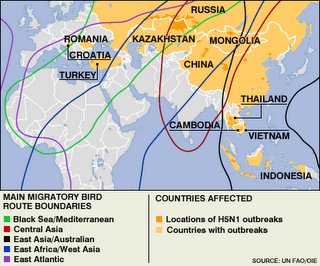
BBC provides this map showing routes by which birds migrate from areas of Asia infected by Avian flu to Africa, Europe, the Indian Subcontinent, and the Middle East.
"China has suspended poultry and bird markets in Beijing as part of efforts to stop any spread of bird flu, officials said on Monday.
"They also announced a major cull in the province hit by the latest outbreak........
"A major conference has just opened in Geneva, to discuss a worldwide plan of action.
"The gathering brings together the World Health Organization, the World Bank, the UN's Food and Agricultural Organization and the World Organisation for Animal Health as well as top policy-makers from WHO member states."

BBC provides this map showing routes by which birds migrate from areas of Asia infected by Avian flu to Africa, Europe, the Indian Subcontinent, and the Middle East.
"A Double Dose of Failure"
Read Sebastian Mallaby's full OpEd piece in todays Washington Post.
France has enough Tamiflu on hand to treat 24 percent of its people. Taiwan says it will manufacture its own version of Tamiflu; "its scientists claim that, after a mere 18 days of lab work, they've figured out how to copy the drug and will attempt to do so on a large scale if necessary. India, Thailand and Argentina have all said they want to make the drug themselves if a pandemic materializes."
"The United States has failed to get in line early. It's been weeks since panicky soccer dads began stockpiling Tamiflu. But the government has so far ordered enough of the drug and a similar medicine, Relenza, to cover just 1.5 percent of the population. Last week's avian flu "blueprint" from the Bush administration belatedly proposes to procure treatment courses for 75 million Americans. But Congress has yet to come up with the money, and the plan assumes that state and local governments will contribute $510 million to the procurement effort. The scope for argument and delay seems endless.........
"Panicked by its own lateness, the Bush administration has bullied Roche into opening a new production operation in the United States; if Roche had refused, the administration was ready to break the patent........Coming on top of similar bullying four years ago of Bayer, the maker of an anti-anthrax drug, this browbeating sends a clear signal: If you make a drug that turns out to be really important, don't expect patent laws to protect you.
"So the United States has the worst of both worlds. It has failed to secure Taiwan-style access to medicines, and it has failed to preserve incentives for new medical discovery. It is getting ready to pay Roche buckets of money for drugs that may arrive too late, because it wants to respect intellectual property. But at the same time it has reminded drug companies that, if they want to be left alone to make money, they had better confine themselves to unpolitical ailments such as cholesterol and asthma."
Flu References in the Blogosphere

A search on the terms "flu" and "Avian flu" using BlogPulse provides evidence of the rapid increase in public concern for the possibility of a flu pandemic.
"Long-Predicted Flu Finally Tops Agenda"
Read the full article by David Brown in The Washington Post.
Brown informs us that a flu pandemic plan was in draft in 1998, that HHS Secretary Thompson reviewed the status of such a plan on 9/11 2001, but a final plan was not published until last week. Apparently the anthrax scare and the SARS outbreak took precedence.
In 2003, NIH sought money to develop a pandemic flu vaccine, that request was cut back to $100 million by the White House Office of Management and Budget (OMB), and Congress ultimately appropriated $49.7 million. The process was being repeated in 2004, when the SARS epidemic scared the Congress into granting the OMB requested $100 million.
Secretary Leavitt, when he took over the HHS job was given John M. Barry's book, "The Great Influenza". He in turn gave the book to many people, including President Bush, who read it over the summer.
Now we have a lot of interest in a flu pandemic. Of course, there should be concern. Indeed, we would be in better condition today to face a possible epidemic had additonal prudent steps been taken two or three years ago to foster vaccine development and the development of vaccine production technology, to order antiviral drugs to stockpile, and to strengthen epidemiological surveillance systems.
Still, no one understands why the 1918 flu epidemic, described in Barry's book, was so much worse than others. I am not sure that I am happy that key policy makers who don't have public health experience are citing that book in justifying the current initiatives. And the timing of the Administration's interest, coming with Bush's approval ratings in the cellar and FEMA's dismal showing in the preparation and aftermaths of the hurricanes, raises my suspicions.
"Experts meet to draw up bird flu battle plan"
Read the full Yahoo! News/Reuters article.
"Health experts meet on Monday to draw up a global strategy to halt the spread of deadly bird flu and prevent it from developing into a human pandemic in which millions could die...........
"Jim Adams, the World Bank's chief for operations policy and country services who will make a financial presentation to the talks on Wednesday, has said a trust fund would require initial donations of $300 million to $500 million to help countries set up programs."
Saturday, November 05, 2005
Lotteries, Insurance and Flu Immunization Campaigns
You buy a ticket for a lottery. You may win any of a number of prizes – most small, some larger, up to a grand prize. Most of the time you just lose the price of a ticket.
You buy a fire insurance policy on your house. If the house burns, at least you collect up to the damages incurred or up to the maximum value of the policy. Most of the time you just pay for the policy, don’t have a fire and don’t collect anything.
You incur the costs of immunizing a population. A pandemic occurs and you avert an amount of sickness and death depending on how severe the pandemic would have been without the immunization campaign. If the public health service is doing its job, most of the time a pandemic does not occur but you have incurred the costs of the immunization campaign. Whether or not you immunize against the putative agent of the pandemic, some sickness and death does occur.
The distinction is that the first case is gambling, the second insurance, and the third prevention.
The difference is that people get a thrill from winning a lottery, get some solace and relief from their loss from the insurance payment in the event of a fire, but are largely unaware of the fate they have avoided due to a successful immunization campaign.
Flu Prevention: Costs and Benefits
The cost of “plain old,” annual, seasonal flu is huge! In the United States, it has been estimated that 36,000 people died of flu the last year for which we have data, and 200,000 were hospitalized. The United States has about five percent of the world’s population, and pretty good mortality statistics. World population is 20 times that of the United States, and if U.S. mortality scales up, the world death toll would have been 720,000. (Most estimates I have seen are less, perhaps 250,000 to 500,000; less than 20 times that of the United States, but still enormous.)
We don’t know the probability of a pandemic emerging this year, next year or the year after. I have read that there were ten in the past 300 years, and if that number is correct we can assume there is one about every 30 years. In a three year period, one might assume one chance in ten of a pandemic. The probability might be higher, given the current flu epidemic in birds, and the subjective probability that the flu will jump from birds to man.
The number of deaths from a new pandemic, like the monetary cost of a house fire, or the winning in a lottery, is not known in advance. The number of flu deaths could vary over a relatively wide range. In this case, due to the terrible quality of mortality statistics, I don’t think it is possible even to estimate the probability distribution of death rates (other than assuming that the probability is essentially zero of a death rate lower than that for the regular seasonal flu). We can reasonably assume that the death rate in the United States will be much less than in poor nations of Africa and Asia, assuming equal rates of infection, because of the relative health of the U.S. population and the availability of medical services in the United States for those who become very ill.
It is hard to say how much we should spend on preventing a flu pandemic. The amount increases if we can find things to do that have other (health) benefits to justify their costs. Thus, improving processes involved in the manufacture of vaccines, improving communicable disease surveillance systems, and assuring the installed capacity of health facilities is adequate to meet increased demands are probably all things we should be doing anyway, that help build preparedness for a possible flu pandemic.
It has been estimated that 17 million people die per year from preventable causes. Medical experts know how to prevent those deaths, but society simply does not allocate the resources to do so. Given this fact, we should not spend funds to avoid speculative flu-pandemic deaths if there are alternative uses of those funds that would avoid equal or greater numbers of fully foreseeable deaths from those preventable causes. Indeed, we should resist any temptation to withdraw funds from other well-functioning public health programs in order to fund a flu pandemic program, lest we see more deaths emerge as a result of the program cutbacks than lives are saved from a preventive-medicine program focused on flu.
I suggest it is probably better to err on the side of life, if err we must. The money we divert from luxuries to public health would not be missed, but the people who might die unnecessarily due to lack of preparedness would be. But it is also better to avoid politicization of the avian flu pandemic preparations or excessive fear, lest we spend foolishly (too much, on the wrong things).
"World Bank, ADB see huge economic risk from bird flu"
Read the full article in The China Post.:
"The World Bank highlighted on Thursday the potentially huge human and economic costs from any bird flu pandemic, while the Asian Development Bank (ADB) said such an outbreak could push the world economy into recession.
"The ADB said a year-long shock from bird flu in humans would cost Asian economies as much as US$283 billion and would reduce the region's gross domestic product by 6.5 percentage points, hitting Hong Kong and Singapore the most."
"Battle Widens as Avian Flu Spreads"
Read about USAID's efforts on the avian flu in the October 2005 edition of its newsletter, FrontLines.

Villagers and domesticated ducks rest in a backyard farm in Kampot Province, southern Cambodia, where the country’s four confirmed human cases of H5N1 have occurred since January 2005. (Photo credit: Ben Zinner, USAID.)

On an assessment mission in Kampot Province of southern Cambodia, USAID’s Dr. Chantha Chak and Dr. Richard Schieber of the Centers for Disease Control and Prevention speak with the family of a woman who died from avian influenza in January, 2005. She was the first of Cambodia’s four confirmed human cases to date. (Photo credit: Ben Zinner, USAID.)
"Is Bird Flu Drug Really So Vexing? Debating the Difficulty of Tamiflu"
Read Andrew Pollack's full article in today's edition of The New York Times. (Registration required, but free.)
Tamiflu (generic name: oseltamivir), the drug of choice for (early) treatment of the flu, is currently made from a natural product, shikimic acid, which in turn is produced from star anise. Apparently, star anise is only grown wild, and is only produced in commercial quantities in China. The price is increasing rapidly, as demand for Tamiflu is increasing to meet the need for protection against avian flu (and other kinds of flu) and supply is limited. (I read one suggestion that the recent flooding in China has threatened next year's yield of star anise, but I don't know if that is true.) This article in The New York Times addresses the potential for producing shikimic acid in a vat fermentation process, using genetically engineered bacteria. (I came across one newspaper article that suggests that the synthetic shikimic acid is not as suitable for drug production as the natural product, but I don't know if that is true.) The article also mentions other natural products that might be used in alternative processes for the production of Tamiflu. Given that 100 firms have made inquiries about licensing of the Tamiflu technologies, one might expect firms to try to produce alternative anti-virals using some of the other natural products with appropriate processing technology.
Tamiflu (generic name: oseltamivir), the drug of choice for (early) treatment of the flu, is currently made from a natural product, shikimic acid, which in turn is produced from star anise. Apparently, star anise is only grown wild, and is only produced in commercial quantities in China. The price is increasing rapidly, as demand for Tamiflu is increasing to meet the need for protection against avian flu (and other kinds of flu) and supply is limited. (I read one suggestion that the recent flooding in China has threatened next year's yield of star anise, but I don't know if that is true.) This article in The New York Times addresses the potential for producing shikimic acid in a vat fermentation process, using genetically engineered bacteria. (I came across one newspaper article that suggests that the synthetic shikimic acid is not as suitable for drug production as the natural product, but I don't know if that is true.) The article also mentions other natural products that might be used in alternative processes for the production of Tamiflu. Given that 100 firms have made inquiries about licensing of the Tamiflu technologies, one might expect firms to try to produce alternative anti-virals using some of the other natural products with appropriate processing technology.
Friday, November 04, 2005
"New bird flu outbreaks hit Asia"
Read the full BBC NEWS story,:
"China and Vietnam have reported major new bird flu outbreaks, as Japan moved to cull 180,000 chickens at a farm where signs of the virus were found.
"The lethal H5N1 virus killed nearly 9,000 chickens in China's Liaoning province and 3,000 birds in Bac Giang province in Vietnam, officials said."
"China and Vietnam have reported major new bird flu outbreaks, as Japan moved to cull 180,000 chickens at a farm where signs of the virus were found.
"The lethal H5N1 virus killed nearly 9,000 chickens in China's Liaoning province and 3,000 birds in Bac Giang province in Vietnam, officials said."
Thursday, November 03, 2005
"Students’ perceptions of science and technology"
Read the full article in the current edition of Connect, UNESCO's International Science, Technology and Educational Newsletter.
This is a very interesting article on the attitudes of 15 year old students in a number of countries on science and technology. The graphs plotting the differences in attitudes among countries are especially striking. Unfortunately, students from the United States were not included in the study, but it seems likely that they would share many of the opinions expressed by students from other developed nations. Excerpts from the article follow.
"In most OECD countries there is a concern about the lack of interest among young people to pursue studies and careers in science, engineering and technology (SET). Many wealthy nations ‘solve’ their recruitment problems by importing able students from poorer countries. About half of the PhD students in SET in the US come from such countries, mainly from Asia2.
"Such a ‘brain drain’ has positive as well as negative effects on both parts, and will not be discussed here. It is, however, noteworthy that the recent preoccupation with the ‘fight against terror’ has complicated the migration of these able students, in particular to the US.
"It is a paradox that the most SET driven economies in the world experience a lack of interest in SET studies and careers among young people. The economic significance for a country to have a high number of skilled scientists and engineers is well accepted.
"But young people do not choose their studies or careers because it is good for the economy of their country. They base their choices (when they have them) on their own interests, values and priorities. It is obvious that SET studies and jobs do not have the same appeal to students in wealthier countries as they used to some decades ago.
"The lack of interest in SET in schools and further studies is not only a problem for the economy. It is also a threat to democracy, since most decisions in modern societies are highly dependent on considerations that involve weighting scientifi c arguments against value judgements. A scientifi cally illiterate voting population can easily be manipulated by propaganda in a voting process.
"From the above perspectives, it becomes urgent to get to know the SET-related attitudes, priorities and interests of the young generation. The ROSE-study has the ambition to do so."
ROSE (The Relevance Of Science Education)
"ROSE is an international comparative study that taps into the diversity of interests, experiences, priorities, hopes and attitudes that children in different countries bring to school (or have developed at school). The underlying hope is to stimulate an informed discussion on how one may make science education more relevant and meaningful for learners in ways that respect gender differences and cultural diversity. It is also hoped that light will be shed on how students’ interest in choosing SET-related studies and careers can be stimulated. Through deliberations that involved science educators from all continents, ROSE has developed an instrument with around 250 single items that tries to map out attitudinal or affective perspectives as seen by 15 year old learners. All items are simple in wording and the responses are given on a 4-point Likert scale. This justifies the use of standard statistical methods like calculations of means, correlations etc. About 40 000 students from 35 countries are taking part in ROSE on whose data 10 students from different countries will base their theses. A full report on the project rationale, development and logistics is available which includes reports on data collection from the participating countries. Data collection for international reporting is now finalized. Several articles and international reports with comparisons will be published during 2005 and the following years. Networks of science educators like ESERA (European Science Education Research Association); NARST (National Association for Research in Science Teaching) – US-based but with international outreach - and in particular, IOSTE (International Organization for Science and Technology Education), have been used to establish the network of research partners."
UNESCO World Report: Towards Knowledge Societies
This is the first in a new series of UNESCO reports, to be published every two years, focusing on subjects at the heart of the Organization’s mission.
"Towards Knowledge Societies clearly makes the distinction between knowledge societies and the information society. While the information society is based on technological breakthroughs, knowledge societies “encompass broader social, ethical and political dimensions.” The Report focuses in particular on the foundations on which knowledge societies that will optimize sustainable human development are constructed.
"The Report analyses the increasingly important role played by knowledge in economic growth and advances that it can serve as a new springboard for development in the countries of the South. It also presents a detailed analysis of the factors blocking the access of many countries to the opportunities offered by information and communication technologies, especially the growing digital divide and restrictions on freedom of expression. Finally, it makes a series of recommendations to improve the situation."
The report is now available for sale (Click here to transfer to the UNESCO website), priced at € 25.00.
Table of Contents
List of boxes, figures and tables, p. 11
List of abbreviations and acronyms, p. 14
Introduction, p. 17
Overview, p. 24
1. From the information society to knowledge societies, p. 27
Knowledge societies as a source of development, p. 27
Digital solidarity, p. 29
Freedom of expression as the touchstone of knowledge societies, p. 36
2. Network societies, knowledge and the new technologies, p. 45
Knowledge economy in network societies, p. 45
The impact of the new technologies on knowledge networks, p. 47
From memory-based societies to knowledge societies? p. 52
3. Learning societies, p. 57
Towards a culture of innovation? p. 57
Learning, a key value of knowledge societies, p. 60
The availability of knowledge, p. 63
4. Towards lifelong education for all? p. 69
Basic education for all, p. 71
Lifelong education for all, p. 76
New inputs for education: institutional reform, pedagogical research, teacher training and quality of education, p. 81
“E-learning”: new technologies and distance education, p. 84
5. The future of higher education, p. 87
Towards a market in higher education? Issues of funding, p. 87
University networks yet to be invented, p. 91
The new missions of higher education, p. 95
6. A research revolution? p. 99
New research locations, p. 99
The new frontiers of science, p. 111
Research and development: future challenges, p. 114
7. Science, the public and knowledge societies, p. 119
A good governance for science and technology, p. 119
A crisis in science education? p. 126
Fostering a scientific culture, p. 128
8. Risks and human security in knowledge societies, p. 133
Knowledge as a risk panacea? Foresight and disaster anticipation, p. 133
Knowledge societies, a source of new risk? Global risks, strategic risks and new forms of criminality, p. 137
Knowledge societies, human security, human rights and the fight against poverty, p. 139
Towards sustainable development societies? p. 142
9. Local and indigenous knowledge, linguistic diversity and knowledge societies, p. 147
Preserving local and indigenous knowledge, p. 148
Linguistic diversity and knowledge societies, p. 151
Pluralism, translation and knowledge sharing, p. 156
10. From access to participation: towards knowledge societies for all, p. 159
From the knowledge divide to knowledge sharing, p. 159
Women in knowledge societies, p. 167
Universal access to knowledge: knowledge sharing and intellectual property protection, p. 169
The renewal of democratic public forums in knowledge societies, p. 178
Conclusion, p. 185
Recommendations, p. 191
References, p. 195
Notes, p. 211
Wednesday, November 02, 2005
The 1976 Swine Flu Program versus the 2005 Avian Flu Program
I have been reading Neustadt and Fineberg’s great book, The Epidemic that Never Was; Policy-Making & the Swine Flu Affair. It is interesting, and would be great for a course on decision making.
In 1976 the federal government of the United States initiated a massive program against a pandemic of swine flu which some experts believed might be imminent. Much money was spent and much effort was exerted, but the epidemic never arrived. The authors of the book stress that some of the pain could have been averted had mid-course corrections been made when cases of the swine flu did not show up in the United States or abroad. I too feel that planning for a possible pandemic should start early, but should allow mid-course corrections.
I also came away from the book convinced that had there been a pandemic, the United States would have fared badly. The program immunized many fewer people than had been planned, and did so later than had been planned. If there had been a pandemic, the U.S. population would have been less protected than would have been appropriate. In part this was due to the failure of leaders, in part to the delays introduced by the checks and balances in the U.S. political system, and in part to the lack of general underlying preparedness for pandemics.
I like the way the book shows the multiple objectives of different players. My favorites players were the public health officials who wanted to protect the public’s health, to live up to their own professional expectations, and to do their jobs. No one wanted a pandemic, but no one seemed especially concerned with guarding against a pandemic’s effects on other countries. The press wanted to inform the public, and to cover a hot story. Senior government officials were seeking not only to protect the public, but to enhance the bureaucratic position of their agencies. Pharmaceutical and insurance company executives wanted to lead their firms in performing useful services, but also wanted to preserve profits and avoid excess business risks. Politicians wanted to protect the public, but also to select a course of action that enhanced their political positions. A lot got lost in the interaction among these differing objectives.
President Ford had assumed office after the resignation of Nixon, and was running for reelection; he was facing difficulties in the primaries early in 1976 and, of course, eventually lost the election to President Carter. CBS and others seemed to suggest that Ford initially approved the swine flu immunization program largely to advance his candidacy in the primary elections. Others suggested he chose what was believed to be the least politically damaging course of action in difficult circumstances.
It is interesting to note that Vice President Cheney was Ford’s Chief of Staff, and must have played a role in the decisions. Donald Rumsfeld was Secretary of Defense then as he is now. (Between the two stints as Secretary of Defense, his jobs included president of a pharmaceutical company and Chairman of the Board of Gilead Sciences, Inc., a pharmaceutical company that holds patent rights to Tamiflu.) Since the initial outbreak of swine flu occurred in an army base, he too must have been involved.
President Bush announced his avian flu pandemic initiative at a time when his popularity was suffering from a series of major setbacks. It may well be late. The flu preparedness plan might well have been promulgated earlier. Other countries have much more adequate stocks of Tamiflu, because they took vigorous action to procure the drug earlier. U.S. leadership to strengthen the global disease surveillance system might have been exercised earlier, and might have been more effective if the administration's international health programs had been more widely respected.
Still, from my amateur’s perspective, a lot of the current proposal seems well conceived and probably useful. The global public health community is taking the avian flu threat much more seriously than it did the swine flu. Stimulating improvement of vaccine manufacturing processes seems likely to be useful in the long run, as well as against a putative avian flu pandemic. So too, there has been a movement to improve surveillance systems against viral diseases for a long time, and such systems seem extremely valuable. Stockpiles of anti-flu drugs seem useful, since seasonal flu is so serious a disease, and we can hope that the drugs retain their utility.
US lawmakers agree to $20.9 bln in foreign aid
Read the Reuters news story.:
"U.S. Senate and House of Representatives negotiators on Tuesday agreed to a $20.9 billion foreign aid bill, with less than President George W. Bush wanted for reform-minded nations, and nearly $3 billion to fight AIDS.
"The bill, which still faces final votes in both chambers, is about $2 billion below Bush's request, cutting $1.2 billion from his signature program to reward countries that make economic and democratic reforms. "
How Bad is the Threat of Avian Flu? That Depends on Where You Live!
The Avian Influenza pandemic is less of a threat to the United States than it is to the developing world.
Think about the threat in terms of the number of people to get the disease, the number of those people who get very ill, and the number of the very ill who die or are left with permanent disability.
Flu epidemics can infect one in six, or even one in five in the entire population. One factor in the number of people infected relates to the flu virus itself. The current avian flu viruses appear to be very effective in infecting birds, but do not seem to pass easily from person to person. It is feared that the virus will evolve into something that is much more infective.
The transmission probability from person to person depends not only on the virus, but on the contact rates between people. Good housing and good hygiene can cut the rates significantly. The United States has an educated population who are relatively easy to reach with hygiene messages, good housing, a relatively uncrowded population, universal access to soap and water, and sufficient affluence to allow the sick to limit their contacts with others. The poor majority of the world’s population have none of these advantages. Indeed, crowding affects a much greater fraction of the world’s population that it did at the time of the Spanish flu epidemic of 1917.
The bird flu has killed about half of the people diagnosed with the disease. It is expected that if the virus population evolves into something capable of causing a pandemic, it will become less lethal. Still, people fear that two to three percent of those who come down with the disease would die of it. These numbers are awesome! If 20 percent of the world’s population got sick in a year, and three percent of those died, the death toll would be 36 million. A pandemic could sweep the world in two or three successive years – say a death toll of 108 million! This is a worst case scenario, and I suppose the death toll would be much less. Still, even a 15 percent incidence with a one percent death toll in a single year would be 9 million, a fearsome number of deaths!
A respiratory disease that makes people very sick, very fast and kills half of its victims is not likely to spread as fast as one that allows its victims to continue their daily activities, and immobilizes or kills only the most susceptible. The worst case scenario is a virus population that spreads easily but also makes a significant portion of its victims very sick, and kills many of them. The annual flu epidemics are major public health events, but one can hope that an emergent strain of avian influenza that does not represent a worst case scenario.
Preexisting immunity can reduce the numbers of people who get the disease, and the seriousness of the disease for those who do get it. That is why we immunize vulnerable populations, such as the old or those with certain chronic conditions such as diabetes. Many if not most people have some antibodies to the currently circulating flu viruses, even if not vaccinated, because they have been infected at some time in the past. This would not be true for a new avian flu strain if one emerges in the human population.
Fortunately, the United States appears well on the way to developing a vaccine for use in humans against the flu virus currently circulating in birds in Asia. President Bush has proposed stockpiling a large supply of this vaccine. In the case of the swine flu campaign undertaken in 1976, it turned out that the hoped for vaccine was not suitable for children; we may find that the current tests don’t justify the hope we have for the candidate vaccine. More than that, there is no way to estimate the efficacy and effectiveness of this vaccine against a strain of the virus that has not yet emerged as a threat to public health. Still we can hope! Even if a useful vaccine is developed in time, it must be widely used. This will be difficult to accomplish in rich countries. It will be more difficult still in poor countries with limited economic resources, and with limited health service capacities.
Tamiflu (oseltamivir) can be used with the currently circulating flu virus to reduce the severity of symptoms and the duration of the disease. Regular doses for well persons would seem to reduce the likelihood of getting flu. But the drug is in short supply, and much larger amounts are needed as a preventive treatment than as a drug for the treatment of the disease. The likelihood of poor people in developing nations getting much Tamiflu seems low to me! WHO seems to be suggesting that it be stockpiled, and rushed to sites where a local infection breaks out to create a circle of resistance, and thus prevent the triggering of an epidemic. I hope that this would work, but it seems to me to require more than the health systems of many poor countries could be expected to produce.
The threat of a flu pandemic is increased, as compared with the historical situation, by a number of “host factors”. There are more old people than there were in 1917, not only totally, but as a portion of the population, and the old are at greater risk. The HIV positive population, numbered in the tens of millions worldwide, are people with compromised immune systems who are at high risk. There remains a global hunger problem, and the malnourished are at high risk. Chronic diseases such as diabetes are epidemic, and their victims too are at increase risk. Clearly, many of the factors that increase people’s risk for the flu are more prevalent in poor than in rich countries.
Finally, medical services have come a long way in the United States and other developed nations since 1917. Even if we don’t have an effective flu nor enough of the drugs that reduce the virulence of a flu infection, we have antibiotics that can reduce the likelihood of bacterial complications of the flu, and supportive therapies that can help sustain life through a crisis of the disease. Currently, hundreds of thousands of people are hospitalized to receive such therapiesfor the flu each year in the United States. Indeed, one of the reasons for focusing preventive measures on front line health workers is so they will be available to help those who do get sick. And part of the economic fear relating to a pandemic is the cost of all the hospitalization that would be required if a large number of people get sick enough to require medical services (and of course the adequacy of existing medical systems to meet such a demand in addition to the demand for services for other diseases). Of course, poor people have less access to medical services than to the more affluent, and poor nations have already overstressed medical facilities.
We don’t know how likely it is that a virus will break out that is both able to infect large numbers of people and to make those infected very sick. In historical terms, such events have not happened more often than several times a century. The epidemic in birds has increased the likelihood that this will occur in the next few years. How high must such a probablity be to how much action? If we face one chance in 20 of a pandemic in the next three years? One chance in 10? One change in 100?
I hope that the world will mobilize to take preventive action, and that vaccines and anti-viral drugs will become available in time to fight against an epidemic of such a virus, if one does develop. I suggest, however, that in the worst case scenario, if a global pandemic does occur, its effects will be most severe in poor countries – those already most burdened by disease and poverty. I hope that the rich countries will not only strive to protect their own citizens, but will offer significant help to poor nations in Africa and Asia.
Rx for Survival
Rx for Survival website
I saw the first two episodes of the Public Broadcasting System special on global health last night, and recommend the series to everyone.
The first two episodes, perhaps inadvertantly, made a strong case for a stronger governmental role in the development of vaccines and antibiotics. In both cases, profits have been too low to attract major development efforts by the commercial pharmaceutical industry, and technology has lagged.
The Gates Foundation has shown, in the case of anti-malarial drugs, that an insertion of money can have a positive influence on the production of new pharmaceuticals. So too has the Foundation's support for the International AIDS Vaccine Initiative stimulated AIDS vaccine research.
President Bush's initiative to fund the development of tissue culture based processes for the production of flu vaccine (rather than the current process that cultures the virus in eggs) seems a good start in the right direction!
Now, I suspect that we need governments to step forward to stimulate research and development on new antibiotics.
Subscribe to:
Posts (Atom)