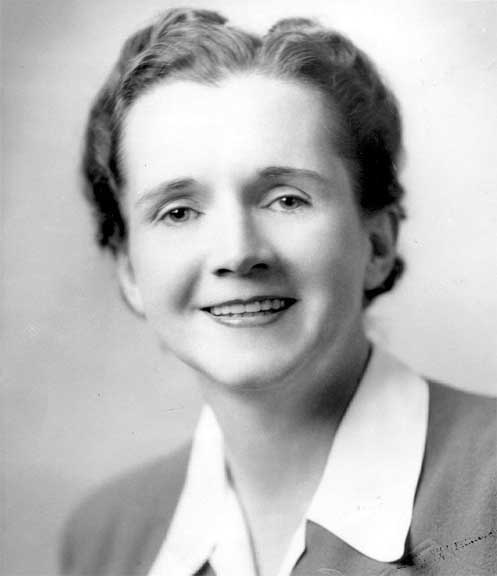
 Rachel Carlson
Source: History Central
According to Wikipedia:
Sen. Benjamin L. Cardin (D) Maryland had intended to submit a resolution celebrating Rachel Carson, author of the 1962 book "Silent Spring," for her "legacy of scientific rigor coupled with poetic sensibility," on the 100th anniversary of her birth. The resolution has been blocked by Sen. Tom Coburn (R) Oklahoma,[23] who is quoted on his website saying that "The junk science and stigma surrounding DDT -- the cheapest and most effective insecticide on the planet -- have finally been jettisoned."[24]Daily Kos comments:
Jeers to pesticide-loving wingnutty goodness......Sen. Tom Coburn (R-OK, much to this ex-Okie's dismay) has placed a hold on a resolution honoring pioneering environmentalist Rachel Carlson, after recieving a $4,000 donation from an executive advocating the use of DDT--the very pesticide Ms.Carlson helped eliminate. The scary part is, compared to Jim Inhofe, Coburn is the smart one.
Comment: Rachel Carlson lived in Silver Spring, Maryland -- the next town over from where I live. Her book, Silent Spring, did great service to the nation and to the world. Note this review, which I believe to be correct:
Silent Spring, released in 1962, offered the first shattering look at widespread ecological degradation and touched off an environmental awareness that still exists. Rachel Carson's book focused on the poisons from insecticides, weed killers, and other common products as well as the use of sprays in agriculture, a practice that led to dangerous chemicals to the food source. Carson argued that those chemicals were more dangerous than radiation and that for the first time in history, humans were exposed to chemicals that stayed in their systems from birth to death. Presented with thorough documentation, the book opened more than a few eyes about the dangers of the modern world and stands today as a landmark work.Carlson was not a scientist, and her book was not a scientific work but a work of "popular science", bringing knowledge developed in the scientific community to a larger audience. Her book is still in print, 45 years after original publication. Ed Wilson, who wrote the afterword to the current paperback edition is, however, one of the leading scientists of our age, as well as a leader in the effort to preserve biological diversity and the environment.
"Junk science" has become a key element in Republican doublespeak, used to challenge scientific opinion when it conflicts with corporate, profit-driven interests. Carlson's efforts to bring public attention to the problems caused by high levels of chemical pollutants in the environment were then and remain important. Surely some took the concerns too far. I personally think the banning of DDT for indoor spraying in anti-malarial campaigns was such an instance (although indoor DDT spraying did kill off a lot of cats, resulting in rodent problems); the danger to the environment of indoor spraying was not great, and a million people die each year of malaria. But the excesses of some true believers does not negate the truth of Carlson's fundamental message. Rachel Carlson's legacy is worthy of formal recognition, Cardin was right and Coburn is not only wrong, but a curmudgeon to have blocked Cardin's efforts. JAD


No comments:
Post a Comment