Sunday, September 17, 2006

What did Pope Benedict XVI Really Say

There has been a lot of commotion (see for example, this from Israel) about what the Pope said in his "Meeting with the Representatives of Science" in Germany on the 12th. I suggest you read the full text yourself. For those interested in knowledge, it is a useful discussion by one far more thoughtful and learned than I.

But the tempest in the teapot is just that. The Pope quoted a short segment of a dialog between Byzantine emperor Manuel II Paleologus and an educated Persian (recorded by an unknown hand, possibly that of the emporer himself) from an edition by Professor Theodore Khoury. He, the Pope, certainly does not suggest that the emporer was right in the quoted remark. If anything, he implies that its "startling brusqueness" was a rhetorical ploy used for argumentative or discursive purpose. The statement is placed in the context of theological debate, which the Pope clearly suggests has value and importance. Indeed, a major theme of the speech seems to be the division of that of Greek philosophy which is intrisic to the New Testiment and thus to Christian and Moslem religion, that which is intrinsic to European culture and philosophy (but not to the religions), and by elimination that which is neither. The Pope must be careful of what he says, as the tempest demonstrates, but I can say that even this speech makes clear that he is a serious student of the "structures of faith contained in the Bible and in the Qur'an, and deals especially with the image of God and of man". I would note that the Pope states that the emporer surely knew that "surah 2, 256 reads: 'There is no compulsion in religion'."

I will quote the English version of the text at length because it so eloquently refutes my last posting:
The scientific ethos, moreover, is......the will to be obedient to the truth, and, as such, it embodies an attitude which belongs to the essential decisions of the Christian spirit. The intention here is not one of retrenchment or negative criticism, but of broadening our concept of reason and its application. While we rejoice in the new possibilities open to humanity, we also see the dangers arising from these possibilities and we must ask ourselves how we can overcome them. We will succeed in doing so only if reason and faith come together in a new way, if we overcome the self-imposed limitation of reason to the empirically verifiable, and if we once more disclose its vast horizons. In this sense theology rightly belongs in the university and within the wide-ranging dialogue of sciences, not merely as a historical discipline and one of the human sciences, but precisely as theology, as inquiry into the rationality of faith.

Only thus do we become capable of that genuine dialogue of cultures and religions so urgently needed today. In the Western world it is widely held that only positivistic reason and the forms of philosophy based on it are universally valid. Yet the world's profoundly religious cultures see this exclusion of the divine from the universality of reason as an attack on their most profound convictions. A reason which is deaf to the divine and which relegates religion into the realm of subcultures is incapable of entering into the dialogue of cultures. At the same time, as I have attempted to show, modern scientific reason with its intrinsically Platonic element bears within itself a question which points beyond itself and beyond the possibilities of its methodology. Modern scientific reason quite simply has to accept the rational structure of matter and the correspondence between our spirit and the prevailing rational structures of nature as a given, on which its methodology has to be based. Yet the question why this has to be so is a real question, and one which has to be remanded by the natural sciences to other modes and planes of thought - to philosophy and theology. For philosophy and, albeit in a different way, for theology, listening to the great experiences and insights of the religious traditions of humanity, and those of the Christian faith in particular, is a source of knowledge, and to ignore it would be an unacceptable restriction of our listening and responding. Here I am reminded of something Socrates said to Phaedo. In their earlier conversations, many false philosophical opinions had been raised, and so Socrates says: "It would be easily understandable if someone became so annoyed at all these false notions that for the rest of his life he despised and mocked all talk about being - but in this way he would be deprived of the truth of existence and would suffer a great loss". The West has long been endangered by this aversion to the questions which underlie its rationality, and can only suffer great harm thereby. The courage to engage the whole breadth of reason, and not the denial of its grandeur - this is the programme with which a theology grounded in Biblical faith enters into the debates of our time. "Not to act reasonably, not to act with logos, is contrary to the nature of God", said Manuel II, according to his Christian understanding of God, in response to his Persian interlocutor. It is to this great logos, to this breadth of reason, that we invite our partners in the dialogue of cultures. To rediscover it constantly is the great task of the university.

"Early U.S. Missteps in the Green Zone"

Read the article "Ties to GOP Trumped Know-How Among Staff Sent to Rebuild Iraq" by Rajiv Chandrasekaran in The Washington Post of September 17, 2006.

This article tells part of the story of appointment of political ideologues to key possitions in Iraq's Coalition Provisional Authority and the disasterous repercussions of those appointments.

The U.S. Institute for Peace Oral Histories Project on the Iraq Experience has dozens of surprisingly frank interviews with people who served in or with the CPA, many of which tell the same sad story.

"Knowledge" is a funny concept. As Will Rogers said, "it's not what you don't know that hurts you, it's what you do know that ain't so." I might suggest another line:
It's not what you don't know that hurts you, its what you don't understand."
I think it is quite clear that the CPA officials didn't understand the situation they faced, and didn't understand the repercussions that their actions would have.

You may think you know something because
* of the evidence supporting that thing,
* it is a logical consequence of theory, or
* it is part of your ideology.
If knowledge is based on evidence, then it can be improved with more or more credible evidence. Dependence on evidence based knowledge requires the holder to be willing to change his mind, and to consider the degree of credance to attach to that knowledge.

In the case of Iraq in 2004, there was not much time for reevaluating knowledge or gaining new evidence.

It should also be said that knowledge and understanding can be gained by experience or by study. Study is great for explicit knowledge, but experience is needed to gain tacit knowledge.

Who wants to be treated for a serious and complex medical problem by someone who has finished the classroom portion of medical school, but who has not been through the clinical training and internship? Sending a 24 year old real estate salesman to rebuild the Iraqi stock market, as apparently was actually done, is a comparable approach to dealing with a serious and complex problem. The Iraqi PhD stock broker, who eventually headed the Board of Directors of the Stock Exchange, may well have thought the U.S. was mad to make him take orders from so unprepared a person.

It occurs to me that people who disagree but who create knowledge and understanding based on evidence and theory -- gained through experiment, experience, and study -- can resolve differences through the application of reason. People who disagree but who base base knowledge and understanding on ideology have little recourse to reason.

It seems that story after story is coming out of Iraq to suggest a fundamental problem. The United States government and its key decision makers did not have adequate knowledge nor understanding of Iraqi culture and society. As a result:
* They overstated the risk that was posed of Iraqi control of weapons of mass destruction, and of its relations with terrorist organizations.
* While they correctly estimated that the Coalition military forces could quickly overcome the Iraqi military, they underestimated the degree of paramilitary resistance that would occur, and gravely underestimated the degree of civil disturbance that would occur after the the fall of the Iraqi government (and the size of the military force that would be required to contain the looting and killing).
* They apparently made a significant error in disbanding the Iraqi army and police, and barring all people with Baath party backgrounds from positions of authority.
* They overestimated the ability of the CPA to rebuild Iraqi infrastructure, and they did not understand the drastic economic distress that they were unleasing on the country. And
* They did not predict the insurgency that would result from this combination of factors.
We too often consider governments as if they were people. A government may well act as though it lacks knowledge and understanding not because it does not have access to such knowledge and understanding, but rather because it does not bring the knowledge it actually holds to bear on the critical decisions that it makes. In the case of Iraq, there is a case to be made that the United States had allowed itself to lack enough people with enough knowledge and understanding of Iraq. But the WP article and many other sources are suggesting that the more important problem was that it failed to bring the appropriate knowledge and understanding that existed in the military, the State Department and its advisors, and the development community to bear on the Iraq decisions. Rather people who shared a neo-Conservative ideology recruited ideologically compatible people without reference to other qualifications to whom to delegate decision making responsibility, and as a result ideology was substituted wholesale for the knowledge and understanding that had been gained in decades of post-conflice situations, in decades of development asssistance, and in centuries of international relations.

Friday, September 15, 2006

"Gates, Rockefeller Charities Join to Fight African Hunger"

By Karen DeYoung, The Washington Post, September 13, 2006

Good news:
"The Bill and Melinda Gates Foundation, the world's richest charity, joined with the Rockefeller Foundation yesterday to launch a new development initiative for sub-Saharan Africa that they said would revolutionize food production and reduce hunger and poverty for tens of millions of people. Modeled on the Rockefeller-pioneered "green revolution" that transformed farming methods and staved off widespread famine in much of the developing world nearly a half-century ago, the initiative coincides with a new round of Western concern about the long-intractable problems of the poorest continent."
The article also notes that:
"The Africa program will begin with a relatively small Gates contribution of $100 million over five years, plus $50 million from Rockefeller, to fund development of more robust disease- and drought-resistant seeds for primary African foodstuffs, enhanced distribution networks for seed and fertilizer, and university-level training for African crop scientists."

Wednesday, September 13, 2006

US deports visa-holding Iranian scientists on arrival - SciDev.Net

US deports visa-holding Iranian scientists on arrival - SciDev.Net: This is a story from last month!

"Dozens of Iranian scientists and engineers who arrived in the United States last week had their visas revoked upon arrival and were asked to leave the country.

The Iranians, whose visas were approved months ago, were due to attend a meeting in California of the Sharif University of Technology Association (SUTA), a global organisation for alumni of Iran's top scientific university.

SUTA's founding president Fredun Hojabri told SciDev.Net that after a two-month delay for security checks, US consulates had granted visas for about half of the 250 Iranians who had applied.

'But when they arrived at the US airports they were told that their visas had been cancelled and they had entered the country illegally,' said Hojabri, a former professor at the University of California in San Diego."

US visa delays for visiting scientists improve - SciDev.Net

US visa delays for visiting scientists improve - SciDev.Net:

"Immigration restrictions imposed after 11 September 2001 turned many scientists away from the United States, but complaints have now subsided and the country is striving to woo researchers back."

Tuesday, September 12, 2006

The Pending Tragedy in Darfur!

TAPPED:

"If the political dynamic surrounding Darfur remains static, the region has about three weeks before African Union forces are replaced by the Sudanese military and its genocidal proxies. Meanwhile, Kofi Annan is struggling to sound the alarm on the sheer urgency of the crisis. Yesterday, he appeared in person before the Council and, in an attempt to raise the individual Council members to action, gave a rather stirring speech."

The article goes on to say that John Bolton delegated the Security Council follow-up to Annan's speech to a mid-level U.S. diplomat so that he, Bolton, could attend a meeting discussing how the Republicans could build anti-UN feelings as an election ploy.

Comment: Arghhh!

Gartner on Social Engineering

Gartner, a consulting firm, has provided this three part series on how a company can protect itself from social engineering attacks.

Social engineering, as defined in the IT security sector, involves the manipulation of people rather than technology to successfully breach an enterprise's security. Social engineering remains the single greatest security risk, despite our advances in technology, and many of the most-damaging security penetrations are the result of social engineering, not electronic "hacking" or "cracking."


I was especially taken by the following table. It apparently comes from a study published in Scientific American (February 2001) that cited six basic tendencies of human behavior that help generate a positive response:

Six Human Behaviors for Positive Response


BehaviorDefinitionExample
ReciprocationSomeone is given a "token" and feels compelled to take action.You buy the wheel of cheese when given a free sample.
ConsistencyCertain behavior patterns are consistent from person to person.If you ask a question and wait, people will be compelled to fill the pause.
Social ValidationSomeone is compelled to do what everyone else is doing.Stop in the middle of a busy street and look up; people will eventually stop and do the same.
LikingPeople tend to say yes to those they like, and also to attractive people.Attractive models are used in advertising.
AuthorityPeople tend to listen and heed the advise of those in a position of authority."Four out of five doctors recommend...."
ScarcityIf someone is in low supply, it becomes more "precious" and, therefore, more appealing.Furbees or Sony Playstation 2.
Source: Gartner Research


I think we all want to influence others to do something for us once and a while, and this table would appear to provide a tool to help us think thru how to achieve that end. (Thanks Ellie for telling me about the table.)

"Time Runs Out on Bolton Nomination"

POLITICS-US: Time Runs Out on Bolton Nomination:

"The committee, which is chaired by Sen. Richard Lugar, another moderate Republican whose support for Bolton has always been less than enthusiastic, has not scheduled a follow-up meeting, and time is rapidly running out. The Senate is expected to recess in advance of the November mid-term elections at the end of this month before returning for a likely brief 'lame-duck' session before the end of the year. "

The Detection and Identification of Infectious Diseases


"Infectious diseases account for a quarter of all human mortality and a similar fraction of morbidity (1). Infectious diseases of crops and livestock cost the global economy uncounted billions of euros every year. On top of this, sudden epidemics of infectious diseases can deliver humanitarian and economic shocks on a scale difficult to absorb." (Science, 8 September 2006:
Vol. 313. no. 5792, pp. 1392 - 1393
).

"Infectious Diseases: preparing for the future", a report from this Foresight project indicates that new measures to combat infectious diseases could drastically cut mortality, save billions of euros and eliminate the need for mass animal culling. It also concludes however that current and new infectious diseases will continue to have profound human, economic and social impacts, and that unless new ways of sharing research and technological advances are implemented at all levels, the poorest people in the world will continue to suffer disproportionately.

Oppose S. 2453, the National Security Surveillance Act.

American Civil Liberties Union : ACLU Demands House Reject Attempts to “Update” FISA, Says Constitution Must Not Be Undermined in Election-Year Tactic:

"Today the American Civil Liberties Union urged the House of Representatives to reject attempts to erode Fourth Amendment protections under the guise of 'updating' the Foreign Intelligence Surveillance Act (FISA), as the House Judiciary Subcommittee on Crime, Terrorism, and Homeland Security met to consider several proposals that would condone President Bush’s warrantless wiretapping program.

'The Republican leadership is recklessly pushing legislation based on an election strategy, with no regard for how these bills undermine our fundamental freedoms,' said Caroline Fredrickson, Director of the ACLU Washington Legislative Office. 'FISA doesn’t need to be updated. We hope that lawmakers will act to uphold the Constitution and Bill of Rights.'.....

The ACLU has raised strong objections to S. 2453, the National Security Surveillance Act. Sponsored by Senator Arlen Specter (R-PA) and drafted in close consultation with the White House, the Cheney-Specter bill would make complying with FISA and the Fourth Amendment optional for the president. The bill would also vastly expand the government’s ability to conduct warrantless surveillance and physical searches of Americans’ homes and businesses without judicial check.

Representatives Heather Wilson (R-NM), Jim Sensenbrenner (R-WI) and Pete Hoekstra (R-MI) have introduced a similar bill, HR 5825, in the House. That proposal would give the president unprecedented power to conduct warrantless spying and physical searches of Americans on American soil for months at a time, without any judicial check or finding that an American is conspiring with al Qaeda. The bill also authorizes the warrantless surveillance program. The ACLU noted the bill allows any act of terrorism to trigger the suspension of the court order requirements of FISA."

Comment: This administration is trying to use 9/11 as a cover for an attack on our civil liberties and their effort to extend executive power. I want the courts to continue to play a role in assuring that privacy is not invaded without just cause.

PLoS Medicine: Eight Americas: Investigating Mortality Disparities across Races, Counties, and Race-Counties in the United States

PLoS Medicine: Eight Americas: Investigating Mortality Disparities across Races, Counties, and Race-Counties in the United States:

"Disparities in mortality across the eight Americas, each consisting of millions or tens of millions of Americans, are enormous by all international standards. The observed disparities in life expectancy cannot be explained by race, income, or basic health-care access and utilization alone. Because policies aimed at reducing fundamental socioeconomic inequalities are currently practically absent in the US, health disparities will have to be at least partly addressed through public health strategies that reduce risk factors for chronic diseases and injuries."

The report shows how important it is to know not only what happens on the average, but how experience differs in different groups. Fortunately, for some groups in the United States is very good indeed, and compares favorably with the best health statistics in the world. Unfortunately, for others such as black and native-American men, mortality is very high.

It is especially striking that there is a 20 year difference in life expectancy between black men and Asian-American women, but that mortality rates in the under five age bracket are reported almost identical. So the usual suspect in developing countries -- high infant and child mortality is not the culprit in the black community. Rather it seems to be smoking, alcohol, obesity, high blood pressure and high cholesterol among the middle aged.

PLoS Medicine: Why Most Published Research Findings Are False

PLoS Medicine: Why Most Published Research Findings Are False:

"There is increasing concern that most current published research findings are false. The probability that a research claim is true may depend on study power and bias, the number of other studies on the same question, and, importantly, the ratio of true to no relationships among the relationships probed in each scientific field. In this framework, a research finding is less likely to be true when the studies conducted in a field are smaller; when effect sizes are smaller; when there is a greater number and lesser preselection of tested relationships; where there is greater flexibility in designs, definitions, outcomes, and analytical modes; when there is greater financial and other interest and prejudice; and when more teams are involved in a scientific field in chase of statistical significance. Simulations show that for most study designs and settings, it is more likely for a research claim to be false than true. Moreover, for many current scientific fields, claimed research findings may often be simply accurate measures of the prevailing bias. In this essay, I discuss the implications of these problems for the conduct and interpretation of research."

Evidence-based medicine under attack | Public Library of Science

Evidence-based medicine under attack | Public Library of Science:

"Here we go again. Evidence-based medicine (EBM) has once more come under fire, only this time the accusations are even more brutal. The EBM movement, says a group of academics at the University of Ottawa and the University of Toronto, is 'outrageously exclusionary,' 'dangerously normative,' and 'a good example of microfascism at play.' As an EBM believer, I guess this would make me a microfascist."

Comment: Me too. I very much want to exclude physicians from practicing on me who do not base their diagnostic and prescriptive judgement on scientific evidence.

Monday, September 11, 2006

Honoring those who died on 9/11

One way to honor those 3000 who died is to honor also the more than 3000 military who have died in Iraq and Afghanistan in the five years since. We should also honor the men and women who are suffering now as a result of their work on Ground Zero.

But let us also remember that more than ten times 3000 people have been killed in Iraq since 9/11, and Iraq is a country less than one-tenth the size of the United States. The grief we feel for our honored dead may help us empathize with the people of Iraq, so many of whom grieve for their own dead.

And while we are at it, let us think of the people of Darfur and other disaster areas. Perhaps an effort to do some good in this world it the best way to honor our own dead.

"Wynn Accused of Inflating His List of Endorsements"

Read the full article by John Wagner and Ovetta Wiggins in The Washington Post, September 11, 2006.

Al Wynn, the incumbent from Maryland's 4th Congressional District, is facing a tough primary challenge from Donna Edwards. Today the Washington Post story suggests he has been playing dirty in the last days of the campaign.

Marilyn Praisner, the longest serving woman ever on the Montgomery County Council, is quoted saying that she refused to endorse Wynn, but found his literature listed her as endorsing him.

The article states:
At least two labor unions -- the Service Employees International Union and the Teamsters -- also have raised questions about Wynn's use of their names on his literature.....

"We were surprised that our name was on the literature," said Ellen Golombek , director of government affairs for SEIU. Curt Clifton , a spokesman for Wynn, said Wynn received contributions from the union and the Teamsters with letters of support for his reelection bid. Golombek said she was looking into whether a check was sent to Wynn last year; none were sent in 2006, she said. She added that the union "elected not to endorse in this congressional race."

Ferline Buie , president of Teamsters Joint Council No. 55, which represents five local unions in the 4th District, sent a letter to Wynn's campaign Friday asking that his literature be corrected because the union has endorsed Edwards. "We believe [it] is inappropriate and inaccurate to claim that the Teamsters have endorsed your campaign," Buie wrote.

Regulations prohibit members of Congress from sending taxpayer-financed mass mailings in the last 90 days before an election. A franked "Pass It On" newsletter dated Sept. 8 apparently was distributed to constituents in Wynn's district.

Comment: I don't like it, but I realize that most if not all politicians shade the truth. (See my posting on "In Congress, a Whole Lot of Half-Truths" By Richard Morin.) But getting caught faking endorsements a couple of days before the election is just dumb! I don't think we need another dumb guy in the House of Representatives!

UNCTAD.ORG Investment Policy Reviews (IPRs)

UNCTAD.ORG >> Investment Policy Reviews (IPRs)

UNCTAD´s program on Investment Policy Reviews (IPRs) seeks to help countries to improve policies and institutions that deal with foreign direct investment (FDI) and to increase their capacity to attract and benefit from it.

The Investment Policy Review (IPR) for a country provides an evaluation of the policy, regulatory, institutional and operational framework for FDI. IPRs are done in developing countries and economies in transition.

The website provides free downloadable versions of IPRs for a number of countries, as well as information on the program and its staff, and related materials.

IPRs can be considered complementary to UNCTAD Science, Technology and Innovation Policy Reviews, or other country assessments of technological capacity.

Check out the OECD Science, Technology and Innovation program while you are here.

Sunday, September 10, 2006

Does the U.S. Constitution, and the migration of the educated, militate against growth of the knowledge society?

Three articles from The Atlantic taken together really worry me. These articles are all identified in the October 2006 edition of The Atlantic. To read The Atlantic online, a subscription is required.

1. "Where the Brains Are: America’s educated elite is clustering in a few cities— and leaving the rest of the country behind" by Richard Florida:
A merica’s social fabric has been regularly reshaped by great migrations—of pioneers westward, of immigrants and farmers to rising industrial cities, of African Americans from the rural South to the urban North, of families outward from cities to suburbs to exurbs.

Today, a demographic realignment that may prove just as significant is under way: the mass relocation of highly skilled, highly educated, and highly paid Americans to a relatively small number of metropolitan regions, and a corresponding exodus of the traditional lower and middle classes from these same places. Such geographic sorting of people by economic potential, on this scale, is unprecedented. I call it the “means migration.”
In 1970, eleven percent of U.S. adults were college graduates; in 2004, 27 percent were college grads. Yet for the vast majority of counties in the United States, the portion of college graduates in the population has decreased.
about half of the residents of Washington, D.C., and San Francisco now have college degrees—versus 14 percent and 11 percent in Cleveland and Detroit respectively. The trends for graduate degrees show a similar pattern. In Washington, D.C., and Seattle, more than 20 percent of the adult population had an advanced degree in 2004, compared with 5 percent in Cleveland, 4 percent in Detroit, and 2 percent in Newark. In the downtown neighborhoods of high-powered cities, the concentration of well-educated people is even greater. In 2000, more than two-thirds of the residents of downtown Chicago and of Midtown Manhattan, for example, held college degrees.......

What’s behind this phenomenon? Some of the reasons for it are essentially aesthetic—many of the means metros are beautiful, energizing, and fun to live in. But there is another reason, rooted in economics: increasingly, the most talented and ambitious people need to live in a means metro in order to realize their full economic value.

The physical proximity of talented, highly educated people has a powerful effect on innovation and economic growth—in fact, the Nobel Prize–winning economist Robert Lucas declared the multiplier effects that stem from talent clustering to be the primary determinant of growth. That’s all the more true in a postindustrial economy dependent on creativity, intellectual property, and high-tech innovation.

Places that bring together diverse talent accelerate the local rate of economic evolution. When large numbers of entrepreneurs, financiers, engineers, designers, and other smart, creative people are constantly bumping into one another inside and outside of work, business ideas are more quickly formed, sharpened, executed, and—if successful—expanded. The more smart people, and the denser the connections between them, the faster it all goes.
Note that it is not only a city rural divide, but only a few cities are concentrating more and more of the educated citizens.

Great maps in the article indicate that these cities are in the NorthEast, the Central Atlantic States, the Rocky Mountain States, and the West Coast. Basically the politically red states are seeing their percentages of college graduates actually going down, while the politically blue states are concentrating more and more college grads.

2. "Primary Sources: A Hard Day’s Night":
For most of the twentieth century, the typical American workday grew shorter and shorter, and the proportion of American men working long hours dropped steadily. But since 1970, a recent paper points out, this trend has reversed itself: men are working longer hours overall, and the share of men who work more than fifty hours a week has been growing. This trend is most pronounced among highly skilled workers: in 1980, 22 percent of college-educated men routinely pulled fifty-hour workweeks; in 2001, 30.5 percent worked fifty hours or more. Meanwhile, low-paid workers are less likely to work long hours than in the past. The authors argue that this shift reflects a changing approach to compensation, in which companies give their salaried workers financial incentives to persuade them to work longer hours. The authors don’t attempt to explain why companies would be increasingly incentivizing fifty-hour workweeks, but they do note the information industries’ steady appetite for highly skilled workers as a potential source for this shift.

—“The Expanding Workweek? Understanding Trends in Long Work Hours Among U.S. Men, 1979–2004,” Peter Kuhn and Fernando Lozano, National Bureau of Economic Research
I conclude that the demand for knowledge workers, generally those with university degrees and advanced degrees is continuing to increase, while that for less educated workers is decreasing (or being supplied in excess by immigrant workers).

3. "Primary Sources: The Rich Are Different From You and Me"
What makes a red state red, and a blue state blue? It’s the voting habits of their wealthiest residents, according to a study from Columbia University. Although the GOP has traditionally been considered the party of the wealthy and the Democrats the party of the poor, lately Republicans have tended to win in the poorer states in the interior of the country, while Democratic victories have been concentrated in the wealthier states along the East and West Coasts. This trend has led pundits to argue that the Republicans have developed a common touch, while the Democrats have become elitist and alienated from the masses—but actually, the study’s authors argue, the red-blue gap is best explained by the fact that rich people in poor states are much more likely to vote Republican than rich people in well-off states. In Mississippi, for example, there is a strong relationship between income and voting patterns: the wealthier the Mississippian, the more likely he or she is to pull the lever for a Republican presidential candidate. But as a state’s average income rises, the correlation between being wealthy and voting Republican disappears. In Connecticut, for instance, there is almost no connection between income and voting behavior: both the poor and the rich tend to vote for Democratic candidates.

—“Rich State, Poor State, Red State, Blue State: What’s the Matter With Connecticut?” A. Gelman, B. Shor, J. Bafumi, and D. Park, Columbia University
We know that there is a high correlation between the level of education and economic status. This is both because the well off can afford to send their kids to college, and because higher education, especially since World War II, has been a route to economic advancement in the United States.

So one group of the educated is increasingly moving to the big cities in the blue states and voting Democrat, while another group of the educated is staying in the red states, and voting Republican. I suspect this implies a very deep shift in the political landscape with important implications for the future of the United States.

One thing that really bothers me is that the Constitution of the United States gives voters in more rural states disproportionate political power. Each state gets two Senators, whether its population is big or small. So the many (red) states that are seeing their numbers of college grads go down get more Senatorial power per person than the large (blue) states that are the centers of innovation and economic growth for this country. Since there is one vote in the Electoral College for each Senator and one for each Congressman, the states that seem to be "educating down" also get more power per person in the presidential elections than the states that are "educating up". As the Bush-Gore election showed, this is not a distant threat.

If you believe the future of the United States depends on its becoming a knowledge economy, this is not a happy state of affairs. The red states, increasing left behind economically, with a smaller and smaller portion of the college educated peoples, are likely to use their excessive power to slow progress toward that knowledge economy. Indeed, the Bush administration approach to the knowledge seems to illustrate the concern -- it is a red state elected administration which appears antagonistic to scientific evidence when that evidence conflicts with its ideological positions.

Another item from The Atlantic's "Primary Sources"

Primary Sources:

"Motivational speakers may tell you to believe in yourself, but if you want to do well in school, you may be better off taking a more pessimistic attitude toward your own abilities. In a report detailing the various things the U.S. can learn from the Chinese educational system about teaching math and science—including the importance of national curricular standards, better training of teachers, longer school years, and extra homework—comes the news that the U.S. lags far behind Asian nations in grade-school math and science scores. This gap, however, is not for want of student self-confidence: despite faring worse on a standardized eighth-grade science test than students in Taiwan, Hong Kong, Japan, and South Korea, American students are more than twice as likely as their peers in those countries to enjoy high “self-confidence” in their ability to learn science."

It's not what you don't know that hurts you, it's what you do know that ain't so.
--Will Rogers


Its not how dumb you are that hurts you, it's how smart you think you are!
John Daly

While I am at it, some quotes I found on the same site as the Will Rogers quote above -- these from Mark Twain:
* I have never let my schooling interfere with my education.

* A crank is a man with a new idea--until it catches on.

* You can't depend on your eyes when your imagination is out of focus.

* Get your facts first, and then you can distort them as much as you please.

* Loyalty to petrified opinion never yet broke a chain or freed a human soul.

* Sometimes I wonder whether the world is being run by smart people who are putting us on or by imbeciles who really mean it.

* Whenever you find yourself on the side of the majority, it's time to pause and reflect.

"Cultures of Corruption: Evidence From Diplomatic Parking Tickets"

"Cultures of Corruption: Evidence From Diplomatic Parking Tickets":
Raymond Fisman, Edward Miguel, NBER Working Paper No. 12312, Issued in June 2006.

Abstract: "Corruption is believed to be a major factor impeding economic development, but the importance of legal enforcement versus cultural norms in controlling corruption is poorly understood. To disentangle these two factors, we exploit a natural experiment, the stationing of thousands of diplomats from around the world in New York City. Diplomatic immunity means there was essentially zero legal enforcement of diplomatic parking violations, allowing us to examine the role of cultural norms alone. This generates a revealed preference measure of government officials' corruption based on real-world behavior taking place in the same setting. We find strong persistence in corruption norms: diplomats from high corruption countries (based on existing survey-based indices) have significantly more parking violations, and these differences persist over time. In a second main result, officials from countries that survey evidence indicates have less favorable popular views of the United States commit significantly more parking violations, providing non-laboratory evidence on sentiment in economic decision-making. Taken together, factors other than legal enforcement appear to be important determinants of corruption."

This is what The Atlantic has to say about the study:
What makes officials corrupt? Disentangling law and culture is a tricky business, but a pair of economists have come up with an ingenious way to do it: studying the frequency of parking violations committed by diplomats in New York City. Since, as their study reports, there is “essentially zero legal enforcement of diplomatic parking violations,” the authors hypothesized that any cross-national variation in parking-violation rates should flow from culture alone. And sure enough, diplomats from countries with high levels of corruption were significantly more likely to incur parking tickets, suggesting that cultural factors rather than legal norms drive a great deal of official misconduct. The worst offenders were Kuwaitis, who accumulated an astonishing 246 violations per diplomat per year from the end of 1997 through 2002, followed by Egyptians, with 140 violations per diplomat per year; countries whose diplomats incurred no parking tickets included Canada, Israel, Norway, Sweden, and Denmark. The study also found that officials from countries where the U.S. is less popular were much more likely to park illegally, and that there was a significant drop-off in violations after 9/11, particularly among diplomats from Muslim nations.

Source: The Atlantic

"Count Ethnic Divisions, Not Bombs, to Tell if a Nation Will Recover From War"

Read the full article by AUSTAN GOOLSBEE from The New York Times of July 20, 2006.

"WITH repeated Shiite and Sunni killings in Iraq, the Hezbollah rocket attacks on Israel, Israeli attacks on Lebanon and Gaza, the assaults by the Taliban and counterassaults by American forces in Afghanistan, and a train bombing in India, it has been quite a fortnight for at least two of the horsemen of the apocalypse — war and death.

"With little prospect of a quick resolution to most of these conflicts, perhaps it is worth looking at the long-run prospects for these nations once the wars actually end (assuming that they do end, of course).

"The good news is that history suggests that the destruction of war has no lasting impact on economic prospects. The bad news is that most of these countries, especially Iraq, are filled with ethnic divisions and civil discord. The evidence shows that these problems, unlike bombs, cause lasting damage to the prospects for a nation’s economy, even if they do not boil over into civil war."

The two papers referenced are:
* "The Long Run Impact of Bombing Vietnam" Edward Miguel and Gérard Roland, University of California, Berkeley, January 2005.
* "Artificial States," by Alberto Alesina, William Easterly and Janina Matuszeski, Working Paper 12328, National Bureau of Economic Research, June 2006.

Artificial Intelligentsia

Artificial Intelligentsia: (Subscription required to read this article in the October edition of The Atlantic online.)

I think Jim Fallows is a national resource, and his contributions to the Atlantic are great both on information technology and on current events. The current piece is a thoughtful discussion of the value of computers to people -- suggesting quite reasonably that they are better regarded as intelligence amplifiers than as artificial people. Thus they amplify our mental abilities the way motor vehicles amplify our ability to run, factory machinery amplifies our ability to fabricate things, or optical devices amplify our ability to see.

But I wanted to share this paragraph, which seems to offer some generally useful tips on what to use right now to amplify you mental abilities.
"A search engine called Clusty, founded by Carnegie Mellon computer scientists and based in Pittsburgh, returns its search results grouped by topic category. Type in “theory of evolution,” for instance, and it will tell you which sites discuss Charles Darwin, which cover modern developments in the theory, and which discuss its relationship with the Bible. An experimental search engine developed at the University of Maryland, at tinyurl.com/qkpht, also provides useful categorized results. Ask.com, formerly known as Ask Jeeves, has a very useful “Zoom” feature. Type in “theory of evolution” there, and it will suggest that you might want to narrow the search for information about the mechanics of natural selection, or broaden it to a general query about the beginnings of life. Cnet’s news site has a feature called “Big Picture.” After you enter a query, it produces a concept map showing the related topics to explore. Grokker was a pioneer in producing such concept maps, and remains a useful and reliably interesting way to display the overlaps and divergences among items discovered by a Web search. Raymond Kurzweil’s site employs an idea map of its own. When I’m doing a search to develop a theme and not to check spot knowledge, I have found that these categorizing sites—especially Ask.com—save me time in getting where I want to go."

Saturday, September 09, 2006

Edwards "has,......the help of Internet bloggers, who support her positions on the environment, campaign finance reform and Iraq"

Read the full article: "Edwards Runs Tough Race Against Wynn" by Ovetta Wiggins, The Washington Post, September 9, 2006.

The race in Maryland's 4th Congressional District for the Democratic Nomination. The 4th is heavily Democratic, and the Democratic candidate is likely to be elected to the Congress in November. Al Wynn is a long time Congressman, and is being challenged by Edwards.

"Wynn is facing the political challenge of his career in Tuesday's Democratic primary against Donna Edwards, a lawyer and community activist who has mounted a vigorous and well-organized campaign to represent Maryland's 4th Congressional District."

What the article says about Wynn:

* Wynn says he was misled by the Bush administration and notes that he was not the only Democrat who was. He has apologized for the vote and now believes the troops should be withdrawn.
* Wynn broke ranks with the party to vote in favor of the Bush administration's energy bill in 2003, which authorized tax breaks for energy producers. Wynn also supported the repeal of the estate tax, which would benefit the wealthiest Americans.
* He makes no apologies for his vote on the Republican-sponsored energy bill. "I'm happy to stand behind the energy bill," he said.
* His campaign literature touts the backing of about 40 left-leaning groups, including the AFL-CIO and Planned Parenthood, as evidence that he remains a true Democrat, despite Edwards's attempts to cast him otherwise. "I consistently vote with pro-choice, I consistently vote with labor unions," Wynn said during a recent interview. "This is a bunch of rubbish of the worst sort."


What the article says about Edwards:

* Internet bloggers (including this one) support her positions on the environment, campaign finance reform and Iraq. Edwards opposes the war; Wynn voted for the resolution authorizing it.
* Edwards.......has worked on Capitol Hill as a lobbyist for groups such as the Center for a New Democracy, where she was the executive director. On a national level, she has pushed for funding for domestic violence victims and reforming the campaign finance system. Locally, she and a community activist group fought against the building of National Harbor, a multibillion dollar resort along the Potomac River, until developers agreed to add a residential component to the project. She has received endorsements from Progressive Democrats of America, the Sierra Club and the National Organization for Women's political action committee.
* Edwards supports a withdrawal from Iraq but has declined to say what the timetable should be. She wants to raise the minimum wage and thinks the country's energy policy should be weaned off of fossil fuels.

Wynn is probsbly right, that both the candidates are liberal Democrats. But I would like one representing me that doesn't vote against the Democrats on so many critical issues. Anyway, Edwards is clearly the more vigorous candidate, and who brings a national reputation to her campaign, and looks like she will be much more effective in the Congress in representing this District than Wynn would be. If we want a new and better Congress, perhaps we should elect new and better Democrats, and not merely work of replacing Republicans with Democrats!

"Complex Science for a Complex World: Exploring Human Ecosystems with Agents"


By Pascal Perez and David Batten (Editors), Australian National University E Press, 2006

Julianne Gilmore brought this book to my attention.

Moore's Law works, and computer modeling is becoming affordable with more and more complex simulations. Models based on agents can now be used in simulations of very complex systems of interactions, and the behaviors of these systems explored as the parameters of the agents behavior, the linkages among agents, and the factors in their environment affecting agent bahavior all change. This book describes the theory of such models, and provides case studies of their application.

The case studies are:
* Sustainability Assessment of Housing Developments: A New Methodology
* WISDOM-II: A Network Centric Model for Warfare
* Managing Agricultural Pest and Disease Incursions: An Application of Agent-Based Modelling
* SimDrug: A Multi-Agent System Tackling the Complexity of Illicit Drug Markets in Australia
* NEMSIM: Finding Ways to Reduce Greenhouse Gas Emissions Using Multi-Agent Electricity Modelling
* AtollGame: A Companion Modelling Experience in the Pacific
* Multiple-Use Management Strategy Evaluation for Coastal Marine Ecosystems Using InVitro
* Rangeland Consolidation Patterns in Australia: An Agent-Based Modelling Approach.

In the 1960's my work included computer modeling of neural systems, and the use of neural networks in pattern recognition. The computers of the day were primative, barely toys by todays standards. But the work was some of the very first work that demonstrated emergence from the complex behavior of simple agents. When later the Santa Fe Institute became famous for its development of Complexity Theory, and when I read Mitch Waldrop's book ("Complexity: The Emerging Science at the Edge of Order and Chaos") I became more of a fan of this theory. The work on evolutionary economics (c.f. An Evolutionary Theory of Economic Change by Richard R. Nelson, Sidney G. Winter) made it clear that the complexity modelling approach was very relevant to understanding technology policy, including technology policy for developing nations. This book adds to the breadth of the approach, showing how complexity modelling can help to understand complex social system behavior, and even the interaction of that behavior with the physical world.

Results from informal summit in Kazakhstani capital of Astana

Read the full article in ErasiaNet.

Central Asian leaders recently made agreements that seek to save the shrinking Aral Sea and strive to improve the regional water management system.

According to Eurasian Net,
the agreement on saving the Aral Sea appears to rest on a shaky foundation. The sea -- a victim of misguided Soviet central planners, who diverted rivers that fed the Aral to support cotton cultivation -- has been shrinking at an alarming rate for over 40 years, and now is estimated by the UN Environment Program to be less than half of its size in the mid-1960s. As a first step toward the Aral’s regeneration, the Central Asian leaders agreed to revive the International Aral Sea Salvation Fund, aiming to raise international awareness about the environmental catastrophe.

The second stage of the Aral salvation blueprint would seem to require the diversion of Siberian rivers, an oft-debated measure that was discredited during in the late Soviet era as environmentally hazardous. At a news conference, Kazakhstani President Nursultan Nazarbayev defended the idea of redirecting rivers, and downplayed the long-standing environmental concerns. "We have talked to the Russian president about the fact that statements to the effect that this would be damaging and so on were populist," Nazarbayev said. "This would be just 8 percent of the flow, which would not even have any effect on drainage but would play a great role in integration and relations between our countries."

Any attempt to implement a river-redirection scheme would be sure to generate a storm of protests. It would also be an enormously expensive project, which, in the end, could merely spread the environmental damage, rather than rescue the Aral. Even while seeming to promote the idea, Nazarbayev admitted that "the issue is quite serious and complex."


Go to this website to see for yourself how much the Aral Sea has shrunk!

I read that the current efforts to improve the situation in the Aral Sea were providing some benefits, and I am glad to see that leaders in the region are still working to reverse one of the worst environmental disasters in the world. Lets hope that they have some success!

The Bolton Nomination

Last year John Bolton failed to obtain the support of Senator Voinovich or any Democrat on the Senate Committee considering his nomination as U.S. Ambassador to the United Nations. Bush temporarily installed Bolton as U.N. ambassador on Aug. 1 of last year while Congress was in recess. That appointment is to expire in January. He re-nominated Bolton again this year, and hearings were again held on the nomination.

Comment: Bolton is, to put it mildly, an undiplomatic diplomat. He dislikes the United Nations. His term to date has, as far as I can see, been marked by counter-productive pugnacity which has antagonized other diplomats, without gaining any advantage for the United States. While sometimes it is necessary to antagonize representatives of other countries in the course of representing ours, to do so needlessly is simply foolish. Sometimes diplomacy depends on the good will of the diplomats!

Read the negative review Bolton's performance recently published by representatives of the United Nations Association of the United States.

Thursday, according to ABC News, the Senate Committee pulled the scheduled vote. "Senate Foreign Relations Committee Chairman Richard Lugar, R-Ind., gave no reason for the delay and did not say when the vote would be held."

Senator Lincoln Chafee sent a letter to Secretary Rice (Posted by Steve Clemons on TPM Cafe) on Thursday which concluded:
It is my hope that answers will be forthcoming about our policy toward the Israeli-Palestinian conflict, and the Committee can reconvene to debate Ambassador Bolton's confirmation.

Yesterday Clemons reported:
Several well-placed sources close to the Bolton nomination process have reported to me that the Bolton confirmation process is now dead.

The Senate Foreign Relations Committee is "highly unlikely" to reconsider Bolton's confirmation again as things now stand.

Lets hope Clemons is right.

Comment: The Bush Administration has the right to nominate (and renominate) Bolton to the post, and apparently agrees with his views and likes the job he has done so far. But the Constitution provides a check, requiring Senate confirmation. Given the opposition of the Democrats to Bolton's policies and behavior, unless the Administration can bring moderate Republicans to vote for Bolton, he will not be confirmed. It now appears that Senator Chaffee, a Republican widely recognized for his good judgement and knowledge of foreign policy, has stood up to the Administration and said no!

Friday, September 08, 2006

The role of universities in knowledge production

Read the SciDev.Net Policy Brief by Judith Sutz)

Summary: "To increase their contribution to development through the production and distribution of knowledge, universities in developing countries need to transform themselves into 'developmental universities'. But to achieve this, other participants, such as industry and government, must be also be prepared to take on new responsibilities. No ready-made model exists to guide these changes; they will require both creativity and the willingness to engage in thoughtful dialogue, both within and outside universities."

"Doha: the low hanging fruit: A successful outcome to the WTO trade talks is still possible."

Read the full article by Angel Gurría (Secretary-General of the OECD) in The OECD Observer.
: Published: August 2006

"I am in contact with leaders and officials both from the world’s most developed nations and from developing countries. When the Doha Development Round talks collapsed in July, I was struck by the gap between what officials say when they meet at the OECD in Paris and how they define their positions in the WTO talks in Geneva.

"The Doha Development Agenda is an opportunity to re-balance trade rules in favour of developing countries while boosting the world economy. The Doha talks reportedly collapsed largely because of disagreements over agriculture, but clearly that is not the whole story. Indeed, some rich countries were not ready to accept larger tariff cuts or bigger reductions in trade-distorting domestic subsidies for farm products. Emerging market countries, meanwhile, offered what some saw as only modest improvements in market access for goods and services."

Thursday, September 07, 2006

"Senators Denounce Scientist's Stem Cell Claims: Confusion Over Harm to Embryos In Study at Issue"

Read the description of the event by Rick Weiss in The Washington Post of September 7, 2006.

Senators Arlen Specter (R-Pa.) and Tom Harkin (D-Iowa), respectively Chairman and Ranking Minority Member of the Senate Appropriations Committee's Labor, Health & Human Services, and Education Appropriations Subcommittee, are described as having "lashed out" yesterday at Robert Lanza of Advanced Cell Technology (ACT) in Worcester, Mass during a Subcommittee hearing. Their complaint was that "the scientist and his company have harmed the struggling field by overstating their results." The two senators are said to "strongly support human embryonic stem cell research."

BusinessWire.com reports:
Robert Lanza, M.D., Advanced Cell Technology's Vice President of Medical and Stem Cell Development, testified today before the Senate Labor, Health & Human Services and Education Appropriations Subcommittee. Dr. Lanza's testimony focused on support for wider availability of human embryonic stem cells for basic medical research. Dr. Lanza is the principle author of a paper published online (ahead of print) on August 23 in the peer-reviewed journal Nature, which described a technique for developing human embryonic stem cells with a single-cell biopsy technique called Preimplantation Genetic Diagnosis (PGD). This technique is not harmful to embryos.

The letter to Nature cited in the dispute is by Lanza and four other authors. It states in part:
The derivation of human embryonic stem (hES) cells currently requires the destruction of ex utero embryos. A previous study in mice indicates that it might be possible to generate embryonic stem (ES) cells using a single-cell biopsy similar to that used in preimplantation genetic diagnosis (PGD), which does not interfere with the embryo's developmental potential. By growing the single blastomere overnight, the resulting cells could be used for both genetic testing and stem cell derivation without affecting the clinical outcome of the procedure. Here we report a series of ten separate experiments demonstrating that hES cells can be derived from single blastomeres.

Apparently wide interest was stimulated in and by the media in the possibility of generating embryonic stem cell lines without destroying embryos. To do so would reduce some, but not all, of the religiously based objections many people (including President Bush) have to embryonic stem cell research. The reported research, however, resulted in the destruction of the donated embrios it used. Certainly the research done to date does not justify Business Wire's claim that "this technique is not harmful to embryos."

Lanza seems not to have made excessive claims about the work, and is quoted as stating:
"Our paper is 100 percent correct!"

Weiss, in the article cited above reports:
(A) plainly incorrect announcement (was) sent to science reporters by the journal Nature itself.

"By plucking single cells from human embryos, Robert Lanza and his colleagues have been able to generate new lines of cultured human embryonic stem (ES) cells while leaving the embryos intact," the release said.

That erroneous description -- written not by scientists at Nature but by the journal's lay staff -- was corrected after news stories were published.

Nature later apologized to reporters, blaming the mistake on "internal communication problems."

Comment: I believe that it would better to utilize the many embryos that are currently being destroyed (as no longer needed for implantation as part of reproductive medicine) to derive stem cell lines for research, and eventually (one hopes) for other clinical applicationss. The value of deriving stem cell lines from blastomeres without destroying the embryo is primarily in the eyes of a religious minority. However, were
* embryonic stem cell lines to be successfully derived from cells extracted from embryos,
* the embryos later successful implanted, and
* the resulting pregnancies to yield healthy babies,
then many who do not do so now would approve government funding of embryonic stem cell research. I would welcome their added support.

If Nature's staff made an error in the news release based upon a letter (which was correct in every way), then those staff members deserve blame. So too do the scientists in charge at Nature for not supervising the lay staff more effectively to prevent such mis-statements. So too do the reporters and editors who published the incorrect information from the news release without further verification. While there is plenty of blame to go around, none would seem to attach to Dr. Lanza and his associates for the misunderstanding.

I find it interesting that Senators should use an appropriations hearing to discuss this paper, and inappropriate that they should "lash out" at a distinguished scientist and entrepreneur for a failure that was not his. A little more decorum, please!

Again, I am reminded that the knowledge systems and processes in the media and the U.S. legislative bodies are much different than those of the scientific community and its journals. The scientific knowledge processes are better at getting at the truth of the issue. But, as this case illustrates, the communication among these knowledge systems is fraught with peril.

Wednesday, September 06, 2006

Intellectual Property Rights Harmonization

Does anyone think this phrase has become current in WTO/WIPO North-South fora in part because technologically innovative firms and nations feel it is more decorous and euphoneous than an alternative, blunt statement of their position, such as:
Give us lots more money right away!

Its good to be tall!

"In Congress, a Whole Lot of Half-Truths", By Richard Morin, The Washington Post, September 6, 2006.

"Researchers have known for decades that taller people earn more and have better jobs. Some researchers said it was because tall people had more self-esteem. Others said taller individuals physically and psychologically dominated their shorter colleagues. Still others said it was height discrimination.

Two economists have a simpler explanation: 'Taller people earn more because they are smarter,' claim Anne Case and Christina Paxson of Princeton University. 'As early as age 3 -- before schooling has had a chance to play a role -- and throughout childhood, taller children perform significantly better on cognitive tests.'"

I used to be over 6' 2" when I was a young man, but I have measurably shrunk over the decades. I wonder if that is why I don't feel so smart any more.

Who would have thunk it -- psychologists think school makes you smarter!

In Congress, a Whole Lot of Half-Truths:

"'The Effect of Education on Cognitive Ability' by Torberg Falch and Sofia Sandgren, working paper published by the economics department at the Norwegian University of Science and Technology. Two economists find that every year of formal education raises a student's IQ an average of about 3 points, regardless of family income or parents' educational levels, raising new doubts that genetics alone determines intelligence."

Scientists versus politicians

Two stories in today's Washington Post caught my eye for the contrast that they present in the ways politicians and scientists handle information and political disagreement.

In Congress, a Whole Lot of Half-Truths By Richard Morin.
Gary Mucciaroni of Temple University and Paul J. Quirk of the University of British Columbia sought to see how truthful America's lawmakers were in debating three major bills: welfare overhaul in 1995-1996, the fate of the estate tax in 1999-2000 and telecommunication deregulation in 1996......

In all, they examined the accuracy of 18 claims in 43 separate House and Senate debates.......

Researchers judged the claims made in only 11 of the 43 debates to have been largely substantiated by the facts. An additional 16 were deemed to be "unsubstantiated"-- a polite way of saying they were misleading, mostly false or flatly wrong -- while 16 were an artful mix of fact and fiction, they report in their new book, "Deliberative Choices: Debating Public Policy in Congress.".....

They stopped short of asserting that members of the House and Senate lied to advance their positions. "We don't pretend to know whether they are lying, are ignorant, or misperceive the facts and informed opinion on an issue," Mucciaroni said. "Instead of using 'flatly lying,' we prefer 'flatly incorrect' or 'flatly inaccurate.' "

In Iran, Searching for Common Ground By David Ignatius
Shahriar Khateri, as a boy of 14,...enlisted in the Iranian militia known as the basij and was exposed to chemical weapons attacks by Iraqi forces three times. He escaped serious injury, but after he graduated from medical school, he took a passionate interest in other Iranians who hadn't been so fortunate. Working with Mostafa Ghanei and other Iranian doctors, he supervised a systematic study of the roughly 34,000 Iranians who had been injured by mustard gas. His office here is lined with gut-wrenching pictures of Iranians who were gassed by Saddam Hussein's troops.

Here's where the Iranian-American link to weapons of mass destruction gets interesting. Khateri found a surprise ally in an American researcher named David Haines, who had been studying the effects of Iraqi chemical weapons ever since he served as an Army officer in the 1991 Persian Gulf War. By 2000 Haines was traveling to conferences in Iran and preparing joint research projects with Iranian scientists. He won a $300,000 grant from the National Institutes of Health to bring a young Iranian scientist named Ali Reza Hosseini Khalili to his lab at the University of Connecticut. (When I first reported on Haines's efforts in a June column, gremlins in the U.S. government were blocking Khalili's visa; happily, the visa problems were resolved the day the column appeared.)

This month Haines will present a paper on his joint efforts with Khateri's Iranian researchers to the U.S. Army's chemical defense research facility at the Aberdeen Proving Ground in Maryland. The working title: "Chemical-Agent-Exposed Iranian Populations: A Tool for Understanding Disease." The subtitle pretty much sums up the rationale for these Iranian-American exchanges: A tool for understanding . In the escalating crisis between the two countries, we are either going to do more talking or we may end up fighting.

Conclusion: Politicians don't tell the truth, even on the floor of the Congress, when debating with opposition politicians. Scientists work together, even when their countries haven't had diplomatic relations for decades, trying to get at the facts.

Conclusion 2: Exposing visa tactics of the U.S. government is conducive to open and useful exchanges among scientists, and we ought to continue doing it.

Comment: I don't think politicians become scientists, and I fear that when (on rare occasions) scientists become politicians they behave more like lifelong pols.

Two Reports on Computer and Internet Use by U.S. Students

"Computer and Internet Use by Students in 2003", U.S. National Center for Education Statistics, September 2006. Description:
"This report examines the use of computers and the Internet by American children enrolled in nursery school and students in kindergarten through grade 12. The report examines the overall rate of use (that is, the percentage of individuals in the population who are users), the ways in which students use the technologies, where the use occurs (home, school, and other locations), and the relationships of these aspects of computer and Internet use to demographic and socioeconomic characteristics such as students' age and race/ethnicity and their parents' education and family income. This report confirms that patterns of computer and Internet use seen in previous research are observed in more recent data. One of the more important findings presented in the report is that schools appear to help narrow the disparities between different types of students in terms of computer use. Differences in the rates of computer use are smaller at school than they are at home when considering such characteristics as race/ethnicity, family income, and parental education."

Internet Access in U.S. Public Schools and Classrooms: 1994-2003, U.S. National Center for Education Statistics, February 2005. Description:
"This report presents 10 years of data from 1994 to 2003 on Internet access in U.S. public schools by school characteristics. It provides trend analysis on the percent of public schools and instructional rooms with Internet access and on the ratio of students to instructional computers with Internet access. The report contains data on the types of Internet connections, support of computer hardware/software and websites, technologies and procedures used to prevent student access to inappropriate material on the Internet, and the availability of hand-held and laptop computers to students or teachers. It also provides information on school websites, the availability of computers with Internet access outside of regular school hours, and teacher professional development on how to integrate the use of the Internet into the curriculum."

I am quite impressed at how fully computers and the Internet have penetrated U.S. schools, but somewhat surprised that the digital divide is still so evident in the homes of minority children.

Sustainable telecenters

Mrs. Maniko reads her email at
a telecenter in Mali
Photo: Serge Daniel, copyright: UNESCO


Thomas Bekkers has contributed this highlight to the Development Gateway Information and Communication Technology for Development Community portal.

"Every ICT4D actor knows reducing the digital divide is primarily a question of physical access to a computer necessarily connected to the Internet. We are not speaking here of infrastructure and bandwidth problems but only basic prime level connection. According to the Panos Institute: “More than two-thirds of the world’s population still don’t have access to computers, the internet and other sophisticated new communication technologies”. Solving this problem can be done by implementing community based access points, also known as telecenters, particularly well adapted to the context of southern developing countries. As a matter of fact, we all feel concerned by innovative ways to implement successful telecenters. Sustainability of such telecenters is an important problem to deal with. Sharing related knowledge and experiences could have a direct impact on reducing the digital divide. This highlight is focusing on existing resources that could help developing relevant models regarding telecenters."

UNESCO provides the International Community Telecenter Resource Site. The site is addressed to community telecenter developers, practitioners, and researchers. It contains an annotated and classified inventory of resources on local information and informatics initiatives such as community multimedia and multipurpose telecentres. There are four major sections in this site:
* Projects and Initiatives
* Research
* Resource Organizations and
* Telecentre Technology

Each section covers an aspect of the process of engendering and appropriating ICTs for community development around the world.

I have also been collecting materials related to the evaluation of telecenters on the Development Gateway's Monitoring and Evaluation of ICT Projects topic page. There are currently 43 resources on the topic.

Tuesday, September 05, 2006

Khatami Arrives As U.S. Weighs Sanctions on Iran

Khatami Arrives As U.S. Weighs Sanctions on Iran:

"'We're going to maintain a policy of no contact between the two governments, but at the same time, that doesn't mean that Americans outside government shouldn't be talking to Iranians. Americans should take every opportunity to address the concerns we have over terrorism and nuclear issues with Iranians who visit our country,' (Undersecretary of State R. Nicholas) Burns said."

Tickets for Khatami's talk at the Washington Cathedral do indeed seem to be in short supply, as one of my friend's was turned down on his request.

New African Union Science Summit discussion group & news focus

Image from SciDev.Net

In January 2007, the African Union will hold its 8th annual summit, focusing on science, technology and innovation and organised with support from NEPAD.

This autumn, a number of meetings will take place to prepare and discuss proposals including a model law to regulate biotechnology across the continent, the role of the African diaspora and a new financing facility to support African research.

SciDev.Net has developed a new website on which it has grouped its coverage of these issues, key documents relating to the summit, links, and an invitation to join our related discussion group.

SciDev.Net's special AU Summit site will bring together coverage in the run up to the summit, which will look at the role of science, technology and innovation in the continent's development. The site will feature relevant news, key documents and links.

What is the right vehicle to promote science in Africa? Do scientists feel their needs are being addressed? Do African politicians understand the role that science and technology plays in development? What are Africa's research priorities?

Join SciDev.Net's discussion group to debate the topics that the summit will discuss and highlight any that have been missed.

To join the group visit:

http://www.scidev.net/ausummit07/discussion

Onesmo ole-MoiYoi, director of research and partnerships at the International Center of Insect Physiology and Ecology (ICIPE) in Nairobi, Kenya opens the discussion by highlighting why efforts to use science to drive Africa's development have failed. "Africa’s development problems have potential generic solutions," he writes.

SciDev.Net is the world’s leading electronic source of free news, views and analysis about science and technology in the developing world. Through support from international aid agencies, all SciDev.Net content and services are free of charge.

Monday, September 04, 2006

Negative Findings on UNESCO Science Programs

An evaluation committee reviewing UNESCO's natural and social science programs has produced an interim report (for UNESCO's Executive Board) which appears quite negative. Check out the main elements of the committee's report on our UNESCO in the Spotlight blog.

This is a test uploading from Flickr.


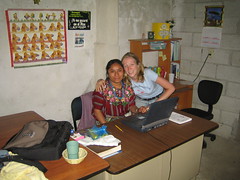
Lizzie at work
Originally uploaded by Tim in Mexico.
In a health center in Patzun, Guatemala, a woman in traditonal dress and a foreign worker use the computer.


I was interested in finding an illustration for posting on the UNESCO in the Spotlight blogs (Education and Culture, and Science and Communications) on the UNESCO program, "ICTs for Intercultural Dialogue: Developing communication capacities of indigenous peoples" (ICT4ID).

This is the result. As it can see, it worked. I wound up cutting from the draft of this blog, and pasting into the two UNESCO in the Spotlight blogs.

Sunday, September 03, 2006

Deep Causality

I am interested in ideas of deep causes that underlie day to day history. I just posted on The Long Summer: How Climate Changed History which suggests that climate and geographical changes were important driving functions in history. Guns, Germs, and Steel: The Fates of Human Societies had similar analysis which implicated environmental factors in partial causality historical models.

I know that people have used single-factor, deterministic models of history with poor effects, but still I think it useful to look at deeper factors, recognizing that they interact in a complex causality.

Two such factors were brought to my attention this week. Both elicited the "why didn't I think of that response".
* An article in the Economist pointed out that globalization underlies a force that makes returns on capital greater in developed nations as compared to returns on labor. As investment can move more freely from rich countries where it has been relatively abundant to poor countries where it has been relatively scarce, the return on capital in rich countries tends to increase. As it moves toward the higher rates of return in poor nations, the balance between labor and capital changes in the rich countries, and returns tend to increase.

* A new book, The J Curve: A New Way to Understand Why Nations Rise and Fall, suggests that democracy and openness in a society enhance stability only in the later stages of their development. Coercive governments can be quite stable, and often become less stable as they open up.


I knew lots of instances where these rules seem to hold, but had not inferred the rules themselves. They may not be laws, but they are worth thinking about.

BBC NEWS | Science/Nature | Top scientist's fears for climate

BBC NEWS | Science/Nature | "Top scientist's fears for climate":

"In his first broadcast interview as president of the American Association for the Advancement of Science, John Holdren told the BBC that the climate was changing much faster than predicted.

'We are not talking anymore about what climate models say might happen in the future.

'We are experiencing dangerous human disruption of the global climate and we're going to experience more,' Professor Holdren said.

He emphasised the seriousness of the melting Greenland ice cap, saying that without drastic action the world would experience more heatwaves, wild fires and floods.

He added that if the current pace of change continued, a catastrophic sea level rise of 4m (13ft) this century was within the realm of possibility; much higher than previous forecasts."

I have been reading "The Long Summer: How Climate Changed Civilization" by Brian M. Fagan. I had not really realized how dramatic climate changes have been in the last 15,000 years. They were enough to melt huge ice sheets, and when the melt water broke through to flow to the oceans, it was enough to shut off the Atlantic circulation, not to mention the geography of continents. Century and millenial climate changes had dramatic effects on plant, animal and human populations.

On the one hand, the book has made me more worried about the impacts of global warming in the 21st century. On the other hand, it has somewhat reduced my concerns for the loss of biodiversity, since species have advanced and retreated to sanctuaries in the past. Still, species are disappearing at a rate never before seen because we are not only changing the climate, but destroying habitat in many other ways.

Would Al Gore accept a position as environmental czar in a Democratic administration in 2009? It gives me some hope!

Wednesday, August 30, 2006

R&D -- the 100 Biggest Spending Firms

Read "R&D 100" by Ron Hira and Harry Goldstein in the IEEE Spectrum Online.

"The 100 companies, taken as a whole, increased their R&D spending by a healthy 7.6 percent in 2004, to US $254 billion. The pharmaceuticals and biotechnology sector actually cut back by 1.1 percent, to $51.7 billion [see box, "Sector Trends"], mirroring a sales drop of 1.6 percent.......Pharmaceuticals and biotechnology ranks as the second most research-intensive industry, just behind software and services........The five years of R&D Top 100 data from the fiscal years 2000 to 2004 show that the top 100 leaders increased their R&D spending by 21 percent—from $210 billion in 2000 to $254 billion in 2004. R&D intensity in 2004 decreased slightly for the group as a whole, from 6.4 percent to 6.1 percent, as sales jumped by 12.3 percent. But that rosy picture certainly doesn't hold for every industry. Each sector has a different story to tell."

BBC NEWS | Business | Google makes novels free to print

BBC NEWS | Business | Google makes novels free to print:

"Search engine Google plans to offer consumers the chance to download and print classic novels free of charge."

SPACE SCIENCE: NASA Chief Blasts Science Advisers, Widening Split With Researchers -- Lawler 313 (5790): 1032a -- Science

SPACE SCIENCE: NASA Chief Blasts Science Advisers, Widening Split With Researchers -- Lawler 313 (5790): 1032a -- Science: (subscription required).

"'The scientific community … expects to have far too large a role in prescribing what work NASA should do,' (NASA Administrator Michael) Griffin wrote council members in a blistering 21 August message. 'By 'effectiveness,' what the scientific community really means is 'the extent to which we are able to get NASA to do what we want to do.''

"The outside engineers, scientists, and educators on the council traditionally offer advice on the agency's policies, budget, and projects. Placed in limbo for nearly a year after Griffin took over as NASA chief in spring 2005, NAC was reorganized this spring under the leadership of geologist Harrison Schmitt, a former U.S. senator and Apollo astronaut who is very enthusiastic about President George W. Bush's plans to send humans back to the moon and to Mars. Schmitt replaced Charles Kennel, director of the Scripps Institution of Oceanography in San Diego, California, who resigned last week from his post as chair of the council's science committee. Two other NAC members--former NASA space science chief Wesley Huntress and Provost Eugene Levy of Rice University in Houston, Texas--resigned last week in response to a direct request from Griffin that they step down.

"Schmitt and members of that committee have clashed repeatedly in recent months over the role of science at the space agency. In a pointed 24 July memo to science committee members, Schmitt complained that they lacked 'willingness to provide the best advice possible to Mike,' refused to back Griffin's decision to cut research funds for astrobiology or recommend an alternative cut, and resisted considering the science component of future human missions to the moon. 'Some members of the committee,' he concluded, 'are not willing to offer positive assistance to Mike.'"

I don't know the details of this public controversy. We had such high hopes for Griffin when he was appointed, and I suppose there is always a tension between the engineers and astronauts (who may tend to be interested in space technology per se) and the scientists (who may tend to want to use space platforms to gain scientific knowledge.) But the politics of NASA make me suspicious. The Bush Administration gets a lot of negative publicity due to the environmental community's reaction to new NASA science results, and a safe technology development program (which will have to be paid for mostly by future administrations)doesn't pose much threat.

Tuesday, August 29, 2006

Higher Education in Africa

This is something of a follow-up to my posting last month about Higher Education in Developing Countries.

There are a number of interesting sources of information on this topic. UNESCO has a website with links to reports including:
* Inventory of major projects in /on higher education and research in Africa by the Africa Scientific Committee of the UNESCO Forum on Higher Education, Research and Knowledge.

* International Bibliographic Database on Higher Education (HEDBIB).

* Arusha Convention on the recognition of qualifications in higher education in Africa.

* "Guide to Teaching and Learning in Higher Education"

* "Recent developments and future prospects of higher education in sub-Saharan Africa in the 21st century" (published for the Meeting of Higher Education Partners (World Conference on Higher Education +5, Paris, 2003).

* "The African university at the threshold of the new millennium: potential, process, performance and prospects."

* Regional Convention on the Recognition of Studies, Certificates, Diplomas, Degrees and other Academic Qualifications in Higher Education in the African States.

* "Recent Developments and Future Prospects of Higher Education in sub-Saharan Africa in the 21st Century (published for the Meeting of Higher Education Partners" (World Conference on Higher Education +5, Paris, 2003)

* "The African University at the Threshold of the New Millennium: Potential, Process, Performance and Prospects."

Note also this UNESCO publication: "Diversification of Higher Education and the Changing Role of Knowledge and Research: Papers produced for the UNESCO Forum Regional Scientific Committee For Europe and North America."

Here are some reports from the World Bank that are relevant to universities in Africa:
* "Constructing Knowledge Societies: New Challenges for Tertiary Education"

* "A chance to learn: knowledge and finance for education in Sub-Saharan Africa"

* "Improving Tertiary Education in Sub-Saharan Africa: Things that Work" (Report of the Africa Regional Training Conference on Tertiary Education" held in Accra, Ghana on September 22-25, 2003.)

* "Higher Education and Economic Development in Africa"
Or, more generally, the website of the World Bank's Africa Region Human Development Working Paper Series.

Also check out:
* The Association of African Universities.

* International Association of Universities (IAU)

* IAU/UNESCO Information Center

Check out also my social bookmarking, especially the things that are tagged both Africa and Higher.Ed.

UNU/UNESCO International Conference on "Globalization: Challenges and Opportunities for Science and Technology"

This UNU/UNESCO International Conference was held 23 & 24 August 2006 in Yokohama, Japan. It was intended to provide "a forum for discussing how we can better harness scientific and technological progress to promote social and economic progress, and to foster knowledge creation/diffusion for the benefit of all." Day One consisted of a public symposium in which experts discussed how globalization is changing science and technology, and vice-versa, and the opportunities that these changes offer. On day Two a workshop allowed parallel working group discussions on the various aspects in which science and technology link with, and contribute to, peace and sustainable development.

A video portal has been provided for the meeting, and streaming videos will soon be available.

An interesting Conceptual Framework

Peter Jones in an email suggested I link to his website on the
Hodges' Health Career - Care Domains - Model [h2cm]

He wrote me, and it seems true, that the model can help identify and map ideas, issues, problems and solutions. The model takes a situated and multi-contextual view across four knowledge domains:
* Interpersonal;
* Sociological;
* Sciences;
* Political.