Friday, August 17, 2012

Young people flocking to show desire to be American citizens


Yesterday thousands of young people applied for a two year freedom from deportation. They were responding on the first day to a new program created by the Obama administration.

Basically, the administration has said that the Congress has not authorized enough budget to the Department of Homeland Security (DHS) to find, process and deport a major portion of the illegal immigrants currently in the United States, so it is not giving priority to a class of those immigrants who are not a threat.

The young people in question were brought to the United States by their parents before the age of 16, so they have no culpability themselves for illegal immigration. They will have been in the United States for at least five years. They will not have a criminal record. And they will have a U.S. high school diploma or have served in the military. The young people who apply will pay for the processing of their application, so this is a budget neutral decision. Qualifying young people will be given a two year guarantee of safety from deportation; if the Congress passes new immigration legislation in that period, of course the young people will be subject to that legislation.

In so far as the young people are serving the United States in the military, or who have done so and received an honorable discharge, I would grant them immediate citizenship. If they volunteer to put their lives on the line for the nation, they deserve citizenship. Certainly they do not deserve deportation.

Think about a typical young person who was brought to this country by his parents at age 10, 8 or 10 years ago, who has completed high school here. Almost all that he can remember occurred here. His friends are here. He is unlikely to know how to live successfully in the home country of his parents. Without the new program, he is unlikely to be able to get further education or training, and unlikely to get a good job. DHS papers guaranteeing two years here should allow him to get on with his life. Deportation would be a great hardship. I think the new program is morally right!

I find the action of the Obama administration to help these young people now to be timely, late if anything. The only immorality involved is the effort of some Republican politicians to unjustly criticize the action in their attempt to obtain political advantage by appealing to the most bigoted among us.


Credulity has a focus in the brain!


Why do some people fall for scams and why are older folks especially prone to being duped? An article provides an answer:

An answer, it seems, is because a specific area of the brain has deteriorated or is damaged, according to researchers at the University of Iowa. By examining patients with various forms of brain damage, the researchers report they've pinpointed the precise location in the human brain, called the ventromedial prefrontal cortex, that controls belief and doubt, and which explains why some of us are more gullible than others. 
"The current study provides the first direct evidence beyond anecdotal reports that damage to the vmPFC (ventromedial prefrontal cortex) increases credulity. Indeed, this specific deficit may explain why highly intelligent vmPFC patients can fall victim to seemingly obvious fraud schemes," the researchers wrote in the paper published in a special issue of the journal Frontiers in Neuroscience.
 Not only do we think with our brains, but if our brains deteriorate with age in a specific manner, our thinking deteriorates with age in a specific, corresponding manner! I bet that if we could look more closely we would find that more credulous people differ from less credulous people in their brains more generally.

Wednesday, August 15, 2012

Daphne Koller: What we're learning from online education


Coursera, described in this video seems to be a great innovation, already providing high quality educational opportunities to millions. I suspect that the Coursera approach will not only be useful for adult education and continuing education, but will greatly influence the offerings of colleges and universities. On the other hand, I wonder how great the inertia will be in the higher education system, especially in those countries that could most benefit from the Coursera approach.

Tuesday, August 14, 2012

Thoughts About the United Nations


There is an interesting article in Foreign Policy magazine on the United Nations. It provides answers from a number of policy wonks on questions posed by FP. Here are the questions and my answers:

  • THE U.N.'s BIGGEST MISTAKE IN THE PAST 10 YEARS HAS BEEN...it failure to protect human rights around the world, especially to prevent outbreaks of genocide.
  • THE BIGGEST THREAT TO THE U.N. IS... failure of people around the world to insist that their governments support the U.N. in its critically important mission.
  • THE MOST IMPORTANT THING PEOPLE DON'T UNDERSTAND ABOUT THE U.N. IS...how much worse world history would have been over the past 60 years had there not been a U.N.
  • THE BEST THING THE U.N. HAS EVER DONE IS...to have tamped down the potential for war  and conflict during a period which saw both the Cold War and the formation of new states from former colonies of empire.
  • THE NEXT U.N. SECRETARY-GENERAL SHOULD BE...elected by the member states following efforts by those of good will to encourage national governments to seek a Secretary-General who will effectively prosecute the mission of the United Nations.

Data confirms we are seeing more extremely hot days.


The Economist quotes new results from James Hansen, a scientist who has studied climate change for years. The graph above shows how the distribution of temperatures over the land surface of the earth has changed over recent decades. Defining "extreme heat" as above the three sigma level of the nomial distribution from the historical past ("the normal distribution"), you can see that there are many more extreme events in recent years. The situation is going to get worse as global warming continues, and if we don't cut back on the emission of greenhouse gasses, by the end of the 21st century, there will be many more extreme events.

The recession is cutting fertility in the USA


I quote from an article in The Economist:
(I)n 2011 America’s fertility rate was below replacement level and below that of some large European countries. The American rate is now 1.9 and falling. France’s is 2.0 and stable. The rate in England is 2.0 and rising slightly....... 
(M)igrants often cannot find work and go back home. Since they tend to have slightly larger families than native-born citizens, this reduces fertility....... 
In 2011 the Pew Research Centre asked 18-to-34-year-old Americans about their reaction to recession: 22% said they had postponed having a baby and 20% said they had postponed marriage as a result.
There will be a long term fallout from this reduction in the number of children being born. There will be some benefits as schools will be able to have smaller classes for a while and young adults will be able make more money outside of the household. However, there will be a long term impact as adults today leave the workforce for retirement, there won't be as many young workers coming into the workforce, nor so many contributing to Social Security (and thus exacerbating the problem of solvency of social security). 

We really don't know what other people think


I really don't like reading books of history that purport to tell me what someone thought. I agree with a comment Stuart Goldman made in discussing Nomonhan, 1939 -- that one can not look inside the scull of a historic figure.

Stuart, as I recall, was talking about Stalin. He pointed out that Stalin did not write a book on his philosophy as did Hitler in Mein Kampf. There are memos that were written to him on which he made notations. There are public statements that he made. There are even reports, sometimes diary entries, of things he said in private meetings. A good historian can report these indicators of a person's thinking, but not what they actually thought.

In the case of Stalin, one wonders how much his decisions were based on Communist ideology, as in the prediction that Capitalism would fall due to the weaknesses inherent in its structure, or that Communism would triumph and replace Capitalism? How much was based on his belief that Fascist Capitalism and Democratic Capitalism would probably result in a major European war? How much was due to a realistic perception that the Soviet Union was surrounded by countries whose leaders hated the USSR and Communism and would oppose the USSR to the point of war, and how much due to a psychology that resulted in excessive fear of such opposition? To what degree were Stalin's pogroms due to a psychology that resulted in excessive fear of internal opposition, and how much to a practical assessment of the real sources of opposition and threat from within the country? How good was the intelligence he received and how balanced was his assessment of situations based on that intelligence? How much did he take into account the views of others that actually reached him?

Clearly public figures often make public statements tailored to produce a desired effect rather than simply stating facts as they are understood or beliefs. Clearly they tell lies, even to their closest allies. Like anyone, a public figure may sometimes poorly express what he means.
“I know that you believe you understand what you think I said, but I'm not sure you realize that what you heard is not what I meant.”
Robert McCloskey
It is always hard to put oneself in the mind of someone from a different time, since the culture of the past is always different than the culture of today. Moreover, as I have pointed out from time to time on this blog, we think with our brains, not our "logical minds", and are often unaware ourselves of exactly why we come to a specific decision. For some persons in history -- Hitler, Stalin -- it is suspected that they suffered from brain defects such as neurosis or psychosis, making their thinking still more opaque both to themselves and to others. Thus the decider may not be able to adequately express the reasons for a decision, and the audience may not be able to properly interpret what it is told about that decision.

It occurs to me that there are a number of decision tools that can be used such as:
These approaches often involve heuristics which draw conclusions from implicit weighting of factors in the decision and estimates of likelihoods. Who ever documents their decision making in sufficient detail that we can say we really understand "what they were thinking".


Saturday, August 11, 2012

The Supreme Court long ago decided the state could use policy power for public health.


I quote from Wikipedia:
In the case of Jacobson v. Massachusetts, 197 U.S. 11 (1905), the Supreme Court of the United States on February 20, 1905, upheld the authority of states to enforce compulsory vaccination laws. The Court's decision articulated the view that the freedom of the individual must sometimes be subordinated to the common welfare and is subject to the police power of the state...... 
The Supreme Court reaffirmed its decision in Jacobson in Zucht v. King (1922), which held that a school system could refuse admission to a student who failed to receive a required vaccination.
Not being a lawyer, I don't understand why these precedents were not used to justify the individual mandate clause of  the Patient Protection and Affordable Care Act. Police power would seem to allow for fines. Requiring people to obtain insurance to pay for medical services is surely likely to improve public health, both in reducing the prevalence of communicable disease and thus the probability of transmission to others, and also to reduce the incidence of complications of existing conditions.

Friday, August 10, 2012

The failure to school children is tragic!


Learn more about why we need quality education for all children from our partner UNESCO:http://bit.ly/RqOQ2X

Thursday, August 09, 2012

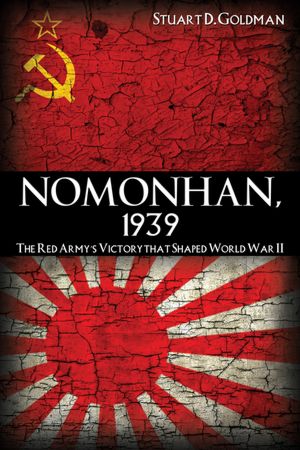
Nomonhan, 1939


My history book club discussed Nomonhan, 1939: The Red Army's Victory That Shaped World War II last night. The author, Stuart Goldman, is a member of the club.  (We had never before in the ten year history of the club discussed a member's book.) I have previously posted a review of the book.

The book tells the story of a limited war between Japan and the USSR in the Summer of 1939. The first clashes were over a border dispute caused by the shift of a river channel which might have allowed Japanese troops in Manchuria to block Soviet shipping from the USSR Maritime Provence. The larger, later clash was over disputed territory that the Japanese military feared might serve as staging ground for a Soviet invasion to seize valuable territory in Manchuria. Recall that Japan had obtained domination of Manchuria in the 1930s and was dependent on its coal and steal.

Why is a border war in east Asia important? First, it saw tens of thousands of casualties on both sides. Then, it directly influenced Soviet and Japanese foreign policy, and indirectly German, English and French policies. It is also an example of conflict between major powers that was successfully limited, not escalating into a full fledged USSR-Japan war (recall that a Russo-Japanese war did occur earlier in the century). This book makes these little known events and their importance available to a wide readership.

Stuart wrote his doctoral dissertation on the topic of this book using -- among other materials -- the records of Nazi-Soviet negotiations in 1939, records that were published after World War II. He sought to publish a book with his research after a post-doc year spent in Japan learning Japanese and exploring the Japanese records of the conflict. That book was written when Stuart was a young university faculty member, but never published. He also speaks Russian and spent several decades at the Congressional Research Service where he had exceptional opportunity to study the materials from Russian archives that had been obtained by the Library of Congress during glasnost.  He has honed his writing skills with hundreds of CRS reports and magazine articles. He brought all this experience to writing the present book for a general audience, producing something far more than just another book for a narrow audience of academic peers.

The discussion at the club meeting was exceptionally rich. About 20 people attended, almost all having read the book attentively. Stuart began the meeting with a brief summary of the book, but was mostly devoted to questions and answers. He was able and willing to share with fellow club members information that he had obtained in research that was not appropriate for publication; he also briefed us on the topic of his next book.

Nonmonhan, 1939 is relatively brief, presenting a carefully selected set of background facts and information about the battles themselves. It describes how the conflict affected Soviet policy in the negotiations that led to the German-USSR non-aggression pact of 1939. The events also influenced Japanese policy makers as they made a final decision to join Germany and Italy, and to make war against France, the British Empire and the United States. Marshal Zhukov, the leader of the successful Soviet forces went on from this victory at Nomonhan to lead the Soviet resistance to German forces attacking Moscow.

The book illustrates that both the Japanese and Soviets were willing to sacrifice men in great numbers to achieve their objectives, and that each army could inflict major damage. Those lessons became clear to the world during World War II, but might have been learned at Nomonhan had other countries been watching.

We found ourselves in the meeting discussing Stalin's purges and the strengths and weaknesses of the industrial systems of the Soviet Union, as we discussed the dangers inherent in the "lead from below" philosophy of the prewar Japanese army and from the Japanese military dominated prewar government.

I found this to be a very good book -- well researched, well documented, and well organized. One of our members mentioned that she normally didn't like books on these themes but found this a real page turner. The book club meeting was lively and made the book still better.

Tuesday, August 07, 2012

Changes in Industrial Structure


Source: The Economist
An article in The Economist magazine suggests three stages in the evolution of manufacturing and trade.

In the first stage, things are produced locally for local markets. This would be the oldest historical stage. Transportation would have been slow and expensive, so production would have usually been for relatively circumscribed local market, and therefore relatively small scale.

The second stage involved an improvement of transportation systems which greatly reduced the time and cost of transportation. It also involved mechanization of production; economies of scale greatly reduced per unit costs and markets became increasingly larger. Eventually manufacturing clusters developed with local markets (and market like institutions) for intermediate goods and services. I am impressed that simultaneously markets for final products were expanding, but markets for intermediate goods and services were local -- I suppose that needs for information and speed of delivery of those intermediate goods and services made clusters most useful. I also note that the second stage was linked to imperialism, with metropolitan powers assuring large areas in which people would provide primary inputs and form markets for final goods for the manufacturing industries centralized at home.

The third and most recent stage is seeing the geographic distribution of manufacturing industries change. Of course transportation technology continues to improve and of course manufacturing is becoming still more automated, but a new element is introduced -- the global information and communication technology infrastructure. Markets for final manufactured products become global. Supply chains for goods became multinational. I would suggest that the liberal trade policy that spread throughout the world encouraged and was encouraged by change in trade patters, and all were influenced by the technological and industrial development.

The graph on the right shows the rapid growth of world trade since the mid 1980s. The VAX Ratio is the ratio of value added to trade value. The graph shows a decades long declining trend in this indicator. That means that countries were importing partially finished products, adding value, and reexporting more finished products. That means that the production process was being split among countries -- no longer done entirely within a single national cluster.

The left hand table indicates the rate of change of GDP, indicating that during the last decade (at long last) developing countries began to catch up with advanced countries economically.

Here are the articles used by the authors of the article in The Economist:


Food prices are spiking.


Source: The Economist
Several days ago I posted a comment on this blog on the increase in triggered by Charles Kenny's recent article on the spike in food prices. The graph presented above indicates that corn, wheat and soybean prices are all increasing this summer from already high levels. A lot of poor people are going to be poorer still, and a lot of people are going to go hungry.

Interesting graphs from The Economist magazine


Source: The Economist
An article in The Economist suggests that there is danger that the United States, Britain and the euro zone are in some danger of suffering now from a long stagnation that has dogged Japan for the pat two decades. Japan's stagnation, shown by the bottom right hand chart shown above, started with the bursting of a Japanese housing bubble. The Japanese GDP is, according to that chart, no greater today than it was 20 years ago. The top graph on the right indicates that all four regions had somewhat similar monetary policies after the crash reducing interest rates to zero or near zero, but that the United States did so faster than other economies. The United States economy some five years after the crash has grown more than any of the other three, but the Japanese experience shows the threat exists of long term future stagnation in spite of the growth for the past few years.

Republican party proposed recessionary fiscal policies (i.e. big budget cuts in the near term) and the lack of unified fiscal policies in Europe would seem to increase the risk of long term stagnation.

Monday, August 06, 2012

Looks like the safety net is working,


Source
The Geography of Government Benefits
Source
As I look at the pattern, it seems to me that government entitlements are going primarily to the places that are poorest.

Of course, Medicare is something that our old people have paid for through their contributions for years, and are entitled. Food stamps are based on our feeling that people -- especially mothers and dependent children -- should not go hungry in this affluent country that pays farmers not to grow food.

Margaret Heffernan: Dare to disagree


Shame, Honor, Morality and War


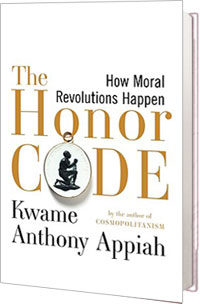
Distinguished scholar Kwame Anthony Appiah, in his book The Honor Code: How Moral Revolutions Happen suggests that societies abandon immoral practices such as slavery only when they become ashamed of those practices:
How does moral progress happen? How are societies brought to repudiate immoral customs they have long accepted? In The Honor Code, Kwame Anthony Appiah explores a long-neglected engine of reform.  Examining moral revolutions in the past—and campaigns against abhorrent practices today—he shows that appeals to reason, morality, or religion aren’t enough to ring in reform. Practices are eradicated only when they come into conflict with honor.
On the other hand, it has been suggested that the idea of honor was very strong in the antebellum South was very strong, albeit a system of beliefs that is hard for us to understand. Northern abolitionists deeply offended southern honor by suggesting that slavery, a system that southerners infused with the ideal of honor, could not imagine living without. For white men in the South, apparently, not having male slaves and being categorized as equal in stature to former slaves was seen as demeaning their manhood, threatening their sacred honor. It has even been suggested that they would go to war rather than let slavery be abolished as a matter of honor.

Recall that dueling occurred in the South up to and during the Civil War. People would fight to the death over what now seem to us to be petty incidents, but in fact to protect and preserve their honor. A man would duel with someone that was likely to seriously wound or kill him rather than let his honor be sullied. Might a community of such men have gone to war with an enemy to whom they were likely to lose rather than see their common honor besmirched? Would southerners have willingly gone to war with the Union rather than accept emancipation, even realizing the significant probability of losing a hard war, because emancipation would threaten their perception of their sacred honor in intolerable fashion, would threaten the perceived basis of their manhood?

If Appiah is right that it is necessary to make people feel that behavior which we feel is immoral offends their honor, is shameful, then it would seem important to do so very carefully.


A Thought About Frequencies and Information


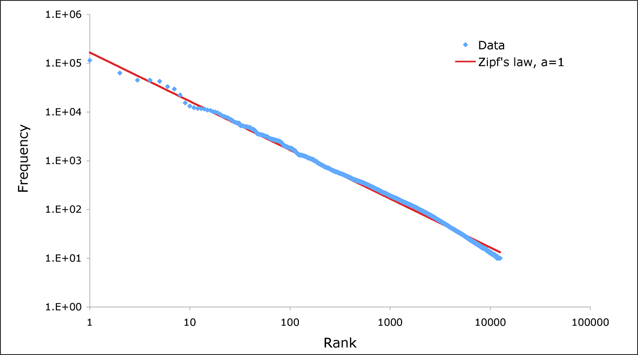
Zipf's Law
Source: "The Mystery of Zipf"
Zipf, and many others noticed that the more frequent words tended also to be the shortest words - "a", "an", "and", "the". Longer words are found less frequently. I quote from a recent article:
Zipf believed that the relationship between word length and frequency of use stemmed from an impulse to minimize the time and effort needed for speaking and writing, as it means we use more short words than long ones. But Steven Piantadosi and colleagues at the Massachusetts Institute of Technology in Cambridge say that, to convey a given amount of information, it is more efficient to shorten the least informative — and therefore the most predictable — words, rather than the most frequent ones.
 An Extension of This Thinking

I have been thinking about what I read for knowledge. It seems to me that I can classify the things I read by length.
  • Very short items such as headlines, titles, Twitter tweets, Facebook posts, etc.
  • Paragraph length items such as lead paragraphs (who, what, when and where), abstracts and Zunia item descriptions.
  • Longer items, such as Wikipedia articles, journal articles and magazine articles.
  • Books.
It happens that I have some problems with my eyes, and I am reading less now. As a result, I tend to watch TV programs and streaming videos more to gain knowledge. Here too there is a similar classification:
  • TV news tends to have many items, each treated for a minute or so.
  • YouTube and other online sources have many interesting videos (TED comes to mind) that are ten to 15 minutes in length.
  • Book TV, CSpan's American History TV, the History channel, and many online college courses tend to have hour long segments.
  • In some cases such as PBS series or college courses longer videos are provided (albeit divided into segments).
Clearly there is less information in the shorter things but I tend to see a lot more short things than long ones. This I don't get much information out of a headline or a TV news item, but I read a lot of them. I get a lot of information out of a history book, but I only read one or two a month. I get a lot of information out of a PBS series such as the one on World War II or on the Prohibition era, but I don't watch many of them.

I suggest that we organize our search for knowledge according to a seldom articulated rule -- that we want relatively shallow knowledge covering relatively large areas, and relatively deep knowledge on relatively narrow areas.

Still another metaphor


There are lots of metaphors we apply to knowledge. We talk about "pools of knowledge", "bodies of knowledge", "knowledge trees", and "knowledge networks". (Fortunately no one has talked about "power points of knowledge.)


In Bahrain, a number of archipelagos of artificial islands are being created. It seems to me that these are a great metaphor for my knowledge. I am dredging up information to create islands of knowledge near the shore in a sea of my ignorance. None of the islands rises very high and it seems likely that many are eroding rather rapidly and will fade from memory.


Sunday, August 05, 2012

Knowledge starts with taxonomy


How has the development and dissemination of computer technology changed the way we organize knowledge? I end this post with an example postulated to explain how taxonomy can help communication.
Taxonomy:
  • the science of classification
  • a classification into ordered categories
In my previous post I shared a video that discussed the change in orientation of researchers from problems of simplicity, to problems of disorganized complexity, to problems of organized complexity. Let me address a related issue, the metaphor for the organization of knowledge.

The organization of fiction in a library is usually by the name of the author. Books are placed on the shelves in alphabetical order of the authors' names. Of course, the alphabetization is a tree structure, with the first branching being on the first letter, the next branching on the second letter, etc. The library transforms the tree structure into a linear order of books on the shelves.

The Dewey Decimal System provides a tree structure for the organization of books in a library. If you think about it, it also provides a way to map a tree structure on to a line. The numbers of the Dewey Decimal System divide the world of books into classes, subclasses, etc. They correspond to the tree structure described in the video. On the other hand, the books are arranged in rows on library shelves -- in a long virtual line.

Most households have relatively few books. The householder can organize his bookshelves as he wishes, and will recall the location of each book. It is relatively easy to put one's finger on any desired volume. It is only when you get to the library, with more books than one can easily place by memory, and in which there are many users and many people shelving books that filing must be systematized.

The library catalog then deals with the problem that our memories don't work according to the library system. We may recall a title or an author, and want to find the book. The library catalog was then a simple system that allowed a few kinds of searches to supplement the order of books on the shelves. One still found oneself going to the shelves if one wanted a book on the Roman empire or Italian cooking, looking within all the books of the category for the one that caught the eye.

I recall some 30 years ago when we got the first personal computer in our office. We were handling about 1000 funding requests per year, funding 50 or 60 of them per year, with a rapidly expanding inventory of current or completed projects. A computer data base allowed us to give proposals numbers that were in the simple sequence of reception, and file them by number. We could search the data base with an entry for each proposal and a field to describe the status to locate project numbers. We could easily list all the proposals from a given proponent, or from a given university, or a given country. We could identify all the funded projects from a given field of science. There were many, many ways that we could search the database which eventually included nearly 10,000 proposals. It seemed like magic at the time.

Of course, now with Google, we can search the vastly more complex knowledge stored on the World Wide Web conducting vastly more complex searches with much less specialized a priori knowledge about the structure of the information base we are searching. Google has developed a complex system to organize information and a complementary system to interpret our requests. (IBM's Watson software is another example of a complex software platform organizing information and responding to questions.) Google too seemed like magic a decade ago, and today seems routine.

The basic point is that computers and the Internet have added computational power to our world and allowed new ways to think about the structuring of knowledge.

An example: Drones

Medea Benjamin
I listened to a talk yesterday by Medea Benjamin on her book, Drone Warfare: Killing by Remote Control. It occurred to me that there are many categories that can be used in the description of drones. A drone in an unmanned vehicle. Here are some of the categories:

  • Is it areal, surface or underwater, or extraterrestrial? The book is about unmanned aerial vehicles, but we also have unmanned surface vehicles such as those used for bomb disposal. There are underwater vehicles run "by wire" used for deep water exploration in the ocean. The Mars rover is scheduled to land today.
  • Benjamin seemed to be especially interested in whether drones were armed or not. While most of the drones used by the military are for surveillance, and some are for disarming IEDs, she focused on those armed as attack weapons.
  • What is the purpose of the drone. Is it surveillance, or is it perhaps scientific. There are large numbers of unmanned devices providing information for oceanographers and meteorologists. If for surveillance, is the purpose to identify military threats, or to identify crop pests, or to assess damage resulting from a natural disaster such as an earthquake or hurricane?
  • What is the size of the drone. Unmanned aerial vehicles are now available from the size of an insect or small bird, to that of a large model airplane, up to the size of a manned plane. 
  • How long can the vehicle operate. There are now underwater vehicles that can operate for months at a time collecting oceanographic information. On the other hand, the small aerial vehicles carried in backpacks by soldiers for battlefield intelligence operation have rather short missions.
  • How distant is the human operator (assuming there is one) from the vehicle he operates? The predator drones used in Afghanistan are apparently operated from the United States. On the other hand, some drones are operated by ground personnel within sight of the drone.
What bothered me about Benjamin's talk is that she described the variety of sizes of unmanned aerial vehicles used by the military in Iraq, Afghanistan and Pakistan, and said that the vast majority of them were used for surveillance and intelligence, but then treated the subject as if all were armed and used as attack weapons. Clearly the vast majority are not armed and are not used as anti-personnel weapons. 

Classification is the basis of knowledge. It is important to define what you are talking about if your concerns are to be appreciated. Benjamin has legitimate concerns about the use of unmanned aerial vehicles as attack weapons to target and kill people in foreign lands. Those concerns would seem not relevant to the vast majority of uses of drones from military surveillance, and even less relevant to the use of drones for scientific purposes, disaster relief, environmental monitoring, or other applications.

In this artist's rendering, the Mars Science Laboratory Curiosity rover examines a rock on Mars. Interested New Yorkers will have the opportunity to watch Curiosity's Mars landing in Times Square.

Thursday, August 02, 2012

RSA Animate - The Power of Networks


In this new RSA Animate, Manuel Lima, senior UX design lead at Microsoft Bing, explores the power of network visualisation to help navigate our complex modern world. Taken from a lecture given by Manuel Lima as part of the RSA's free public events programme. Listen to the full talk: http://www.thersa.org/events/audio-and-past-events/2011/the-power-of-networks...
I like the idea of three ways of organizing categories of knowledge:
  • Problems of Simplicity
  • Problems of Disorganized Complexity
  • Problems of Organized Complexity
I suspect that the intelligence amplification available via the computer and the Internet allows us to create systems of knowledge like Wikipedia, which uses hyperlinks to make interconnections among huge numbers of pieces of knowledge. I suspect that in some sense that capability was always resident in our brains.

Newton invented calculus as a help in creating simple models to replace massive amounts of data, and the tool served admirably for a variety of purposes ranging from the solar system to trajectories of artillery, and I am sure the tool is still used today. We see Newton as bringing physics to preeminence among the sciences, and the physicists of the early 20th century as they developed relativity and quantum theory as continuing that preeminence. Still, systematic biologists continued their fundamental work in the discovery of new species and the illumination of inheritance among species.

Fortunately, we continue to use all three kinds of models for different purposes.
  • We continue to map our family trees and systematic biologists continue to trace the genetic linkages among species using tree models.
  • We (or the scientists among us) continue to use the insights of quantum theory to consider a world  described by random events and limits to knowledge, as social scientists continue to use statistical analysis of real world data to create models of partial causality.
  • We use network models not only for Wikipedia and the human brain, but for many fields.

Wednesday, August 01, 2012

We are less integrated than we were.


I quote from a story on the PBS Newshour tonight:

A recent Pew Research Center report finds that Americans are more likely to live in economically segregated neighborhoods today than 30 years ago. Pew looked at census data from 30 metropolitan cities and found a rise in economic segregation in 27 of those cities. 
The report shows the number of people living in majority high-income neighborhoods has doubled in 30 years, from 9 percent to 18 percent. The number of those living in low-income neighborhoods has increased by 35 percent, from 23 percent to 28 percent. The middle or mixed-income class has shrunk from 85 percent in 1980 to 76 percent in 2010. The Pew research concludes that the increase in economic segregation is related to the rise in income inequality. 
View the Pew Research Center Map on 10 Most Populated Metro Areas and Their Residential Segregation By Income.
This is still another indication of the increasing social distance in the United States. Since we also tend to elect people to represent relatively compact districts, the changing patters that make neighborhoods more homogeneous implies that elected officials will be less likely to seek middle ground and more likely to take extreme positions typical of the extreme wing of the people they represent -- the activist, true believers.


One finding, not represented in the print version, is that we are less segregated by race and ethnicity, but more segregated by income and wealth. I find that hopeful.

People seem divided on political priorities


There is a new poll by Gallup from which I have taken the following table:

Large numbers of jobs should be created in the next year or two. The federal budget deficit is a long term problem, one that will be solved by economic growth, decreasing federal expenditure, increasing tax rates and closing tax loopholes, and possibly selling off some government owned property. The fiscal and monetary policies that will create jobs in the next few years are likely to contribute to the long term solution of the problem of the federal government's debt.

Why do so many people on both sides of the political divide think government corruption is a problem? Why don't they see the unregulated banks and financial industries as a bigger problem. My experience in government over a couple of decades didn't uncover any corruption.

Terrorism? There were nearly 15,000 homicides in the United States in 2010. There were nearly 33,000 motor vehicle traffic fatalities that year. Of course, we want the federal government to work to limit international threats, but put them into proportion.

You can't legislate to make people behave morally. The president has little power to improve moral standards.

On the other hand, the government can make a significant difference in human capital development. We need a healthy, well educated population. Of course the more affluent portion of our population have good health care and generally get good educations. I personally don't want to see our society keep leaving large minorities poorly educated and unable to afford health care. However, others may find it more convincing to point out that unless we have high levels of productive employment, the economy will not be in good shape.

It is too bad that we will not enjoy a serious effort by the presidential candidates and political parties to debate the priorities for the nation and the best ways for the government to move toward satisfaction of the priority needs before the November election. It will be hard to come together on policy if people are so divided on priorities.

Food prices are spiking, people will be hungrey -- a warning!


Source: "The Age of Scarcity" by Charles Kenny, Bloomberg Businessweek,  July 26, 2012
The United States is undergoing a major drought this year, and crop yields will be way down. As a result, and as a result of the continuing domestic demand for agricultural products, U.S. food exports will be expected to decrease. There will of course be shortfalls from crops in other countries (water shortage in India due to a weak monsoon, flooding in parts of Japan, drought in parts of Africa, etc.) As a result, food prices are spiking.

The result will be hunger for the poor, I quote from Charles Kinny's article:
World Bank researchers estimate that food-price changes between June and December 2010—including a 73 percent rise in corn prices—pushed 44 million people back below the $1.25-per-day extreme poverty line.
Global climate change is going to be with us at least in coming decades, probably longer. The climate change is predicted to bring with it more extreme weather events. It will also change the areas best suited for different crops, perhaps resulting in crop losses as farmers are slow to make the adjustments.

Other factors also play a role in food-price spikes. For example:
In both 2008 and 2011, agricultural prices rose in tandem with energy prices, just as they did in the 1970s. That’s in part because it takes 160 liters of oil to produce a metric ton of corn in the U.S., and the cost of natural gas accounts for three-quarters of the cost of nitrogen fertilizer.
Price is determined by both demand and supply.
Between 1990 and 2010, total global per capita consumption of beef, pork, and poultry increased by 1.2 percent annually (and thus the demand for feed is also increasing). Over the next 50 years food output will have to rise 50 percent to cater to 2 billion extra people and their growing appetite for meat. Meanwhile, growth in global biofuel production rose 30 percent per year from 2006 to 2008.
Speculation in commodity markets can increase the cost of food to the consumer.
Finally, volatility itself makes gambling on commodity futures more attractive for speculators. Commodity futures funds in 2008 invested as much as $250 billion to $300 billion. During the 2008 crisis, fear of domestic food shortages led governments to aggressively purchase on international markets and to curb exports—Russia banned wheat sales, for example—raising global prices even more.
There are of course many policy instruments that could be used to ameliorate the growing problem of high food prices (and failures in distribution systems that leave those most at risk still hungrey. Charles says:
This year’s price spike probably won’t be a disaster of Biblical proportion. If global leaders don’t act, however, it’s likely to be a sign of things to come: permanent volatility in prices that are trending upward, putting at risk some of the world’s most vulnerable people.

Davos 2010 - IdeasLab with MIT - Rebecca Saxe


My friend Emily alerted me to this video by her daughter-in-law, Rebecca Saxe, head of the Saxe laboratory at MIT.

 The key finding that I want to discuss is that there is a region in the brain that helps us to make moral judgments based on inferences on what another person is thinking. Moreover, Saxe's research suggests that that capacity is not always present, but requires maturation of the brain. A child of 5 will generally have an idea of intention, but it is not until children reach the age of seven that they attach moral culpability to bad intentions (in the absence of bad outcomes).

Consider these two situations:

  • You have a switch which controls the track on which a trolley car will run. If you put it in one position, five people in a stalled car down one line will die. If however, you switch it to the other position you will save those five, but another person on the second track will die.
  • You are standing on a bridge over a trolley line. A trolley is approaching from around a bend. There is a car stalled on the tracks just down the line from you and the five occupants will die if the trolley hits the car. There is a man standing on the bridge next to you. If you toss him off the bridge in front of the trolley, it will stop the trolley and the people in the car will be saved. 
Forgetting that there are other options (such as jumping off the bridge yourself to save the five people), most people will say in the first example that you should put the switch in the position that will save the most people. On the other hand, in the second example, they will say that you should not kill one person to save five.

I assume that the difference results from the way that the brain works. We have evolved as social animals, and apparently our brains have evolved to avoid killing a member of the group to save others, and that choice is built in the genes and matures with the maturation of the brain.

On the other hand, it seems that an emotionless actor (Mr. Spock on Star Trek) would always chose to save five people rather than one person.

I suspect that our moral thinking often (always) comes back to "what feels right". But should we make public policy on the basis of "what feels right" or what is more logical?

Here are two videos that you should watch in sequence in which Dr. Saxe describes the work in her laboratory:

A New U.S. Foreign Assistance Dashboard


Click here to go to the Foreign Assistance Dashboard which makes information on U.S. foreign aid more available.

RSA Animate - Drive: The surprising truth about what motivates us


This video is still another illustration that the simplification of "economic man" does not apply well in all circumstances.

In terms of the topic of this blog, "knowledge for development", the video has an important implication. You can't motivate people for the difficult task of harnessing better knowledge to promote faster social and economic development if you depend on financial rewards. It is better to find people who are devoted to the purpose, to give then independence to work on what they feel are important problems and applications, and give them opportunities to achieve mastery of their fields and work.

Tuesday, July 31, 2012

One of the things that Romney and the Republicans don't get!


Source: "Wages aren’t stagnating, they’re plummeting" posted by Dylan Matthews on Washington Post Wonkblog

The United States remains competitive in tradable goods and services, given our high wage rates compared to developing nations, by having high worker productivity. We achieve that in turn by high levels of capital investment per worker in the production of goods and services that can be economically exported and imported. (Of course, we also remain competitive by innovation, using intellectual property protection for some products, and in high technology areas where other countries can not compete effectively.) Where once Americans with little education could earn enough in factory jobs to live a middle class life, even though we still manufacture a great deal of product, due to automation of the factories there are many fewer such factory jobs.

Thus our workforce must be prepared to work in fields like education and health care, or to work in highly technical fields in tradable goods and service production. Education is needed for those jobs.

As the graph shows, people in American who have little education face hard economic times. It is in these areas too that we have lots of illegal immigration from people who still want our lowest paying jobs.


Saturday, July 28, 2012

Nomonhan


The late 1930s saw the buildup to World War II. Nomonhan, 1939: The Red Army's Victory That Shaped World War II by Stuart D. Goldman tells the story of events in the far East that influenced policy makers in several countries at the time -- events that were perhaps more important than has been widely appreciated.

Japan was embarked on an program of imperial expansion. It occupied Korea, had a client state in Manchukuo, and had embarked on a war of conquest against nationalist China. Its government was dominated by military officers.

The Soviet Union with its own imperial ambitions was threatened in the west by Germany and feared Japanese expansion in the east. Its empire extended to the Pacific, shared a border with Manchukuo, and had a client state in the People's Republic of Mongolia. The Communist government was still solidifying its control of the nation.

I would note that the client states of Japan and the USSR were very different. Manchukuo had important natural resources, and in fact was producing more steel than the home islands of Japan. Manchuria was much less developed, still dominated by nomadic herders.

Two localized military clashes over contested border areas between the USSR and Manchukuo in 1937 and 1938 were followed by a much larger clash on the Mongolia-Manchukuo border in the summer of 1939. This latter conflict was near the town of Nomonhan, and appears to have involved an area claimed by both countries of several tens of square miles, albeit an area of little strategic importance to either side.. In all three cases, the clashes were primarily between Soviet and Japanese armies. In this final clash there were something like 50,000 casualties between the two sides. The USSR and Mongolia were left in command of the disputed territory, and the Japanese army in Manchukuo was deemed to have suffered a major defeat.

The military situation was resolved ultimately by national governments on the basis of geopolitical strategies. After the USSR signed the non-aggression pact with Germany, Germany encouraged Japan to normalize relations with the USSR. A cease fire was rapidly agreed upon, and a committee set up which rapidly defined an appropriate boundary. Note that thousands of soldiers died in a battle over a disputed boundary, a boundary that ultimately was quickly negotiated when political will dictated settlement. Neither those in power in Tokyo nor those in power in Moscow seemed to have much concern for the lives of the common soldiers who fought, were wounded and died in these battles.

Goldman provides a picture of a Japanese military that was overconfident of its ability to win against all odds, that was imbued by a philosophy that gave low ranking officers in planning units great influence on strategy, and in which regional units might with impunity disregard orders from headquarters. That army had a culture that appears very alien to me because it believed in the divinity of the emperor, it imbued flags and ornaments presented to military units in the name of the emperor with religious significance, it refused to accept the possibility of defeat, and it demanded suicide of soldiers about to be captured and of officers who failed in the code of Bushido. Japanese soldiers fought to the death.

Goldman notes the Stalin purges that decimated the senior ranks of the Soviet army before the battle of Nomonhan. He also notes that the purges affected the officer corps broadly. He is perhaps less detailed in describing the rapid increase in the size of the army as the USSR was preparing for war in Europe (from which I infer probable lack of training of many soldiers). I found it hard to imagine the culture of the Soviet soldier, nor to understand their effectiveness in combat. In the final battle in August of 1939, with overwhelming advantages in artillery, armored vehicles, air support and numbers the Soviet army crushed the opposition, but suffered more casualties in the process than did the Japanese.

The book stresses the concern that Soviet leadership had that the nation might face war with Germany on its western front and simultaneously war with Japan in the east. It emphasizes the part that the border conflicts with Japanese forces had in stoking that concern;. The Communist government might well not have survived simultaneous wars with Germany and Japan. The book also stresses the diplomatic subtlety with which the Soviet government first tried to encourage war between democratic capitalism and fascist capitalism, and then conducted negotiations with Britain and France on the one hand and with Germany on the other. When the non-aggression pact was finally negotiated with Germany, that pact reduced the threat from Japan in the east as well as delaying the attack from Germany on the west, providing valuable time to strengthen the army.

The defeat at Nomonhan convinced authorities in Tokyo that the Soviet army was more formidable than had been thought. Japan entered into a non-aggression pact with Soviet Russia following the German-USSR non aggression pact. The Japan-USSR pact lasted until after the defeat of Germany (and the Soviet invasion of Manchukuo and rapid defeat of the Japanese army there must be considered to have contributed to the Japanese decision to surrender). Nomonhan also led to power shifts that in turn resulted in replacement of the "northern strategy" of imperial expansion with a "southern strategy". The Japanese continued to occupy Korea and Manchukuo, continued to fight a war with China (both the nationalist and communist forces there), and following the southern strategy invaded French Indochina, Dutch Indonesia, and the Philippines, and declared war on the United States and its European allies. History shows that this southern strategy was disastrous for the Japanese government and the Japanese people.

I really liked the book. It is very clear and succinct as might be expected from an author with decades of experience writing briefings from the Congressional Research Service for members of Congress and their staffs. It is very well researched, and very well documented.  It is effective in providing background for the events and assessment of their implications without neglecting to describe the military encounters in some detail. Not only does this book bring to public attention events that should be better appreciated as influential in the buildup to World War II, it gives one a basis to think generally about some factors of importance in Nomonhan that may also influence more generally history.

Japan was governed by the military as much as any nation in recent history. The Soviet Union was a nation with very strong control of the military by the civilian government. Goldman points out how much more effective the Soviet government was in using military power to achieve political objectives, and how prone the Japanese military government was to get into strategic problems as a result of tactical military thinking and local operations. I am reminded of Eisenhower's warning about excess influence of the military industrial complex on U.S. policy.

Goldman reminds us of the contingency of history. I was left wondering what would have happened had Germany gone to war with the USSR with Japan as an ally and the French and British empires as neutral onlookers. The world today might be very different. Yet that alternative was not so very distant a possibility in the 1930s.

I recommend this book strongly!

Friday, July 27, 2012

A thought about the psychology of moral reasoning.


There is a simple story that is used by psychologists to study moral reasoning:

Two women go on a tour of a chemical factory. During a break, one of them - Ann - says to the other that she is going to get a cup of coffee to carry with her. The other - Betty - asks the first to also get her a cup with sugar but no cream.

  • Version 1: Ann fills the cup and sees a bottle next to the coffee machine marked "poison" full of white powder. She adds some to the coffee in Betty's cup. Betty drinks the coffee, the white powder turns out to be sugar, and Betty is fine.
  • Version 2: Ann fills the cup and sees a bottle next to the coffee machine marked "sugar" full of white powder. She adds some to the coffee in Betty's cup. Betty drinks the coffee, the white powder turns out to be poison, and Betty dies.
Most people when asked, find Ann is morally at fault in version 1 but not in version 2.

In Version 1, I believe that Ann would not be charged with a crime. No damage to Betty, no crime. On the other hand, in Version 2 there would be a crime, but presumably Ann would not be charged. Rather, the person who filled a jar marked "sugar" with poison and put it next to a coffee machine would presumably be guilty of homicidal negligence.

I suggest that you not participate in lab experiments of psychologists, or if you insist on doing so, you not limit yourself to the way that they frame problems for your analysis. Think for yourself.

Thursday, July 26, 2012

How much credit do business owners deserve for the success of their businesses?


I have come to the conclusion after four or five decades in international development that the most important basis for development is a good set of institutions -- rule of law, fair markets, government that makes policies for the good of the people rather than the good of the power elite, etc. Businessmen I have known support these institutions. They know that their business won't survive without a well educated and healthy workforce.

 I also know that it takes more than one generation to build the complete set of these institutions, what President Obama called in his talk, the American system that is responsible for the success of our businesses.

He of course also mentioned infrastructure. It is really hard to build a successful business these days if you can't rely on the electric power getting to your place of business. It is also very nice to have piped water and sewerage. If the runoff from rainfall isn't drained away and floods your offices and factory, production goes down. How do you plan to sell products if the roads, railroads, airports and ports are in bad shape and transportation costs increase the prices of your products. Indeed, how does an Indian entrepreneur sell Internet mediated services abroad without electricity, telecommunications and Internet providers.

I suspect that most successful businessmen had mothers and fathers that saw that they got a great start in life --- this is doubly true now that there is very little chance in the United States of someone from poor and uneducated parents rising to the class of successful businessmen. As President Obama said, most successful businessmen had good educations, paid for by others and provided by hard working teachers.

It takes money to start a business. Where did the successful entrepreneur get the funds needed. He may have inherited wealth, which implies help from family. He may have inherited family connections as some prominent politicians have done, and gotten financial help from those connections. He may have married money, getting financing from wife and/or her family. He may have tapped angel capital, investment capital, banks or eventually the stock market and bond market; in all cases, someone helped.

In my classes in business school I learned that while once managers treated employees as interchangeable parts, increasingly good management involves encouraging employees to contribute to the success of their companies and recognizing their contributions. I would not invest in a company in which the CEO or major stockholders did not recognize how much the success of the business was due to its staff, and indeed to consultants, suppliers and others who contribute to the bottom line.

Businesses are based on technology. Technology by its very nature is cumulative. Think about firms like Amazon and EBay, and the degree to which they depend on the Internet, computers, software, microelectronics, etc. All of those technologies were created by others and were available for those enterprises. (Incidentally, the key contributors to these technologies -- people who won Nobel Prizes and the National Medal of Technology and Innovation -- were successful by almost everyone's criteria, except that they seldom got rich. Money is not the only indicator of success, even in business.) Even more generally, we can trace the Internet back to discoveries of the nature of electro-magnetism, to the invention of the telephone, to the invention of the technology for electrical power generation and distribution, to the invention of electronic devices, etc. The modern businessman draws on centuries of technological invention and improvement, without which he would be as successful as a prehistoric member of a hunter-gatherer society.

It has been suggested that the payment due to all this help is the payment of one's fair share of taxes. I would maintain that that is certainly true. Perhaps the debt is also some humility, and some fellow feeling for the descendants of all those who have gone before, creating the conditions that allow us to succeed.

Quotation


Change is the law of life. And those who look only to the past or present are certain to miss the future.
John Fitzgerald Kennedy

I recall Bob Textor, an anthropologist, used to caution that we are tempocentric. That is, we have the values of our time, but the values of people in the future will be different from ours, as ours are different than those of our ancestors. The economic and technological changes occurring now will drive and be driven by changes in values.

Views from the International Space Station at Night


This great video was produced by Knate Myers. Enjoy!

"Every frame in this video is a photograph taken from the International Space Station. All credit goes to the crews on board the ISS.

"Music by John Murphy - Sunshine (Adagio In D Minor) http://itunes.apple.com/us/album/sunshine-music-from-motion/id297702863

"Image Courtesy of the Image Science and Analysis Laboratory, NASA Johnson Space Center, The Gateway to Astronaut Photography of Earth

http://eol.jsc.nasa.gov

Wednesday, July 25, 2012

Why an emotionless person makes you uneasy!


An article in The Economist points out that people experience discomfort when confronted either by a machine that seems to have emotions and feelings or by a person who does not. Our brains are built to mirror the emotions of others, but only others that we feel should have emotions. If we feel that an entity should have emotions and they do not show them, we feel uncomfortable. If we feel that an entity should not have emotions and emotions are expressed, we feel uncomfortable.  We think with our brains, including our emotions, not with our "rational" minds.

Just because a law is constitutional doesn't mean it is good!


A federal appeals court upheld a South Dakota law on Tuesday that requires doctors to tell women seeking abortions that the procedure causes an increased risk of suicide...........A 2008 Johns Hopkins review of various studies on the link between abortion and suicide concluded that the highest quality studies showed few, if any, differences between the mental health of women who'd had abortions and women who hadn't. Laura Bassett, The Huffington Post 
The Supreme Court decides if a law is unconstitutional. I accede to the legal knowledge of the justices -- the Constitution apparently does not prohibit a state government from ordering its doctors to lie to their patients. On the other hand, even if constitutional, the law is a bad one, and should be repealed.

I recall that South Dakota was admitted to statehood in 1890 under the Benjamin Harrison administration although it had a tiny population. Apparently the Republicans wanted two more safely Republican senators in the Senate, one more safely Republican representative in the House, and three more safely Republican electoral votes in presidential elections. We live with the result.

Re. The World AIDS Conference, 2012


Frequency of Google Searches and References to HIV & AIDS

Blue refers to AIDS
Red refers to HIV

Note that people get much more interested in HIV/AIDS on World AIDS Day. The frequency of references to both HIV and AIDS seems to have increased over the years.

The 2012 drought will dent farm profits and push up food prices


Source: The Economist
"(A)new report from the National Climatic Data Centre finds that 55% of the continental United States was in moderate to extreme drought and a third in severe to extreme drought as of July 10th."

Bad news for the U.S. economy, bad news for urban poor all over the world. One summer does not measure climate change, but it is hard to avoid thinking that this is not related to global warming.

Another sign of global warming


I quote from a story on ABC News about the Greenland ice sheet:
According to satellite data, an estimated 97 percent of the ice sheet surface thawed at some point in mid-July.
We reported last month on the “Unprecedented May Heat In Greenland,” where the temperature hit 76.6°F. So it would seem that unprecedented heat leads to unprecedented melting.
The melting of ice sheets means at the least that the environment in Greenland is changing and  sea levels are likely to rise. The massive flow of fresh water into the North Atlantic may have results that we can not predict.

Thanks to Irish cousins Karen and Laura for pointing me to this